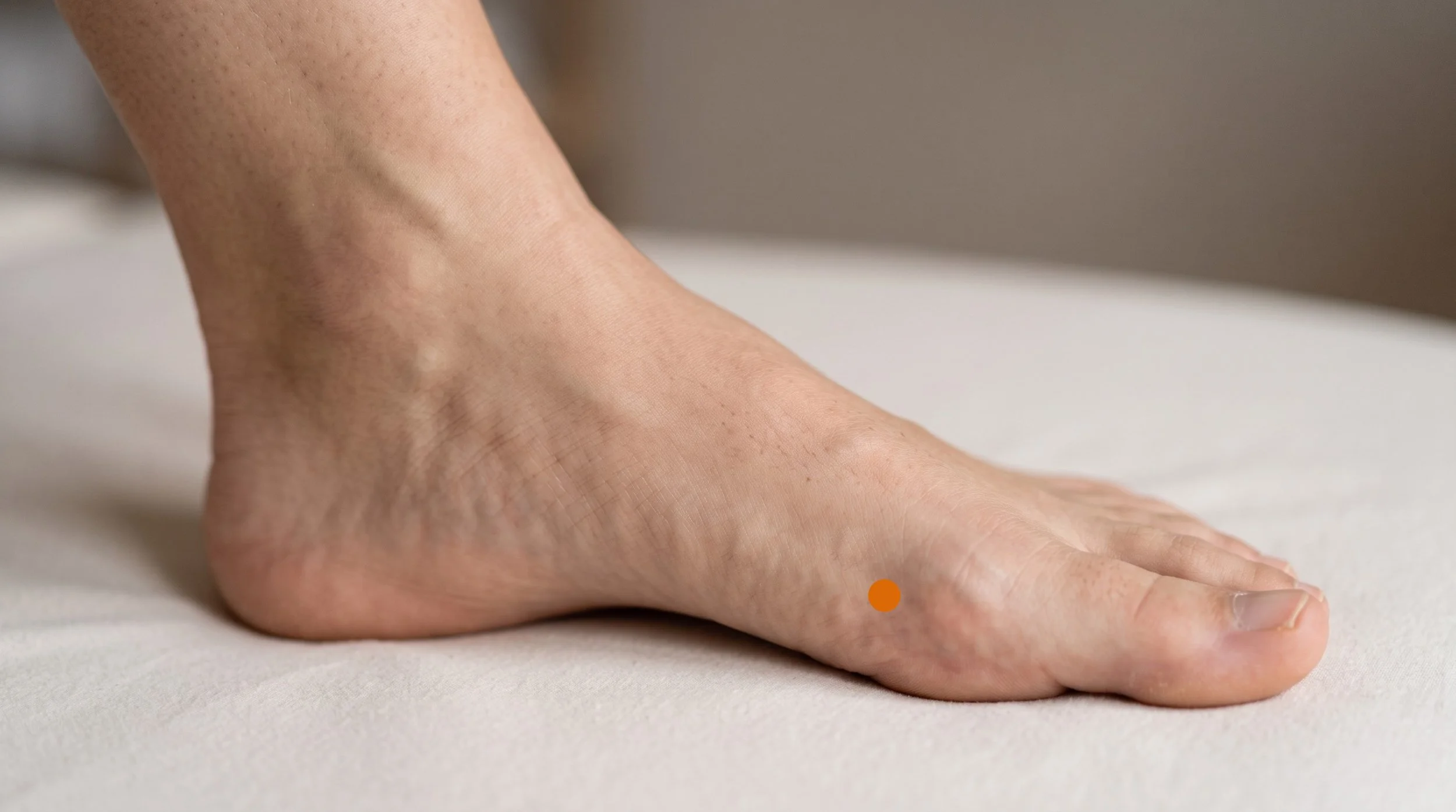
SP3 Acupuncture Point (Taibai)
Supreme White on the Medial Arch: Anatomy, Mechanism, and Why the Spleen Channel's Source Point Anchors Digestive and First-Ray Treatment
SP3 (Taibai, "Supreme White") is the third point of the Spleen channel and one of the most heavily used points on the medial foot. You'll find it on the inner border of the foot, in the small hollow just behind and below the knuckle of the big toe, at the ridge where the pale plantar skin meets the darker skin of the instep. In classical texts it carries three designations at once (shu-stream, yuan-source, and Earth point of the Spleen channel), which is why generations of practitioners have treated it as the channel's anchor for digestive complaints such as bloating, loose stools, and epigastric discomfort.
In modern practice the sp3 acupuncture point earns a second life as a local point for medial arch and first-ray pain, since the needle sits directly over the medial pillar of the arch in abductor hallucis territory.
- Taibai point location is straightforward once you use the landmark: slide a fingertip backward along the inner edge of the foot from the ball of the big toe and drop into the depression just proximal and inferior to the head of the first metatarsal (Deadman et al., 2007). The needle passes through skin and subcutaneous tissue into the fascia and muscular border of abductor hallucis, close to the first metatarsal periosteum.
- Classical sources classify spleen 3 as the shu-stream, yuan-source, and Earth point of the Spleen channel, and traditionally credit it with strengthening Spleen and Stomach function, resolving dampness, and regulating qi (Deadman et al., 2007; Kim, 2016). Read neurophysiologically, those categories describe a distal foot point used to influence gut symptoms and limb heaviness rather than any measurable flow of energy.
- The point lies in medial plantar nerve territory (a tibial nerve branch, roughly L4 to S2), with saphenous cutaneous supply nearby, so needling recruits deep somatic afferents that project into lumbosacral segments and then upward into brainstem circuitry (Zhao, 2008).
- Somatic input from lower limb points can shift autonomic outflow. Animal work has mapped a specific population of deep-fascia sensory neurons in the hindlimb that is required for electroacupuncture to drive a vagal pathway, a finding that helps explain why distal leg and foot needling is studied for gut and inflammatory outcomes (Liu et al., 2021).
- The research picture is honest rather than dramatic: reviews of acupuncture for functional dyspepsia suggest symptom improvement compared with sham (Li et al., 2026), a large trial in postprandial distress syndrome reported higher response rates with acupuncture (Yang et al., 2020), and Cochrane's IBS review found no clear benefit over sham (Manheimer et al., 2012). SP3 is one component of the multi-point protocols these studies test, never the whole treatment.
- De qi at SP 3 foot placement is usually a dull, slightly heavy ache that spreads through the arch or toward the base of the big toe. Because the foot is well innervated, most patients notice the insertion, and a light technique with a fine needle is often enough.
Bloating, Loose Stools, or Post-Meal Heaviness That Never Quite Settles?
At Morningside Acupuncture we use SP3 as a foundation point in digestive treatment plans, usually paired with ST36 and abdominal points so the protocol works on both segmental and autonomic levels. Sessions are calm, needles are hair-thin, and we track symptoms week to week rather than promising overnight change. Most patients pair acupuncture with simple meal timing and stress adjustments that we discuss in the room. Schedule a visit and we'll build a plan around your actual pattern.
Schedule NowAnatomy of SP3: Why the Base of the First Metatarsal Is Such an Important Location
SP3 sits on the medial border of the foot in the depression just proximal and inferior to the head of the first metatarsal, at the boundary between plantar and dorsal skin (Deadman et al., 2007; Kim, 2016). Under the skin and a thin subcutaneous layer, the needle meets the fascial envelope and medial belly of abductor hallucis, with the medial band of the plantar aponeurosis and the flexor hallucis brevis lying deeper and slightly plantar. This is loaded tissue: every step transfers force through the first ray, and the arch's medial pillar absorbs repeated tension during push-off.
Runners, dancers, and anyone in minimal footwear can develop tenderness right here, which is one reason a point classically framed as a digestive anchor also functions as a local musculoskeletal target.
The nerve geography is what makes the point interesting. Sensation and motor supply in this region come primarily from the medial plantar nerve, a terminal branch of the tibial nerve carrying fibers from roughly L4 through S2, with the saphenous nerve contributing cutaneous supply along the medial foot.
Needling stimulates A-delta and C fiber afferents in muscle and fascia, and that input converges in lumbosacral dorsal horn segments where it can modulate the processing of nociceptive signals from the foot itself while also recruiting supraspinal circuits that release endogenous opioids and monoamines (Zhao, 2008).
Two further layers matter clinically: deep fascial afferents in the lower limb are the population implicated in driving vagal autonomic output in mechanistic animal studies (Liu et al., 2021), and pooled patient-level data across chronic pain conditions show effects that persist beyond a single session (Vickers et al., 2018).
Deep to the needling zone run branches of the medial plantar artery and the first plantar metatarsal vessels, along with digital nerve branches heading toward the great toe, so the conventional technique stays modest: perpendicular insertion of about 0.5 to 1 cun, with some texts recommending a shallower 0.3 to 0.5 cun depth, and moxibustion is considered applicable (Deadman et al., 2007; Kim, 2016). Practically, this means angling straight in against the bony shelf, avoiding forceful thrusting toward the metatarsal periosteum, and stopping when de qi arrives. Local tenderness, swelling, skin breakdown, or altered sensation from diabetic neuropathy all warrant a lighter approach or a different point choice.
Related Spleen Channel Related ST36 Acupuncture PointSP3 at a Glance: Classification, Location, and Clinical Use
| Category | Detail |
|---|---|
| Traditional Name | Taibai (Supreme White), also translated as Greater White or Most White |
| Channel Classification | Third point of the Spleen channel of the foot (foot taiyin) |
| Point Categories | Shu-stream point, yuan-source point, and Earth point of the Spleen channel (Deadman et al., 2007; Kim, 2016). Classical five-shu theory pairs shu-stream points with disorders of the zang and with heaviness and joint pain, and as the Spleen's source point it is the endpoint of the transverse luo connection from the Stomach channel's luo point ST40 in luo vessel theory (Sterman, 2015). |
| Precise Location | On the medial side of the foot, in the depression proximal and inferior to the head of the first metatarsal bone, at the border between plantar and dorsal skin. Locate it by sliding a fingertip backward along the side of the ball of the foot until it drops into the hollow. |
| Tissue Stimulated | Skin and subcutaneous tissue over the medial first ray, the fascia and medial border of abductor hallucis, with flexor hallucis brevis and the deep intrinsic foot muscles lying deeper; medial plantar nerve territory with saphenous cutaneous overlap |
| Needle Depth / Direction | Perpendicular insertion 0.5 to 1 cun (some texts advise 0.3 to 0.5 cun), directed against the shelf of the first metatarsal without forcing the periosteum; moxibustion is applicable |
| De Qi Sensation | A dull, heavy, slightly spreading ache through the medial arch, sometimes travelling toward the base of the great toe; sharp or electric sensation means redirect |
| Primary Clinical Uses | Traditionally used for weak digestion with bloating and loose stools, abdominal and epigastric pain and distention, and heaviness or fatigue in damp patterns; in modern practice also used locally for medial arch pain, first metatarsophalangeal joint irritation, and abductor hallucis tension |
| Common Point Combinations |
|
In the traditional literature summarized by Deadman and colleagues in A Manual of Acupuncture, Taibai is presented as the shu-stream, yuan-source, and Earth point of an Earth channel, a triple designation that classical authors read as unusually direct access to Spleen and Stomach function. The Spiritual Pivot recommended shu-stream points for disorders of the zang and source points when the five zang are diseased, and the Classic of the Jade Dragon named this point specifically for weakness of the Spleen and Stomach.
From there the traditional logic runs in a chain: when transformation and transportation falter, dampness accumulates, and dampness in turn obstructs the movement of qi. That single chain accounts for an indication list that would otherwise look scattered, covering borborygmus, diarrhea with undigested food, dysenteric disorder, vomiting, heaviness of the body, oppression in the four limbs, joint and lumbar pain, and even constipation and distention in the abdomen, epigastrium, and chest.
What makes the classical pattern striking is that opposite symptoms (loose stools and constipation, emptiness and fullness) are traced back to the same underlying weakness, with the point reinforced or reduced depending on which side of the picture dominates.
Why SP3 Is Used for Gut Symptoms When It Sits on the Foot
The first part of the answer is segmental. Needling SP3 recruits deep afferents in the medial plantar nerve distribution that enter the cord at lumbosacral levels, and that barrage of input changes how dorsal horn neurons in those segments handle incoming signals. For local foot complaints this is straightforward: the point sits inside the painful region, so segmental convergence and local tissue effects can reduce sensitivity in the arch and first ray directly (Zhao, 2008).
The gut story runs through autonomic reflexes rather than through the spinal segments that supply the intestines. Somatic stimulation at distant sites can shift vagal and sympathetic outflow, and a mapping study in mice identified a specific set of deep fascia sensory neurons in the hindlimb that is necessary for electroacupuncture to activate a vagal pathway, while abdominal stimulation at low intensity did not do the same thing (Liu et al., 2021).
That work was done in animals and at a single well-studied hindlimb site, so it is best treated as a plausible mechanism rather than proof of what happens at SP3 in a human patient. Alongside it, an exploratory resting-state fMRI study needled SP3 in healthy volunteers and reported changes in regional brain activity compared with sham needling, including sensory and visual association areas, though the sample was small and the clinical meaning is not established (Wang et al., 2021).
Descending inhibition ties the two threads together. Needle stimulation activates midbrain and brainstem systems that release endogenous opioids, serotonin, and noradrenaline back down onto the spinal cord, damping pain transmission and modestly influencing autonomic tone at the same time (Zhao, 2008). Patient-level pooled data across chronic pain trials show effects that outlast the treatment session itself, which supports a course of care rather than a single visit (Vickers et al., 2018).
What the Research Shows for SP3
Almost no clinical trial tests SP3 by itself. What the literature evaluates is whole protocols for conditions where this point is commonly included, which means the evidence below tells you about acupuncture for digestive complaints and for foot pain, not about the specific contribution of one needle in the arch. Results are mixed by condition, generally modest in size, and often limited by small samples and difficulties designing convincing sham controls. The one SP3-specific study available is an exploratory imaging experiment in healthy volunteers, useful for mechanism discussion and nothing more.
| Study | Type | Focus | Key Finding |
|---|---|---|---|
| Manheimer et al., 2012 | Cochrane systematic review | Acupuncture for irritable bowel syndrome (17 trials, 1,806 participants) | Acupuncture was not superior to sham for IBS symptoms, though it outperformed two antispasmodic drugs in unblinded comparative trials, a difference that expectation effects may explain. |
| Li et al., 2026 | Systematic review and meta-analysis | Acupuncture for functional dyspepsia (23 randomized trials, 2,454 participants) | Compared with sham, acupuncture probably improved dyspeptic symptoms and quality of life without an increase in adverse events, at moderate to high certainty. |
| Yang et al., 2020 | Multicenter randomized clinical trial | Acupuncture for postprandial distress syndrome | Acupuncture produced higher response and symptom elimination rates than sham acupuncture in this trial population. |
| Liu et al., 2016 | Large sham-controlled randomized trial | Electroacupuncture for chronic severe functional constipation (1,075 patients) | Electroacupuncture increased mean weekly complete spontaneous bowel movements more than sham, with a modest between-group difference and a good safety profile. |
| Llurda-Almuzara et al., 2021 | Systematic review and meta-analysis | Trigger point dry needling for plantar heel pain | Moderate to low quality evidence suggested improvements in pain intensity and related disability, with the authors urging caution given the small number of trials. |
| Vickers et al., 2018 | Individual patient data meta-analysis | Acupuncture across chronic pain conditions (about 21,000 patients) | Acupuncture was better than sham and no-acupuncture controls, with effects that decayed only modestly over twelve months. |
| Wang et al., 2021 | Exploratory resting-state fMRI study | Unilateral needling at SP3 in 15 healthy volunteers | Real needling at SP3 altered regional brain activity measures compared with sham, an early mechanistic signal that cannot be translated into clinical benefit. |
| Liu et al., 2021 | Mechanistic animal study | Neuroanatomy of electroacupuncture-driven vagal signaling from a hindlimb site | A defined population of deep fascia sensory neurons was required for low-intensity stimulation to activate a vagal pathway, supporting body-region specificity in autonomic effects. |
Medial Arch or Big Toe Joint Pain Slowing Down Your Runs?
The tissue under SP3 is the same tissue that loads every time your first ray pushes off, which makes it a practical target for arch and first metatarsophalangeal complaints. We combine gentle needling at the point with dry needling of abductor hallucis and the deep intrinsic foot muscles, then layer in loading work so the change holds. Our clinicians are trained in both acupuncture and dry needling, so you get one integrated treatment instead of two separate visits. Book an evaluation and we'll assess your foot mechanics directly.
Schedule NowSP3 in the Context of Trigger Point Work
Acupuncture means treatment with an acupuncture needle, and that includes dry needling, so at Morningside we don't separate the two. When a patient presents with medial arch pain, first metatarsophalangeal irritation, or a foot that cramps after long days on Manhattan sidewalks, SP3 often lands within a few millimeters of the tender band along the medial belly of abductor hallucis. Trigger points in that muscle and in the deeper intrinsic layer can refer pain along the medial heel and arch, patterns catalogued in the trigger point literature (Simons et al., 1999).
Treating the point and the taut band in the same session is efficient and anatomically honest, since the needle is engaging the same tissue either way.
A typical foot session might combine light needling at SP3 with dry needling of abductor hallucis, flexor hallucis brevis, and the deep intrinsic foot muscles, then extend up the chain to tibialis posterior or the calf when push-off mechanics are involved. Evidence for dry needling in plantar heel pain is encouraging but limited in quantity and quality (Llurda-Almuzara et al., 2021), so we use it as one input alongside loading exercise, footwear review, and gait discussion.
Patients with digestive complaints who also carry a tender SP3 sometimes get both purposes served by one needle, though we treat that as a convenient overlap rather than a diagnostic sign.
SP3 Digestive and Foot Pain Treatment at NYC's Highest-Rated Acupuncture Clinic
Morningside Acupuncture is the highest-rated acupuncture and dry needling clinic in New York City with over 500 five-star Google reviews, and SP3 is part of our standard toolkit for digestive complaints and medial foot pain alike. We explain what each needle is doing, keep treatments comfortable, and adjust the point selection as your symptoms change. Whether you're dealing with daily bloating or an arch that aches by mile three, we'll give you a clear plan. Schedule your first session and let's get started.
Schedule NowFrequently Asked Questions
What does SP3 feel like when needled?
Most people feel a brief pinch as the needle passes the skin, then a dull, spreading ache or fullness through the medial arch that may drift toward the base of the big toe. The foot is densely innervated, so SP3 tends to be more noticeable than points on the abdomen or back, and a fine needle with gentle technique is usually enough to get de qi. A sharp, electric, or radiating sensation into the toe is not the goal and means your practitioner should withdraw slightly and redirect. The ache generally fades within a minute or two and the foot often feels warm or heavy afterward.
Why would a point on the foot be used for digestion instead of a point on the abdomen?
Classical practice treated Taibai as the Spleen channel's source point, the place where the channel's function could be reached most directly, so it was chosen for digestive weakness regardless of its distance from the gut (Deadman et al., 2007). The modern explanation is different: distal limb points recruit deep somatic afferents that can shift autonomic outflow through spinal and brainstem reflex pathways, and mechanistic work in animals shows that hindlimb stimulation can activate vagal signaling in a way abdominal stimulation at the same low intensity does not (Liu et al., 2021). Practically, distal points are also easy to access with a patient lying comfortably, and they combine well with abdominal points such as Ren-12 in the same treatment. Most digestive protocols in clinical trials use both distal and local points together.
Can I press SP3 myself between sessions?
Yes, acupressure at SP3 is simple and low risk. Sit with one ankle crossed over the opposite knee, slide your thumb backward along the inner edge of the foot from the ball of the big toe until it drops into the hollow behind the first metatarsal head, and press with steady, moderate pressure that feels like a firm ache rather than a sharp pain. Hold for 30 to 60 seconds, release, and repeat two or three times per foot, once or twice a day. Many patients find it useful after meals or at the end of a long day on their feet. Stop if pressure increases pain, and skip it entirely over broken skin, active infection, or an area with reduced sensation.
Is SP3 safe to needle?
In trained hands it's a low-risk point. The standard technique is perpendicular insertion of roughly 0.5 to 1 cun, with some texts advising a shallower depth, which keeps the needle in muscle and fascia well clear of anything dangerous (Deadman et al., 2007; Kim, 2016). Branches of the medial plantar artery and digital nerves run deeper, so practitioners avoid forceful deep thrusting and stop when de qi arrives. Minor bruising or transient soreness in the arch is the most common side effect. Patients with diabetic neuropathy, peripheral vascular disease, active foot infection, or open skin need a modified approach or a different point, and anyone on anticoagulants should mention it before treatment.
Where exactly is SP3 located?
SP3 sits on the medial (inner) side of the foot, in the depression just proximal and inferior to the head of the first metatarsal bone, along the boundary between the pale sole skin and the darker skin of the instep. The easiest way to find it is to run a fingertip backward along the side of the ball of the big toe until it slides off the bony prominence into a small hollow; that hollow is the point. It sits behind SP2, which lies just in front of the same metatarsal head at the base of the big toe. Tenderness under the fingertip is common in people with arch strain and helps confirm you're in the right spot.
References
- Deadman, P., Al-Khafaji, M., & Baker, K. (2009). A manual of acupuncture. Journal of Chinese Medicine Publications.
- Kim, H. (2008). Handbook of Oriental medicine (3rd ed.). Harmony & Balance Press.
- Maciocia, G. (2005). The foundations of Chinese medicine: A comprehensive text for acupuncturists and herbalists (2nd ed.). Elsevier Churchill Livingstone.
- Cecil-Sterman, A. (2012). Advanced acupuncture: A clinic manual. Classical Wellness Press.
- Simons, D. G., Travell, J. G., & Simons, L. S. (1999). Travell & Simons' myofascial pain and dysfunction: The trigger point manual, Vol. 1: Upper half of body (2nd ed.). Williams & Wilkins.
- Zhao, Z. Q. (2008). Neural mechanism underlying acupuncture analgesia. Progress in Neurobiology, 85(4), 355-375. https://doi.org/10.1016/j.pneurobio.2008.05.004
- Vickers, A. J., Vertosick, E. A., Lewith, G., MacPherson, H., Foster, N. E., Sherman, K. J., Irnich, D., Witt, C. M., & Linde, K. (2018). Acupuncture for chronic pain: Update of an individual patient data meta-analysis. Journal of Pain, 19(5), 455-474. https://doi.org/10.1016/j.jpain.2017.11.005
- Wang, F., Yang, T., Li, X., Liu, X., Cao, D., Wang, D., Yang, Y., Li, C., Qu, Y., Zhao, X., Sun, Z., & Asakawa, T. (2021). Cerebral areas affected by unilateral acupuncture on SP3 in healthy volunteers: An explorative resting-state fMRI study. Brain and Behavior, 11(4), e02057. https://doi.org/10.1002/brb3.2057
- Manheimer, E., Cheng, K., Wieland, L. S., Min, L. S., Shen, X., Berman, B. M., & Lao, L. (2012). Acupuncture for treatment of irritable bowel syndrome. Cochrane Database of Systematic Reviews, 2012(5), CD005111. https://doi.org/10.1002/14651858.CD005111.pub3
- Yang, J. W., Wang, L. Q., Zou, X., Yan, S. Y., Wang, Y., Zhao, J. J., Tu, J. F., Wang, J., He, L. Y., Shao, J. K., Zhang, N., Wang, Y., & Liu, C. Z. (2020). Effect of acupuncture for postprandial distress syndrome: A randomized clinical trial. Annals of Internal Medicine, 172(12), 777-785. https://doi.org/10.7326/M19-2880
- Liu, Z., Yan, S., Wu, J., He, L., Li, N., Dong, G., Fang, J., Fu, W., Fu, L., Sun, J., Wang, L., Wang, S., Yang, J., Zhang, H., Zhang, J., Zhao, J., Zhou, W., Zhou, Z., Ai, Y., ... Liu, B. (2016). Acupuncture for chronic severe functional constipation: A randomized trial. Annals of Internal Medicine, 165(11), 761-769. https://doi.org/10.7326/M15-3118
- Li, X. X., Hu, Z. Y., Li, Z. C., Tang, J., Liu, Y. Y., Zeng, D. H., Zhou, Q. Q., Ma, W. B., Lan, L., & Wang, L. (2026). Efficacy and safety of acupuncture for functional dyspepsia: An updated meta-analysis of randomized controlled trials. Frontiers in Medicine, 2026, Article 1718632. https://doi.org/10.3389/fmed.2026.1718632
- Liu, S., Wang, Z., Su, Y., Qi, L., Yang, W., Fu, M., Jing, X., Wang, Y., & Ma, Q. (2021). A neuroanatomical basis for electroacupuncture to drive the vagal-adrenal axis. Nature, 598(7882), 641-645. https://doi.org/10.1038/s41586-021-04001-4
- Llurda-Almuzara, L., Labata-Lezaun, N., Meca-Rivera, T., Navarro-Santana, M. J., Cleland, J. A., Fernández-de-las-Peñas, C., & Pérez-Bellmunt, A. (2021). Is dry needling effective for the management of plantar heel pain or plantar fasciitis? An updated systematic review and meta-analysis. Pain Medicine, 22(7), 1630-1641. https://doi.org/10.1093/pm/pnab114
Disclaimer: This web site is intended for educational and informational purposes only. Reading this website does not constitute providing medical advice or any professional services. This information should not be used for diagnosing or treating any health issue or disease. Those seeking medical advice should consult with a licensed physician. Seek the advice of a medical doctor or other qualified health professional for any medical condition. If you think you have a medical emergency, call 911 or go to the emergency room. No acupuncturist-patient relationship is created by reading this website or using the information. Morningside Acupuncture PLLC and its employees and contributors do not make any express or implied representations with respect to the information on this site or its use. For any legal interpretation of scope of practice in your state, consult a licensed attorney or regulatory authority.
Read more from our blog



