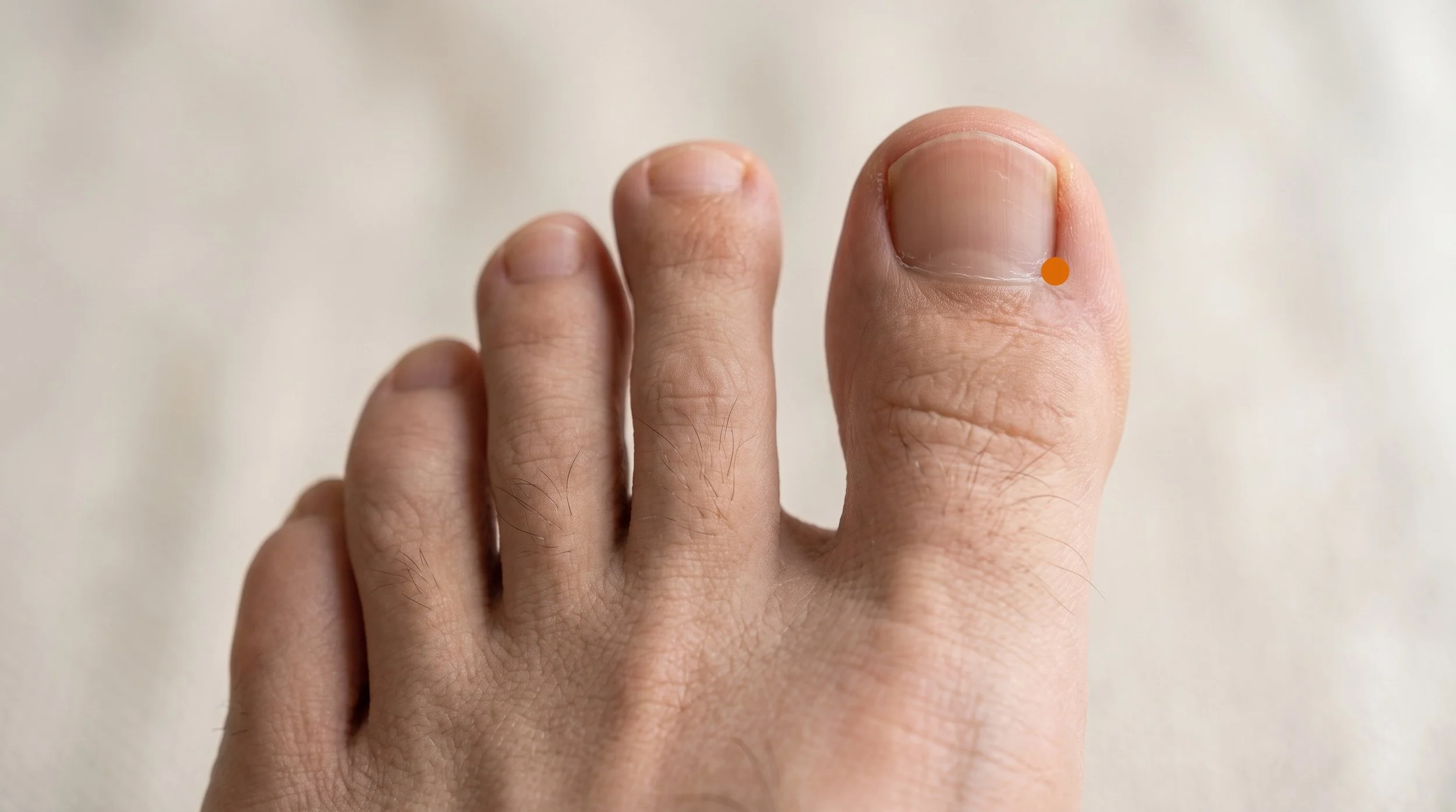
SP1 Acupuncture Point (Yinbai)
The Hidden White Point at the Corner of the Big Toenail: Anatomy, Mechanism, and Why This Jing-Well Point Anchors Classical Bleeding and Sleep Treatment
SP1 (Yinbai, often translated as Hidden White) is the first point of the Spleen channel, sitting at the medial corner of the great toenail where a line along the inner edge of the nail meets a line along its base, roughly 0.1 cun from the corner. It's a tiny target on thin skin over the distal phalanx, and it's needled shallowly, pricked for a drop or two of blood, or warmed with small moxa cones rather than needled deeply.
Classically it's the jing-well and wood point of the channel, one of Sun Si-miao's ghost points, and the point most associated with the traditional idea that the Spleen keeps blood in its vessels, which is why the hidden white point shows up in old texts for heavy uterine bleeding, nosebleed, and blood in the stool or urine. Modern clinicians reach for the sp1 acupuncture point far less for pain than for its distinctive combination of gynecological, digestive, and sleep-related classical indications, always alongside proper medical evaluation of any bleeding.
- Spleen 1 sits at the medial nail corner of the great toe, where the tissue stack is only skin, nail fold, a thin layer of connective tissue, and periosteum, so needling conventions are shallow (0.1 to 0.2 cun angled proximally) or a quick prick to bleed (Deadman et al., 2007).
- Traditional categories translate into neurophysiology reasonably well: jing-well points are acral, densely innervated sites, and classical texts describe them as the most dynamic and fast-acting points on a channel, which fits the intense afferent barrage generated from a high receptor density terminal nerve field (Deadman et al., 2007; Zhao, 2008).
- The sp 1 toe location lies in the terminal field of digital branches of the medial plantar nerve, with dorsal digital contributions nearby, feeding spinal levels that also receive pelvic and lower abdominal visceral input, a convergence pattern relevant to segmental and somato-autonomic effects (Zhao, 2008).
- Moxibustion is central here rather than incidental: heat at the acupoint activates TRPV1 and related thermosensitive channels in cutaneous afferents, and animal work suggests the biological effect of moxa is temperature dependent (Wang et al., 2013).
- The research picture is thin but not empty. A randomized trial found wheat-grain moxibustion at Yinbai shortened prolonged menstrual bleeding after IVF down-regulation compared with an oral progestogen (Su et al., 2020), while broad reviews of acupuncture for insomnia and menstrual complaints remain cautious about certainty (Cheuk et al., 2012; Smith et al., 2016).
- De qi at SP1 doesn't feel like the deep spreading ache of a leg or gluteal point. Patients typically report a sharp, bright, well localized sting that fades within seconds, and the therapeutic intent is a brief strong stimulus rather than sustained needle retention (Deadman et al., 2007).
Struggling With Heavy or Prolonged Periods in NYC?
Heavy menstrual bleeding deserves a proper workup first, and then a plan that addresses how you actually feel between cycles. At Morningside Acupuncture we use SP1 with moxibustion alongside points like SP6, ST36, and CV6 as part of a cycle-aware treatment plan, and we coordinate with your gynecologist rather than working around them. Many patients also learn safe home moxa technique so the work continues between visits. Schedule a visit and let's build a plan around your cycle.
Schedule NowAnatomy of SP1: Why the Medial Nail Corner of the Great Toe Is Such an Important Location
There isn't much tissue at SP1, and that's the point. Under the needle you have thin, tightly bound skin at the nail fold, a shallow layer of dense connective tissue, and then the periosteum of the distal phalanx of the great toe. There's no muscle belly and no fascial plane to travel through, so the needle either sits in the dermis and subcutaneous layer or it hits bone. What loads this region in daily life is mechanical: pressure from the toe box of a shoe, push-off forces through the hallux during gait, and the shear that shows up in runners and dancers.
That mechanical exposure matters clinically because the same region is often tender for reasons that have nothing to do with the classical indications, so palpation findings here need interpreting rather than treating reflexively.
The nerve geography is what makes this a potent site. The medial nail corner of the great toe sits in the terminal territory of digital branches of the medial plantar nerve, with dorsal digital branches from the superficial fibular nerve supplying the adjacent dorsal skin. Acral skin like this carries a very high density of A-delta and C fiber endings per square centimeter, so a shallow needle or a prick produces a large, rapid afferent volley for a very small physical insult.
That volley enters lumbosacral spinal segments, and the spinal and supraspinal machinery it engages includes the endogenous opioid and monoaminergic systems that mediate descending inhibition, along with somato-autonomic reflex pathways that can shift sympathetic outflow to the periphery and the viscera (Zhao, 2008).
When moxa rather than a needle is used, the driving stimulus is thermal instead of mechanical, and experimental work indicates that heat-activated TRPV1 channels in cutaneous afferents are an important part of how moxibustion produces systemic effects, in a temperature-dependent way (Wang et al., 2013).
Vascularly, the toe tip is a dense arteriovenous network fed by dorsal and plantar digital arteries, and it's unusually rich in arteriovenous anastomoses under sympathetic control, which is one reason acral sites respond visibly to autonomic change (cold, pale, or flushed toes). Practically, this means SP1 bleeds readily when pricked, which is intentional in some classical protocols, and it also means clean technique and a firm safety filter matter.
Needling stays shallow and proximally angled, moxa cones stay small and closely monitored on thin skin, and pricking to bleed is avoided or modified in anyone on anticoagulants or with a bleeding disorder. Moxa on the foot warrants extra caution in diabetes, peripheral neuropathy, or peripheral arterial disease, where heat perception and healing are both compromised.
Related Spleen Channel Related SP6 Acupuncture PointSP1 at a Glance: Classification, Location, and Clinical Use
| Category | Detail |
|---|---|
| Traditional Name | Yinbai (Hidden White), SP1, also recorded under the alternative name Guilei among the ghost points |
| Channel Classification | First point of the Spleen channel of the foot taiyin, and the channel's starting point on the medial tip of the great toe |
| Point Categories | Jing-well point of the Spleen channel; wood point in five-shu correspondence; one of Sun Si-miao's thirteen ghost points |
| Precise Location | On the big toe at the junction of a line drawn along the medial border of the nail and a line along the base of the nail, about 0.1 cun from the nail corner |
| Tissue Stimulated | Thin nail-fold skin, subcutaneous connective tissue, and periosteum of the distal phalanx, in the terminal digital nerve field; the surrounding intrinsic foot muscles treated in the same region include abductor hallucis and adductor hallucis |
| Needle Depth / Direction | Perpendicular or oblique insertion angled proximally, 0.1 to 0.2 cun, or a quick prick to bleed; small moxa cones or a moxa stick are commonly used instead of retained needling |
| De Qi Sensation | A brief, sharp, bright, highly localized sting or distending sensation at the nail corner that settles quickly, rather than the dull spreading ache typical of muscular points |
| Primary Clinical Uses | Traditionally used for heavy or prolonged uterine bleeding (usually with moxibustion), nosebleed and other bleeding patterns, dream-disturbed sleep and nightmares, abdominal distention with sudden digestive upset, and as a jing-well point for restoring alertness |
| Common Point Combinations |
|
In the classical literature summarized by Deadman and colleagues, SP1 carries four attributed actions: stopping bleeding, regulating the Spleen, unbinding the chest, and calming the Heart and spirit including restoring consciousness. The framing rests on an old physiological claim, repeated in the Supplement to the Thousand Ducat Formulas and later in the Treatise on Disorders of Blood, that the Spleen holds blood within its vessels and that when this capacity weakens, blood escapes, most often chronically and most often in the lower body as uterine bleeding or blood in urine or stool.
Yinbai is described as the leading point for that pattern, typically with moxa cones or a moxa stick, and classical authors also extended it to hot, reckless bleeding in the upper body such as nosebleed or vomiting blood, where pricking to bleed was more usual.
As jing-well point it was reserved for acute, sudden digestive presentations (distention, sudden diarrhea, sudden swelling of the limbs) rather than slow chronic ones, and because the Spleen channel runs up through the chest and links with the Heart, the same distal point was credited with treating chest fullness, sighing, sadness, agitation, and restless dreaming. What's striking is the internal consistency: one small point at the toe was expected to reach the pelvis, the chest, and the mind, all through a single channel logic, and the same point earned a place among the ghost points under the name Guilei.
Why SP1 Is Used for Heavy Menstrual Bleeding and Nightmares Even Though It Sits on the Big Toe
The first question patients ask is how a point at the corner of a toenail could plausibly matter for the uterus or for sleep. Part of the answer is segmental. Afferents from the medial great toe run in digital branches of the medial plantar nerve into lower lumbar and sacral spinal levels, and those same spinal segments receive input from pelvic structures. Sensory input arriving from the periphery can modify how those segments process visceral signals and can trigger somato-autonomic reflexes that alter sympathetic and parasympathetic tone to organs sharing that innervation territory (Zhao, 2008).
This isn't a claim that a needle at the toe stops bleeding directly. It's a claim that acral stimulation is a real physiological input with measurable autonomic consequences, and that pelvic blood flow is autonomically regulated. Supporting that idea from a different direction, electro-acupuncture at leg and abdominal points has been shown to reduce uterine artery blood flow impedance, an effect attributed to reduced sympathetic vasomotor drive (Stener-Victorin et al., 1996).
The second part of the answer is central rather than segmental. Needling generates activity in ascending pathways that recruit brainstem and hypothalamic structures, releasing endogenous opioids and monoamines that drive descending inhibition and shift overall autonomic balance (Zhao, 2008). That system is the best-documented mechanism in acupuncture research, largely because it's been studied intensively in pain, where individual patient data meta-analysis supports real, persisting effects for chronic pain conditions (Vickers et al., 2018).
Sleep and arousal ride on the same autonomic and neurochemical machinery, which gives a plausible (though not proven) reason why a strongly stimulating distal point earned a classical reputation for calming agitation and quieting excessive dreaming.
When moxa is used at SP1 instead of a needle, the input changes character. Focal heat above roughly forty degrees Celsius activates TRPV1 and related thermosensitive channels in cutaneous nerve endings, and experimental work indicates that the systemic biological effects of moxibustion depend on reaching an adequate temperature, not simply on placing warmth near the skin (Wang et al., 2013).
That's consistent with the classical emphasis on small, hot, direct cones at this point rather than gentle warming, and it's a useful thing to understand if you're doing home moxa: technique and temperature are part of the dose.
What the Research Shows for SP1
Research on any single acupuncture point is limited, and SP1 is no exception. Most trials test multi-point protocols, so the honest framing is that Yinbai appears as one component within larger prescriptions, and reviews assess the protocol rather than the point. There is one useful exception, a randomized trial in which moxibustion was applied at SP1 alone, and there are broader reviews that set expectations for the conditions this point is classically used for.
Heavy menstrual bleeding in particular has well-studied conventional options and needs a diagnostic workup, so acupuncture should be considered adjunctive rather than a replacement.
| Study | Type | Focus | Key Finding |
|---|---|---|---|
| Su et al., 2020 | Randomized controlled trial (point-specific) | Wheat-grain moxibustion at Yinbai (SP1) versus oral dydrogesterone for prolonged menstrual bleeding after IVF down-regulation | The moxibustion group reached cessation of bleeding sooner with better reported endometrial parameters, though the trial was small, unblinded, and single-center. |
| Bofill Rodriguez et al., 2022 | Cochrane overview of reviews with network meta-analysis | Comparative effectiveness of medical and surgical interventions for heavy menstrual bleeding | Established medical and surgical options carry the strongest evidence base for reducing heavy menstrual bleeding, which is why acupuncture is best positioned as adjunctive care after evaluation. |
| Cheuk et al., 2012 | Cochrane systematic review | Acupuncture of any form for insomnia across 33 randomized trials | Methodological limitations and heterogeneity meant the review could neither support nor refute acupuncture for insomnia, with adverse events rarely reported and minor. |
| Smith et al., 2016 | Cochrane systematic review | Acupuncture and acupressure for primary dysmenorrhoea | Evidence was judged low or very low certainty across comparisons, so menstrual pain benefit remains unclear rather than established. |
| Stener-Victorin et al., 1996 | Prospective mechanistic clinical study | Electro-acupuncture and uterine artery blood flow impedance in women with high pulsatility index | Impedance in the uterine arteries fell after a course of treatment, suggesting acupuncture can influence pelvic vascular tone through autonomic pathways. |
| Wang et al., 2013 | Controlled animal experiment | Moxibustion temperature, TRPV1 expression, and systemic biological response | Effects were temperature dependent and largely absent in TRPV1 knockout animals, indicating heat-sensitive channels help mediate how moxibustion works. |
| Vickers et al., 2018 | Individual patient data meta-analysis | Acupuncture across chronic pain conditions in nearly 21,000 patients | Acupuncture outperformed sham and no-acupuncture controls with effects persisting over time, supporting the plausibility of needling as an active intervention. |
Vivid Dreams and Restless Sleep Wearing You Down?
Classical texts pair Yinbai with ST45 specifically for nightmares and dream-disturbed sleep, and that pairing still earns its place in modern practice. We combine distal points like SP1 with body points that calm arousal, plus dry needling for the neck and jaw tension that so often accompanies broken sleep. Sessions are calm, precise, and built around what your sleep actually looks like week to week. Book a consultation and let's work on your nights.
Schedule NowSP1 in the Context of Trigger Point Work
Acupuncture, in our definition, is the use of an acupuncture needle, and that includes the hundreds of styles practiced worldwide as well as dry needling. SP1 itself is not a trigger point target, since there's no muscle belly at the nail corner, but it sits at the end of a functional chain that we do treat with dry needling.
Patients with big toe pain, hallux stiffness, or forefoot overload frequently have taut bands in abductor hallucis along the medial arch, in adductor hallucis in the forefoot, and in the deeper flexors, and referral from these intrinsic muscles can reach the great toe and medial arch (Simons et al., 1999). When someone presents with medial foot symptoms rather than a classical Spleen pattern, we treat the muscles that generate the referral and use SP1 only if the clinical picture calls for it.
In practice the two approaches often sit in the same session. A patient coming in for cycle-related symptoms may also be dealing with foot and calf tightness from training, so we might needle SP1 with moxibustion for its classical indications while dry needling abductor hallucis, tibialis posterior, or the calf complex for mechanical load. That combination is a treatment plan decision, not a claim that one causes the other.
What matters clinically is that a shallow, brief stimulus at the toenail and a deeper mechanical intervention in a taut band are different tools with different rationales, and we tell patients which is which.
SP1 Menstrual and Sleep Treatment at NYC's Highest-Rated Acupuncture Clinic
Morningside Acupuncture is the highest-rated acupuncture and dry needling clinic in New York City with over 500 five-star Google reviews, and our Upper West Side practice blends classical point selection with modern pain science. We use the sp1 acupuncture point where its classical indications genuinely apply, and we're honest when a symptom needs medical evaluation instead. Every plan is built around your history, your goals, and measurable change. Schedule your appointment today.
Schedule NowFrequently Asked Questions
What does SP1 feel like when needled?
Sharp and brief. Because the skin at the nail corner is thin and densely innervated, the sensation is a quick bright sting or pinch that peaks immediately and fades within a few seconds, sometimes with a small distending feeling around the nail fold. It doesn't produce the heavy, spreading, dull ache that patients associate with points in the calf, hip, or back. The needle stays shallow, insertion is fast, and the needle is often removed quickly rather than retained. If moxibustion is used instead, you feel building warmth followed by a short pinpoint of heat, and your practitioner should remove the cone the moment it becomes uncomfortable.
Why would a point on the toe be used for menstrual bleeding or sleep rather than a point near the pelvis or head?
Two reasons, one classical and one physiological. Classically, SP1 is the jing-well point where the Spleen channel begins, and old texts treated jing-well points as the most dynamic points on a channel, capable of affecting the far end of the channel's pathway, which for the Spleen includes the abdomen, chest, and a link to the Heart (Deadman et al., 2007). Physiologically, acral skin has an unusually high density of nerve endings, so a small stimulus generates a large afferent input into lumbosacral spinal segments and into brainstem systems that regulate autonomic tone and descending inhibition (Zhao, 2008). Distal points are also practical: they're accessible while a patient lies comfortably, and they're easy to self-treat at home.
Can I press SP1 myself between sessions?
Yes, acupressure at Spleen 1 is safe and simple. Sit with one foot resting on the opposite knee, find the inner corner of your big toenail, and locate the small hollow where the edge of the nail meets its base, about a fingernail's width from the corner. Use your thumbnail edge or the pad of your thumb to apply firm, steady pressure straight into that corner for 30 to 60 seconds, enough to feel a distinct sensation but not enough to cause lingering soreness. Release, rest for 10 seconds, and repeat two or three times per foot, doing both sides. Once or twice a day is plenty, and many patients pair it with a slow breathing pattern in the evening. Don't press over broken skin, an infected nail fold, or an ingrown toenail, and stop if it stays sore afterward. If you want to use home moxibustion at this point rather than pressure, ask your practitioner to teach you directly, since burn risk on thin toe skin is real.
Is SP1 safe to needle?
In trained hands, yes. The needling depth is minimal, there are no major vessels or organs at risk, and the main considerations are comfort and hygiene, since nail folds can harbor bacteria and the foot is a higher-contamination environment than most sites. Clean skin preparation and single-use sterile needles are standard. Pricking to bleed should be modified or avoided in anyone taking anticoagulants or living with a bleeding disorder, and moxibustion on the foot deserves extra caution in diabetes, peripheral neuropathy, or peripheral arterial disease, where reduced heat sensation and slower healing raise burn risk. Because it's traditionally described as strongly moving blood, we're conservative with vigorous stimulation during pregnancy. Most importantly, heavy, prolonged, or new abnormal bleeding needs medical evaluation, and acupuncture should support that workup rather than delay it.
Where exactly is SP1 located?
On the big toe, at the medial (inner) corner of the toenail. Picture one line running along the inner border of the nail and another running along the base of the nail: SP1 sits where those two lines meet, roughly 0.1 cun (about the width of your own thumbnail edge, a couple of millimeters) away from the nail corner itself. It's the mirror image, on the same toe, of where you'd find the Liver channel's first point at the lateral corner, so getting the correct side of the toe matters. As the starting point of the Spleen channel, it marks the beginning of a pathway that runs along the border of the sole and instep, up the medial leg, and into the abdomen and chest.
References
- Deadman, P., Al-Khafaji, M., & Baker, K. (2009). A manual of acupuncture. Journal of Chinese Medicine Publications.
- Kim, H. (2008). Handbook of Oriental medicine (3rd ed.). Harmony & Balance Press.
- Simons, D. G., Travell, J. G., & Simons, L. S. (1999). Travell & Simons' myofascial pain and dysfunction: The trigger point manual, Vol. 1: Upper half of body (2nd ed.). Williams & Wilkins.
- Su, W. W., Tian, J. S., Liang, X. Y., & Gao, X. A. (2020). Effect of wheat-grain moxibustion at Yinbai (SP 1) on the menstrual period prolongation after IVF-ET down-regulation treatment. Zhongguo Zhen Jiu (Chinese Acupuncture and Moxibustion), 40(2), 153-156. https://doi.org/10.13703/j.0255-2930.20190202-k00014
- Bofill Rodriguez, M., Dias, S., Jordan, V., Lethaby, A., Lensen, S. F., Wise, M. R., Wilkinson, J., Brown, J., & Farquhar, C. (2022). Interventions for heavy menstrual bleeding; overview of Cochrane reviews and network meta-analysis. Cochrane Database of Systematic Reviews, 2022(5), CD013180. https://doi.org/10.1002/14651858.CD013180.pub2
- Cheuk, D. K. L., Yeung, W.-F., Chung, K. F., & Wong, V. (2012). Acupuncture for insomnia. Cochrane Database of Systematic Reviews, 2012(9), CD005472. https://doi.org/10.1002/14651858.CD005472.pub3
- Smith, C. A., Armour, M., Zhu, X., Li, X., Lu, Z. Y., & Song, J. (2016). Acupuncture for dysmenorrhoea. Cochrane Database of Systematic Reviews, 2016(4), CD007854. https://doi.org/10.1002/14651858.CD007854.pub3
- Stener-Victorin, E., Waldenström, U., Andersson, S. A., & Wikland, M. (1996). Reduction of blood flow impedance in the uterine arteries of infertile women with electro-acupuncture. Human Reproduction, 11(6), 1314-1317. https://doi.org/10.1093/oxfordjournals.humrep.a019378
- Wang, G.-Y., Wang, L.-L., Xu, B., Zhang, J.-B., & Jiang, J.-F. (2013). Effects of moxibustion temperature on blood cholesterol level in a mice model of acute hyperlipidemia: Role of TRPV1. Evidence-Based Complementary and Alternative Medicine, 2013, 871704. https://doi.org/10.1155/2013/871704
- Zhao, Z. Q. (2008). Neural mechanism underlying acupuncture analgesia. Progress in Neurobiology, 85(4), 355-375. https://doi.org/10.1016/j.pneurobio.2008.05.004
- Vickers, A. J., Vertosick, E. A., Lewith, G., MacPherson, H., Foster, N. E., Sherman, K. J., Irnich, D., Witt, C. M., & Linde, K. (2018). Acupuncture for chronic pain: Update of an individual patient data meta-analysis. Journal of Pain, 19(5), 455-474. https://doi.org/10.1016/j.jpain.2017.11.005
Disclaimer: This web site is intended for educational and informational purposes only. Reading this website does not constitute providing medical advice or any professional services. This information should not be used for diagnosing or treating any health issue or disease. Those seeking medical advice should consult with a licensed physician. Seek the advice of a medical doctor or other qualified health professional for any medical condition. If you think you have a medical emergency, call 911 or go to the emergency room. No acupuncturist-patient relationship is created by reading this website or using the information. Morningside Acupuncture PLLC and its employees and contributors do not make any express or implied representations with respect to the information on this site or its use. For any legal interpretation of scope of practice in your state, consult a licensed attorney or regulatory authority.
Read more from our blog



