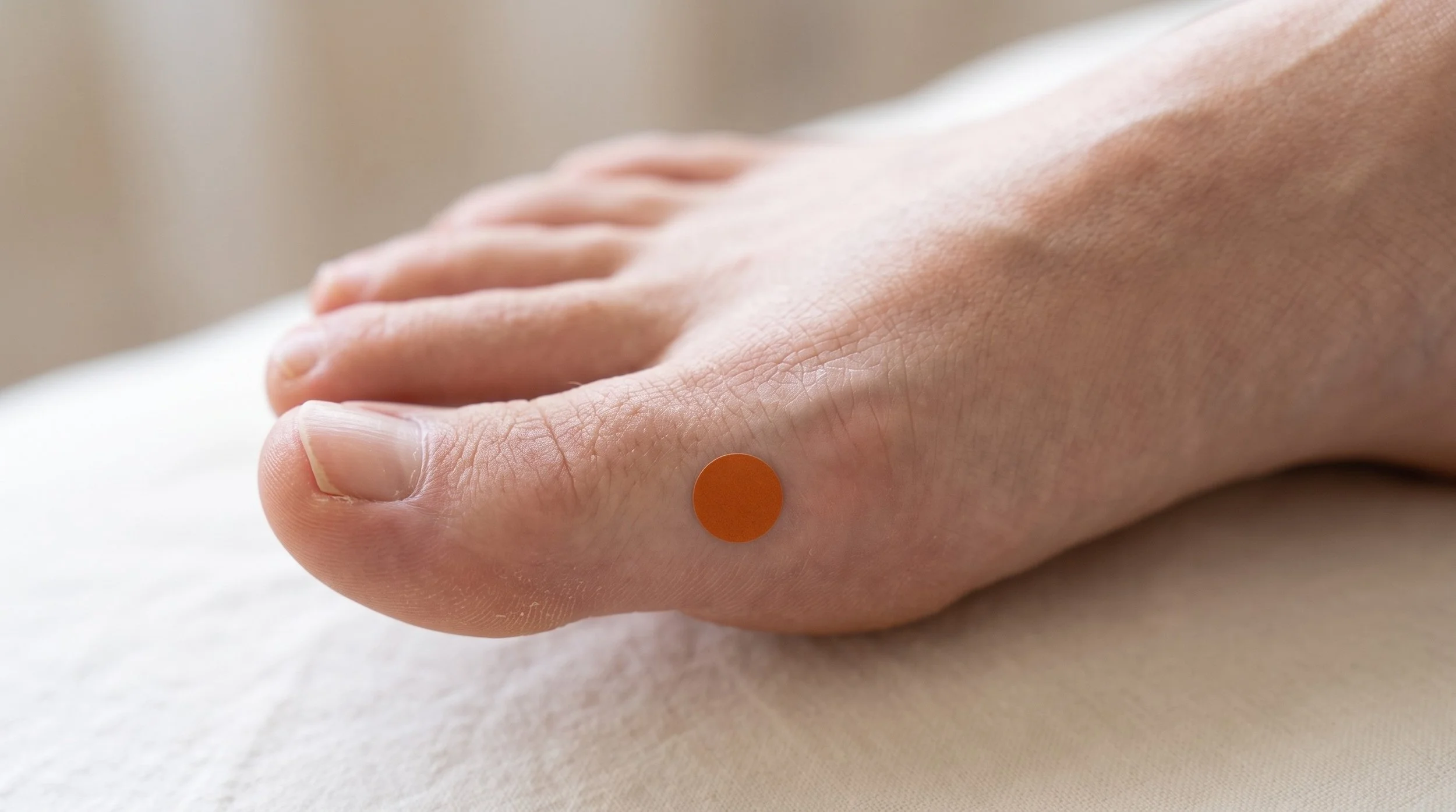
SP2 Acupuncture Point (Dadu)
The Great Metropolis Beside the Big Toe Joint: Anatomy, Mechanism, and Why a Point on the Ball of the Foot Is Used for Digestion and Bunion Pain
SP2 (Dadu), translated as Great Metropolis or Big Capital, sits on the inner edge of the big toe, in the small dip just in front of and below the knuckle of the first metatarsophalangeal joint. You find it by sliding a fingertip forward along the side of the ball of the foot until the bone gives way to a soft depression, right where the pale sole skin meets the darker skin of the foot's side (Deadman et al., 2007; Kim, 2010).
It's the second point on the Spleen channel and, in classical five-shu terms, its ying-spring and fire point, which is why the old texts lean on it for digestive complaints, damp and heavy sensations in the body, and fevers without sweating. In a modern clinic the dadu point location matters for two very different reasons: it lies directly over tissue that gets irritated in bunion and first-toe joint pain, and it's a distal limb point whose stimulation reaches the gut through reflex autonomic pathways rather than through anything happening locally in the abdomen.
- Location and layers: SP2 lies on the medial big toe, distal and inferior to the first metatarsophalangeal joint, at the light and dark skin border, over thin skin, the medial capsule of the joint, and the fibers of abductor hallucis (Deadman et al., 2007; Kim, 2010).
- Traditional categories, translated: as the ying-spring and fire point of the Spleen channel, SP2 was classically used to clear heat and to resolve dampness and damp-heat, and the Illustrated Classic of the Bronze Man also treated it as the mother point for tonifying a deficient Spleen (Deadman et al., 2007). In neurophysiological language, those categories describe a distal point used to influence digestive function and to reduce local joint irritation.
- Nerve story: the site sits in medial plantar nerve territory, a branch of the tibial nerve carrying lumbosacral input, so needling here recruits somatic afferents whose reflex effects on the stomach and bowel are relayed centrally rather than segmentally (Uchida et al., 2017).
- Mechanism: animal work shows that limb stimulation, unlike abdominal stimulation, tends to facilitate gastric motility through vagal efferent pathways, which gives a plausible account of why toe and lower leg points were traditionally used for the upper abdomen (Uchida et al., 2017; Guo et al., 2020).
- Research picture: reviews of acupuncture for functional dyspepsia and irritable bowel syndrome report modest symptom improvements with meaningful uncertainty, and none of them isolate SP2 as a single point (Manheimer et al., 2012; Pang et al., 2016; Li et al., 2026).
- Clinical framing and de qi: SP2 is rarely a stand-alone choice. It's added to Spleen and Stomach channel protocols, or needled locally for first toe joint pain alongside dry needling of the intrinsic foot muscles (Simons et al., 1999). Expect a sharp initial prick from the thin skin followed by a dull, spreading ache around the joint, occasionally tracking into the arch.
Bloating, Sluggish Digestion, or Post-Meal Heaviness in NYC?
At Morningside Acupuncture we treat digestive complaints as patterns, not single symptoms, and SP2 is one of the distal Spleen channel points we may use alongside SP6, ST36, and abdominal points to support more comfortable digestion. Treatment plans combine acupuncture with breathing work, gentle abdominal techniques, and practical food-timing advice. Most patients notice changes across a short course of care rather than after a single visit. Schedule a visit to see whether this approach fits your case.
Schedule NowAnatomy of SP2: Why the Medial Border of the Big Toe Joint Is Such an Important Location
SP2 sits in a shallow depression on the inner side of the big toe, just forward of and below the prominence of the first metatarsophalangeal joint, at the transition between the pale plantar skin and the darker skin of the foot's side (Deadman et al., 2007; Kim, 2010). The tissue here is thin: skin, a modest fat pad, then the medial joint capsule and the collateral ligament, with the belly and tendon of abductor hallucis running just behind and below. This is a high-load corner of the foot.
Every push-off drives force through the first ray, and in hallux valgus the medial capsule is stretched and the sesamoid mechanism shifts, which is exactly why patients so often point to this spot when they describe bunion pain.
Sensory supply comes from the medial plantar nerve, a terminal branch of the tibial nerve, with contributions from the medial dorsal cutaneous branch of the superficial peroneal nerve along the upper margin. That input enters the cord at lumbosacral levels, nowhere near the thoracic segments that supply the stomach and intestines. This matters for how we explain the point's traditional digestive reputation: the effect can't be segmental convergence in the way a mid-back point's effect on the gut can be.
Instead, the plausible route is a somatoautonomic reflex, in which afferent traffic from a limb site is relayed through the brainstem and returns as vagal efferent activity (Uchida et al., 2017; Guo et al., 2020). Locally, stimulating nociceptive and mechanosensitive afferents around an irritated joint also engages descending inhibitory control from the brainstem, one of the better characterized components of acupuncture analgesia (Zhao, 2008).
The vascular structures nearby are small: branches of the medial plantar artery and the first plantar metatarsal artery, along with the digital vessels of the hallux. There's no major vessel or organ at risk, so the main practical concerns are patient comfort and bleeding from superficial vessels. Standard technique is an oblique insertion angled downward and distally, roughly 0.3 to 0.5 cun, kept shallow enough to stay clear of the joint space itself (Deadman et al., 2007).
Some texts prefer a shallower perpendicular insertion of 0.1 to 0.3 cun, and moxibustion is traditionally described as suitable here (Kim, 2010). Because the skin is thin and richly innervated, fine needles and a fast insertion make a real difference to how the point is tolerated.
Related Spleen Channel Related Abductor Hallucis Trigger PointsSP2 at a Glance: Classification, Location, and Clinical Use
| Category | Detail |
|---|---|
| Traditional Name | Dadu, translated as Great Metropolis or Big Capital |
| Channel Classification | Second point of the Spleen channel of Foot Taiyin |
| Point Categories | Ying-spring point and fire point of the Spleen channel; treated in the Illustrated Classic of the Bronze Man as the mother point of the Spleen channel, since fire is the mother of earth (Deadman et al., 2007) |
| Precise Location | Medial side of the big toe, in the depression distal and inferior to the first metatarsophalangeal joint, at the border between the light plantar skin and the darker skin of the foot's side; located by sliding a fingertip forward along the side of the ball of the foot |
| Tissue Stimulated | Thin skin and subcutaneous tissue over the medial joint capsule of the first MTP joint, adjacent to the fibers of abductor hallucis and near flexor hallucis brevis; medial plantar nerve territory |
| Needle Depth / Direction | Oblique insertion directed downward and distally, 0.3 to 0.5 cun; some traditions use a shallower perpendicular insertion of 0.1 to 0.3 cun. Moxibustion is traditionally applied here |
| De Qi Sensation | A brief sharp prick from the thin skin, then a dull, heavy ache concentrated around the toe joint that may spread into the arch or along the inner border of the foot |
| Primary Clinical Uses | Abdominal distention and sluggish digestion, epigastric discomfort, diarrhea and other digestive complaints in classical use, heaviness of the body in damp patterns as classically framed, and big toe joint pain in modern practice |
| Common Point Combinations |
|
Deadman, Al-Khafaji, and Baker note that SP2 sits at an interesting crossroads in the classical literature, and the sources don't entirely agree with one another (Deadman et al., 2007). The Classic of Difficulties assigns ying-spring points to conditions of heat in the body, which frames SP2 as a heat-clearing point for the Spleen. The Illustrated Classic of the Bronze Man pulls in the opposite direction, recommending reinforcement here when the Spleen is deficient, on the five-phase logic that fire is the mother of earth.
The Classic of the Jade Dragon takes the simplest line and describes SP2 as a point for disharmony between the Spleen and Stomach. Deadman resolves the tension by pointing to the clinical picture most often seen in practice, an underlying digestive weakness that generates or invites dampness and damp-heat, and he adds a useful caution: among the distal Spleen points, the tonifying action of SP2 is comparatively minor, and its main strength lies in reducing excess.
The classical indication lists cover swelling and heaviness of the limbs, oppression in the chest, abdominal distention, epigastric pain, vomiting, diarrhea, constipation, agitation and disturbed sleep, fevers without sweating, cold hands and feet, and disorders of the big toe itself. What's striking is how that last, purely local indication sits in the same paragraph as a list of systemic digestive and febrile complaints, which tells you the classical authors were tracking two quite different kinds of usefulness at one small site.
Why SP2 Is Used for Digestive Complaints That Have Nothing to Do With the Foot
The obvious question about a point on the big toe is how it could possibly influence the stomach. The honest answer is that it isn't segmental. Sensation from the medial forefoot travels in the medial plantar nerve to lumbosacral spinal levels, while the stomach and intestines receive sympathetic supply from mid and lower thoracic segments and parasympathetic supply from the vagus. There's no shared spinal cord level to converge on, so the local convergence model that explains, say, a low back point acting on pelvic structures doesn't apply here (Uchida et al., 2017).
What the experimental literature does describe is a reflex organized by body region. Stimulation applied to a limb tends to facilitate gastric motility through vagal efferent pathways, while stimulation over the abdomen tends to inhibit it through sympathetic pathways, a distinction demonstrated repeatedly in anesthetized animal preparations and echoed in electroacupuncture work (Uchida et al., 2017; Guo et al., 2020).
That gives a coherent, if incomplete, account of why the classical tradition reached for toe and lower leg points when treating the upper abdomen, and why distal Spleen and Stomach channel points still appear in modern digestive protocols. The reviewers themselves are careful here: most of this evidence comes from anesthetized animals, and conscious human responses may differ (Uchida et al., 2017).
The second reason SP2 gets used is much more direct. When the first toe joint is the problem, SP2 is simply a local point over an irritated joint capsule and its neighboring muscle attachments. Needling in and around painful tissue engages segmental spinal inhibition and brainstem descending control, mechanisms that are reasonably well described for acupuncture analgesia generally (Zhao, 2008), and large individual patient data analyses support a real, if moderate, effect of acupuncture on chronic musculoskeletal pain (Vickers et al., 2018). Neither mechanism changes the underlying bony alignment of a bunion, and we're clear with patients about that.
What the Research Shows for SP2
There's no clinical trial of SP2 on its own, and there almost certainly never will be, because points like this are used inside multi-point protocols. The research below tests whole treatments for digestive conditions in which distal Spleen and Stomach channel points commonly appear, along with mechanism studies that make the distal-point rationale plausible. Read it as context for why SP2 is included in a prescription, not as evidence that this one point produces the results reported.
| Study | Type | Focus | Key Finding |
|---|---|---|---|
| Li et al., 2026 | Systematic review and meta-analysis with GRADE | Acupuncture for functional dyspepsia across 23 randomized trials | Compared with sham, acupuncture probably improved dyspepsia symptom scores and quality of life without an increase in adverse events, at moderate to high certainty. |
| Pang et al., 2016 | Systematic review and meta-analysis | Manual acupuncture and electroacupuncture for functional dyspepsia | Pooled results favored acupuncture for symptom and quality of life measures, though the authors judged most included trials to be of low methodological quality. |
| Manheimer et al., 2012 | Cochrane systematic review | Acupuncture for irritable bowel syndrome | Acupuncture did not outperform sham acupuncture on symptom severity, though it did better than no specific treatment, which suggests context effects contribute substantially. |
| Guo et al., 2020 | Systematic review of clinical and mechanistic studies | Effects and mechanisms of acupuncture and electroacupuncture in functional dyspepsia | Reported effects on gastric accommodation, motility, and autonomic balance, with the authors noting substantial heterogeneity across studies. |
| Uchida et al., 2017 | Narrative review of animal physiology | Somatoautonomic reflexes underlying acupuncture effects on visceral function | Limb stimulation tends to facilitate gastric motility via vagal pathways while abdominal stimulation inhibits it via sympathetic pathways, with the caveat that most data come from anesthetized animals. |
| Vickers et al., 2018 | Individual patient data meta-analysis | Acupuncture for chronic musculoskeletal, headache, and osteoarthritis pain | Acupuncture was superior to both sham and no-acupuncture controls, with effects persisting over time, supporting its use for the local joint pain applications of points like SP2. |
Big Toe Joint Pain, Bunion Irritation, or Foot Stiffness?
Pain at the first metatarsophalangeal joint often involves the joint capsule, the surrounding intrinsic muscles, and how you load the forefoot when you walk. Our clinicians use SP2 as a local point in that presentation, combined with dry needling of abductor hallucis and flexor hallucis brevis and simple loading strategies you can carry out at home. Acupuncture and dry needling are two applications of the same tool, and we choose whichever suits the tissue in front of us. Book an evaluation and we'll map out what's driving your foot pain.
Schedule NowSP2 in the Context of Trigger Point Work
The sp 2 foot location sits right where several intrinsic muscles converge on the first ray. Abductor hallucis runs along the medial border of the foot and inserts near the base of the proximal phalanx of the big toe, and flexor hallucis brevis with its sesamoids lies just plantar to the point. Trigger points in these muscles refer pain into the medial heel, the arch, and the big toe region, patterns that overlap closely with what patients describe when they say their bunion hurts (Simons et al., 1999).
At Morningside we often needle SP2 as the channel point and then treat the surrounding muscle bellies directly, which is dry needling in the technical sense but the same instrument and, in our view, part of the same practice.
A typical foot session might combine SP2 and SP3 along the medial ray with dry needling of abductor hallucis, flexor hallucis brevis, adductor hallucis, and the deeper intrinsic layers, plus assessment further up the chain at flexor hallucis longus and the calf. Big toe pain rarely exists in isolation. Restricted ankle dorsiflexion, a stiff first ray, or altered push-off mechanics often show up in the same exam, so needling is paired with loading and mobility work rather than used alone. Patients typically feel a deep, familiar ache during the muscular portion and a lighter, more surface sensation at SP2 itself.
SP2 Digestive and Foot Pain Treatment at NYC's Highest-Rated Acupuncture Clinic
Morningside Acupuncture is the highest-rated acupuncture and dry needling clinic in New York City with over 500 five-star Google reviews, and our approach pairs classical point selection with current pain science. Whether your concern is digestive discomfort, foot and toe pain, or both, we build a plan around your presentation rather than a template. Every session includes clear explanation of what we're needling and why. Schedule your appointment today.
Schedule NowFrequently Asked Questions
What does SP2 feel like when needled?
The skin on the inner big toe is thin and well supplied with nerve endings, so you'll usually notice a brief, sharp prick as the needle passes through. That settles within a second or two into a duller, heavier ache concentrated around the joint, which sometimes spreads into the arch or along the inner edge of the foot. Feet are generally more sensitive than the trunk, so we use fine needles, a shallow oblique angle, and light stimulation here. If the sensation stays sharp or feels electric, tell your clinician and the needle will be adjusted.
Why would a point on the big toe be used for stomach and bowel symptoms?
Traditionally, SP2 belongs to the Spleen channel, which classical medicine linked to the whole digestive process, and its ying-spring and fire designations gave it roles in clearing heat and resolving dampness (Deadman et al., 2007). Physiologically, the explanation is different. Sensory input from the forefoot doesn't share spinal segments with the stomach, so the relevant pathway appears to be a reflex routed through the brainstem, in which limb stimulation can increase vagal outflow to the gut (Uchida et al., 2017). It's a reasonable mechanism, though most of the direct evidence comes from animal studies, and SP2 is essentially always used alongside other points rather than by itself.
Can I press SP2 myself between sessions?
Yes, and it's easy to reach. Sit with one ankle crossed over the opposite knee, run your thumb forward along the inner side of the big toe, and stop in the small dip just in front of and below the joint knuckle, at the line where the pale sole skin meets the darker skin. Apply steady, moderate pressure with your thumb tip, enough to feel a firm ache but not enough to make you tense up, and hold for 30 to 60 seconds. Repeat two or three times on each foot, once or twice daily, and add small circular motions if that feels better. For post-meal heaviness, try it 20 to 30 minutes after eating rather than immediately. Skip the area if the skin is broken, inflamed, or acutely swollen, and stop if pressure sharply increases joint pain.
Is SP2 safe to needle?
It's a low-risk point in trained hands. There are no organs or major vessels nearby, only small digital and plantar arterial branches, so the main considerations are comfort, avoiding the joint space itself, and clean technique. Insertion is kept shallow and oblique, typically 0.3 to 0.5 cun, with some traditions using an even shallower perpendicular approach (Deadman et al., 2007; Kim, 2010). Minor bruising or a drop of blood on withdrawal is the most common minor effect. We're more cautious in patients with diabetes, peripheral neuropathy, or peripheral vascular disease, where foot skin healing can be impaired, and in anyone with an active infection or open wound in the area.
Where exactly is SP2 located?
Look at the inner side of your big toe and find the bony bump of the first metatarsophalangeal joint, the knuckle that sticks out in a bunion. SP2 is in the depression just in front of that bump and slightly below it, toward the sole, on the border where the light skin of the sole meets the darker skin of the side of the foot. The reliable way to find it is to slide a fingertip forward along the medial side of the ball of the foot until it drops into a small hollow (Deadman et al., 2007; Kim, 2010). Its neighbor SP3 sits just behind the joint on the same border, and the two are frequently used together.
References
- Deadman, P., Al-Khafaji, M., & Baker, K. (2009). A manual of acupuncture. Journal of Chinese Medicine Publications.
- Kim, H. (2008). Handbook of Oriental medicine (3rd ed.). Harmony & Balance Press.
- Simons, D. G., Travell, J. G., & Simons, L. S. (1999). Travell & Simons' myofascial pain and dysfunction: The trigger point manual, Vol. 1: Upper half of body (2nd ed.). Williams & Wilkins.
- Zhao, Z. Q. (2008). Neural mechanism underlying acupuncture analgesia. Progress in Neurobiology, 85(4), 355-375. https://doi.org/10.1016/j.pneurobio.2008.05.004
- Vickers, A. J., Vertosick, E. A., Lewith, G., MacPherson, H., Foster, N. E., Sherman, K. J., Irnich, D., Witt, C. M., & Linde, K. (2018). Acupuncture for chronic pain: Update of an individual patient data meta-analysis. Journal of Pain, 19(5), 455-474. https://doi.org/10.1016/j.jpain.2017.11.005
- Uchida, S., Kagitani, F., & Sato-Suzuki, I. (2017). Somatoautonomic reflexes in acupuncture therapy: A review. Autonomic Neuroscience, 203, 1-8. https://doi.org/10.1016/j.autneu.2016.11.001
- Guo, Y., Wei, W., & Chen, J. D. Z. (2020). Effects and mechanisms of acupuncture and electroacupuncture for functional dyspepsia: A systematic review. World Journal of Gastroenterology, 26(19), 2440-2457. https://doi.org/10.3748/wjg.v26.i19.2440
- Pang, B., Jiang, T., Du, Y. H., Li, J., Li, B., Hu, Y. C., & Cai, Q. H. (2016). Acupuncture for functional dyspepsia: What strength does it have? A systematic review and meta-analysis of randomized controlled trials. Evidence-Based Complementary and Alternative Medicine, 2016, 3862916. https://doi.org/10.1155/2016/3862916
- Manheimer, E., Cheng, K., Wieland, L. S., Min, L. S., Shen, X., Berman, B. M., & Lao, L. (2012). Acupuncture for treatment of irritable bowel syndrome. Cochrane Database of Systematic Reviews, 2012(5), CD005111. https://doi.org/10.1002/14651858.CD005111.pub3
- Li, X. X., Hu, Z. Y., Li, Z. C., Tang, J., Liu, Y. Y., Zeng, D. H., Zhou, Q. Q., Ma, W. B., Lan, L., & Wang, L. (2026). Efficacy and safety of acupuncture for functional dyspepsia: An updated meta-analysis of randomized controlled trials. Frontiers in Medicine, 13, 1718632. https://doi.org/10.3389/fmed.2026.1718632
Disclaimer: This web site is intended for educational and informational purposes only. Reading this website does not constitute providing medical advice or any professional services. This information should not be used for diagnosing or treating any health issue or disease. Those seeking medical advice should consult with a licensed physician. Seek the advice of a medical doctor or other qualified health professional for any medical condition. If you think you have a medical emergency, call 911 or go to the emergency room. No acupuncturist-patient relationship is created by reading this website or using the information. Morningside Acupuncture PLLC and its employees and contributors do not make any express or implied representations with respect to the information on this site or its use. For any legal interpretation of scope of practice in your state, consult a licensed attorney or regulatory authority.
Read more from our blog



