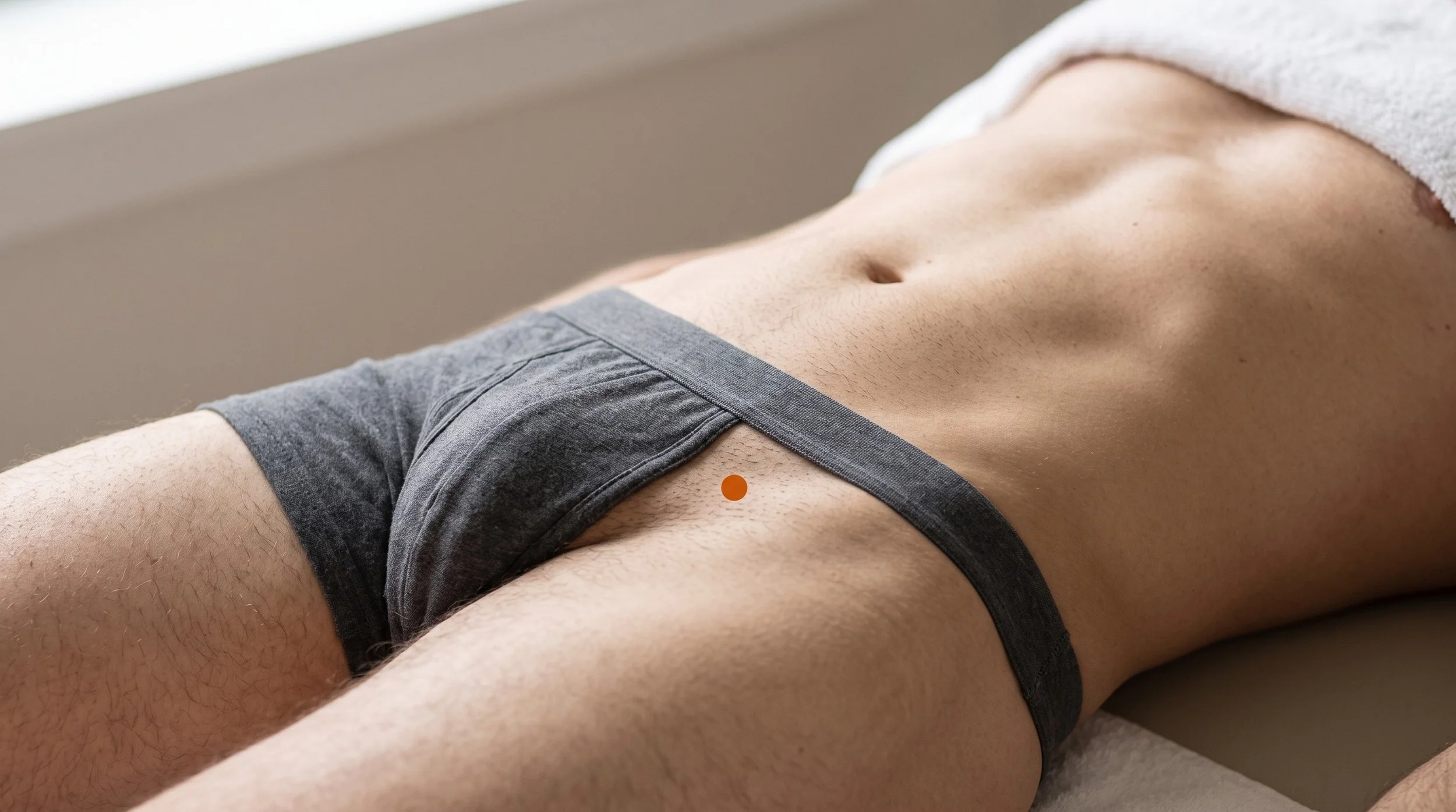
SP12 Acupuncture Point (Chongmen)
The Rushing Gate at the Femoral Triangle: Anatomy, Mechanism, and Why This Groin Point Belongs in Careful Hands
SP12 (Chongmen, often translated as Rushing Gate or Surging Door) sits in the crease of the groin, roughly a handbreadth out from the midline at the level of the top of the pubic bone, in the small depression just to the outside of the femoral artery pulse. It's the twelfth point of the Spleen channel and one of the few classical points defined by a pulse rather than a bone or tendon, which tells you immediately why it demands precision.
Classically it's described as a meeting point of the Spleen and Liver channels with the Yin Linking vessel, and it was used for lower abdominal pain, groin and hernia-type complaints, and difficult urination (Deadman et al., 2001). In a modern clinic, the sp12 acupuncture point is most often considered when patients describe deep, hard-to-localize groin discomfort, restriction at the front of the hip, or tension where the abdominal wall meets the thigh.
- Location and layers: Chongmen is found 3.5 cun lateral to CV2 at the level of the upper border of the pubic symphysis, in the depression immediately lateral to the palpable femoral pulse, above the inguinal crease (Deadman et al., 2001). The needle passes skin, subcutaneous fat, and the fascial envelope of the femoral triangle, with iliopsoas and pectineus lying deeper.
- Traditional categories: the classical literature lists spleen 12 as a crossing point of the Spleen and Liver channels with the Yin Linking vessel, with attributed actions of moving blood and qi, easing pain, and regulating urination (Deadman et al., 2001; Kim, 2013). Some lineages also use it as the opening point of the Spleen Divergent channel (Sterman, 2019).
- Mechanism: this is a lumbar segmental point. Needling here stimulates branches of the ilioinguinal, genitofemoral, and lateral femoral cutaneous nerves at roughly the L1 to L3 levels, the same segments that carry sensory traffic from the lower abdominal wall, bladder, and pelvic structures, which gives a plausible convergence pathway for referred groin symptoms (Zhao, 2008).
- Research picture: no trial has tested Chongmen in isolation. What exists is evidence for needling within multi-point protocols for chronic musculoskeletal pain (Vickers et al., 2018), for hip complaints where results are modest and mixed (Manheimer et al., 2018), and for trigger point needling of hip flexors including iliopsoas (Ceballos-Laita et al., 2019).
- Clinical framing: because the point sits at a vascular landmark, practice conventions matter more than technique flourishes. The pulse is palpated first, the needle is placed lateral to it, insertion is perpendicular and shallow to moderate at 0.5 to 1 cun, and deep angulation is avoided in both directions (Deadman et al., 2001; Cheng, 1987).
- De qi: patients usually report a heavy, spreading fullness across the groin that may travel into the upper thigh or lower abdomen, occasionally with a warm flush. Sharp electrical sensation shooting down the front of the thigh means the needle is too far lateral and near the femoral nerve, so it's withdrawn and repositioned.
Deep Groin Pain That Nobody Can Seem to Pin Down?
Groin discomfort is one of the harder regions to sort out because the hip joint, adductors, iliopsoas, abdominal wall, and pelvic nerves all report to overlapping spinal segments. At Morningside Acupuncture, we palpate the whole region before we needle, then use SP12 alongside adductor and hip flexor work when the presentation points that way. Treatment may reduce guarding and improve how the groin tolerates load. Schedule a visit and we'll map your pattern properly.
Schedule NowAnatomy of SP12: Why the Femoral Triangle Beside the Pulse Is Such an Important Location
The chongmen point location sits at the top of the femoral triangle, just below the inguinal ligament and above the inguinal crease. Under the skin and a variable layer of subcutaneous fat lies the fascia lata and the femoral sheath region, with the aponeurosis of the external oblique contributing to the inguinal ligament just above. Deeper still are iliopsoas laterally and pectineus medially, the two muscles that most often carry protective tone in patients with anterior hip restriction.
This is a crossroads for load: hip flexion, trunk rotation, and the transfer of force between the abdominal wall and the leg all funnel through this small area, which is part of why groin symptoms here are so difficult to attribute to a single structure.
The nerve geography explains the clinical logic. Superficially, the region receives the ilioinguinal nerve, the femoral branch of the genitofemoral nerve, and branches of the lateral femoral cutaneous nerve, arising from roughly L1 to L3. Those same segments carry afferent input from the lower abdominal wall and, through sympathetic pathways, from pelvic viscera.
Needle stimulation at this level activates A-delta and C fiber afferents that project into dorsal horn neurons already receiving convergent visceral and deep somatic input, and the resulting spinal and supraspinal processing engages descending inhibitory pathways using endogenous opioid, serotonergic, and noradrenergic signaling (Zhao, 2008). Local effects matter too: needling has been shown to increase blood flow in skin and underlying muscle at and around the insertion site, an effect attributed to axon reflex and neuropeptide release rather than anything mystical (Sandberg et al., 2003).
Deep to the point run the femoral vessels, and this is the whole reason SP12 is taught the way it is. The femoral artery is medial to the point, the femoral vein is medial to the artery, and the femoral nerve lies further lateral. Classical and modern texts both warn that deep needling angled medially risks the artery while deep lateral needling risks the nerve, so the standard is perpendicular insertion of 0.5 to 1 cun placed in the depression just lateral to the palpated pulse (Deadman et al., 2001; Cheng, 1987).
The technique mirrors how ST9 is located: find the pulse, define its border, guard it with a finger, and needle away from it. In our clinic we also screen for inguinal hernia, enlarged lymph nodes, or vascular grafts before needling here, and we skip the point entirely when anything about the palpation seems off.
Related Best Acupuncture Points For Hip Pain Related Acupuncture For Adductor Magnus PainSP12 at a Glance: Classification, Location, and Clinical Use
| Category | Detail |
|---|---|
| Traditional Name | Chongmen (Rushing Gate, also translated as Surging Door or Penetrating Door) |
| Channel Classification | SP12, the twelfth point of the Spleen channel of Foot Taiyin |
| Point Categories | Meeting point of the Spleen and Liver channels with the Yin Linking vessel (Yin Wei mai); coalescent point of the Yin Linking vessel; used in some traditions as the opening point of the Spleen Divergent channel |
| Precise Location | In the groin, 3.5 cun lateral to CV2 at the level of the upper border of the pubic symphysis, superior to the lateral end of the inguinal groove, in the depression immediately lateral to the palpable femoral artery pulse |
| Tissue Stimulated | Skin and subcutaneous tissue of the femoral triangle, fascia at the lower border of the inguinal ligament formed by the external abdominal oblique aponeurosis, with iliopsoas lying deep and laterally and pectineus deep and medially; regional referral overlaps with abdominal oblique patterns |
| Needle Depth / Direction | Perpendicular insertion 0.5 to 1 cun, placed lateral to the defined femoral pulse; deep medial angling risks the femoral artery and deep lateral angling the femoral nerve, so the pulse is located and guarded before insertion |
| De Qi Sensation | Heavy, spreading fullness across the groin that may radiate into the upper thigh or lower abdomen, sometimes with warmth; sharp electrical radiation down the front of the thigh is a signal to withdraw and reposition |
| Primary Clinical Uses | Groin and inguinal region pain, anterior hip and hip flexor tension, lower abdominal pain and fullness in classical use, difficult urination in classical use |
| Common Point Combinations |
|
Deadman's A Manual of Acupuncture presents Chongmen as a coalescent point of the Yin Linking vessel, and it repeats the line from the Classic of Difficulties associating disease of that vessel with pain in the region of the heart. Traditional indications gathered there cluster into three groups: abdominal patterns (pain, cold with fullness, palpable masses, shan or hernia-type disorders), urinary and gynecological patterns (difficult urination, retention, painful urinary dysfunction, vaginal discharge), and channel patterns in the lower limb such as weakness and painful obstruction.
The commentary also notes a striking parallel: both Chongmen (Rushing Gate) and Qichong ST30 (Rushing Qi) were traditionally indicated for what the classical authors called fetal qi rushing upward toward the heart, a late-pregnancy picture of abdominal and chest fullness described by Zhu Dan-xi. These are attributions from within the classical system rather than physiological claims, but the pattern is worth noting: the tradition kept assigning upward-surging, pressure-from-below complaints to points located exactly where the abdomen empties into the thigh.
Why SP12 Is Used for Deep Groin Pain That Imaging Often Cannot Explain
Groin pain is notoriously hard to localize because so many structures share spinal segments. The hip joint capsule, adductors, iliopsoas, lower abdominal wall, inguinal canal, and pelvic organs all send afferent traffic into roughly the same L1 to L3 territory. When one of those sources becomes persistently irritated, dorsal horn neurons receiving that convergent input can become more responsive, and the brain's read on where the problem sits becomes blurry. That's why patients often say the pain feels like it's inside the crease rather than in any muscle they can point to.
Needling at SP12 puts a controlled, well-defined stimulus into that exact segmental neighborhood, and the point of the intervention is to change the quality of input arriving at those shared neurons (Zhao, 2008).
Beyond the segment, needle stimulation recruits descending inhibitory systems that dampen pain signaling from the brainstem downward, using endogenous opioids along with serotonergic and noradrenergic pathways (Zhao, 2008). There are also measurable local and reflex circulatory effects: human studies have documented increased skin and muscle blood flow following needling, and animal work has mapped somato-autonomic reflexes through which somatic stimulation alters regional blood flow, including in pelvic structures (Sandberg et al., 2003; Uchida & Hotta, 2008).
None of that proves SP12 does anything specific for a given diagnosis, but it does describe a coherent physiology behind why patients often report that the groin feels less braced and easier to load after treatment.
Practically, this is why we treat SP12 as one part of a regional strategy rather than a standalone fix. If iliopsoas and pectineus are guarding, they get addressed directly. If the hip joint is the driver, that changes the plan. Studies suggest needling approaches may reduce pain and improve function in hip complaints when used as part of a broader program, though effects compared with sham are small and uncertain (Manheimer et al., 2018).
What the Research Shows for SP12
It's worth being direct about the evidence: there is no trial of SP12 by itself, and there almost certainly never will be, because acupuncture research tests protocols rather than single points. What the literature can tell us is whether needling in general helps the conditions this point is used for, and whether the physiological mechanisms invoked are real. On chronic musculoskeletal pain the individual patient data are reasonably strong, on hip-specific outcomes they are modest and mixed, and on classical pelvic and urinary indications the trials are of variable quality. Read the table below as context for how a point like Chongmen fits inside a treatment plan, not as evidence for the point itself.
| Study | Type | Focus | Key Finding |
|---|---|---|---|
| Vickers et al., 2018 | Individual patient data meta-analysis | Chronic musculoskeletal, headache, and osteoarthritis pain across 39 trials | Acupuncture was more effective than both sham and no-acupuncture controls, with effects persisting over time, supporting needling as a reasonable option for persistent pain. |
| Manheimer et al., 2018 | Cochrane systematic review | Acupuncture for hip osteoarthritis (6 trials, 413 participants) | Acupuncture probably makes little or no difference compared with sham, though adding it to routine physician care may improve pain and function. |
| Ceballos-Laita et al., 2019 | Double-blind randomized controlled trial | Dry needling of iliopsoas, rectus femoris, tensor fasciae latae, and gluteus minimus trigger points in hip osteoarthritis | Three sessions of trigger point needling reduced pain and improved function compared with sham needling in the short term. |
| Qin et al., 2022 | GRADE-assessed systematic review and meta-analysis | Acupuncture for chronic prostatitis and chronic pelvic pain syndrome | Acupuncture was associated with symptom improvement compared with sham, offering indirect support for needling in pelvic and lower abdominal pain presentations. |
| Sandberg et al., 2003 | Controlled physiological study in healthy subjects | Skin and muscle blood flow responses to needle stimulation | Needling increased local blood flow in skin and underlying muscle, consistent with neurogenic vasodilation rather than a purely psychological response. |
| Uchida & Hotta, 2008 | Review of animal physiology studies | Somato-autonomic reflex control of regional blood flow | Acupuncture-like stimulation altered blood flow in several organs through segmental and non-segmental reflexes, providing a mechanism for regional autonomic effects. |
| Zhao, 2008 | Narrative review of neurophysiology | Spinal and supraspinal mechanisms of acupuncture analgesia | Needle stimulation engages segmental gating and descending inhibitory pathways involving opioid, serotonergic, and noradrenergic signaling. |
Tight Hip Flexors That Never Fully Release After Stretching?
When the front of the hip stays short despite mobility work, the limiter is often protective tone in iliopsoas and pectineus rather than true tissue length. We combine careful needling at the sp 12 groin location with dry needling of the hip flexors and distal channel points to change the input the nervous system is receiving. Many patients notice easier hip extension in the days after a session. Book an evaluation and let's test it.
Schedule NowSP12 in the Context of Trigger Point Work
The groin is one of the regions where classical point work and myofascial work overlap almost completely. Iliopsoas lies deep and lateral to SP12, pectineus lies deep and medial, and adductor longus starts just below and medial to the point. Trigger points in these muscles refer pain into the groin, the front of the thigh, and sometimes the low back or anterior hip, a pattern that patients frequently describe as an internal ache rather than a surface soreness (Simons et al., 1999).
The abdominal obliques, whose aponeurosis forms the inguinal ligament above the point, can also refer into the same territory, which is why we palpate the abdominal wall and not just the leg when someone presents with groin symptoms.
At Morningside Acupuncture, SP12 is typically one element of a session rather than the centerpiece. A common approach is to needle the point itself lateral to the guarded pulse, then dry needle active trigger points in iliopsoas, pectineus, or adductor longus using safe angles and depths appropriate to each muscle, and finish with distal points to support the segmental work. Randomized data on hip flexor trigger point needling show short-term reductions in pain and improvements in function in people with hip osteoarthritis, which is a fair model for what we aim for here (Ceballos-Laita et al., 2019).
Whether we use SP12 at all on a given visit depends entirely on what palpation finds and on whether the anatomy is clean enough to needle confidently.
SP12 Groin and Hip Pain Treatment at NYC's Highest-Rated Acupuncture Clinic
Morningside Acupuncture is the highest-rated acupuncture and dry needling clinic in New York City with over 500 five-star Google reviews, and precision in sensitive regions like the femoral triangle is exactly why patients come to us. Every SP12 treatment starts with locating and guarding the pulse, and we'll always explain what we're doing before a needle goes in. Care is combined with movement guidance so gains hold between visits. Schedule your appointment today.
Schedule NowFrequently Asked Questions
What does SP12 feel like when needled?
Most patients report a dull, heavy fullness in the crease of the groin that spreads a little into the upper thigh or toward the lower abdomen, sometimes with a sense of warmth. Because the point sits near a large artery, some people become briefly aware of their own pulse in the area, which is normal and settles quickly. What shouldn't happen is a sharp electrical sensation running down the front of the thigh, which suggests the needle is too close to the femoral nerve; a practitioner will withdraw and reposition immediately if that occurs. The point is usually needled shallowly, and the sensation typically fades into a mild ache within the first minute.
Why needle the groin for hip flexor tightness instead of just stretching?
Persistent shortness at the front of the hip is often protective tone rather than true tissue shortening, meaning the nervous system is holding iliopsoas and pectineus in a guarded state. Stretching a guarded muscle can temporarily increase tolerance without changing the underlying drive. Needling in the same segment feeds a different kind of input into the dorsal horn and engages descending inhibition, which may reduce that guarding (Zhao, 2008). That said, needling isn't a substitute for loading; the durable changes come when reduced guarding is followed by graded strength and mobility work in the new range.
Can I press SP12 myself between sessions?
You can, with one firm rule: never press on the pulse itself. Lie on your back with knees bent, find the femoral pulse in the groin crease with two fingers, then slide about a fingerwidth laterally, away from the midline, until you're off the pulsation and on softer tissue at the top of the thigh. Apply gentle, steady pressure at a comfort level around 4 out of 10 for 30 to 60 seconds while breathing slowly, release, and repeat two or three times on each side. Do one side at a time rather than both together, keep total time under a few minutes, and stop immediately if you feel throbbing, numbness, tingling down the leg, or any bulge in the area. Skip self-acupressure here entirely if you're pregnant, have a known or suspected hernia, have varicose veins or a vascular graft in the groin, are on blood thinners, or have swollen lymph nodes, and check with your clinician first.
Is SP12 safe to needle?
It's safe in trained hands and inappropriate for casual needling. The femoral artery lies medial to the point, the femoral vein is medial to the artery, and the femoral nerve is further lateral, so classical and modern texts alike caution against deep medial or deep lateral angling and recommend perpendicular insertion of 0.5 to 1 cun after the pulse has been located and guarded (Deadman et al., 2001; Cheng, 1987). Practitioners should also screen for inguinal hernia, enlarged lymph nodes, aneurysm, vascular surgery history, and anticoagulant use, and should avoid the point when any of those raise concern. Pregnancy, active infection in the region, and broken or compromised skin are additional reasons to choose a different point. Anyone with unexplained groin swelling, fever, or pain that worsens at night should be evaluated medically before receiving any needling in the area.
Where exactly is SP12 located?
Lie on your back with the leg slightly abducted. Find the top edge of the pubic bone and trace laterally about 3.5 cun, which is roughly a handbreadth, staying at that same horizontal level just above the inguinal crease. In that zone you'll feel the femoral artery pulsing; SP12 is the small depression immediately lateral to that pulsation, toward the outside of the leg (Deadman et al., 2001). A useful check is that the point sits above the crease rather than down on the thigh, and that your finger is off the pulse but still within the upper corner of the femoral triangle. If you can't clearly define the pulse, you can't safely define the point.
References
- Deadman, P., Al-Khafaji, M., & Baker, K. (2009). A manual of acupuncture. Journal of Chinese Medicine Publications.
- Cheng, X. (Ed.). (1999). Chinese acupuncture and moxibustion (Rev. ed.). Foreign Languages Press.
- Kim, H. (2008). Handbook of Oriental medicine (3rd ed.). Harmony & Balance Press.
- Maciocia, G. (2006). The channels of acupuncture: Clinical use of the secondary channels and eight extraordinary vessels. Churchill Livingstone Elsevier.
- Cecil-Sterman, A. (2012). Advanced acupuncture: A clinic manual. Classical Wellness Press.
- Simons, D. G., Travell, J. G., & Simons, L. S. (1999). Travell & Simons' myofascial pain and dysfunction: The trigger point manual, Vol. 1: Upper half of body (2nd ed.). Williams & Wilkins.
- Vickers, A. J., Vertosick, E. A., Lewith, G., MacPherson, H., Foster, N. E., Sherman, K. J., Irnich, D., Witt, C. M., & Linde, K. (2018). Acupuncture for chronic pain: Update of an individual patient data meta-analysis. Journal of Pain, 19(5), 455-474. https://doi.org/10.1016/j.jpain.2017.11.005
- Zhao, Z. Q. (2008). Neural mechanism underlying acupuncture analgesia. Progress in Neurobiology, 85(4), 355-375. https://doi.org/10.1016/j.pneurobio.2008.05.004
- Manheimer, E., Cheng, K., Wieland, L. S., Shen, X., Lao, L., Guo, M., & Berman, B. M. (2018). Acupuncture for hip osteoarthritis. Cochrane Database of Systematic Reviews, 2018(5), CD013010. https://doi.org/10.1002/14651858.CD013010
- Ceballos-Laita, L., Jimenez-Del-Barrio, S., Marin-Zurdo, J., Moreno-Calvo, A., Marin-Bone, J., Albarova-Corral, M. I., & Estebanez-de-Miguel, E. (2019). Effects of dry needling in hip muscles in patients with hip osteoarthritis: A randomized controlled trial. Musculoskeletal Science and Practice, 43, 76-82. https://doi.org/10.1016/j.msksp.2019.07.006
- Qin, Z., Guo, J., Chen, H., & Wu, J. (2022). Acupuncture for chronic prostatitis/chronic pelvic pain syndrome: A GRADE-assessed systematic review and meta-analysis. European Urology Open Science, 46, 55-67. https://doi.org/10.1016/j.euros.2022.10.005
- Sandberg, M., Lundeberg, T., Lindberg, L. G., & Gerdle, B. (2003). Effects of acupuncture on skin and muscle blood flow in healthy subjects. European Journal of Applied Physiology, 90(1-2), 114-119. https://doi.org/10.1007/s00421-003-0825-3
- Uchida, S., & Hotta, H. (2008). Acupuncture affects regional blood flow in various organs. Evidence-Based Complementary and Alternative Medicine, 5(2), 145-151. https://doi.org/10.1093/ecam/nem051
Disclaimer: This web site is intended for educational and informational purposes only. Reading this website does not constitute providing medical advice or any professional services. This information should not be used for diagnosing or treating any health issue or disease. Those seeking medical advice should consult with a licensed physician. Seek the advice of a medical doctor or other qualified health professional for any medical condition. If you think you have a medical emergency, call 911 or go to the emergency room. No acupuncturist-patient relationship is created by reading this website or using the information. Morningside Acupuncture PLLC and its employees and contributors do not make any express or implied representations with respect to the information on this site or its use. For any legal interpretation of scope of practice in your state, consult a licensed attorney or regulatory authority.
Read more from our blog



