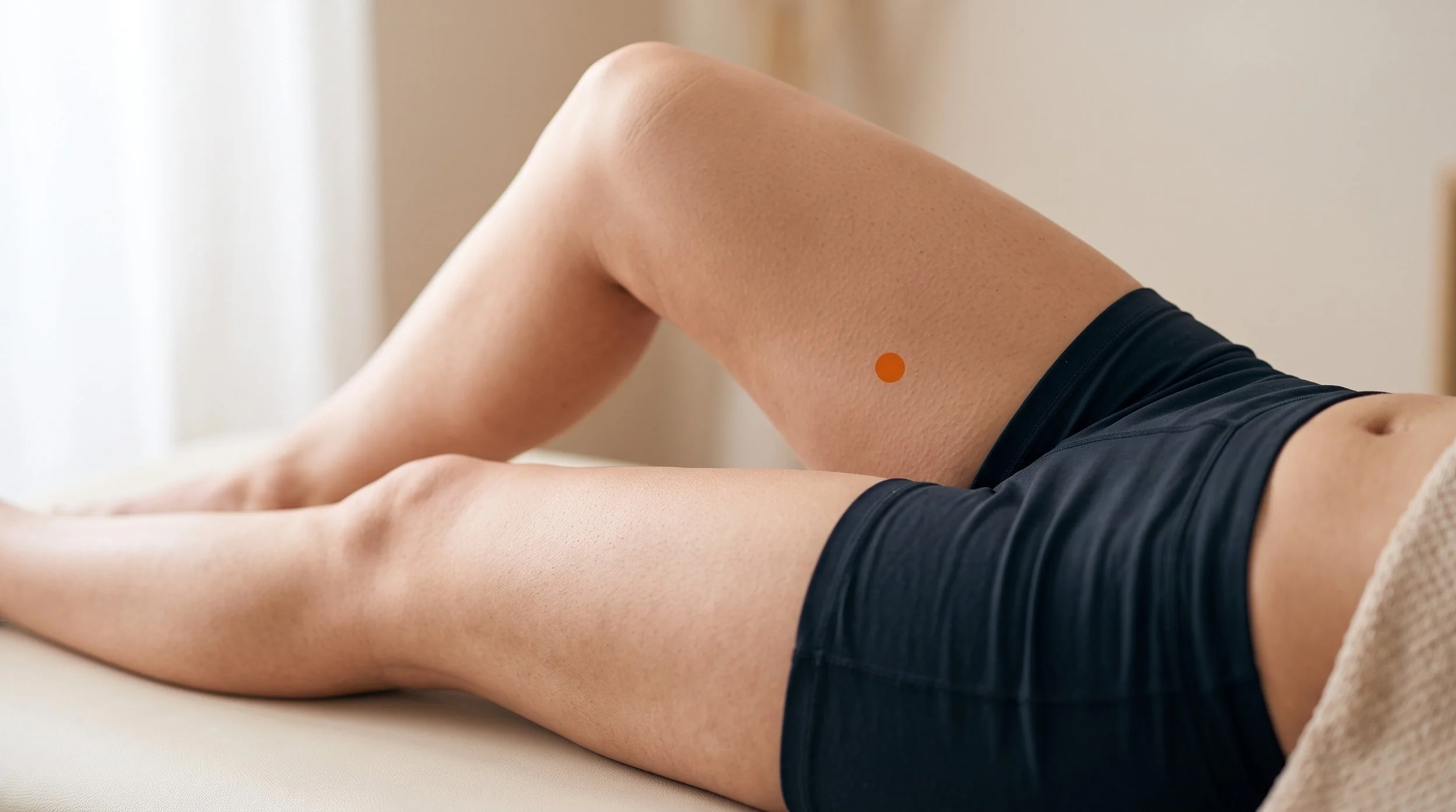
SP11 Acupuncture Point (Jimen)
The Winnowing Gate on the Inner Thigh: Anatomy, Mechanism, and Why This Adductor Canal Point Bridges Groin Pain and Urinary Complaints
SP11 (Jimen), often translated as Winnowing Gate or Basket's Door, sits high on the inner thigh, roughly two handbreadths above SP10 on the line running up toward SP12 at the groin crease, about midway between the knee joint line and the inguinal crease. It's one of the least discussed points on the Spleen channel, partly because it sits directly over the adductor canal, the narrow tunnel where the femoral artery, femoral vein, and saphenous nerve travel together beneath the sartorius muscle.
That anatomy is exactly why the sp11 acupuncture point matters clinically: it gives access to the adductor and vastus medialis corridor that so often drives medial thigh and groin complaints, while classical sources assign it a very different job, regulating urination and draining damp from the lower body (Deadman et al., 2007). Handled with respect for the vessels underneath, spleen 11 is a useful, conservative-depth point for athletes with adductor-related groin pain and for patients whose pelvic and urinary symptoms are being treated as part of a broader protocol.
- Location and layers: SP11 lies 6 cun above SP10 on the SP10 to SP12 line, passing through skin and subcutaneous fat into the groove between sartorius and vastus medialis, with the adductor group medially and the femoral vessels and saphenous nerve in the canal beneath (Deadman et al., 2007; Kapoor et al., 2012).
- Traditional attributions: classical texts credit SP11 with regulating urination, draining damp, and clearing heat, and list it for painful or obstructed urination, enuresis, damp itching and eczema of the genital region, and inguinal pain and swelling (Deadman et al., 2007; Cunningham, 1996). These are traditional categories, not physiological claims.
- Mechanism: needling here engages femoral and obturator nerve territory (roughly L2 to L4) and the saphenous nerve as it runs in the adductor canal, so effects are best explained through segmental convergence in the spinal cord, descending inhibitory pathways, and local autonomic and vascular responses (Zhao, 2008; Kapoor et al., 2012).
- Local circulation: needle stimulation, particularly when a de qi sensation is elicited, has been shown to increase skin and muscle blood flow in the treated region, which may help explain the softening patients report in a tight adductor corridor (Sandberg et al., 2003).
- Research picture: no trial has isolated SP11, so evidence comes from multi-point protocols. Acupuncture shows modest, durable benefits for chronic musculoskeletal pain (Vickers et al., 2018), sustained improvement in chronic prostatitis and chronic pelvic pain syndrome versus sham (Sun et al., 2021), and low-certainty signals for overactive bladder (Hargreaves et al., 2022).
- Clinical framing and de qi: at Morningside we needle SP11 shallowly (0.5 to 1 cun), always after palpating for the femoral pulse, and patients typically describe a deep, heavy, spreading ache through the inner thigh rather than anything sharp or electric (Deadman et al., 2007).
Struggling With Groin or Inner Thigh Pain That Keeps Coming Back?
Adductor-related groin pain has a habit of settling in, especially in runners, cyclists, soccer players, and anyone who trains with a lot of cutting and lateral load. We use SP11 alongside careful dry needling of the adductor longus, adductor brevis, adductor magnus, and sartorius, plus manual work and loading strategy, so the corridor gets treated as a system rather than a single sore spot. Most patients notice changes in tolerance and stride within a handful of sessions. Schedule a visit and let's map out what's actually driving your groin pain.
Schedule NowAnatomy of SP11: Why the Adductor Canal Is Such an Important Location
Standing at SP11, the needle passes through skin and a variable layer of subcutaneous fat before reaching the interval between the sartorius, which crosses the thigh diagonally as a thin strap, and the bulk of the vastus medialis on the outer side. The adductor longus and adductor magnus form the medial wall of this space. Functionally, this is the corridor that absorbs load whenever you decelerate, change direction, or stabilize a single-leg stance, which is why cyclists, runners, dancers, and field-sport athletes accumulate tension and tender bands here.
Prolonged sitting with the hips adducted and internally rotated loads it differently but no less persistently, and desk-based patients frequently show restriction through the same tissue.
The nerve geography is what makes this point interesting. The saphenous nerve, the long sensory branch of the femoral nerve, travels within the adductor canal alongside the nerve to vastus medialis, and cadaveric work has mapped how closely those two structures sit to each other and to the femoral artery (Kapoor et al., 2012). Adductor tissue is supplied largely by the obturator nerve, so a needle placed at SP11 sits in an overlap zone drawing on roughly the L2 to L4 segments.
Stimulating this territory sends afferent traffic into the same dorsal horn levels that receive input from the medial thigh, medial knee, and lower abdominal wall, and that segmental convergence is the most defensible explanation for why local needling can change pain and muscle tone at a distance from the needle itself (Zhao, 2008). Alongside segmental effects, needling recruits descending inhibitory pathways from the brainstem and produces measurable local increases in skin and muscle blood flow, particularly when a de qi sensation is elicited (Sandberg et al., 2003; Zhao, 2008).
Safety is the reason SP11 stays shallow. The femoral artery and vein run deep to the point inside the adductor canal, and standard texts explicitly caution that deep insertion risks puncturing the artery (Deadman et al., 2007). Our convention is to palpate for the femoral pulse first, position the needle away from it, and insert perpendicularly or obliquely to a conservative 0.5 to 1 cun, which is more than enough to reach the muscular interval without approaching the vessels.
Patients on anticoagulants, patients with known vascular disease in the leg, and anyone with a history of deep vein thrombosis warrant extra caution or a different point selection entirely. A sharp, electric sensation shooting toward the medial knee suggests saphenous nerve contact and means the needle gets withdrawn and repositioned.
Related Acupuncture For Adductor Magnus Pain Related Acupuncture For Sartorius Muscle PainSP11 at a Glance: Classification, Location, and Clinical Use
| Category | Detail |
|---|---|
| Traditional Name | Jimen (Winnowing Gate, also translated Basket's Door or Winnower Door) |
| Channel Classification | Eleventh point of the Spleen channel of the foot taiyin, on the Spleen channel |
| Point Categories | No five-shu, luo-connecting, xi-cleft, or hui-meeting status; the reference texts list no meeting or crossing designations for SP11. Traditional actions given are regulating urination and draining damp while clearing heat. Classically noted as one of the artery-adjacent sites used for regional pulse taking, with the SP11 to SP12 stretch described as a palpation and diagnostic area over the femoral pulse (Deadman et al., 2007; Maciocia, 2004; Maciocia, 2006). |
| Precise Location | Medial thigh, 6 cun above SP10 on the line joining SP10 with SP12 at the groin, roughly midway between the tibiofemoral joint line and SP12, about two handbreadths above the knee |
| Tissue Stimulated | Interval between sartorius and vastus medialis, with the adductor longus and brevis and adductor magnus forming the medial border; saphenous nerve and femoral vessels lie deeper within the adductor canal |
| Needle Depth / Direction | Perpendicular or oblique insertion, 0.5 to 1 cun, angled away from the palpable femoral pulse; deeper needling is avoided because of the femoral artery in the canal below |
| De Qi Sensation | A deep, heavy, spreading ache or fullness through the inner thigh, sometimes traveling toward the medial knee or up toward the groin; sharp, electric, or pulsatile sensations mean the needle is repositioned |
| Primary Clinical Uses | Adductor-related groin and inner thigh pain, medial thigh tension and restricted hip adduction, and, in classical use, difficult urination, enuresis, inguinal pain and swelling, and damp itching of the genital region |
| Common Point Combinations |
|
In A Manual of Acupuncture, Deadman and colleagues present Jimen as a point whose traditional actions are regulating urination and draining damp while clearing heat, and the indication list they record clusters tightly around the lower body: painful, obstructed, or retained urination, bedwetting, itching and eczematous irritation of the external genitals, swelling and pain in the inguinal region, and lower abdominal pain.
Cunningham's commentary on the point name adds a nice image, noting that the character ji refers to a winnowing basket and that the posture of winnowing exposes precisely this part of the inner thigh, while the converging adductors themselves were likened to a basket's shape. Both texts also flag the door in the name as marking a transition, the place where the Spleen channel leaves the leg and enters the abdomen.
What's striking about the classical pattern is how consistently a point on the mid-thigh was assigned to urinary and genital complaints rather than to leg problems, and reading that alongside the point's position directly over a major vascular and neural corridor gives the traditional grouping an anatomical coherence that isn't obvious from the indication list alone.
Why SP11 Is Used for Urinary and Pelvic Symptoms Far From the Thigh
The first question patients ask is why a point on the inner thigh would appear in treatments for bladder or pelvic complaints. The honest answer starts with segmental anatomy. The upper medial thigh draws its innervation largely from the upper lumbar segments, and those same levels carry sensory input from the inguinal region and lower abdominal wall, while sympathetic outflow influencing the bladder emerges from the lowest thoracic and upper lumbar cord.
Afferent signals from different tissues converge on shared dorsal horn neurons, and that convergence is the mechanism through which needling in one territory can modulate processing for structures that feel unrelated on the surface (Zhao, 2008). It's a plausible route, not a proven one for this specific point, and we present it that way.
Beyond the segmental story, needling activates descending inhibitory systems from the periaqueductal gray and rostroventromedial medulla, releasing endogenous opioids, serotonin, and noradrenaline that damp nociceptive transmission across multiple levels (Zhao, 2008). Autonomic reflexes matter too. Somatic stimulation can shift sympathetic tone regionally, and needle stimulation with de qi has been shown to raise local skin and muscle blood flow (Sandberg et al., 2003), which is relevant when a treatment goal is reducing guarding in a chronically tight adductor and pelvic floor complex.
The clinical evidence for pelvic and urinary applications comes from whole protocols rather than from SP11 alone. A multicenter sham-controlled trial found that eight weeks of acupuncture produced sustained symptom improvement in men with moderate to severe chronic prostatitis and chronic pelvic pain syndrome through six months of follow-up (Sun et al., 2021). For overactive bladder, a Cochrane review reported low-certainty evidence of a slight benefit compared with medication, along with fewer minor adverse events (Hargreaves et al., 2022).
For childhood bedwetting, the condition most closely tied to Jimen's classical indications, a systematic review found limited, very low quality evidence favoring some acupuncture-related modalities (Kannan and Bello, 2022).
Taken together, that's a picture of possible benefit within a broader treatment plan, not a reason to substitute acupuncture for urological evaluation.
What the Research Shows for SP11
There's no randomized trial that isolates SP11, and it would be misleading to imply otherwise. Acupuncture research almost always tests multi-point prescriptions, so the fair question is whether protocols that plausibly include a point like this one, needled in the lower limb and lower abdomen for pain, pelvic, or urinary complaints, outperform sham or usual care. The table below summarizes the most relevant reviews and trials plus the anatomical and physiological work that grounds how we needle this location. Read them as context for a point selection, not as evidence about a single needle.
| Study | Type | Focus | Key Finding |
|---|---|---|---|
| Vickers et al., 2018 | Individual patient data meta-analysis | Chronic musculoskeletal, headache, and osteoarthritis pain across nearly 21,000 patients | Acupuncture was modestly superior to both sham and no-acupuncture controls, with effects that persisted over about twelve months. |
| Sun et al., 2021 | Multicenter randomized sham-controlled trial | Chronic prostatitis and chronic pelvic pain syndrome in men | Twenty sessions over eight weeks produced greater symptom improvement than sham, with benefit maintained across twenty-four weeks of follow-up. |
| Hargreaves et al., 2022 | Cochrane systematic review | Acupuncture for overactive bladder in adults | Low-certainty evidence suggested a slight increase in symptom improvement compared with medication, alongside fewer minor adverse events. |
| Kannan and Bello, 2022 | Systematic review and meta-analysis | Different forms of acupuncture for nocturnal enuresis in children | Several modalities outperformed controls, though the authors rated the underlying evidence as limited and of very low quality. |
| Sandberg et al., 2003 | Experimental physiological study | Skin and muscle blood flow responses to different modes of needle stimulation | Intramuscular needling with de qi was associated with increased local blood flow, supporting a vascular component to needling effects. |
| Kapoor et al., 2012 | Cadaveric anatomical study | Saphenous nerve and nerve to vastus medialis within and around the adductor canal | Mapped the close relationship of these nerves to the femoral vessels, which is the anatomical basis for keeping needle depth at SP11 conservative. |
| Zhao, 2008 | Narrative review of mechanisms | Neural pathways of acupuncture analgesia | Describes segmental spinal modulation, descending inhibition, and endogenous opioid release as the principal explanatory mechanisms. |
Pelvic, Bladder, or Lower Abdominal Symptoms You'd Rather Not Keep Ignoring?
Classical practice grouped urinary difficulty, genital-region dampness, and inguinal pain under points like Jimen, and modern acupuncture protocols for pelvic pain and bladder symptoms still draw on the lower abdomen, sacrum, and medial leg. We build these treatments conservatively, coordinate with your urologist or pelvic floor therapist when appropriate, and track symptoms session by session. Acupuncture may reduce symptom burden for some patients, and we'll tell you honestly if it isn't helping. Book a consultation to talk through whether this is a reasonable addition to your care.
Schedule NowSP11 in the Context of Trigger Point Work
The sp 11 thigh location sits right where several clinically important myofascial targets meet. Trigger points in the adductor longus and adductor brevis typically refer pain deep into the groin and down the front of the inner thigh, adductor magnus can refer into the groin and pelvic interior, and vastus medialis is a classic source of deep medial knee ache (Simons et al., 1999). Sartorius, which forms the roof of the adductor canal at this level, tends to produce a more superficial, tingling discomfort along its course.
When a patient points to the inner thigh and says the pain feels like it's inside the leg, we're usually palpating all of these before deciding where the needle goes.
In practice we treat the winnowing gate point as one entry into that corridor rather than as the whole treatment. A typical session might combine shallow needling at SP11 with dry needling of taut bands in the adductor group and vastus medialis, hands-on release of the sartorius interval, and then loading work such as isometric adduction or Copenhagen-style progressions to consolidate the change. Because the femoral vessels sit beneath this region, needle depth and angle are decided by palpation, and if the pulse is prominent at the point we shift laterally into muscle belly or select a nearby target instead.
Acupuncture, in our usage, means treatment with an acupuncture needle across many styles, so classical point selection and trigger point needling are simply two tools sharing the same instrument.
SP11 Groin and Inner Thigh Pain Treatment at NYC's Highest-Rated Acupuncture Clinic
Morningside Acupuncture is the highest-rated acupuncture and dry needling clinic in New York City with over 500 five-star Google reviews, and our approach blends classical point selection with orthopedic assessment and myofascial needling. Points like SP11 are chosen because of what's underneath them, not out of habit, and every needle near the femoral corridor is placed with palpation-first care. You'll leave each visit knowing what we treated, why, and what to do between sessions. Schedule your appointment and get a clear plan for your thigh, groin, or pelvic complaint.
Schedule NowFrequently Asked Questions
What does SP11 feel like when needled?
Most patients describe a deep, dull, heavy fullness spreading through the inner thigh, sometimes drifting toward the medial knee or up into the groin. Some feel a brief muscular twitch if a taut band in the adductors or vastus medialis is engaged, which is normal and usually followed by a sense of release. What you shouldn't feel is a sharp electrical zap toward the knee, which suggests saphenous nerve contact, or any throbbing that follows your pulse. Tell us right away if either happens, and we'll withdraw and reposition the needle immediately.
Why needle the mid-thigh for a problem in the groin or bladder?
Two reasons. Mechanically, the tissue at SP11 is continuous with the adductor and pelvic floor complex, so tension and sensitivity here often track with groin symptoms and with guarding in the pelvis. Neurologically, the upper medial thigh shares upper lumbar segmental innervation with the inguinal region and lower abdominal wall, and afferent input converges in the spinal cord in ways that let stimulation in one territory influence processing for another (Zhao, 2008). Classical practice arrived at a similar grouping by observation, listing urinary difficulty, inguinal pain, and genital-region itching under this single thigh point (Deadman et al., 2007).
Can I press SP11 myself between sessions?
Yes, with one caution: find the femoral pulse first and stay away from it. Sit with the knee slightly bent and the thigh relaxed, locate SP11 about two handbreadths above the upper inner edge of the kneecap along the line toward the groin crease, then slide your fingers into the soft groove just behind the bulge of the inner quadriceps. Press with your thumb or the heel of your hand at moderate pressure, around a 4 to 6 out of 10, and hold for 30 to 60 seconds, breathing slowly. Repeat two or three times per side, once or twice a day. If you feel a pulse under your fingers, move a half inch toward the inner thigh muscles and try again. Stop if pressure produces numbness, tingling, or sharp radiating pain.
Is SP11 safe to needle?
In trained hands, yes, but it's a point that demands respect. The femoral artery and vein run within the adductor canal deep to SP11, and standard texts caution specifically against deep insertion here (Deadman et al., 2007). We palpate for the pulse before every insertion, keep depth to 0.5 to 1 cun, and angle away from the vessels. Patients taking anticoagulants, those with peripheral vascular disease, and those with a history of blood clots in the leg either get extra caution or a different point. Bruising is the most common minor side effect at any lower limb point, and it typically resolves within a few days.
Where exactly is SP11 located?
On the medial thigh, 6 cun above SP10 along the line that connects SP10 to SP12 at the groin. Two practical checks help: the point sits roughly two handbreadths above SP10, and it falls approximately midway between the knee joint line and SP12 at the inguinal crease (Deadman et al., 2007). Anatomically you're looking for the interval between the sartorius and the vastus medialis, with the adductor group just medial to it, which on most people is a palpable soft groove when the thigh is relaxed.
References
- Deadman, P., Al-Khafaji, M., & Baker, K. (2009). A manual of acupuncture. Journal of Chinese Medicine Publications.
- Cunningham, P. M. (2000). Acupuncture points: A practical guide to classical and modern usage. Odyssey Press.
- Maciocia, G. (2005). The foundations of Chinese medicine: A comprehensive text for acupuncturists and herbalists (2nd ed.). Elsevier Churchill Livingstone.
- Maciocia, G. (2006). The channels of acupuncture: Clinical use of the secondary channels and eight extraordinary vessels. Churchill Livingstone Elsevier.
- Simons, D. G., Travell, J. G., & Simons, L. S. (1999). Travell & Simons' myofascial pain and dysfunction: The trigger point manual, Vol. 1: Upper half of body (2nd ed.). Williams & Wilkins.
- Vickers, A. J., Vertosick, E. A., Lewith, G., MacPherson, H., Foster, N. E., Sherman, K. J., Irnich, D., Witt, C. M., & Linde, K. (2018). Acupuncture for chronic pain: Update of an individual patient data meta-analysis. Journal of Pain, 19(5), 455-474. https://doi.org/10.1016/j.jpain.2017.11.005
- Zhao, Z. Q. (2008). Neural mechanism underlying acupuncture analgesia. Progress in Neurobiology, 85(4), 355-375. https://doi.org/10.1016/j.pneurobio.2008.05.004
- Sun, Y., Liu, Y., Liu, B., Zhou, K., Yue, Z., Zhang, W., Fu, W., Yang, J., Li, N., He, L., & Liu, Z. (2021). Efficacy of acupuncture for chronic prostatitis/chronic pelvic pain syndrome: A randomized trial. Annals of Internal Medicine, 174(10), 1357-1366. https://doi.org/10.7326/M21-1814
- Hargreaves, E., Baker, K., Barry, G., Harding, C., Zhang, Y., Kandala, N. B., Zhang, X., Kernohan, A., & Clarkson, C. E. (2022). Acupuncture for treating overactive bladder in adults. Cochrane Database of Systematic Reviews, 2022(9), CD013519. https://doi.org/10.1002/14651858.CD013519.pub2
- Kannan, P., & Bello, U. M. (2022). The efficacy of different forms of acupuncture for the treatment of nocturnal enuresis in children: A systematic review and meta-analysis. Explore, 18(4), 488-497. https://doi.org/10.1016/j.explore.2021.11.008
- Sandberg, M., Lundeberg, T., Lindberg, L. G., & Gerdle, B. (2003). Effects of acupuncture on skin and muscle blood flow in healthy subjects. European Journal of Applied Physiology, 90(1-2), 114-119. https://doi.org/10.1007/s00421-003-0825-3
- Kapoor, R., Adhikary, S. D., Siefring, C., & McQuillan, P. M. (2012). The saphenous nerve and its relationship to the nerve to the vastus medialis in and around the adductor canal: An anatomical study. Acta Anaesthesiologica Scandinavica, 56(3), 365-367. https://doi.org/10.1111/j.1399-6576.2011.02645.x
Disclaimer: This web site is intended for educational and informational purposes only. Reading this website does not constitute providing medical advice or any professional services. This information should not be used for diagnosing or treating any health issue or disease. Those seeking medical advice should consult with a licensed physician. Seek the advice of a medical doctor or other qualified health professional for any medical condition. If you think you have a medical emergency, call 911 or go to the emergency room. No acupuncturist-patient relationship is created by reading this website or using the information. Morningside Acupuncture PLLC and its employees and contributors do not make any express or implied representations with respect to the information on this site or its use. For any legal interpretation of scope of practice in your state, consult a licensed attorney or regulatory authority.
Read more from our blog



