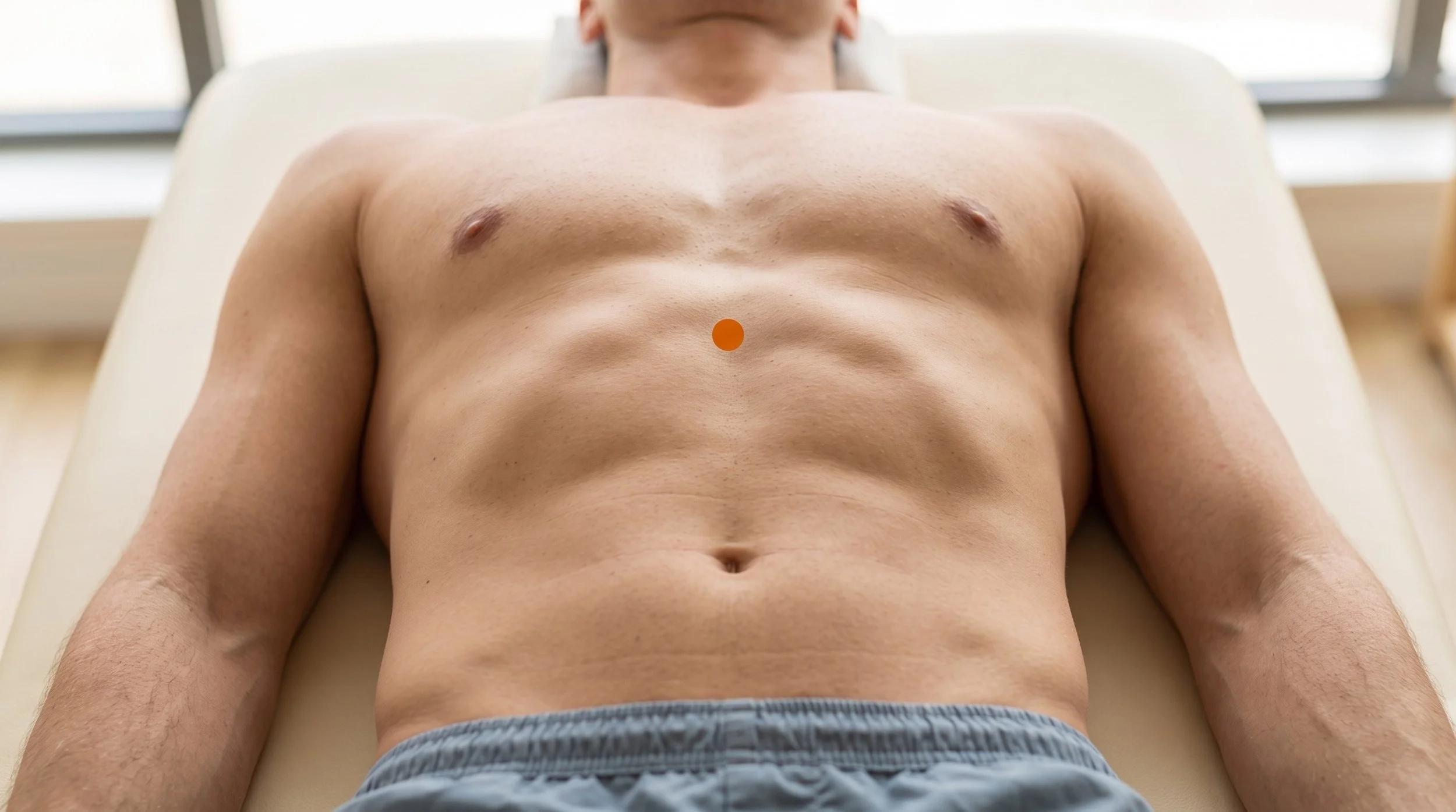
CV14 Acupuncture Point (Juque)
The Great Gateway Below the Breastbone: Anatomy, Mechanism, and Why the Heart's Front-Mu Point Sits Where Chest and Stomach Symptoms Overlap
CV14 (Juque, often translated as Great Gateway or Great Palace Gate), also written Ren 14, is the fourteenth point of the Conception Vessel and the front-mu (alarm) point of the Heart. You'll find it high on the abdominal midline, roughly 6 cun above the navel and about 2 cun below the sternocostal angle, in the soft hollow just under the breastbone where the ribs flare apart. That small patch of midline tissue sits at a busy anatomical crossroads: the diaphragm attaches just above it, the stomach and lower esophagus lie behind it, the left lobe of the liver is deeper still, and the heart sits above and behind the sternum.
Because sensation from all of those structures funnels into overlapping segments of the thoracic spinal cord, the CV14 acupuncture point is one of the places where chest symptoms, upper digestive symptoms, and the physical sensations of anxiety tend to be felt in the same square inch of skin, which is exactly why classical practitioners and modern clinicians keep coming back to it.
- Location and layers: CV14 sits on the linea alba just below the xiphoid, 6 cun above the umbilicus and 2 cun below the sternocostal angle. The needle passes through skin, a thin subcutaneous layer, and the interlacing aponeurosis of the abdominal wall, with the peritoneum, left lobe of the liver, diaphragm, and heart all lying deeper or higher, which is why depth and angle matter more here than at most points.
- Traditional category, translated: classical sources call CV14 the front-mu point of the Heart, described as the place where the Heart's qi gathers on the front of the body. In neurophysiological terms it's a segmentally relevant reflex zone for cardiac, esophageal, gastric, and diaphragmatic afferents rather than a literal reservoir of energy.
- Mechanism: needling here generates A-delta and C fiber input that recruits segmental spinal inhibition and descending pain-modulating pathways involving the periaqueductal gray and endogenous opioid systems (Zhao, 2008). Animal work also shows that where you stimulate matters, with abdominal stimulation engaging spinal sympathetic circuits in an intensity-dependent way (Liu et al., 2020).
- Autonomic effects: a meta-analysis of sham-controlled trials found measurable shifts in heart rate variability after real needling but not sham, consistent with a modest parasympathetic shift (Hamvas et al., 2023). That's the plausible bridge between a point under the sternum and the calmer breathing patients often report.
- Research picture: trials relevant to CV14's traditional territory include adjunctive acupuncture for chronic stable angina (Zhao et al., 2019), functional dyspepsia of the postprandial distress type (Yang et al., 2020), reflux symptoms (Zhu et al., 2017), and anxiety disorders (Yang et al., 2021). All of these tested multi-point protocols, so results describe treatments that may include CV14, not the point alone.
- De qi and practice framing: patients typically describe a dull, heavy fullness or a slow spreading ache under the breastbone, sometimes with a sense that the breath drops lower. We needle shallowly or obliquely downward, never angling up toward the heart, and any new, severe, or exertional chest pain goes to emergency evaluation first.
Chest Tightness and Epigastric Pressure That Keep Coming Back?
When the workup is clear but the squeeze under the breastbone isn't, we treat the tissue and the nervous system that keep producing the sensation. At Morningside Acupuncture, CV14 is often paired with points on the forearm and lower leg, with gentle diaphragm and upper abdominal wall work when the exam points there. Sessions are calm, precise, and built around what your breathing and abdominal palpation actually show. Schedule a visit and let's map where your symptom really lives.
Schedule NowAnatomy of CV14: Why the Hollow Below the Breastbone Is Such an Important Location
CV14 lies on the linea alba, the fibrous midline seam where the aponeuroses of the external oblique, internal oblique, and transversus abdominis from both sides interlace. Just above it the xiphoid process ends (in some people the xiphoid is long enough to reach the point itself), and the costal margins fan outward to form the sternocostal angle. The upper fibers of rectus abdominis sit immediately to either side, and the diaphragm anchors along the inner surface of the costal margin just overhead.
This is loaded tissue: sustained forward-flexed sitting, chronic bracing of the abdominal wall, breath-holding under stress, heavy coughing, and postsurgical guarding all leave the upper rectus and the costal attachments stiff and tender, and that tenderness is often what a clinician first meets when palpating here.
The skin and abdominal wall at CV14 are supplied mainly by the anterior cutaneous branch of the seventh intercostal nerve, placing the point around the T7 segment. That segmental address is the whole story. Afferents from the lower esophagus, stomach, and diaphragmatic periphery enter the cord in roughly the same mid-thoracic range, and cardiac afferents enter one to several segments above, which is why inferior wall cardiac events can present as epigastric pressure and why reflux can masquerade as chest pain.
Needling here delivers a well-localized barrage of small-fiber input into those shared dorsal horn segments, which may dampen the amplification of visceral signals and recruit descending inhibition through brainstem structures and endogenous opioid mechanisms (Zhao, 2008). Experimental work in mice adds an important nuance: stimulation at abdominal sites tends to recruit spinal sympathetic pathways, and the response depends on stimulation intensity, so dose and location shape the autonomic outcome (Liu et al., 2020).
Deep to the linea alba there's little cushion. The peritoneum lies close behind the aponeurosis, the left lobe of the liver sits beneath it, and the diaphragm, pericardium, and heart lie above and behind. The superior epigastric vessels run deeper and lateral within the rectus sheath. Standard needling conventions are therefore conservative: perpendicular insertion of about 0.5 to 1 cun, or oblique insertion angled inferiorly (away from the heart) of about 1 to 1.5 cun.
Deep insertion is avoided in thin patients and in anyone with a known enlarged liver or heart, and oblique insertion directed superiorly toward the heart is contraindicated in every case. Clinicians also avoid needling directly into a prominent xiphoid tip and keep depth modest in anyone with a history of abdominal surgery or a known hiatal hernia.
Related Conception Vessel Related Heart ChannelCV14 (Ren 14) at a Glance: Classification, Location, and Clinical Use
| Category | Detail |
|---|---|
| Traditional Name | Juque (Great Gateway, also translated Great Palace Gate) |
| Channel Classification | Conception Vessel (Ren Mai), point 14, on the anterior midline of the upper abdomen (CV14, also written REN14) |
| Point Categories | Front-mu (alarm) point of the Heart, described in classical sources as the place where Heart qi gathers on the front of the body. The reference sources list no five-shu, hui-meeting, or extraordinary vessel intersection roles for this point. |
| Precise Location | On the midline of the abdomen, 6 cun above the umbilicus and 2 cun below the sternocostal angle, in the depression just below the breastbone. In some people the xiphoid process extends down to this level. |
| Tissue Stimulated | Skin and subcutaneous tissue over the linea alba, the interlacing aponeuroses of the abdominal wall, with the upper rectus abdominis and diaphragm attachments immediately adjacent; innervation from the anterior cutaneous branch of the seventh intercostal nerve (about T7) |
| Needle Depth / Direction | Perpendicular 0.5 to 1 cun, or oblique inferiorly 1 to 1.5 cun. Never angle superiorly toward the heart. Shallow technique in thin patients and in anyone with hepatomegaly or cardiomegaly. |
| De Qi Sensation | A dull, heavy fullness or spreading ache under the breastbone, occasionally with a mild pulling toward the diaphragm and a sense of the breath dropping lower. Sharp or radiating sensation means the needle should be withdrawn and repositioned. |
| Primary Clinical Uses | Traditionally used for chest and epigastric pain, palpitations and agitation felt below the heart, anxiety, nausea, reflux and acid regurgitation, hiccups, diaphragmatic tightness, and poor memory in classical listings. Modern use focuses on chest wall and upper abdominal discomfort, functional dyspepsia, reflux symptoms, and the somatic component of anxiety, always alongside appropriate medical evaluation. |
| Common Point Combinations |
|
In the classical literature summarized by Deadman and colleagues, CV14 is presented first and foremost as the front-mu point of the Heart, a place where, according to the Essential Questions, the qi of an organ was said to collect on the front of the body.
Li Ting's Ming dynasty Introduction to Medicine credits the point with treating the so-called nine types of Heart pain, and the accumulated indications fall into three recognizable groups: chest and cardiac pain (including pain radiating to the back or the flanks, cough, and breathlessness), disturbances of the spirit (fright palpitations, agitation, poor memory, disorientation, and the raving and fury of what the texts call mania disorder), and upper digestive rebellion (nausea, vomiting, reflux, acid regurgitation, hiccups, and a blocked feeling at the diaphragm).
Traditional theory explained the spirit-related indications through phlegm clouding the Heart's portals or heat agitating the spirit, and the digestive indications through the downward-directing effect attributed to Conception Vessel points on the chest and abdomen. What's striking, read through a modern lens, is how precisely that classical triad maps onto a single mid-thoracic viscerosomatic zone, as though centuries of palpation had traced out a segmental convergence pattern without any way to name it.
Why CV14 Is Used for Anxiety That Patients Feel in the Chest and Stomach
Ask someone with anxiety where they feel it, and a surprising number will press a thumb into the hollow below the sternum. That's not a coincidence of language. The upper abdominal wall at CV14 shares spinal segments with the lower esophagus, stomach, and diaphragm, and sits just below the segments carrying cardiac sensation. When the autonomic nervous system is running hot, the diaphragm rides high, the upper abdominal wall braces, gastric motility changes, and all of that visceral and muscular traffic converges on the same dorsal horn neurons that also receive skin sensation from this exact spot.
Needling into that convergence zone gives the cord a strong, competing, non-threatening input, which may reduce the amplification of visceral signals and is the same segmental logic behind acupuncture analgesia more broadly (Zhao, 2008).
The second half of the story is efferent rather than afferent. A meta-analysis of randomized sham-controlled trials found significant changes in high-frequency power and the LF/HF ratio after genuine needling, with no equivalent change after sham, which the authors interpreted as a shift toward parasympathetic dominance (Hamvas et al., 2023). Preclinical work adds that these somato-autonomic reflexes are organized by body region and stimulation intensity, with abdominal sites recruiting different circuits than hindlimb sites (Liu et al., 2020).
Practically, that means CV14 is best understood as one input into an autonomic system, usually paired with distal points, rather than as a switch for calm.
Clinically, this shows up as easier breathing, less epigastric gripping, and a subjective drop in chest tension during and after treatment. Reviews of acupuncture for anxiety disorders suggest modest benefit over control conditions, though the trials are heterogeneous and many are of limited methodological quality (Yang et al., 2021). We treat that as reason for cautious optimism, not certainty, and we're explicit that acupuncture supports rather than replaces psychotherapy, medication, or cardiology follow-up when those are indicated.
What the Research Shows for CV14 (Ren 14)
One note on naming before the evidence: in the research literature this point is almost always listed as CV14, the WHO standard code, while many textbooks and Chinese sources write Ren 14 or RN14, so it is worth searching those as well if you want to read the studies below in full.
No clinical trial has ever isolated CV14 by itself, and that's worth stating plainly. The studies below tested multi-point protocols in conditions that overlap with this point's traditional territory: angina, functional dyspepsia, reflux, and anxiety. CV14 or its immediate neighbors appear in many of these prescriptions, but the results describe whole treatments, not single points, and several reviews flag substantial risk of bias in the underlying trials. Read this as evidence that needling protocols targeting the chest and upper abdomen may help, with the specific contribution of any one point still unresolved.
| Study | Type | Focus | Key Finding |
|---|---|---|---|
| Zhao et al., 2019 | Multicenter randomized clinical trial (404 participants) | Acupuncture as an adjunct to standard antianginal therapy in mild to moderate chronic stable angina | Adjunctive needling on the disease-affected meridian reduced angina attack frequency more than off-meridian needling, sham, or waitlist over 16 weeks, and was administered safely. |
| Yang et al., 2020 | Multicenter randomized sham-controlled trial (278 participants) | Acupuncture for postprandial distress syndrome, the fullness-predominant subtype of functional dyspepsia | Acupuncture produced higher response and symptom elimination rates than sham, with benefits that appeared to persist through 12 weeks of follow-up. |
| Zhu et al., 2017 | Systematic review and meta-analysis (12 trials, 1235 patients) | Manual acupuncture or electroacupuncture for gastro-oesophageal reflux disease | Adding acupuncture to conventional medication was associated with better global symptom improvement, though the authors cautioned that small samples and weak methodology limit confidence. |
| Yang et al., 2021 | Systematic review and meta-analysis (20 randomized trials) | Acupuncture for anxiety disorder | Pooled results favored acupuncture over control conditions for anxiety symptoms with few adverse effects, but heterogeneity and trial quality temper the conclusion. |
| Hamvas et al., 2023 | Systematic review and meta-analysis (9 randomized trials) | Effect of manual acupuncture on heart rate variability compared with placebo needling | Significant pre-to-post changes in high-frequency and LF/HF measures occurred in the real acupuncture groups but not in sham groups, suggesting a parasympathetic shift. |
| Liu et al., 2020 | Preclinical mechanistic study in mice | Somatotopic and intensity-dependent recruitment of autonomic pathways by electroacupuncture | Abdominal and hindlimb stimulation drove distinct sympathetic and vagal circuits depending on site and intensity, supporting body-region specificity of somato-autonomic reflexes. |
| Zhao, 2008 | Narrative review of mechanism research | Neural pathways underlying acupuncture analgesia | Needle stimulation activates small-diameter afferents that engage segmental inhibition and descending opioid-mediated modulation, the framework used to explain local points like CV14. |
Anxiety You Feel in Your Chest and Stomach, Not Just Your Head?
Plenty of our patients describe anxiety as a physical knot right where CV14 sits, with shallow breathing, a fluttery chest, and a stomach that won't settle. We use this point alongside distal calming points and breath retraining to shift autonomic tone rather than chasing symptoms one at a time. Research on acupuncture for anxiety is encouraging but not definitive, so we track your response session by session. Book an appointment and we'll build a plan around your specific pattern.
Schedule NowCV14 in the Context of Trigger Point Work
Acupuncture, by our definition, is the use of an acupuncture needle, and that includes dry needling. At CV14 the two frameworks land in nearly the same tissue. Trigger points in the upper portion of rectus abdominis are described as referring pain horizontally across the mid-back and producing epigastric symptoms that can imitate heartburn, indigestion, and nausea (Simons et al., 1999).
When a patient's chest and upper abdominal complaints have been medically cleared and palpation reproduces the symptom in the upper rectus or along the costal margin, the myofascial contribution deserves direct attention rather than being treated as an afterthought.
In practice we palpate the midline first, then work laterally along the costal margin into the upper rectus, the oblique attachments, and the accessible portions of the diaphragm insertion. Needling at CV14 itself stays shallow or angled inferiorly, while adjacent muscular targets are needled tangentially and never perpendicular to the abdominal wall at depth.
Many patients get the most relief from a combination approach: a light needle at CV14 for the segmental and autonomic effect, targeted release of the diaphragm and abdominal oblique attachments for the mechanical component, and breath retraining so the pattern doesn't simply reload between visits.
CV14 Chest and Digestive Symptom Treatment at NYC's Highest-Rated Acupuncture Clinic
Morningside Acupuncture is the highest-rated acupuncture and dry needling clinic in New York City with over 500 five-star Google reviews, and our practitioners are trained in both classical point theory and modern orthopedic needling. That combination matters at CV14, where safe technique, careful palpation, and knowing when to refer out are as important as point selection. We'll coordinate with your physician when chest or upper GI symptoms need medical management alongside care. Schedule your visit at our Upper West Side clinic today.
Schedule NowFrequently Asked Questions
Is CV14 the same point as Ren 14?
Yes. CV14 and Ren 14 are two codes for the same point, Juque. CV stands for Conception Vessel and is the WHO standard abbreviation, the one you will see in most research papers. Ren comes from Ren Mai, the Chinese name of the vessel, and it is the form used in many textbooks and acupuncture schools. You will also come across it written as REN-14, RN14, or Conception Vessel 14. Whichever code is used, the location and the uses are the same.
What does CV14 feel like when needled?
Most people describe a dull, heavy fullness or a slowly spreading ache right under the breastbone, sometimes with a subtle pulling sensation toward the diaphragm and a feeling that the breath sits lower in the body. Because the needle is kept shallow or angled downward, the sensation is usually mild rather than intense. Sharp, radiating, or pulsing sensation isn't the goal, and it means the needle should be withdrawn and redirected. Some patients also feel a wave of relaxation or a gurgle in the stomach, which is a common autonomic response to needling in this region.
Why needle the abdomen for a symptom I feel in my chest?
Because the nervous system doesn't respect anatomical boundaries the way we imagine it does. Sensation from the heart, esophagus, stomach, and diaphragm converges onto overlapping segments of the thoracic spinal cord, and the skin at CV14 reports to that same neighborhood through the seventh intercostal nerve. This is the same convergence that makes a cardiac event feel like indigestion for some people. Needling into a shared segment gives the cord competing input that may reduce how loudly visceral signals are broadcast (Zhao, 2008), which is why a point on the upper abdomen can influence sensations felt higher in the chest.
Can I press CV14 myself between sessions?
Yes, with a light touch. Sit or lie down, find the soft hollow on the midline about two finger widths below the point where your ribs meet at the base of the breastbone, and use the pad of your thumb or two fingertips. Press in gently, only to the point of mild pressure rather than pain, and hold for 30 to 60 seconds while you exhale slowly. Repeat two or three times, and you can do this once or twice a day. Small circular motions are fine. Skip it entirely if you're pregnant, have had recent abdominal or cardiac surgery, feel a pulsation under your fingers, or have any new chest pain that hasn't been evaluated. Acupressure here is meant to be a calming, breath-focused habit, not deep tissue work.
Is CV14 safe to needle?
It's safe in trained hands, and it demands respect. The classical cautions are explicit and still clinically correct: deep insertion, particularly in thin patients or anyone with an enlarged liver or heart, risks injuring those organs, and oblique insertion angled upward toward the heart is contraindicated without exception. Practitioners therefore use perpendicular insertion of about 0.5 to 1 cun or oblique inferior insertion of 1 to 1.5 cun, and modify further based on body habitus. We also screen carefully: any new, severe, exertional, or radiating chest pain needs emergency medical evaluation before acupuncture is even considered, and acupuncture is never a substitute for cardiac workup.
Where exactly is CV14 located?
On the anterior midline of the upper abdomen, 6 cun above the umbilicus and 2 cun below the sternocostal angle, the V-shaped notch where the two costal margins meet at the bottom of the breastbone. A practical way to find it is to locate the tip of the sternum, then move about two thumb widths straight down along the midline into the soft depression. Keep in mind that the umbilicus-to-sternocostal-angle distance is 8 cun, so CV14 sits at three-quarters of the way up that line. Anatomical variation matters here: in some people the xiphoid process is long enough to reach this level, in which case the practitioner adjusts the needling site and angle accordingly.
References
- Deadman, P., Al-Khafaji, M., & Baker, K. (2009). A manual of acupuncture. Journal of Chinese Medicine Publications.
- Cunningham, P. M. (2000). Acupuncture points: A practical guide to classical and modern usage. Odyssey Press.
- Simons, D. G., Travell, J. G., & Simons, L. S. (1999). Travell & Simons' myofascial pain and dysfunction: The trigger point manual, Vol. 1: Upper half of body (2nd ed.). Williams & Wilkins.
- Zhao, L., Li, D., Zheng, H., Chang, X., Cui, J., Wang, R., Shi, J., Fan, H., Li, Y., Sun, X., Zhang, F., Wu, X., & Liang, F. (2019). Acupuncture as adjunctive therapy for chronic stable angina: A randomized clinical trial. JAMA Internal Medicine, 179(10), 1388-1397. https://doi.org/10.1001/jamainternmed.2019.2407
- Yang, J. W., Wang, L. Q., Zou, X., Yan, S. Y., Wang, Y., Zhao, J. J., Tu, J. F., Wang, J., Shi, G. X., Hu, H., Zhou, W., Du, Y., & Liu, C. Z. (2020). Effect of acupuncture for postprandial distress syndrome: A randomized clinical trial. Annals of Internal Medicine, 172(12), 777-785. https://doi.org/10.7326/M19-2880
- Zhu, J., Guo, Y., Liu, S., Su, X., Li, Y., Yang, Y., Hou, L., Wang, G., Zhang, J., Chen, J. D. Z., Wang, Q., Wei, R., & Wei, W. (2017). Acupuncture for the treatment of gastro-oesophageal reflux disease: A systematic review and meta-analysis. Acupuncture in Medicine, 35(5), 316-323. https://doi.org/10.1136/acupmed-2016-011205
- Yang, X. Y., Yang, N. B., Huang, F. F., Ren, S., & Li, Z. J. (2021). Effectiveness of acupuncture on anxiety disorder: A systematic review and meta-analysis of randomised controlled trials. Annals of General Psychiatry, 20, 9. https://doi.org/10.1186/s12991-021-00327-5
- Hamvas, S., Hegyi, P., Kiss, S., Lohner, S., McQueen, D., & Havasi, M. (2023). Acupuncture increases parasympathetic tone, modulating HRV: Systematic review and meta-analysis. Complementary Therapies in Medicine, 72, 102905. https://doi.org/10.1016/j.ctim.2022.102905
- Liu, S., Wang, Z. F., Su, Y. S., Ray, R. S., Jing, X. H., Wang, Y. Q., & Ma, Q. (2020). Somatotopic organization and intensity dependence in driving distinct NPY-expressing sympathetic pathways by electroacupuncture. Neuron, 108(3), 436-450. https://doi.org/10.1016/j.neuron.2020.07.015
- Zhao, Z. Q. (2008). Neural mechanism underlying acupuncture analgesia. Progress in Neurobiology, 85(4), 355-375. https://doi.org/10.1016/j.pneurobio.2008.05.004
Disclaimer: This web site is intended for educational and informational purposes only. Reading this website does not constitute providing medical advice or any professional services. This information should not be used for diagnosing or treating any health issue or disease. Those seeking medical advice should consult with a licensed physician. Seek the advice of a medical doctor or other qualified health professional for any medical condition. If you think you have a medical emergency, call 911 or go to the emergency room. No acupuncturist-patient relationship is created by reading this website or using the information. Morningside Acupuncture PLLC and its employees and contributors do not make any express or implied representations with respect to the information on this site or its use. For any legal interpretation of scope of practice in your state, consult a licensed attorney or regulatory authority.
Read more from our blog



