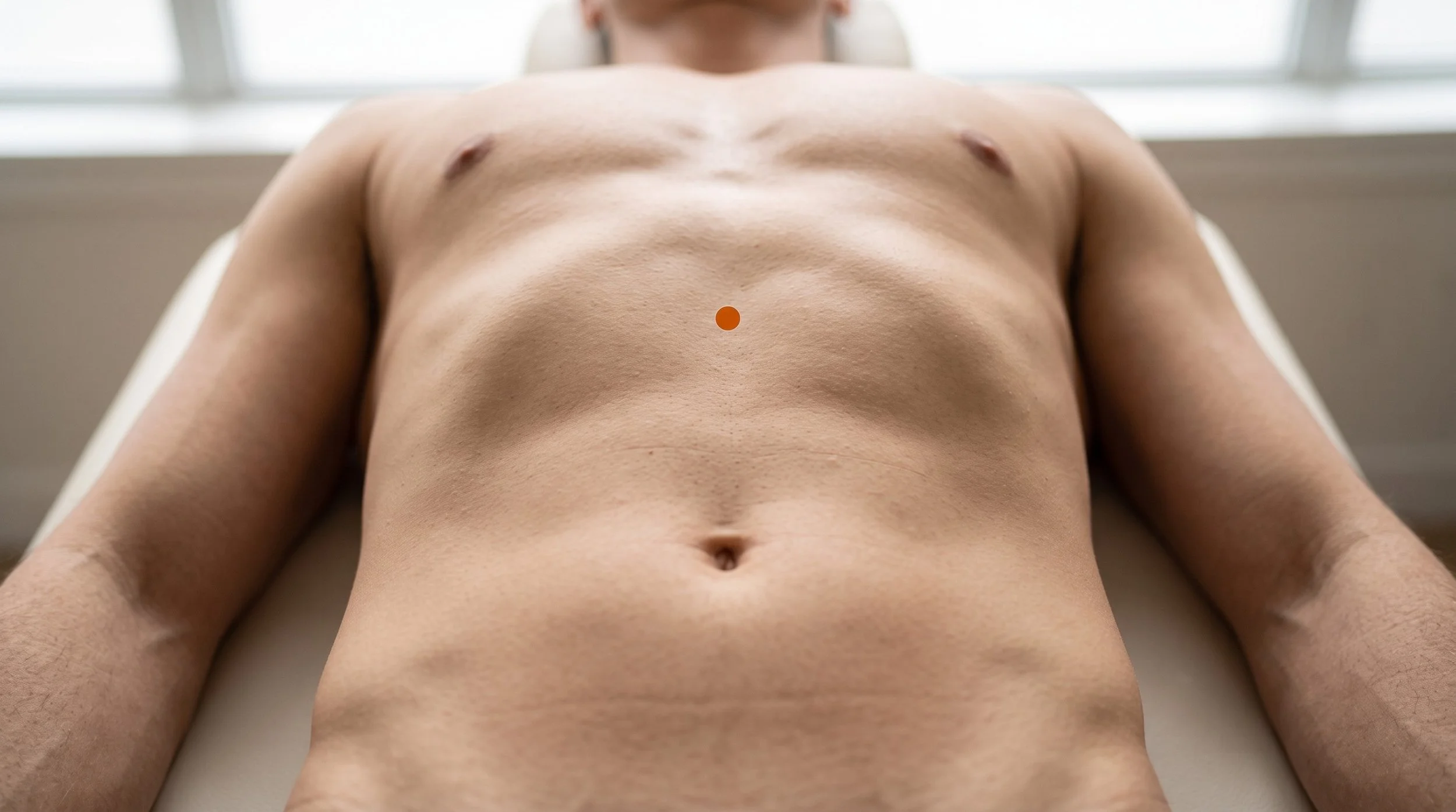
CV13 Acupuncture Point (Shangwan)
The Upper Cavity Point on the Midline: Anatomy, Autonomic Mechanism, and Why This Epigastric Point Anchors Treatment for Nausea, Reflux, and Upper Belly Tension
CV13 (Shangwan, often translated as Upper Cavity or Upper Stomach), also written Ren 13, sits on the midline of the upper abdomen, 5 cun above the navel and 3 cun below the point where the ribcage arches apart at the sternocostal angle. It is the highest of the three classical "cavity" points that map the stomach onto the belly wall: CV10 for the lower portion, CV12 for the middle, and the CV13 acupuncture point for the upper stomach, roughly where the esophagus enters and food first arrives.
Classical texts also list it as a meeting point of the Conception vessel with the Stomach and Small Intestine channels, which is why its traditional indications reach beyond digestion into agitation and discomfort felt behind the breastbone. In modern terms, conception vessel 13 is a segmentally matched point: the skin and fascia here share spinal cord levels with the stomach itself, which gives needling at this location a plausible route into gastric and autonomic regulation rather than a purely local effect.
- Location and layers: CV13 lies on the linea alba, the tough fibrous seam where the two rectus sheaths meet, 5 cun above the umbilicus and 3 cun below the sternocostal angle. The needle passes through skin, subcutaneous fat, and that aponeurotic seam, with the upper stomach and the left lobe of the liver lying deep to it (Deadman et al., 2009).
- Traditional categories, translated: classical sources credit CV13 with harmonizing the stomach, descending rebellious qi, and settling the heart region (Deadman et al., 2009). Read neurophysiologically, those three actions describe modulation of gastric motility and tone, reduction of upper abdominal visceral hypersensitivity, and a shift in autonomic balance that patients often experience as calmer breathing and a looser upper belly.
- Mechanism: abdominal points that sit over the stomach's own segments behave differently from points on the limbs. In animal recordings, stimulation at homosegmental abdominal sites tended to inhibit gastric motility through sympathetic (splanchnic) pathways, while limb points produced facilitation through vagal pathways (Li et al., 2007), and mapping work in mice and humans supports this regional split (Dong et al., 2025).
- Research picture: reviews of acupuncture for functional dyspepsia and reflux report symptom and quality of life improvements but rate the underlying trials as small and methodologically limited (Lan et al., 2014; Zhu et al., 2017), while mechanistic reviews describe measurable effects on gastric accommodation, slow wave rhythm, and vagal tone (Guo et al., 2020).
- Clinical framing: CV13 is rarely used alone. In practice it joins a middle burner group (commonly CV12, ST36, and PC6) and is chosen when symptoms sit high, closer to the sternum than the navel, with the classical CV13 combinations for epigastric pain and fullness still shaping modern prescriptions (Deadman et al., 2009; Maciocia, 2005).
- De qi and dosing: the sensation at Ren 13 abdomen is usually a slow, dull spreading heaviness under the sternum rather than a sharp ache, sometimes with audible gurgling as the abdomen relaxes. Needling is perpendicular at 0.8 to 1.5 cun, and shallower in thin patients, since deep insertion here may reach the peritoneal cavity (Deadman et al., 2009).
Nausea, Reflux, or Fullness After Every Meal?
Upper abdominal symptoms rarely respond to a single point, so we treat CV13 as one anchor inside a full middle burner strategy that usually includes CV12, PC6, and ST36. Your acupuncturist palpates the epigastrium first, since tenderness, guarding, and pulsation at this level change both point choice and needle depth. Many patients notice the belly wall soften within a session or two, even before symptom scores move. Schedule an evaluation at Morningside Acupuncture and let's map what your upper abdomen is actually doing.
Schedule NowAnatomy of CV13: Why the Linea Alba Above the Stomach Is Such an Important Location
CV13 sits on the linea alba, the fibrous midline seam where the aponeuroses of the abdominal muscles interlace between the two rectus abdominis bellies. From the surface inward, a needle at this point crosses skin, a variable layer of subcutaneous fat, and that dense collagenous seam before reaching the preperitoneal space. What loads this tissue is not lifting or reaching but breathing and posture: sustained flexed sitting, bracing, chronic cough, and habitual shallow breathing all keep the upper abdominal wall and the diaphragmatic attachments short.
Patients with long standing reflux or dyspepsia frequently present with a rigid, tender epigastrium that resists gentle pressure, and that palpable guarding is part of what the point is chosen to address (Deadman et al., 2009).
The nerve geography is the reason CV13 matters clinically. Skin and fascia here are supplied by the anterior cutaneous branches of the lower thoracic intercostal nerves, roughly the T7 and T8 levels, and the stomach sends its own spinal afferents into approximately the same T5 to T9 segments through the greater splanchnic nerve. Somatic and visceral inputs therefore converge on shared dorsal horn neurons, which explains both referred epigastric tenderness in gastric conditions and the possibility of influencing gastric activity by stimulating the overlying wall.
Needle stimulation strong enough to recruit small diameter A-delta and C fibers is what drives these somato-autonomic reflexes, and it also engages the descending inhibitory systems and endogenous opioid mechanisms described in the acupuncture analgesia literature (Zhao, 2008; Li et al., 2007).
Deep to the point lie structures that dictate technique. The upper portion of the stomach sits behind this part of the wall, and in many people the left lobe of the liver extends far enough to the left of midline to be encountered at depth. Standard practice is perpendicular insertion of 0.8 to 1.5 cun, with the important caveat that in thin patients deep needling may penetrate the peritoneal cavity, so depth is reduced accordingly (Deadman et al., 2009).
Practically, this means the clinician assesses body habitus and abdominal tone before inserting, uses a shallower angle and depth in lean patients, avoids the point over recent surgical scars or hernias, and never needles it aggressively in someone with unexplained upper abdominal pain that has not been medically evaluated.
Related Conception Vessel Related Stomach ChannelCV13 (Ren 13) at a Glance: Classification, Location, and Clinical Use
| Category | Detail |
|---|---|
| Traditional Name | Shangwan (Upper Cavity, also rendered Upper Stomach or Upper Epigastrium); an older alternate name is Shangguan, the Upper Controller |
| Channel Classification | Conception Vessel (Ren Mai), point 13, on the anterior midline of the upper abdomen (CV13, also written REN13) |
| Point Categories | Meeting (crossing) point of the Conception vessel with the Stomach and Small Intestine channels; traditionally assigned to the upper cavity of the stomach, paired conceptually with CV12 (middle) and CV10 (lower). No five-shu, front-mu, or hui-meeting designation. |
| Precise Location | On the anterior midline of the abdomen, 5 cun above the umbilicus and 3 cun below the sternocostal angle (the umbilicus to sternocostal angle distance is measured as 8 cun) |
| Tissue Stimulated | Skin and subcutaneous fascia over the linea alba, the aponeurotic seam formed by the rectus sheaths, with the medial fibers of rectus abdominis and the abdominal obliques adjacent; the upper stomach and left lobe of the liver lie deep |
| Needle Depth / Direction | Perpendicular insertion 0.8 to 1.5 cun, reduced in thin patients because deep needling may reach the peritoneal cavity; moxibustion and gentle retained needling are also common |
| De Qi Sensation | A dull, spreading heaviness or fullness under the sternum, sometimes with a warm sinking feeling or audible gurgling as the abdomen relaxes; sharp or stabbing sensation is not expected and should prompt adjustment |
| Primary Clinical Uses | Nausea, vomiting, and reflux felt high in the epigastrium; epigastric pain, distention, and fullness; poor appetite and early satiety; upper abdominal tension associated with stress; classically also listed for agitation and heat sensations below the heart |
| Common Point Combinations |
|
In the Deadman, Al-Khafaji, and Baker point manual, CV13 is presented as the upper of three points that classical writers mapped onto the stomach organ itself, with CV12 assigned to its middle and CV10 to its lower portion. The Spiritual Pivot is quoted there as distinguishing treatment by location: when the obstruction sits in the upper cavity, needle CV13 to restrain the upward surge and send it down, and when it sits lower, use CV10 to disperse and move.
Traditional actions listed for the point are harmonizing the stomach and regulating qi, descending rebellion to stop vomiting, and regulating the heart, with indications that group into rebellious stomach qi (nausea, vomiting, difficult swallowing, reflux, and in deficiency-taxation contexts vomiting of blood) and stagnation in the epigastrium (pain, distention, fullness, and palpable masses).
The heart region indications follow from the point's status as a crossing point with the Stomach and Small Intestine channels, both of which were described as connecting internally with the heart, although the same text notes that CV14 is the more common modern choice for those complaints. What makes the classical pattern striking is how precisely anatomical it is: physicians without imaging still divided the stomach into three zones and matched the needle to the zone where the trouble was felt.
Why CV13 Is Used for Nausea, Reflux, and the Anxious Knot Below the Ribs
The most useful way to understand CV13 is convergence. The skin, fascia, and muscle of the upper abdominal wall are supplied by the lower thoracic spinal nerves, and the stomach sends visceral afferents into overlapping segments of the same spinal cord levels. Those two streams of information meet on shared neurons in the dorsal horn. That is why an irritated stomach can make the belly wall above it tender and guarded, and it is also why stimulating the wall can feed back into the reflex circuits that set gastric tone.
Needling here is essentially working the somatic side of a shared circuit, which is a very different proposition from needling a point on the leg (Li et al., 2007; Zhao, 2008).
That segmental relationship also predicts what the point tends to do. In experimental recordings, acupuncture-like stimulation at abdominal sites that share segments with the stomach produced inhibitory gastric responses mediated through sympathetic splanchnic pathways, while stimulation at limb points produced facilitation that depended on intact vagal pathways (Li et al., 2007). Later mapping work in mice and humans reinforced that the somatosensory to vagal gastric reflex is driven from the limbs rather than from the abdomen (Dong et al., 2025).
Clinically this fits the classical description of a point used to quiet upward surging rather than to stimulate: CV13 is chosen when the stomach feels overactive, tight, and refluxing, and it is usually paired with a limb point when more motility is also needed.
Beyond the segmental story, needling recruits the descending inhibitory systems that reduce the perceived intensity of visceral discomfort, involving brainstem pathways and endogenous opioid signaling (Zhao, 2008). Reviews of acupuncture in functional dyspepsia also describe changes in gastric accommodation, gastric slow wave rhythm, and heart rate variability measures of vagal tone, which offers a plausible account for why patients often report a general easing of upper abdominal tension rather than relief of one isolated symptom (Guo et al., 2020). None of this makes CV13 a stand-alone treatment, but it does explain why a point over the stomach behaves consistently across patients.
What the Research Shows for CV13 (Ren 13)
One note on naming before the evidence: in the research literature this point is almost always listed as CV13, the WHO standard code, while many textbooks and Chinese sources write Ren 13 or RN13, so it is worth searching those as well if you want to read the studies below in full.
There is no trial that isolates CV13. Like nearly all point-level questions, the evidence comes from studies of multi-point protocols for conditions where this point commonly appears, mostly functional dyspepsia and reflux, plus animal work on how abdominal stimulation changes gastric activity.
Reviews in this area consistently report positive signals alongside serious caveats about small samples, blinding difficulty, and trial quality, so the honest reading is that acupuncture may help upper digestive symptoms for some patients and that CV13's specific contribution within those protocols has not been separately tested.
| Study | Type | Focus | Key Finding |
|---|---|---|---|
| Lan et al., 2014 | Cochrane systematic review | Manual acupuncture and electroacupuncture for functional dyspepsia | The review found some evidence of improved quality of life compared with sham, but rated the trials as low quality and concluded that robust conclusions could not yet be drawn. |
| Zhu et al., 2017 | Systematic review and meta-analysis | Acupuncture for gastro-oesophageal reflux disease | Pooled results suggested benefit and a lower recurrence rate than medication alone, though the authors cautioned that small samples and poor methodological quality limit confidence. |
| Guo et al., 2020 | Systematic review of clinical and mechanistic studies | Effects and mechanisms of acupuncture and electroacupuncture in functional dyspepsia | The review described plausible mechanisms including improved gastric accommodation and motility and shifts in autonomic balance, while noting variability across protocols. |
| Li et al., 2007 | Animal neurophysiology study | Segmental basis of acupuncture effects on gastric motility | Stimulation at abdominal points sharing segments with the stomach tended to inhibit gastric motility via sympathetic pathways, while limb points facilitated motility via vagal pathways. |
| Dong et al., 2025 | Basic science study in mice and humans | Neuroanatomical organization of electroacupuncture effects on gastric function | The work supports a regional organization in which vagal gastric reflexes are driven from limb points rather than abdominal points, consistent with the segmental model. |
| Vickers et al., 2018 | Individual patient data meta-analysis | Acupuncture for chronic pain across multiple conditions | Effects were modest but persistent over time compared with sham and usual care, which supports acupuncture as a reasonable option within a broader plan. |
Stress That Lands In Your Stomach Instead of Your Shoulders?
Some people carry tension in the neck, and some carry it in a tight band under the ribs that turns into appetite loss, queasiness, or a knot that appears an hour before a meeting. CV13 was traditionally used for exactly this overlap of digestive and agitated presentations, and we pair it with distal points that support autonomic downshifting. Sessions are unhurried, with time spent breathing while the needles are retained. Book a visit and we'll build a plan around how your symptoms actually behave.
Schedule NowCV13 in the Context of Trigger Point Work
Acupuncture is defined by the tool, an acupuncture needle, and it covers hundreds of styles including dry needling. At Morningside that means a session built around CV13 can move fluidly between classical point selection and myofascial assessment. Trigger points in the upper rectus abdominis and in the oblique attachments along the lower ribs can produce symptoms patients describe in digestive language: burning under the sternum, queasiness, bloating, and a band of pressure across the upper belly (Simons et al., 1999). When palpation over those bands reproduces the complaint, the muscle is at least part of the picture, and treating it changes what the patient feels.
In practice we palpate the epigastrium and costal margin first, then decide. If the abdominal wall is taut and reproducing symptoms, superficial dry needling of rectus abdominis and the obliques is added to the midline point, always with shallow, controlled technique given the underlying viscera. If the wall is soft but the patient reports reflux and early fullness, CV13 is used as a retained midline point alongside distal choices such as PC6 and ST36.
Diaphragm-focused breathing work and, when relevant, thoracic mobility work are usually part of the same plan, since a stiff upper abdomen and a poorly moving diaphragm tend to travel together.
CV13 Digestive Treatment at NYC's Highest-Rated Acupuncture Clinic
Morningside Acupuncture is the highest-rated acupuncture and dry needling clinic in New York City with over 500 five-star Google reviews, and digestive complaints are among the most common reasons patients come to us alongside pain. We combine classical point selection like the Shangwan digestion point with modern trigger point work on the abdominal wall when the muscles themselves are contributing. Every plan is explained in plain language, with realistic timelines and no open-ended packages. Schedule your first session and start with a thorough intake.
Schedule NowFrequently Asked Questions
Is CV13 the same point as Ren 13?
Yes. CV13 and Ren 13 are two codes for the same point, Shangwan. CV stands for Conception Vessel and is the WHO standard abbreviation, the one you will see in most research papers. Ren comes from Ren Mai, the Chinese name of the vessel, and it is the form used in many textbooks and acupuncture schools. You will also come across it written as REN-13, RN13, or Conception Vessel 13. Whichever code is used, the location and the uses are the same.
What does CV13 feel like when needled?
Most people feel a slow, dull heaviness or a spreading fullness just under the breastbone, sometimes with a warm sinking sensation as the abdominal wall softens. Gurgling in the belly during retention is common and generally a good sign. The sensation should not be sharp, electric, or breath-catching; if it is, the needle depth or angle needs adjusting. Because the point sits over sensitive viscera, clinicians typically use gentler stimulation here than at limb points.
Why needle the belly directly instead of using points on the arms and legs?
Because the two do different things. Points over the stomach share spinal segments with the organ, so they act through local convergence and largely sympathetic reflex pathways, which tends to quiet an overactive, refluxing stomach (Li et al., 2007). Limb points such as PC6 and ST36 drive vagal reflexes and tend to support motility (Dong et al., 2025). Good treatment usually uses both, and the classical CV13 combinations do exactly that by pairing this midline point with points on the forearm and lower leg.
Can I press CV13 myself between sessions?
Yes, with a light touch and never on a full stomach or after a large meal. Find the midline about halfway between the navel and the bottom of the breastbone, slightly closer to the sternum, then rest two or three fingertips flat on the spot. Use gentle, sustained pressure with slow diaphragmatic breathing rather than digging in, holding for 60 to 90 seconds and repeating two or three times, up to a couple of times a day. Stop immediately if pressure produces sharp pain, pulsation, or nausea that worsens, and skip this entirely if you have unexplained abdominal pain, a known aneurysm, hernia, recent abdominal surgery, or are pregnant.
Is CV13 safe to needle?
In trained hands, yes. The main caution is depth: the upper stomach and often the left lobe of the liver lie beneath this point, and in thin patients deep insertion may enter the peritoneal cavity, so depth is kept conservative and matched to body habitus (Deadman et al., 2009). Practitioners avoid the point over hernias, recent surgical scars, or areas of unexplained tenderness, and any new or severe upper abdominal pain, vomiting of blood, unintended weight loss, or difficulty swallowing warrants medical evaluation before acupuncture is considered.
Where exactly is CV13 located?
On the anterior midline of the abdomen, 5 cun above the umbilicus and 3 cun below the sternocostal angle, the notch where the two rib margins meet below the breastbone. The full distance from navel to sternocostal angle is measured as 8 cun, so CV13 sits about five eighths of the way up that line. That places it above CV12 (4 cun above the navel) and below CV14. For self-orientation, slide a finger up the midline from the navel until you are roughly two finger widths below the bottom tip of the sternum.
References
- Deadman, P., Al-Khafaji, M., & Baker, K. (2009). A manual of acupuncture. Journal of Chinese Medicine Publications.
- Maciocia, G. (2005). The foundations of Chinese medicine: A comprehensive text for acupuncturists and herbalists (2nd ed.). Elsevier Churchill Livingstone.
- Simons, D. G., Travell, J. G., & Simons, L. S. (1999). Travell & Simons' myofascial pain and dysfunction: The trigger point manual, Vol. 1: Upper half of body (2nd ed.). Williams & Wilkins.
- Lan, L., Zeng, F., Liu, G. J., Ying, L., Wu, X., Liu, M., & Liang, F. R. (2014). Acupuncture for functional dyspepsia. Cochrane Database of Systematic Reviews, 2014(10), CD008487. https://doi.org/10.1002/14651858.CD008487.pub2
- Zhu, J., Guo, Y., Liu, S., Su, X., Li, Y., Yang, Y., Hou, L., Wang, G., Zhang, J., Chen, J. D. Z., Wang, Q., Wei, R., & Wei, W. (2017). Acupuncture for the treatment of gastro-oesophageal reflux disease: A systematic review and meta-analysis. Acupuncture in Medicine, 35(5), 316-323. https://doi.org/10.1136/acupmed-2016-011205
- Guo, Y., Wei, W., & Chen, J. D. Z. (2020). Effects and mechanisms of acupuncture and electroacupuncture for functional dyspepsia: A systematic review. World Journal of Gastroenterology, 26(19), 2440-2457. https://doi.org/10.3748/wjg.v26.i19.2440
- Li, Y. Q., Zhu, B., Rong, P. J., Ben, H., & Li, Y. H. (2007). Neural mechanism of acupuncture-modulated gastric motility. World Journal of Gastroenterology, 13(5), 709-716. https://doi.org/10.3748/wjg.v13.i5.709
- Dong, S., Zhao, L., Liu, J., Sha, X., Wu, Y., Liu, W., Sun, J., Su, Y., Zhuang, Z., Chen, J., Dong, Y., Xie, B., Zhou, A., Ji, H., Wang, Y., Deng, X., Jing, X., Ma, Q., Wang, N., & Liu, S. (2025). Neuroanatomical organization of electroacupuncture in modulating gastric function in mice and humans. Neuron, 113(19), 3243-3259.e11. https://doi.org/10.1016/j.neuron.2025.06.023
- Zhao, Z. Q. (2008). Neural mechanism underlying acupuncture analgesia. Progress in Neurobiology, 85(4), 355-375. https://doi.org/10.1016/j.pneurobio.2008.05.004
- Vickers, A. J., Vertosick, E. A., Lewith, G., MacPherson, H., Foster, N. E., Sherman, K. J., Irnich, D., Witt, C. M., & Linde, K. (2018). Acupuncture for chronic pain: Update of an individual patient data meta-analysis. Journal of Pain, 19(5), 455-474. https://doi.org/10.1016/j.jpain.2017.11.005
Disclaimer: This web site is intended for educational and informational purposes only. Reading this website does not constitute providing medical advice or any professional services. This information should not be used for diagnosing or treating any health issue or disease. Those seeking medical advice should consult with a licensed physician. Seek the advice of a medical doctor or other qualified health professional for any medical condition. If you think you have a medical emergency, call 911 or go to the emergency room. No acupuncturist-patient relationship is created by reading this website or using the information. Morningside Acupuncture PLLC and its employees and contributors do not make any express or implied representations with respect to the information on this site or its use. For any legal interpretation of scope of practice in your state, consult a licensed attorney or regulatory authority.
Read more from our blog



