PC7 Acupuncture Point (Daling)
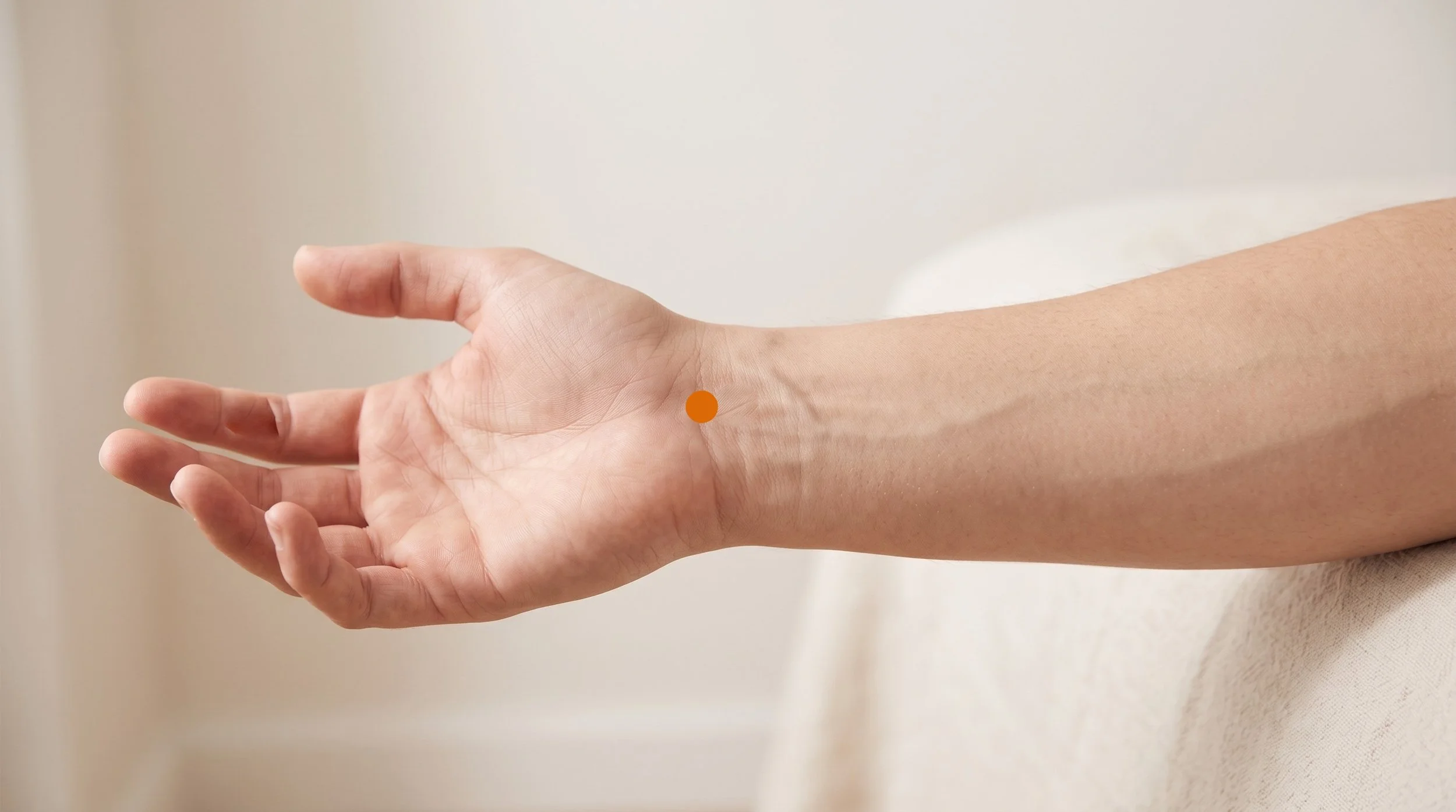
PC7 Acupuncture Point
The Great Mound at the Center of the Wrist Crease: Anatomy, Median Nerve Mechanism, and Why PC7 Sits at the Crossroads of Carpal Tunnel and Calming Treatment
PC7, called Daling in pinyin and usually translated as Great Mound, sits at the middle of the front of the wrist, in the small hollow between the two tendons that stand up when you cup your hand and flex the wrist. In classical texts it's the shu-stream, yuan-source and earth point of the Pericardium channel, and it also appears among Sun Si-miao's ghost points (Deadman et al., 2001).
What makes the pc7 acupuncture point clinically interesting is that this single spot sits directly over the roof of the carpal tunnel with the median nerve immediately beneath it, which means the classical wrist and chest indications and the modern use of Daling for carpal tunnel pattern symptoms are really the same anatomy described in two different vocabularies.
- Location and layers: PC7 lies at the middle of the anterior wrist crease between the palmaris longus and flexor carpi radialis tendons, level with HT7, and because the crease itself is variable, the tendon landmarks and the pisiform reference are more reliable than the skin line (Deadman et al., 2001).
- Traditional categories, read neurophysiologically: pericardium 7 is classified as shu-stream, yuan-source and earth point, and in the five phase logic of the Classic of Difficulties, the earth point of a fire channel was used to drain excess from that channel (Deadman et al., 2001). In modern terms, this is a heavily innervated distal wrist site with dense access to median nerve afferents.
- The nerve story: the median nerve runs directly deep to this point, so needling can produce a distinct electric sensation into the fingers. Peripheral neuromodulation at the wrist appears to change more than local tissue, since real acupuncture at the affected wrist improved median nerve conduction and somatosensory cortical finger representation compared with sham in carpal tunnel syndrome (Maeda et al., 2017).
- The research picture is mixed rather than settled: a Cochrane review found the trials small and at unclear or high risk of bias, with no serious adverse events reported (Choi et al., 2018), while later reviews suggest acupuncture may help symptom severity and function without high certainty (Wu et al., 2020; Dong et al., 2023).
- Clinical framing: at Morningside we rarely use the pc 7 wrist point alone. It's typically combined with forearm and hand needling, nerve gliding, load management and, when indicated, dry needling of the forearm flexors (Simons et al., 1999), inside a broader pain modulation model (Vickers et al., 2018).
- De qi at PC7 is usually a heavy, slightly aching fullness spreading across the wrist crease into the palm. A sharp zing into the thumb, index or middle finger means the needle is contacting the median nerve directly, and the correct response is to withdraw and reposition rather than stimulate further (Deadman et al., 2001).
Wrist Pain, Numbness or Tingling in Your Fingers?
Median nerve irritation at the wrist rarely responds to one thing alone. At Morningside Acupuncture we combine careful needling at PC7 and the surrounding wrist points with dry needling of the forearm flexors, nerve glides and specific advice on keyboard, mouse and phone loading. If your hand wakes you at night or your grip feels unreliable, that pattern is worth a proper assessment. Schedule a visit and we'll build a plan around your wrist, not a template.
Schedule NowAnatomy of PC7: Why the Carpal Tunnel Roof Is Such an Important Location
Put your palm up and gently cup your hand while flexing the wrist, and you'll usually see two tendons rise at the center of the wrist: palmaris longus (present in most but not all people) and, just to its thumb side, flexor carpi radialis. PC7 sits in the groove between them at the middle of the anterior wrist crease, level with HT7 (Deadman et al., 2001). Under the skin here there's very little padding. The needle passes through thin dermis and superficial fascia into the space bounded by those tendons, directly above the flexor retinaculum that forms the roof of the carpal tunnel.
This region is loaded by everything that repeatedly flexes the wrist and fingers: typing, mousing, phone scrolling, lifting a baby, gripping a bike handlebar, holding a bow or a chef's knife. Sustained wrist flexion and extension both raise pressure inside the tunnel, which is why symptoms so often show up at night and after long desk days.
The clinically decisive structure is the median nerve, which lies immediately deep to this point as it enters the carpal tunnel (Deadman et al., 2001). That proximity explains both the point's usefulness and the caution it demands. Needling here delivers input into a segmental field around C7 to T1, and afferent traffic from that field converges in the dorsal horn with input from the hand and forearm, which is one of the accepted routes by which needling modulates pain signaling.
Broader work on acupuncture analgesia describes activation of A-delta and group III afferents recruiting spinal and supraspinal inhibitory pathways, including descending control from the periaqueductal gray and rostral ventromedial medulla, with endogenous opioid and monoamine involvement (Zhao, 2008).
In carpal tunnel syndrome specifically, imaging work found that real acupuncture, unlike sham, was associated with improved median nerve conduction and with changes in how the fingers are represented in primary somatosensory cortex, suggesting peripheral and central effects rather than a purely local one (Maeda et al., 2017), and brain response during electroacupuncture therapy has been linked to subsequent nerve and functional improvement (Fisher et al., 2021).
Deep and slightly to the thumb side of this region run the radial artery and its branches, and the median nerve itself sits within a millimeter or two of the needle path, so technique matters more here than at most distal points. Classical needling convention is a perpendicular insertion of roughly 0.3 to 0.5 cun, with an oblique insertion angled distally along the carpal tunnel of about 0.5 to 1 cun described for carpal tunnel presentations (Deadman et al., 2001).
A brief electric sensation into the fingers is considered an acceptable form of de qi in the classical literature, but once it appears, further manipulation isn't appropriate and can risk nerve irritation (Deadman et al., 2001).
In practice we use fine needles, gentle insertion, minimal manipulation, and we ask patients to tell us immediately if they feel anything sharp or electrical.
Related Palmaris Longus Trigger Points Related Flexor Carpi Radialis Trigger PointsPC7 at a Glance: Classification, Location, and Clinical Use
| Category | Detail |
|---|---|
| Traditional Name | Daling (Great Mound), P-7 in the Deadman numbering |
| Channel Classification | Pericardium channel (hand jueyin), seventh point of the channel |
| Point Categories | Shu-stream point, yuan-source point and earth point of the Pericardium channel; included among Sun Si-miao's thirteen ghost points under the alternative name Guixin; listed in the Spiritual Axis as the source point associated with the Heart |
| Precise Location | At the middle of the anterior wrist crease, in the depression between the tendons of palmaris longus and flexor carpi radialis, level with HT7 at the proximal border of the pisiform. If palmaris longus is absent, locate on the ulnar side of the flexor carpi radialis tendon. |
| Tissue Stimulated | Skin and superficial fascia over the flexor retinaculum, between the palmaris longus and flexor carpi radialis tendons, with the median nerve immediately deep and the carpal tunnel contents below |
| Needle Depth / Direction | Perpendicular 0.3 to 0.5 cun for general use; oblique distal insertion along the carpal tunnel 0.5 to 1 cun for median nerve territory symptoms. Fine gauge, slow insertion, minimal manipulation. |
| De Qi Sensation | A heavy, spreading ache or fullness across the wrist crease, sometimes radiating into the palm. A sharp electric sensation into the thumb, index or middle finger indicates median nerve contact and calls for immediate repositioning. |
| Primary Clinical Uses | Wrist pain and carpal tunnel pattern symptoms; palpitations and chest fullness in classical listings; agitation and emotional distress in classical listings; insomnia in classical listings |
| Common Point Combinations |
|
In the classical literature summarized by Deadman, Al-Khafaji and Baker, Daling is attributed with clearing heat from the Heart and calming the spirit, harmonizing the Stomach and intestines, unbinding the chest, and cooling the blood, and its indication list is unusually broad: palpitations and heart pain, insomnia, mania and epilepsy, agitation and fright, but also ceaseless laughter and weeping with grief, along with stomach pain, vomiting, foul breath, fevers with agitation, skin eruptions, throat problems, and locally wrist pain, contraction of the hand and heat in the palms (Deadman et al., 2001).
These are traditional attributions rather than physiological claims. The commentary explains the logic in five phase terms: as the earth point of a fire channel, PC7 was regarded as the child point used to drain excess, and because the Pericardium was understood as the wrapping of the Heart, points on this channel were assigned a strong influence on the spirit, so much so that the Spiritual Axis listed Daling rather than HT7 as the source point relating to the Heart (Deadman et al., 2001).
What's striking is that the same point was expected to treat both extremes of emotional disturbance, endless laughter and inconsolable sadness, which tells you the classical framework was thinking about regulation rather than sedation.
Why PC7 Is Used for Palpitations and Restlessness, Not Just Wrist Pain
Patients are often surprised that a wrist point shows up in treatments for anxiety, palpitations or poor sleep. The segmental explanation is straightforward: needling at PC7 feeds afferent input into spinal levels around C7 to T1, the same neighborhood that receives sympathetic and somatic traffic related to the upper limb and upper thorax. Input at one site converges with input from others in the dorsal horn, and repeated stimulation recruits inhibitory interneurons that turn down the gain on incoming signals (Zhao, 2008).
That's the mechanism behind distal point selection generally, and it's why a needle at the wrist can influence sensations experienced elsewhere in the same segmental territory.
The second layer is descending and autonomic. Needling reliably activates brainstem structures involved in descending pain inhibition and engages endogenous opioid and monoaminergic systems (Zhao, 2008), and the subjective experience for many people is a distinct settling: slower breathing, warmer hands, a drop in muscle guarding. This isn't unique to PC7, and we're careful not to overclaim.
What the evidence supports is that acupuncture, delivered as multi-point protocols, may modestly improve anxiety symptoms and sleep quality in reviews of randomized trials, though the trials vary in quality (Yang et al., 2021; Kim et al., 2021).
There's also a point-specific thread worth knowing. In carpal tunnel syndrome, needling at and around the wrist has been associated with improved median nerve conduction and with measurable reorganization of finger representation in the somatosensory cortex, effects not seen with sham needling at a distant site (Maeda et al., 2017), and the degree of brain response during electroacupuncture treatment predicted nerve and functional improvement (Fisher et al., 2021).
That's a concrete example of a wrist needle producing effects well upstream of the wrist, which is the same principle, tested with imaging, that the classical texts described in their own language.
What the Research Shows for PC7
A quick word on how to read the evidence. Almost no trial tests PC7 by itself. Studies test protocols, usually a handful of points at the wrist, forearm and hand, sometimes with electrical stimulation, compared against sham needling, splinting, medication or steroid injection. So the honest question isn't whether Daling works in isolation but whether protocols that include it may help, and how confident we can be. The answer for carpal tunnel is cautious optimism with real uncertainty, and for calming and sleep it's a modest signal from trials of variable quality.
| Study | Type | Focus | Key Finding |
|---|---|---|---|
| Choi et al., 2018 | Cochrane systematic review | Acupuncture and related interventions for carpal tunnel syndrome symptoms, 12 studies with 869 participants | The review found little or no evidence of a difference from placebo and could not determine whether acupuncture is better or worse than other treatments, with most studies small and at unclear or high risk of bias, and no serious adverse events reported. |
| Wu et al., 2020 | Systematic review of RCTs | Acupuncture and related therapies for primary carpal tunnel syndrome, 10 RCTs with 728 participants | Manual acupuncture showed greater symptom reduction than ibuprofen and prednisolone in the pooled comparisons, though most included trials were at high risk of bias for blinding. |
| Dong et al., 2023 | Systematic review and meta-analysis | Acupuncture for carpal tunnel syndrome, updated search through late 2022 | The authors concluded that acupuncture may benefit carpal tunnel symptoms while noting that the existing evidence base remains insufficient and reporting quality uneven. |
| Chung et al., 2016 | Randomized controlled trial | Electroacupuncture plus night splinting versus splinting alone in carpal tunnel syndrome | Adding electroacupuncture to splinting produced small additional short-term symptom improvements, with the authors cautious about clinical significance. |
| Maeda et al., 2017 | Randomized neuroimaging trial | Local and distal acupuncture versus sham in carpal tunnel syndrome, with nerve conduction and fMRI outcomes | All groups reported symptom improvement, but only real acupuncture was associated with improved median nerve conduction and with somatosensory cortex changes that tracked longer-term outcome. |
| Fisher et al., 2021 | Neuroimaging analysis of an acupuncture trial | Brain response during electroacupuncture in carpal tunnel syndrome | Connectivity involving primary somatosensory cortex during therapy was linked to subsequent median nerve and functional improvement, supporting a peripheral-to-central mechanism. |
| Kim et al., 2021 | Systematic review and meta-analysis | Acupuncture for insomnia, 24 randomized controlled trials | Pooled results suggested acupuncture may improve sleep quality scores relative to pharmacotherapy in the included trials, with methodological limitations noted. |
| Yang et al., 2021 | Systematic review and meta-analysis | Acupuncture for anxiety disorders | Acupuncture was associated with reductions in anxiety symptom scores compared with control conditions, though heterogeneity and blinding limitations temper the conclusion. |
| Vickers et al., 2018 | Individual patient data meta-analysis | Acupuncture across chronic pain conditions, roughly 20,000 patients | Acupuncture was better than both sham and no-acupuncture control for chronic pain, with effects persisting over time, supporting its use as a reasonable referral option. |
| Zhao, 2008 | Narrative mechanism review | Neural mechanisms of acupuncture analgesia | Describes segmental spinal inhibition and descending control with opioid and monoamine involvement as the leading explanation for needling analgesia. |
Feeling Wired, Restless or Unable to Settle at Night?
Daling has been used for centuries for palpitations, agitation and disturbed sleep, and modern practice still favors wrist points for their calming, autonomic effects. We use PC7 alongside HT7, PC6 and body points in quiet, low-stimulation treatments designed to downshift a nervous system that's stuck in high gear. Many patients notice the shift within the session itself. Book a session and let's see how your system responds.
Schedule NowPC7 in the Context of Trigger Point Work
Acupuncture, by our definition, is the use of an acupuncture needle, and that includes the hundreds of styles practiced worldwide as well as dry needling. In wrist and hand cases we treat PC7 as one node in a regional plan rather than a standalone prescription. The forearm flexors that cross the wrist are frequent contributors: palmaris longus, flexor carpi radialis, flexor carpi ulnaris, flexor digitorum and flexor pollicis longus can all harbor taut bands and trigger points that refer discomfort into the wrist and hand and that add tension to the structures crossing the carpal tunnel (Simons et al., 1999).
Needling those muscles in the proximal and mid forearm, then finishing with a light, precisely placed needle at the wrist crease, tends to be better tolerated than heavy stimulation at the wrist itself.
There's a practical overlap worth noting: the PC7 location sits right where the palmaris longus tendon and the flexor carpi radialis tendon frame the tunnel roof, so the point and the myofascial targets share a corridor. What differs is depth and intent. Trigger point needling aims into muscle belly to produce a local twitch response and reduce taut band tension, while needling at PC7 is deliberately shallow and gentle because of the median nerve directly below.
At Morningside we sequence the two, often adding wrist and finger nerve glides, grip loading and workstation changes, since the evidence for carpal tunnel care generally supports multimodal management rather than any single technique (Choi et al., 2018).
PC7 Carpal Tunnel and Wrist Pain Treatment at NYC's Highest-Rated Acupuncture Clinic
Morningside Acupuncture is the highest-rated acupuncture and dry needling clinic in New York City with over 500 five-star Google reviews, and wrist and hand complaints are among the most common problems we see in Manhattan office workers, musicians and new parents. Treatment blends acupuncture at PC7 and neighboring points with targeted dry needling, manual therapy and practical ergonomic changes. You'll leave with a clear sense of what's driving your symptoms and what to do between visits. Schedule your appointment today.
Schedule NowFrequently Asked Questions
What does PC7 feel like when needled?
Most people feel a brief prick at the skin, then a heavy, spreading ache or fullness at the wrist crease that may travel into the palm. That dull, expanding quality is the de qi sensation practitioners are aiming for. Because the median nerve lies directly beneath this point, some patients also feel a quick electric flick into the thumb, index or middle finger. Classical texts treat that as an acceptable arrival of sensation, but it's also a signal to stop manipulating and reposition the needle (Deadman et al., 2001). Tell your practitioner right away if you feel anything sharp or electrical, and it can be adjusted in seconds.
Why needle the wrist for symptoms in the hand and fingers?
Because the problem often isn't in the fingers. In carpal tunnel pattern symptoms, the median nerve is irritated where it passes under the flexor retinaculum at the wrist, and the numbness or tingling is simply that nerve's territory reporting the trouble downstream. Needling at the wrist puts input right at the site of irritation and into the segmental levels that serve the hand, which is thought to modulate signaling both spinally and through descending pathways (Zhao, 2008). Imaging work in carpal tunnel syndrome has also shown that wrist-focused acupuncture may be accompanied by improved median nerve conduction and changes in how the fingers are mapped in the brain (Maeda et al., 2017).
Can I press PC7 myself between sessions?
Yes, and it's a reasonable self-care option as long as you're gentle. Turn your palm up, cup your hand slightly so the two central wrist tendons pop up, and find the small hollow between them right at the wrist crease. Use the pad of your opposite thumb, not a fingernail or a hard tool, and apply light to moderate pressure for 30 to 60 seconds, breathing slowly. Small circular movements are fine. You can repeat two or three times per wrist, once or twice a day. Stop immediately if you get shooting, electric or numbing sensations into the fingers, since that means you're compressing the median nerve rather than the surrounding tissue. Acupressure here won't replace treatment for a genuine entrapment, but many people find it helps with wrist tightness and with feeling more settled.
Is PC7 safe to needle?
In trained hands, yes, with specific precautions. The median nerve lies immediately deep to the point and the radial artery runs nearby on the thumb side, so this location calls for accurate landmarking, shallow perpendicular insertion of roughly 0.3 to 0.5 cun, and restrained manipulation (Deadman et al., 2001). For carpal tunnel presentations, an oblique distally angled insertion along the tunnel is described. Reported adverse events in acupuncture trials for carpal tunnel have been minor, mainly local pain and bruising, with no serious events documented (Choi et al., 2018). Tell your practitioner if you're on anticoagulants, have had wrist surgery, or have a known nerve injury, and always report electric sensations as they happen.
Where exactly is PC7 located?
At the middle of the anterior wrist crease, in the depression between the tendons of palmaris longus and flexor carpi radialis, level with HT7 (Deadman et al., 2001). To find it, rest your forearm palm up, cup the hand and flex the wrist slightly so the two tendons stand out at the center of the wrist; PC7 sits between them. Because the visible wrist crease varies from person to person, practitioners often use the proximal border of the pisiform bone on the little finger side as the more reliable horizontal reference. Roughly one in seven people lack a palmaris longus tendon, and in that case the point is located just on the little finger side of the flexor carpi radialis tendon (Deadman et al., 2001).
References
- Deadman, P., Al-Khafaji, M., & Baker, K. (2009). A manual of acupuncture. Journal of Chinese Medicine Publications.
- Simons, D. G., Travell, J. G., & Simons, L. S. (1999). Travell & Simons' myofascial pain and dysfunction: The trigger point manual, Vol. 1: Upper half of body (2nd ed.). Williams & Wilkins.
- Choi, G. H., Wieland, L. S., Lee, H., Sim, H., Lee, M. S., & Shin, B. C. (2018). Acupuncture and related interventions for the treatment of symptoms associated with carpal tunnel syndrome. Cochrane Database of Systematic Reviews, 12(12), CD011215. https://doi.org/10.1002/14651858.CD011215.pub2
- Maeda, Y., Kim, H., Kettner, N., Kim, J., Cina, S., Malatesta, C., Gerber, J., McManus, C., Ong-Sutherland, R., Mezzacappa, P., Libby, A., Mawla, I., Morse, L. R., Kaptchuk, T. J., Audette, J., & Napadow, V. (2017). Rewiring the primary somatosensory cortex in carpal tunnel syndrome with acupuncture. Brain, 140(4), 914-927. https://doi.org/10.1093/brain/awx015
- Fisher, H., Sclocco, R., Maeda, Y., Kim, J., Malatesta, C., Gerber, J., Audette, J., Kettner, N., & Napadow, V. (2021). S1 brain connectivity in carpal tunnel syndrome underlies median nerve and functional improvement following electro-acupuncture. Frontiers in Neurology, 12, 754670. https://doi.org/10.3389/fneur.2021.754670
- Wu, I. X. Y., Lam, V. C. K., Ho, R. S. T., Cheung, W. K. W., Sit, R. W. S., Chou, L. W., Zhang, Y., Leung, T. H., & Chung, V. C. H. (2020). Acupuncture and related interventions for carpal tunnel syndrome: Systematic review. Clinical Rehabilitation, 34(1), 34-44. https://doi.org/10.1177/0269215519877511 [VERIFY BEFORE PUBLISHING]
- Dong, Q., Li, X., Yuan, P., Chen, G., Li, J., Deng, J., Wu, F., Yang, Y., Fu, H., & Jin, R. (2023). Acupuncture for carpal tunnel syndrome: A systematic review and meta-analysis of randomized controlled trials. Frontiers in Neuroscience, 17, 1097455. https://doi.org/10.3389/fnins.2023.1097455
- Chung, V. C. H., Ho, R. S. T., Liu, S., Chong, M. K. C., Leung, A. W. N., Yip, B. H. K., Griffiths, S. M., Zee, B. C. Y., Wu, J. C. Y., Sit, R. W. S., Lau, A. Y. L., & Wong, S. Y. S. (2016). Electroacupuncture and splinting versus splinting alone to treat carpal tunnel syndrome: A randomized controlled trial. CMAJ, 188(12), 867-875. https://doi.org/10.1503/cmaj.151003
- Kim, S. A., Lee, S. H., Kim, J. H., van den Noort, M., Bosch, P., Won, T., Yeo, S., & Lim, S. (2021). Efficacy of acupuncture for insomnia: A systematic review and meta-analysis. The American Journal of Chinese Medicine, 49(5), 1135-1150. https://doi.org/10.1142/S0192415X21500543
- Yang, X. Y., Yang, N. B., Huang, F. F., Ren, S., & Li, Z. J. (2021). Effectiveness of acupuncture on anxiety disorder: A systematic review and meta-analysis of randomised controlled trials. Annals of General Psychiatry, 20(1), 9. https://doi.org/10.1186/s12991-021-00327-5
- Zhao, Z. Q. (2008). Neural mechanism underlying acupuncture analgesia. Progress in Neurobiology, 85(4), 355-375. https://doi.org/10.1016/j.pneurobio.2008.05.004
- Vickers, A. J., Vertosick, E. A., Lewith, G., MacPherson, H., Foster, N. E., Sherman, K. J., Irnich, D., Witt, C. M., & Linde, K. (2018). Acupuncture for chronic pain: Update of an individual patient data meta-analysis. Journal of Pain, 19(5), 455-474. https://doi.org/10.1016/j.jpain.2017.11.005
Disclaimer: This web site is intended for educational and informational purposes only. Reading this website does not constitute providing medical advice or any professional services. This information should not be used for diagnosing or treating any health issue or disease. Those seeking medical advice should consult with a licensed physician. Seek the advice of a medical doctor or other qualified health professional for any medical condition. If you think you have a medical emergency, call 911 or go to the emergency room. No acupuncturist-patient relationship is created by reading this website or using the information. Morningside Acupuncture PLLC and its employees and contributors do not make any express or implied representations with respect to the information on this site or its use. For any legal interpretation of scope of practice in your state, consult a licensed attorney or regulatory authority.
Read more from our blog