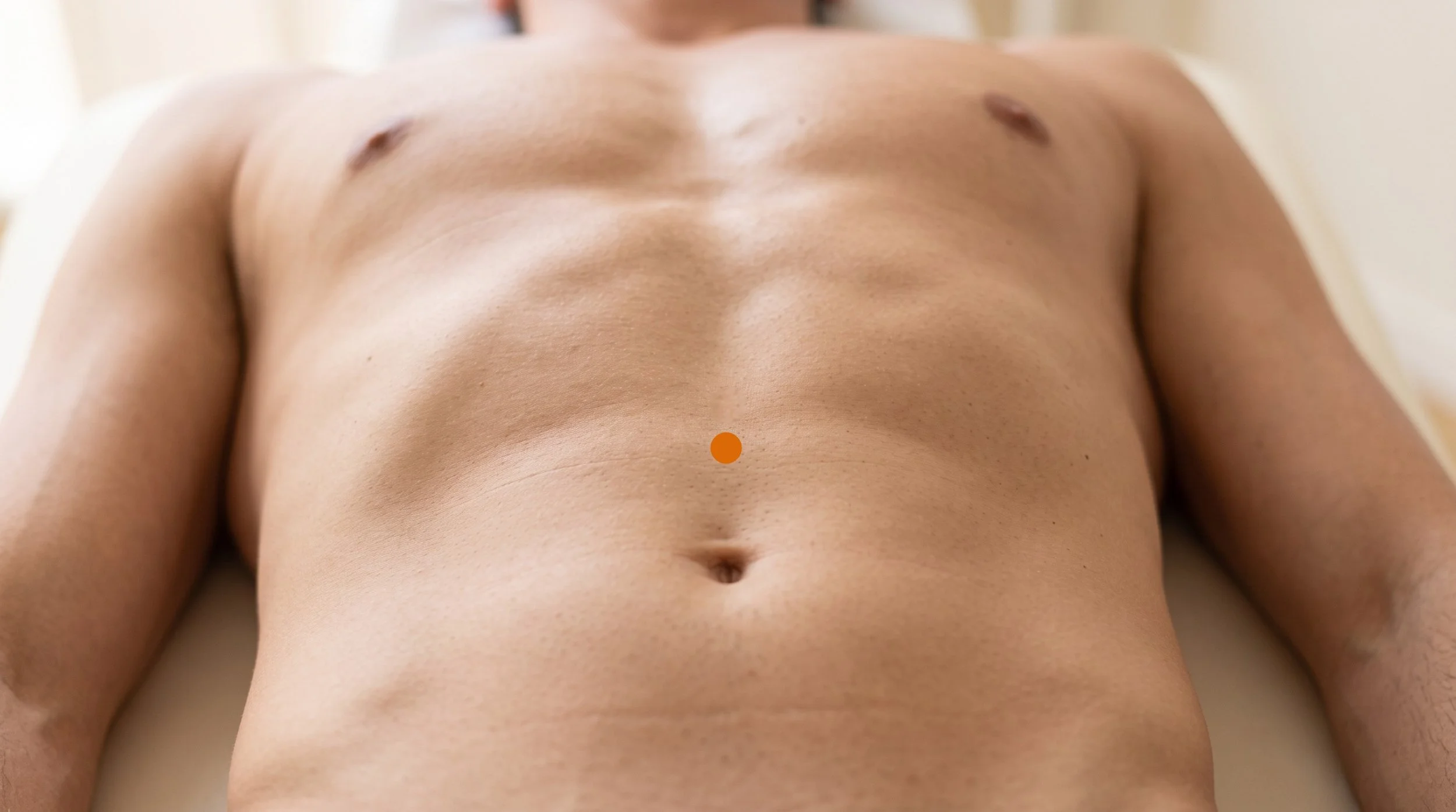
CV10 Acupuncture Point (Xiawan)
The Lower Cavity Point Two Inches Above the Navel: Anatomy, Segmental Gut Reflexes, and Why CV10 Anchors Treatment for Bloating, Nausea, and Sluggish Digestion
CV10 (also written Ren 10), called Xiawan in Chinese and usually translated as Lower Cavity or Lower Stomach, sits on the midline of the abdomen two cun above the umbilicus and six cun below the sternocostal angle. In plain terms, that is roughly two finger widths above the belly button, right on the vertical seam of connective tissue that runs down the front of the belly.
The CV10 acupuncture point matters clinically because it lies directly over the lower part of the stomach and the transverse colon, in the same spinal segments that carry sensation from those organs, which is why conception vessel 10 shows up again and again in treatment plans for fullness after meals, nausea, gurgling, and the heavy, stuck feeling that patients describe as food just sitting there.
- Location and layers: CV10 is a midline point over the linea alba, so a needle passes through skin, subcutaneous fat, and the interwoven aponeuroses of the abdominal wall muscles before reaching the deeper fascial planes; the lower stomach and transverse colon lie beneath, which is why depth is kept modest (Deadman et al., 2009).
- Traditional categories translated: classical texts describe CV10 as a meeting point of the Conception vessel with the Spleen channel that harmonizes the stomach, regulates qi, and disperses food stagnation (Deadman et al., 2009). Read neurophysiologically, those descriptions map onto a somatic point that can shift autonomic outflow to the upper gut.
- Mechanism: needling the abdominal wall stimulates thoracoabdominal nerve branches that share spinal segments with visceral afferents from the stomach, and stimulation of abdominal skin and muscle can reflexively change gastric motor activity through sympathetic and vagal pathways (Uchida et al., 2017; Li et al., 2007).
- Research picture: reviews of acupuncture for functional dyspepsia and irritable bowel syndrome report modest and uncertain benefits with generally low quality evidence, and protocols almost always combine several abdominal and limb points rather than testing CV10 alone (Lan et al., 2014; Manheimer et al., 2012; Guo et al., 2020).
- Clinical framing: at Morningside we treat CV10 as a local regulator rather than a standalone fix, pairing it with distal points and, when the abdominal wall itself is guarded, with careful dry needling of the surrounding muscles (Simons et al., 1999).
- De qi at CV10 is usually a slow, spreading heaviness or dull distension around the needle rather than a sharp sensation, and some patients notice audible gurgling or a warm sinking feeling within a minute or two of insertion.
Bloated, Nauseated, or Full Hours After Eating?
Persistent fullness, early satiety, and post-meal nausea are among the most common digestive complaints we see, and CV10 is one of the abdominal points we reach for most often. Our acupuncturists assess the abdominal wall, breathing pattern, and meal timing before deciding how CV10 fits into your plan, then combine it with distal points such as ST36 and PC6. Treatment is gentle, shallow, and adjusted to your body type. Schedule a visit and let's map out what is driving the symptoms.
Schedule NowAnatomy of CV10: Why the Midline Two Cun Above the Navel Is Such an Important Location
CV10 sits on the linea alba, the tough vertical seam where the flat sheets of the external oblique, internal oblique, and transversus abdominis meet in the middle of the belly. From the surface down, a needle at this point encounters skin, a variable layer of subcutaneous fat, then that dense aponeurotic seam, and then the deeper fascial planes of the abdominal wall. This region is loaded constantly: it takes tension from breathing, from bracing during lifting and core work, from coughing, and from the postural habits that come with long hours at a desk.
In patients who guard their abdomen after gastrointestinal illness, surgery, or prolonged stress, the tissue here often feels tight and tender to light pressure, which is part of what makes the Ren 10 abdomen area clinically informative on palpation.
The nerve geography is what gives CV10 its reach. The skin and muscle at this level are supplied by anterior cutaneous branches of the lower thoracoabdominal (intercostal) nerves, which enter the spinal cord in the same general segments that receive visceral afferents from the stomach and upper intestine traveling with the splanchnic nerves.
Because somatic and visceral inputs converge on shared dorsal horn neurons, stimulating the abdominal wall can modulate reflex outflow to the gut, and experimental work shows that somatic stimulation over the abdomen changes gastric motor activity through sympathetic and vagal efferents (Uchida et al., 2017; Li et al., 2007). Needling also recruits the broader antinociceptive machinery of the nervous system, including descending inhibitory pathways that dampen how strongly the cord relays incoming signals (Zhao, 2008), which may explain why local abdominal tenderness often eases within the same session.
Deep to CV10 lie the peritoneum and, depending on body habitus and how recently a patient has eaten, the lower stomach, the transverse colon, and nearby vasculature branching from the superior epigastric supply just off midline. Standard practice is perpendicular insertion of about 0.8 to 1.5 cun, with the shallow end of that range used in thin patients because deep needling here may penetrate the peritoneal cavity (Deadman et al., 2009).
Practical conventions matter: we needle with the abdomen relaxed and the knees supported, avoid the point over hernias, surgical scars, or organ enlargement, and adjust depth for body type rather than following a fixed number. Classical sources also record a caution for moxibustion here in pregnancy, and modern clinical practice extends similar conservatism to needling the abdomen during pregnancy.
Related Conception Vessel Related Stomach ChannelCV10 (Ren 10) at a Glance: Classification, Location, and Clinical Use
| Category | Detail |
|---|---|
| Traditional Name | Xiawan (Lower Cavity, also translated Lower Stomach); an older alternate name is Xiaguan, the Lower Controller |
| Channel Classification | Conception Vessel (Ren mai), point 10, on the anterior midline of the abdomen; see the Conception Vessel overview (CV10, also written REN10) |
| Point Categories | Meeting point of the Conception vessel with the Spleen channel; traditionally grouped with CV13 (Upper Cavity) and CV12 (Middle Cavity) as the three points governing the upper, middle, and lower portions of the stomach |
| Precise Location | On the anterior midline of the abdomen, 2 cun above the umbilicus and 6 cun below the sternocostal angle |
| Tissue Stimulated | Skin and subcutaneous fat over the linea alba, where the aponeuroses of the transverse abdominis and the external abdominal oblique converge, innervated by anterior cutaneous branches of the lower thoracoabdominal nerves |
| Needle Depth / Direction | Perpendicular insertion 0.8 to 1.5 cun, using the shallower range in thin patients; depth adjusted to body habitus, with the peritoneal cavity as the structure to respect |
| De Qi Sensation | A slow, spreading heaviness or dull distension around the needle, sometimes with warmth, a sinking feeling, or audible gurgling; sharp or radiating pain is not expected and means the needle should be adjusted |
| Primary Clinical Uses | Food stagnation with abdominal fullness and epigastric pain, nausea and vomiting after eating, poor appetite, borborygmus, and (in classical listings) undigested food in the stool |
| Common Point Combinations |
|
Deadman's A Manual of Acupuncture presents Xiawan as one of three midline points that classical authors assigned to different parts of the stomach: CV13 to the upper portion, CV12 to the middle, and CV10 to the lower, near the outlet. The Spiritual Pivot is cited as directing practitioners to needle the upper point when the obstruction sits high, restraining and descending what has rebelled upward, and to needle CV10 when the problem sits low, in order to scatter and move what has lodged there.
Later texts add that this point was favored when the stomach was described as cold, and the Systematic Classic names it a principal choice when food and drink are not digested and come back up after eating. Modern texts echo the same picture, describing CV10 as the point that traditionally influences the passage of food out of the stomach (Cunningham, 2000). These are traditional attributions rather than physiological claims, but what is striking is how precisely the classical authors localized the concept: not simply the stomach, but a specific portion of it, matched to a specific spot on the midline.
Why CV10 Is Used for Bloating That Shows Up Hours After a Meal
Patients often describe a very specific pattern: the first few bites feel fine, then an hour or two later the abdomen feels tight, heavy, and full, sometimes with nausea or gurgling. That pattern points to how the stomach and upper intestine are emptying and how sensitive the gut has become to normal distension. CV10 is positioned directly over that territory, and the nerves supplying the abdominal wall there enter the spinal cord alongside afferents coming from the stomach and transverse colon.
When somatic and visceral inputs converge on the same dorsal horn neurons, a needle in the abdominal wall becomes a way to nudge the reflex circuits that set gastric tone, and experimental work confirms that stimulating the abdomen changes gastric motor activity through autonomic pathways (Uchida et al., 2017; Li et al., 2007).
The direction of that change is not one-way. Animal studies show that stimulation at abdominal points and stimulation at limb points can produce different, sometimes opposite, effects on gastric motility, with abdominal stimulation tending to act through segmental sympathetic reflexes and limb points recruiting vagal pathways (Li et al., 2007).
One line of research on the neighboring midline point CV12 found that electroacupuncture there inhibited gastric contractions and that the effect depended on TRPV1 signaling, evidence that specific receptor mechanisms in the tissue underlie what practitioners feel as a local, calming response (Yu et al., 2013). That is one reason clinicians rarely use an abdominal point alone: combining the Xiawan digestion point with a distal point such as ST36 gives access to both arms of the reflex.
There is also a pain component. Many people with chronic bloating develop a tender, guarded abdominal wall, and the discomfort they report blends visceral sensation with musculoskeletal sensitivity. Needling recruits descending inhibitory systems and endogenous opioid mechanisms that reduce how strongly incoming signals are amplified (Zhao, 2008), which may account for the softening of abdominal tenderness that often shows up before any change in bowel habits does.
Acupuncture may reduce these symptoms for some patients, but it works best alongside sensible meal timing, and any new or severe abdominal pain needs medical evaluation first.
What the Research Shows for CV10 (Ren 10)
One note on naming before the evidence: in the research literature this point is almost always listed as CV10, the WHO standard code, while many textbooks and Chinese sources write Ren 10 or RN10, so it is worth searching those as well if you want to read the studies below in full.
It is worth being clear about what the research can and cannot tell us. No high-quality trial has isolated CV10 by itself; instead, reviews evaluate multi-point protocols for conditions such as functional dyspepsia and irritable bowel syndrome, in which CV10 often appears alongside CV12, ST25, ST36, and PC6. That means the evidence below speaks to acupuncture as a package of care, and CV10's contribution is inferred from anatomy, mechanism studies at nearby abdominal points, and clinical experience rather than measured directly. Blinding is also difficult in this field, sham comparisons are inconsistent, and several reviews rate the overall certainty as low.
| Study | Type | Focus | Key Finding |
|---|---|---|---|
| Lan et al., 2014 | Cochrane systematic review | Manual acupuncture and electroacupuncture for functional dyspepsia | The review found some improvement in symptoms and quality of life but judged the evidence too limited and methodologically weak to support firm conclusions. |
| Manheimer et al., 2012 | Cochrane systematic review | Acupuncture for irritable bowel syndrome | Acupuncture was not clearly superior to sham in most comparisons, though it performed better than some pharmacological comparators in trials at higher risk of bias. |
| Guo et al., 2020 | Systematic review of effects and mechanisms | Acupuncture and electroacupuncture for functional dyspepsia | The authors report symptom benefits across trials and link them to changes in gastric accommodation, motility, and autonomic balance, while noting variable trial quality. |
| Yu et al., 2013 | Experimental animal study | Electroacupuncture at the adjacent midline point CV12 and gastric motility | Stimulation at CV12 inhibited gastric contractions in a manner dependent on TRPV1 signaling, suggesting a defined receptor-level mechanism for abdominal points. |
| Li et al., 2007 | Experimental physiological study | Neural pathways behind acupuncture modulation of gastric motility | Effects on gastric motility differed by point location, with abdominal stimulation acting largely through segmental sympathetic reflexes and limb stimulation through vagal pathways. |
| Uchida et al., 2017 | Narrative review of somatoautonomic physiology | Reflex control of visceral function by somatic stimulation | The review summarizes how skin and muscle stimulation reaches autonomic efferents, while cautioning that findings in anesthetized animals may not transfer directly to patients. |
Looking for Acupuncture That Takes Your Gut Symptoms Seriously?
We spend the first visit sorting out patterns: what triggers the fullness, whether stress is amplifying it, and how your abdominal wall responds to light pressure. CV10 and its neighbors along the Conception vessel give us a direct, low-risk way to influence the upper gut, and we track your response session by session. Most patients get a clear sense of whether acupuncture is helping within a handful of visits. Book an appointment to get started.
Schedule NowCV10 in the Context of Trigger Point Work
Acupuncture, as we define it, is the use of an acupuncture needle, and that includes the hundreds of styles practiced worldwide as well as dry needling. At Morningside, CV10 frequently sits in a treatment alongside dry needling of the abdominal wall muscles, particularly the rectus abdominis, the external and internal obliques, and the transversus abdominis. That matters because trigger points in the abdominal musculature can produce pain, bloating sensations, nausea, and referred discomfort that closely mimic visceral complaints (Simons et al., 1999).
Sorting out how much of a patient's fullness is coming from the gut and how much from a guarded, overworked abdominal wall changes the treatment plan.
In practice, we palpate the region around CV10 before needling. If the midline seam and the muscle bellies to either side feel taut and reproduce the patient's symptoms under pressure, we combine the midline point with shallow, carefully angled needling of the involved muscles, always respecting depth and body habitus. Patients recovering from abdominal surgery, from prolonged bracing during heavy training, or from chronic coughing tend to fall into this category. When the abdominal wall settles, the visceral symptoms often become easier to read and easier to treat with points like CV10, CV12, and ST36.
CV10 Digestion Treatment at NYC's Highest-Rated Acupuncture Clinic
Morningside Acupuncture is the highest-rated acupuncture and dry needling clinic in New York City with over 500 five-star Google reviews, and our licensed acupuncturists use points like CV10 as part of structured, evidence-informed treatment plans. We combine classical point selection with modern pain science and trigger point work, so digestive complaints and abdominal wall tension are addressed together. Sessions are calm, clean, and clearly explained from start to finish. Schedule your appointment today.
Schedule NowFrequently Asked Questions
Is CV10 the same point as Ren 10?
Yes. CV10 and Ren 10 are two codes for the same point, Xiawan. CV stands for Conception Vessel and is the WHO standard abbreviation, the one you will see in most research papers. Ren comes from Ren Mai, the Chinese name of the vessel, and it is the form used in many textbooks and acupuncture schools. You will also come across it written as REN-10, RN10, or Conception Vessel 10. Whichever code is used, the location and the uses are the same.
What does CV10 feel like when needled?
Most people feel a dull, spreading heaviness or a sense of distension right under the needle, sometimes with warmth or a mild sinking feeling. It is common to hear or feel gurgling in the abdomen within a minute or two, which usually means the autonomic response is shifting. Sharp, burning, or radiating pain is not the goal and should be reported right away so the practitioner can adjust the needle. Because the abdomen is a sensitive area, stimulation at CV10 is generally kept gentle.
Why needle the abdomen directly instead of only using points on the arms and legs?
Both approaches have a role, and they appear to work through different circuits. Abdominal points like CV10 sit in the same spinal segments as the sensory nerves from the stomach and transverse colon, so they act largely through segmental reflexes, while limb points such as ST36 tend to recruit vagal pathways, and animal research suggests these can produce different effects on gastric motility (Li et al., 2007; Uchida et al., 2017). Classical practice arrived at a similar conclusion by observation, pairing a local abdominal point with a distal leg point in most digestive formulas. That is why conception vessel 10 is rarely used on its own.
Can I press CV10 myself between sessions?
Yes, gentle acupressure is reasonable for most people. Lie on your back with your knees bent so the abdominal wall relaxes, find the midline two finger widths above your navel, and press with the pads of two or three fingers using slow, moderate pressure. Hold for 30 to 60 seconds, breathing into your lower ribs, then release; you can repeat two or three times and add small, slow circles if that feels better. Once or twice a day is plenty, ideally not immediately after a large meal. Skip it if you are pregnant, if you have an abdominal hernia, recent abdominal surgery, or any new, severe, or unexplained abdominal pain, and see a physician instead.
Is CV10 safe to needle?
In trained hands it is a routine point, but it deserves respect because the peritoneal cavity lies beneath. Standard depth is 0.8 to 1.5 cun perpendicular, and shallower needling is used in thin patients because deep insertion may penetrate the peritoneum (Deadman et al., 2009). Classical sources record a caution against moxibustion at this point in pregnancy, and modern practice is conservative about abdominal needling in pregnancy generally. We also avoid the area over hernias, recent surgical sites, organ enlargement, or acute abdominal pain that has not been evaluated medically. Choose a licensed acupuncturist who uses sterile single-use needles.
Where exactly is CV10 located?
CV10 lies on the anterior midline of the abdomen, 2 cun above the center of the umbilicus and 6 cun below the sternocostal angle, since the total distance from navel to sternocostal angle is measured as 8 cun. A quick way to find it is to place two of your own finger widths above your belly button and stay exactly on the midline. It sits below CV11 and CV12 and above CV9, all on the same vertical line, which is why the Ren 10 abdomen region is often treated as a group rather than a single spot.
References
- Deadman, P., Al-Khafaji, M., & Baker, K. (2009). A manual of acupuncture. Journal of Chinese Medicine Publications.
- Cunningham, P. M. (2000). Acupuncture points: A practical guide to classical and modern usage. Odyssey Press.
- Simons, D. G., Travell, J. G., & Simons, L. S. (1999). Travell & Simons' myofascial pain and dysfunction: The trigger point manual, Vol. 1: Upper half of body (2nd ed.). Williams & Wilkins.
- Lan, L., Zeng, F., Liu, G. J., Ying, L., Wu, X., Liu, M., & Liang, F. R. (2014). Acupuncture for functional dyspepsia. Cochrane Database of Systematic Reviews, 2014(10), CD008487. https://doi.org/10.1002/14651858.CD008487.pub2
- Manheimer, E., Cheng, K., Wieland, L. S., Min, L. S., Shen, X., Berman, B. M., & Lao, L. (2012). Acupuncture for treatment of irritable bowel syndrome. Cochrane Database of Systematic Reviews, 2012(5), CD005111. https://doi.org/10.1002/14651858.CD005111.pub3
- Guo, Y., Wei, W., & Chen, J. D. (2020). Effects and mechanisms of acupuncture and electroacupuncture for functional dyspepsia: A systematic review. World Journal of Gastroenterology, 26(19), 2440-2457. https://doi.org/10.3748/wjg.v26.i19.2440
- Uchida, S., Kagitani, F., & Sato-Suzuki, I. (2017). Somatoautonomic reflexes in acupuncture therapy: A review. Autonomic Neuroscience, 203, 1-8. https://doi.org/10.1016/j.autneu.2016.11.001
- Li, Y. Q., Zhu, B., Rong, P. J., Ben, H., & Li, Y. H. (2007). Neural mechanism of acupuncture-modulated gastric motility. World Journal of Gastroenterology, 13(5), 709-716. https://doi.org/10.3748/wjg.v13.i5.709
- Yu, Z., Cao, X., Xia, Y., Ren, B., Feng, H., Wang, Y., Jiang, J., & Xu, B. (2013). Electroacupuncture stimulation at CV12 inhibits gastric motility via TRPV1 receptor. Evidence-Based Complementary and Alternative Medicine, 2013, 294789. https://doi.org/10.1155/2013/294789
- Zhao, Z. Q. (2008). Neural mechanism underlying acupuncture analgesia. Progress in Neurobiology, 85(4), 355-375. https://doi.org/10.1016/j.pneurobio.2008.05.004
Disclaimer: This web site is intended for educational and informational purposes only. Reading this website does not constitute providing medical advice or any professional services. This information should not be used for diagnosing or treating any health issue or disease. Those seeking medical advice should consult with a licensed physician. Seek the advice of a medical doctor or other qualified health professional for any medical condition. If you think you have a medical emergency, call 911 or go to the emergency room. No acupuncturist-patient relationship is created by reading this website or using the information. Morningside Acupuncture PLLC and its employees and contributors do not make any express or implied representations with respect to the information on this site or its use. For any legal interpretation of scope of practice in your state, consult a licensed attorney or regulatory authority.
Read more from our blog



