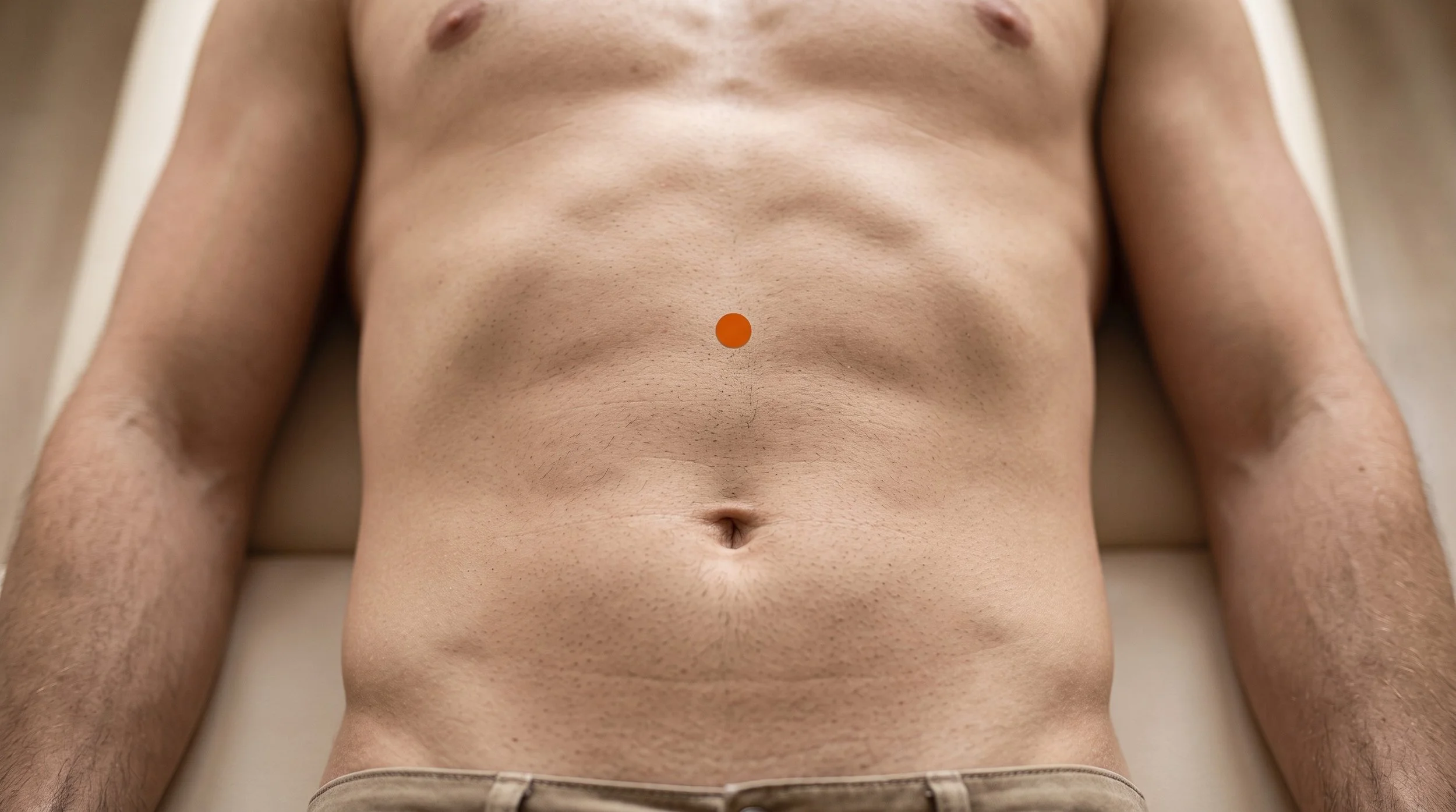
CV11 Acupuncture Point (Jianli)
Strengthen the Interior on the Upper Abdomen: Anatomy, Segmental Reflexes, and Why This Midline Point Belongs in Digestive Treatment Plans
CV11 (Jianli, often rendered as Strengthen the Interior, and translated elsewhere as Building Mile or Fortify the Earth), also written Ren 11, is a Conception Vessel point on the midline of the upper abdomen, sitting three cun above the navel and five cun below the sternocostal angle, roughly halfway up the stretch of belly wall that covers the stomach. It is one of a tight cluster of midline points (CV9 through CV13) that practitioners reach for when the complaint is centered in the epigastrium: fullness after meals, poor appetite, nausea, or a dull ache that patients describe with a flat hand rather than a fingertip.
In classical texts the CV11 acupuncture point is credited with harmonising the middle jiao and regulating qi, and in modern terms it is a well-placed access route to the abdominal wall segments that share spinal cord real estate with the stomach and transverse colon. It rarely works alone, but as part of a digestive protocol it is one of the more useful pieces of midline geography on the torso.
- Jianli point location is straightforward once you use the abdominal proportional measure: the distance from the navel to the sternocostal angle is divided into eight cun, and CV11 sits three cun above the umbilicus on the midline, level with ST22 and SP16.
- The needle passes skin and superficial fascia into the linea alba, the fibrous seam between the rectus abdominis bellies, with transversalis fascia, preperitoneal fat, peritoneum, and then stomach or transverse colon lying deeper, which is exactly why depth stays conservative.
- Traditional sources classify CV11 as a middle jiao harmonising and qi regulating point, language that maps reasonably well onto a modern description: a midline somatic input in the T8 to T10 territory that shares segmental connections with upper gut viscera.
- Experimental work suggests abdominal wall stimulation tends to recruit splanchnic sympathetic reflexes that quiet gastric contraction, while limb points such as ST36 more often recruit vagal pathways that increase it, an acupoint selectivity that appears repeatedly in animal recordings (Li et al., 2007; Noguchi, 2010; Ma, 2020).
- The clinical research picture is honest but modest: Cochrane reviews of functional dyspepsia and irritable bowel syndrome evaluated whole multi-point protocols rather than single points, with mixed and generally low certainty results (Lan et al., 2014; Manheimer et al., 2012), so CV11 should be framed as one component of a plan, not a standalone answer.
- De qi at CV11 is usually a spreading, heavy fullness or mild pressure under the needle rather than the electric quality patients notice at limb points, and that dull deep-tissue sensation is the type of afferent input most associated with acupuncture's descending pain modulating effects (Zhao, 2008).
Bloating, Poor Appetite, or Stomach Pain That Keeps Coming Back?
At Morningside Acupuncture we use CV11 as part of a midline abdominal strategy alongside CV12 and distal points such as ST36 and PC6, chosen after we take a full history of your meals, stress load, and symptom timing. Treatment is gentle, needles are fine, and abdominal depth is kept conservative and comfortable. Many patients also get manual work on a tight, guarded abdominal wall in the same visit. Schedule a session and let's map out what is actually driving your symptoms.
Schedule NowAnatomy of CV11: Why the Linea Alba Three Cun Above the Navel Is Such an Important Location
CV11 lies on the linea alba, the tough fibrous midline seam where the aponeuroses of the abdominal muscles meet between the two rectus abdominis bellies. Surface to deep, a needle here crosses skin, subcutaneous fat and superficial fascia, then the dense connective tissue of the linea alba itself, then transversalis fascia and preperitoneal fat before the peritoneum.
Nothing muscular sits directly under the midline, so what loads this tissue is mostly indirect: trunk flexion, chronic bracing, coughing, postpartum changes, post-surgical scarring, and the constant low-grade tension that comes with stress-related abdominal guarding. Because the seam is relatively avascular compared with the muscle bellies flanking it, midline needling is generally well tolerated when depth is controlled.
Sensory supply to this patch of abdominal wall comes from the anterior cutaneous branches of the lower intercostal nerves, roughly the eighth and ninth thoracic segments at this height, with the umbilicus itself sitting near T10. That matters because visceral afferents from the stomach and proximal intestine travel with the greater splanchnic nerves into overlapping thoracic cord segments.
When somatic and visceral inputs converge on the same dorsal horn neurons, two things follow clinically: gut irritation can be felt as a diffuse ache in the upper abdominal wall, and stimulating the wall can influence processing of the visceral signal. Needling also engages the wider antinociceptive machinery, including descending inhibitory pathways from the brainstem that modulate spinal transmission (Zhao, 2008), and pooled patient level data indicate acupuncture produces effects on chronic pain that exceed those of sham needling by a modest but consistent margin (Vickers et al., 2018).
Deep to the point are the stomach and transverse colon, and in a lean patient the peritoneal cavity is closer than it looks. The standard convention is perpendicular insertion of about 0.8 to 1.5 cun, with the shallower end of that range for thin patients, and Deadman's manual explicitly cautions that deep needling here can penetrate the peritoneal cavity. Practically, we needle CV11 with the patient supine and the knees supported so the abdominal wall relaxes, we avoid it directly over hernias, recent surgical sites, or unexplained masses, and we avoid deep insertion in pregnancy or when the abdomen is distended.
Slow insertion, attention to tissue feel, and no aggressive deep manipulation are the safeguards that make this a routine point rather than a risky one.
Related Conception Vessel Related Rectus Abdominis Trigger PointsCV11 (Ren 11) at a Glance: Classification, Location, and Clinical Use
| Category | Detail |
|---|---|
| Traditional Name | Jianli (Strengthen the Interior; also translated as Building Mile or Fortify the Earth) |
| Channel Classification | Conception Vessel (Ren Mai), point 11 of 24; conception vessel 11 in the upper abdominal midline group (CV11, also written REN11) |
| Point Categories | The reference sources list no meeting, crossing, five-shu, or hui-meeting designation for CV11. Its traditional standing is functional rather than categorical: a middle jiao harmonising and qi regulating point within the CV9 to CV13 upper abdominal cluster, level with ST22 and SP16. |
| Precise Location | On the anterior midline of the abdomen, 3 cun above the umbilicus and 5 cun below the sternocostal angle (the navel to sternocostal angle distance is measured as 8 cun) |
| Tissue Stimulated | Skin and superficial fascia over the linea alba, the fibrous seam between the rectus abdominis bellies, formed by the aponeuroses of the transverse abdominis and external abdominal oblique, with stomach and transverse colon lying deep |
| Needle Depth / Direction | Perpendicular insertion, 0.8 to 1.5 cun, patient supine with knees supported; shallower depths in thin patients because deep needling can reach the peritoneal cavity |
| De Qi Sensation | A dull, spreading fullness or heavy pressure under the needle, sometimes radiating toward the navel or upward to the sternum; typically less sharp or electric than limb points |
| Primary Clinical Uses | Abdominal distention and fullness, poor appetite, epigastric pain, nausea and vomiting, and (in classical use) generalized swelling and fluid retention |
| Common Point Combinations |
|
Deadman, Al-Khafaji, and Baker's point manual assigns CV11 a compact traditional role, harmonising the middle jiao and regulating qi, and its classical indication list clusters into four recognizable themes: pressure symptoms in the belly (distention and intestinal pain), loss of interest in food, upward-moving symptoms (vomiting, and the violent vomiting and diarrhea episodes older texts called sudden turmoil disorder), and pain felt high in the epigastrium near what the classics termed the Heart region.
Bolted onto that digestive list is a fifth theme that sits oddly with the rest: swelling of the body, or generalized fluid retention. Later commentators kept that thread alive by pairing CV11 with CV9 Shuifen and ST22 Guanmen to move fluids in the middle of the trunk. All of this is a traditional attribution rather than a physiological claim, but the pattern is striking: a single midline point was asked to handle both the mechanics of a stalled stomach and the distribution of fluid through the torso, which tells you how central the epigastric midline was to classical models of digestion.
Why CV11 Is Used for Bloating and Fluid Retention, Not Just Stomach Pain
The first part of the explanation is segmental. The skin and fascia at CV11 are supplied by lower thoracic nerve roots, and sensory fibers from the stomach and upper intestine funnel into overlapping segments of the spinal cord. Those two streams meet on shared neurons, which is the same convergence that makes gut irritation feel like a vague ache in the abdominal wall.
Needling into that shared territory gives the nervous system a clear, well-localized somatic signal in a region where the visceral signal is diffuse and poorly mapped, and it can change how the wall itself behaves, since chronically guarded abdominal muscles contribute to the sensation of fullness and pressure.
The second part is autonomic. In anesthetized animal preparations, stimulating abdominal points increases splanchnic sympathetic discharge and tends to reduce gastric contraction, and that inhibitory effect disappears when the splanchnic nerves are cut, while stimulating limb points such as ST36 tends to increase vagal activity and facilitate motility instead (Li et al., 2007).
Reviews of this literature describe the same somatotopic pattern: abdominal inputs preferentially drive spinal sympathetic reflexes, limb inputs preferentially drive vagally mediated ones, and the size of the response depends on stimulation intensity (Noguchi, 2010; Ma, 2020). That is a plausible physiological reason why classical practice pairs an abdominal point like CV11 with a leg point like ST36 rather than using either alone, though animal motility data should not be over-read as proof of symptom relief in people.
The classical fluid retention indication is harder to translate, and we do not claim a mechanism for it. What can be said fairly is that autonomic tone influences splanchnic blood flow, gut secretion, and the sensation of abdominal fullness, and that patients who describe themselves as puffy and bloated frequently have a distended, poorly mobile abdominal wall along with irregular digestion. Treating both the wall and the autonomic picture is a reasonable modern reading of an old instruction, offered as an interpretation rather than an established finding.
What the Research Shows for CV11 (Ren 11)
One note on naming before the evidence: in the research literature this point is almost always listed as CV11, the WHO standard code, while many textbooks and Chinese sources write Ren 11 or RN11, so it is worth searching those as well if you want to read the studies below in full.
There is no clinical trial of CV11 by itself, and it would be misleading to imply otherwise. What exists is research on whole acupuncture protocols for digestive conditions, in which abdominal midline points such as CV11 and CV12 typically appear alongside distal points, plus laboratory work on how abdominal versus limb stimulation affects gut physiology. Read the table below as evidence about the approach CV11 belongs to, with the usual caveats: many trials are small, blinding is difficult, certainty of evidence is often low, and effects on functional gut symptoms are modest and variable between people.
| Study | Type | Focus | Key Finding |
|---|---|---|---|
| Lan et al., 2014 | Cochrane systematic review | Manual acupuncture and electroacupuncture for functional dyspepsia | Seven trials were included and no clear advantage over comparison medications was demonstrated, with the authors describing the evidence as limited by risk of bias and incomplete outcome reporting. |
| Manheimer et al., 2012 | Cochrane systematic review | Acupuncture for irritable bowel syndrome | Acupuncture did not outperform sham needling for symptom severity, though it compared favorably with pharmacological and usual care controls in trials where blinding was not possible. |
| Li et al., 2007 | Animal experimental study | Autonomic pathways behind acupuncture effects on gastric motility in rats | Stimulating abdominal points increased splanchnic sympathetic discharge and inhibited gastric contraction, an effect abolished by splanchnic denervation, while limb point stimulation facilitated motility via vagal activity. |
| Noguchi, 2010 | Narrative physiological review | Somato-autonomic reflex regulation of gut motility and secretion | Experimental data reviewed here suggest that abdominal wall stimulation inhibits visceral motility through a spinal reflex requiring sympathetic activation. |
| Ma, 2020 | Mechanistic review | Somatotopic organization of acupuncture-driven autonomic reflexes | The review argues that point location and stimulation intensity determine which autonomic pathway is recruited, supporting the practice of combining abdominal and limb points. |
| Zhao, 2008 | Neurophysiological review | Neural mechanisms of acupuncture analgesia | Needling activates spinal and supraspinal inhibitory circuits and endogenous opioid signaling, which may contribute to reduced discomfort in painful abdominal presentations. |
| Vickers et al., 2018 | Individual patient data meta-analysis | Acupuncture for chronic pain across 39 trials | Acupuncture was associated with statistically significant benefit over both sham and no-acupuncture controls, with effects that persisted over time, though the sham comparison difference was modest. |
Tight, Guarded Abdominal Wall Making Everything Feel Worse?
A rigid upper abdomen can amplify fullness, reflux sensations, and post-meal discomfort, and it often persists after surgery, illness, or long stretches of stress. Our clinicians combine CV11 with dry needling of the rectus abdominis and transverse abdominis when the abdominal wall itself is part of the problem. We explain every step and adjust intensity to your comfort. Book an evaluation and we'll assess both the wall and the underlying pattern.
Schedule NowCV11 in the Context of Trigger Point Work
CV11 sits on the midline seam, so it is not itself a muscle belly target, but it is surrounded by muscle that frequently needs attention. Trigger points in the rectus abdominis are well described as producing horizontal bands of abdominal aching and can be accompanied by nausea, bloating, and a sense of indigestion that mimics visceral disease (Simons et al., 1999).
When a patient presents with upper abdominal discomfort and we find taut, exquisitely tender bands in the upper rectus abdominis or the oblique attachments along the costal margin, treating those bands is often as important as treating the point over the stomach.
In practice, our clinicians tend to needle CV11 and CV12 shallowly on the midline for the visceral and autonomic side of the picture, then use dry needling with a flat palpation technique on the rectus abdominis, transverse abdominis, and external oblique where restriction and referral are reproducible. Distal points such as ST36 or PC6 usually round out the session.
Because acupuncture is defined by the use of an acupuncture needle across hundreds of styles, dry needling of the abdominal wall and classical point needling are not competing approaches here, they are two applications of the same tool aimed at different tissue problems in the same complaint.
CV11 Digestive Treatment at NYC's Highest-Rated Acupuncture Clinic
Morningside Acupuncture is the highest-rated acupuncture and dry needling clinic in New York City with over 500 five-star Google reviews, and digestive complaints are among the most common reasons patients find us. We integrate classical point selection such as CV11 with modern myofascial and neurophysiological reasoning, so treatment is grounded rather than mystical. You'll get a clear plan, realistic expectations, and measurable check-ins. Schedule your visit today.
Schedule NowFrequently Asked Questions
Is CV11 the same point as Ren 11?
Yes. CV11 and Ren 11 are two codes for the same point, Jianli. CV stands for Conception Vessel and is the WHO standard abbreviation, the one you will see in most research papers. Ren comes from Ren Mai, the Chinese name of the vessel, and it is the form used in many textbooks and acupuncture schools. You will also come across it written as REN-11, RN11, or Conception Vessel 11. Whichever code is used, the location and the uses are the same.
What does CV11 feel like when needled?
Most people feel a dull, spreading fullness or a mild sense of pressure that seems to sit under the needle rather than at the skin. Some notice the sensation travel a short way toward the navel or up toward the breastbone, and occasionally there is a soft gurgle in the belly within a minute or two. It is generally a quieter sensation than at limb points such as LI4 or ST36, and sharp or burning feelings are not expected, so tell your practitioner if you notice one.
Why needle the abdomen directly instead of only using distal points on the arms and legs?
Because the two do different jobs. Abdominal points sit in the same nerve segments as the stomach and upper intestine, which lets them influence local wall tension and segmental processing of visceral signals, and experimental work suggests abdominal stimulation preferentially recruits sympathetic reflex pathways (Li et al., 2007; Ma, 2020). Distal points such as ST36 more often engage vagally mediated responses in the same experiments (Noguchi, 2010). Combining a midline point like CV11 with a leg point is the standard approach precisely because the two inputs are not redundant.
Can I press CV11 myself between sessions?
Yes, acupressure at CV11 is low risk when done gently. Lie on your back with your knees bent so the abdominal wall softens, find the midline three cun (about four finger widths) above your navel, and rest two or three fingerpads there with light to moderate pressure. Press on a slow exhale, hold for about 30 to 60 seconds, ease off, and repeat for a total of three to five minutes, once or twice a day. Small slow circles are fine. Skip it within an hour of a large meal, skip it if the area is sharply tender, and stop if pressure worsens symptoms rather than easing them.
Is CV11 safe to needle?
In trained hands, yes, with sensible precautions. The main consideration is depth: in thin patients, deep insertion can reach the peritoneal cavity, so practitioners keep to the shallower end of the 0.8 to 1.5 cun range and insert slowly with the patient supine and relaxed. We avoid needling over hernias, recent surgical incisions, unexplained masses, or an acutely distended and rigid abdomen, and we avoid deep abdominal needling in pregnancy. Mild transient soreness or a small bruise are the usual side effects. Any abdominal pain that is severe, sudden, or accompanied by fever, vomiting, or blood needs medical evaluation, not acupuncture.
Where exactly is CV11 located?
On the anterior midline of the abdomen, three cun above the center of the umbilicus and five cun below the sternocostal angle. The upper abdomen is measured proportionally, with the navel to sternocostal angle distance counted as eight cun, so CV11 is a bit above the midpoint of that span. Locating Ren 11 abdomen positioning is easiest by finding CV12 (four cun above the navel, halfway between navel and sternocostal angle) and dropping one cun down the midline. The point is level with ST22 and SP16 on either side.
References
- Deadman, P., Al-Khafaji, M., & Baker, K. (2009). A manual of acupuncture. Journal of Chinese Medicine Publications.
- Maciocia, G. (2005). The foundations of Chinese medicine: A comprehensive text for acupuncturists and herbalists (2nd ed.). Elsevier Churchill Livingstone.
- Maciocia, G. (2006). The channels of acupuncture: Clinical use of the secondary channels and eight extraordinary vessels. Churchill Livingstone Elsevier.
- Kim, H. (2008). Handbook of Oriental medicine (3rd ed.). Harmony & Balance Press.
- Cunningham, P. M. (2000). Acupuncture points: A practical guide to classical and modern usage. Odyssey Press.
- Simons, D. G., Travell, J. G., & Simons, L. S. (1999). Travell & Simons' myofascial pain and dysfunction: The trigger point manual, Vol. 1: Upper half of body (2nd ed.). Williams & Wilkins.
- Lan, L., Zeng, F., Liu, G. J., Ying, L., Wu, X., Liu, M., & Liang, F. R. (2014). Acupuncture for functional dyspepsia. Cochrane Database of Systematic Reviews, 2014(10), CD008487. https://doi.org/10.1002/14651858.CD008487.pub2
- Manheimer, E., Cheng, K., Wieland, L. S., Min, L. S., Shen, X., Berman, B. M., & Lao, L. (2012). Acupuncture for treatment of irritable bowel syndrome. Cochrane Database of Systematic Reviews, 2012(5), CD005111. https://doi.org/10.1002/14651858.CD005111.pub3
- Li, Y. Q., Zhu, B., Rong, P. J., Ben, H., & Li, Y. H. (2007). Neural mechanism of acupuncture-modulated gastric motility. World Journal of Gastroenterology, 13(5), 709-716. https://doi.org/10.3748/wjg.v13.i5.709
- Noguchi, E. (2010). Acupuncture regulates gut motility and secretion via nerve reflexes. Autonomic Neuroscience: Basic and Clinical, 156(1-2), 15-18. https://doi.org/10.1016/j.autneu.2010.06.010
- Ma, Q. (2020). Somato-autonomic reflexes of acupuncture. Medical Acupuncture, 32(6), 362-366. https://doi.org/10.1089/acu.2020.1488
- Zhao, Z. Q. (2008). Neural mechanism underlying acupuncture analgesia. Progress in Neurobiology, 85(4), 355-375. https://doi.org/10.1016/j.pneurobio.2008.05.004
- Vickers, A. J., Vertosick, E. A., Lewith, G., MacPherson, H., Foster, N. E., Sherman, K. J., Irnich, D., Witt, C. M., & Linde, K. (2018). Acupuncture for chronic pain: Update of an individual patient data meta-analysis. Journal of Pain, 19(5), 455-474. https://doi.org/10.1016/j.jpain.2017.11.005
Disclaimer: This web site is intended for educational and informational purposes only. Reading this website does not constitute providing medical advice or any professional services. This information should not be used for diagnosing or treating any health issue or disease. Those seeking medical advice should consult with a licensed physician. Seek the advice of a medical doctor or other qualified health professional for any medical condition. If you think you have a medical emergency, call 911 or go to the emergency room. No acupuncturist-patient relationship is created by reading this website or using the information. Morningside Acupuncture PLLC and its employees and contributors do not make any express or implied representations with respect to the information on this site or its use. For any legal interpretation of scope of practice in your state, consult a licensed attorney or regulatory authority.
Read more from our blog



