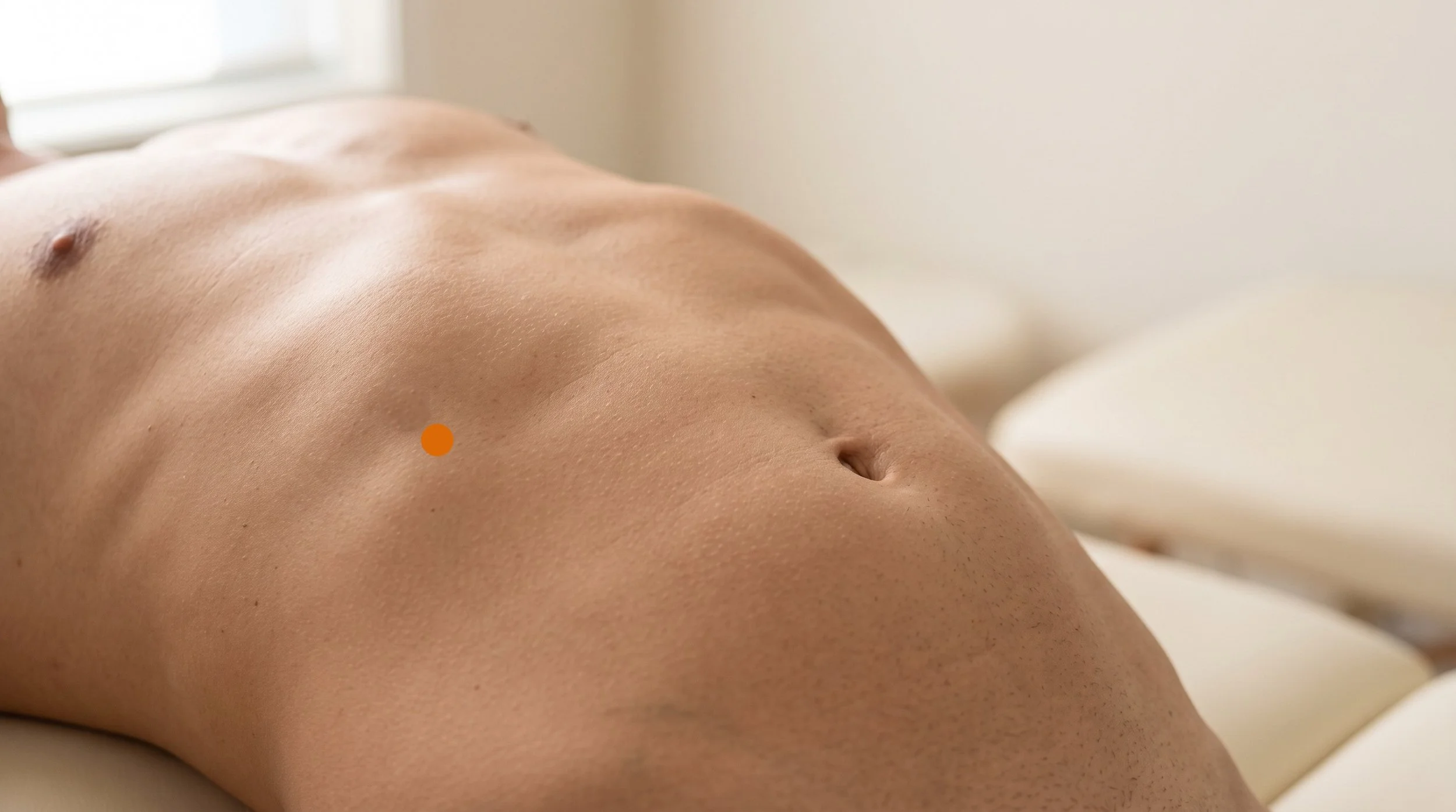
SP16 Acupuncture Point (Fuai)
Abdomen Sorrow at the Edge of the Rectus Abdominis: Anatomy, Segmental Mechanism, and Why This Upper Abdominal Point Belongs in Digestive Care
SP16 (Fuai, often translated as Abdomen Sorrow or Abdomen's Lament) is the highest of the Spleen channel's abdominal points, sitting on the outer edge of the rectus abdominis muscle about three finger-widths plus a hand-width above the navel, roughly level with CV11 on the midline.
In plain terms, it's the spot where the flat sheet of the abdominal wall meets the vertical band of the six-pack muscle, high enough that in slim patients with a narrow rib angle it can crowd the costal margin. Clinicians reach for the SP16 acupuncture point when the complaint sits in the upper and lateral abdomen: cramping around and above the navel, sluggish bowels, a bloated or braced feeling under the ribs, and the tender abdominal wall that so often accompanies long-standing digestive symptoms.
Its appeal is anatomical rather than mystical, because needling here lands in the same T8-T9 spinal territory that carries sensation from the upper gut.
- Location and layers: spleen 16 sits at the lateral border of the rectus abdominis on the 4 cun line, 3 cun above SP15 and level with CV11, so the needle passes through skin, subcutaneous fascia, and the oblique aponeuroses at the semilunar line rather than through thick muscle bulk (Deadman et al., 2007; Kim, 2018).
- Traditional categories, translated: classical texts list Fuai as a crossing point of the Spleen channel with the Yin Linking vessel and give it a single core action, regulating the intestines (Deadman et al., 2007; Maciocia, 2006). In modern language, that describes a body-wall site used to influence gut function and abdominal wall tone rather than a structure that moves energy.
- Mechanism: the SP 16 abdomen site lies in the T8-T9 dermatome and myotome, the same segments that receive visceral afferents from the stomach, duodenum, and transverse colon, which creates the convergence that makes somatovisceral effects plausible (Uchida et al., 2017).
- Physiology specific to abdominal needling: in anesthetized animals, needling the abdominal wall reduced gastric motility through a sympathetic reflex that disappeared when the relevant thoracic nerves were cut, while limb needling tended to produce the opposite effect (Sato et al., 1993). Reviews of gastrointestinal acupuncture describe this segmental versus distal contrast as a recurring theme (Yang et al., 2025).
- Research picture: no trial has isolated SP16 on its own. Evidence comes from multi-point protocols in irritable bowel syndrome, chronic constipation, and functional dyspepsia, where results range from uncertain to moderately encouraging (Manheimer et al., 2012; Liu et al., 2016; Pang et al., 2016).
- De qi and practice framing: patients usually report a dull spreading heaviness or a mild ache that drifts toward the navel or up under the rib edge, not a sharp sting. Depth stays conservative because the peritoneal cavity sits close beneath thin abdominal walls and an enlarged spleen may lie deep to the left-side point (Deadman et al., 2007).
Struggling With Bloating, Cramping, or Sluggish Digestion?
At Morningside Acupuncture we treat upper abdominal complaints as both a gut story and an abdominal wall story, and SP16 sits right where the two meet. We combine shallow, comfortable needling along the Spleen channel's abdominal line with distal points like ST36 and hands-on assessment of the rectus and obliques. Most patients notice that the tense, guarded feeling under the ribs settles before the bowel pattern shifts. Schedule a visit and we'll map your pattern before we needle anything.
Schedule NowAnatomy of SP16: Why the Lateral Rectus Border Is Such an Important Location
SP16 sits on the vertical line about four inches lateral to the midline, where the rectus abdominis gives way to the flat abdominal muscles. Under the fingertip you can often feel a shallow groove there, the semilunar line, where the aponeuroses of the external oblique, internal oblique, and transversus abdominis wrap the rectus sheath. This junction is loaded constantly: it tightens with every cough, laugh, and forced exhale, it braces during core work, and it holds tension in people who spend the day slightly hunched at a desk.
In patients with a narrow subcostal angle the point can fall right on the cartilage of the costal margin, which is why textbooks advise shifting slightly medially or choosing a neighboring point instead (Deadman et al., 2007).
The nerve geography is straightforward and clinically useful. This part of the abdominal wall is supplied by the lower thoracoabdominal nerves, mainly T8 and T9, whose fibers travel between the oblique layers before piercing the rectus sheath. Visceral afferents from the stomach, duodenum, and much of the transverse colon feed into the same lower thoracic segments, so body wall input and gut input converge on shared dorsal horn neurons (Uchida et al., 2017).
That convergence explains two things patients often describe: why gut irritation can make the overlying abdominal wall feel sore and hypersensitive, and why stimulating the wall may in turn modulate autonomic outflow to the gut (Sato et al., 1993). Needling also recruits the broader analgesic machinery documented for acupuncture generally, including spinal gating and descending inhibition from brainstem centers (Zhao, 2008).
Deep to the point lie the transversalis fascia, the peritoneum, and then the abdominal contents, with the transverse colon region beneath and, on the left, the spleen if it happens to be enlarged. The superior epigastric vessels run within the rectus sheath just medial to this line. For all these reasons the standard is perpendicular insertion of about 0.5 to 1 cun, with practitioners going shallower in thin patients and using oblique or transverse angles when the costal margin is close (Deadman et al., 2007; Kim, 2018). Skilled abdominal needling is a matter of feeling the layers, not chasing depth.
Related Rectus Abdominis Trigger Points Related Abdominal Obliques Trigger PointsSP16 at a Glance: Classification, Location, and Clinical Use
| Category | Detail |
|---|---|
| Traditional Name | Fuai (Abdomen Sorrow, also translated Abdomen's Lament) |
| Channel Classification | Sixteenth point of the Spleen channel of the foot Taiyin, on the upper abdomen |
| Point Categories | Meeting (crossing) point of the Spleen channel with the Yin Linking vessel (Yin Wei Mai), alongside SP12, SP13, and SP15; the highest of the Spleen channel's abdominal points; no five-shu, yuan, luo, or hui-meeting designation |
| Precise Location | On the abdomen at the lateral border of the rectus abdominis (the 4 cun line), 3 cun superior to SP15, which sits level with the navel, and roughly level with CV11; if a narrow rib angle places the spot on the costal margin, locate slightly more medially |
| Tissue Stimulated | Skin and subcutaneous fascia over the semilunar line, the aponeurotic junction of the external oblique, internal oblique, and transverse abdominis, and the lateral edge of the rectus abdominis, in T8-T9 nerve territory |
| Needle Depth / Direction | Perpendicular 0.5 to 1 cun, shallower in thin patients; transverse or oblique along the costal margin when the rib edge interferes; moxibustion is traditionally permitted |
| De Qi Sensation | A dull, spreading heaviness or mild ache at the rib edge that may drift toward the navel or across the upper abdomen; sharp or radiating pain means reposition, and the abdomen should never feel pressured or deeply penetrating |
| Primary Clinical Uses | Periumbilical and upper-lateral abdominal pain, constipation and irregular bowel patterns, digestive weakness described classically as undigested food in the stool, costal-margin and abdominal wall tension |
| Common Point Combinations |
|
Deadman's point manual gives Fuai a single, tightly focused traditional action: regulating the intestines. The classical indication list it records is almost entirely lower gut in character, covering pain around the navel, a cold feeling in the abdomen, food passing through undigested, dysenteric conditions with pus or blood in the stool, and constipation (Deadman et al., 2007). Other sources widen the picture slightly, adding indigestion and rib-region pain, and describing traditional attributions of strengthening the Spleen, harmonizing the Stomach, and clearing damp heat (Kim, 2018; Cunningham, 2013).
The point is also listed across the literature as one of the Spleen channel sites where the Yin Linking vessel crosses, linking it to a network that classical writers associated with the interior and with emotional tone (Maciocia, 2006; Sterman, 2011). What's striking is the contrast between the name and the indications: a point called Abdomen Sorrow whose recorded uses are overwhelmingly about bowel function, as if the older writers were pointing at the place where digestive misery and emotional weight are felt in the same square inch of belly.
Why SP16 Is Used for Constipation and Upper Abdominal Bracing
The most useful way to understand SP16 is segmentally. The abdominal wall at this level and the upper gut share the lower thoracic spinal segments, so their sensory traffic converges on the same spinal neurons (Uchida et al., 2017). When a gut is irritable, that convergence can leave the overlying wall tender, guarded, and quick to spasm, which patients experience as bloating or a band of tightness under the ribs.
Needling into the same segment gives the nervous system a clean, well-localized input in a region already flooded with noisy signaling, and this is the basic rationale for choosing an abdominal point rather than only distal ones.
There's also a measurable autonomic side. In classic animal work, needling the abdominal wall inhibited gastric motility through a sympathetic reflex that vanished after cutting the lower thoracic spinal nerves, while stimulating the limbs tended to increase motility through vagal pathways (Sato et al., 1993). Later reviews confirm that abdominal and limb points can produce different, sometimes opposite, autonomic effects, and that stimulation intensity and frequency matter as much as location (Yang et al., 2025).
This is why clinicians rarely use SP16 alone. Pairing it with a leg point such as ST36 covers both segmental and distal routes, which mirrors the classical habit of combining an abdominal point with a distal one.
Layered on top of that is the general analgesic response to needling: activation of small-diameter afferents, spinal modulation, and descending inhibition from brainstem centers that damp pain signaling body-wide (Zhao, 2008). For the patient with a sore, over-braced abdominal wall, that combination of local desensitization and central modulation is often what makes the belly feel less defensive within a session or two, even when the underlying bowel pattern takes longer to shift.
What the Research Shows for SP16
It's worth being direct about the state of the evidence. There is no clinical trial testing Fuai on its own, and there probably never will be, because acupuncture is nearly always delivered as a multi-point prescription. What research can tell us is whether protocols that include abdominal points in this region help with the conditions SP16 is traditionally chosen for, and whether the underlying physiology holds up in the laboratory. The clinical picture is mixed to modestly encouraging, the mechanistic picture is reasonably solid, and neither justifies promising a specific outcome to any individual patient.
| Study | Type | Focus | Key Finding |
|---|---|---|---|
| Manheimer et al., 2012 | Cochrane systematic review | Acupuncture for irritable bowel syndrome | Pooled trials did not show acupuncture outperforming sham for IBS symptoms, though it compared favorably with some usual-care and drug comparators, so benefit remains uncertain. |
| Liu et al., 2016 | Multicenter randomized sham-controlled trial | Electroacupuncture for chronic severe functional constipation, using abdominal and limb points | Participants receiving electroacupuncture had a larger increase in complete spontaneous bowel movements than sham, with effects persisting during follow-up. |
| Pang et al., 2016 | Systematic review and meta-analysis | Acupuncture for functional dyspepsia | Analyses favored acupuncture for dyspeptic symptoms and quality of life, although most included trials were judged low quality. |
| Li et al., 2026 | Updated systematic review and meta-analysis | Acupuncture versus sham for functional dyspepsia | Moderate to high certainty evidence suggested acupuncture probably improves symptom scores and quality of life without more adverse events. |
| Sato et al., 1993 | Animal physiology experiment | Segmental effects of needling on gastric motility | Abdominal wall needling inhibited gastric motility through a sympathetic reflex that depended on intact lower thoracic nerves, unlike limb stimulation. |
| Uchida et al., 2017 | Narrative review of autonomic physiology | Somatoautonomic reflexes underlying acupuncture effects | The review describes how somatic stimulation reaches visceral organs through segmentally organized autonomic reflex pathways, while cautioning that animal findings may not transfer directly to conscious patients. |
| Vickers et al., 2018 | Individual patient data meta-analysis | Acupuncture for chronic pain across conditions | Acupuncture outperformed both sham and no-acupuncture controls for chronic pain, with effects persisting over time, supporting its use for persistent musculoskeletal complaints. |
Abdominal Wall Tenderness That Keeps Getting Missed?
A surprising number of people carrying a digestive diagnosis also have taut, tender bands in the rectus abdominis and obliques that reproduce their symptoms on palpation. Our licensed acupuncturists screen for that overlap and use precise dry needling of the abdominal wall alongside points like Fuai and SP15. It's a low-force approach designed to reduce guarding without aggravating a sensitive gut. Book an evaluation and we'll show you exactly what we find.
Schedule NowSP16 in the Context of Trigger Point Work
The abdomen sorrow point sits directly over territory that myofascial practitioners know well. Trigger points in the upper rectus abdominis and in the oblique layers near the costal margin can refer pain across the upper abdomen and the mid-back, and abdominal wall trigger points are documented as producing symptoms that mimic visceral complaints, including heartburn-like burning, nausea, and cramping (Simons et al., 1999). Because SP16 lies exactly at the rectus-oblique junction, the site a clinician palpates as a classical point and the site palpated as a taut band are frequently the same square inch of tissue.
At Morningside Acupuncture we treat that overlap as an advantage rather than a coincidence. A typical session for abdominal wall pain or digestion-related bracing might combine shallow needling at SP16 and SP15 with careful dry needling of the rectus abdominis and external oblique using a pincer grip or angled technique to stay superficial, plus distal points such as ST36 to bring in the non-segmental route. Serious abdominal pathology has to be ruled out first, and abdominal needling is always kept shallow and controlled.
When the wall itself is a genuine pain generator, patients often feel the difference quickly, since reducing guarding tends to improve both comfort and breathing mechanics.
SP16 Digestive Treatment at NYC's Highest-Rated Acupuncture Clinic
Morningside Acupuncture is the highest-rated acupuncture and dry needling clinic in New York City with over 500 five-star Google reviews, and our Upper West Side team uses points like SP16 within evidence-informed treatment plans for digestive discomfort, constipation, and abdominal wall pain. Every session begins with palpation, so point selection reflects your tissue rather than a template. We keep needling depths conservative on the abdomen and explain each step as we go. Schedule your appointment today.
Schedule NowFrequently Asked Questions
What does SP16 feel like when needled?
Most patients describe a dull, heavy, slightly spreading sensation right at the outer edge of the abdominal muscle, sometimes with a faint pull toward the navel or up under the rib margin. Abdominal points are usually needled shallowly, so the feeling tends to be milder than at leg or hand points. You should not feel sharpness, burning, or any sense of deep pressure inside the belly, and if you do, the practitioner will withdraw and reposition. Many people also notice their abdomen relaxing and their breathing dropping lower into the belly while the needles are in.
Why needle the abdomen at all instead of only using distal points like ST36?
Because they do different things. Points on the abdomen sit in the same T8-T9 spinal segments that carry sensation from the upper gut, so they act through direct segmental convergence, while limb points reach the gut through longer, non-segmental routes (Uchida et al., 2017). Laboratory work found that abdominal wall stimulation and limb stimulation can even produce opposite effects on gastric motility (Sato et al., 1993). Using both, which is what classical prescriptions like SP16 with ST36 do, covers more of the nervous system than either alone.
Can I press SP16 myself between sessions?
Yes, acupressure here is simple and low-risk for most people. Lie down with knees bent so the abdominal wall softens, find your navel, move about four finger-widths straight up, then slide outward until you feel the vertical groove at the outer edge of the six-pack muscle. Press with two fingertips at a comfortable, moderate depth (never hard enough to feel sharp), hold steady or make small slow circles for 30 to 60 seconds, then repeat on the other side. Two or three rounds per side, once or twice a day, is plenty, and pairing it with slow exhales usually helps. Skip it right after a large meal, and stop if pressure produces sharp pain, nausea, or anything that feels unfamiliar.
Is SP16 safe to needle?
In trained hands, yes, with clear boundaries. Point texts advise perpendicular insertion of roughly 0.5 to 1 cun and warn that deep needling can enter the peritoneal cavity in thin patients, and that an enlarged spleen may lie deep to the left-side point (Deadman et al., 2007). Practitioners therefore keep depth conservative, adjust the angle near the costal margin, and avoid the area entirely in cases of acute abdomen, recent abdominal surgery, hernia at the site, or known organ enlargement. Abdominal points are also approached cautiously in pregnancy, so tell your acupuncturist if you are or might be pregnant.
Where exactly is SP16 located?
SP16 is on the upper abdomen at the outer border of the rectus abdominis, on the line about 4 cun lateral to the midline, 3 cun above SP15 (which sits level with the navel) and approximately level with CV11 (Deadman et al., 2007; Kim, 2018). A practical way to find it: from the navel, measure roughly a hand-width upward, then move laterally to the ridge where the vertical abdominal muscle ends and the flat side muscles begin. If your rib angle is narrow, the measured spot may land on the costal cartilage, in which case clinicians shift slightly toward the midline or select a neighboring point.
References
- Deadman, P., Al-Khafaji, M., & Baker, K. (2009). A manual of acupuncture. Journal of Chinese Medicine Publications.
- Kim, H. (2008). Handbook of Oriental medicine (3rd ed.). Harmony & Balance Press.
- Cunningham, P. M. (2000). Acupuncture points: A practical guide to classical and modern usage. Odyssey Press.
- Maciocia, G. (2006). The channels of acupuncture: Clinical use of the secondary channels and eight extraordinary vessels. Churchill Livingstone Elsevier.
- Cecil-Sterman, A. (2012). Advanced acupuncture: A clinic manual. Classical Wellness Press.
- Simons, D. G., Travell, J. G., & Simons, L. S. (1999). Travell & Simons' myofascial pain and dysfunction: The trigger point manual, Vol. 1: Upper half of body (2nd ed.). Williams & Wilkins.
- Manheimer, E., Cheng, K., Wieland, L. S., Min, L. S., Shen, X., Berman, B. M., & Lao, L. (2012). Acupuncture for treatment of irritable bowel syndrome. Cochrane Database of Systematic Reviews, 2012(5), CD005111. https://doi.org/10.1002/14651858.CD005111.pub3
- Liu, Z., Yan, S., Wu, J., He, L., Li, N., Dong, G., Fang, J., Fu, W., Fu, L., Sun, J., Wang, L., Wang, S., Yang, J., Zhang, H., Zhang, J., Zhao, J., Zhou, W., Zhou, Z., Ai, Y., ... Liu, B. (2016). Acupuncture for chronic severe functional constipation: A randomized trial. Annals of Internal Medicine, 165(11), 761-769. https://doi.org/10.7326/M15-3118
- Pang, B., Jiang, T., Du, Y. H., Li, J., Li, B., Hu, Y. C., & Cai, Q. H. (2016). Acupuncture for functional dyspepsia: What strength does it have? A systematic review and meta-analysis of randomized controlled trials. Evidence-Based Complementary and Alternative Medicine, 2016, 3862916. https://doi.org/10.1155/2016/3862916
- Li, X. X., Hu, Z. Y., Li, Z. C., Tang, J., Liu, Y. Y., Zeng, D. H., Zhou, Q. Q., Ma, W. B., Lan, L., & Wang, L. (2026). Efficacy and safety of acupuncture for functional dyspepsia: An updated meta-analysis of randomized controlled trials. Frontiers in Medicine, 13, 1718632. https://doi.org/10.3389/fmed.2026.1718632
- Sato, A., Sato, Y., Suzuki, A., & Uchida, S. (1993). Neural mechanisms of the reflex inhibition and excitation of gastric motility elicited by acupuncture-like stimulation in anesthetized rats. Neuroscience Research, 18(1), 53-62. https://doi.org/10.1016/0168-0102(93)90105-y
- Uchida, S., Kagitani, F., & Sato-Suzuki, I. (2017). Somatoautonomic reflexes in acupuncture therapy: A review. Autonomic Neuroscience, 203, 1-8. https://doi.org/10.1016/j.autneu.2016.11.001
- Yang, N. N., Xie, X. X., Yan, W. L., Liu, Y. D., Wang, H. X., Yang, L. X., & Liu, C. Z. (2025). The autonomic nervous system in acupuncture for gastrointestinal dysmotility: From anatomical insights to clinical medicine. International Journal of Medical Sciences, 22(11), 2620-2634. https://doi.org/10.7150/ijms.107643
- Zhao, Z. Q. (2008). Neural mechanism underlying acupuncture analgesia. Progress in Neurobiology, 85(4), 355-375. https://doi.org/10.1016/j.pneurobio.2008.05.004
- Vickers, A. J., Vertosick, E. A., Lewith, G., MacPherson, H., Foster, N. E., Sherman, K. J., Irnich, D., Witt, C. M., & Linde, K. (2018). Acupuncture for chronic pain: Update of an individual patient data meta-analysis. Journal of Pain, 19(5), 455-474. https://doi.org/10.1016/j.jpain.2017.11.005
Disclaimer: This web site is intended for educational and informational purposes only. Reading this website does not constitute providing medical advice or any professional services. This information should not be used for diagnosing or treating any health issue or disease. Those seeking medical advice should consult with a licensed physician. Seek the advice of a medical doctor or other qualified health professional for any medical condition. If you think you have a medical emergency, call 911 or go to the emergency room. No acupuncturist-patient relationship is created by reading this website or using the information. Morningside Acupuncture PLLC and its employees and contributors do not make any express or implied representations with respect to the information on this site or its use. For any legal interpretation of scope of practice in your state, consult a licensed attorney or regulatory authority.
Read more from our blog



