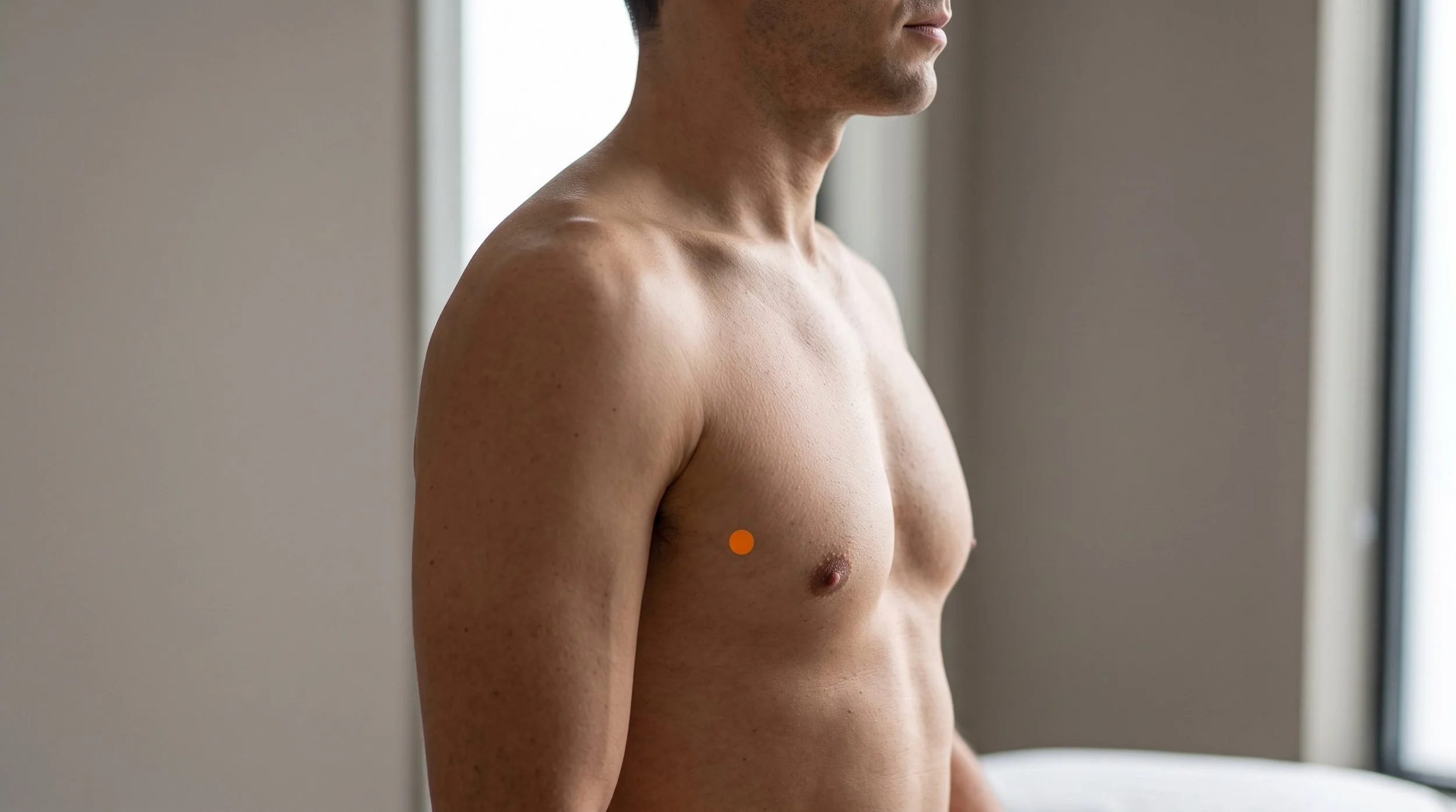
SP18 Acupuncture Point (Tianxi)
The Heavenly Stream on the Side of the Chest: Anatomy, Segmental Mechanism, and Why This Fourth Intercostal Space Point Sits at the Crossroads of Rib Cage, Breast, and Breathing Complaints
SP18 (Tianxi, often translated as Heavenly Stream) is the Spleen channel point that sits on the side of the chest in the fourth intercostal space, 6 cun from the midline, which in practical terms is about two thumb widths lateral to the nipple line and just outside the lateral border of the breast tissue.
It's one of the few classical points that lands squarely on the chest wall at breast level, and that position explains almost everything about how it's used: traditional texts group it with rib-side fullness, cough with rattling phlegm, hiccup, breast tenderness, and difficulty with milk flow, while modern anatomy places it over the lateral edge of pectoralis major, the digitations of serratus anterior, and the external intercostal muscles of the fourth space.
Because the pleura lies only a short distance beneath, the sp18 acupuncture point is also a teaching point for safe technique: the needle stays flat in the plane of the rib space, never aimed inward.
- Location and layers: spleen 18 is found in the fourth intercostal space, 6 cun lateral to the anterior midline, which is two cun outside the mammillary line, with the space counted down from the second rib space just below the sternal angle. The needle passes through skin, subcutaneous fat, the lateral fibers of pectoralis major or serratus anterior depending on build, and into the external intercostal layer.
- Traditional categories in modern language: classical sources credit SP18 with regulating and descending qi and with benefiting the breasts and lactation, which reads clinically as a local chest wall point used for fullness, oppression, hiccup, and breast symptoms rather than a systemic distal point.
- The nerve story: SP18 sits in the territory of the lateral cutaneous branch of the fourth intercostal nerve, the same T4 segment that supplies the nipple line and much of the breast, so stimulation here converges with breast and chest wall input in the same spinal segment before any of it reaches the brain (Zhao, 2008).
- Research picture: no trial has isolated the sp 18 chest point on its own, so the evidence comes from broader work on acupuncture for breast pain (Shi et al., 2024), postpartum low milk supply (Bao et al., 2024), engorgement (Zakarija-Grkovic & Stewart, 2020), and chronic musculoskeletal pain generally (Vickers et al., 2018), all of which suggest modest and uncertain effects rather than reliable ones.
- Clinical framing: at Morningside we use SP18 as one element of a chest wall plan that usually includes rib cage mobility work, breathing retraining, and dry needling of pectoralis major and serratus anterior, not as a standalone treatment for any breast condition, which always needs medical evaluation first.
- Safety and de qi: the sensation is typically mild, a spreading heaviness or dull ache that tracks along the rib space rather than a strong grabbing feeling, because the needle lies flat. Perpendicular or deep insertion here risks pneumothorax, historically the most commonly reported serious traumatic event in acupuncture safety reviews (White, 2004).
Struggling With Rib Cage Tightness, Chest Wall Pain, or Breathing That Feels Restricted?
Chest wall pain that has been cleared medically can still be miserable, and it often responds to work directly on the muscles and rib spaces that generate it. Our licensed acupuncturists combine gentle needling along points like SP18 with dry needling of pectoralis major, pectoralis minor, and serratus anterior, plus breathing and posture coaching you can carry between visits. Every chest treatment is done with a flat, in-plane technique and a careful anatomical check first. Schedule a visit and let's map out what's actually driving the tightness.
Schedule NowAnatomy of SP18: Why the Fourth Intercostal Space Lateral to the Breast Is Such an Important Location
Start at the sternal angle, drop into the rib space immediately below it, and count down two more spaces: that's the fourth intercostal space, and in most adult males the nipple sits right in it. Move laterally about two cun beyond the nipple line and you reach SP18, on the outer slope of the chest where the flat lateral fibers of pectoralis major thin out and the finger-like digitations of serratus anterior begin their run toward the shoulder blade.
Under those muscles are the external intercostals, which link rib four to rib five and stiffen with the same things that stiffen the whole front of the chest: long hours rounded over a keyboard, side sleeping, breath holding under stress, carrying a baby on one hip, or the guarded shallow breathing that follows a rib injury or a bout of coughing.
The nerve geography here is unusually tidy. SP18 lies in the field of the lateral cutaneous branch of the fourth intercostal nerve, and that same T4 level supplies the skin of the nipple line, the deeper chest wall, and part of the breast itself.
Somatic input from the point and sensory input from the breast and rib cage therefore arrive at overlapping dorsal horn neurons, which is the basic setup for segmental convergence: strong, well-localized afferent traffic from a needle can modulate how the cord processes nearby nociceptive input, and repeated stimulation recruits descending inhibitory pathways from the brainstem that damp transmission more broadly (Zhao, 2008). Thoracic segments also carry sympathetic outflow to the chest wall, so needling in this zone can shift local blood flow and muscle tone as well as pain report.
Deeper still is the reason SP18 demands respect. The intercostal vessels run along the lower border of each rib, branches of the lateral thoracic and thoracoepigastric vessels cross the area, and beneath the intercostal muscles sit the parietal pleura and lung with very little margin, especially in slim patients. Classical and modern texts converge on the same rule: insert transverse to oblique along the line of the rib space, roughly 0.3 to 1 cun depending on the source, and avoid perpendicular or deep insertion entirely.
Pneumothorax remains the most frequently reported serious traumatic complication in acupuncture safety literature, and it's essentially an avoidable one when practitioners respect chest anatomy (White, 2004).
Related Spleen Channel Related Intercostal Muscles Trigger PointsSP18 at a Glance: Classification, Location, and Clinical Use
| Category | Detail |
|---|---|
| Traditional Name | Tianxi (Heavenly Stream, also translated Heaven's Stream or Celestial Stream) |
| Channel Classification | Spleen channel (foot taiyin), the eighteenth point of the channel and the second of its four chest points, sitting between SP17 below and SP19 above |
| Point Categories | No five-shu, yuan-source, luo-connecting, xi-cleft, or hui-meeting designation is recorded for this point, and the standard reference texts list no extraordinary vessel intersection or meeting-point status. Classical texts describe it functionally rather than categorically, crediting it with regulating and descending qi and with benefiting the breasts and promoting lactation. |
| Precise Location | On the lateral chest in the fourth intercostal space, 6 cun lateral to the anterior midline, which is two cun lateral to the mammillary (nipple) line. Count the spaces downward from the second intercostal space, which lies just below the sternal angle. |
| Tissue Stimulated | Skin and subcutaneous tissue over the lateral border of pectoralis major, the upper digitations of serratus anterior, and the external intercostal muscles of the fourth space, in the field of the lateral cutaneous branch of the fourth intercostal nerve |
| Needle Depth / Direction | Transverse to oblique insertion along the line of the intercostal space, 0.5 to 1 cun (some texts specify a shallower 0.3 to 0.5 cun oblique). Perpendicular insertion is avoided, and the risk of pneumothorax rises sharply in thin patients. Moxibustion is described as applicable in the classical literature. |
| De Qi Sensation | Usually mild and superficial: a dull heaviness, warmth, or spreading ache that follows the rib space outward or forward. Sharp or radiating sensation, coughing, or any shortness of breath means the needle should be withdrawn immediately. |
| Primary Clinical Uses | Fullness, oppression, and pain of the chest and rib side; chest wall and intercostal muscle pain; guarded or shallow breathing; hiccup and cough with phlegm in classical use; breast tenderness, breast abscess, and insufficient lactation in classical use |
| Common Point Combinations |
|
Deadman, Al-Khafaji, and Baker's A Manual of Acupuncture presents Tianxi in traditional terms as a point that regulates and descends qi and benefits the breasts, and the indication list it records splits cleanly into two families. The first is respiratory and chest-centered: fullness and pain of the chest and rib side, shortness of breath, cough, phlegm rattling in the throat, hiccup, and the classical pattern called running piglet qi, described as a surging sensation rising up through the trunk.
The second is breast-centered: abscess of the breast, milk that fails to flow, and insufficient lactation. Chinese and Western teaching texts add mastitis and bronchitis-type complaints to the same list. These are traditional attributions rather than tested clinical claims, but what makes the pattern striking is how consistently it maps onto one anatomical fact: a point at breast level, in a rib space, sharing its spinal segment with both the airway-adjacent chest wall and the breast itself. The classical indications and the T4 dermatome are telling nearly the same story in different vocabularies.
Why SP18 Is Used for Rib Cage Tightness and Restricted Breathing, Not Just Breast Symptoms
Most patients who end up with a needle in this rib space aren't there for a breast complaint at all. They come in with a band of tightness along the side of the chest, pain that flares with a deep breath or a cough, discomfort under the bra line or along the ribs after a long stretch of desk work, or the vague sense that they can't get a full breath. The intercostal muscles, the lateral fibers of pectoralis major, and the serratus anterior digitations all attach in this neighborhood, and all three can become tender, shortened, and reactive.
Needling at SP18 delivers a strong, precisely localized afferent signal into the T4 segment, which is exactly where the chest wall and breast send their own sensory traffic, so the input converges on the same dorsal horn circuitry that's been amplifying the discomfort (Zhao, 2008).
That segmental effect is only half of it. Sustained needle stimulation also engages descending inhibitory systems running from the periaqueductal gray and rostral ventromedial medulla back down to the cord, and it triggers release of endogenous opioids and other neurochemical mediators that reduce transmission well beyond the segment that was needled (Zhao, 2008).
Autonomic effects come along for the ride: thoracic needling can shift local vasomotor tone and sympathetic drive to the chest wall, which is one plausible reason patients often describe the whole ribcage feeling looser and the breath feeling deeper within a few minutes of the needles going in.
How much of that translates into measurable clinical benefit is a fair question, and the honest answer is: some, modestly. The largest individual patient data analysis of acupuncture for chronic pain found real effects over both sham and no-acupuncture controls, with the difference from sham being smaller than the difference from usual care, and with benefits persisting over months rather than evaporating immediately (Vickers et al., 2018). That's the realistic frame for SP18 in chest wall pain: a useful contributor to a broader plan, not a switch that turns the problem off.
What the Research Shows for SP18
There's no clinical trial anywhere that isolates SP18 by itself, and anyone claiming otherwise is overselling. What exists is research on multi-point acupuncture protocols for conditions this point is traditionally used within, plus mechanistic work on how needling modulates pain processing. Trials of acupuncture for breast engorgement and low milk supply have used varied point prescriptions that often didn't include SP18 at all, sample sizes have been small, blinding has been difficult, and the certainty of evidence in the better reviews is consistently rated low. Read the table below as context for a point's plausible role, not as proof that this point does any particular thing.
| Study | Type | Focus | Key Finding |
|---|---|---|---|
| Zakarija-Grkovic & Stewart, 2020 | Cochrane systematic review | Treatments for breast engorgement during lactation, including acupuncture arms | Reviewers concluded that no intervention, acupuncture included, could be recommended with confidence, since the included trials were small and the evidence was low certainty. |
| Kvist et al., 2007 | Randomised controlled trial | Acupuncture added to standard midwifery care for inflammatory breast symptoms during lactation | Primary symptom severity outcomes didn't differ significantly between groups, though some secondary signals such as fewer breast abscesses were interpreted cautiously in later reviews. |
| Bao et al., 2024 | Systematic review and meta-analysis | Acupuncture for postpartum hypogalactia, with prolactin and milk volume as outcomes | Pooled results favored acupuncture on prolactin and milk secretion measures, but the authors flagged substantial methodological limitations that temper any conclusion. |
| Shi et al., 2024 | Systematic review and meta-analysis | Acupuncture for cyclic and noncyclic breast pain in women | Findings suggested possible reduction in breast pain intensity with few adverse events, though the trial pool was limited and the evidence base remains thin. |
| Vickers et al., 2018 | Individual patient data meta-analysis | Acupuncture for chronic musculoskeletal, headache, and osteoarthritis pain across 39 trials | Acupuncture outperformed both sham and no-acupuncture controls with effects that persisted over time, supporting a genuine but moderate treatment effect. |
| Zhao, 2008 | Narrative review of neurophysiology | Spinal, brainstem, and neurochemical mechanisms of acupuncture analgesia | Analgesic effects are attributed to afferent fiber activation, segmental gating, descending inhibitory pathways, and endogenous opioid release rather than to any channel-specific phenomenon. |
| White, 2004 | Cumulative safety review | Range and incidence of significant adverse events associated with acupuncture | Serious events were rare overall, with pneumothorax the most commonly reported traumatic complication, underscoring why chest points require flat, shallow technique. |
Postpartum Breast Discomfort and Feeding Challenges: Where Acupuncture Might Fit
Breast pain, engorgement, and low milk supply deserve a lactation consultant and a physician first, and we say that to every new parent who calls. Where acupuncture may help is around the edges: chest wall and upper back tension, sleep, stress load, and general comfort during a hard stretch of weeks. We use SP18 and related points gently, in short sessions, with clear expectations about what the research does and doesn't show. Book a consultation and we'll tell you honestly whether we think we can help.
Schedule NowSP18 in the Context of Trigger Point Work
SP18 sits in a genuinely busy myofascial neighborhood. Trigger points in the costal and sternal fibers of pectoralis major refer pain across the front of the chest and can produce breast tenderness and hypersensitivity that patients often assume is coming from the breast itself, while serratus anterior trigger points refer along the side of the chest and down the inner arm and are classically linked to the complaint of not being able to take a deep breath (Simons et al., 1999).
Intercostal trigger points contribute their own local, sharply positional rib pain. When a patient points to the area around SP18 and describes tightness that worsens with breathing, arm reaching, or side lying, we're usually looking at some combination of these three.
In practice that means the sp18 acupuncture point and dry needling of the surrounding musculature aren't competing approaches, they're the same intervention framed two ways, since acupuncture is defined by the use of an acupuncture needle across hundreds of styles. A typical Morningside session might use a flat, in-plane needle at SP18 alongside pincer-grip needling of pectoralis major, careful tangential needling of serratus anterior over a rib, and release of pectoralis minor under the coracoid, then finish with thoracic mobility and breathing work.
Every one of those chest targets is needled with rib contact or a tangential angle so the pleura is never in the path, and patients with a history of lung disease, a bleeding disorder, anticoagulant use, or a very slim build get an extra layer of caution or an alternative plan.
SP18 Chest and Rib Pain Treatment at NYC's Highest-Rated Acupuncture Clinic
Morningside Acupuncture is the highest-rated acupuncture and dry needling clinic in New York City with over 500 five-star Google reviews, and chest wall and rib pain is one of the patterns we see most often in desk-heavy Manhattan workers. We treat the whole region around the heavenly stream point: the intercostals, the pectoral group, serratus anterior, and the thoracic segments that feed them. Sessions are precise, evidence-informed, and built around measurable change in how you breathe and move. Schedule your appointment today.
Schedule NowFrequently Asked Questions
What does SP18 feel like when needled?
Milder than most people expect. Because the needle is laid almost flat along the rib space rather than pushed inward, the sensation is usually a soft heaviness, warmth, or dull spreading ache that travels a few centimeters along the space. Some patients feel a brief pinch as the needle passes the skin, then very little. Many also notice the chest wall softening and the breath deepening within a minute or two. What you shouldn't feel is anything sharp, electric, radiating into the arm, or accompanied by coughing or breathlessness. Tell your practitioner right away if you do, and the needle comes out immediately.
Why needle the side of the chest for breast or rib symptoms instead of the tender spot itself?
Two reasons. First, the point sits in the T4 segment, the same spinal level that receives sensory input from the nipple line, the breast, and the surrounding chest wall, so stimulation here converges with the problem area in the spinal cord even though it's a couple of inches away from it (Zhao, 2008). Second, needling directly into inflamed, acutely swollen, or infected breast tissue isn't appropriate, whereas the muscular chest wall just lateral to it is safe territory when technique is correct. Classical practice went further still and paired SP18 with points as distant as GB43 on the foot, which fits with what we now understand about descending inhibitory pathways operating well beyond the local segment.
Can I press SP18 myself between sessions?
Yes, acupressure here is safe and easy to self-apply. Find the fourth intercostal space by starting at the bony ridge where the manubrium meets the sternum and counting down two rib spaces, then trace laterally past the nipple line about two thumb widths until you're on the outer curve of the chest, off the breast tissue and on the ribs. Press with a flat fingertip or two fingers into the groove between the ribs, using gentle to moderate pressure only, and hold for 30 to 60 seconds while breathing slowly through the nose. Repeat two or three times per side, up to twice a day. You can add a slow arm reach overhead while holding pressure to add a stretch through serratus anterior. Keep pressure light if you're postpartum or the area is inflamed, and stop entirely if there's redness, fever, a lump, or increasing pain, which are reasons to see a physician rather than press harder.
Is SP18 safe to needle?
It's safe in trained hands and genuinely risky in untrained ones. The pleura and lung lie a short distance beneath the intercostal muscles, and perpendicular or deep insertion at this location can cause a pneumothorax, which safety reviews identify as the most commonly reported serious traumatic complication of acupuncture (White, 2004). The controls are straightforward: transverse or oblique insertion in the plane of the rib space, shallow depth, no aggressive manipulation, and extra caution in thin patients, in anyone with emphysema or other lung disease, and after chest surgery. We also avoid needling into breast tissue, into any area of active infection or unexplained lump, and around implants or recent surgical sites. Any new chest pain, shortness of breath, or persistent cough after treatment warrants prompt medical evaluation.
Where exactly is SP18 located?
On the lateral chest in the fourth intercostal space, 6 cun lateral to the anterior midline. The most reliable way to find it is to locate the sternal angle, the horizontal ridge partway down the breastbone, drop into the rib space immediately below it (that's the second), then count down two more spaces. In most adult men the nipple sits in the fourth space. From the nipple line, which is 4 cun from the midline, move another 2 cun laterally, roughly two thumb widths, and you'll be at SP18 on the outer chest wall where pectoralis major thins out and serratus anterior begins. SP17 is one space below, SP19 one space above, both on the same vertical line.
References
- Deadman, P., Al-Khafaji, M., & Baker, K. (2009). A manual of acupuncture. Journal of Chinese Medicine Publications.
- Cheng, X. (Ed.). (1999). Chinese acupuncture and moxibustion (Rev. ed.). Foreign Languages Press.
- O'Connor, J., & Bensky, D. (Eds. & Trans.). (1981). Acupuncture: A comprehensive text. Shanghai College of Traditional Medicine. Eastland Press.
- Simons, D. G., Travell, J. G., & Simons, L. S. (1999). Travell & Simons' myofascial pain and dysfunction: The trigger point manual, Vol. 1: Upper half of body (2nd ed.). Williams & Wilkins.
- Zhao, Z. Q. (2008). Neural mechanism underlying acupuncture analgesia. Progress in Neurobiology, 85(4), 355-375. https://doi.org/10.1016/j.pneurobio.2008.05.004
- Vickers, A. J., Vertosick, E. A., Lewith, G., MacPherson, H., Foster, N. E., Sherman, K. J., Irnich, D., Witt, C. M., & Linde, K. (2018). Acupuncture for chronic pain: Update of an individual patient data meta-analysis. Journal of Pain, 19(5), 455-474. https://doi.org/10.1016/j.jpain.2017.11.005
- Zakarija-Grkovic, I., & Stewart, F. (2020). Treatments for breast engorgement during lactation. Cochrane Database of Systematic Reviews, 2020(9), CD006946. https://doi.org/10.1002/14651858.CD006946.pub4
- Kvist, L. J., Hall-Lord, M. L., Rydhstroem, H., & Larsson, B. W. (2007). A randomised-controlled trial in Sweden of acupuncture and care interventions for the relief of inflammatory symptoms of the breast during lactation. Midwifery, 23(2), 184-195. https://doi.org/10.1016/j.midw.2006.02.003
- Bao, Q.-N., Yin, Z.-H., Zhou, Y.-F., Li, Y.-Q., Zhang, X.-Y., Xia, M.-Z., Chen, Z.-H., Zhong, W.-Q., Yao, J., Wu, K.-X., Zhang, Z.-Y., Xu, S.-J., & Liang, F.-R. (2024). Efficacy and safety of acupuncture for postpartum hypogalactia: A systematic review and meta-analysis of randomized controlled trials. PLOS ONE, 19(6), e0303948. https://doi.org/10.1371/journal.pone.0303948
- Shi, H., Chen, H., Gao, S., Fang, J., Zhu, L., & Liu, Z. (2024). Acupuncture for cyclic and noncyclic breast pain in women: A systematic review and meta-analysis of randomized controlled trials. European Journal of Integrative Medicine, 68, 102355. https://doi.org/10.1016/j.eujim.2024.102355
- White, A. (2004). A cumulative review of the range and incidence of significant adverse events associated with acupuncture. Acupuncture in Medicine, 22(3), 122-133. https://doi.org/10.1136/aim.22.3.122
Disclaimer: This web site is intended for educational and informational purposes only. Reading this website does not constitute providing medical advice or any professional services. This information should not be used for diagnosing or treating any health issue or disease. Those seeking medical advice should consult with a licensed physician. Seek the advice of a medical doctor or other qualified health professional for any medical condition. If you think you have a medical emergency, call 911 or go to the emergency room. No acupuncturist-patient relationship is created by reading this website or using the information. Morningside Acupuncture PLLC and its employees and contributors do not make any express or implied representations with respect to the information on this site or its use. For any legal interpretation of scope of practice in your state, consult a licensed attorney or regulatory authority.
Read more from our blog



