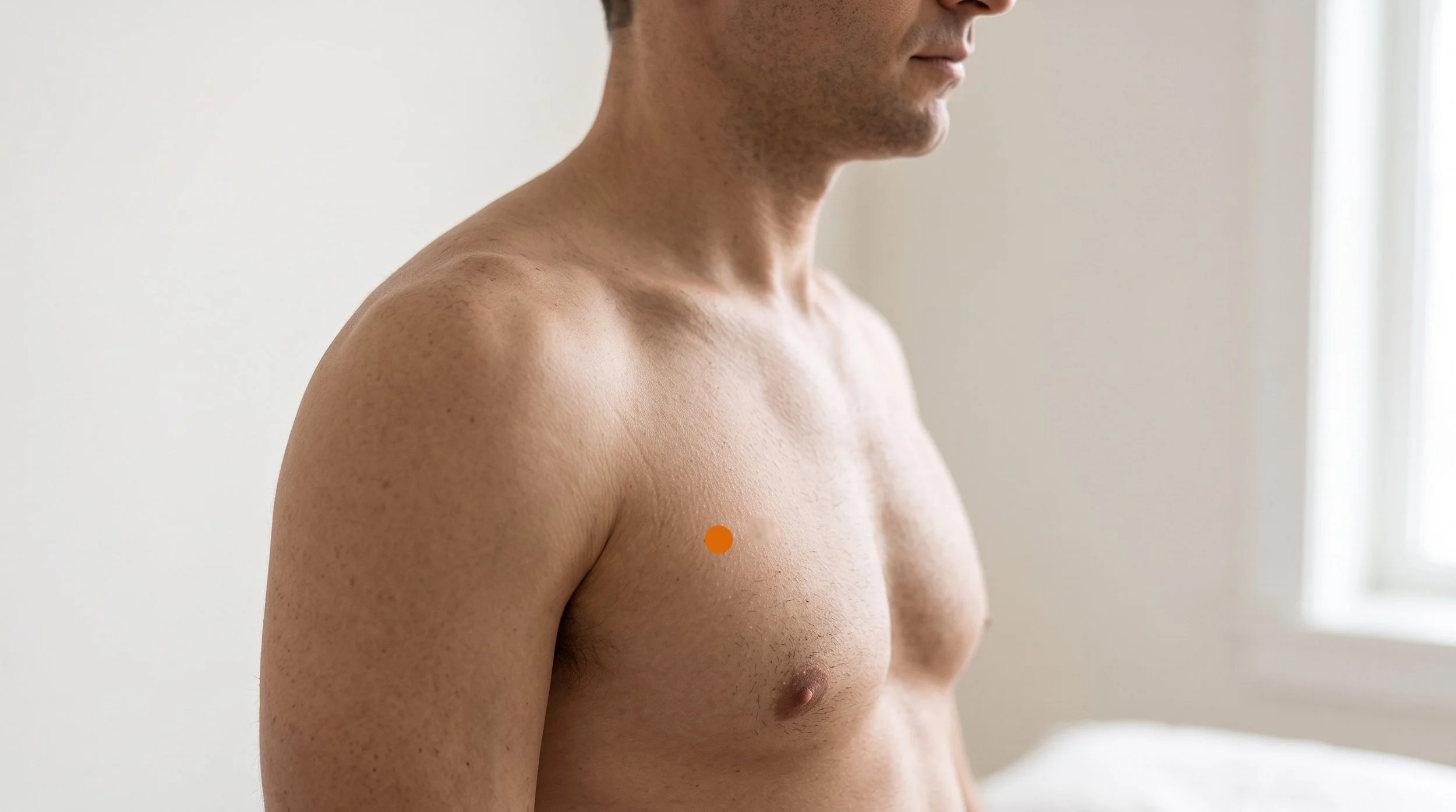
SP19 Acupuncture Point (Xiongxiang)
Chest Village on the Lateral Rib Cage: Anatomy, Segmental Mechanism, and Why This Third Intercostal Space Point Is Used for Chest Tightness and Rib-Side Pain
SP19 (Xiongxiang), translated as Chest Village, is the second-to-last point of the Spleen channel's short run up the side of the chest, sitting in the third intercostal space about 6 cun lateral to the midline, which works out to roughly two thumb-widths outside the nipple line.
In plain terms, it's on the outer chest wall between the third and fourth ribs, in the soft valley where the lateral fibers of pectoralis major hand off to the finger-like slips of serratus anterior. Classical texts group the sp19 acupuncture point with the other lateral chest points as a place to address a bound-up, oppressed feeling in the chest and rib side, and modern clinicians reach for spleen 19 when a patient describes tightness that spreads from the front of the chest around into the upper back, worsens with deep breathing, and never quite resolves with stretching alone. Because the lung sits just beneath, the sp 19 chest location is also one of the clearest examples of why needle angle matters more than needle depth.
- Location and layers: the chest village point lies in the third intercostal space, 6 cun from the midline, with skin, superficial fascia, the lateral border of pectoralis major, a digitation of serratus anterior, and the external and internal intercostal muscles stacked over the pleura, so needling is kept tangential rather than perpendicular (Deadman et al., 2007).
- Traditional attribution, modern translation: classical sources credit Xiongxiang with regulating and descending qi and unbinding the chest, language that maps clinically onto reduced chest wall guarding, easier rib excursion, and a calmer breathing pattern rather than any measurable flow of energy (Deadman et al., 2007; Cunningham, 2019).
- Nerve geography: stimulation here recruits the lateral cutaneous branch of the third intercostal nerve and the muscular layers it supplies, feeding segmental input into upper thoracic dorsal horn levels that also receive afferents from thoracic viscera, a convergence pattern that helps explain why chest wall points are used for chest sensations (Zhao, 2008; Uchida et al., 2017).
- Mechanism beyond the segment: needling activates diffuse descending inhibitory pathways involving endogenous opioid and monoaminergic systems, which is the best-supported account of why acupuncture may reduce pain sensitivity at and beyond the treated area (Zhao, 2008; Vickers et al., 2018).
- Research picture: no trial has isolated SP19, but reviews of acupuncture in respiratory populations report modest improvements in quality-of-life scores when acupuncture is added to standard care, while a sham-controlled inpatient trial found short-term differences in breathlessness ratings and one placebo-controlled cancer dyspnea pilot did not (Hsieh et al., 2019; Levy et al., 2022; Vickers et al., 2005).
- Practice framing and de qi: patients usually feel a dull, spreading fullness along the rib space that some describe as a band loosening, and the safety conversation is straightforward, since pneumothorax remains the most commonly reported serious acupuncture complication and is avoided by angling along the intercostal space (Xu et al., 2013; Deadman et al., 2007).
Chest Tightness That Doesn't Ease With Stretching?
If your chest and rib side feel bound, if deep breaths catch, and if the tightness wraps into your upper back, the pattern is often muscular and neurologic rather than structural. At Morningside Acupuncture, we combine gentle tangential needling at SP19 with dry needling of pectoralis major, serratus anterior, and the intercostals, then check how your rib cage moves before and after. Treatment is paired with simple breathing retraining so the change holds between visits. Schedule a session and let's look at what your chest wall is actually doing.
Schedule NowAnatomy of SP19: Why the Third Intercostal Space Is Such an Important Location
Finding SP19 starts with counting ribs rather than guessing. The second intercostal space sits just below the sternal angle, the small ridge you can feel where the manubrium meets the body of the sternum, and counting down one space from there lands you in the third. From the midline, measure 6 cun laterally, which is two cun outside the mamillary line, since the midline to nipple distance is standardized at 4 cun (Deadman et al., 2007).
What sits under your finger at that spot is a layered structure: thin skin and subcutaneous fat, the lateral edge of pectoralis major, a slip of serratus anterior wrapping the rib cage toward the scapula, then the external and internal intercostal muscles bridging the space itself. These are the tissues loaded by desk posture, overhead lifting, forceful coughing, chronic upper chest breathing, and the guarding that follows a rib injury.
Sensory supply to this area comes largely from the lateral cutaneous branch of the third intercostal nerve, with motor input to the overlying muscles from the lateral pectoral and long thoracic nerves. That matters because the upper thoracic segments receiving this input also receive afferent traffic from thoracic viscera, and convergence of somatic and visceral inputs onto shared dorsal horn neurons is a well-described feature of spinal organization.
Needling somatic tissue at a given segment can modulate activity in that segment and can trigger reflex autonomic responses whose size and direction depend on where the stimulus is applied (Uchida et al., 2017). Layered on top of this local effect are the diffuse mechanisms studied for decades in acupuncture analgesia research, including endogenous opioid release and descending inhibition from brainstem structures (Zhao, 2008), which is why patients often report a general settling rather than a purely local change.
Deep to the intercostal muscles lie the endothoracic fascia, parietal pleura, and lung, and the intercostal vessels and nerve run in the costal groove along the lower border of the rib above. Both facts drive the needling convention. The needle goes in transverse to oblique along the plane of the intercostal space, typically 0.5 to 1 cun, hugging the direction of the ribs rather than pointing into the chest, and perpendicular insertion here is explicitly cautioned against, particularly in slim patients where the pleura is close to the surface (Deadman et al., 2007).
Pneumothorax remains the most frequently reported serious complication in the acupuncture safety literature, and essentially all of it is preventable with anatomical care and shallow, angled technique (Xu et al., 2013).
Related Serratus Anterior Trigger Points Related Intercostal Muscles Trigger PointsSP19 at a Glance: Classification, Location, and Clinical Use
| Category | Detail |
|---|---|
| Traditional Name | Xiongxiang (Chest Village, also rendered Chest Home) |
| Channel Classification | Nineteenth point of the Spleen channel of the foot taiyin, in the chest region group of Spleen points (SP17 to SP21) |
| Point Categories | No five-shu, luo-connecting, xi-cleft, back-shu, front-mu, hui-meeting, or extraordinary vessel intersection status is recorded for SP19 in the reference texts. It's a regular channel point classed by region, one of the lateral chest points traditionally described as unbinding the chest, sitting one space above SP18 and below SP20 on the Spleen line (Deadman et al., 2007; Cunningham, 2019). |
| Precise Location | On the lateral chest in the third intercostal space, 6 cun lateral to the anterior midline, which is 2 cun lateral to the nipple line. In men the nipple almost always sits in the fourth intercostal space, so SP19 is one space above nipple level. Count spaces down from the second, which lies just below the sternal angle. |
| Tissue Stimulated | Skin and superficial fascia, lateral fibers of pectoralis major, a digitation of serratus anterior, and the external and internal intercostal muscles, in the territory of the lateral cutaneous branch of the third intercostal nerve |
| Needle Depth / Direction | Transverse to oblique insertion along the line of the intercostal space, 0.5 to 1 cun, staying in the plane of the space. Perpendicular or deep insertion is avoided because of pneumothorax risk, which is higher in thin patients. Moxibustion is described as applicable in some texts. |
| De Qi Sensation | A dull, spreading fullness or mild ache along the rib space, sometimes felt as a band easing across the side of the chest. Sharp pain, a cough reflex, or any breathlessness means the needle is withdrawn and the technique reassessed. |
| Primary Clinical Uses | Traditionally used for fullness and pain of the chest and rib side extending to the back, difficulty turning or settling when lying down, cough, and shortness of breath. In modern practice it's used for lateral chest wall tension, intercostal soreness, and myofascial chest pain once cardiac and pulmonary causes have been excluded. |
| Common Point Combinations |
|
Deadman, Al-Khafaji, and Baker's A Manual of Acupuncture presents Xiongxiang with a compact set of traditional attributions: it regulates and descends qi and unbinds the chest, and its indications cluster around fullness of the chest and lateral costal region that extends through to the back, along with cough and shortness of breath. One classical detail stands out from the rest of the list, the inability to turn over comfortably when lying down, which is presented as part of the same chest-binding pattern rather than as a separate complaint.
Cunningham's point text keeps a similar frame, describing SP19 as a local point for chest pain, tightness, and cough, and adding intercostal neuralgia to the modern indications, and the Shanghai text likewise reduces it largely to intercostal nerve pain.
Read as traditional attribution rather than physiology, that grouping is striking because of how consistently it describes a positional, breath-linked complaint: the discomfort isn't just where the chest is touched, it's what happens when the chest is asked to expand, rotate, or bear weight against a mattress.
Why SP19 Is Used for Chest Tightness That Wraps Into the Upper Back
Patients are often surprised that a point on the front-outer chest is chosen for a symptom they feel behind the shoulder blade. The explanation is segmental. The third intercostal nerve, the muscles of that rib space, the skin over it, and the corresponding thoracic spinal level all share the same neurological neighborhood, and sensory neurons from these different tissues converge onto overlapping populations of dorsal horn cells.
When one part of that segment is irritated, the brain's read on where the trouble sits becomes imprecise, which is why chest wall problems commonly present as a wraparound band rather than a pinpoint. Needling within the same segment gives the nervous system a strong, clean, competing input at exactly the level that's been noisy (Zhao, 2008).
There's a second layer that's less local. Needle stimulation reliably engages descending inhibitory systems from the brainstem, involving endogenous opioids and monoamine transmitters, which dampen nociceptive transmission more broadly than a single segment (Zhao, 2008). Somatic stimulation can also drive reflex autonomic changes, with the direction and magnitude depending heavily on the body region stimulated, which is one plausible reason chest and abdominal points behave differently from limb points in practice (Uchida et al., 2017). For a patient, this often shows up as a slower, lower, easier breath during the treatment rather than a dramatic change in the sore spot.
None of this means SP19 does something the surrounding tissue can't. It means that a needle placed carefully in a loaded intercostal space, in the right plane and at the right segment, is a targeted way to reach tissue that's hard to influence with stretching. The large individual patient data analysis of acupuncture for chronic pain found effects that were modest but persistent over time and larger than sham comparison, which is the realistic expectation to set for any single point in a wider protocol (Vickers et al., 2018).
What the Research Shows for SP19
Almost all of the useful research here tests multi-point protocols for a condition, not individual points, so no study can tell you what SP19 contributes on its own. What the literature can do is set expectations for the categories SP19 is used in: chronic musculoskeletal pain, chest and breathing-related symptoms, and the safety profile of needling over the thorax. The picture is mixed and mostly modest, with better evidence in chronic pain than in breathlessness, and it's worth reading the negative trials alongside the positive ones.
| Study | Type | Focus | Key Finding |
|---|---|---|---|
| Vickers et al., 2018 | Individual patient data meta-analysis | Acupuncture for chronic musculoskeletal, headache, and osteoarthritis pain across nearly 21,000 patients | Acupuncture was associated with modest but statistically significant reductions in pain versus both sham and no-acupuncture controls, with effects largely sustained over a year. |
| Hsieh et al., 2019 | Systematic review and meta-analysis | Body acupuncture added to medication in chronic obstructive pulmonary disease | Pooled results across 12 trials suggested improved health-related quality of life scores when acupuncture was added to usual medication, though trial quality varied. |
| Levy et al., 2022 | Three-arm double-blinded randomized sham-controlled trial | Inpatient acupuncture during acute exacerbations of COPD | Dyspnea ratings differed significantly between arms from the first day after treatment through day three, with no adverse events attributed to acupuncture. |
| Vickers et al., 2005 | Randomized placebo-controlled pilot trial | Acupuncture for dyspnea in advanced lung and breast cancer | The technique studied was unlikely to produce effects on breathlessness meaningfully larger than placebo, a useful counterweight to more positive reports. |
| Zhao et al., 2019 | Randomized clinical trial | Acupuncture added to standard antianginal therapy in chronic stable angina | Needling points on the disease-affected meridian reduced angina attack frequency more than non-affected meridian, sham, and waitlist groups, and was safely administered. |
| Xu et al., 2013 | Systematic review of case reports | Serious adverse events reported after acupuncture | Pneumothorax was the most commonly reported organ injury, reinforcing that chest points require shallow, angled technique and sound anatomical knowledge. |
| Uchida et al., 2017 | Narrative review of somatoautonomic physiology | Reflex autonomic responses to somatic stimulation relevant to acupuncture | Somatic stimulation can produce measurable autonomic reflex changes whose direction depends on the body region stimulated, though most data come from anesthetized animals. |
Rib-Side Pain and Shortness of Breath in NYC?
Persistent rib-side soreness, a stitch that never fully clears, and breathing that feels effortful can all involve chest wall muscles that have stopped sharing load evenly. Our clinicians use Xiongxiang alongside PC6, CV17, and thoracic paraspinal points as part of a wider treatment, always after ruling in a musculoskeletal picture and referring out when symptoms suggest something else. Most patients notice easier rib excursion within the first few sessions. Book an evaluation and we'll map your pattern carefully.
Schedule NowSP19 in the Context of Trigger Point Work
The location of the chest village point overlaps neatly with muscles that generate chest and rib-side complaints. Trigger points in the lateral fibers of pectoralis major refer pain across the front of the chest and down the inner arm, serratus anterior is classically associated with lateral chest pain and a sense of not being able to get a full breath, and intercostal trigger points produce well-localized soreness in a single rib space that flares with coughing, twisting, and deep inhalation (Simons et al., 1999).
When a patient's description matches one of these referral patterns, the SP19 location is often already tender on palpation before any needle is considered.
At Morningside Acupuncture, SP19 is rarely used alone. A typical session might include tangential needling at the point itself, dry needling of pectoralis major and pectoralis minor for anterior tightness, serratus anterior along the rib slips for lateral chest complaints, and thoracic paraspinal work at the matching segmental level to address the back of the same band. Because acupuncture and dry needling both mean the use of an acupuncture needle, this isn't a switch between two therapies, it's one continuous approach that draws on classical point locations and myofascial anatomy together.
Over the chest, technique stays conservative regardless of the framework: shallow angles, rib-directed insertion, and clear communication with the patient throughout.
SP19 Chest and Rib Pain Treatment at NYC's Highest-Rated Acupuncture Clinic
Morningside Acupuncture is the highest-rated acupuncture and dry needling clinic in New York City with over 500 five-star Google reviews, and chest wall and rib-side complaints are a regular part of our caseload. We treat spleen 19 as one piece of a full assessment that includes posture, breathing mechanics, and trigger point examination of the pectoral and serratus groups. Every session is delivered with sterile single-use needles and conservative, plane-respecting technique on the chest. Schedule your visit and start with a clear plan rather than guesswork.
Schedule NowFrequently Asked Questions
What does SP19 feel like when needled?
Most people feel a light pinch at the skin, then a dull, spreading fullness or heaviness along the rib space, sometimes described as a band loosening across the side of the chest. Because the needle travels along the intercostal space rather than into it, the sensation stays superficial and broad rather than deep and sharp. Some patients notice their breath drop lower and slow down within a minute or two. Sharp pain, a sudden urge to cough, or any change in breathing is not the expected response, and the needle should be removed if any of those occur.
Why needle the front of the chest for pain I feel in my upper back?
Because the chest wall is a continuous ring and the nervous system reads it segmentally. The nerve serving the third intercostal space runs from the thoracic spine around the rib cage to where SP19 sits, so a problem anywhere along that path can be felt anywhere else along it. Classical texts noticed the same thing without the neuroanatomy, listing chest and rib-side fullness that extends to the back as a single pattern for this point (Deadman et al., 2007). Modern pain science calls it segmental convergence, and it's the reason we often treat both ends of the band in the same session (Zhao, 2008).
Can I press SP19 myself between sessions?
Yes, acupressure here is safe when it's done gently. Find the sternal angle, the small ridge on your breastbone, slide one finger-width below it into the second intercostal space, then count down one more space to the third. Move your fingers laterally about two thumb-widths past the nipple line, staying on the rib cage and off breast tissue. Use the flat pads of two fingers, not a fingertip, and press with light to moderate pressure for 30 to 60 seconds while exhaling slowly, then release and repeat two or three times per side. Once or twice a day is plenty. Stop if pressure produces sharp pain, and do not use acupressure to manage chest pain that hasn't been medically evaluated.
Is SP19 safe to needle?
It's safe in trained hands and requires respect. The lung lies beneath the intercostal muscles at this location, which is why the standard technique is transverse to oblique insertion of 0.5 to 1 cun along the plane of the rib space, and why perpendicular insertion is specifically cautioned against, especially in thin patients (Deadman et al., 2007). Pneumothorax is consistently the most commonly reported serious complication in acupuncture case report reviews, and it's largely a technique and anatomy issue rather than an unavoidable one (Xu et al., 2013). Practitioners should also avoid needling directly into breast tissue, use sterile single-use needles, and screen for anything suggesting a cardiac or pulmonary cause of chest symptoms before treating the chest wall at all.
Where exactly is SP19 located?
SP19 sits on the side of the chest in the third intercostal space, 6 cun lateral to the anterior midline, which is 2 cun lateral to the nipple line since the midline to nipple measurement is 4 cun. The most reliable way to count is downward from the second intercostal space, which lies immediately below the sternal angle. In men the nipple nearly always falls in the fourth intercostal space, so SP19 is one space above and slightly outside nipple level (Deadman et al., 2007). SP18 sits one space below it in the fourth intercostal space, and SP20 sits one space above in the second.
References
- Deadman, P., Al-Khafaji, M., & Baker, K. (2009). A manual of acupuncture. Journal of Chinese Medicine Publications.
- Cunningham, P. M. (2000). Acupuncture points: A practical guide to classical and modern usage. Odyssey Press.
- Simons, D. G., Travell, J. G., & Simons, L. S. (1999). Travell & Simons' myofascial pain and dysfunction: The trigger point manual, Vol. 1: Upper half of body (2nd ed.). Williams & Wilkins.
- Zhao, Z. Q. (2008). Neural mechanism underlying acupuncture analgesia. Progress in Neurobiology, 85(4), 355-375. https://doi.org/10.1016/j.pneurobio.2008.05.004
- Vickers, A. J., Vertosick, E. A., Lewith, G., MacPherson, H., Foster, N. E., Sherman, K. J., Irnich, D., Witt, C. M., & Linde, K. (2018). Acupuncture for chronic pain: Update of an individual patient data meta-analysis. Journal of Pain, 19(5), 455-474. https://doi.org/10.1016/j.jpain.2017.11.005
- Uchida, S., Kagitani, F., & Sato-Suzuki, I. (2017). Somatoautonomic reflexes in acupuncture therapy: A review. Autonomic Neuroscience, 203, 1-8. https://doi.org/10.1016/j.autneu.2016.11.001
- Hsieh, P.-C., Yang, M.-C., Wu, Y.-K., Chen, H.-Y., Tzeng, I.-S., Hsu, P.-S., Lee, C.-T., Chen, C.-L., & Lan, C.-C. (2019). Acupuncture therapy improves health-related quality of life in patients with chronic obstructive pulmonary disease: A systematic review and meta-analysis. Complementary Therapies in Clinical Practice, 35, 208-218. https://doi.org/10.1016/j.ctcp.2019.02.016
- Levy, I., Elimeleh, Y., Gavrieli, S., Attias, S., Schiff, A., Oliven, A., & Schiff, E. (2022). Treatment of acute exacerbations of chronic obstructive pulmonary disease with acupuncture during hospitalization: A three-arm double-blinded randomized sham-controlled trial. Acupuncture in Medicine, 40(6), 505-515. https://doi.org/10.1177/09645284221086293
- Vickers, A. J., Feinstein, M. B., Deng, G. E., & Cassileth, B. R. (2005). Acupuncture for dyspnea in advanced cancer: A randomized, placebo-controlled pilot trial. BMC Palliative Care, 4, 5. https://doi.org/10.1186/1472-684X-4-5
- Zhao, L., Li, D., Zheng, H., Chang, X., Cui, J., Wang, R., Shi, J., Fan, H., Li, Y., Sun, X., Zhang, F., Wu, X., & Liang, F. (2019). Acupuncture as adjunctive therapy for chronic stable angina: A randomized clinical trial. JAMA Internal Medicine, 179(10), 1388-1397. https://doi.org/10.1001/jamainternmed.2019.2407
- Xu, S., Wang, L., Cooper, E., Zhang, M., Manheimer, E., Berman, B., Shen, X., & Lao, L. (2013). Adverse events of acupuncture: A systematic review of case reports. Evidence-Based Complementary and Alternative Medicine, 2013, 581203. https://doi.org/10.1155/2013/581203
Disclaimer: This web site is intended for educational and informational purposes only. Reading this website does not constitute providing medical advice or any professional services. This information should not be used for diagnosing or treating any health issue or disease. Those seeking medical advice should consult with a licensed physician. Seek the advice of a medical doctor or other qualified health professional for any medical condition. If you think you have a medical emergency, call 911 or go to the emergency room. No acupuncturist-patient relationship is created by reading this website or using the information. Morningside Acupuncture PLLC and its employees and contributors do not make any express or implied representations with respect to the information on this site or its use. For any legal interpretation of scope of practice in your state, consult a licensed attorney or regulatory authority.
Read more from our blog



