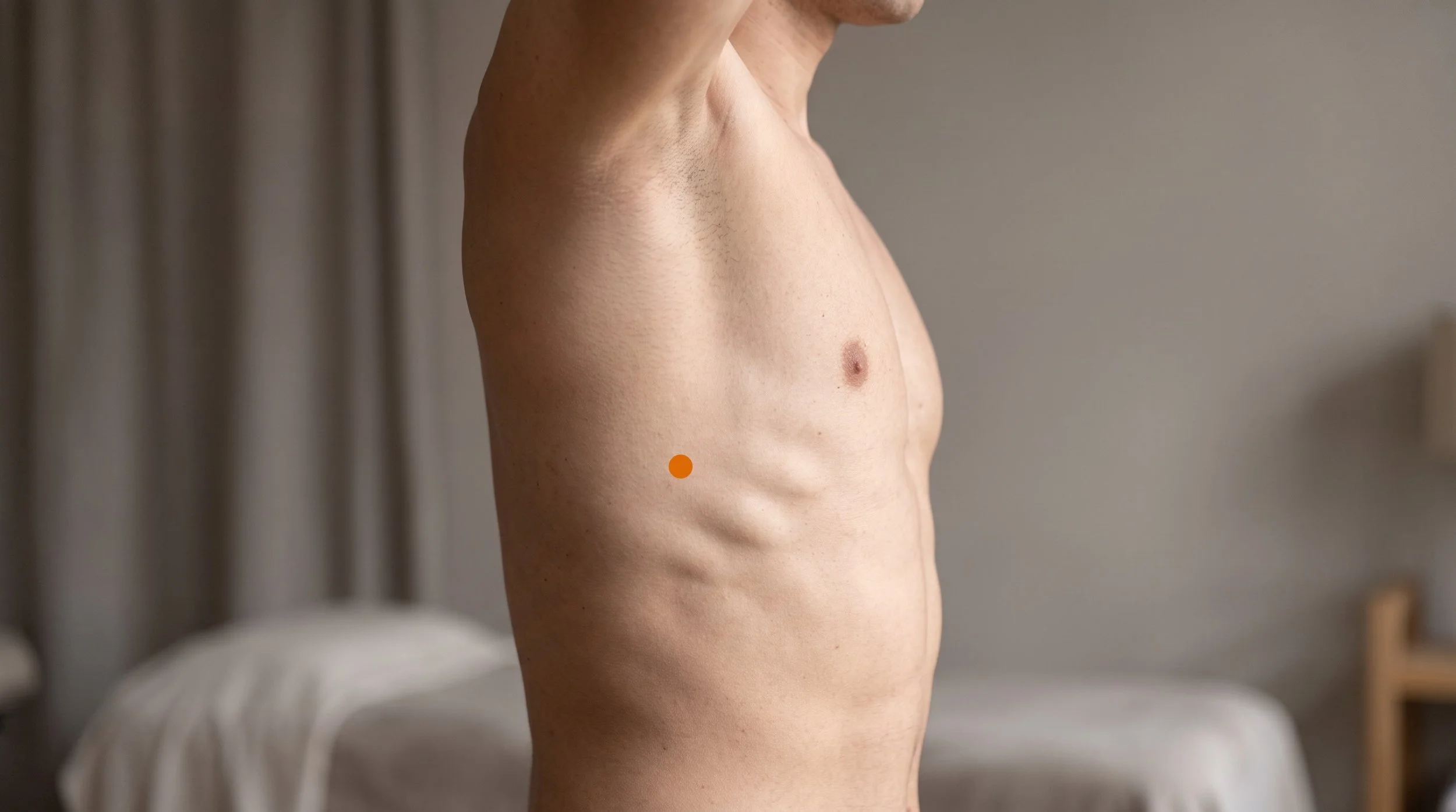
SP21 Acupuncture Point (Dabao)
Great Wrapping on the Side of the Ribcage: Anatomy, Mechanism, and Why the Great Luo of the Spleen Anchors Rib, Breathing, and Whole-Body Pain Treatment
SP21 (Dabao, translated as Great Wrapping or Big Wrapping) is the final point of the Spleen channel and the one point in the system classed as a great luo-connecting point (Deadman et al., 2007). You will find it high on the side of the chest, on the mid-axillary line, in the seventh intercostal space, with several texts placing it one space higher in the sixth.
In plain terms, drop a straight line down from the peak of the armpit and slide into the soft gap between two ribs. What makes the sp21 acupuncture point clinically interesting is that it sits directly over serratus anterior and the intercostal muscles, exactly where patients with rib cage tightness, painful deep breaths, and post-cough or post-training side pain tend to point when asked to show where it hurts. Spleen 21 is therefore both a classical point with unusually broad traditional claims and a very practical local target for the lateral chest wall.
- Location and layers: SP21 lies on the mid-axillary line in the seventh intercostal space, with some sources placing it in the sixth, and the needle passes through thin skin and superficial fascia into the digitations of serratus anterior overlying the intercostal muscles (Deadman et al., 2007).
- Traditional category translated: Spleen 21 is the great luo of the Spleen, described in classical sources as governing distribution of blood through the finest connecting vessels, which in modern language is best read as a statement about a widely branching, whole-body regulatory idea rather than a literal circulatory claim (Deadman et al., 2007).
- Mechanism: needling here stimulates the lateral cutaneous branch of the mid-thoracic intercostal nerve and the muscle it supplies, feeding segmental input into dorsal horn levels that also receive convergent input from deeper thoracic structures, a plausible route for local pain modulation (Zhao, 2008).
- Research picture: no trial has isolated SP21, but acupuncture protocols have been tested for acute rib fracture pain with improvements in pain and inspiratory volume compared with sham (Liu et al., 2022), and pooled data across chronic musculoskeletal pain show modest, durable effects (Vickers et al., 2018).
- Clinical practice framing: at Morningside we use sp 21 ribs work mostly as a local point for lateral chest wall pain, serratus and intercostal tension, and restricted breathing mechanics, layered with distal points rather than used alone.
- De qi and safety: the sensation is usually a dull spreading ache or warmth that fans along the rib space, sometimes with a sense of the ribs releasing on the next inhale, and the needle is always angled along the intercostal space because perpendicular insertion over the ribcage carries real pneumothorax risk (Deadman et al., 2007; Xu et al., 2013).
Struggling With Rib Pain That Gets Worse When You Breathe?
Pain along the side of the ribcage often has more to do with serratus anterior, the intercostals, and guarded breathing mechanics than with anything structurally alarming, once red flags have been ruled out. Our acupuncturists use SP21 together with careful palpation of the rib spaces and gentle needling angled along the intercostal plane, so the treatment is precise and comfortable. We pair that local work with distal points and breathing retraining so the change carries over between visits. Schedule a visit and let us assess what is actually driving your rib pain.
Schedule NowAnatomy of SP21: Why the Mid-Axillary Line at the Seventh Rib Space Is Such an Important Location
Surface to deep, SP21 is one of the thinner regions on the trunk. Under the skin and a modest layer of subcutaneous fat sit the fleshy slips of serratus anterior, which arise from the upper eight or nine ribs and wrap around the chest wall toward the shoulder blade. Beneath serratus lie the external and internal intercostal muscles filling the rib space, and beneath those, the pleura and lung. Serratus anterior works constantly during pushing, reaching overhead, carrying, swimming strokes, and hard coughing, and the intercostals load with every breath.
That combination is why the tissue at Spleen 21 so often feels ropey or exquisitely tender in people who train upper body pushing patterns, who have recently had a respiratory infection, or who sit hunched and breathe shallowly for long stretches (Deadman et al., 2007; Simons et al., 1999).
The nerve geography here is straightforward and useful. Each intercostal nerve gives off a lateral cutaneous branch that pierces the chest wall right around the mid-axillary line, which is precisely the vertical line SP21 sits on. This is the same neural territory anesthesiologists target with fascial plane blocks between serratus anterior and the ribs when treating lateral chest wall and rib fracture pain, which tells you how much sensory traffic passes through this small area.
Needling into that field produces a burst of A-delta and C-fiber input into mid-thoracic dorsal horn segments, where somatic input from the chest wall converges with input from deeper thoracic structures. Repeated stimulation of that convergent zone is one mechanism by which acupuncture may reduce local sensitization and pain report, alongside recruitment of brainstem descending inhibitory pathways (Zhao, 2008).
Motor supply to serratus anterior itself comes from the long thoracic nerve, so changes in tenderness and ease of breathing after treatment reflect a mix of sensory modulation and reduced muscular guarding rather than any single tidy pathway.
The deep structure that matters most here is the lung. Because the chest wall at the mid-axillary line is thin, especially in lean patients, needling convention is strict: transverse-oblique insertion along the line of the intercostal space to a depth of roughly 0.5 to 1 cun, never perpendicular toward the chest cavity (Deadman et al., 2007). Kept in that plane, the needle stays superficial to the pleura and remains within serratus and the outer intercostal layer.
Pneumothorax remains the most frequently reported serious organ injury in acupuncture case report reviews, and nearly all of it is attributable to angle and depth errors over the thorax rather than to needling the thorax at all (Xu et al., 2013). A clinician who palpates the ribs, angles along the space, and uses appropriate needle length can treat this region safely.
Related Serratus Anterior Trigger Points Related Intercostal Muscles Trigger PointsSP21 at a Glance: Classification, Location, and Clinical Use
| Category | Detail |
|---|---|
| Traditional Name | Dabao, translated as Great Wrapping or Big Wrapping |
| Channel Classification | Spleen channel of foot taiyin; the last point of the channel, on the lateral chest wall |
| Point Categories | Great luo-connecting point of the Spleen, the additional luo point that joins the twelve channel luo points along with CV15 and GV1; no five-shu, hui-meeting, or extraordinary vessel designations are given for this point in the source texts |
| Precise Location | On the side of the chest at the mid-axillary line, in the seventh intercostal space, with some sources placing it in the sixth. Count spaces downward from the second intercostal space just below the sternal angle, and draw the mid-axillary line vertically down from the apex of the armpit (HT1). |
| Tissue Stimulated | Skin and superficial fascia, digitations of serratus anterior, and the outer layer of the intercostal muscles within the rib space |
| Needle Depth / Direction | Transverse to oblique insertion along the intercostal space, 0.5 to 1 cun. Perpendicular insertion is avoided over the ribcage because of substantial pneumothorax risk, particularly in thin patients. |
| De Qi Sensation | A dull, spreading ache or warmth that travels along the rib space, occasionally with a light pressure sensation under the arm and a feeling that the side of the ribcage lets go on the next inhale. Sharp or stabbing sensation means the angle should be adjusted. |
| Primary Clinical Uses | Lateral rib cage pain including pain on breathing, serratus and intercostal tension, restricted or guarded breathing mechanics, and in classical usage generalized body aching (excess pattern) or weak, heavy limbs (deficiency pattern) |
| Common Point Combinations |
|
The Deadman compendium gathers what the classical record says about this point, and it is a short but unusual list. The name pairs a character meaning great with one meaning to wrap or envelop, and the Spiritual Pivot describes the great luo of the Spleen emerging below the armpit and spreading across the chest and rib side, embracing the blood of all the connecting vessels, with pain of the whole body when it is in excess and slackness of the hundred joints when it is deficient (Deadman et al., 2007).
Later commentary on the connecting channels attributes to this point a supervisory role over blood throughout the body, which is consistent with the traditional designation of the Spleen as ruler of blood (Shanghai College of Traditional Chinese Medicine, 1981). The Ode to Elucidate Mysteries adds that Dabao governs the upper region of the body, paired with ST25 for the middle and SP8 for the lower.
What is striking is the gap between those grand claims and the record of use: despite being credited with whole-body reach, this point appears in essentially no combinations in the major classical texts, which makes it one of the most theoretically weighted and least practically documented points in the system.
Why SP21 Is Used for Whole-Body Aching and Not Just Local Rib Pain
The local logic is easy. Pain on the side of the ribcage, pain that spikes on a deep inhale or a cough, and the ache under the arm that follows a heavy pressing session are almost always coming from serratus anterior and the intercostals, the two tissues SP21 sits directly on. Needling into a tender segment of that tissue delivers concentrated input into the mid-thoracic dorsal horn through the lateral cutaneous branches of the intercostal nerves.
Because those same segments receive convergent input from deeper thoracic structures, patients often describe relief that feels broader than the needle site itself, with the chest simply expanding more easily (Zhao, 2008).
The whole-body claim needs more careful framing. Classical texts attributed generalized aching and limb heaviness to this point because of a theoretical model about the distribution of blood through the finest connecting vessels, not because of any measured systemic effect (Deadman et al., 2007). What modern pain science can offer is a partial parallel rather than a translation.
Needle stimulation anywhere on the body engages spinal and supraspinal circuitry, including brainstem descending inhibitory pathways and endogenous opioid and monoaminergic systems, which is why acupuncture effects are not confined to the segment treated (Zhao, 2008). That gives a rationale for including a chest wall point in a treatment aimed at diffuse pain, though it does not validate the classical explanation.
Practically, this means we tend to use Spleen 21 when the lateral chest wall is genuinely involved, and we do not treat it as a standalone remedy for widespread pain. In someone with fibromyalgia-type widespread pain and marked rib cage guarding, SP21 may earn a place in a larger protocol. In someone with an isolated intercostal strain from a coughing illness, it may be the main event. Reviews of acupuncture for widespread pain conditions report modest and inconsistent results, which is exactly the expectation we set with patients before starting (Deare et al., 2013).
What the Research Shows for SP21
There is no clinical trial that isolates SP21, and that is worth saying plainly. Acupuncture research almost always tests multi-point protocols, so what the literature can tell us is whether needling helps the categories of problem this point is used for, and whether the mechanisms invoked are plausible. The nearest direct evidence comes from trials of acupuncture for rib fracture pain, where the outcomes measured (pain on deep breathing and inspiratory volume) map closely onto why we reach for a rib space point, even though those protocols used distal points rather than local ones.
| Study | Type | Focus | Key Finding |
|---|---|---|---|
| Liu et al., 2022 | Randomized controlled trial | Acupuncture added to standard care for acute traumatic rib fracture pain | Manual acupuncture using a distal point set was associated with greater reductions in pain and better sustained maximal inspiration than sham laser acupuncture, though the protocol did not include SP21. |
| Vickers et al., 2018 | Individual patient data meta-analysis | Chronic musculoskeletal pain across nearly 21,000 patients | Acupuncture outperformed both sham and no-acupuncture controls by modest but statistically robust margins, with effects largely maintained at one year. |
| Deare et al., 2013 | Cochrane systematic review | Acupuncture for fibromyalgia and widespread pain | Low to moderate quality evidence suggested small short-term improvements in pain and stiffness, with benefits fading over follow-up and no clear advantage over sham in pooled pain data. |
| Zhao, 2008 | Mechanistic review | Neural pathways underlying acupuncture analgesia | Describes segmental spinal processing plus descending inhibitory and neurochemical pathways that plausibly explain effects extending beyond the needled area. |
| Xu et al., 2013 | Systematic review of case reports | Adverse events associated with acupuncture | Pneumothorax was the most frequently reported organ injury, reinforcing tangential needling technique over the ribcage as a basic safety requirement. |
Whole-Body Aching and Heavy, Tired Limbs?
Classical texts attached Dabao to two very different presentations: aching everywhere, and limbs that feel weak and heavy. Modern practice reads that as a reminder to treat widespread, poorly localized pain systemically rather than chasing one sore spot. We combine the sp21 acupuncture point with distal points, targeted dry needling, and a graded activity plan tailored to how you feel through the week. Book an evaluation and we will build a plan around your pattern.
Schedule NowSP21 in the Context of Trigger Point Work
SP21 and the classic serratus anterior trigger point sit in nearly the same real estate. Trigger points in serratus anterior are described along the mid-axillary region over the fifth to seventh ribs, and they characteristically refer pain to the side of the chest, down the inner arm, and toward the lower shoulder blade, often with a complaint of being unable to get a full breath (Simons et al., 1999). Patients frequently arrive convinced something is wrong with the lung or the heart, and a careful exam plus appropriate medical clearance usually reframes it as chest wall pain.
Whether a clinician calls the target Spleen 21 or the serratus anterior trigger point, the needle enters the same tissue: acupuncture is defined by the use of an acupuncture needle, and dry needling is one of the hundreds of styles that use it.
In a typical Morningside session for lateral rib pain, we palpate rib by rib to find the taut, reproducible band, then needle along the intercostal plane at SP21 and adjacent spaces, adding the intercostals themselves where breathing is clearly restricted. We often extend the treatment posteriorly to latissimus dorsi and the thoracic paraspinals, and anteriorly toward pectoralis minor, since guarded breathing rarely involves only one muscle. Electrical stimulation may be added at low intensity when tolerance allows. The needling is then paired with rib mobility drills and slow nasal breathing work so the tissue is asked to use its new range before the next visit.
SP21 Rib and Chest Wall Pain Treatment at NYC's Highest-Rated Acupuncture Clinic
Morningside Acupuncture is the highest-rated acupuncture and dry needling clinic in New York City with over 500 five-star Google reviews, and rib cage and breathing-related pain is something we see often in desk workers, lifters, rowers, and singers. Every session begins with an exam so needling at Spleen 21 is chosen for a reason, not applied from a template. We use clean, tangential needling technique over the ribcage and explain each step before it happens. Schedule your appointment and we will get to work on the side of the ribcage that has been limiting your breath.
Schedule NowFrequently Asked Questions
What does SP21 feel like when needled?
Most people feel a mild pinch at the skin followed by a dull, spreading ache or warmth that fans along the rib space and sometimes toward the shoulder blade. Because the needle lies almost flat under the skin rather than pointing inward, the sensation is usually gentler than at thick muscle points like the glutes. If the underlying serratus or intercostal tissue is irritable, you may feel a brief twitch or a sharp flicker that settles within seconds. Many patients report that the side of the ribcage feels looser on the next deep breath, and mild tenderness for a day afterward is normal.
Why needle the side of my ribcage when my whole body aches?
Two reasons, one traditional and one modern. Traditionally, SP21 is the great luo of the Spleen, credited in the Spiritual Pivot with whole-body reach and specifically with pain everywhere in excess patterns and slack, weak joints in deficiency patterns (Deadman et al., 2007). In modern terms, that is a theoretical framework rather than a measured mechanism, but there is a real physiological point nearby: needle stimulation engages descending inhibitory pathways that are not limited to the treated segment, so effects can extend beyond the needle site (Zhao, 2008). In practice we include Spleen 21 for widespread aching when the chest wall itself is also guarded or tender, and we combine it with distal points rather than relying on it alone.
Can I press SP21 myself between sessions?
Yes, and acupressure here is easy to do safely because you are only pressing, not penetrating. Sit or stand, raise the arm on the side you want to treat and rest that hand behind your head, which opens the rib spaces. Find the mid-axillary line by dropping straight down from the peak of your armpit, then walk your fingertips down the ribs until you find a soft gap that feels tender or ropey, usually around the level of the lower tip of the shoulder blade. Press with the flat pads of two or three fingers using moderate pressure for 30 to 60 seconds while breathing slowly into that side, then release and repeat two or three times per side, up to a few times a day. Keep total time on any one spot to about three minutes, ease off if you feel sharp pain, over the rib rather than in the space, and stop entirely if you have any chest pain that is new, severe, or accompanied by shortness of breath, since that needs medical evaluation first.
Is SP21 safe to needle?
It is safe in trained hands and requires respect. The chest wall at the mid-axillary line is thin, so the standard technique is transverse to oblique insertion along the intercostal space at 0.5 to 1 cun, never perpendicular into the chest (Deadman et al., 2007). Pneumothorax remains the most commonly reported serious organ injury in reviews of acupuncture case reports, and it is overwhelmingly a technique issue of angle and depth rather than an argument against treating the thorax (Xu et al., 2013). Tell your clinician if you are very lean, have COPD or emphysema, have had thoracic surgery, or are on anticoagulants, and expect a licensed acupuncturist to palpate your ribs carefully before any needle goes in.
Where exactly is SP21 located?
Raise your arm and draw an imaginary vertical line straight down from the apex of your armpit: that is the mid-axillary line. SP21 sits on that line in the seventh intercostal space, although some texts place it in the sixth, and at least one describes it as roughly midway between the armpit and the free end of the eleventh rib. To count accurately, start at the second intercostal space, which lies just below the ridge of the sternal angle, and count downward from there. Because sources disagree by a space, clinicians generally palpate along the mid-axillary line and treat the rib space that is tender and reproduces the patient's symptoms.
References
- Deadman, P., Al-Khafaji, M., & Baker, K. (2009). A manual of acupuncture. Journal of Chinese Medicine Publications.
- O'Connor, J., & Bensky, D. (Eds. & Trans.). (1981). Acupuncture: A comprehensive text. Shanghai College of Traditional Medicine. Eastland Press.
- Simons, D. G., Travell, J. G., & Simons, L. S. (1999). Travell & Simons' myofascial pain and dysfunction: The trigger point manual, Vol. 1: Upper half of body (2nd ed.). Williams & Wilkins.
- Liu, C.-T., Hsieh, T.-M., Wu, B.-Y., Huang, Y.-C., Shih, C.-H., Hu, W.-L., Tsai, M.-Y., & Chen, Y.-H. (2022). Acupuncture analgesia in patients with traumatic rib fractures: A randomized-controlled trial. Frontiers in Medicine, 9, 896692. https://doi.org/10.3389/fmed.2022.896692
- Vickers, A. J., Vertosick, E. A., Lewith, G., MacPherson, H., Foster, N. E., Sherman, K. J., Irnich, D., Witt, C. M., & Linde, K. (2018). Acupuncture for chronic pain: Update of an individual patient data meta-analysis. Journal of Pain, 19(5), 455-474. https://doi.org/10.1016/j.jpain.2017.11.005
- Deare, J. C., Zheng, Z., Xue, C. C. L., Liu, J. P., Shang, J., Scott, S. W., & Littlejohn, G. (2013). Acupuncture for treating fibromyalgia. Cochrane Database of Systematic Reviews, 2013(5), CD007070. https://doi.org/10.1002/14651858.CD007070.pub2
- Zhao, Z. Q. (2008). Neural mechanism underlying acupuncture analgesia. Progress in Neurobiology, 85(4), 355-375. https://doi.org/10.1016/j.pneurobio.2008.05.004
- Xu, S., Wang, L., Cooper, E., Zhang, M., Manheimer, E., Berman, B., Shen, X., & Lao, L. (2013). Adverse events of acupuncture: A systematic review of case reports. Evidence-Based Complementary and Alternative Medicine, 2013, 581203. https://doi.org/10.1155/2013/581203
Disclaimer: This web site is intended for educational and informational purposes only. Reading this website does not constitute providing medical advice or any professional services. This information should not be used for diagnosing or treating any health issue or disease. Those seeking medical advice should consult with a licensed physician. Seek the advice of a medical doctor or other qualified health professional for any medical condition. If you think you have a medical emergency, call 911 or go to the emergency room. No acupuncturist-patient relationship is created by reading this website or using the information. Morningside Acupuncture PLLC and its employees and contributors do not make any express or implied representations with respect to the information on this site or its use. For any legal interpretation of scope of practice in your state, consult a licensed attorney or regulatory authority.
Read more from our blog



