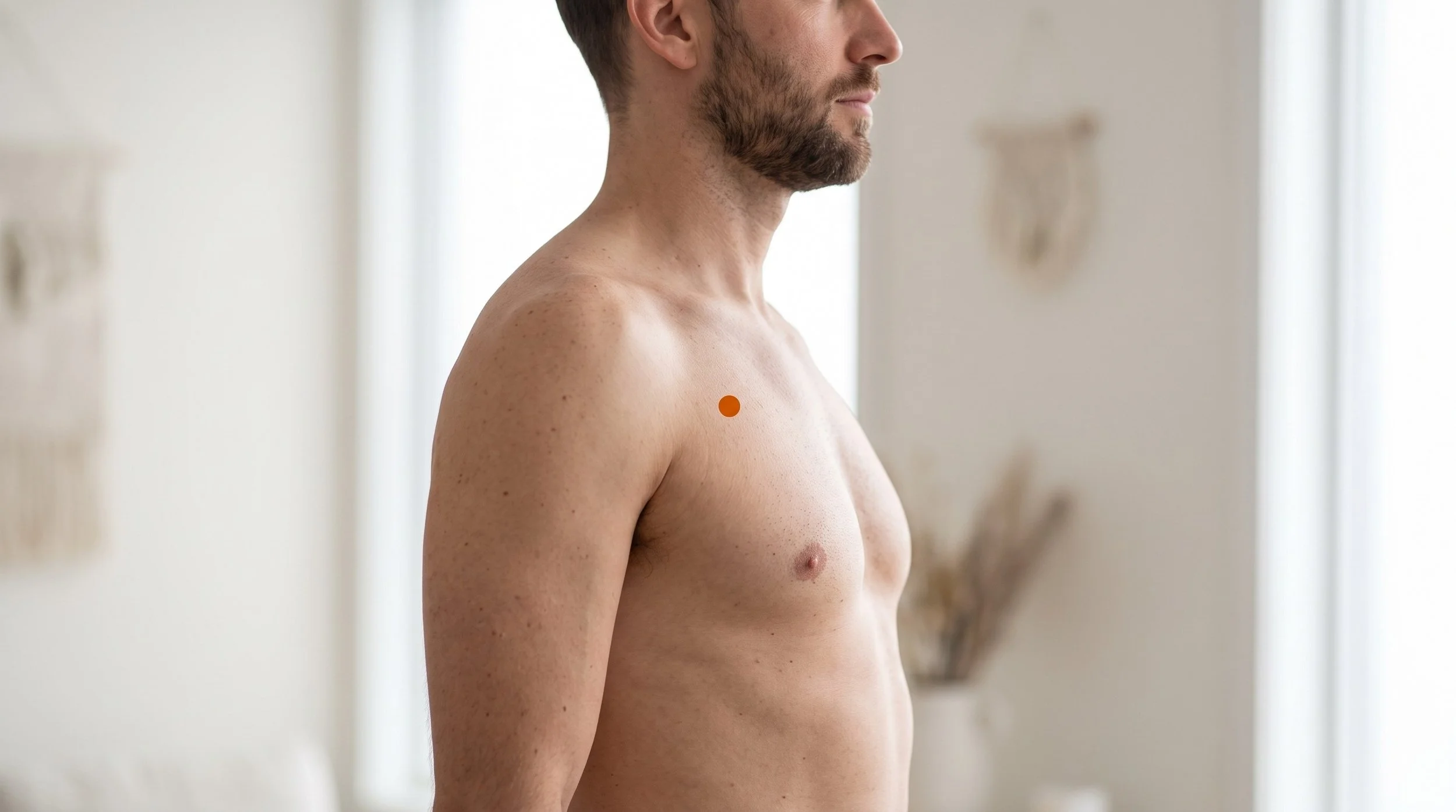
SP20 Acupuncture Point (Zhourong)
Encircling Glory in the Second Rib Space: Anatomy, Mechanism, and Why the Highest Spleen Channel Point Belongs in Upper Chest and Breathing Work
SP20 (Zhourong), translated as Encircling Glory, is the twentieth and highest point of the Spleen channel, sitting on the upper chest in the second intercostal space, roughly 6 cun lateral to the midline and one rib space directly below LU1.
In plain terms, it's the soft hollow you can feel between the second and third ribs, out toward the front of the shoulder, buried under the fibers of pectoralis major. Classical texts group it with the chest and lateral costal points and describe it as regulating and descending qi and unbinding the chest, which in modern language maps onto a small, well innervated window into the upper chest wall: a region that gets loaded by desk posture, shallow breathing, and heavy pressing work, and that shares spinal segments with the airway and heart.
It's also one of the points where technique matters more than theory, because the pleura sits close beneath and the needle stays flat in the plane of the rib space.
- SP20 lies in the second intercostal space about 6 cun from the anterior midline, one space below LU1, with the needle passing through skin, fascia, and pectoralis major toward the upper field of pectoralis minor and the intercostal muscles, never straight down toward the pleura (Deadman et al., 2007).
- Traditional sources attribute to SP20 the actions of regulating and descending qi and unbinding the chest, with classical indications clustered around chest and rib-side fullness, cough with copious phlegm, shortness of breath, and difficulty swallowing food with a desire for fluids (Deadman et al., 2007; Kim, 2010).
- Neurophysiologically, the point sits in territory served by the lateral cutaneous branch of the second intercostal nerve and pectoral nerve branches to pectoralis major, so stimulation feeds segmental input into the upper thoracic dorsal horn where somatic and visceral afferents converge (Chinese Acupuncture and Moxibustion; Zhao, 2008).
- Needling also recruits the broader descending inhibitory and autonomic machinery that has been mapped for acupuncture generally, including opioid and monoamine mediated pain modulation and measurable shifts in heart rate variability toward parasympathetic predominance (Zhao, 2008; Hamvas et al., 2023).
- The research picture for chest points is indirect but not empty: trials and reviews in chronic respiratory disease suggest acupuncture protocols may reduce breathlessness and improve exercise capacity, while lung function measures usually don't move (Suzuki et al., 2012; Yu et al., 2024).
- De qi at SP20 is usually a heavy, spreading ache or distention that fans across the upper chest and sometimes toward the front of the shoulder. Sharpness, sudden coughing, or any breathlessness means the needle is wrong, and pneumothorax remains the most reported serious organ injury in acupuncture safety reviews (He et al., 2012).
Is Your Chest Tight Every Time You Sit Down to Work?
Upper chest tightness that shows up at a desk, in the gym, or after a long stretch of stress rarely comes from one tissue. At Morningside Acupuncture, we use SP20 alongside pectoralis and intercostal dry needling to release the front of the chest while calming the nervous system input that keeps it braced. Treatment is paired with breathing retraining and simple posture cues you can actually use at your desk. Schedule a visit and let's map out what's driving it.
Schedule NowAnatomy of SP20: Why the Second Intercostal Space Is Such an Important Location
From the surface down, SP20 passes through skin and superficial fascia into the fibers of pectoralis major, then toward the upper field of pectoralis minor and the external and internal intercostal muscles bridging the second and third ribs. This is a small area that absorbs a lot of load: hours of forward reaching at a keyboard, heavy pressing and push-up volume, carrying bags across the front of the shoulder, and the shallow upper chest breathing pattern that stress reliably produces.
Pectoralis major and minor are both classic sources of anterior chest and medial arm pain, and the intercostals themselves can generate a sharp, band-like rib ache that patients often interpret as something internal (Simons et al., 1999). Palpation at SP20 frequently finds a taut, tender strip that reproduces a familiar tightness rather than a new pain.
The nerve geography is what makes the point interesting. The area receives the lateral cutaneous branch of the second intercostal nerve along with muscular branches of the pectoral nerves supplying pectoralis major (Chinese Acupuncture and Moxibustion). Those second thoracic afferents enter the dorsal horn in the same upper thoracic segments that receive input from the airways, the heart, and the great vessels, so somatic and visceral signals converge on shared second order neurons.
That convergence is one reason chest wall input can change how tight or oppressive the chest feels, and it's also why referred sensation from these segments can be hard to localize. On top of the segmental effect, needling drives A-delta and group III afferent traffic that engages descending inhibitory pathways from the periaqueductal gray and rostroventral medulla, with opioid and monoamine mediated modulation of dorsal horn transmission (Zhao, 2008).
Deeper still are the structures that dictate technique. The second intercostal and lateral thoracic vessels run in this region, with the intercostal neurovascular bundle tucked along the lower border of the rib above, and just beneath the internal intercostal layer lie the endothoracic fascia, the parietal pleura, and the lung (Chinese Acupuncture and Moxibustion).
That's why every major text keeps the needle shallow and tangential: transverse-oblique insertion along the intercostal space at 0.5 to 1 cun in Deadman, oblique insertion at 0.3 to 0.5 cun in Kim, and slanted insertion at 0.5 to 0.8 units with an explicit warning against deep needling in the Shanghai text (Deadman et al., 2007; Kim, 2010; Shanghai College of Traditional Medicine, 1981). Perpendicular insertion here, especially in a thin patient, carries a substantial pneumothorax risk, and that isn't a theoretical caution.
Related Pectoralis Minor Trigger Points Related Intercostal Muscles Trigger PointsSP20 at a Glance: Classification, Location, and Clinical Use
| Category | Detail |
|---|---|
| Traditional Name | Zhourong (Encircling Glory), SP-20, sometimes rendered as Nourish the Whole |
| Channel Classification | Spleen channel of the foot taiyin, the twentieth and highest point of the channel, one of the chest and lateral costal points (SP17 to SP21) |
| Point Categories | No five-shu, luo-connecting, xi-cleft, hui-meeting, or extraordinary vessel intersection is assigned to SP20 in the standard references. It's classified functionally rather than categorically, with traditional actions given as regulating and descending qi and unbinding the chest, and it sits one intercostal space directly below LU1, the front-mu point of the Lung (Deadman et al., 2007; Kim, 2010; Cunningham, 1996). |
| Precise Location | On the upper lateral chest in the second intercostal space, 6 cun lateral to the anterior midline, which is 2 cun lateral to the mammillary line. Find the sternal angle, drop to the second rib and the space below it, then move laterally. SP20 sits one space directly below LU1. |
| Tissue Stimulated | Skin and superficial fascia, the fibers of pectoralis major, the deeper upper field of pectoralis minor, and the external and internal intercostal muscles of the second space |
| Needle Depth / Direction | Transverse-oblique insertion along the line of the intercostal space, 0.5 to 1 cun (Deadman), with shallower oblique depths of 0.3 to 0.8 cun given in other texts. Perpendicular insertion is avoided, particularly in thin patients, because of substantial pneumothorax risk. Moxibustion is traditionally permitted. |
| De Qi Sensation | A dull, heavy, spreading distention across the upper chest, sometimes fanning laterally along the rib space or toward the front of the shoulder. It shouldn't be sharp, and it shouldn't provoke coughing or any change in breathing. |
| Primary Clinical Uses | Traditionally used for chest and rib-side distention and fullness, cough with copious phlegm, shortness of breath, hiccup, and difficult ingestion with a desire to drink. In modern practice it's used mainly as a local point for anterior chest wall tension, intercostal rib pain, and restricted upper rib breathing mechanics. |
| Common Point Combinations |
|
Deadman, Al-Khafaji and Baker place SP20 among the chest and lateral costal points of the Spleen channel and attribute to it a single functional pair: regulating and descending qi, and unbinding the chest (Deadman et al., 2007). The classical indication list they record falls into three loose groups as I'd translate them: pressure and fullness through the chest and ribs, respiratory complaints including cough with heavy phlegm and shortness of breath, and a swallowing complaint described as difficult ingestion accompanied by thirst for fluids.
Cunningham's commentary notes the point's position just below LU1 and reads the name in terms of the Spleen sending refined nourishment upward to the Lung for distribution outward (Cunningham, 1996). What's striking about the classical pattern is that a point on the second rib space carries an esophageal and swallowing indication at all, which tells you these texts were thinking about a single upward and downward axis through the chest rather than about organs in isolation.
That framing is a traditional attribution, not a physiological claim, but it does explain why two of the recorded formulas for difficult ingestion route through this piece of chest wall.
Why SP20 Is Used for Upper Chest Tightness That Patients Assume Is Coming From Their Lungs
A common presentation in the clinic is a patient who says they can't take a full breath, feels a band of pressure across the top of the chest, and has already been cleared by a physician. Nothing is wrong with their lungs, but the front of the chest is genuinely tight and the upper ribs barely move. SP20 sits directly in that tissue.
Needling the second intercostal space delivers input through second thoracic afferents into dorsal horn segments that also receive traffic from the airways and mediastinum, and that shared segmental territory is part of why chest wall work can change the subjective quality of chest tightness rather than only the local soreness (Zhao, 2008). It also explains the reverse situation, where genuine visceral irritation makes the overlying chest wall tender and guarded.
Beyond the segment, needling engages descending inhibitory systems that dampen dorsal horn transmission through opioid, serotonergic, and noradrenergic pathways, which is the general mechanism supported for acupuncture analgesia across body regions (Zhao, 2008). There's an autonomic side too. A meta-analysis of randomized trials comparing real with sham needling found consistent shifts in heart rate variability indices toward parasympathetic predominance after verum acupuncture, though the authors advised cautious interpretation given study quality and heterogeneity (Hamvas et al., 2023).
For a patient whose chest tightness is bound up with a stress-driven breathing pattern, that combination of local tissue effect and autonomic downshift is a reasonable working explanation for why the chest feels looser afterward.
None of this makes SP20 a treatment for lung disease, and we frame it that way with patients. What it may do, as one component of a larger plan, is reduce the muscular and fascial contribution to chest tightness while making it easier to breathe low and slow. Chronic pain evidence supports acupuncture as a modestly effective intervention for persistent musculoskeletal pain with effects that persist over time (Vickers et al., 2018), and the chest wall is musculoskeletal territory even when the symptom sounds respiratory.
What the Research Shows for SP20
No trial has isolated SP20. Like almost every classical point, it appears inside multi-point protocols, so the honest reading is that the evidence supports the approach it belongs to rather than the point itself. Respiratory acupuncture research is the closest relevant literature: those protocols usually include chest, back shu, and distal limb points, and the outcomes that move are symptom and function measures rather than spirometry. Chronic pain evidence supports the general analgesic use of needling, and safety literature is worth reading carefully before anyone needles the upper chest at all. Here's the picture, with the caveat that sham-controlled needling trials are difficult to blind and effect sizes vary widely.
| Study | Type | Focus | Key Finding |
|---|---|---|---|
| Suzuki et al., 2012 | Randomized, placebo-controlled trial | Dyspnea on exertion in COPD, weekly acupuncture over 12 weeks alongside standard medication | Patients receiving real acupuncture reported greater reductions in exertional breathlessness and walked further on the six-minute walk test than those receiving placebo needling, though the trial has been debated on blinding grounds. |
| Yu et al., 2024 | Systematic review and meta-analysis of RCTs | Acupuncture for dyspnea and breathing physiology across chronic respiratory diseases | Across 23 trials, acupuncture was associated with reduced dyspnea severity, better walking distance, and improved quality of life, while FEV1 and FVC showed no significant change. |
| Hamvas et al., 2023 | Systematic review and meta-analysis of RCTs | Effect of manual acupuncture on heart rate variability compared with sham | Verum needling was associated with shifts in high frequency power and the LF/HF ratio consistent with increased parasympathetic tone, with the authors urging caution because of study quality and heterogeneity. |
| Vickers et al., 2018 | Individual patient data meta-analysis | Acupuncture for chronic musculoskeletal, headache, and osteoarthritis pain | Acupuncture outperformed both sham and no-acupuncture controls for chronic pain, with treatment effects that persisted over about a year of follow-up. |
| He et al., 2012 | Systematic review of adverse event reports | Acupuncture-related adverse events in the Chinese literature, 1956 to 2010 | Pneumothorax was the most frequently reported tissue or organ injury, with chest, shoulder, and upper back points implicated, which supports strict angle and depth discipline at points like SP20. |
Short of Breath When You Try to Take a Full Breath?
When the upper ribs stop moving well, breathing gets shallow and the accessory muscles take over, which feeds the sense of not getting a full breath. We use sp 20 chest needling in the plane of the rib space, combined with CV17 and distal points, to reduce chest wall guarding and support easier diaphragmatic breathing. Every session includes a careful screening of the ribs, neck, and thoracic spine. Book an appointment to get started.
Schedule NowSP20 in the Context of Trigger Point Work
The location of SP20 overlaps almost exactly with the tissue a dry needling practitioner would target for anterior chest complaints. Pectoralis major sits directly under the point, pectoralis minor runs beneath it toward the coracoid, and the second and third intercostals bridge the ribs on either side.
Trigger points in pectoralis major refer pain across the front of the chest and down the medial arm, pectoralis minor can produce a similar pattern along with a sense of the shoulder being pulled forward, and intercostal trigger points produce localized rib pain that patients often describe as sharp with breathing (Simons et al., 1999). Because those referral patterns overlap with the classical indications for SP20, the same needle can be described either as a Spleen channel point or as a myofascial target. We treat that as one intervention with two vocabularies.
In practice at Morningside, SP20 is rarely used alone. A typical session for anterior chest tightness might combine flat needling at SP20 and LU1 with pectoralis major and pectoralis minor release, intercostal work where the rib space is guarded, and attention to the neck and thoracic spine, since scapular and upper back muscles usually share in the problem. All chest and pectoral needling is done tangentially or with the tissue lifted away from the rib cage, and needle angle is chosen with the patient's build in mind.
Manual therapy, breathing retraining, and specific pec and thoracic mobility work follow the needling, because the tissue tends to re-tighten if the load that created it doesn't change.
SP20 Chest Tightness Treatment at NYC's Highest-Rated Acupuncture Clinic
Morningside Acupuncture is the highest-rated acupuncture and dry needling clinic in New York City with over 500 five-star Google reviews, and precision on chest points like SP20 is exactly why patients keep coming back. Our licensed acupuncturists needle the second intercostal space with flat, tangential technique and combine it with trigger point work in pectoralis major and minor. You'll leave with a plan, not just a treatment. Schedule your appointment today.
Schedule NowFrequently Asked Questions
What does SP20 feel like when needled?
Most people feel a dull, heavy fullness or spreading distention across the upper chest, occasionally traveling laterally along the rib space or toward the front of the shoulder. Because the needle is laid flat in the tissue rather than pushed downward, the sensation is usually mild. What you shouldn't feel is anything sharp, any urge to cough, or any change in your breathing. Tell your practitioner immediately if you do, since the needle should be adjusted or removed.
Why needle the chest for chest tightness instead of using distal points only?
Both approaches have a rationale, and we often use them together. Distal points work through descending inhibition and broader autonomic modulation, while a local point like SP20 delivers input directly into the second thoracic segment where chest wall and visceral afferents converge, and it addresses the pectoral and intercostal tissue that's physically restricting rib motion (Zhao, 2008). If the tightness is largely myofascial, the local needle usually does more. If it's driven by stress physiology and breathing pattern, distal points and breath work often carry more weight.
Can I press SP20 myself between sessions?
Yes, and acupressure here is safe because you're using a fingertip, not a needle. Find the sternal angle, the ridge a few inches below the notch at the base of your throat, then move down one rib and out toward the front of the shoulder until your finger drops into the soft space between the second and third ribs, roughly two thumb widths outside the nipple line. Press with steady, moderate pressure using the pad of the finger, angling into the space rather than jamming into the rib. Hold for 30 to 60 seconds while breathing slowly into the lower ribs, release, and repeat two or three times per side, once or twice a day. Stop if it produces sharp pain, radiating symptoms into the arm, or any breathlessness, and don't press hard over a recent rib injury.
Is SP20 safe to needle?
It's safe in trained hands and genuinely risky in untrained ones. The pleura and lung sit close beneath the intercostal muscles, so perpendicular insertion, especially in a thin patient, carries a substantial pneumothorax risk, and the standard technique is transverse-oblique insertion along the plane of the rib space at 0.5 to 1 cun (Deadman et al., 2007). Pneumothorax is the most frequently reported organ injury in acupuncture adverse event reviews, which is why angle and depth discipline matters more here than at almost any limb point (He et al., 2012). Tell your practitioner if you have emphysema, prior thoracic surgery, or a history of lung disease, since these conditions may raise the risk. Never needle chest points on yourself.
Where exactly is SP20 located?
SP20 is in the second intercostal space, 6 cun lateral to the anterior midline, on the upper lateral chest. To locate it, feel for the sternal angle where the second rib meets the sternum, identify the space just below that rib, then move laterally: the midline to nipple line distance is 4 cun, so the 6 cun line falls another half of that distance further out. The point sits one intercostal space directly below LU1 and just above SP19 on the same vertical line.
References
- Deadman, P., Al-Khafaji, M., & Baker, K. (2009). A manual of acupuncture. Journal of Chinese Medicine Publications.
- Kim, H. (2008). Handbook of Oriental medicine (3rd ed.). Harmony & Balance Press.
- Cunningham, P. M. (2000). Acupuncture points: A practical guide to classical and modern usage. Odyssey Press.
- Cheng, X. (Ed.). (1999). Chinese acupuncture and moxibustion (Rev. ed.). Foreign Languages Press.
- O'Connor, J., & Bensky, D. (Eds. & Trans.). (1981). Acupuncture: A comprehensive text. Shanghai College of Traditional Medicine. Eastland Press.
- Simons, D. G., Travell, J. G., & Simons, L. S. (1999). Travell & Simons' myofascial pain and dysfunction: The trigger point manual, Vol. 1: Upper half of body (2nd ed.). Williams & Wilkins.
- Zhao, Z. Q. (2008). Neural mechanism underlying acupuncture analgesia. Progress in Neurobiology, 85(4), 355-375. https://doi.org/10.1016/j.pneurobio.2008.05.004
- Vickers, A. J., Vertosick, E. A., Lewith, G., MacPherson, H., Foster, N. E., Sherman, K. J., Irnich, D., Witt, C. M., & Linde, K. (2018). Acupuncture for chronic pain: Update of an individual patient data meta-analysis. Journal of Pain, 19(5), 455-474. https://doi.org/10.1016/j.jpain.2017.11.005
- Suzuki, M., Muro, S., Ando, Y., Omori, T., Shiota, T., Endo, K., Sato, S., Aihara, K., Matsumoto, M., Suzuki, S., Itotani, R., Ishitoko, M., Hara, Y., Takemura, M., Ueda, T., Kagioka, H., Hirabayashi, M., Fukui, M., & Mishima, M. (2012). A randomized, placebo-controlled trial of acupuncture in patients with chronic obstructive pulmonary disease (COPD): The COPD-acupuncture trial (CAT). Archives of Internal Medicine, 172(11), 878-886. https://doi.org/10.1001/archinternmed.2012.1233
- Yu, Y., Xiao, W., Du, L. Y., Li, Y., Xiong, C., Liang, F. R., Mao, B., & Fu, J. J. (2024). Acupuncture for dyspnea and breathing physiology in chronic respiratory diseases: A systematic review and meta-analysis of randomized controlled trials. Heliyon, 10(10), e31176. https://doi.org/10.1016/j.heliyon.2024.e31176
- Hamvas, S., Hegyi, P., Kiss, S., Lohner, S., McQueen, D., & Havasi, M. (2023). Acupuncture increases parasympathetic tone, modulating HRV: Systematic review and meta-analysis. Complementary Therapies in Medicine, 72, 102905. https://doi.org/10.1016/j.ctim.2022.102905
- He, W., Zhao, X., Li, Y., Xi, Q., & Guo, Y. (2012). Adverse events following acupuncture: A systematic review of the Chinese literature for the years 1956-2010. Journal of Alternative and Complementary Medicine, 18(10). https://doi.org/10.1089/acm.2011.0825
Disclaimer: This web site is intended for educational and informational purposes only. Reading this website does not constitute providing medical advice or any professional services. This information should not be used for diagnosing or treating any health issue or disease. Those seeking medical advice should consult with a licensed physician. Seek the advice of a medical doctor or other qualified health professional for any medical condition. If you think you have a medical emergency, call 911 or go to the emergency room. No acupuncturist-patient relationship is created by reading this website or using the information. Morningside Acupuncture PLLC and its employees and contributors do not make any express or implied representations with respect to the information on this site or its use. For any legal interpretation of scope of practice in your state, consult a licensed attorney or regulatory authority.
Read more from our blog



