Who Does Dry Needling?
Who Does Dry Needling? Understanding different dry needling providers, their training, and scope of practice laws in the US for dry needling.
Who is Allowed to Perform Dry Needling? Scope of Practice, Training, and the Controversy Explained
Dry needling has become one of the more contested topics in musculoskeletal medicine. Patients encounter the term constantly — in physical therapy offices, on sports medicine websites, in athletic recovery centers — and many are surprised to learn that the practitioners performing it, the training they received, and the legal authority under which they operate can vary dramatically depending on where they live.
That complexity is not accidental. Dry needling sits at the intersection of two distinct clinical traditions — trigger point therapy and acupuncture — and the blending of those traditions, combined with active professional politics, has produced a regulatory landscape that is genuinely difficult to navigate. If you have ever wondered who actually performs dry needling, what qualifies them to do it, and why the answer changes from state to state, this post is for you.
For a deeper look at the technique itself, see our complete dry needling guide.
Key Points
- Dry needling originated from injection-based trigger point therapy, not acupuncture — but it now uses acupuncture needles exclusively.
- Multiple professions may perform dry needling, including licensed acupuncturists, physicians, physical therapists, chiropractors, athletic trainers, dentists, and in some states, nurses and nurse practitioners.
- Training requirements vary enormously — from a licensed acupuncturist's 3–4 year graduate education to weekend certification courses completed by other professions.
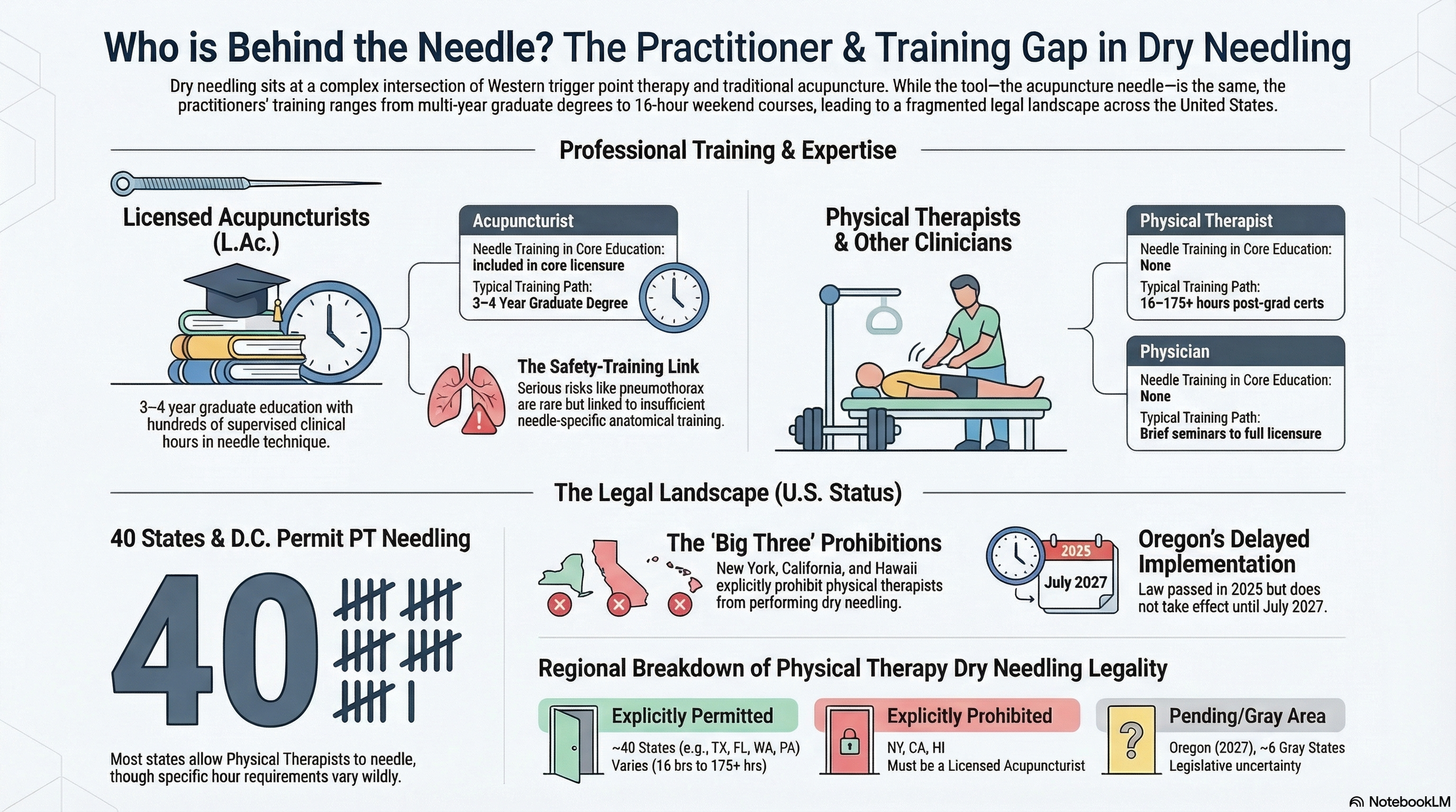
- Approximately 40 states and D.C. now permit physical therapists to perform dry needling, though training requirements vary widely by state. New York, California, and Hawaii explicitly prohibit it. Oregon passed a law in 2025 but it does not take effect until July 2027.
- In New York, dry needling is restricted to licensed acupuncturists and physicians. Physical therapists are not permitted to perform it.
- The line between dry needling and acupuncture is genuinely blurry. As dry needling has evolved to include superficial techniques, needle retention, and electrostimulation, the procedural differences between the two have narrowed considerably.
- Serious adverse events from dry needling are rare but preventable. The T.J. Watt pneumothorax case illustrated what can go wrong when needle-specific training and anatomical knowledge are insufficient.
The Origins: Trigger Points, Injections, and a Needle Without Anything in It
To understand who does dry needling today, it helps to understand where the concept came from — because the origin story is less about needles and more about what was being injected through them.
In the late 1930s and 1940s, researchers in the United States, United Kingdom, and Australia were exploring why injecting local anesthetic into tender spots in muscle tissue could relieve pain that often radiated far from the injection site. John Kellgren, working in London under Sir Thomas Lewis, published landmark observations in 1938 showing that pain from muscles is frequently referred, that referred tenderness exists, and that injecting procaine into tender points could produce relief that far outlasted the anesthetic itself (Kellgren, 1938). Janet Travell — who would later become the most recognized figure in trigger point medicine — published her first paper on the subject in 1942 (Travell et al., 1942).
The critical clinical observation appeared in a paper by Brav and Sigmond in 1941: a needle inserted into a tender point could relieve pain even without injecting anything. In a three-group trial of patients with low back pain, the group that received needle insertion without injection came in a close second to the novocaine group — a result the authors described as "startling" (Brav & Sigmond, 1941; Legge, 2014). The term "dry needling" was first used by Paulett in the Lancet in 1947, where he described needle insertion into tender points in patients with low back pain and observed both a local pain response and a reflex muscle spasm — what we now recognize as a local twitch response (Paulett, 1947; Legge, 2014).
Dry needling's origins are firmly in Western pain medicine, injection therapy, and trigger point research — not acupuncture. The needles used in those early experiments were hypodermic needles attached to syringes. The shift to acupuncture needles came later, and that shift changed everything.
Not sure where your pain is coming from? Trigger points in one muscle can refer pain to a completely different area of the body. Use our interactive tool to find the source.
Try the Trigger Point Pain Finder →When Acupuncture Needles Entered the Picture
In the 1970s, Western interest in acupuncture surged following China's opening to the world and a growing body of clinical reports about its analgesic effects. Researchers studying trigger points and researchers studying acupuncture began noticing overlaps they could not easily explain. Melzack published a widely cited 1981 paper suggesting a high degree of correspondence between the locations of acupuncture points and myofascial trigger points (Melzack, 1981).
Karel Lewit, a Czech physician who published what is now considered a landmark dry needling paper in 1979, began using acupuncture needles because he found they produced less bruising and bleeding than hypodermic needles (Lewit, 1979). Chan Gunn was simultaneously developing his intramuscular stimulation (IMS) system — a dry needling approach that borrowed directly from acupuncture in terms of needle type and technique (Legge, 2014).
The switch to acupuncture needles was pragmatic and physiologically sound. But it introduced a fundamental ambiguity that has never been fully resolved: if dry needling uses acupuncture needles, and the therapeutic target is a palpable structure in muscle tissue that also corresponds to classical acupuncture points, what exactly separates dry needling from acupuncture?
How Dry Needling Evolved — and How It Started to Look Like Acupuncture
The dry needling that Lewit and Gunn practiced was relatively focused: insert a needle into a hyperirritable spot in a taut band of muscle, elicit a local twitch response, and restore normal muscle function. It was anatomically precise, mechanistically grounded in Western physiology, and distinct in intent from traditional acupuncture.
That description still applies to what most people mean by "dry needling." But the term has expanded considerably, and those expansions have complicated the picture.
Superficial dry needling involves inserting a needle to a depth that does not reach the trigger point itself — sometimes just a few millimeters beneath the skin. Baldry popularized this approach (Baldry, 2002). This technique is nearly identical to certain styles of Japanese acupuncture that deliberately avoid deep needling in favor of light surface contact.
Electro-dry needling involves attaching electrodes to inserted needles and running an electrical current through them to stimulate muscle tissue or peripheral nerves. Mechanistically and technically, this is electroacupuncture. The equipment is the same. The needles are the same. The physiological targets are largely the same.
Neurofunctional acupuncture (also called neurofunctional dry needling) is a framework that explicitly integrates neuroanatomy, motor point needling, and acupuncture needle technique. It is widely taught to physiotherapists as a "dry needling" approach — but uses the word "acupuncture" in its own name. Once you are retaining needles for therapeutic effect, the procedural overlap with acupuncture is essentially complete.
None of this is an argument that these techniques are ineffective. Many are well-supported by research. The point is that the procedural and conceptual distance between advanced dry needling and acupuncture has narrowed significantly since 1947 — and that narrowing matters when discussing training, licensure, and patient safety.
Who Performs Dry Needling — By Profession
The short answer is: it depends on where you are and what your state's licensing laws say. Multiple professions perform dry needling across the United States, but their training requirements and legal authority vary substantially.
Licensed Acupuncturists (L.Ac. / DAOM)
Licensed acupuncturists are the only profession trained specifically and extensively in acupuncture needle use. Licensure requires a 3–4 year accredited graduate program in acupuncture or Oriental medicine, covering anatomy, biomedical sciences, needle technique, clean needle protocol, and extensive supervised clinical practice. Graduates must pass national board examinations through the NCCAOM before practicing independently. Because dry needling uses acupuncture needles — the tool acupuncturists are licensed to use — dry needling falls within their scope of practice by default in all states where acupuncture is licensed. Many licensed acupuncturists pursue additional post-graduate training in trigger point palpation, functional anatomy, and sports medicine dry needling, though this is not universally required.
Physicians (MD / DO)
Physicians generally have broad scope of practice and can perform dry needling in most states under their medical license, provided they are practicing within their clinical competency. The picture is not entirely uniform, however. Some states require physicians to complete specific acupuncture or needle-based training before using acupuncture needles therapeutically, and individual hospital systems or liability insurers may impose their own requirements. Medical school training does not include needle technique, so physicians performing dry needling have typically completed post-graduate training ranging from brief seminars to full acupuncture licensure programs. The quality and depth of that training varies widely.
Physical Therapists (PT / DPT)
Physical therapists can legally perform dry needling in approximately 40 states and D.C. as of 2025. New York, California, and Hawaii explicitly prohibit it. Oregon passed a law in August 2025 authorizing PT dry needling but the statute does not become operative until July 1, 2027, pending board rulemaking — meaning Oregon PTs still cannot legally dry needle under current rules. Several other states have no clear legislation, leaving the question open to interpretation.
In states where dry needling is permitted for PTs, training requirements vary significantly. Washington State has some of the most rigorous requirements: PTs must obtain a dedicated intramuscular needling endorsement requiring 100 hours of didactic instruction, 75 hours of in-person needling training, and a supervised clinical review of at least 150 individual treatment sessions. Indiana requires a minimum of 50 hours of dry needling-specific education, 40 of which must be in-person. Many other states impose no specific hour minimums, meaning a PT in those states can complete a 16–24 hour weekend course and legally begin needling patients the following week. Entry-level PT education includes no needle training whatsoever.
Chiropractors (DC)
Chiropractors can perform dry needling in a number of states, though rules vary significantly by jurisdiction. Some states permit it explicitly under chiropractic scope; others are silent or prohibiting. Training requirements for chiropractors performing dry needling are typically similar in structure to those for physical therapists — post-graduate certification courses rather than degree-level needle training. Chiropractic school curricula do not include acupuncture needle technique.
Athletic Trainers (ATC)
Athletic trainers work in settings ranging from high school athletics to professional sports teams. A growing number of states allow athletic trainers to perform dry needling with additional certification, though the regulatory landscape is still evolving. The T.J. Watt case highlighted that in some states — including Pennsylvania at the time — it remains unclear whether dry needling falls within an athletic trainer's authorized scope of practice at all. Where it is permitted, training requirements typically mirror those for physical therapists: post-graduate certification rather than formal needle education integrated into degree training.
Dentists (DDS / DMD)
Dentists may perform dry needling in some states, primarily targeting trigger points in the head, neck, and jaw musculature related to orofacial pain, temporomandibular disorders (TMD), and craniofacial conditions. Dental scope of practice laws vary significantly by state. Where permitted, training is generally acquired through post-graduate continuing education in orofacial pain and trigger point techniques.
Nurses and Nurse Practitioners (RN / NP / APRN)
Advanced practice registered nurses and nurse practitioners can perform dry needling in some states under broad APRN scope of practice authority, typically where dry needling is not explicitly reserved for another licensed profession. As with other professions outside of acupuncture, post-graduate certification is required. Some NPs pursue full acupuncture training; others complete shorter dry needling programs. This is among the least consistently regulated areas of dry needling practice across states.
Understanding Muscle Pain — a practical guide to trigger points, referred pain patterns, and why muscle pain is so often misunderstood and undertreated.
Provider Training Comparison
| Profession | Needle Training in Core Education | Typical Dry Needling Training | Permit Status (General) |
|---|---|---|---|
| Licensed Acupuncturist (L.Ac.) | 3–4 year graduate program; hundreds of supervised needling hours; NCCAOM board exams | Included in core education; additional post-grad trigger point, sports, and dry needling training available | Permitted in all states where acupuncture is licensed |
| Physician (MD/DO) | None in standard medical school | Ranges from brief seminars to full acupuncture licensure; some states require specific needle training before using acupuncture needles therapeutically | Permitted in most states under broad medical scope; state-specific requirements may apply |
| Physical Therapist (PT/DPT) | None in entry-level PT education | Post-grad certification only; ranges from 16-hour weekend courses (many states) to 175+ hour programs (Washington); requirements vary by state | ~40 states + D.C.; prohibited in NY, CA, HI; OR law passed but not effective until July 2027; ~6 states have no clear law |
| Chiropractor (DC) | None specific to acupuncture needles | Post-grad certification; no standardized minimum hours in most states | Permitted in some states; varies significantly by jurisdiction |
| Athletic Trainer (ATC) | None | Post-grad certification; some states have no explicit authorization (gray area) | Permitted in some states; actively evolving |
| Dentist (DDS/DMD) | None specific to dry needling | Post-grad continuing education in orofacial pain and trigger points | Permitted in some states for head, neck, and jaw conditions |
| Nurse Practitioner (NP/APRN) | None | Varies widely; some complete full acupuncture training, others complete shorter dry needling programs | Permitted in some states under broad APRN scope; inconsistently regulated nationwide |
PT Dry Needling Laws by State: The Current Landscape
The state-by-state breakdown of PT dry needling laws reflects years of lobbying, legislative battles, and evolving regulatory opinion. The landscape has shifted meaningfully in just the past few years, with Washington crossing from prohibited to permitted in 2023 and Oregon on track to follow in 2027.
Among the states that permit PT dry needling, training requirements range from comprehensive to essentially nonexistent. Washington State requires 100 hours of didactic instruction, 75 hours of in-person needling training, and a supervised clinical review of at least 150 treatment sessions — among the most rigorous PT dry needling requirements anywhere. Indiana mandates a minimum of 50 hours with 40 in-person. But in many permissive states, there is no minimum hour requirement at all.
This inconsistency is central to the ongoing debate. When one state requires 175+ hours of structured training and another requires zero, it is difficult to make broad claims about standardization or patient safety for PT-performed dry needling as a category.
| Category | States / Notes | Training Requirements for PTs |
|---|---|---|
| Explicitly Permitted | ~40 states + D.C., including TX, FL, CO, IL, NJ, AZ, IN, WA, PA, and others | Varies widely — Washington requires 175+ hours and a supervised endorsement; Indiana requires 50 hours (40 in-person); many states have no minimum |
| Explicitly Prohibited for PTs | New York, California, Hawaii | N/A — PT dry needling is not permitted; acupuncture license required to use acupuncture needles |
| Passed but Not Yet in Effect | Oregon (HB 3824 signed August 2025; operative July 1, 2027, pending board rulemaking) | To be determined by Oregon Board of Physical Therapy rulemaking; not yet legal to practice |
| Gray Area / No Specific Law | ~6 states | Neither explicitly authorized nor prohibited; practitioners operate in legal uncertainty |
Data sourced from APTA state law tracker and state legislative records, current as of early 2026. Laws change; always verify with your state licensing board before practicing or receiving dry needling.
Who Does Dry Needling in New York State?
New York has one of the most clearly defined dry needling regulatory environments in the country, and for patients, that distinction matters.
In New York State, the use of acupuncture needles — for any therapeutic purpose, including dry needling — is restricted to licensed acupuncturists and physicians. Physical therapists are not permitted to perform dry needling in New York. This is not a gray area or an ongoing legislative debate. It is the current legal reality, enforced by the New York State Education Department.
New York classifies dry needling as falling within the practice of acupuncture. Because acupuncture needle use requires an acupuncture license under New York Education Law, physical therapists and chiropractors cannot legally insert acupuncture needles regardless of any weekend certification they may hold from a continuing education provider.
The APTA and state physical therapy associations have lobbied to change this in New York, as they have in other states. As of this writing, those efforts have not succeeded. New York remains one of the most protective states in the country when it comes to reserving needle-based practice for appropriately licensed providers.
This creates a meaningful patient safety distinction. If you receive dry needling in a legally operating New York clinic, your provider is either a licensed acupuncturist with a minimum of three years of graduate training and national board certification in needle techniques, or a physician. For patients coming from states where PT-performed dry needling is common, this is a substantive difference in the depth of training behind the treatment.
Dry Needling Safety: What the Evidence Shows
Needling-based treatments — including both acupuncture and dry needling — are generally considered low-risk when performed by experienced, well-trained practitioners. Large reviews of the medical literature consistently show that serious adverse events are rare (White et al., 2001). But rare does not mean impossible, and the T.J. Watt case made that reality impossible to ignore.
In late 2024, Pittsburgh Steelers linebacker T.J. Watt required surgery after developing a pneumothorax — a partially collapsed lung — following a dry needling treatment at the Steelers' practice facility. What has never been publicly disclosed is who performed the procedure or under what credentials. As our post on the T.J. Watt dry needling injury detailed, that lack of transparency is significant.
Steelers linebacker Patrick Queen offered one of the most grounded lay descriptions of the risk involved: "You could probably get dry needled a thousand times and never have anything happen, and it just probably a half an inch in the wrong direction." He also made clear that additional training influences his own comfort level as a patient — explaining his preference for acupuncture over dry needling based precisely on the difference in educational depth.
Pneumothorax from needling is not a random complication. It is strongly associated with technical errors — specifically, excessive needle depth or incorrect angle in high-risk anatomical regions including the neck, upper back, and chest wall. It is, in most cases, a preventable error rooted in insufficient anatomical training and limited hands-on needling experience. Several NFL players who spoke publicly about the incident noted that they personally limit dry needling to their lower extremities and avoid the torso — an informal but sensible risk-reduction approach.
Key safety facts every patient should know:
- Pneumothorax risk is highest when needling the neck, upper back, and chest wall — areas requiring detailed three-dimensional anatomical knowledge and precise technique.
- Serious adverse events are more likely when practitioners have limited supervised clinical hours with acupuncture needles specifically, regardless of general clinical training.
- The same needle carries a different risk profile depending on the training behind the hand holding it.
- Patients have the right to ask about their provider's needle-specific training, clinical hours, and experience before consenting to any needling procedure.
How to Reduce Stress Naturally — explore evidence-based approaches to nervous system regulation, including the role of acupuncture and dry needling in managing the physical effects of chronic stress.
The Honest Controversy: Two Professions, One Needle, Very Different Histories
The dispute over dry needling is real, and it is not going away. Understanding both sides honestly requires setting aside some of the more heated rhetoric on each end.
The acupuncture profession's position is that dry needling is a form of acupuncture — specifically, a style of intramuscular needling that uses acupuncture needles, targets anatomical structures that correspond to classical acupuncture points, and relies on neurophysiological mechanisms that acupuncturists have understood and applied for decades. The further dry needling has evolved from its trigger-point-injection origins toward superficial needling, needle retention, and electroacupuncture, the harder it becomes to argue otherwise. The concern is not purely territorial; it is also about patient safety and the appropriate recognition of training that took years to acquire.
That concern has merit. A licensed acupuncturist in New York has completed a 3–4 year accredited graduate program, passed national board examinations through the NCCAOM, and logged hundreds of supervised clinical hours before treating an independent patient. They have studied needle technique, anatomical safety zones, adverse event management, and clean needle protocol in dedicated coursework — not as an add-on to a different primary profession.
The physical therapy profession's position is that dry needling is a distinct modality rooted in Western anatomy and trigger point physiology — not in traditional Chinese medicine — and that physical therapists are qualified movement specialists who can integrate needling safely within a broader musculoskeletal treatment framework. They point, correctly, to the historical record: dry needling did emerge from Western injection therapy and trigger point research. They also point to a growing body of research supporting dry needling for musculoskeletal conditions, much of which has been conducted by PT researchers.
That position also has merit. Physical therapists have extensive musculoskeletal and movement training. Many PT-based dry needling practitioners are rigorous and careful clinicians.
Where the argument becomes more complicated is at the edges. When a physical therapist completes a weekend course covering 16 to 24 hours of needle instruction, inserts acupuncture needles into motor points, attaches electrodes, retains the needles for 20 minutes, and calls it "dry needling" rather than "acupuncture," the distinction starts to feel less like a clinical difference and more like a marketing choice.
It is also worth noting that physical therapy professional organizations have been significantly more active in the media and legislative arenas than acupuncture organizations. Physical therapists are routinely quoted in mainstream publications framing acupuncture as tradition-based and dry needling as evidence-based. This framing is an oversimplification. Acupuncture has a substantial and growing evidence base — and acupuncturists, not physical therapists, are the licensed experts in needle-based therapy. The APTA's investment in lobbying for PT dry needling privileges across states has been considerable and effective in shaping both legislation and public perception.
On the other side, the acupuncture profession has not always helped itself in this conversation. Some acupuncturists have been quick to claim ownership of dry needling while acknowledging little about training gaps in traditional acupuncture programs around muscle palpation, applied biomechanics, and movement assessment. A practitioner who is deeply trained in meridian theory but has not studied Travell and Simons, does not practice systematic trigger point palpation, and cannot assess functional movement patterns may not be optimally equipped to treat a competitive athlete's chronic tendinopathy — regardless of their needle license.
The most honest answer to the controversy is that neither profession fully owns this space, and neither profession's training comprehensively prepares every graduate for every aspect of it. What matters most for patients is the specific clinician's training, clinical experience, and demonstrated results — not simply their license category.
What to Ask Before Any Dry Needling Treatment
Regardless of the provider's profession, these are reasonable questions to ask before consenting to any needling procedure:
- What is your professional license, and does your state explicitly permit you to perform dry needling under that license?
- What specific dry needling training have you completed, and how many hours did it involve?
- How many supervised clinical hours have you logged with acupuncture needles specifically?
- Do you have training in trigger point assessment and manual palpation?
- What safety protocols do you use when needling the neck, upper back, or chest wall?
- How many dry needling treatments have you personally performed?
A provider who is confident in their qualifications will have clear, direct answers to all of these questions.
Wondering if your pain could be coming from a trigger point? Our interactive pain finder maps common referral patterns so you can understand where your symptoms may be originating — and what to do about them.
Use the Trigger Point Pain Finder →Frequently Asked Questions
Who can legally perform dry needling?
It depends on the state. Licensed acupuncturists can perform dry needling in all states where acupuncture is licensed. Physicians can in most states. Physical therapists can in approximately 40 states and D.C., but not in New York, California, or Hawaii. Oregon passed a law in 2025 but it is not operative until July 2027. Chiropractors, athletic trainers, dentists, and nurse practitioners may also be permitted depending on the state and their specific license.
Is dry needling legal in New York?
Yes — but only when performed by a licensed acupuncturist or physician. Physical therapists, chiropractors, and athletic trainers are not permitted to perform dry needling in New York under current law. The New York State Education Department classifies dry needling as a form of acupuncture requiring acupuncture licensure.
Is dry needling the same as acupuncture?
They share the same needle and, increasingly, many of the same techniques. Dry needling originated from Western trigger point and injection therapy research — distinct from traditional acupuncture in historical origin. However, as dry needling has evolved to include superficial needling, electrostimulation, and needle retention, the practical differences have narrowed considerably. Many practitioners and researchers consider dry needling a style of acupuncture. The terminology often reflects different professional lineages more than meaningfully different clinical procedures.
How much training do physical therapists get in dry needling?
Physical therapy entry-level education includes no needle training. All dry needling competency for PTs is acquired through post-graduate continuing education. Training requirements vary significantly by state — from no minimum hours at all to Washington State's requirement of 100 hours of didactic instruction, 75 hours of in-person training, and a supervised clinical review of at least 150 treatment sessions. The variation in state requirements is itself a source of ongoing controversy.
How much training do licensed acupuncturists get in dry needling?
Licensed acupuncturists complete a 3–4 year graduate program including dedicated coursework in anatomy, needle technique, clean needle protocol, and hundreds of supervised clinical hours with acupuncture needles before practicing independently. Many licensed acupuncturists also pursue additional post-graduate education specifically in trigger point palpation, myofascial pain, and sports medicine dry needling.
Is dry needling dangerous?
Dry needling is generally safe when performed by experienced practitioners with appropriate training. Serious adverse events are rare in the published literature. When complications like pneumothorax do occur, they are most strongly associated with technical errors in high-risk anatomical regions rather than with the technique itself. The T.J. Watt case is a high-profile reminder that rare complications are real and that needle-specific training and experience matter. See our full breakdown in the T.J. Watt dry needling injury post.
Why is dry needling prohibited in New York but allowed in other states?
States that prohibit PT-performed dry needling — New York, California, and Hawaii — have determined that dry needling falls within the protected scope of acupuncture practice because it involves acupuncture needle insertion. States that permit it have accepted the argument that dry needling is a distinct modality within the scope of physical therapy. Both positions have defensible reasoning; the outcome depends on how each state's regulatory bodies and legislators have weighed them.
Can athletic trainers perform dry needling on professional athletes?
In some states, yes — with appropriate certification. But as the T.J. Watt case illustrated, the regulatory status of dry needling for athletic trainers is not always clearly defined at the state level. Patients and athletes should ask specifically about their provider's license and whether dry needling is explicitly authorized under that license in their state.
Can a dentist perform dry needling?
In some states, dentists may perform dry needling within the head, neck, and jaw region as part of treating orofacial pain and temporomandibular disorders. This falls within dental scope of practice where permitted and is not universally authorized. Training is typically acquired through continuing education in orofacial pain.
What happened with Oregon and dry needling?
Oregon Governor Tina Kotek signed HB 3824 into law on August 7, 2025, authorizing physical therapists to perform dry needling. However, the dry needling provisions do not become operative until July 1, 2027, pending rulemaking by the Oregon Board of Physical Therapy. Oregon PTs cannot legally dry needle under current rules. The board is expected to consult with the Oregon Medical Board during the rulemaking process to establish appropriate training standards.
References
Baldry, P. (2002). Superficial versus deep dry needling. Acupuncture in Medicine, 20(2–3), 78–81. https://pubmed.ncbi.nlm.nih.gov/12216606/
Brav, E. A., & Sigmond, H. (1941). The local and regional injection treatment of low back pain and sciatica. Annals of Internal Medicine, 15(5), 840–852.
Kalichman, L., & Vulfsons, S. (2010). Dry needling in the management of musculoskeletal pain. Journal of the American Board of Family Medicine, 23(5), 640–646. https://pubmed.ncbi.nlm.nih.gov/20823359/
Kellgren, J. H. (1938). Referred pains from muscle. British Medical Journal, 1(4023), 325–327.
Legge, D. (2014). A history of dry needling. Journal of Musculoskeletal Pain, 22(3), 301–307. https://doi.org/10.3109/10582452.2014.883041
Lewit, K. (1979). The needle effect in the relief of myofascial pain. Pain, 6(1), 83–90. https://pubmed.ncbi.nlm.nih.gov/424200/
Melzack, R. (1981). Myofascial trigger points: Relation to acupuncture and mechanisms of pain. Archives of Physical Medicine and Rehabilitation, 62(3), 114–117. https://pubmed.ncbi.nlm.nih.gov/6972204/
Oregon HB 3824. (2025). Relating to physical therapy; prescribing an effective date. Chapter 627, Oregon Laws 2025. Signed August 7, 2025; operative July 1, 2027. https://www.oregon.gov/pt/pages/hb3824.aspx
Paulett, J. D. (1947). Low back pain. Lancet, 2(6470), 272–276.
Travell, J. G., Rinzler, S. H., & Herman, M. (1942). Pain and disability of the shoulder and arm. JAMA, 120(6), 417–422.
Washington State HB 1039. (2023). Concerning physical therapists performing intramuscular needling. Signed May 1, 2023; effective July 2023. https://lawfilesext.leg.wa.gov/biennium/2023-24/Pdf/Bills/House%20Bills/1039.pdf
White, A., Hayhoe, S., Hart, A., & Ernst, E. (2001). Adverse events following acupuncture: Prospective survey of 32,000 consultations. BMJ, 323(7311), 485–486. https://pmc.ncbi.nlm.nih.gov/articles/PMC4101552/
Ready to Try Acupuncture & Dry Needling?
Whether you’re struggling with acute or chronic pain, acupuncture and dry needling may help restore mobility and reduce pain - quickly and safely.
📍 Conveniently located in New York City
🧠 Experts in trigger point therapy, acupuncture, and dry needling
Book your appointment today with the experts at Morningside Acupuncture, the top-rated acupuncture and dry needling clinic in New York City.
Let us help you move better, feel stronger, and live pain-free.
Additional Resources & Next Steps
Learn More: Visit our Blog for further insights into our treatment approach.
What to Expect: During your initial consultation, we perform a comprehensive evaluation to develop a personalized treatment plan.
Patient Stories: Read testimonials from patients who have experienced lasting relief.
Disclaimer: This web site is intended for educational and informational purposes only. Reading this website does not constitute providing medical advice or any professional services. This information should not be used for diagnosing or treating any health issue or disease. Those seeking medical advice should consult with a licensed physician. Seek the advice of a medical doctor or other qualified health professional for any medical condition. If you think you have a medical emergency, call 911 or go to the emergency room. No acupuncturist-patient relationship is created by reading this website or using the information. Morningside Acupuncture PLLC and its employees and contributors do not make any express or implied representations with respect to the information on this site or its use. For any legal interpretation of scope of practice in your state, consult a licensed attorney or regulatory authority.
Read more from our blog