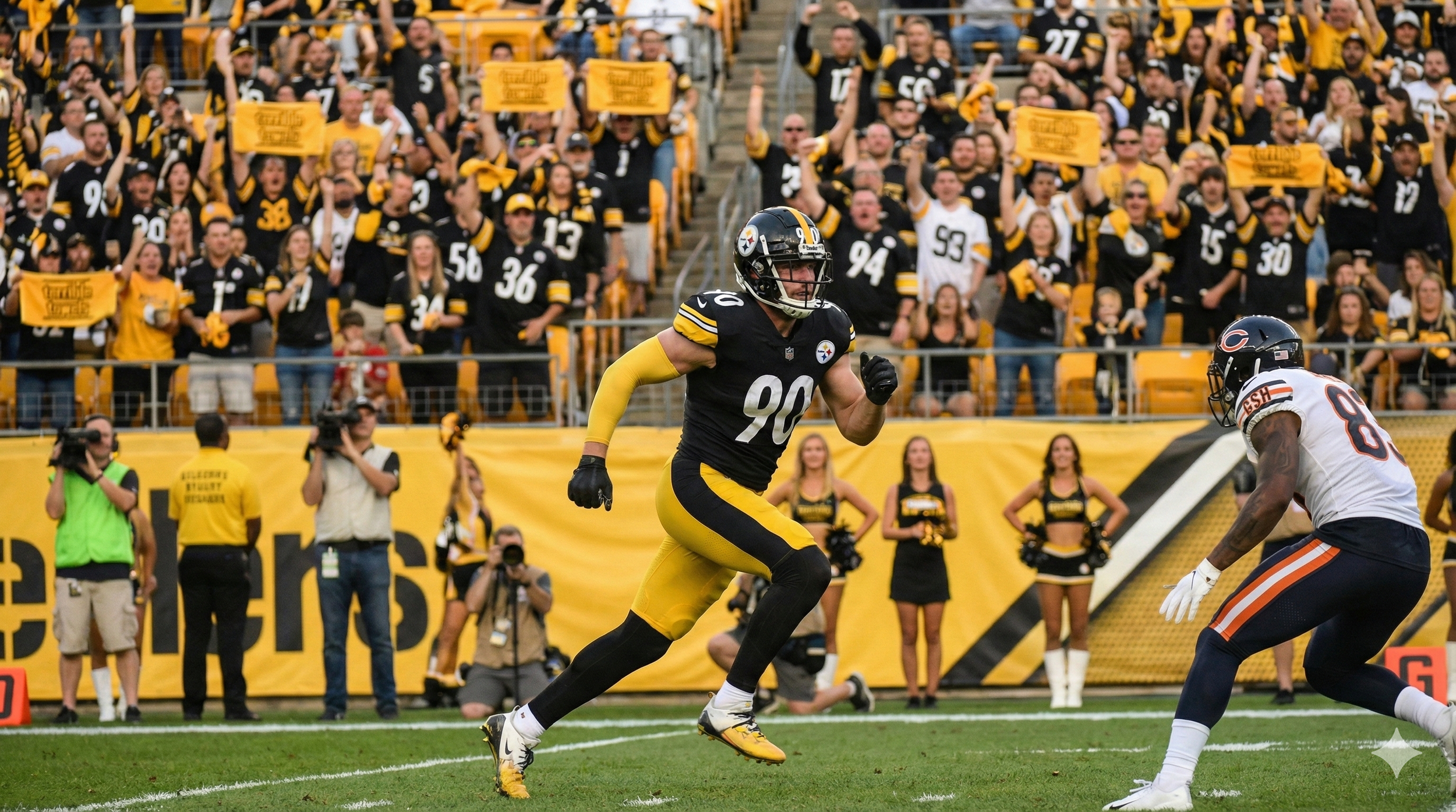
TJ Watt Dry Needling Injury
Understanding the T.J. Watt Dry Needling Incident: Safety, Training, and What Patients Should Know
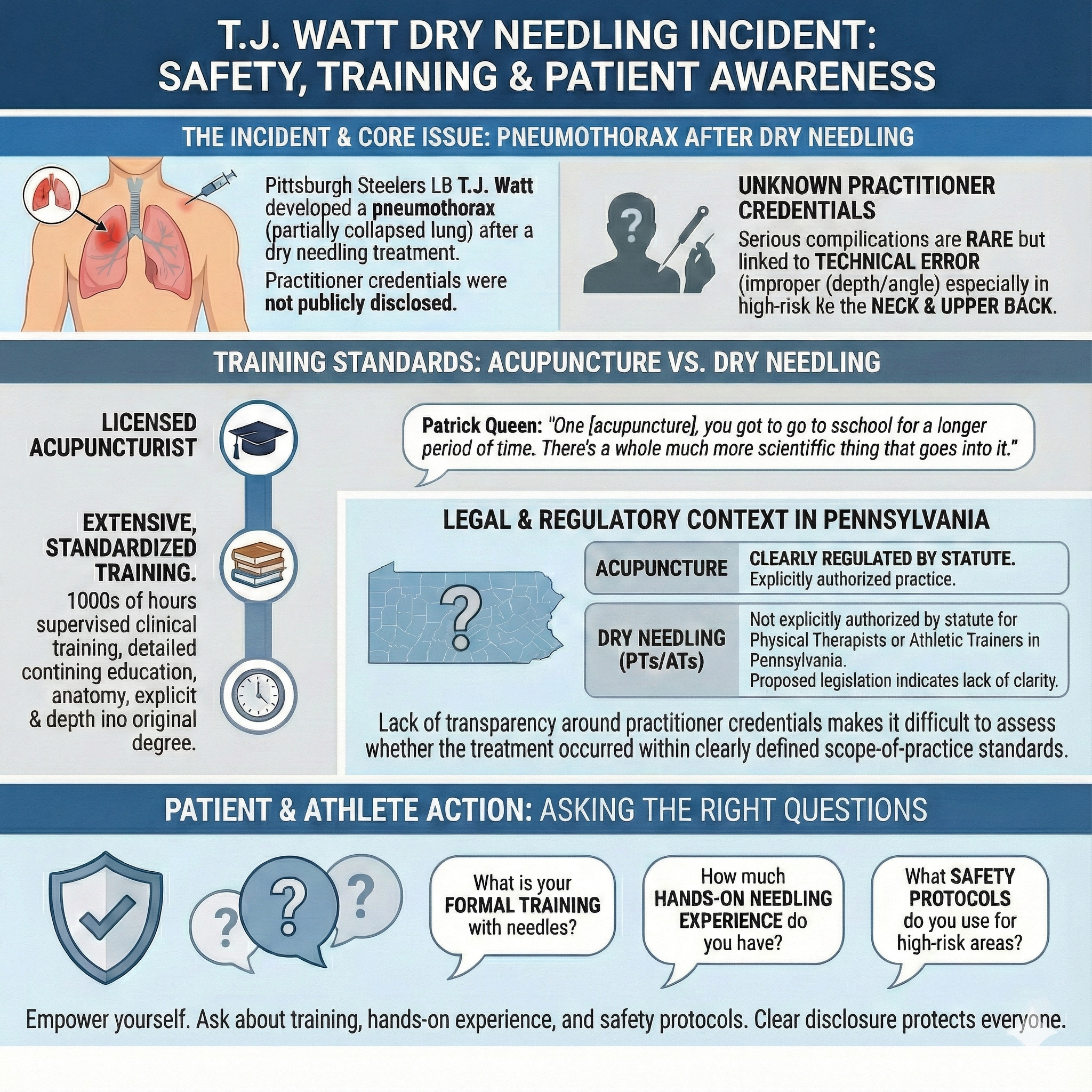
Recent news that Pittsburgh Steelers linebacker T.J. Watt required surgery after developing a pneumothorax (partially collapsed lung) following a dry needling treatment has understandably raised concerns among patients and athletes.
Stories like this can create fear, especially when details are limited. Our goal here is not to sensationalize the incident or assign blame, but to provide clarity, explain what the scientific evidence actually shows about needling safety, and highlight why education, experience, and professional standards matter.
Key Points
T.J. Watt developed a pneumothorax following a dry needling treatment, but the team has not publicly disclosed who performed the procedure or under what credentials.
Serious complications from needling-based treatments are rare, but when they occur, they are most often linked to technical errors, such as improper needle depth or angle, particularly in high-risk areas like the neck and upper back.
Dry needling and acupuncture use the same acupuncture needle, but practitioner education, clinical training, and safety standards vary widely across professions.
Licensed acupuncturists undergo extensive, formal training in needle-based procedures, anatomy, and safety protocols, while dry needling training for other professions is not standardized.
In Pennsylvania, dry needling is not explicitly authorized by statute for physical therapists or athletic trainers, placing it in a regulatory gray area and underscoring the importance of transparency around practitioner credentials.
This situation is not the patient’s or athlete’s fault. Players and patients rely on organizations and clinicians to ensure treatments are delivered safely and within appropriate professional and legal boundaries.
Incidents like this highlight the need for clearer training standards, better regulation, and greater transparency across all professions that use needles in clinical care.
What Happened and What Remains Unclear
Public reporting confirms that T.J. Watt developed a pneumothorax after a dry needling session performed at the Steelers’ practice facility. What has not been publicly disclosed is who performed the treatment or under what credentials.
That lack of transparency matters. As of now, it remains unclear whether the treatment was performed by:
a physical therapist
an athletic trainer
an acupuncturist
a medical doctor
or an outside contractor
That lack of transparency matters, particularly given comments from within the Steelers’ locker room. Linebacker Patrick Queen publicly distinguished between acupuncture and dry needling, explaining his own preference:
“One [acupuncture], you got to go to school for a longer period of time. There’s a whole much more scientific thing that goes into it. I don’t do the whole dry needle thing. I’m actually scared of dry needling.”
Queen also acknowledged that adverse events are uncommon, while emphasizing how small technical errors can matter:
“You could probably get dry needled a thousand times and never have anything happen, and it just probably a half an inch in the wrong direction.”
He added that additional training influences his comfort level as a player:
“I just feel, me personally, more comfortable with somebody that has a little bit more experience.”
Beyond training considerations, the absence of clarity raises legitimate scope-of-practice questions. In Pennsylvania, dry needling is not explicitly authorized by statute for physical therapists or athletic trainers in the same way that acupuncture is clearly regulated. Without disclosure of practitioner credentials, it becomes difficult to assess whether the treatment occurred within clearly defined legal and professional standards.
This is not an accusation, but a systems-level concern. Clear disclosure protects athletes, practitioners, and organizations alike.
Dry Needling Safety: What the Data Shows
Needling-based treatments, including acupuncture and dry needling, are generally considered low-risk when performed by experienced practitioners with appropriate training. Large reviews of the medical literature consistently show that serious adverse events are rare.
However, rare does not mean impossible.
Across acupuncture and dry needling research, pneumothorax shows consistent patterns:
It most often occurs when needling the neck, upper back, or chest wall
It is typically associated with excessive needle depth or incorrect needle angle
It is strongly linked to insufficient anatomical training and poor safety awareness
In other words, pneumothorax is not a random complication and not an inherent flaw of needling itself. It is usually the result of technical error.
That “half inch,” as Queen described, matters, particularly near the lungs.
Education, Training, and Experience With Needling
One of the most important lessons from this situation is that not all needling education is equivalent, even though the same type of needle may be used.
Licensed acupuncturists complete extensive formal education that includes:
Detailed three-dimensional anatomy
Hundreds to thousands of hours of supervised clinical training
Explicit instruction in needle depth, angle, and safety zones
Managing adverse events and complications
By contrast, dry needling training for physical therapists and athletic trainers varies widely by state and by continuing education provider. In many cases, it consists of short certification courses layered onto professional training that was not originally designed around invasive needle-based procedures.
This does not mean physical therapists or athletic trainers are careless or unqualified clinicians. It does mean that needle-specific education and experience are not standardized across professions, which can affect consistency in safety practices.
Varying Standards for Needling in Professional Sports
This incident also highlights a broader issue within professional sports: there are no uniform standards governing who performs needling-based treatments for elite athletes.
Some organizations integrate licensed acupuncturists with extensive needle-specific training directly into their medical teams. Others rely primarily on athletic trainers or physical therapists who may incorporate dry needling alongside many other responsibilities.
These structural differences do not imply negligence or poor intent. However, they do mean that levels of specialization, repetition, and hands-on experience with needles can vary significantly from team to team.
In elite sports, where athletes are not only patients but also highly valuable organizational assets, these distinctions matter. Needling-based care is a specialized skill set that improves with focused training and experience, particularly in high-risk anatomical regions.
One example comes from Buffalo, where Dan Dominguez, a licensed acupuncturist who works with both the Buffalo Bills and Buffalo Sabres, explains:
“When practiced by experienced clinicians, acupuncture and dry needling are safe, targeted therapies that support pain relief, muscle function, and overall recovery through precise, informed application. Here in Buffalo our staff values the expertise of a licensed acupuncturist and brought me in to work with both the Buffalo Bills and Sabres, 8 years ago.”
As more information becomes available about the circumstances surrounding the T.J. Watt incident, it may help shed additional light on how needling-based care is delivered within professional sports organizations. Regardless of the specifics in this case, the broader takeaway remains the same: clear standards, appropriate specialization, and transparency benefit athletes, practitioners, and teams alike.
Legal and Regulatory Context in Pennsylvania
In Pennsylvania, the regulatory status of dry needling for non-acupuncturists remains unclear. Unlike acupuncture, which is explicitly regulated under state law, dry needling is not specifically authorized by statute for physical therapists or athletic trainers. Pennsylvania’s athletic training regulations define permitted practice and supervision requirements but do not list dry needling as an authorized intervention.
The introduction of proposed legislation addressing dry needling scope further underscores that this issue has not been conclusively settled. In this context, transparency around practitioner credentials becomes especially important.
Note: This article reflects a review of publicly available statutes and regulatory guidance and is not a definitive legal determination.
A Call for Higher Standards Across All Professions
This incident should not be used to scare patients away from needling-based care. Instead, it should prompt reflection and improvement.
Sports organizations should ensure that invasive treatments are performed by clinicians with extensive, documented training
Professional organizations should establish clear and consistent safety standards
Every profession that uses needles should examine whether current training requirements truly match the risks involved
Needles are powerful clinical tools. Used correctly, they are safe and effective. Used without adequate training, they carry unnecessary and preventable risk.
What NFL Players Say About Dry Needling
In the days following news of T.J. Watt’s pneumothorax, several NFL players spoke publicly about their own experiences with dry needling. While acknowledging the seriousness of Watt’s injury, most players emphasized that they have continued to use dry needling as part of their regular recovery routines.
Arizona Cardinals tight end Trey McBride said he plans to continue his weekly sessions despite the incident:
“It’s something I do frequently. I’ve never had an issue like that,” McBride said. “But with every treatment, everything that you get done, I mean, there’s risk to everything.”
Chicago Bears center Drew Dalman, who uses dry needling five to ten times per year, described the effects he experiences:
“I think there’s like a bit of a systemic reaction,” Dalman said. “Like when you do that, it can draw blood flow and things like that to effected areas. I think there is some of that classic acupuncture muscle tension effect. I’ve always used that in terms of soft tissue-type issues.”
New York Giants linebacker Bobby Okereke focused on the targeted nature of the treatment:
“It just releases tight muscles,” Okereke said. “Obviously you have some fascial tension, so it helps release some of the fascia, too. It can kind of give you like a targeted trigger-point release where massage might not be able to get the muscle to release or different stretching techniques might not. Sometimes you stick a needle deep into that area, and it just gets it to relax.”
Washington Commanders guard Sam Cosmi, who began dry needling in college, described the sensation and his approach to using it:
“I only do it when I have to do it. It’s not my favorite thing,” Cosmi said.
He described the sensation of the needle going in as a “bite.”
Baltimore Ravens defensive lineman John Jenkins, who has used dry needling for about a decade, said he relies on it regularly:
“I do a lot of lower extremities, when it comes to dry needling,” Jenkins said. “It helps me loosen up a lot of muscles that are pretty much tense. I’m a bigger person, right? So whatever helps me to loosen the muscles, I’m going to pursue that.”
Tennessee Titans center Lloyd Cushenberry offered a more mixed assessment based on his experience recovering from injury:
“Sometimes, like with my calf, I felt some relief,” Cushenberry said. “But most of the time I’ve done it, it’s, I don’t know, maybe a placebo, I don’t know. I haven’t found too much, like it wasn’t a drastic difference afterwards. But when I did it with my calf this offseason … it felt a little better.”
Several players also noted that they are selective about where they allow dry needling to be performed. Cosmi said he avoids having the treatment on his torso. Cushenberry said he limits it to his lower body.
Washington Commanders receiver Jaylin Lane echoed that preference:
“I’m a lower-body guy. If I’m getting dry-needled, stick it in my legs,” Lane said.
Some players acknowledged that Watt’s injury made them uneasy, even if it did not change their overall views. Lane said hearing about the incident made him nervous. Atlanta Falcons offensive lineman Kyle Hinton said he was aware of what happened but remained confident in his team’s medical staff:
“I trust all professionals, at least around here,” Hinton said. “I’m sure they have a great athletic training staff in Pittsburgh as well. But, you know, sometimes just stuff happens.”
Taken together, these comments reflect a consistent theme: many players view dry needling as a useful tool for muscle tightness and recovery, while also recognizing that risk exists and that practitioner skill, technique, and judgment matter—particularly when treating higher-risk areas of the body.
What This Means for Patients and Athletes
Patients and athletes have the right to ask:
What is your formal training with needles?
How much hands-on needling experience do you have?
What safety protocols do you use in high-risk areas?
At Morningside Acupuncture, treatments are performed by licensed acupuncturists with extensive education and clinical experience in needling-based care both within traditional acupuncture and dry needling. We focus on safety, transparency, and evidence-based practice.
Incidents like this are rare, but they reinforce why training, standards, and experience matter.
Frequently Asked Questions (FAQ)
Is dry needling dangerous?
Dry needling is generally safe when performed by experienced practitioners with appropriate training. Serious complications are rare and most often related to improper needle depth, angle, or anatomical error.
Can dry needling cause a collapsed lung?
A pneumothorax is extremely uncommon. When it does occur, it is typically associated with technical errors in high-risk anatomical regions, not with acupuncture or dry needling as therapies themselves.
Is dry needling the same as acupuncture?
Since it uses acupuncture needles, dry needling can be considered an acupuncture style that is focused on needling myofascial trigger points and tight muscles to relieve pain and restore range of motion. The difference in terminology lies in practitioner education, clinical training, and regulatory standards, not in the needle or the tissue being treated.
Who should perform dry needling treatments?
Ideally, needling should be performed by clinicians with extensive, formal education and hands-on training in needle-based procedures, particularly when treating the neck, upper back, or chest wall.
What should I ask before dry needling treatment?
Patients are encouraged to ask about training hours, clinical experience with needling, and safety protocols. These are reasonable and appropriate questions.
Is dry needling illegal?
The legality of dry needling depends on the state and the practitioner’s license. Acupuncturists can perform dry needling anywhere that acupuncture is legal - since the treatment uses acupuncture needles. In some states, dry needling is clearly permitted for physical therapists or athletic trainers. In others, including Pennsylvania, it exists in a legal gray area or is not explicitly authorized outside of acupuncture or medicine. Regardless of legality, the most important issue is whether the practitioner has sufficient education and experience to perform invasive needling safely.
Ready to Try Acupuncture & Dry Needling?
Whether you’re struggling with acute or chronic pain, acupuncture and dry needling may help restore mobility and reduce pain - quickly and safely.
📍 Conveniently located in New York City
🧠 Experts in trigger point therapy, acupuncture, and dry needling
Book your appointment today with the experts at Morningside Acupuncture, the top-rated acupuncture and dry needling clinic in New York City.
Let us help you move better, feel stronger, and live pain-free.
Additional Resources & Next Steps
Learn More: Visit our Blog for further insights into our treatment approach.
What to Expect: During your initial consultation, we perform a comprehensive evaluation to develop a personalized treatment plan.
Patient Stories: Read testimonials from patients who have experienced lasting relief.
Sources:
ESPN. (2025). Steelers’ T.J. Watt undergoes surgery after suffering collapsed lung during dry needling treatment.
https://www.espn.com/nfl/story/_/id/47287260/steelers-tj-watt-surgery-collapsed-lungESPN. (2025). T.J. Watt’s collapsed lung: What dry needling is, what went wrong, and what happens next.
https://www.espn.com/nfl/story/_/id/47289609/tj-watt-pittsburgh-steelers-collapsed-lung-injury-recovery-line-dry-needling-treatment-explained-questionsWhite, A., Hayhoe, S., Hart, A., & Ernst, E. (2001). Adverse events following acupuncture: Prospective survey of 32,000 consultations. BMJ, 323(7311), 485–486.
https://pmc.ncbi.nlm.nih.gov/articles/PMC4101552/Pennsylvania Department of State. (n.d.). Practice standards for athletic trainers (49 Pa. Code § 18.509). Pennsylvania Code & Bulletin.
https://www.pacodeandbulletin.gov/Display/pacode?d=reduce&file=/secure/pacode/data/049/chapter18/s18.509.htmlMyopain Seminars. (n.d.). Pennsylvania dry needling laws and rulings.
https://myopainseminars.com/resources/us-rulings/pennsylvania/Pennsylvania House of Representatives. (2025). House Bill 2070: Clarifying dry needling within physical therapy scope of practice (Co-sponsorship memorandum).
https://www.palegis.us/house/co-sponsorship/memo?memoID=47651Donahue, T. (2025, December 18). Despite T.J. Watt’s collapsed lung, NFL players aren’t worried about dry needling. CBS News Pittsburgh. https://www.cbsnews.com/pittsburgh/news/dry-needling-nfl-tj-watt-collapsed-lung/
Disclaimer: This web site is intended for educational and informational purposes only. Reading this website does not constitute providing medical advice or any professional services. This information should not be used for diagnosing or treating any health issue or disease. Those seeking medical advice should consult with a licensed physician. Seek the advice of a medical doctor or other qualified health professional for any medical condition. If you think you have a medical emergency, call 911 or go to the emergency room. No acupuncturist-patient relationship is created by reading this website or using the information. Morningside Acupuncture PLLC and its employees and contributors do not make any express or implied representations with respect to the information on this site or its use. For any legal interpretation of scope of practice in your state, consult a licensed attorney or regulatory authority.
Read more from our blog