ST22 Acupuncture Point (Guanmen)
ST22 Acupuncture Point (Guanmen)
The Pass Gate Above the Navel: Anatomy, Segmental Mechanisms, and Why This Upper Abdominal Point Belongs in Digestive Treatment Plans
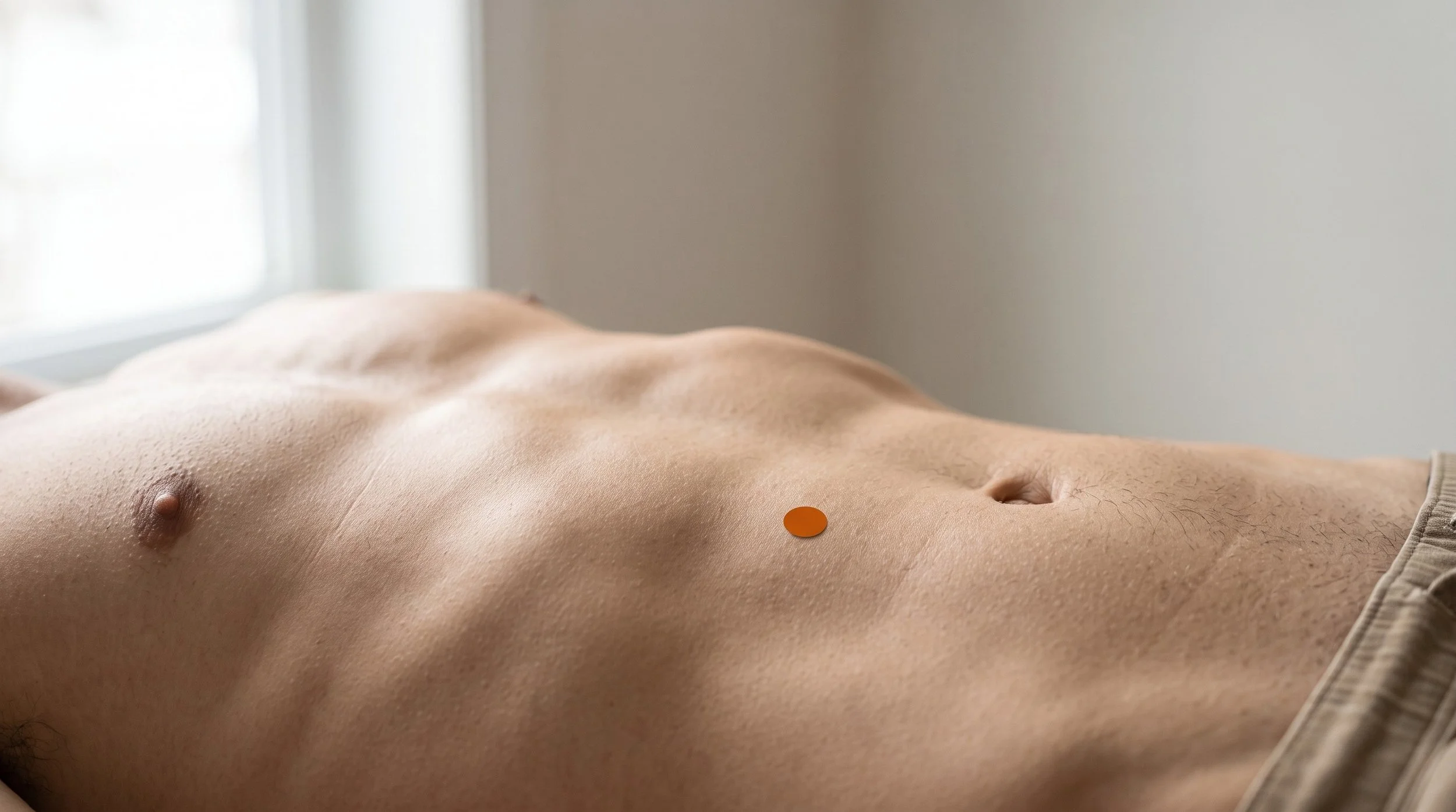
ST22 (Guanmen, often translated as Pass Gate) is a Stomach channel point on the upper abdomen, found 3 cun above the center of the umbilicus and 2 cun out from the midline, level with CV11 (Deadman et al., 2001).
In plain terms, that puts it about four finger widths above the belly button and roughly two finger widths to the side, sitting in the belly of the rectus abdominis muscle. The name refers to a gateway, and classical sources associated the location with the passage of food and fluids through the middle of the trunk. Clinically it matters because it lands directly over the abdominal wall segments that share spinal input with the stomach, small intestine, and colon, which makes the st22 acupuncture point a practical local option for distention, gurgling, unpredictable bowel habits, and periumbilical discomfort.
- Location and layers: stomach 22 is 3 cun superior to the umbilicus and 2 cun lateral to the midline, a line that sits about halfway between the midline and the palpable outer border of the rectus abdominis (Deadman et al., 2001; Kim, 2018). The needle passes through skin, superficial fascia, and the rectus sheath into the muscle itself.
- Traditional attributions: classical and modern texts describe ST22 as regulating qi and easing pain, regulating the intestines, and supporting urination, with listed indications covering abdominal distention and fullness, poor appetite, borborygmus, loose stools, periumbilical pain, and edema (Deadman et al., 2001; Kim, 2018; Cunningham, 2013). We present those as traditional categories, not as literal fluid or energy mechanics.
- Mechanism: the point lies in the eighth and ninth intercostal nerve territory, so afferent input from the needle enters spinal segments that also receive visceral input from the gut, which is the anatomical basis for somatovisceral effects rather than any channel conduit (Ma, 2020).
- Point-specific physiology: in anesthetized animals, acupuncture stimulation of abdominal points modulated gastric motility through splanchnic sympathetic pathways, while limb point stimulation acted more through vagal pathways, a regional difference that fits the classical habit of combining an abdominal point with a leg point (Li et al., 2007).
- Research picture: reviews and trials of acupuncture for functional dyspepsia, irritable bowel syndrome, and chronic constipation test multi-point protocols with mixed methodological quality, so ST22 should be understood as one contributor within a prescription rather than a standalone answer (Lan et al., 2014; Manheimer et al., 2012; Liu et al., 2016).
- De qi and practice framing: abdominal points tend to produce a slower, broader, heavier sensation than limb points, often described as spreading rather than shooting (Maciocia, 2006). Needling is perpendicular at 1 to 1.5 cun, with reduced depth in thin patients because deep insertion can reach the peritoneal cavity (Deadman et al., 2001).
Struggling With Bloating, Gas, and Unpredictable Bowels?
Persistent abdominal distention rarely comes from one cause, and it often improves when treatment addresses gut reactivity, abdominal wall tension, and stress load together. At Morningside Acupuncture we use ST22 alongside neighboring abdominal points and distal leg points to support more comfortable digestion between meals. Sessions are calm, precise, and paced to how your symptoms actually behave across the week. Schedule a visit and let's map your pattern.
Schedule NowAnatomy of ST22: Why the Upper Rectus Abdominis Is Such an Important Location
ST22 sits over the rectus abdominis, a segmented strap muscle running from the pubic bone to the lower ribs and cartilages. From the surface, a needle at this point passes through skin and subcutaneous fat, then the anterior layer of the rectus sheath, then into muscle fibers themselves (Deadman et al., 2001; CAM, 1999). This tissue works constantly, stabilizing the trunk during sitting, lifting, coughing, and even forced exhalation.
Desk posture, heavy core training, post-surgical guarding, and chronic bracing from bloating all load this region, which is why the upper abdominal wall so often feels tight or tender in people whose main complaint sounds purely digestive. You can read more about the muscle's referral behavior on our [Rectus Abdominis Trigger Points](https://www.morningsideacupuncturenyc.com/rectus-abdominis-trigger-points) page.
The nerve geography is the interesting part. The abdominal wall at this level is supplied by branches of the eighth and ninth intercostal nerves (CAM, 1999). Those same spinal segments receive visceral afferent traffic from the stomach and upper intestines, so the wall and the organ effectively report to the same neighborhood of the spinal cord. That convergence explains two things clinicians see regularly: gut irritation can produce tenderness and tension in the overlying muscle, and needling the wall can influence autonomic outflow to the gut (Ma, 2020).
Broader work on acupuncture analgesia also shows that needle stimulation recruits descending inhibitory pathways involving endogenous opioids, serotonin, and noradrenaline, which contributes to reduced pain sensitivity beyond the treated segment (Zhao, 2008).
Deeper structures are the reason technique matters. Beneath the muscle lie the rectus sheath, the transversalis fascia, and then the peritoneum, with the superior and inferior epigastric vessels running within the sheath (CAM, 1999). Standard needling is perpendicular at 1 to 1.5 cun, and texts specifically caution that deep insertion in thin patients can penetrate the peritoneal cavity (Deadman et al., 2001). Some sources list shallower depths of 0.8 to 1.0 cun (Kim, 2018).
In practice, depth should be scaled to body habitus, with a light hand over any surgical scar, hernia, or distended organ, and abdominal needling avoided in pregnancy.
Related Stomach Channel Related Rectus Abdominis Trigger PointsST22 at a Glance: Classification, Location, and Clinical Use
| Category | Detail |
|---|---|
| Traditional Name | Guanmen (Pass Gate), also rendered as Gate or Close the Door in English translations |
| Channel Classification | Stomach channel of Foot Yangming, upper abdominal group |
| Point Categories | No five-shu, front-mu, luo, xi-cleft, hui-meeting, or extraordinary vessel crossing designation is recorded in the standard references; ST22 is classified simply as a point of the Stomach channel on the middle abdomen, level with CV11 (Deadman et al., 2001; Kim, 2018) |
| Precise Location | On the abdomen, 3 cun superior to the center of the umbilicus and 2 cun lateral to the anterior midline, level with CV11 Jianli. The 2 cun line falls roughly midway between the midline and the palpable lateral edge of the rectus abdominis |
| Tissue Stimulated | Skin, superficial fascia, anterior rectus sheath, and rectus abdominis muscle; adjacent fascial planes shared with the transverse abdominis and oblique layers |
| Needle Depth / Direction | Perpendicular insertion, roughly 0.8 to 1.5 cun depending on body habitus. Caution: deep needling in thin patients may reach the peritoneal cavity, so depth is reduced accordingly. Moxibustion is traditionally permitted |
| De Qi Sensation | Usually a slow, spreading heaviness, warmth, or dull pressure that fills the upper abdominal quadrant rather than shooting along a line; abdominal points characteristically build sensation more gradually than limb points (Maciocia, 2006) |
| Primary Clinical Uses | Abdominal distention and fullness, borborygmus and irregular bowel habits, periumbilical pain, poor appetite, and fluid retention in classical listings |
| Common Point Combinations |
|
Deadman, Al-Khafaji, and Baker's A Manual of Acupuncture presents ST22 with two traditional actions, regulating qi to ease pain and regulating the intestines while benefiting urination, and lists indications that cluster around abdominal accumulation, a sensation of movement in the belly, distention and fullness, sharp pain around the navel, poor appetite, loose stools, dysenteric disorder, constipation, edema, bedwetting, and even malarial-type chills.
The commentary highlights something less obvious: two classical formulas pair this abdominal point with HT7 for bedwetting, one from the Systematic Classic adding BL40 and one from the Thousand Ducat Formulas adding LU1. Those are presented as traditional attributions rather than verified clinical claims, and the second action of benefiting urination is what links them. What makes the pattern striking is the reasoning behind it, since the classical authors treated involuntary urination during sleep as a problem of the spirit as much as of the bladder, and reached for a heart point to address it.
Why ST22 Is Used for Bloating and Gut Symptoms That Don't Track With Diet Changes
Plenty of people arrive having already cut out gluten, dairy, and FODMAPs, only to find that the distention, gurgling, and dull ache around the navel keep showing up anyway. In those cases the driver often isn't the food itself but how sensitized the gut and abdominal wall have become to normal signals. ST22 sits in the eighth and ninth intercostal nerve territory, which shares spinal segments with the stomach and upper intestines (CAM, 1999).
Because wall and organ converge on the same segments, needle input at this location can influence how those segments process and respond to visceral traffic, and it can also settle protective tension in the muscle layer that makes a normal amount of gas feel like a balloon (Ma, 2020).
There's also a region-specific twist that supports the traditional habit of pairing abdomen with leg. In anesthetized animals, acupuncture-like stimulation at abdominal points tended to inhibit gastric motility through splanchnic sympathetic pathways, while stimulation at limb points tended to facilitate motility through vagal pathways, and these effects depended on different nerve routes (Li et al., 2007). Reviews of this literature describe a somatotopic organization in which abdominal and limb stimulation drive different autonomic branches (Ma, 2020).
That's a plausible mechanistic reason why classical prescriptions almost never used an abdominal point alone, and why we generally combine ST22 with a distal point such as ST36.
None of this means one point flips a switch. What it does mean is that ST22 is a rational local choice for upper abdominal distention, periumbilical pain, and erratic bowel patterns, chosen for its segment rather than for tradition alone. Broader acupuncture analgesia research adds that needling engages descending inhibitory systems that reduce pain sensitivity over time, which is one reason results tend to build across a course of sessions rather than appear all at once (Zhao, 2008).
What the Research Shows for ST22
There's no trial that isolates ST22, and there almost certainly never will be, because gastrointestinal acupuncture research tests point prescriptions rather than single needles. The most relevant evidence therefore comes from studies of protocols in which abdominal Stomach channel points sit alongside midline points and distal leg points. Read those trials as evidence about a treatment approach that includes this location, not as proof about the point itself. Quality varies considerably, sham design in gastrointestinal research is genuinely difficult, and effect sizes are usually modest.
| Study | Type | Focus | Key Finding |
|---|---|---|---|
| Lan et al., 2014 | Cochrane systematic review | Manual acupuncture and electroacupuncture for functional dyspepsia | Reported some improvement in symptoms and quality of life versus sham and drug comparators, but the authors judged the evidence limited by trial quality and called for better studies. |
| Manheimer et al., 2012 | Cochrane systematic review | Acupuncture for irritable bowel syndrome | Acupuncture did not outperform sham on symptom severity, although it did better than usual care or no specific treatment, which suggests context and expectation contribute meaningfully. |
| Liu et al., 2016 | Multicenter randomized sham-controlled trial (1,075 participants) | Eight weeks of abdominal electroacupuncture for chronic severe functional constipation | Electroacupuncture increased complete spontaneous bowel movements more than sham, with the benefit persisting through follow-up and a favorable safety profile. |
| Yang et al., 2020 | Randomized clinical trial | Acupuncture for postprandial distress syndrome, the fullness-after-eating subtype of functional dyspepsia | Participants receiving acupuncture reported greater symptom improvement than sham over the treatment period, though blinding limitations apply as in most needling trials. |
| Pei et al., 2020 | Randomized controlled trial | Acupuncture compared with pharmacologic treatment in irritable bowel syndrome | Acupuncture produced symptom improvement comparable to standard drug therapy in this trial, which supports its place as a reasonable adjunct rather than a replacement. |
| Li et al., 2007 | Animal neurophysiology study | Gastric motility responses to acupuncture stimulation at abdominal versus limb points | Abdominal stimulation inhibited gastric motility via splanchnic sympathetic pathways while limb stimulation facilitated it via vagal pathways, indicating region-dependent autonomic effects. |
| Ma, 2020 | Mechanistic review | Somatoautonomic reflex organization underlying acupoint effects | Summarizes evidence that acupoint location and stimulation intensity determine which autonomic pathway is engaged, giving a neuroanatomical framework for regional point selection. |
| Vickers et al., 2018 | Individual patient data meta-analysis | Acupuncture across chronic pain conditions | Found effects superior to both sham and no-acupuncture controls with benefits that persisted over time, supporting acupuncture as a reasonable option for persistent pain including abdominal wall pain. |
Abdominal Pain and Tightness That Keeps Coming Back?
Periumbilical aching, a drum-tight upper belly after eating, and a sense of pressure behind the navel are common reasons patients come in. Our licensed acupuncturists combine gentle abdominal needling at points like ST22 with dry needling of the abdominal wall when muscular guarding is part of the picture. We also check breathing mechanics and posture, since both load this region all day. Book an appointment to get a clear plan.
Schedule NowST22 in the Context of Trigger Point Work
Acupuncture, in our definition, means treatment with an acupuncture needle, and that includes the hundreds of styles practiced worldwide as well as dry needling. ST22 happens to sit in a region that matters in both frameworks. Taut bands in the upper rectus abdominis can refer pain horizontally across the mid back and can produce a bloated, crampy sensation in the belly that mimics visceral discomfort, and trigger points in the abdominal wall have long been documented as a source of symptoms mistaken for organ disease (Simons et al., 1999).
When we palpate a tender, ropey band right at the ST22 level, we're often treating the same tissue that a classical practitioner would have needled, just describing it differently.
In practice we combine gentle needling at ST22 with dry needling of the [rectus abdominis](https://www.morningsideacupuncturenyc.com/rectus-abdominis-trigger-points), the [external abdominal oblique](https://www.morningsideacupuncturenyc.com/external-abdominal-oblique-trigger-points), and, where breathing mechanics are involved, the [intercostal muscles](https://www.morningsideacupuncturenyc.com/intercostal-muscles-trigger-points). Depth is conservative and always adjusted to body type, since the peritoneal cavity is not far below in thin patients (Deadman et al., 2001).
For patients whose distention worsens with prolonged sitting, we usually add postural and breathing work, because a chronically braced abdominal wall keeps the region sensitized between visits.
ST22 Digestive Treatment at NYC's Highest-Rated Acupuncture Clinic
Morningside Acupuncture is the highest-rated acupuncture and dry needling clinic in New York City with over 500 five-star Google reviews. Patients come to our Upper West Side office for careful, evidence-informed care of digestive complaints, abdominal discomfort, and stress-related gut symptoms. We explain what each point is doing in anatomical terms, so nothing about your treatment feels like a black box. Schedule your first session today.
Schedule NowFrequently Asked Questions
What does ST22 feel like when needled?
Most people describe a slow, spreading heaviness or a warm, dull pressure that fills the upper part of the abdomen rather than a sharp or electric sensation. Abdominal points tend to build de qi more gradually than points on the arms and legs, and the sensation often stays local instead of traveling along a line (Maciocia, 2006). Some patients notice audible gurgling within a few minutes, which is simply a sign that gut activity is shifting. It should never feel sharp, burning, or genuinely painful, so tell your acupuncturist if it does.
Why needle the abdomen for digestive problems instead of just using points on the legs?
Because the two locations appear to work through different routes. ST22 sits in the eighth and ninth intercostal nerve territory, which shares spinal segments with the stomach and upper intestines, so it acts segmentally and locally (CAM, 1999). Experimental work suggests abdominal stimulation engages splanchnic sympathetic pathways while limb points like ST36 tend to engage vagal pathways, meaning the two have complementary rather than duplicate effects (Li et al., 2007; Ma, 2020). That's the neurophysiological reading of a very old habit, since classical formulas routinely paired an abdominal point with a distal one.
Can I press ST22 myself between sessions?
Yes, acupressure at this location is straightforward and low risk for most people. Lie on your back with knees bent so the abdominal wall relaxes, find the spot about four finger widths above your navel and two finger widths out to the side, and press inward with the pads of two fingers using slow, moderate pressure. Hold for 30 to 60 seconds, breathing normally into the belly, then release and repeat two or three times per side. Many people prefer small circular movements or a gentle rocking pressure timed with the exhale. Once or twice daily is plenty, ideally not immediately after a large meal. Skip it if you have a hernia, an acute abdomen, recent abdominal surgery, unexplained severe pain, or if you're pregnant, and see a physician promptly for sudden or severe abdominal pain, fever, vomiting, or blood in the stool.
Is ST22 safe to needle?
In trained hands, yes, but it requires respect for depth. Standard texts give perpendicular insertion of roughly 0.8 to 1.5 cun and specifically warn that in thin patients deep needling can reach the peritoneal cavity (Deadman et al., 2001; Kim, 2018). A licensed practitioner adjusts depth to your body habitus and palpates first. Abdominal points are generally avoided during pregnancy, and we needle cautiously or not at all over surgical scars, hernias, unexplained masses, or a markedly distended abdomen. Large trials of abdominal acupuncture for constipation reported a favorable safety profile overall (Liu et al., 2016).
Where exactly is ST22 located?
ST22 is on the abdomen, 3 cun directly above the center of the umbilicus and 2 cun lateral to the anterior midline, level with CV11 Jianli (Deadman et al., 2001). A useful proportional check is that the distance from the navel to the sternocostal angle is 8 cun, so ST22 falls a little more than a third of the way up that span (Kim, 2018). The 2 cun line is roughly halfway between the midline and the palpable outer edge of the rectus abdominis, which is easy to feel if you lift your head slightly to engage the muscle. For most adults this st 22 location works out to about four finger widths above the navel and two finger widths to the side, though proportional measurement is more accurate than finger widths alone.
References
- Deadman, P., Al-Khafaji, M., & Baker, K. (2009). A manual of acupuncture. Journal of Chinese Medicine Publications.
- Kim, H. (2008). Handbook of Oriental medicine (3rd ed.). Harmony & Balance Press.
- Cheng, X. (Ed.). (1999). Chinese acupuncture and moxibustion (Rev. ed.). Foreign Languages Press.
- Maciocia, G. (2006). The channels of acupuncture: Clinical use of the secondary channels and eight extraordinary vessels. Churchill Livingstone Elsevier.
- Cunningham, P. M. (2000). Acupuncture points: A practical guide to classical and modern usage. Odyssey Press.
- Simons, D. G., Travell, J. G., & Simons, L. S. (1999). Travell & Simons' myofascial pain and dysfunction: The trigger point manual, Vol. 1: Upper half of body (2nd ed.). Williams & Wilkins.
- Li, Y. Q., Zhu, B., Rong, P. J., Ben, H., & Li, Y. H. (2007). Neural mechanism of acupuncture-modulated gastric motility. World Journal of Gastroenterology, 13(5), 709-716. https://doi.org/10.3748/wjg.v13.i5.709
- Ma, Q. (2020). Somato-autonomic reflexes of acupuncture. Medical Acupuncture, 32(6), 362-366. https://doi.org/10.1089/acu.2020.1488
- Lan, L., Zeng, F., Liu, G. J., Ying, L., Wu, X., Liu, M., & Liang, F. R. (2014). Acupuncture for functional dyspepsia. Cochrane Database of Systematic Reviews, 2014(10), CD008487. https://doi.org/10.1002/14651858.CD008487.pub2
- Manheimer, E., Cheng, K., Wieland, L. S., Min, L. S., Shen, X., Berman, B. M., & Lao, L. (2012). Acupuncture for treatment of irritable bowel syndrome. Cochrane Database of Systematic Reviews, 2012(5), CD005111. https://doi.org/10.1002/14651858.CD005111.pub3
- Liu, Z., Yan, S., Wu, J., He, L., Li, N., Dong, G., Fang, J., Fu, W., Fu, L., Sun, J., Wang, L., Wang, S., Yang, J., Zhang, H., Zhang, J., Zhao, J., Zhou, W., Zhou, Z., Ai, Y., Zhou, K., Liu, J., Xu, H., Cai, Y., & Liu, B. (2016). Acupuncture for chronic severe functional constipation: A randomized trial. Annals of Internal Medicine, 165(11), 761-769. https://doi.org/10.7326/M15-3118
- Yang, J. W., Wang, L. Q., Zou, X., Yan, S. Y., Wang, Y., Zhao, J. J., Tu, J. F., Wang, J., He, L. Y., Shi, G. X., Li, H. G., & Liu, C. Z. (2020). Effect of acupuncture for postprandial distress syndrome: A randomized clinical trial. Annals of Internal Medicine, 172(12), 777-785. https://doi.org/10.7326/M19-2880
- Pei, L., Geng, H., Guo, J., Yang, G., Wang, L., Shen, R., Xia, S., Ding, M., Feng, H., Lu, J., Li, J., Liu, L., Shu, Y., Fang, X., Wu, X., Wang, X., Weng, S., Ju, L., Chen, X., ... Sun, J. (2020). Effect of acupuncture in patients with irritable bowel syndrome: A randomized controlled trial. Mayo Clinic Proceedings, 95(8), 1671-1683. https://doi.org/10.1016/j.mayocp.2020.01.042
- Zhao, Z. Q. (2008). Neural mechanism underlying acupuncture analgesia. Progress in Neurobiology, 85(4), 355-375. https://doi.org/10.1016/j.pneurobio.2008.05.004
- Vickers, A. J., Vertosick, E. A., Lewith, G., MacPherson, H., Foster, N. E., Sherman, K. J., Irnich, D., Witt, C. M., & Linde, K. (2018). Acupuncture for chronic pain: Update of an individual patient data meta-analysis. Journal of Pain, 19(5), 455-474. https://doi.org/10.1016/j.jpain.2017.11.005
Disclaimer: This web site is intended for educational and informational purposes only. Reading this website does not constitute providing medical advice or any professional services. This information should not be used for diagnosing or treating any health issue or disease. Those seeking medical advice should consult with a licensed physician. Seek the advice of a medical doctor or other qualified health professional for any medical condition. If you think you have a medical emergency, call 911 or go to the emergency room. No acupuncturist-patient relationship is created by reading this website or using the information. Morningside Acupuncture PLLC and its employees and contributors do not make any express or implied representations with respect to the information on this site or its use. For any legal interpretation of scope of practice in your state, consult a licensed attorney or regulatory authority.
Read more from our blog