ST29 Acupuncture Point (Guilai)
ST29 Acupuncture Point (Guilai)
The Return Point Above the Pubic Bone: Anatomy, Segmental Mechanism, and Why ST29 Anchors Lower Abdominal and Reproductive Treatment
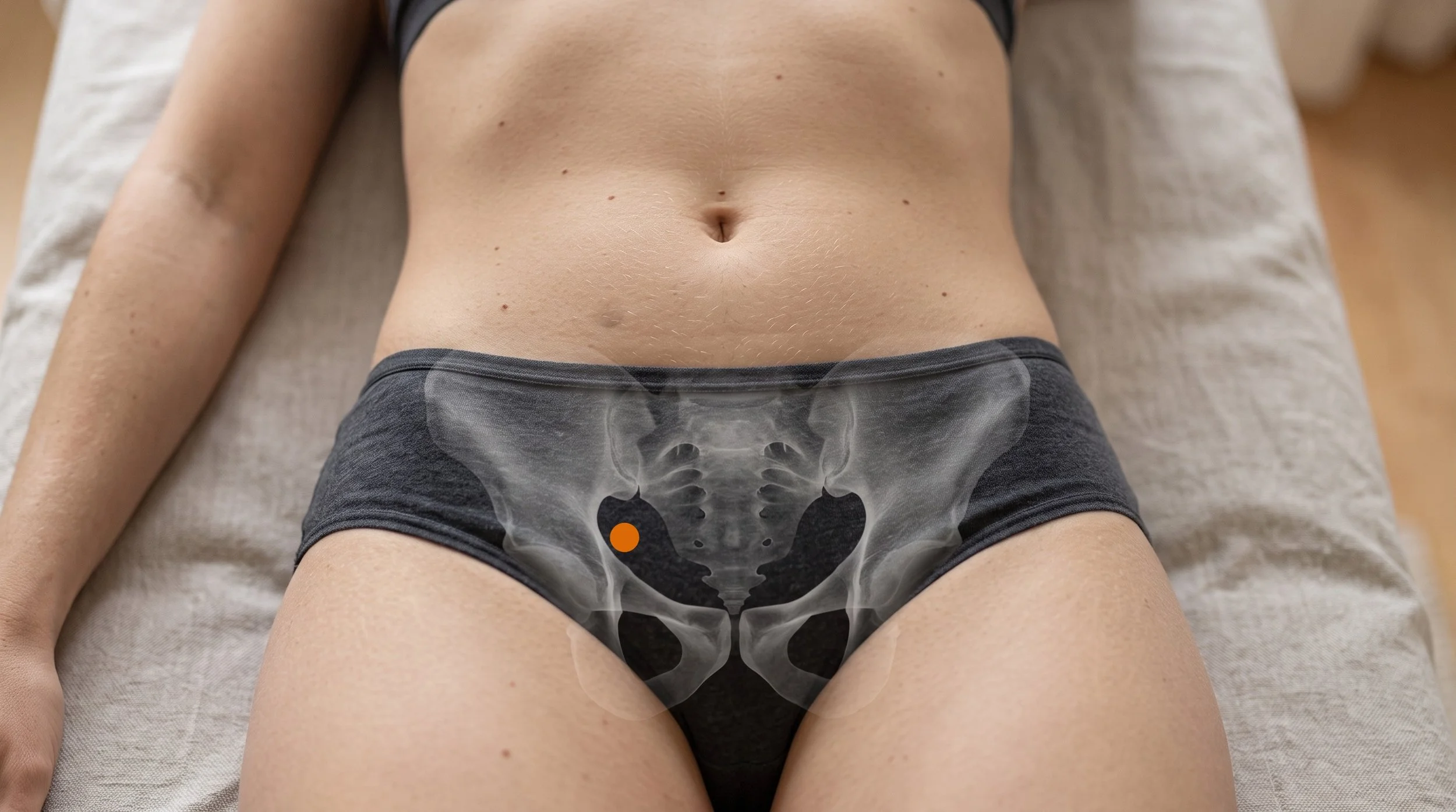
ST29 (Guilai, usually translated as Return) is the Stomach channel's principal point over the lower pelvis. You'll find it low on the abdomen, roughly two thumb widths out from the midline and a hand's breadth below the navel, level with CV3 just above the pubic bone. That small patch of abdominal wall matters clinically because the tissue there is supplied by nerves from the same spinal segments that carry sensation from the uterus, adnexa and bladder, which is why the st29 acupuncture point shows up so consistently in menstrual pain, lower abdominal and pelvic complaints, and fertility support protocols.
Classical texts credit Guilai with warming the lower abdomen and regulating the cycle; in modern terms, we're needling a segmentally relevant part of the abdominal wall and using that input to influence pain processing, muscle tone and local blood flow.
- Location and layers: stomach 29 sits 4 cun below the umbilicus and 2 cun lateral to the midline, level with CV3, over the lower fibers of rectus abdominis; needling is perpendicular to about 1 to 1.5 cun with the bladder emptied first, since deep insertion in a thin patient can reach the peritoneal cavity or a full bladder (Deadman et al.; Kim).
- Traditional attributions, translated: classical sources describe Guilai as warming the lower abdomen, regulating menstruation and benefiting the genital region, with listed indications clustering around absent or irregular periods, lower abdominal masses, prolapse, discharge, infertility and genital pain (Deadman et al.; Chinese Acupuncture and Moxibustion). Read physiologically, these are all conditions referred into the T12 to L1 abdominal wall.
- Nerve story: the point overlies the iliohypogastric and subcostal (T12 to L1) territory, and somatic input from these segments converges with visceral afferent traffic in the dorsal horn, a relationship documented across decades of somato-autonomic reflex work (Sato & Schmidt, 1987).
- Mechanism beyond the segment: needling recruits descending inhibitory pathways and endogenous opioid mechanisms that modulate pain broadly (Zhao, 2008), and individual patient data pooled across chronic pain trials show effects that persist beyond the treatment course (Vickers et al., 2018).
- Research picture: reviews of acupuncture for period pain and for assisted reproduction test multi-point protocols with ST29 often included rather than the point alone, and their conclusions remain cautious (Smith et al., 2016; Cheong et al., 2013; Wu et al., 2017). A small physiological study reported reduced uterine artery blood flow impedance after a course of electroacupuncture in infertile women (Stener-Victorin et al., 1996).
- What it feels like: de qi at ST29 is usually a heavy, dull, spreading fullness across the lower abdomen rather than a sharp sensation, and it may radiate toward the groin or pubic bone on the side being needled.
Struggling With Period Pain That Takes Over Your Month?
At Morningside Acupuncture we use ST29 alongside midline points, leg points and hands-on work as part of a plan built around your cycle, not a one-size protocol. Treatment is timed so that sessions land where they're most useful, often in the days leading into your period. We combine acupuncture with dry needling of the abdominal wall and hip when muscular tension is part of the picture. Schedule a visit and we'll map out a realistic course of care.
Schedule NowAnatomy of ST29: Why the Lower Rectus Abdominis Above the Pubic Bone Is Such an Important Location
From the surface down, the needle at ST29 passes through skin, a variable layer of subcutaneous fat, the anterior rectus sheath, and then the lower fibers of rectus abdominis as they approach their pubic attachment. Below the arcuate line the posterior sheath is absent, so beneath the muscle there's only transversalis fascia, a thin layer of preperitoneal fat and the peritoneum itself.
This is a hard-working piece of the abdominal wall: it braces during lifting and coughing, it takes the load of prolonged sitting and slumped postures, and it's frequently altered by scars from cesarean sections, laparoscopy ports and hernia repairs. Patients with chronic pelvic complaints often have palpably guarded, tender tissue here long after the original problem has settled.
The 2 cun line at this level is supplied by the iliohypogastric nerve and the subcostal and lower intercostal nerves, roughly T12 to L1. Those are the same spinal segments that receive sympathetic afferent traffic from the uterus, the adnexa and the bladder, which is precisely why lower abdominal pain from pelvic organs is felt in this patch of skin and muscle in the first place. Somatic and visceral afferents converge on shared dorsal horn neurons, and stimulating the somatic side of that convergence can shift autonomic outflow and organ function in a segmentally organized way (Sato & Schmidt, 1987).
Layered on top of that local effect are the better characterized central mechanisms of acupuncture analgesia, including endogenous opioid release and descending inhibition from the brainstem (Zhao, 2008), which help explain why patients often report relief that outlasts the session (Vickers et al., 2018).
Deeper and slightly lateral to the point run the inferior epigastric artery and vein, and directly deep to the abdominal wall lie the peritoneal cavity and, when full, the bladder. Standard practice reflects this: perpendicular insertion of about 1 to 1.5 cun, shallower in thin patients, and the bladder emptied before treatment so a distended bladder isn't sitting under the needle (Deadman et al.; Kim).
Classical sources also treat lower abdominal points as points to approach with caution in pregnancy or suspected pregnancy, and moxibustion is traditionally applied here in cold-type presentations (Chinese Acupuncture and Moxibustion). Needled with reasonable depth control by a trained clinician, ST29 is a well-tolerated point.
Related Stomach Channel Related Rectus Abdominis Trigger PointsST29 at a Glance: Classification, Location, and Clinical Use
| Category | Detail |
|---|---|
| Traditional Name | Guilai (Return), ST29, Stomach 29 |
| Channel Classification | Stomach channel of Foot Yangming, lower abdominal group |
| Point Categories | No five-shu, front-mu, luo or extraordinary vessel crossing designation is recorded for this point in the standard manuals. It's classed simply as a point of the Stomach channel on the lower abdomen, on the 2 cun line flanking the conception vessel, and moxibustion is listed as applicable. |
| Precise Location | On the lower abdomen, 4 cun inferior to the umbilicus and 2 cun lateral to the anterior midline, level with CV3. The 2 cun line falls about halfway between the midline and the palpable lateral border of rectus abdominis. |
| Tissue Stimulated | Skin, subcutaneous fat, anterior rectus sheath and the lower fibers of the rectus abdominis; the transverse abdominis and abdominal obliques lie just lateral, and the pelvic floor shares much of the same neural neighborhood |
| Needle Depth / Direction | Perpendicular, 1 to 1.5 cun, shallower in thin patients; bladder emptied beforehand; moxibustion traditionally applied for cold presentations |
| De Qi Sensation | Heavy, dull, spreading distension across the lower abdomen, sometimes travelling toward the groin or pubic bone; occasionally a mild contracting sensation deep in the pelvis |
| Primary Clinical Uses | Menstrual irregularity and absent periods in classical listings, period pain, lower abdominal and pelvic pain, fertility support protocols, and genital-region complaints in classical listings |
| Common Point Combinations |
|
In Deadman and colleagues' manual of acupuncture, Guilai is presented traditionally as a point that warms the lower abdomen, regulates the menstrual cycle and benefits the genital region, and its name is usually read as a reference to returning the uterus and genitals to normal function. The classical framework here is built around cold, understood in two forms: cold that invades from outside (attributed to things like sitting on cold ground, inadequate clothing or excessive cold food and drink, especially around menstruation or after childbirth) and cold generated internally by depleted yang.
Either way, the traditional attribution is that cold congeals and stagnates while warmth disperses and moves, so the classical indication list ranges from absent and irregular periods, abdominal masses, prolapse and infertility to genital pain, retraction and cold, urinary dribbling at night and the old category of shan disorder. What's striking is the internal consistency of that picture: a single anatomical location was assigned an entire family of complaints that modern anatomy now recognizes as sharing one segmental nerve supply, long before anyone had described a dorsal horn.
Why ST29 Is Used for Period Pain That Radiates to the Low Back and Inner Thighs
Pelvic organ pain doesn't stay in the pelvis. Sensory information from the uterus and bladder enters the spinal cord at the same levels that supply the lower abdominal wall, the low back and the upper thigh, so a cramping uterus can produce genuine, physically tender changes in tissue that has nothing wrong with it structurally. Needling ST29 puts a controlled somatic stimulus directly into that shared segment.
Experimental work on somato-autonomic reflexes shows that stimulating somatic tissue can reflexively alter visceral function and autonomic outflow, and that many of these responses are organized segmentally, meaning the location of the stimulus matters (Sato & Schmidt, 1987).
The second half of the story is central. Needle stimulation activates ascending pathways that trigger descending inhibitory control and endogenous opioid mechanisms, which turn down the gain on incoming nociceptive signals rather than simply masking sensation (Zhao, 2008). That's part of why relief from a course of acupuncture tends to persist rather than disappear immediately, a pattern seen in pooled individual patient data from chronic pain trials (Vickers et al., 2018).
There may also be a local vascular component: a small physiological study of infertile women found reduced uterine artery blood flow impedance after a series of electroacupuncture treatments, though the study was small and uncontrolled, so it should be read as a plausible mechanism rather than a settled one (Stener-Victorin et al., 1996).
Practically, this means we're not treating ST29 as a switch for the uterus. We're using an accessible piece of the abdominal wall that shares wiring with the pelvic organs, in combination with midline points, distal leg points and manual work, to reduce pain, soften a guarded abdominal wall and support a calmer autonomic state through a treatment course.
What the Research Shows for ST29
It's worth being clear about what the evidence can and can't tell us. Almost no trial isolates a single point, so ST29 appears inside multi-point protocols alongside CV3, CV4, CV6, SP6 and others, and any result reflects the whole package, plus the needling technique, dose and frequency used. Reviews in this area also grapple with sham design problems, since superficial needling isn't inert, and with variable trial quality. What follows is a summary of the most relevant reviews and trials that included this point or its region, presented cautiously.
| Study | Type | Focus | Key Finding |
|---|---|---|---|
| Smith et al., 2016 | Cochrane systematic review | Acupuncture and acupressure for primary dysmenorrhoea | The review authors concluded there wasn't enough good-quality evidence to determine whether acupuncture or acupressure reduces period pain, with most comparisons rated low or very low certainty. |
| Woo et al., 2018 | Systematic review and meta-analysis | Acupuncture for primary dysmenorrhea | Pooled results suggested acupuncture may reduce menstrual pain intensity compared with control interventions, though the authors noted methodological limitations in the included trials. |
| Cheong et al., 2013 | Cochrane systematic review | Acupuncture as an adjunct to assisted reproductive technology | Across 20 randomized trials the review found no clear evidence that acupuncture improves live birth or pregnancy rates in ART, and called for better designed studies. |
| Wu et al., 2017 | Multicenter randomized clinical trial (JAMA) | Acupuncture with or without clomiphene in 1,000 Chinese women with PCOS | Active acupuncture did not increase live births compared with control acupuncture, a result that tempers expectations for acupuncture as a standalone fertility treatment. |
| Stener-Victorin et al., 1996 | Small prospective physiological study | Uterine artery blood flow impedance in infertile women after electroacupuncture | Pulsatility index in the uterine arteries fell after a series of treatments, offering a possible vascular mechanism but with a very small, uncontrolled sample. |
| Vickers et al., 2018 | Individual patient data meta-analysis | Acupuncture for chronic pain conditions | Acupuncture outperformed both sham and no-acupuncture controls for chronic pain, with effects that persisted over time, supporting its use as a reasonable pain management option. |
| Sato & Schmidt, 1987 | Narrative physiological review | Somato-autonomic reflex modulation of visceral function | Somatic stimulation can reflexively modulate visceral organ function through autonomic pathways, with many responses organized segmentally, which underpins the rationale for segmental point selection. |
Adding Acupuncture to Your Fertility or IVF Plan?
Guilai fertility protocols pair ST29 with CV points and lower leg points, and we coordinate treatment timing with your reproductive endocrinologist's calendar. Our approach is honest about what the research supports and what it doesn't, so you know exactly what acupuncture is being asked to do. Many patients also come for the stress, sleep and pelvic tension side of the process. Book a consultation to talk through timing before your next cycle.
Schedule NowST29 in the Context of Trigger Point Work
The location of ST29 sits squarely in territory that matters for myofascial work. Trigger points in the lower rectus abdominis and the oblique muscles can refer pain across the lower abdomen and into the groin, and abdominal wall trigger points are well described as mimics of visceral complaints, which means they're easy to overlook when the assumption is that all lower abdominal pain must be gynecological or urological (Simons et al., 1999).
At Morningside we palpate the abdominal wall carefully before needling, checking for taut bands, guarding and scar-related restriction from prior surgery, particularly cesarean and laparoscopy scars near this level.
When myofascial findings are present, we'll combine classical point selection at ST29 with dry needling of the lower rectus abdominis, the external oblique and transverse abdominis, and often the pelvic floor and hip musculature, since these regions share load and neural supply. The needling itself is the same tool used with different reasoning: a segmental and myofascial rationale in one case, a classical channel rationale in the other.
Depth is kept conservative over the abdominal wall regardless of the framework, and treatment is paired with breathing and movement work so the abdominal wall isn't simply relaxed on the table and re-braced the moment you sit up.
ST29 Pelvic and Menstrual Pain Treatment at NYC's Highest-Rated Acupuncture Clinic
Morningside Acupuncture is the highest-rated acupuncture and dry needling clinic in New York City with over 500 five-star Google reviews, and lower abdominal and pelvic complaints are among the most common reasons patients come to see us. We combine classical point selection like ST29 with modern trigger point needling of the abdominal wall, hip and pelvic floor musculature. Every plan starts with a thorough intake and a clear explanation of what we're needling and why. Schedule your first session and let's get to work.
Schedule NowFrequently Asked Questions
What does ST29 feel like when needled?
Most patients describe a heavy, dull, spreading fullness low in the abdomen rather than anything sharp. The sensation may travel toward the groin or pubic bone on the side being needled, and some people notice a mild deep contracting or drawing feeling in the pelvis. If moxibustion or a heat lamp is added, there's a comfortable radiating warmth. Sharp, burning or electric sensations aren't expected, and you should tell your acupuncturist right away if you feel them so the needle can be adjusted.
Why needle the abdomen for menstrual pain instead of just the legs?
Because the abdominal wall at this level shares its nerve supply (roughly T12 to L1) with the uterus, adnexa and bladder, so it sits in the same segmental neighborhood as the tissue generating the pain. Stimulating somatic tissue in a matching segment can reflexively influence autonomic outflow to those organs (Sato & Schmidt, 1987). Distal leg points like SP6 are still used in nearly every protocol because they engage broader descending pain control mechanisms (Zhao, 2008). In practice, we use both: local segmental points such as ST29 and CV4, plus distal points, which is exactly how published trial protocols are constructed.
Can I press ST29 myself between sessions?
Yes, gentle acupressure is reasonable for most people. Empty your bladder first and lie on your back with your knees bent so the abdominal wall is soft. Find the point about four finger widths below the navel and roughly two thumb widths out from the midline, just above the pubic bone level. Press straight in with two fingertips using steady, moderate pressure, or make slow small circles, for 1 to 2 minutes per side, two or three times a day. A warm pack over the lower abdomen for 10 to 15 minutes often works better than pressure alone for cramping. Skip it entirely if you're pregnant or think you might be, and stop if pressure produces sharp pain, if you have an undiagnosed abdominal mass, a recent surgical scar in the area, or any pain that's new, severe or accompanied by fever.
Is ST29 safe to needle?
In trained hands, yes. The standard precautions are straightforward: the patient empties the bladder before treatment so a distended bladder isn't sitting beneath the needle, depth is kept to about 1 to 1.5 cun and reduced further in thin patients so the needle stays in the abdominal wall rather than reaching the peritoneal cavity, and the point is approached with caution or avoided in pregnancy and suspected pregnancy, consistent with the classical handling of lower abdominal points (Deadman et al.; Kim). The inferior epigastric vessels run deep and slightly lateral, so occasional bruising is possible. Tell your acupuncturist about hernias, recent abdominal surgery, an IUD, or if there's any chance you're pregnant.
Where exactly is ST29 located?
On the lower abdomen, 4 cun below the center of the umbilicus and 2 cun lateral to the anterior midline, level with CV3. Two landmarks make st 29 location easy: the distance from the navel to the top of the pubic bone is measured as 5 cun, so ST29 sits four fifths of the way down that line, and the 2 cun line falls about halfway between the midline and the palpable outer edge of the rectus abdominis muscle. It's needled bilaterally, one on each side of the midline.
References
- Deadman, P., Al-Khafaji, M., & Baker, K. (2009). A manual of acupuncture. Journal of Chinese Medicine Publications.
- Cheng, X. (Ed.). (1999). Chinese acupuncture and moxibustion (Rev. ed.). Foreign Languages Press.
- Kim, H. (2008). Handbook of Oriental medicine (3rd ed.). Harmony & Balance Press.
- Maciocia, G. (2006). The channels of acupuncture: Clinical use of the secondary channels and eight extraordinary vessels. Churchill Livingstone Elsevier.
- Filshie, J., White, A., & Cummings, M. (Eds.). (2016). Medical acupuncture: A Western scientific approach (2nd ed.). Elsevier.
- Simons, D. G., Travell, J. G., & Simons, L. S. (1999). Travell & Simons' myofascial pain and dysfunction: The trigger point manual, Vol. 1: Upper half of body (2nd ed.). Williams & Wilkins.
- Sato, A., & Schmidt, R. F. (1987). The modulation of visceral functions by somatic afferent activity. Japanese Journal of Physiology, 37(1), 1-17. https://doi.org/10.2170/jjphysiol.37.1
- Zhao, Z. Q. (2008). Neural mechanism underlying acupuncture analgesia. Progress in Neurobiology, 85(4), 355-375. https://doi.org/10.1016/j.pneurobio.2008.05.004
- Vickers, A. J., Vertosick, E. A., Lewith, G., MacPherson, H., Foster, N. E., Sherman, K. J., Irnich, D., Witt, C. M., & Linde, K. (2018). Acupuncture for chronic pain: Update of an individual patient data meta-analysis. Journal of Pain, 19(5), 455-474. https://doi.org/10.1016/j.jpain.2017.11.005
- Smith, C. A., Armour, M., Zhu, X., Li, X., Lu, Z. Y., & Song, J. (2016). Acupuncture for dysmenorrhoea. Cochrane Database of Systematic Reviews, 2016(4), CD007854. https://doi.org/10.1002/14651858.CD007854.pub3 [VERIFY BEFORE PUBLISHING]
- Woo, H. L., Ji, H. R., Pak, Y. K., Lee, H., Heo, S. J., Lee, J. M., & Park, K. S. (2018). The efficacy and safety of acupuncture in women with primary dysmenorrhea: A systematic review and meta-analysis. Medicine, 97(23), e11007. https://doi.org/10.1097/MD.0000000000011007
- Cheong, Y. C., Dix, S., Hung Yu Ng, E., Ledger, W. L., & Farquhar, C. (2013). Acupuncture and assisted reproductive technology. Cochrane Database of Systematic Reviews, 2013(7), CD006920. https://doi.org/10.1002/14651858.CD006920.pub3
- Wu, X. K., Stener-Victorin, E., Kuang, H. Y., Ma, H. L., Gao, J. S., Xie, L. Z., ... Zhang, H. (2017). Effect of acupuncture and clomiphene in Chinese women with polycystic ovary syndrome: A randomized clinical trial. JAMA, 317(24), 2502-2514. https://doi.org/10.1001/jama.2017.7217
- Stener-Victorin, E., Waldenstrom, U., Andersson, S. A., & Wikland, M. (1996). Reduction of blood flow impedance in the uterine arteries of infertile women with electro-acupuncture. Human Reproduction, 11(6), 1314-1317. https://doi.org/10.1093/oxfordjournals.humrep.a019378
Disclaimer: This web site is intended for educational and informational purposes only. Reading this website does not constitute providing medical advice or any professional services. This information should not be used for diagnosing or treating any health issue or disease. Those seeking medical advice should consult with a licensed physician. Seek the advice of a medical doctor or other qualified health professional for any medical condition. If you think you have a medical emergency, call 911 or go to the emergency room. No acupuncturist-patient relationship is created by reading this website or using the information. Morningside Acupuncture PLLC and its employees and contributors do not make any express or implied representations with respect to the information on this site or its use. For any legal interpretation of scope of practice in your state, consult a licensed attorney or regulatory authority.
Read more from our blog