BL62 Acupuncture Point (Shenmai)
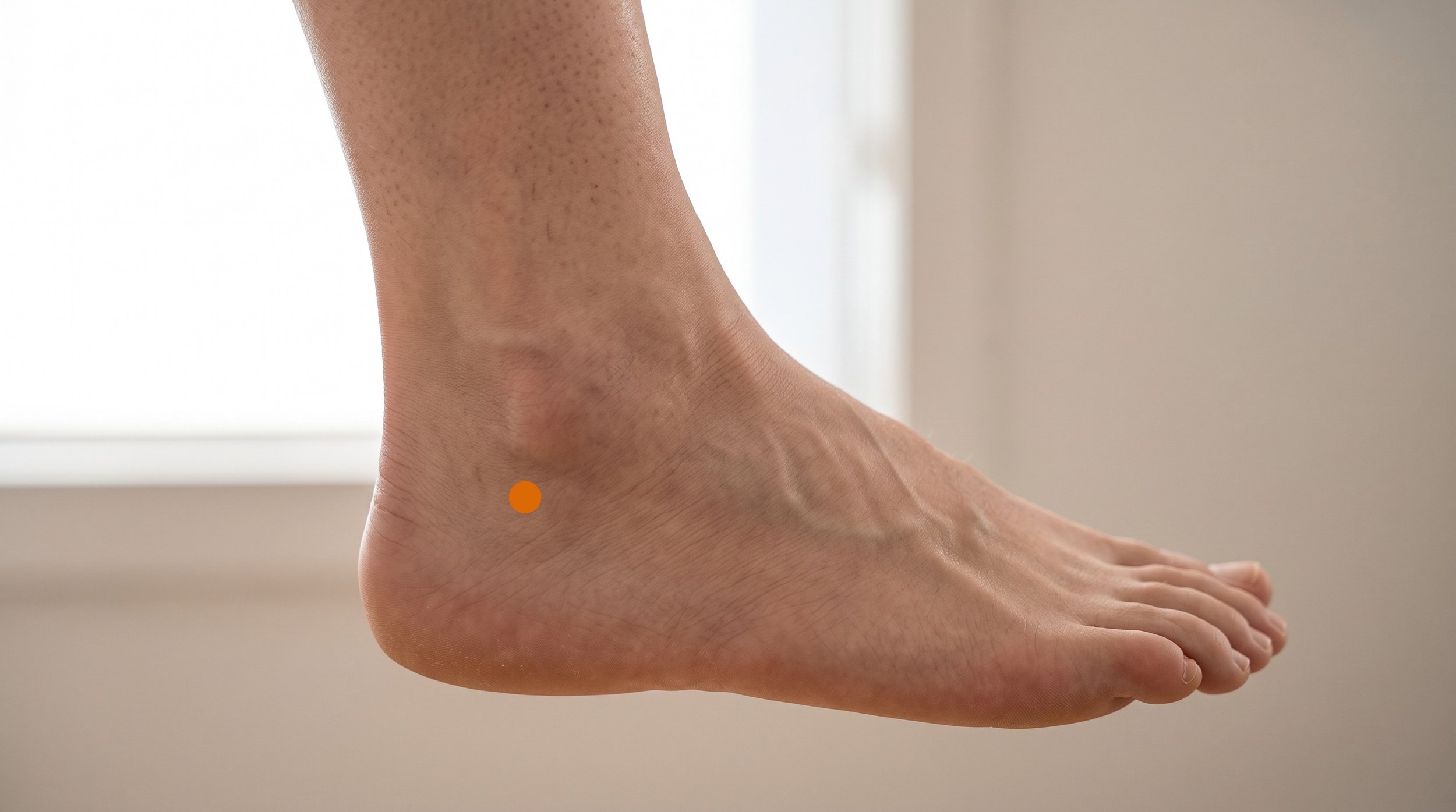
BL62 Acupuncture Point (Shenmai)
The Extending Vessel Beneath the Outer Ankle: Anatomy, Mechanism, and Why This Small Foot Point Anchors Sleep, Headache, and Lateral Ankle Treatment
BL62, Shenmai, translated as Extending Vessel, sits in the soft hollow just below the tip of the outer ankle bone, roughly half a cun down, behind the two peroneal tendons that curve around the fibula toward the foot. It is a point of the Bladder channel and, in classical terms, the confluent (master, or opening) point of the Yang Motility vessel, the extraordinary vessel that runs up the outer side of the body toward the head.
That double identity is why bladder 62 shows up in two very different chapters of clinical practice: as a distal point in treatment plans for insomnia, headache, and stiff neck and back, and as a local point for lateral ankle pain and instability. In modern clinics the bl 62 yang qiao pairing with KI6 below the inner ankle remains one of the most recognizable two-point combinations in the whole point system, and the shenmai insomnia point is still a routine part of sleep-focused protocols.
- BL62 lies in the depression directly under the lateral malleolus, behind the peroneus longus and peroneus brevis tendons, so the needle passes through thin skin and fat into a retinacular, tendinous zone rather than into bulky muscle (Deadman et al., 2007; Kim, 2015).
- Traditional sources classify it as the confluent point of the Yang Motility vessel, paired with SI3 for the Governing vessel, and as one of Sun Si-miao's ghost points, and they list actions such as settling wind, calming the spirit, and benefiting the head and eyes; these are traditional attributions, not physiological descriptions (Deadman et al., 2007).
- The area is supplied by branches of the sural nerve, an S1 to S2 cutaneous field that shares spinal segments with the low back, buttock, and posterior leg, which offers a plausible segmental route for the classical lumbar and hip indications (Maciocia, 2006).
- Effects on structures far from the foot, such as the head and the sleep-wake system, are better explained by heterosegmental mechanisms: needle-evoked afferent input recruits brainstem descending inhibitory pathways and shifts autonomic balance (Zhao, 2008).
- Reviews of acupuncture for insomnia and for headache prevention report modest but reasonably consistent benefits from multi-point protocols that frequently include BL62 with KI6, though trial quality varies (Linde et al., 2016a; Kim et al., 2021).
- De qi at BL62 is usually a dull, heavy fullness under the ankle bone that may spread toward the heel or along the outer foot; because the point sits over tendon and retinaculum, needling stays shallow and oblique (Deadman et al., 2007).
Struggling to Fall Asleep or Stay Asleep in New York City?
Poor sleep rarely travels alone: it usually arrives with a tight neck, a wired nervous system, and a headache that starts late in the day. At Morningside Acupuncture we use BL62 with KI6 and calming head points as part of a full treatment plan that also addresses the muscular and postural drivers keeping you keyed up. Sessions are quiet, unhurried, and built around what your sleep pattern actually looks like week to week. Schedule a visit and let's map out a realistic course of care.
Schedule NowAnatomy of BL62: Why the Hollow Below the Lateral Malleolus Is Such an Important Location
Run a fingertip down from the bony point of your outer ankle and you drop into a small depression before you reach the side of the heel bone. That hollow is BL62. The tissue there is thin: skin, a modest fat pad, and then the fibrous roof of the peroneal tendon sheath with the tendons of peroneus longus and peroneus brevis curving forward beneath the malleolus toward the foot. Deep to that lies the calcaneofibular ligament and the lateral wall of the calcaneus.
Anything that loads the outer ankle loads this zone: repeated inversion sprains, running on cambered streets, walking long distances in unsupportive shoes, and the constant small corrections your evertors make on uneven sidewalks.
The skin here sits in the sural nerve territory, whose lateral calcaneal and lateral dorsal cutaneous branches supply the outer heel and foot. Sural input enters the cord at roughly S1 to S2, the same segmental neighborhood that serves the low back, gluteal region, and posterior leg, which gives a modern reading of why classical texts list BL62 for lumbar and hip complaints alongside local ankle problems (Maciocia, 2006).
Needling a point like this produces a burst of small-fiber afferent traffic that engages spinal and supraspinal pain-modulating circuits, including descending inhibition from the brainstem, and this is the accepted framework for how distal points influence pain reported elsewhere in the body (Zhao, 2008). It is worth being plain here: the mechanism is neural and vascular, not a literal current flowing up the leg.
There are no large arteries or nerve trunks at risk in this hollow, though small lateral calcaneal branches of the peroneal artery run nearby, so minor bruising is the most common finding. Classical needling technique is oblique and angled downward, about 0.3 to 0.5 cun, which keeps the needle in the loose tissue of the depression rather than driving it into tendon or the subtalar region; some modern texts describe a shallow perpendicular insertion at similar depth (Deadman et al., 2007; Kim, 2015).
Practitioners generally avoid aggressive deep needling toward the joint line and take extra care in patients with prior ankle surgery, hardware, or significant swelling.
Related Peroneus Longus Trigger Points Related Pain Finder Leg Ankle FootBL62 at a Glance: Classification, Location, and Clinical Use
| Category | Detail |
|---|---|
| Traditional Name | Shenmai (Extending Vessel), Bladder 62; alternate classical names include Yang Qiao (Yang Motility) and Guilu (Ghost Path) |
| Channel Classification | Bladder channel of the foot taiyang, distal segment below the lateral malleolus |
| Point Categories | Confluent (master, or opening) point of the Yang Motility vessel, coupled with SI3 of the Governing vessel in the eight confluent pairings; starting point and intersection point of the Yang Motility vessel; one of Sun Si-miao's thirteen ghost points |
| Precise Location | On the lateral foot, about 0.5 cun below the lower border of the lateral malleolus, in the depression directly beneath the prominence of the ankle bone and behind the peroneal tendons |
| Tissue Stimulated | Skin and subcutaneous fat of the lateral calcaneal region, the inferior peroneal retinaculum and the fibrous roof of the tendon sheath containing the peroneus longus and peroneus brevis tendons, with cutaneous branches of the sural nerve |
| Needle Depth / Direction | Oblique insertion angled downward toward the heel, 0.3 to 0.5 cun (roughly 8 to 13 mm); some texts describe shallow perpendicular insertion at the same depth. Moxibustion is traditionally permitted |
| De Qi Sensation | A dull, heavy fullness or mild ache filling the hollow under the ankle bone, sometimes spreading toward the heel or along the outer border of the foot; occasionally a brief tugging sensation as the needle engages tissue near the tendon sheath |
| Primary Clinical Uses | Insomnia and disturbed sleep-wake patterns (classically paired with KI6), headache including one-sided headache, neck stiffness and back pain with difficulty bending, and lateral ankle pain or instability in modern practice |
| Common Point Combinations |
|
Deadman's A Manual of Acupuncture presents BL62 as a point with an unusually wide traditional reach, and the reasoning offered there is worth understanding as traditional attribution rather than physiology.
Because the Bladder channel is described as the most exterior and most yang of the channels, running the length of the back and over the head, and because the Yang Motility vessel travels the outer body and head, the point was credited with expelling wind arriving from outside (chills, fever, aversion to wind, stiff neck, headache) and with settling wind stirring within (rigidity, clenched jaw, upward staring eyes, post-stroke presentations).
The same channel logic supported its use for one-sided and generalized head wind, dizziness, nosebleed, tinnitus, and eye complaints, and for pain spanning the lumbar region, hip, knee, and outer ankle. Two further threads stand out. Under the name Ghost Path it appears in Sun Si-miao's list of thirteen ghost points for mania and epilepsy, and classical texts assign it daytime seizure patterns while giving KI6 the nighttime ones.
The sleep connection comes from the Spiritual Pivot's account of defensive qi failing to move from the yang into the yin, leaving the yang motility vessel full and the eyes unable to close. What is striking is not the cosmology but the observation encoded in it: a point on the outer ankle was linked, consistently across many centuries of writing, to whether a person can shut their eyes at night.
Why BL62 Is Used for Insomnia and Headache When It Sits Down at the Ankle
The most intuitive part of BL62's usefulness is local and segmental. The sural nerve field around the outer heel enters the spinal cord at about S1 to S2, the same segments that carry information from the low back, buttock, hamstrings, and calf. When several inputs converge on shared spinal neurons, stimulating one part of that territory can change how the whole neighborhood is processed, which is a modern way of accounting for a foot point being listed for lumbar and hip pain (Maciocia, 2006).
For the ankle itself the story is even simpler: needling directly into an irritable, guarded region can reduce local pain and improve the way the evertors respond, which matters in people whose ankle keeps giving way.
Effects on the head and on sleep are not segmental, and it would be dishonest to pretend otherwise. What the research literature describes instead is a general, whole-nervous-system response. Needling generates afferent traffic that engages brainstem and midbrain circuits, releases endogenous opioids and monoamines, and activates descending pathways that dampen pain signaling at the spinal level (Zhao, 2008).
Large individual patient data analyses of chronic pain trials show effects that persist beyond a single visit and are larger than sham comparisons, which fits a real physiological process rather than a purely expectancy-driven one (Vickers et al., 2018).
Sleep may involve a related but distinct pathway: a shift in autonomic balance away from sympathetic arousal, along with changes in cortical arousal measures. A small randomized trial that used BL62 and KI6 specifically reported changes in daytime arousal indices in people with chronic insomnia, which is one of the few point-specific signals available for this pair (Wu et al., 2014).
Reviews of acupuncture for insomnia more broadly report improvements in sleep quality scores and, in some analyses, in objective sleep measures, while noting inconsistent trial quality and heterogeneity (Kim et al., 2021; Zhao et al., 2021). Taken together the picture is encouraging rather than settled, and that is how we frame it with patients.
What the Research Shows for BL62
Very little research isolates a single point, and BL62 is no exception. Nearly all of the relevant trials test whole protocols in which BL62 appears alongside head, wrist, and lower leg points, so the honest reading is that BL62 is a component of protocols with modest supporting evidence rather than a proven active ingredient on its own. The insomnia literature is the one place where this point appears with unusual consistency, since the BL62 and KI6 pair is written into many standard sleep prescriptions.
The table below summarizes reviews and trials that are relevant to how BL62 is typically used, with the caveat that effect sizes are generally moderate and blinding in needling trials is difficult.
| Study | Type | Focus | Key Finding |
|---|---|---|---|
| Linde et al., 2016a | Cochrane systematic review | Acupuncture for prevention of tension-type headache | Courses of at least six sessions appeared to be a worthwhile option for people with frequent tension-type headache, though sham comparisons showed smaller differences. |
| Linde et al., 2016b | Cochrane systematic review | Acupuncture for prevention of episodic migraine | Acupuncture reduced migraine frequency compared with no prophylaxis and appeared at least as good as prophylactic drugs, with moderate certainty evidence. |
| Kim et al., 2021 | Systematic review and meta-analysis | Acupuncture for insomnia across 24 randomized trials | Pooled results favored acupuncture on the Pittsburgh Sleep Quality Index compared with drug therapy, but heterogeneity between trials was high. |
| Zhao et al., 2021 | Systematic review and meta-analysis | Objective sleep indices in primary insomnia | Some polysomnographic measures improved with acupuncture, though the authors urged caution given methodological limits in the source trials. |
| Wu et al., 2014 | Randomized controlled trial | Needling BL62 and KI6 for daytime arousal in chronic insomnia | The point-specific protocol was associated with changes in daytime arousal measures, a suggestive result from a small sample. |
| Salemi et al., 2024 | Systematic review and meta-analysis | Trigger point dry needling for ankle sprain and chronic ankle instability | Dry needling appeared to help pain and aspects of function and postural control, with the strongest results when combined with exercise. |
| Vickers et al., 2018 | Individual patient data meta-analysis | Chronic pain across roughly 20,000 patients | Acupuncture outperformed both sham and no-acupuncture controls, with benefits largely maintained at twelve months. |
| Zhao, 2008 | Narrative mechanism review | Neural basis of acupuncture analgesia | Analgesic effects are attributed to afferent stimulation engaging spinal and descending inhibitory systems and endogenous opioid release. |
Recurring Headaches or a Neck That Will Not Loosen?
Headaches that sit at the back of the head or along one side often ride on top of a stiff upper neck and overworked shoulder muscles. We combine distal points like BL62 with GB20 and precise dry needling of the muscles that reproduce your pain pattern, so both ends of the problem get attention. Most patients notice how much of the day-to-day tension they had stopped registering as abnormal. Book an appointment and we'll start with a careful assessment.
Schedule NowBL62 in the Context of Trigger Point Work
BL62 sits right where the peroneal tendons turn under the lateral malleolus, so it is a natural companion to dry needling of the peroneus longus and peroneus brevis muscle bellies higher up the outer leg. Trigger points in the peroneals are described as referring pain around the outer ankle and along the lateral foot, a pattern that overlaps closely with what patients point to when they describe an ankle that aches after a long day or feels unreliable on stairs (Simons et al., 1999).
At Morningside we often treat the muscle bellies first, then use BL62 and nearby ah shi points as a finishing local input, and we pair the needling with balance and eversion strength work, since the review evidence for dry needling in ankle problems is strongest when needles and exercise are used together (Salemi et al., 2024).
Referred pain from further up the chain matters too. Gluteus minimus and the lateral hip muscles can project pain down the outer thigh and leg toward the ankle, which is one reason a patient with stubborn lateral ankle symptoms sometimes improves faster once the hip is addressed (Simons et al., 1999). This dovetails neatly with the classical picture, since the Yang Motility vessel is described as running the lateral line of the body and BL62 is traditionally listed for hip and lateral leg complaints.
In practice that means a treatment built around BL62 rarely stops at the ankle: we assess the peroneals, the lateral hip, and the way the whole limb loads before deciding where the needles go.
BL62 Sleep and Ankle Pain Treatment at NYC's Highest-Rated Acupuncture Clinic
Morningside Acupuncture is the highest-rated acupuncture and dry needling clinic in New York City with over 500 five-star Google reviews, and our approach blends classical point selection with sports medicine style assessment. Whether you are here for disrupted sleep, chronic headaches, or an ankle that keeps rolling, BL62 is one tool inside a broader, individualized plan. Every session includes clear explanations of what we are treating and why. Schedule your appointment today.
Schedule NowFrequently Asked Questions
What does BL62 feel like when needled?
Most people feel a brief pinch as the needle passes the skin, then a dull, heavy fullness that settles into the hollow below the ankle bone. That heaviness is de qi, and it may spread toward the heel or along the outer edge of the foot. Because the point sits over tendon and retinaculum rather than thick muscle, the sensation can feel slightly tighter or more surface-level than at fleshy points like ST36. It should never be sharp, electric, or burning, and if it is, the needle is adjusted or removed.
Why treat a point on the ankle for insomnia or headache?
Classical texts explain it through the Yang Motility vessel, which is described as beginning at BL62 and running up the outer body and head, with a traditional role in whether the eyes open or close. Modern reasoning is different: needling generates afferent input that engages descending inhibitory pathways in the brainstem and shifts autonomic balance away from sympathetic arousal, effects that are not limited to the segment being needled (Zhao, 2008). There is also a practical advantage. Distal points let the practitioner treat effectively while the patient lies comfortably, which matters when someone has a headache and does not want their head handled.
Can I press BL62 myself between sessions?
Yes, and it is one of the easier points to find on yourself. Trace down from the tip of your outer ankle bone until your fingertip drops into the small hollow just below it. Use your index or middle finger to press with firm but comfortable pressure, either steadily or in small circles, for 60 to 90 seconds per side. A common approach for sleep is to work BL62 and KI6 at the same time on the same ankle, thumb in the hollow below the inner ankle bone and index finger in the hollow below the outer one, for one to two minutes, then switch sides. Doing this while sitting in bed, two or three rounds in the half hour before lights out, fits naturally into a wind-down routine. Stop if pressure is painful, and do not press over broken skin, a fresh sprain, or significant swelling.
Is BL62 safe to needle?
In trained hands it is a low-risk point. There are no major arteries or nerve trunks in the hollow, and needling is shallow (about 0.3 to 0.5 cun) and angled downward, which keeps the needle out of the tendon sheath and away from the joint (Deadman et al., 2007). Small lateral calcaneal vessels run nearby, so occasional minor bruising is the most likely side effect. Extra caution is used with recent ankle sprains, active swelling or infection, prior ankle surgery or hardware, and in people taking anticoagulants. As always, single-use sterile needles and clean technique are standard.
Where exactly is BL62 located?
On the outer side of the foot, roughly 0.5 cun (about a fingertip's width) below the lower edge of the lateral malleolus, in the depression directly under the prominence of the ankle bone and just behind the peroneal tendons. A reliable way to find it is to drop straight down from the most prominent point of the outer ankle bone until you feel your finger settle into a soft dip before reaching the side of the heel. Its classical partner, KI6, sits in the corresponding hollow below the inner ankle bone, which makes the two easy to locate together.
References
- Deadman, P., Al-Khafaji, M., & Baker, K. (2009). A manual of acupuncture. Journal of Chinese Medicine Publications.
- Maciocia, G. (2006). The channels of acupuncture: Clinical use of the secondary channels and eight extraordinary vessels. Churchill Livingstone Elsevier.
- Cunningham, P. M. (2000). Acupuncture points: A practical guide to classical and modern usage. Odyssey Press.
- Kim, H. (2008). Handbook of Oriental medicine (3rd ed.). Harmony & Balance Press.
- Simons, D. G., Travell, J. G., & Simons, L. S. (1999). Travell & Simons' myofascial pain and dysfunction: The trigger point manual, Vol. 1: Upper half of body (2nd ed.). Williams & Wilkins.
- Linde, K., Allais, G., Brinkhaus, B., Fei, Y., Mehring, M., Shin, B. C., Vickers, A., & White, A. R. (2016a). Acupuncture for the prevention of tension-type headache. Cochrane Database of Systematic Reviews, 2016(4), CD007587. https://doi.org/10.1002/14651858.CD007587.pub2
- Linde, K., Allais, G., Brinkhaus, B., Fei, Y., Mehring, M., Vertosick, E. A., Vickers, A., & White, A. R. (2016b). Acupuncture for the prevention of episodic migraine. Cochrane Database of Systematic Reviews, 2016(6), CD001218. https://doi.org/10.1002/14651858.CD001218.pub3
- Kim, S.-A., Lee, S.-H., Kim, J.-H., van den Noort, M., Bosch, P., Won, T., Yeo, S., & Lim, S. (2021). Efficacy of acupuncture for insomnia: A systematic review and meta-analysis. American Journal of Chinese Medicine, 49(5), 1135-1150. https://doi.org/10.1142/S0192415X21500543
- Zhao, F. Y., Fu, Q. Q., Kennedy, G. A., Conduit, R., Zhang, W. J., Wu, W. Z., & Zheng, Z. (2021). Can acupuncture improve objective sleep indices in patients with primary insomnia? A systematic review and meta-analysis. Sleep Medicine, 80, 244-259. https://doi.org/10.1016/j.sleep.2021.01.053
- Wu, X., Hu, H., Xing, J., Zhou, M., & Xie, Z.-Y. (2014). Effect of pricking Shenmai (BL 62) and Zhaohai (KI 6) on daytime arousal of patients with chronic insomnia: A randomized controlled trial. World Journal of Acupuncture - Moxibustion, 24(4), 1-23. https://doi.org/10.1016/S1003-5257(15)60019-8
- Salemi, P., Hosseini, M., Daryabor, A., Fereydounnia, S., & Smith, J. H. (2024). Trigger point dry needling to reduce pain and improve function and postural control in people with ankle sprain: A systematic review and meta-analysis. Journal of Chiropractic Medicine, 23(1-2), 23-36. https://doi.org/10.1016/j.jcm.2024.02.005
- Vickers, A. J., Vertosick, E. A., Lewith, G., MacPherson, H., Foster, N. E., Sherman, K. J., Irnich, D., Witt, C. M., & Linde, K. (2018). Acupuncture for chronic pain: Update of an individual patient data meta-analysis. Journal of Pain, 19(5), 455-474. https://doi.org/10.1016/j.jpain.2017.11.005
- Zhao, Z. Q. (2008). Neural mechanism underlying acupuncture analgesia. Progress in Neurobiology, 85(4), 355-375. https://doi.org/10.1016/j.pneurobio.2008.05.004
Disclaimer: This web site is intended for educational and informational purposes only. Reading this website does not constitute providing medical advice or any professional services. This information should not be used for diagnosing or treating any health issue or disease. Those seeking medical advice should consult with a licensed physician. Seek the advice of a medical doctor or other qualified health professional for any medical condition. If you think you have a medical emergency, call 911 or go to the emergency room. No acupuncturist-patient relationship is created by reading this website or using the information. Morningside Acupuncture PLLC and its employees and contributors do not make any express or implied representations with respect to the information on this site or its use. For any legal interpretation of scope of practice in your state, consult a licensed attorney or regulatory authority.
Read more from our blog