ST7 Acupuncture Point (Xiaguan)
ST7 Acupuncture Point (Xiaguan)
Below the Joint: Anatomy, Mechanism, and Why the Stomach Channel's Jaw Point Anchors TMJ, Facial Pain, and Clenching Treatment
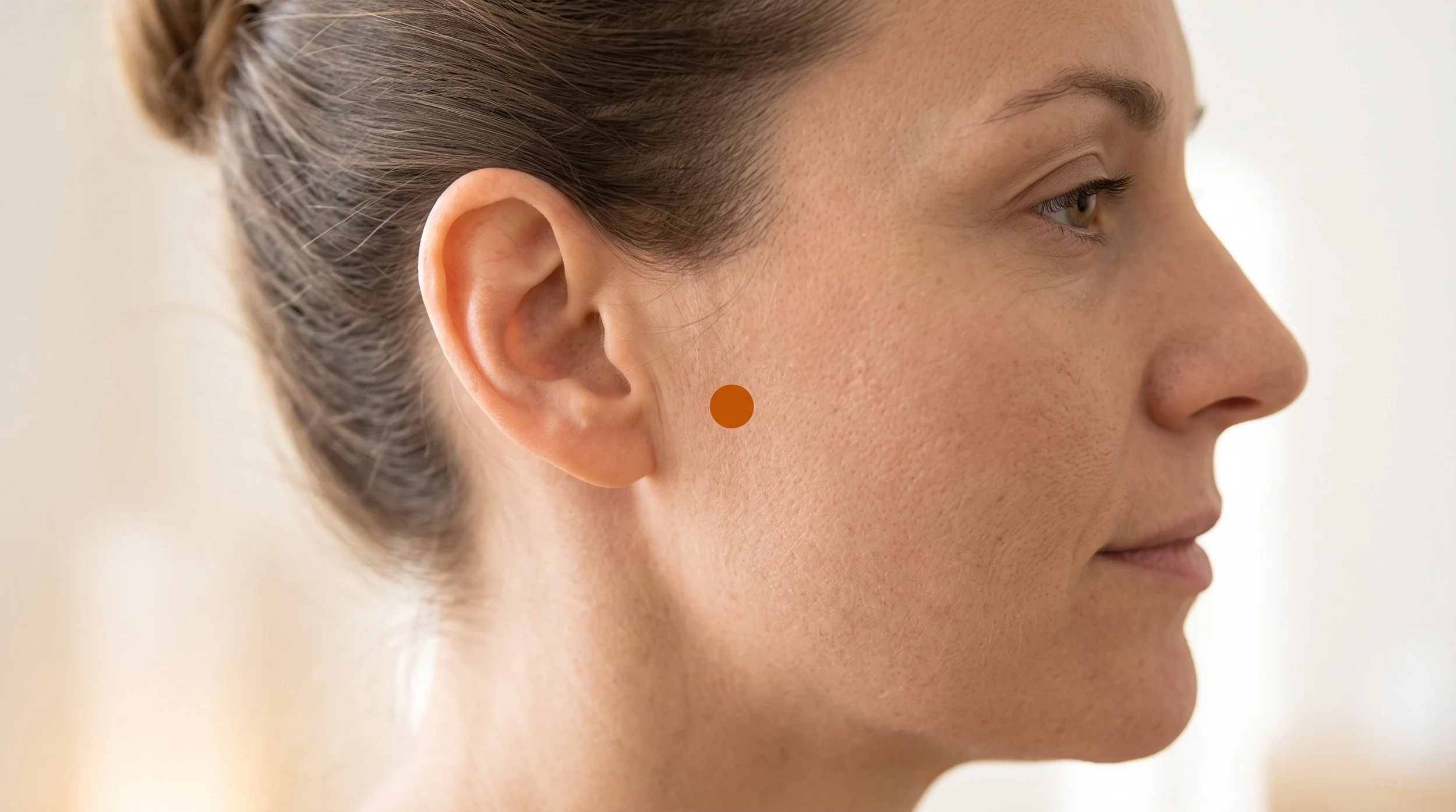
ST7, known in Chinese as Xiaguan and usually translated as Below the Joint or Lower Hinge, is the seventh point of the Stomach channel and the most direct acupuncture access to the temporomandibular joint. You find it on the side of the face, in the small depression under the cheekbone (the zygomatic arch) and just in front of the bump of the jaw joint, located with the mouth closed because the depression disappears when the condyle slides forward.
That address matters clinically: the needle sits over the joint capsule and the deep jaw muscles, inside the territory of the mandibular division of the trigeminal nerve, which is why the stomach 7 point shows up in almost every protocol for jaw pain, clenching, facial pain, and the ear symptoms that so often travel with them.
- ST7 lies at the lower border of the zygomatic arch, in the notch anterior to the mandibular condyle, and the needle passes through skin and the upper posterior fibers of masseter toward the mandibular notch and the lateral pterygoid region. It is one of the most consistently selected points in trial protocols for temporomandibular disorders, typically alongside ST6 and LI4 (Sung et al., 2021).
- Classical sources categorize the xiaguan point as a meeting point of the Stomach and Gallbladder channels and credit it with benefiting the ears, teeth, and jaw. Read anatomically, those traditional attributions describe one continuous nerve territory rather than a flow of energy, since the jaw joint, the ear canal, and the lower teeth all report to the mandibular branch of the trigeminal nerve.
- The point sits in the field of the auriculotemporal and masseteric branches of the mandibular nerve, and stimulation here is best explained by segmental input into the trigeminal brainstem complex plus recruitment of descending pain modulating pathways, opioid and monoaminergic systems included (Zhao, 2008).
- Reviews of acupuncture for temporomandibular disorders report reductions in pain and improvements in jaw function, but the evidence base is small and of low to moderate certainty, so results should be read as encouraging rather than settled (Fernandes et al., 2017; Park et al., 2023; Di Francesco et al., 2024).
- In practice ST7 is rarely used alone. It is combined with ST6 over masseter, LI4 as a distal point for the face, Taiyang when clenching drives temporal headache, and GB20 when the neck is part of the picture, and it may be paired with trigger point dry needling of the jaw muscles, which performs comparably to manual therapy in myofascial TMD (Menéndez-Torre et al., 2023).
- De qi at ST7 is usually described as a deep, dull, expanding ache or pressure that fills the jaw joint and may spread toward the ear, temple, or lower teeth. It is a heavy sensation rather than a sharp one, and it often eases within seconds of the needle settling.
Jaw Pain, Clicking, or Morning Clenching That Will Not Settle?
TMJ pain rarely responds to one thing done in isolation, which is why our clinicians treat the joint, the muscles that load it, and the neck in the same session. ST7 is our central local point at the joint line, paired with ST6 and targeted needling of masseter, temporalis, and the pterygoids when examination points there. We also look at clenching patterns, sleep, and cervical mechanics rather than only the sore spot. Schedule an evaluation and we will map out what is actually driving your jaw.
Schedule NowAnatomy of ST7: Why the Depression in Front of the Mandibular Condyle Is Such an Important Location
The surface landmark is simple once you feel it: the zygomatic arch above, the mandibular notch below, and the condyle just behind. Under the skin and thin superficial fascia lie the upper posterior fibers of masseter, and deeper still the needle approaches the mandibular notch, the tendon of temporalis as it descends toward the coronoid process, the lateral pterygoid, and the anterior aspect of the temporomandibular joint capsule.
Everything at this site is loaded by chewing, sustained clenching and grinding, gum chewing, prolonged talking, dental work with the mouth held open, and the low grade bracing that comes with stress and forward head posture. That is why the tissue here so often feels thickened, tender, and unhappy in patients with jaw complaints.
Sensory supply comes from the mandibular division of the trigeminal nerve, chiefly the auriculotemporal and masseteric branches, with the masseteric nerve crossing the mandibular notch and the auriculotemporal nerve supplying both the joint capsule and part of the external ear. This shared innervation is the practical explanation for a pattern patients describe constantly: jaw trouble that feels like ear pain, fullness, or ringing.
Needling into this field creates a strong, well localized afferent barrage that converges with nociceptive traffic in the trigeminal brainstem complex and engages descending inhibitory control from the midbrain and brainstem, involving endogenous opioid and monoaminergic mechanisms (Zhao, 2008). Individual patient data from chronic pain trials suggest effects that are modest but persistent rather than purely momentary (Vickers et al., 2018).
Deep to the point, the maxillary artery and the pterygoid venous plexus run through the infratemporal fossa, and the transverse facial artery crosses more superficially, so this is a vascular neighborhood where bruising is the most common minor event. Standard practice is perpendicular insertion angled slightly inferiorly, roughly 0.5 to 1 cun, with the mouth closed, and classical technique also describes threading toward neighbouring ear and jaw points for ear, tooth, and jaw complaints.
Depth is kept conservative and deliberate, the practitioner avoids aggressive deep manipulation, and patients are told in advance that a small bruise on the face is possible.
Related Masseter Trigger Points Related Lateral Pterygoid Trigger PointsST7 at a Glance: Classification, Location, and Clinical Use
| Category | Detail |
|---|---|
| Traditional Name | Xiaguan (Below the Joint, also translated Lower Hinge) |
| Channel Classification | Stomach channel, point 7 (ST7) |
| Point Categories | Meeting point of the Stomach and Gallbladder channels |
| Precise Location | On the face, at the lower border of the zygomatic arch, in the depression anterior to the condylar process of the mandible, located with the mouth closed |
| Tissue Stimulated | Skin and superficial fascia, upper posterior fibers of masseter, the mandibular notch region with temporalis tendon, and the lateral pterygoid territory overlying the temporomandibular joint capsule; auriculotemporal and masseteric branches of the mandibular trigeminal nerve |
| Needle Depth / Direction | Perpendicular insertion directed slightly inferiorly, 0.5 to 1 cun, with the mouth closed; classical practice also threads transversely toward neighbouring ear and jaw points for ear, tooth, and jaw disorders |
| De Qi Sensation | Deep dull ache, pressure, or expanding heaviness in the jaw joint, often spreading toward the ear, temple, or lower teeth |
| Primary Clinical Uses | TMJ pain and jaw dysfunction, facial pain and trigeminal territory symptoms, and toothache, ear pain, and tinnitus in classical listings |
| Common Point Combinations |
|
In A Manual of Acupuncture, Deadman and colleagues present ST7 as a heavily used local point for disorders of the ear, cheek, teeth, and jaw, listing traditional indications that include tinnitus, deafness, ear pain and discharge, toothache and gum swelling of the lower jaw, facial and cheek pain and swelling, deviation of the mouth and eye, and lockjaw or dislocation of the jaw.
Traditional commentary explains the ear indications by the point's position and by its status as a meeting point where the Gallbladder channel, which enters the ear, crosses the Stomach channel, and it notes that for facial pain and trigeminal neuralgia some practitioners needle slightly anterior to the textbook site. These are traditional attributions rather than modern diagnoses, but the pattern is striking: centuries before anyone mapped the mandibular nerve, classical texts had grouped the jaw joint, the lower teeth, the cheek, and the ear into a single clinical family served by one point.
Why ST7 Is Used for Ear Symptoms, Tinnitus, and Headaches That Seem to Have Nothing to Do With the Jaw
Patients with jaw problems very often report ear symptoms: fullness, aching in front of or inside the ear, ringing, or a sense that the ear needs to pop. The anatomy makes this predictable. The auriculotemporal nerve supplies both the temporomandibular joint capsule and part of the ear region, so irritated joint and muscle tissue sends signals into the same second order neurons in the trigeminal brainstem complex that receive input from the ear.
When many inputs converge on shared neurons, the brain's localization of the problem becomes imprecise, and pain gets reported in a neighboring structure that is perfectly healthy. Needling at ST7 addresses the segment rather than the symptom's address.
The same convergence logic explains temple headaches in people who clench. Temporalis and masseter share trigeminal supply with the joint, and sustained low level muscle activity is a well described contributor to referred head pain from the masticatory muscles (Simons et al., 1999).
Beyond the segmental effect, needle stimulation recruits descending inhibitory pathways that reduce the excitability of central pain relaying neurons, which is one reason relief can outlast the session and can extend slightly beyond the needled area (Zhao, 2008).
None of this makes ST7 a standalone answer. It makes it a well placed input into a system, which is exactly how we use it: as the local anchor for jaw mechanics, combined with distal points and with muscle specific needling when the examination supports it.
What the Research Shows for ST7
Research on acupuncture for jaw pain almost never tests a single point. Trials use protocols, and ST7 happens to be one of the most frequently included points in those protocols, so the fair way to read the literature is that it evaluates ST7 as part of a package rather than in isolation. The overall picture is cautiously positive for short term pain and jaw function in temporomandibular disorders, with small sample sizes, short follow up, and variable protocols limiting how strongly anyone can state the conclusion.
| Study | Type | Focus | Key Finding |
|---|---|---|---|
| Sung et al., 2021 | Systematic review of randomized controlled trials | Electroacupuncture for temporomandibular disorders | Across eleven trials, ST6, ST7, and LI4 were the points used most consistently, and results suggested potential benefit with no reported adverse events, though study quality limited firm conclusions. |
| Park et al., 2023 | Systematic review and meta-analysis | Acupuncture for temporomandibular disorder | Outcomes improved compared with active controls and when acupuncture was added to usual care, but the certainty of evidence was judged low. |
| Fernandes et al., 2017 | Systematic review | Acupuncture for myofascial pain in temporomandibular disorders | Acupuncture produced results broadly similar to occlusal splint therapy in a small number of trials with short follow up. |
| Di Francesco et al., 2024 | Systematic review and meta-analysis | Acupuncture and laser acupuncture for TMD pain | Pooled results supported a reduction in TMD associated pain, with the authors urging caution because of heterogeneity across trials. |
| Menéndez-Torre et al., 2023 | Systematic review and network meta-analysis | Deep dry needling versus manual therapy in myofascial TMD | No significant difference emerged between dry needling and manual therapy for short term pain reduction, with both ranking highly among available options. |
| Vickers et al., 2018 | Individual patient data meta-analysis | Acupuncture for chronic pain conditions | Acupuncture outperformed sham and no acupuncture controls for chronic pain, with effects that persisted over time rather than fading immediately. |
Headaches That Start in the Temples and End in the Jaw?
Temple headaches and jaw tension travel together more often than most people realize, because the same trigeminal territory carries both. At Morningside Acupuncture we combine ST7 with Taiyang, GB20, and LI4, then add trigger point work when the temporalis and masseter reproduce your familiar headache. Treatment is graded, comfortable, and reassessed each visit. Book a session and let us test whether your headache pattern is jaw driven.
Schedule NowST7 in the Context of Trigger Point Work
Acupuncture means the use of an acupuncture needle, and that includes dry needling, so at Morningside the question is never which system to use but which tissue needs input. ST7 sits directly over territory that trigger point mapping treats as a major source of orofacial pain: the upper masseter, the temporalis tendon as it passes under the zygomatic arch, and the pterygoids deeper in the infratemporal region.
Referral patterns from these muscles include the jaw joint, the ear, the temple, and the upper and lower teeth, which overlaps almost exactly with the classical indication list for the st 7 tmj point (Simons et al., 1999).
In a typical jaw session we palpate first, then decide. If the tender band that reproduces your pain sits in masseter or temporalis, we needle it directly and use ST7 and ST6 as the local joint line pair, often adding LI4 distally and GB20 when the upper neck contributes. Network meta-analysis in myofascial TMD found deep dry needling and manual therapy performing comparably for short term pain, which supports combining needling with hands on work and jaw loading advice rather than relying on any single technique (Menéndez-Torre et al., 2023).
ST7 TMJ and Facial Pain Treatment at NYC's Highest-Rated Acupuncture Clinic
Morningside Acupuncture is the highest-rated acupuncture and dry needling clinic in New York City with over 500 five-star Google reviews, and jaw pain is one of the conditions we see most often in our Midtown office. We use the st7 acupuncture point as an anchor for TMJ care, integrated with dry needling, manual therapy, and simple daily strategies for clenching and jaw loading. Sessions are one on one, precise, and built around your examination findings rather than a template. Schedule your visit today.
Schedule NowFrequently Asked Questions
What does ST7 feel like when needled?
Most people describe a deep, dull ache or a sense of pressure filling the jaw joint, sometimes spreading toward the ear, temple, or lower teeth. It can feel intense for a few seconds and then settle into heaviness once the needle is in place. If a masseter or temporalis trigger point is needled nearby, you may feel a brief muscle twitch, which is expected. Mild soreness or a sensation of jaw fatigue for a day afterward is common and usually short lived.
Why needle the jaw joint directly instead of only using distal points?
Local needling at ST7 delivers a strong afferent signal from the exact segment producing the pain, which is where trigeminal convergence and descending inhibition are most useful (Zhao, 2008). Distal points such as LI4 remain valuable, and classical practice pairs them with local points for precisely this reason, but the joint capsule and deep jaw muscles are hard to influence from a distance alone. Trial protocols for TMD reflect this, combining local jaw points with distal ones (Sung et al., 2021).
Can I press ST7 myself between sessions?
Yes, and it is one of the easier points to self treat. Close your mouth, run a fingertip along the lower edge of your cheekbone toward the ear, and find the small hollow just in front of the jaw joint (open and close your mouth a few times to feel the condyle move, then keep the mouth closed). Press inward with moderate, tolerable pressure for 30 to 60 seconds, breathing slowly, then release and repeat two or three times per side, once or twice a day. Use less pressure than you think you need, avoid pressing into a sharply painful or pulsing spot, and stop if you feel dizziness, numbness, or increased ear symptoms.
Is ST7 safe to needle?
In trained hands it is a routinely used point with a good safety record, and TMD trials using it have reported no serious adverse events (Sung et al., 2021). The main considerations are anatomical: the face is vascular, so small bruises are the most common minor effect, and depth is kept controlled because the maxillary artery and pterygoid venous plexus lie deeper in the infratemporal fossa. Practitioners needle with the mouth closed, angle slightly inferiorly, and avoid aggressive deep manipulation. Tell your clinician if you take blood thinners, have had recent facial surgery or injections, or have an active ear or dental infection.
Where exactly is ST7 located?
On the side of the face, at the lower border of the zygomatic arch, in the depression anterior to the condylar process of the mandible, located with the mouth closed. The simplest way to find the xiaguan point is to place a finger just in front of the ear, open the mouth so you feel the condyle glide forward under your fingertip, then close the mouth so your finger drops into the hollow that appears. That hollow, roughly a finger's width in front of the ear canal and just below the cheekbone, is ST7.
References
- Deadman, P., Al-Khafaji, M., & Baker, K. (2009). A manual of acupuncture. Journal of Chinese Medicine Publications.
- Cheng, X. (Ed.). (1999). Chinese acupuncture and moxibustion (Rev. ed.). Foreign Languages Press.
- Simons, D. G., Travell, J. G., & Simons, L. S. (1999). Travell & Simons' myofascial pain and dysfunction: The trigger point manual, Vol. 1: Upper half of body (2nd ed.). Williams & Wilkins.
- Sung, S.-H., Kim, D., Park, M., Hwang, S.-I., Yoon, Y.-J., Park, J.-K., & Sung, H.-K. (2021). Electroacupuncture for temporomandibular disorders: A systematic review of randomized controlled trials. Healthcare, 9(11), 1497. https://doi.org/10.3390/healthcare9111497
- Park, E. Y., Cho, J.-H., Lee, S.-H., Kim, K.-W., Ha, I.-H., & Lee, Y. J. (2023). Is acupuncture an effective treatment for temporomandibular disorder? A systematic review and meta-analysis of randomized controlled trials. Medicine, 102(38), e34950. https://doi.org/10.1097/MD.0000000000034950
- Fernandes, A. C., Duarte Moura, D. M., Da Silva, L. G. D., De Almeida, E. O., & Barbosa, G. A. S. (2017). Acupuncture in temporomandibular disorder myofascial pain treatment: A systematic review. Journal of Oral & Facial Pain and Headache, 31(3), 225-232. https://doi.org/10.11607/ofph.1719
- Di Francesco, F., Minervini, G., Siurkel, Y., Cicciù, M., & Lanza, A. (2024). Efficacy of acupuncture and laser acupuncture in temporomandibular disorders: A systematic review and meta-analysis of randomized controlled trials. BMC Oral Health, 24, 174. https://doi.org/10.1186/s12903-023-03806-1
- Menéndez-Torre, Á., Pintado-Zugasti, A. M., Cuenca Zaldivar, J. N., García-Bermejo, P., Gómez-Costa, D., Molina-Álvarez, M., Arribas-Romano, A., & Fernández-Carnero, J. (2023). Effectiveness of deep dry needling versus manual therapy in the treatment of myofascial temporomandibular disorders: A systematic review and network meta-analysis. Chiropractic & Manual Therapies, 31, 46. https://doi.org/10.1186/s12998-023-00489-x
- Vickers, A. J., Vertosick, E. A., Lewith, G., MacPherson, H., Foster, N. E., Sherman, K. J., Irnich, D., Witt, C. M., & Linde, K. (2018). Acupuncture for chronic pain: Update of an individual patient data meta-analysis. Journal of Pain, 19(5), 455-474. https://doi.org/10.1016/j.jpain.2017.11.005
- Zhao, Z. Q. (2008). Neural mechanism underlying acupuncture analgesia. Progress in Neurobiology, 85(4), 355-375. https://doi.org/10.1016/j.pneurobio.2008.05.004
Disclaimer: This web site is intended for educational and informational purposes only. Reading this website does not constitute providing medical advice or any professional services. This information should not be used for diagnosing or treating any health issue or disease. Those seeking medical advice should consult with a licensed physician. Seek the advice of a medical doctor or other qualified health professional for any medical condition. If you think you have a medical emergency, call 911 or go to the emergency room. No acupuncturist-patient relationship is created by reading this website or using the information. Morningside Acupuncture PLLC and its employees and contributors do not make any express or implied representations with respect to the information on this site or its use. For any legal interpretation of scope of practice in your state, consult a licensed attorney or regulatory authority.
Read more from our blog