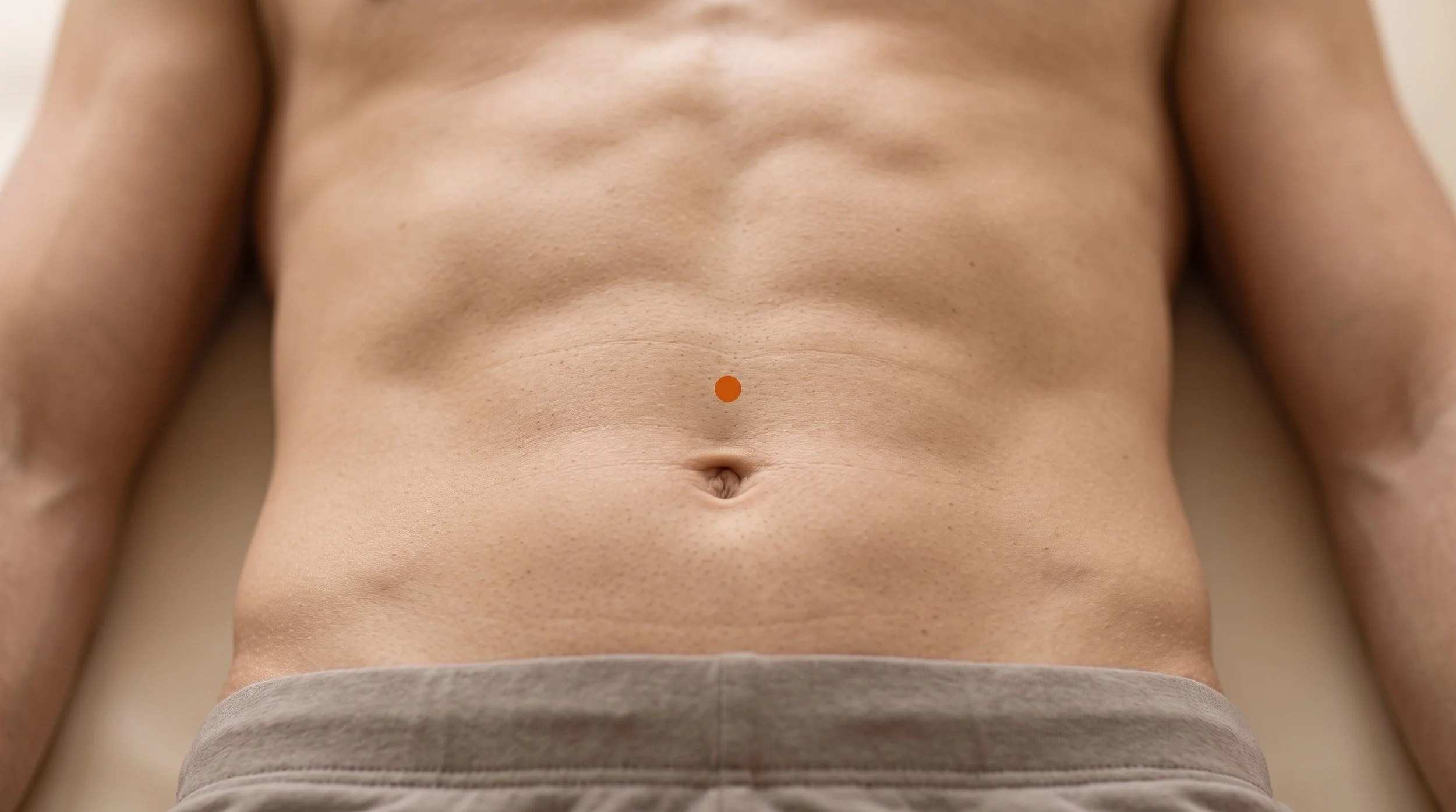
CV9 Acupuncture Point (Shuifen)
The Water Separation Point Above the Navel: Anatomy, Autonomic Mechanism, and Why Ren 9 Anchors Classical Treatment of Swelling and Abdominal Distension
CV9 (Shuifen), also written Ren 9, whose name is usually rendered as Water Separation, sits on the midline of the abdomen one cun above the umbilicus, roughly a thumb's width above the belly button on the fibrous seam that runs down the front of the belly. Classical sources treat it as the abdominal point for water diseases and swelling, and the Great Compendium of Acupuncture and Moxibustion locates it directly over the small intestine, the organ traditionally credited with sorting usable fluid from waste (Deadman et al., 2009).
In modern terms, the CV9 acupuncture point is a segmentally targeted abdominal wall point that sits over the mid-gut, is innervated by the same thoracic nerve levels that carry sensation from the small bowel, and is used clinically for bloating, distention, sluggish digestion, and the heavy, puffy abdomen that patients often describe as feeling waterlogged.
- Location and layers: conception vessel 9 lies on the linea alba one cun above the navel, so the needle passes through skin, subcutaneous fat, and dense midline fascia rather than muscle belly, with the rectus abdominis borders on either side (Deadman et al., 2009).
- Traditional category translated: classical texts assign CV9 the actions of regulating the water passages and harmonizing the intestines, which reads clinically as a point for abdominal fullness, gurgling, and fluid-heavy swelling rather than a point that literally moves water (Deadman et al., 2009; Cunningham, 2000).
- Mechanism: the anterior cutaneous branches of the lower intercostal nerves supply this part of the midline, and those segments overlap with visceral afferents from the small intestine, so stimulation here works through viscerosomatic convergence and segmental autonomic reflexes (Ma, 2020).
- Body-region specificity matters: laboratory work shows that stimulating the abdominal wall and stimulating the limbs drive different autonomic pathways to the gut, which is one reason clinicians rarely use Ren 9 abdomen points alone (Kametani et al., 1979; Liu et al., 2021).
- Research picture: reviews of acupuncture for functional dyspepsia and irritable bowel syndrome report modest, mixed benefits from multi-point protocols that often include midline abdominal points, and none isolate CV9 by itself (Manheimer et al., 2012; Guo et al., 2020; Mao et al., 2020).
- De qi here is usually a deep, spreading heaviness or a warm ache under the needle, sometimes with audible gurgling within a minute or two, and classical texts often preferred moxibustion over needling at this location in cases of swelling (Deadman et al., 2009).
Bloated, Puffy, and Uncomfortable After Every Meal?
Persistent abdominal fullness, gurgling, and that heavy waterlogged feeling in the belly are among the most common complaints we hear at Morningside Acupuncture. We use CV9 as part of a wider treatment that combines gentle midline abdominal needling with limb points such as ST36 and SP9, plus manual work and breathing retraining for a guarded abdominal wall. Treatment is calm, precise, and adapted to how your abdomen actually feels under the hands. Schedule a visit and let's map out a plan for your digestion.
Schedule NowAnatomy of CV9: Why the Linea Alba Just Above the Navel Is Such an Important Location
CV9 sits on the linea alba, the fibrous midline seam where the aponeuroses of the abdominal muscles from both sides interweave, one cun above the center of the umbilicus and seven cun below the sternocostal angle (Deadman et al., 2009). Surface to deep, a needle here passes through skin, a variable layer of subcutaneous fat, then dense collagenous fascia, with the medial borders of the rectus abdominis sitting just to either side. This midline strip is loaded constantly.
It resists the outward pressure of the abdominal contents during breathing, coughing, and lifting, and it tightens reflexively when the gut is distended or irritated. Patients with chronic bloating, abdominal surgery scars, or a habitual breath-holding pattern often present with a midline that feels either boardlike or oddly slack, and both patterns change how the tissue accepts a needle.
The skin and fascia at this level are supplied by the anterior cutaneous branches of the lower intercostal nerves, and the same thoracic segments carry afferent traffic from the small intestine and adjacent gut through the splanchnic pathways. That anatomical overlap is the basis of viscerosomatic convergence: sensory signals from the bowel and from the abdominal wall meet on shared dorsal horn neurons, which is why gut distention can produce midline abdominal tenderness and why needling the wall can influence gut tone (Ma, 2020).
Classic animal physiology showed that stimulating the abdominal skin and stimulating the limbs produce opposite reflex effects on gastric motility, with abdominal stimulation tending to engage segmental sympathetic pathways while limb stimulation recruits vagal ones (Kametani et al., 1979). Later neuroanatomical work confirmed that these somatosensory autonomic reflexes are organized by body region and depend on stimulation intensity and depth (Liu et al., 2021).
Needle stimulation also engages the descending inhibitory systems that dampen dorsal horn transmission, which helps explain the reduction in abdominal wall tenderness that often follows treatment (Zhao, 2008).
Deep to the fascia lie the transversalis fascia, extraperitoneal fat, peritoneum, and then loops of small intestine, sometimes overlaid by the greater omentum. Because the abdominal wall is thin here, particularly in slim patients, standard guidance is perpendicular insertion of about 0.8 to 1.5 cun with the caution that deeper needling risks entering the peritoneal cavity (Deadman et al., 2009). Practical technique matters: we palpate first, gauge tissue thickness, angle conservatively, and reduce depth in anyone who is very lean, has a midline hernia or diastasis, has had abdominal surgery, or is pregnant.
Several early texts favored moxibustion over needling at this point when treating swelling, and moxibustion over the abdomen is contraindicated in pregnancy (Deadman et al., 2009).
Related Conception Vessel Related Small Intestine ChannelCV9 (Ren 9) at a Glance: Classification, Location, and Clinical Use
| Category | Detail |
|---|---|
| Traditional Name | Shuifen (Water Separation), Conception Vessel 9, also written Ren 9 |
| Channel Classification | Conception Vessel (Ren mai), abdominal midline segment (CV9, also written REN9) |
| Point Categories | No five-shu, front-mu, or crossing designations are recorded for CV9 in the sources cited here. It is classified as a Conception Vessel abdominal point whose traditional actions are regulating the water passages and treating swelling, and harmonizing the intestines to disperse accumulation (Deadman et al., 2009). Some modern authors group it with CV17 and CV5 as the Conception Vessel points that address fluid transformation in the upper, middle, and lower burners, with CV9 representing the middle (Maciocia, 2005). |
| Precise Location | On the anterior midline of the abdomen, 1 cun above the center of the umbilicus and 7 cun below the sternocostal angle, on the linea alba |
| Tissue Stimulated | Skin and subcutaneous fascia over the linea alba, with the medial edges of the rectus abdominis and the aponeurotic contributions of the abdominal obliques adjacent to the midline |
| Needle Depth / Direction | Perpendicular insertion 0.8 to 1.5 cun, adjusted downward in thin patients. Deep needling may penetrate the peritoneal cavity. Classical texts favored plentiful moxibustion over needling in cases of water swelling, and moxibustion is contraindicated in pregnancy (Deadman et al., 2009). |
| De Qi Sensation | A deep, spreading heaviness or dull warm ache under the navel, occasionally with a sensation of softening or audible gurgling in the abdomen |
| Primary Clinical Uses | Traditionally used for swelling and water diseases, tight drum-like abdominal distention, borborygmus, poor appetite, acid regurgitation and vomiting after eating, and periumbilical pain described in classical texts as rushing up toward the chest |
| Common Point Combinations |
|
Deadman, Al-Khafaji, and Baker record CV9 under two traditional actions: regulating the water passages to treat swelling, and harmonizing the intestines to break up accumulation. Their commentary explains that the point name was understood literally by the classical authors, since the Great Compendium of Acupuncture and Moxibustion placed CV9 over the small intestine, the organ credited in traditional physiology with separating clear from turbid and directing fluid one way and solid residue the other.
Because that sorting function was said to depend on the spleen and kidneys, the point was reserved above all for the yin type of swelling attributed to depletion of those organs, particularly swelling centered on the abdomen.
The second action addresses a different picture: when the intestines stop moving, everything above them backs up, producing distention and hardness, rumbling, loss of appetite, sour regurgitation, vomiting after eating, and pain around the navel that classical texts described as surging upward toward the chest and making breathing difficult.
What is striking is the coherence of the classical pattern with what a clinician sees today, since the same abdomen that feels tight, fluid-heavy, and noisy is the one that presents with post-meal fullness and reflux, and the point sits precisely where those two complaints overlap on the body wall (Deadman et al., 2009).
Why CV9 Is Used for Bloating, Rumbling, and the Feeling of a Waterlogged Abdomen
The most useful way to think about CV9 is by segment. The midline just above the navel is supplied by the anterior cutaneous branches of the lower intercostal nerves, and those thoracic segments also receive afferent input from the small intestine. When those two inputs converge on the same spinal cord neurons, distended or irritable bowel can make the abdominal wall tender and guarded, and needling the wall can feed back onto autonomic outflow to the gut (Ma, 2020).
Experimental work going back decades established that this relationship is directional and region-specific: stimulating abdominal skin tends to recruit segmental sympathetic reflexes that slow gastric activity, while stimulating limb points tends to recruit vagal reflexes that promote it (Kametani et al., 1979). More recent neuroanatomical studies mapped these somatosensory autonomic pathways in detail and showed that the response depends on where you needle, how deeply, and how strongly (Liu et al., 2021).
That is exactly why an abdominal point like conception vessel 9 is almost never used on its own. In practice, we pair midline abdominal needling with limb points so that both arms of the autonomic response are available, calming a hypersensitive, cramping abdomen segmentally while supporting motility through the limbs. Patients tend to notice two things during a treatment that includes CV9: the abdominal wall softens under the hand, and the gut becomes audibly more active. Neither is a promise of results, but both are consistent with the reflex physiology above.
There is a pain component too. Needling activates the descending inhibitory systems that reduce transmission through the dorsal horn, which is part of why tender abdominal wall points become less reactive after a few sessions and why acupuncture shows small to moderate effects across chronic pain conditions in individual patient data analyses (Zhao, 2008; Vickers et al., 2018). For someone whose abdomen has been sore and braced for months, lowering that background sensitivity can be as valuable as any change in motility.
What the Research Shows for CV9 (Ren 9)
One note on naming before the evidence: in the research literature this point is almost always listed as CV9, the WHO standard code, while many textbooks and Chinese sources write Ren 9 or RN9, so it is worth searching those as well if you want to read the studies below in full.
Clinical research does not test CV9 on its own. Trials study protocols, and protocols usually combine midline abdominal points with limb points such as ST36, SP6, and PC6, so any result reflects the whole prescription, the number of sessions, and the population studied. The literature closest to CV9's traditional territory covers functional dyspepsia, irritable bowel syndrome, and postoperative recovery of bowel function, and it is best described as promising but methodologically uneven.
The classical use for generalized swelling from organ failure has not been tested in modern trials and should not be extrapolated from digestive research. What follows is a summary of the reviews and mechanistic studies that inform how we use this point, not evidence that this single point treats any condition.
| Study | Type | Focus | Key Finding |
|---|---|---|---|
| Manheimer et al., 2012 | Cochrane systematic review | Acupuncture for irritable bowel syndrome, 17 randomized trials with 1,806 participants | Acupuncture outperformed no specific treatment for symptom severity but did not clearly outperform sham needling, so much of the benefit may be nonspecific. |
| Guo et al., 2020 | Systematic review of mechanistic trials | Acupuncture and electroacupuncture in functional dyspepsia | Included studies suggested improvements in gastric motility and accommodation alongside changes in autonomic and central measures, though study quality varied. |
| Mao et al., 2020 | Systematic review and meta-analysis | Electroacupuncture for functional dyspepsia symptoms and quality of life | Pooled results favored electroacupuncture over control conditions, with the authors cautioning that trial quality limits confidence in the estimate. |
| Kametani et al., 1979 | Animal neurophysiology study | Reflex facilitation and inhibition of gastric motility from stimulation of different skin regions | Abdominal stimulation and limb stimulation produced opposite reflex effects on gastric motility, establishing region-specific somato-autonomic responses. |
| Liu et al., 2021 | Neuroanatomical animal study | Somatosensory pathways driven by electroacupuncture at limb versus abdominal points | Distinct autonomic pathways were recruited depending on body region and stimulation intensity, supporting point and depth specificity in mechanism terms. |
| Vickers et al., 2018 | Individual patient data meta-analysis | Acupuncture across chronic pain conditions | Effects were statistically significant versus sham and no-acupuncture controls, with modest effect sizes that persisted over time. |
Looking for Digestive Acupuncture on the Upper West Side?
Our practitioners treat digestive complaints the way we treat pain: with a clear anatomical rationale, careful point selection, and honest expectations. The Shuifen edema point is one tool among many, layered with abdominal palpation, dry needling of the abdominal wall where indicated, and lifestyle guidance around meals, hydration, and stress. Most patients notice how much of the tension in the belly is muscular and postural, not just dietary. Book an evaluation and we'll show you what we find.
Schedule NowCV9 in the Context of Trigger Point Work
Acupuncture, as we define it, is treatment with an acupuncture needle, and that includes the hundreds of styles practiced worldwide as well as dry needling. At CV9 the two frameworks converge neatly, because the classical point sits on the linea alba between the medial borders of the rectus abdominis, a muscle that develops taut bands and referred pain patterns of its own.
Trigger points in the upper rectus abdominis can refer horizontally across the mid-back, while points in the lower fibers and in the oblique musculature can produce symptoms that mimic visceral complaints, including belching, nausea, and a sense of fullness (Simons et al., 1999). Recognizing that overlap prevents a common clinical error, which is treating an abdominal wall problem as if it were purely a gut problem.
In practice, we palpate the abdominal wall segment by segment before deciding what to needle. If the midline itself is thickened and tender, shallow needling at CV9 with careful depth control is often enough. If the taut bands sit lateral to the midline, we add dry needling to the rectus abdominis and the external and internal obliques using flat or tangential angles that keep the needle in the muscle layer and away from the peritoneum, and we avoid needling over hernias, surgical mesh, or unexplained masses.
Combining the segmental input at CV9 with limb points and with hands-on release of the abdominal wall tends to produce a softer, quieter abdomen than any of those approaches used alone.
CV9 Bloating and Digestive Treatment at NYC's Highest-Rated Acupuncture Clinic
Morningside Acupuncture is the highest-rated acupuncture and dry needling clinic in New York City with over 500 five-star Google reviews, and digestive complaints are a regular part of our caseload. We integrate classical points such as CV9 with modern trigger point needling, myofascial release, and clear at-home guidance so progress continues between visits. Every plan starts with a thorough intake and hands-on abdominal assessment, never a template. Schedule your first session and get started.
Schedule NowFrequently Asked Questions
Is CV9 the same point as Ren 9?
Yes. CV9 and Ren 9 are two codes for the same point, Shuifen. CV stands for Conception Vessel and is the WHO standard abbreviation, the one you will see in most research papers. Ren comes from Ren Mai, the Chinese name of the vessel, and it is the form used in many textbooks and acupuncture schools. You will also come across it written as REN-9, RN9, or Conception Vessel 9. Whichever code is used, the location and the uses are the same.
What does CV9 feel like when needled?
Most people feel a brief pinch at the skin, then a deep, spreading heaviness or a dull warm ache just above the navel. Because the point sits on dense midline fascia, the needle often meets a firm, grabbing quality rather than the soft give of muscle. Some patients feel a sensation of the belly relaxing or widening, and it is common to hear gurgling within a minute or two of insertion. If moxibustion is used instead of or alongside the needle, the sensation is a slowly building, comfortable warmth over the lower abdomen. Sharp, burning, or radiating pain is not expected and should be reported right away so the needle can be adjusted.
Why needle the abdomen for digestive symptoms instead of just using points on the arms and legs?
Because the two locations do different things. Abdominal points such as CV9 share spinal segments with the small intestine, so they act through local viscerosomatic convergence and segmental autonomic reflexes, and they also treat the abdominal wall itself, which is frequently tender and guarded in people with chronic bloating (Ma, 2020). Limb points recruit different pathways, and experimental work shows that stimulating limbs and stimulating the abdomen can produce opposite reflex effects on gastric activity (Kametani et al., 1979; Liu et al., 2021). Good treatment usually uses both, which is exactly what the classical combinations for CV9 do when they pair it with KD7 or SP9.
Can I press CV9 myself between sessions?
Yes, gentle self-acupressure at this point is reasonable for most people. Find the center of your navel, move up about one thumb width, and rest two or three fingertips flat on the midline. Press slowly inward with light to moderate pressure while exhaling, hold for 20 to 30 seconds, release, and repeat for two to three minutes. Small slow circles or a gentle rocking pressure often feels better than sustained deep pressing. Do this once or twice a day, ideally 60 to 90 minutes after a meal rather than on a full stomach, and pair it with slow diaphragmatic breathing so the abdominal wall can release. Stop if pressure produces sharp pain, nausea, or lightheadedness, and skip it entirely if you are pregnant, have a hernia or recent abdominal surgery, or have any undiagnosed abdominal pain, mass, or swelling that has not been evaluated by a physician.
Is CV9 safe to needle?
In trained hands, yes, with clear precautions. The abdominal wall is thin at the midline, so classical and modern texts both warn that deep needling can penetrate the peritoneal cavity, particularly in slim patients, and recommended depth is roughly 0.8 to 1.5 cun with conservative technique (Deadman et al., 2009). We reduce depth or choose a different approach for anyone who is very lean, pregnant, has a midline hernia or diastasis recti, has had recent abdominal surgery, or has significant abdominal distention of unknown cause. Several early texts preferred moxibustion at this point over needling when treating swelling, and moxibustion over the abdomen is contraindicated in pregnancy. Swelling that is new, one-sided, rapidly worsening, or accompanied by shortness of breath needs medical evaluation first, since it can reflect heart, kidney, or liver disease.
Where exactly is CV9 located?
On the front midline of the abdomen, one cun above the center of the umbilicus, which is about one thumb width for most people, and seven cun below the sternocostal angle where the rib margins meet (Deadman et al., 2009). It lies directly on the linea alba, the firm fibrous seam you can feel running vertically between the two columns of the rectus abdominis. To find it, place a fingertip in the center of your navel, slide straight upward one thumb width, and stay on the midline rather than drifting to either side. Its neighbors help confirm the level, since ST24 sits two cun lateral to CV9 on the same horizontal line.
References
- Deadman, P., Al-Khafaji, M., & Baker, K. (2009). A manual of acupuncture. Journal of Chinese Medicine Publications.
- Maciocia, G. (2005). The foundations of Chinese medicine: A comprehensive text for acupuncturists and herbalists (2nd ed.). Elsevier Churchill Livingstone.
- Cheng, X. (Ed.). (1999). Chinese acupuncture and moxibustion (Rev. ed.). Foreign Languages Press.
- Cunningham, P. M. (2000). Acupuncture points: A practical guide to classical and modern usage. Odyssey Press.
- O'Connor, J., & Bensky, D. (Eds. & Trans.). (1981). Acupuncture: A comprehensive text. Shanghai College of Traditional Medicine. Eastland Press.
- Simons, D. G., Travell, J. G., & Simons, L. S. (1999). Travell & Simons' myofascial pain and dysfunction: The trigger point manual, Vol. 1: Upper half of body (2nd ed.). Williams & Wilkins.
- Manheimer, E., Cheng, K., Wieland, L. S., Min, L. S., Shen, X., Berman, B. M., & Lao, L. (2012). Acupuncture for treatment of irritable bowel syndrome. Cochrane Database of Systematic Reviews, 2012(5), CD005111. https://doi.org/10.1002/14651858.CD005111.pub3
- Guo, Y., Wei, W., & Chen, J. D. Z. (2020). Effects and mechanisms of acupuncture and electroacupuncture for functional dyspepsia: A systematic review. World Journal of Gastroenterology, 26(19), 2440-2457. https://doi.org/10.3748/wjg.v26.i19.2440
- Mao, X., Guo, S., Ni, W., Zhang, T., Liu, Q., Du, S., Luo, M., Pan, Y., Wu, B., Su, X., Yang, Y., Guo, Y., Chen, J. D. Z., Rong, P., & Wei, W. (2020). Electroacupuncture for the treatment of functional dyspepsia: A systematic review and meta-analysis. Medicine, 99(45), e23014. https://doi.org/10.1097/MD.0000000000023014
- Ma, Q. (2020). Somato-autonomic reflexes of acupuncture. Medical Acupuncture, 32(6), 362-366. https://doi.org/10.1089/acu.2020.1488
- Kametani, H., Sato, A., Sato, Y., & Simpson, A. (1979). Neural mechanisms of reflex facilitation and inhibition of gastric motility to stimulation of various skin areas in rats. The Journal of Physiology, 294, 407-418. https://doi.org/10.1113/jphysiol.1979.sp012937
- Liu, S., Wang, Z., Su, Y., Qi, L., Yang, W., Fu, M., Jing, X., Wang, Y., & Ma, Q. (2021). A neuroanatomical basis for electroacupuncture to drive the vagal-adrenal axis. Nature, 598(7882), 641-645. https://doi.org/10.1038/s41586-021-04001-4
- Zhao, Z. Q. (2008). Neural mechanism underlying acupuncture analgesia. Progress in Neurobiology, 85(4), 355-375. https://doi.org/10.1016/j.pneurobio.2008.05.004
- Vickers, A. J., Vertosick, E. A., Lewith, G., MacPherson, H., Foster, N. E., Sherman, K. J., Irnich, D., Witt, C. M., & Linde, K. (2018). Acupuncture for chronic pain: Update of an individual patient data meta-analysis. Journal of Pain, 19(5), 455-474. https://doi.org/10.1016/j.jpain.2017.11.005
Disclaimer: This web site is intended for educational and informational purposes only. Reading this website does not constitute providing medical advice or any professional services. This information should not be used for diagnosing or treating any health issue or disease. Those seeking medical advice should consult with a licensed physician. Seek the advice of a medical doctor or other qualified health professional for any medical condition. If you think you have a medical emergency, call 911 or go to the emergency room. No acupuncturist-patient relationship is created by reading this website or using the information. Morningside Acupuncture PLLC and its employees and contributors do not make any express or implied representations with respect to the information on this site or its use. For any legal interpretation of scope of practice in your state, consult a licensed attorney or regulatory authority.
Read more from our blog



