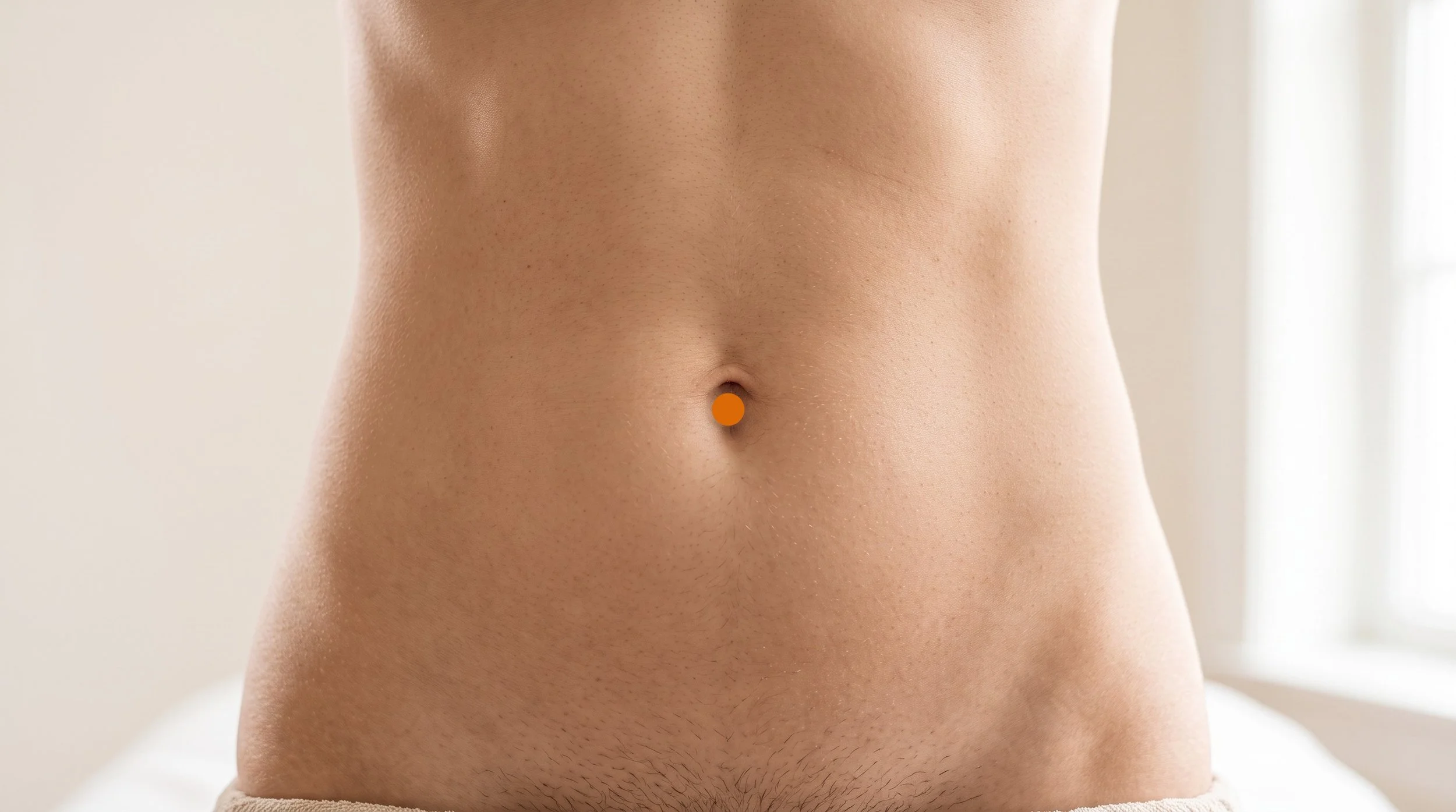
CV8 Acupuncture Point (Shenque)
The Spirit Gateway at the Center of the Navel: Anatomy, Mechanism, and Why This Conception Vessel Point Is Treated With Heat Instead of Needles
CV8 (Shenque, often translated as Spirit Gateway or Spirit Palace) sits in the exact center of the umbilicus, which makes it the easiest point on the body to find and one of the very few that is never needled. The classical literature treats this Ren 8 navel location as a place of entry and nourishment (the fetal connection), and in adult practice as a site for warming a cold, sluggish abdomen and supporting patients who feel depleted, chilled, and loose in the bowels.
Anatomically the umbilicus is a healed scar with no muscular layer between the skin and the peritoneum, so the classical warning against needling here has a straightforward modern rationale, and the point is instead treated with moxibustion (commonly over salt or sliced ginger), a warm patch, or gentle massage.
At Morningside Acupuncture in NYC we use conception vessel 8 as a heat point that pairs with needling elsewhere on the abdomen, legs, and back, particularly for patients whose digestive symptoms are worse with cold, stress, and fatigue.
- CV8 is located in the center of the umbilicus, a scar rather than a muscle belly: thin adherent skin sits on a dense fibrous ring with essentially no subcutaneous cushion, and the peritoneum and small bowel lie immediately beneath, which is why the point is treated as forbidden to needling in modern practice (Deadman reference material; Kim reference material).
- Traditional sources attribute two main actions to Shenque: warming and rescuing yang in states of collapse with cold limbs, and warming and harmonizing the intestines in what the classics call a deficient cold abdomen, with classical indications clustering around ceaseless diarrhea, borborygmus, periumbilical pain, rectal prolapse, and edema. In modern language these describe hypoperfused, hypomotile, autonomically dysregulated abdominal states rather than any literal flow of energy.
- The umbilicus sits in the T10 dermatome, and the same spinal segments receive visceral afferents from the small intestine and proximal colon, so cutaneous stimulation here converges with gut input in the dorsal horn and can engage somato-autonomic reflexes that modulate motility and secretion (Zhao, 2008).
- Moxibustion works through measurable heat: sustained skin temperatures in the mid-forties Celsius recruit warm and nociceptive afferents, and in healthy volunteers indirect moxibustion produced a small drop in heart rate with increased short-term heart rate variability, consistent with a parasympathetic shift (Nakahara et al., 2022).
- The research picture is promising but modest in quality. Systematic reviews suggest moxibustion may improve global symptoms in irritable bowel syndrome and in diarrhea-predominant IBS, with high risk of bias across included trials (Park et al., 2013; Tang et al., 2016; Dai et al., 2022), and a CV8-specific review of umbilical herbal patching in pediatric acute diarrhea reported shorter symptom duration with no serious adverse effects, again from low-quality trials (Liu et al., 2017).
- Because no needle is inserted, there is no de qi in the usual sense at this Shenque moxibustion point. Patients typically describe a deep, spreading warmth behind the navel, sometimes audible gurgling, an urge to sigh or yawn, and a settled, sleepy feeling that often outlasts the session.
Struggling With Loose Stools, Bloating, and a Belly That Always Feels Cold?
Patients who describe urgency after meals, gurgling, and abdominal discomfort that eases with a hot water bottle are often good candidates for warming work at CV8. We combine salt or ginger moxibustion over the navel with needling of abdominal, leg, and back points selected for your pattern, then track symptoms week to week rather than guessing. Nothing is inserted at the umbilicus itself, so the treatment is comfortable even for sensitive patients. Schedule a visit and we can map out a short trial course.
Schedule NowAnatomy of CV8: Why the Center of the Umbilicus Is Such an Important Location
The umbilicus is not a joint, a muscle, or a tendon: it is the healed remnant of the umbilical cord's passage through the abdominal wall. At the surface there is thin, often puckered skin that adheres directly to underlying fibrous tissue, with almost none of the subcutaneous fat that pads the rest of the belly. Beneath that is the fibrous umbilical ring set within the linea alba, where the two rectus sheaths meet at the midline, and then a thin layer of fascia and preperitoneal tissue.
What loads this region is pressure rather than movement: coughing, straining, pregnancy, rapid weight change, and heavy lifting all stress the ring, which is why umbilical hernias are common here. Because the umbilicus sits at the geometric center of the abdominal wall, it is also a reliable landmark, and standard texts locate it directly rather than by proportional measurement (CAM reference material).
Sensory supply to the navel comes from the anterior cutaneous branch of the tenth thoracic spinal nerve, placing CV8 squarely in the T10 dermatome. That segment matters clinically because visceral afferents from the small intestine and the proximal colon travel back to the same spinal levels through splanchnic pathways. When two input streams converge on shared dorsal horn neurons, stimulating the skin can influence how that segment processes visceral signals and can trigger reflex changes in autonomic outflow to the gut, a mechanism well described in the acupuncture neuroscience literature (Zhao, 2008).
Heat adds a second layer: moxibustion raises local skin temperature into a range that recruits warm-sensitive and small-diameter afferents, and human recording studies show measurable autonomic consequences, including a bradycardic response with increased beat-to-beat variability (Nakahara et al., 2022). Local warming also produces vasodilation in skin and underlying tissue, which is part of why patients report a diffuse, comfortable heat rather than a sharp sensation.
The reason CV8 is handled differently from every neighboring conception vessel point is what sits directly deep to it. At the umbilical scar there is no muscle layer and often only a few millimeters of tissue between skin and peritoneum, with small bowel loops immediately below, and in patients with an umbilical hernia the margin is smaller still.
Deadman's text lists Shenque as one of only two points (with ST17 Ruzhong) considered forbidden to needling in current clinical practice, and it is treated instead with moxibustion or massage (Deadman reference material). Conventional technique uses large moxa cones burned on a mound of salt, a slice of ginger, crushed garlic, or a prepared cake, or an indirect moxa stick held above the skin.
Practical cautions matter more than usual here: the barrier must be thick enough to prevent burns, the skin is checked frequently, treatment is avoided over broken or irritated skin, and dose is reduced for children, older adults, and anyone with reduced sensation.
Related Conception Vessel Related Acupuncture Channels CollateralsCV8 (Ren 8) at a Glance: Classification, Location, and Clinical Use
| Category | Detail |
|---|---|
| Traditional Name | Shenque (Spirit Gateway, also translated Spirit Palace); classical alternate names include Qishe (abode of qi) and Qihe (joining of qi) |
| Channel Classification | Conception Vessel (Ren Mai), point 8, on the anterior midline of the abdomen (CV8, also written REN8) |
| Point Categories | No five-shu, luo-connecting, or hui-meeting designation is assigned to this point in the reference sources. Its distinctive status is technical rather than categorical: it is one of only two points (with ST17) treated as forbidden to needling in current practice, and is classified as a moxibustion and massage point, classically with salt-, ginger-, garlic-, or aconite-partitioned cones. KD16 lies level with it, 0.5 cun lateral, making CV8 a useful reference landmark for abdominal point location. |
| Precise Location | In the center of the umbilicus, on the anterior midline |
| Tissue Stimulated | Umbilical scar tissue, the fibrous umbilical ring within the linea alba, and T10 cutaneous afferents; surrounding needling targets include the rectus abdominis and the abdominal obliques and external abdominal oblique trigger point regions |
| Needle Depth / Direction | No insertion at any depth or angle. Needling is contraindicated in all cases. Treatment is by indirect moxa stick held above the skin, or moxa cones over a bed of salt or a ginger slice, or gentle circular massage over the navel |
| De Qi Sensation | No needle sensation. Patients report a deep spreading warmth behind the navel, occasional gurgling or shifting in the abdomen, mild sweating on the belly, and a heavy, relaxed, sometimes drowsy feeling |
| Primary Clinical Uses | Traditionally used for cold-type abdominal pain and borborygmus, ceaseless or chronic diarrhea (especially in older or depleted patients), rectal prolapse from deficiency, edema and abdominal distention, and as a classical revival point for collapse with cold limbs alongside emergency medical care |
| Common Point Combinations |
|
Deadman, Al-Khafaji, and Baker's point text frames Shenque around the umbilicus as a passage: the place through which a fetus was fed, and later in life a place to reach for when reserves run out.
Two traditional actions are attributed to it, warming and rescuing yang in collapse, and warming and harmonizing the intestines, and the indication lists that follow cluster tightly around those themes: unrelenting diarrhea, diarrhea in infants and in older or depleted patients, rumbling and pain around the navel, rectal prolapse, edema with abdominal distention, sudden severe vomiting and diarrhea, and loss of consciousness with cold limbs. A smaller group of entries covers postpartum abdominal distention with urinary retention and difficulty conceiving attributed to cold, along with convulsive presentations.
Names recorded in the older literature (abode of qi, joining of qi) reinforce the same idea. What is striking is the internal consistency of the classical pattern: a point that cannot be needled at all was nonetheless assigned some of the heaviest clinical work in the canon, which tells you how much traditional practice trusted sustained heat over the navel.
Why CV8 Is Used for Chronic Diarrhea and Cold Abdominal Pain Without Ever Being Needled
The clinical logic starts with segmental anatomy. Skin at the navel is supplied by the tenth thoracic nerve, and visceral afferents from the small intestine and proximal colon report back to that same neighborhood of the spinal cord. Because somatic and visceral inputs converge on shared neurons, a strong, sustained cutaneous signal at the umbilicus is delivered to the exact segments that are processing gut sensation. That convergence is the accepted framework for how surface stimulation can change visceral pain reporting and reflex motor output rather than acting on the bowel directly (Zhao, 2008).
It also explains why abdominal points tend to be chosen for abdominal complaints while distal points on the leg are used for broader, whole-system effects.
Heat is the active ingredient at this point, and heat has measurable autonomic consequences. In healthy volunteers, indirect moxibustion that raised local skin temperature to roughly 45 degrees Celsius was followed by a small but significant fall in heart rate along with increased short-term heart rate variability, a pattern consistent with a parasympathetic shift (Nakahara et al., 2022).
Since gut motility, secretion, and visceral sensitivity are all under autonomic control, a treatment that nudges the system toward parasympathetic dominance is at least mechanistically plausible for cramping, urgency, and bloating. Local warming also drives cutaneous vasodilation and may recruit descending inhibitory pathways that dampen pain signaling from the same segments (Zhao, 2008).
None of this makes CV8 a stand-alone answer for a digestive problem. In our clinic it works as one input within a session: needling at points on the legs, back, and abdominal wall does most of the work, while moxibustion over the navel adds a slow thermal and autonomic stimulus that many patients find deeply calming. Chronic diarrhea, unexplained weight change, blood in the stool, fever, or night symptoms need medical evaluation first, and acupuncture is best used alongside that workup rather than in place of it.
What the Research Shows for CV8 (Ren 8)
One note on naming before the evidence: in the research literature this point is almost always listed as CV8, the WHO standard code, while many textbooks and Chinese sources write Ren 8 or RN8, so it is worth searching those as well if you want to read the studies below in full.
Two cautions apply to the evidence here. First, almost all of the relevant trials test multi-point moxibustion protocols in which CV8 is one of several sites, so the literature speaks to moxibustion as a treatment strategy more than to this point in isolation.
Second, the methodological quality of the underlying trials is generally low, with small samples, weak blinding, and comparators that are hard to interpret. The umbilicus is one of the few locations with point-specific review evidence, mostly from studies of herbal patches applied to the navel in pediatric diarrhea, and even there the reviewers describe the trial pool as poor quality. The reasonable reading is that warming the navel appears safe and may help symptom burden in some digestive presentations, and that firmer conclusions await better trials.
| Study | Type | Focus | Key Finding |
|---|---|---|---|
| Liu et al., 2017 | Systematic review and meta-analysis (21 trials, 3560 children) | Herbal patching applied specifically at Shenque (CV8) as an add-on for acute pediatric diarrhea | Adding CV8 patching to conventional care was associated with shorter diarrhea duration and fewer treatment failures, with no serious adverse effects reported, though the authors judged the included trials to be of generally poor quality. |
| Park et al., 2013 | Systematic review and meta-analysis (20 trials, 1625 patients) | Moxibustion for global symptom improvement in irritable bowel syndrome | Moxibustion may offer benefit compared with pharmacological treatment, but risk of bias across trials was high, so the reviewers called for better-designed studies before drawing conclusions. |
| Tang et al., 2016 | Systematic review and meta-analysis (7 trials, 568 patients) | Moxibustion versus medication in diarrhea-predominant IBS | Global symptom scores favored moxibustion, with significant improvements in abdominal distention and stool frequency and no serious adverse events, though methodological rigor was described as insufficient. |
| Dai et al., 2022 | Systematic review and meta-analysis | Updated pooling of randomized trials of moxibustion for IBS with diarrhea | The review reached broadly similar cautious conclusions, supporting a possible symptomatic benefit while highlighting persistent limitations in trial design. |
| Ma et al., 2013 | Randomized clinical trial | Herb-partitioned moxibustion in patients with diarrhea-predominant IBS | The partitioned moxibustion protocol was associated with improved symptom scores, illustrating the kind of single-center trial that underpins the pooled reviews. |
| Nakahara et al., 2022 | Human physiological study (15 healthy volunteers) | Cardiovascular and autonomic responses to indirect moxibustion | Local skin temperature peaking near 45 degrees Celsius was accompanied by a modest heart rate reduction and increased short-term heart rate variability, suggesting a parasympathetic response to moxa heat. |
| Zhao, 2008 | Narrative review of mechanisms | Segmental convergence, spinal processing, and descending inhibition in acupuncture | Provides the neurophysiological framework for why stimulation within a dermatome that shares spinal segments with a target organ can influence pain and autonomic output. |
Fatigue, Cold Hands and Feet, and Digestion That Never Quite Recovers?
The classical texts reserved CV8 for people who were depleted, chilled, and slow to bounce back, and that description still fits many of the patients we see on the Upper West Side. Warming the navel is a low-intensity way to add autonomic input to a treatment plan that also addresses sleep, stress, and food tolerance. We explain what the research does and does not support, and we adjust dose based on how you respond. Book an appointment to get started.
Schedule NowCV8 in the Context of Trigger Point Work
CV8 is never a dry needling target, but it sits in the middle of a region we do needle often. Trigger points in the rectus abdominis, particularly bands close to the umbilicus, can produce periumbilical aching and cramping that patients and clinicians alike may attribute to the gut, and abdominal wall trigger points have long been described as capable of referring pain and producing nausea or a sense of fullness (Simons et al., 1999). The external and internal obliques can do something similar along the flank and lower abdomen.
When a patient's abdominal pain reproduces on palpation of a taut band and changes with trunk position or breath, that is a signal the wall deserves attention rather than only the viscera.
In practice the two approaches sit comfortably together. We may needle tender rectus abdominis and oblique bands with fine needles at conservative, tangential angles well away from the umbilical scar, then finish with indirect moxibustion over CV8 while the abdomen is already relaxed. The needling addresses mechanical, myofascial contributors to abdominal discomfort, while warming the navel supplies a broader segmental and autonomic input.
Abdominal dry needling requires careful anatomical judgment, so it is performed only where the wall can be assessed confidently and never in patients where a hernia or other structural concern is suspected.
CV8 Digestive Treatment at NYC's Highest-Rated Acupuncture Clinic
Morningside Acupuncture is the highest-rated acupuncture and dry needling clinic in New York City with over 500 five-star Google reviews, and CV8 moxibustion is one of the tools we reach for in digestive and fatigue-related cases. Our clinicians combine classical point selection with orthopedic dry needling and clear, cautious explanations of what treatment may and may not do. If cold-aggravated digestive symptoms have been dragging on, schedule a consultation and let us build a plan around them.
Schedule NowFrequently Asked Questions
Is CV8 the same point as Ren 8?
Yes. CV8 and Ren 8 are two codes for the same point, Shenque. CV stands for Conception Vessel and is the WHO standard abbreviation, the one you will see in most research papers. Ren comes from Ren Mai, the Chinese name of the vessel, and it is the form used in many textbooks and acupuncture schools. You will also come across it written as REN-8, RN8, or Conception Vessel 8. Whichever code is used, the location and the uses are the same.
What does CV8 feel like when needled?
It is not needled, so there is no needle sensation to describe. What patients feel instead is heat: a warmth that builds slowly at the navel and then seems to sink inward and spread across the lower abdomen. Many people notice gurgling or shifting in the belly, a light sweat on the skin around the navel, and a heavy, relaxed feeling that can tip into drowsiness. The heat should always stay comfortable, and telling your clinician the moment it goes from pleasantly hot to sharp is the main safety check during treatment.
Why is CV8 treated with heat instead of a needle?
Because of what is under the skin. The umbilicus is a scar rather than muscle, and at its center there is essentially no muscular layer separating the surface from the peritoneum and the bowel beneath, a margin that is thinner still in anyone with an umbilical hernia. Classical texts list Shenque as forbidden to needling, and modern texts keep that restriction, making it one of only two points (with ST17) still treated that way in current practice. Moxibustion solves the problem elegantly: it delivers a strong, sustained thermal stimulus to the same segmental territory with nothing crossing the skin at all.
Can I press CV8 myself between sessions?
Yes, and self-care at the navel is straightforward because there is nothing sharp involved. Lie on your back with your knees supported, place the pads of two or three fingers over the navel, and press with light to moderate pressure while breathing slowly into your lower ribs, holding for 30 to 60 seconds and repeating for 3 to 5 minutes. You can also make slow circles around the navel in either direction for a similar duration. A warm compress, a heating pad on low, or a warm palm resting over the navel for 10 to 15 minutes is often more comfortable than pressure and better matches how the point is traditionally used. Once or twice a day is plenty. Skip it if the area is painful to touch, if there is a bulge or lump at the navel, if you are pregnant unless your clinician has cleared it, or if you have any new or severe abdominal pain, which needs medical assessment rather than self-treatment.
Is CV8 safe to needle?
No. Needling at CV8 is contraindicated in all cases, at any depth or angle, and there is no clinical situation in which it is considered acceptable. The concern is direct: thin scar tissue over peritoneum and bowel, with no muscle buffer and a meaningful chance of an unrecognized umbilical hernia. Moxibustion and massage are safe alternatives when done thoughtfully, with a thick enough barrier of salt or ginger to prevent burns, frequent skin checks, and reduced dose for children, older adults, people with diabetes or reduced sensation, and anyone with fragile or broken skin. Moxa smoke should also be used in a well-ventilated room, and smokeless options are available for sensitive patients.
Where exactly is CV8 located?
In the center of the umbilicus, on the anterior midline of the abdomen. It is the one point in the whole system that requires no measuring, which is why textbooks use it as a direct anatomical landmark. It is also a useful reference for locating its neighbors: CV9 sits one cun above it, CV7 one cun below, and KD16 lies 0.5 cun to either side at the same level.
References
- Deadman, P., Al-Khafaji, M., & Baker, K. (2009). A manual of acupuncture. Journal of Chinese Medicine Publications.
- Maciocia, G. (2005). The foundations of Chinese medicine: A comprehensive text for acupuncturists and herbalists (2nd ed.). Elsevier Churchill Livingstone.
- Kim, H. (2008). Handbook of Oriental medicine (3rd ed.). Harmony & Balance Press.
- Cunningham, P. M. (2000). Acupuncture points: A practical guide to classical and modern usage. Odyssey Press.
- Cheng, X. (Ed.). (1999). Chinese acupuncture and moxibustion (Rev. ed.). Foreign Languages Press.
- O'Connor, J., & Bensky, D. (Eds. & Trans.). (1981). Acupuncture: A comprehensive text. Shanghai College of Traditional Medicine. Eastland Press.
- Simons, D. G., Travell, J. G., & Simons, L. S. (1999). Travell & Simons' myofascial pain and dysfunction: The trigger point manual, Vol. 1: Upper half of body (2nd ed.). Williams & Wilkins.
- Liu, Z., Wang, C., Wang, Y., Wang, D., Zhao, J., Wu, X., Liu, J., & Liu, Z. (2017). Acupoint herbal patching at Shenque (CV8) as an adjunctive therapy for acute diarrhea in children: A systematic review and meta-analysis. European Journal of Integrative Medicine, 10, 25-37. https://doi.org/10.1016/j.eujim.2017.01.009
- Park, J.-W., Lee, B.-H., & Lee, H. (2013). Moxibustion in the management of irritable bowel syndrome: Systematic review and meta-analysis. BMC Complementary and Alternative Medicine, 13, 247. https://doi.org/10.1186/1472-6882-13-247
- Tang, B., Zhang, J., Yang, Z., Lu, Y., Xu, Q., Chen, X., & Lin, J. (2016). Moxibustion for diarrhea-predominant irritable bowel syndrome: A systematic review and meta-analysis of randomized controlled trials. Evidence-Based Complementary and Alternative Medicine, 2016, 5105108. https://doi.org/10.1155/2016/5105108
- Dai, Y. Q., Weng, H., Wang, Q., Guo, X. J., Wu, Q., Zhou, L., & Huang, L. (2022). Moxibustion for diarrhea-predominant irritable bowel syndrome: A systematic review and meta-analysis of randomized controlled trials. Complementary Therapies in Clinical Practice, 46, 101532. https://doi.org/10.1016/j.ctcp.2021.101532
- Ma, Y.-X., Liu, X., Liu, C.-Z., Wang, L.-P., Guo, G., Du, D.-Q., Wang, Z.-L., Ma, H., Qi, P., Li, Z.-F., Guo, Y.-P., Yi, H.-Q., & Gao, S.-Z. (2013). Randomized clinical trial: The clinical effects of herb-partitioned moxibustion in patients with diarrhoea-predominant irritable bowel syndrome. Evidence-Based Complementary and Alternative Medicine, 2013, 605460. https://doi.org/10.1155/2013/605460
- Nakahara, H., Kawai, E., & Miyamoto, T. (2022). Acute effects of regional heat stimulation by indirect moxibustion on cardiovascular responses. The Journal of Physiological Sciences, 72(1), 30. https://doi.org/10.1186/s12576-022-00855-z
- Zhao, Z. Q. (2008). Neural mechanism underlying acupuncture analgesia. Progress in Neurobiology, 85(4), 355-375. https://doi.org/10.1016/j.pneurobio.2008.05.004
Disclaimer: This web site is intended for educational and informational purposes only. Reading this website does not constitute providing medical advice or any professional services. This information should not be used for diagnosing or treating any health issue or disease. Those seeking medical advice should consult with a licensed physician. Seek the advice of a medical doctor or other qualified health professional for any medical condition. If you think you have a medical emergency, call 911 or go to the emergency room. No acupuncturist-patient relationship is created by reading this website or using the information. Morningside Acupuncture PLLC and its employees and contributors do not make any express or implied representations with respect to the information on this site or its use. For any legal interpretation of scope of practice in your state, consult a licensed attorney or regulatory authority.
Read more from our blog



