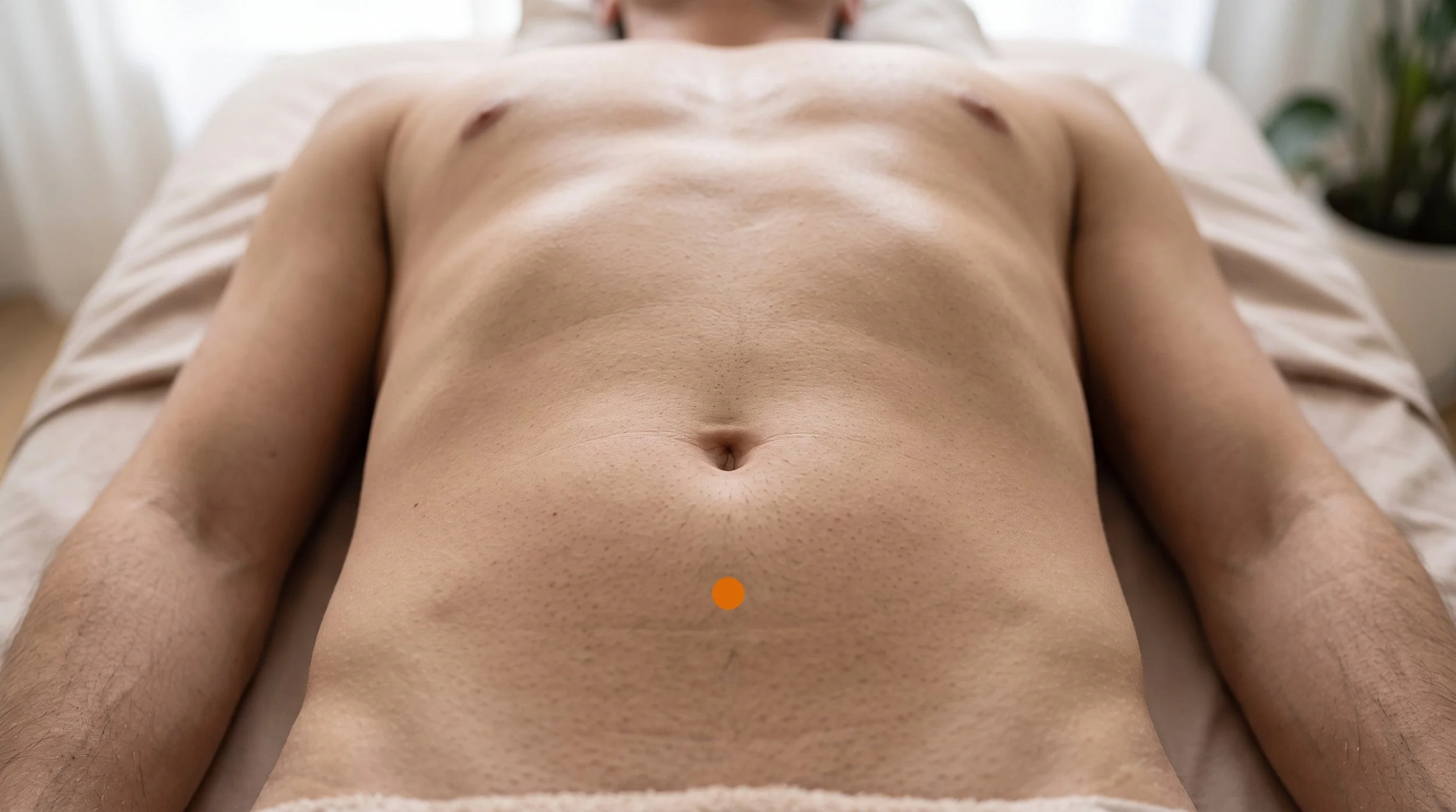
CV5 Acupuncture Point (Shimen)
The Stone Gate Below the Navel: Anatomy, Autonomic Mechanism, and Why the Triple Burner Front-Mu Point Belongs in Lower Abdominal and Urinary Treatment
CV5 (Shimen, "Stone Gate"), also written Ren 5, is the fifth point of the Conception Vessel, sitting on the anterior midline of the lower abdomen 2 cun below the umbilicus and 3 cun above the pubic symphysis, roughly two finger-widths under the navel in the soft seam between the two columns of the rectus abdominis.
Classically it's the front-mu (alarm) point of the Triple Burner, the collecting point on the abdominal wall for a system traditionally described as governing the movement of fluids, and the classical indication lists that grew around it cluster tightly around urination, swelling, loose stools, cramping lower abdominal pain, and uterine bleeding.
In modern terms, the value of this CV5 acupuncture point is that it sits directly over the lower abdominal wall segments that share spinal levels with the bladder, uterus, and distal gut, which makes it a useful local point when a patient's complaint is felt low and deep rather than in a single muscle.
- Location and layers: CV5 is on the linea alba, 2 cun below the umbilicus and 3 cun above the pubic symphysis, so the needle passes skin, superficial fascia, and dense midline aponeurotic tissue rather than muscle belly, with the rectus abdominis columns and their trigger point zones sitting just to either side (Simons et al., 1999).
- Traditional category translated: classical texts assign CV5 the front-mu point of the Triple Burner and describe it as moving the water passages, regulating qi to relieve pain, and regulating the uterus. Read neurophysiologically, those are descriptions of a lower abdominal wall site whose afferents share segments with pelvic viscera.
- Mechanism: needling here recruits A-delta and C-fiber afferents in the eleventh and twelfth thoracic dermatomes, which converge in the dorsal horn with visceral afferents from bladder, uterus, and lower intestine, and which engage descending inhibitory and opioidergic pathways (Zhao, 2008).
- Autonomic angle: experimental work on somato-autonomic reflexes shows that needling effects on visceral function are regionally organized, with abdominal stimulation tending to drive different reflex pathways than limb stimulation, which is a plausible framework for why classical practice reserved abdominal front-mu points for organ-related complaints (Ma, 2022).
- Research picture: no trial has isolated CV5, but reviews of acupuncture for menstrual pain and pelvic pain syndromes, and large individual patient data analyses in chronic pain, suggest modest effects for multi-point protocols that often include lower abdominal midline points (Smith et al., 2016; Sun et al., 2021; Vickers et al., 2018).
- De qi and practice framing: patients usually report a heavy, spreading fullness or a low dull ache that may sink toward the pubic bone, not a sharp sting. Depth stays conservative (0.8 to 1.5 cun), the bladder should be emptied first, and classical texts contraindicate needling and moxibustion here during pregnancy.
Dealing With Lower Belly Cramping, Bloating, or Bladder Urgency?
Persistent lower abdominal discomfort often involves more than one layer: an irritable gut or bladder, a guarded abdominal wall, and a nervous system that has learned to amplify both. At Morningside Acupuncture, CV5 is used as part of a lower abdominal protocol alongside distal points and, where appropriate, dry needling of the rectus abdominis and obliques. We work with your gastroenterologist, urologist, or gynecologist rather than around them. Schedule a visit and we'll map out where your symptoms are actually coming from.
Schedule NowAnatomy of CV5: Why the Linea Alba Below the Umbilicus Is Such an Important Location
CV5 sits on the anterior midline, 2 cun below the umbilicus and 3 cun above the pubic symphysis, which places it exactly on the linea alba, the fibrous seam where the aponeuroses of the external oblique, internal oblique, and transversus abdominis from both sides interlace. From surface to depth the needle passes skin, the fatty and membranous layers of superficial fascia, and then that dense midline band, with the medial borders of the two rectus abdominis columns lying immediately to either side.
This is a mechanically busy seam. Anything that repeatedly raises intra-abdominal pressure loads it, including coughing, heavy lifting, bracing during training, chronic constipation, and the post-partum period, and the lower rectus abdominis segments flanking the point are a common site of myofascial tenderness that can mimic visceral symptoms (Simons et al., 1999).
The sensory supply here comes from the anterior cutaneous branches of the eleventh and twelfth thoracic nerves, with contribution from the iliohypogastric nerve nearby, so CV5 lives in the T11 to T12 band of the abdominal wall. Those same lower thoracic and upper lumbar segments carry sympathetic afferent and efferent traffic to and from the bladder, uterus, and distal small intestine, which means somatic input from the point and visceral input from the pelvic organs converge on overlapping dorsal horn neurons.
That convergence is the practical explanation for two clinical observations: deep organ irritation can present as midline abdominal wall tenderness, and needling the abdominal wall can shift how those visceral signals are processed. Needle stimulation recruits A-delta and C-fiber afferents that engage segmental gating and descending inhibitory pathways involving endogenous opioids, serotonin, and noradrenaline (Zhao, 2008), while animal work on somato-autonomic reflexes indicates that abdominal and limb stimulation drive visceral responses through partly different routes (Ma, 2022).
Deep to the transversalis fascia are preperitoneal fat, the peritoneum, and loops of small intestine, and a distended bladder can rise well above the pubic symphysis into range. That anatomy sets the needling conventions. The inferior epigastric vessels run lateral to the midline inside the rectus sheath, so staying precisely on the linea alba avoids them, and perpendicular insertion of 0.8 to 1.5 cun is standard with shallower depth in thin patients.
Deep needling can reach the peritoneal cavity, so technique here stays conservative, patients void beforehand, and the point is avoided over hernias, surgical mesh, or fresh scars. Classical texts specifically contraindicate needling and moxibustion at CV5 during pregnancy, a caution modern practice preserves.
Related Rectus Abdominis Trigger Points Related Conception VesselCV5 (Ren 5) at a Glance: Classification, Location, and Clinical Use
| Category | Detail |
|---|---|
| Traditional Name | Shimen (Stone Gate or Stone Door); alternate classical names include Jueyun (cease fertility), and in some texts this area is grouped with the dantian |
| Channel Classification | Conception Vessel 5 (Ren 5, CV5), fifth point of the Conception Vessel on the anterior midline of the lower abdomen (also called the Ren Mai or Ren channel) |
| Point Categories | Front-mu (alarm) point of the Triple Burner (Sanjiao). Maciocia's channel text also frames it as the front-collecting point for the Lower Burner. No five-shu, hui-meeting, or extraordinary vessel intersection designations are attributed to it in the standard references. |
| Precise Location | On the anterior midline, 2 cun below the umbilicus and 3 cun above the pubic symphysis; level with KD14 (0.5 cun lateral) and ST27 (2 cun lateral), sitting between CV4 below and CV6 above |
| Tissue Stimulated | Skin, superficial fascia, and the linea alba, flanked by the medial fibers of the rectus abdominis and the converging aponeuroses of the external abdominal oblique and other abdominal obliques |
| Needle Depth / Direction | Perpendicular insertion 0.8 to 1.5 cun, shallower in thin patients; bladder emptied first, no aggressive deep manipulation, and avoided during pregnancy per classical texts |
| De Qi Sensation | Heavy, dull, spreading fullness in the lower abdomen, sometimes sinking toward the pubic bone or bladder; occasionally a mild warmth. Sharp, burning, or radiating pain means the needle should be adjusted. |
| Primary Clinical Uses | Traditionally used for difficult urination and fluid retention patterns, twisting or cramping lower abdominal pain, diarrhea with undigested food, and irregular uterine bleeding; used clinically today as a local point within lower abdominal, urinary, and menstrual protocols |
| Common Point Combinations |
|
Deadman's A Manual of Acupuncture presents CV5 as the front-mu point of the Triple Burner, explaining that mu points are places where the qi of an organ system was traditionally said to gather on the front of the body, and that the Triple Burner was classically described as the official responsible for drainage and the pathway through which water and grain move. On that logic the point's traditional indications concentrate on fluid: difficulty passing urine, retention, painful urination, and swelling, alongside diarrhea with undigested food and dysenteric patterns.
A second cluster covers stagnation and pain in the lower abdomen and genital region, including twisting pain, shan disorder with severe pain around the navel, distention, and genital swelling or retraction, and a third covers gynecological patterns such as persistent lochia, abdominal masses, uterine bleeding, and vaginal discharge.
What makes the classical picture striking is the contrast with its immediate neighbors: where CV4 and CV6 are traditionally described as tonifying points, CV5 is notable for how little deficiency language attaches to it, and is presented instead as a point for excess and stagnation patterns.
Why CV5 Is Used for Urinary Symptoms and Cramping That Patients Feel Deep Inside the Pelvis
Patients are often surprised that a needle in the abdominal wall can change how the bladder or gut feels, since the needle never comes close to the organ. The explanation is convergence. The skin, fascia, and midline tissue at CV5 send sensory information into the same lower thoracic spinal segments that receive input from the bladder, uterus, and distal intestine, and once those signals share dorsal horn neurons, the nervous system can no longer cleanly separate them.
That's why organ irritation sometimes shows up as tenderness on the abdominal wall, and why stimulating the wall can alter how strongly visceral signals register (Zhao, 2008).
Beyond the local segment, needling recruits descending pathways from the brainstem that dampen incoming nociceptive traffic using endogenous opioids and monoamines, which is the mechanism most often invoked for acupuncture's effect on pain generally (Zhao, 2008). Layered on top of that is an autonomic story: experimental research indicates that needle stimulation drives reflex changes in visceral function, and that the response depends on where you stimulate, with abdominal sites and limb sites engaging different reflex pathways (Ma, 2022).
This gives a plausible modern reading of why classical practice grouped abdominal front-mu points with organ complaints rather than treating them as generic pain points.
On the clinical evidence side, the most relevant human data comes from trials in the pelvic region rather than from CV5 itself. A large randomized trial found that electroacupuncture at pelvic-region points reduced urine leakage in women with stress urinary incontinence compared with sham (Liu et al., 2017), and a multicenter sham-controlled trial reported sustained symptom improvement in men with chronic prostatitis and chronic pelvic pain syndrome (Sun et al., 2021).
Neither trial isolates this point, and both used protocols that differ from a typical clinic visit, so the fair conclusion is that needling in this region may influence pelvic symptoms, with CV5 serving as one reasonable local component of a broader plan.
What the Research Shows for CV5 (Ren 5)
One note on naming before the evidence: in the research literature this point is almost always listed as CV5, the WHO standard code, while many textbooks and Chinese sources write Ren 5 or RN5, so it is worth searching those as well if you want to read the studies below in full.
Almost no research tests single acupuncture points, and CV5 is no exception: there's no trial that isolates Shimen. What exists are studies of multi-point protocols for conditions that overlap with this point's traditional territory, including menstrual pain, urinary symptoms, pelvic pain, and functional bowel complaints, plus mechanistic work on how somatic needling influences visceral function.
Results are mixed and often modest, sham comparisons frequently narrow the gap, and the honest framing is that CV5 is a reasonable local point within protocols that have some supportive evidence, not a treatment with its own evidence base.
| Study | Type | Focus | Key Finding |
|---|---|---|---|
| Smith et al., 2016 | Cochrane systematic review | Acupuncture and acupressure for dysmenorrhoea | The review found low-quality evidence overall and could not draw firm conclusions about whether acupuncture reduces menstrual pain compared with sham or usual care. |
| Manheimer et al., 2012 | Cochrane systematic review | Acupuncture for irritable bowel syndrome | No benefit was detected over credible sham acupuncture for symptom severity or quality of life, though patients in Chinese comparative trials reported more improvement than with drug therapy. |
| Liu et al., 2017 | Multicenter randomized clinical trial | Electroacupuncture for stress urinary incontinence in women | Electroacupuncture at pelvic-region points reduced urine leakage compared with sham over six weeks, supporting the idea that regional needling may influence bladder function. |
| Sun et al., 2021 | Multicenter randomized sham-controlled trial | Acupuncture for chronic prostatitis and chronic pelvic pain syndrome | Twenty sessions over eight weeks produced greater symptom improvement than sham, with effects that persisted through 24 weeks of follow-up. |
| Vickers et al., 2018 | Individual patient data meta-analysis | Acupuncture for chronic pain across roughly 20,000 patients | Acupuncture was associated with modest but statistically significant benefits over both sham and no-acupuncture controls, with effects persisting over time. |
| Ma, 2022 | Mechanistic review | Somatotopic organization of autonomic reflexes evoked by acupuncture | Evidence suggests needling drives visceral responses through somato-autonomic reflex pathways whose character depends on the body region stimulated. |
Menstrual Pain and Cycle-Related Abdominal Discomfort?
Cramping that starts low and radiates toward the pubic bone or low back responds well to a plan that combines local abdominal points such as CV5 with distal points like SP6 and LV3. Studies suggest acupuncture may reduce menstrual pain intensity for some people, and treatment timed across the cycle tends to work better than one-off sessions. Our licensed acupuncturists on the Upper West Side build that timing into your care plan. Book a session to get started before your next cycle.
Schedule NowCV5 in the Context of Trigger Point Work
Lower abdominal complaints are one of the places where classical point selection and trigger point work overlap most usefully. Taut bands in the lower fibers of the rectus abdominis and in the oblique layers can refer pain across the low belly and around the navel, and the trigger point literature describes abdominal wall referral patterns that can imitate menstrual cramping, bladder irritation, and bowel upset (Simons et al., 1999).
When a patient's tenderness reproduces their symptom under a fingertip on the abdominal wall, a meaningful part of the problem may be muscular rather than visceral, and treating the wall changes the picture.
At Morningside, CV5 is typically used as the midline anchor of a lower abdominal treatment, then combined with dry needling of the rectus abdominis segments on either side and the external oblique where taut bands are found, all with shallow, angled technique appropriate to abdominal wall thickness. Distal points such as SP6, ST36, and LV3 are often added to bring in non-segmental input.
Because the point itself sits on the linea alba rather than in muscle, it doesn't produce a local twitch response the way a rectus abdominis trigger point does, and any red flags that suggest a visceral cause get referred out for medical workup before we treat the wall.
CV5 Lower Abdominal and Pelvic Treatment at NYC's Highest-Rated Acupuncture Clinic
Morningside Acupuncture is the highest-rated acupuncture and dry needling clinic in New York City with over 500 five-star Google reviews, and abdominal and pelvic complaints are among the cases we see most. We combine classical point selection such as the Triple Burner front-mu point with modern orthopedic needling, always with conservative depth and clear safety screening. Every plan starts with an exam, not a template. Schedule your first visit today.
Schedule NowFrequently Asked Questions
Is CV5 the same point as Ren 5?
Yes. CV5 and Ren 5 are two codes for the same point, Shimen. CV stands for Conception Vessel and is the WHO standard abbreviation, the one you will see in most research papers. Ren comes from Ren Mai, the Chinese name of the vessel, and it is the form used in many textbooks and acupuncture schools. You will also come across it written as REN-5, RN5, or Conception Vessel 5. Whichever code is used, the location and the uses are the same.
What does CV5 feel like when needled?
Most people describe a heavy, dull fullness spreading through the lower abdomen, sometimes with a sinking or warm sensation that drifts toward the pubic bone. Because the point sits on the fibrous midline rather than in muscle, the sensation is usually more diffuse than the sharp grabbing feeling of a muscular trigger point. Some patients feel an urge-like awareness of the bladder, which typically settles within a minute. Sharp, burning, or electrical pain isn't normal here and means the needle should be repositioned.
Why needle the abdominal wall for symptoms coming from the bladder or bowel?
The abdominal wall at CV5 shares spinal segments with the bladder, uterus, and lower intestine, so sensory signals from skin and fascia converge with signals from those organs in the same region of the spinal cord (Zhao, 2008). That shared wiring means stimulating the wall can modulate how visceral input is processed, and animal research indicates that needling also triggers autonomic reflexes whose pattern depends on where the stimulus is applied (Ma, 2022). It's worth saying clearly that this modulates symptoms rather than treating underlying pathology, so persistent urinary or bowel changes still need a medical evaluation.
Can I press CV5 myself between sessions?
Yes, acupressure here is straightforward and low risk for most people. Lie on your back with your knees bent so the abdominal wall relaxes, find the midline two finger-widths below your navel, and press with the pads of two or three fingers using slow, steady pressure to about a 4 or 5 out of 10 in intensity. Hold for 30 to 60 seconds while breathing into the belly, release, and repeat two or three times, or use slow circles for one to two minutes. Once or twice daily is plenty, and a warm pack over the area can be used instead if direct pressure feels uncomfortable. Skip it entirely if you're pregnant, if you have an abdominal hernia, mesh, or recent surgery, or if the area is sharply tender, and stop if pressure makes symptoms worse.
Is CV5 safe to needle?
In trained hands, yes, with specific precautions. Standard depth is perpendicular insertion of 0.8 to 1.5 cun, shallower in thin patients, because deep needling can reach the peritoneal cavity, and a full bladder can rise above the pubic bone into needling range, so patients are asked to void first. Classical texts contraindicate both needling and moxibustion at this point during pregnancy, and modern practice keeps that caution. We also avoid the point over hernias, surgical mesh, recent incisions, or an acutely rigid or rebound-tender abdomen, which is a medical emergency rather than an acupuncture case.
Where exactly is CV5 located?
CV5 is on the anterior midline of the lower abdomen, 2 cun below the umbilicus and 3 cun above the pubic symphysis. A practical way to find the Shimen point location is to remember that the distance from navel to pubic bone is measured as 5 cun: divide that span into fifths and CV5 sits at the second mark down from the navel, on the soft midline groove between the two rectus abdominis columns. It's the Ren 5 abdomen landmark between CV4 (3 cun below the navel) and CV6 (1.5 cun below), level with KD14 half a cun lateral and ST27 two cun lateral.
References
- Deadman, P., Al-Khafaji, M., & Baker, K. (2009). A manual of acupuncture. Journal of Chinese Medicine Publications.
- Maciocia, G. (2006). The channels of acupuncture: Clinical use of the secondary channels and eight extraordinary vessels. Churchill Livingstone Elsevier.
- Cunningham, P. M. (2000). Acupuncture points: A practical guide to classical and modern usage. Odyssey Press.
- Cheng, X. (Ed.). (1999). Chinese acupuncture and moxibustion (Rev. ed.). Foreign Languages Press.
- Simons, D. G., Travell, J. G., & Simons, L. S. (1999). Travell & Simons' myofascial pain and dysfunction: The trigger point manual, Vol. 1: Upper half of body (2nd ed.). Williams & Wilkins.
- Zhao, Z. Q. (2008). Neural mechanism underlying acupuncture analgesia. Progress in Neurobiology, 85(4), 355-375. https://doi.org/10.1016/j.pneurobio.2008.05.004
- Vickers, A. J., Vertosick, E. A., Lewith, G., MacPherson, H., Foster, N. E., Sherman, K. J., Irnich, D., Witt, C. M., & Linde, K. (2018). Acupuncture for chronic pain: Update of an individual patient data meta-analysis. Journal of Pain, 19(5), 455-474. https://doi.org/10.1016/j.jpain.2017.11.005
- Ma, Q. (2022). Somatotopic organization of autonomic reflexes by acupuncture. Current Opinion in Neurobiology, 76, 102602. https://doi.org/10.1016/j.conb.2022.102602
- Liu, Z., Liu, Y., Xu, H., He, L., Chen, Y., Fu, L., Li, N., Lu, Y., Su, T., Sun, J., Wang, J., Yue, Z., Zhang, W., Zhao, J., Zhou, Z., Wu, J., Zhou, K., Ai, Y., Zhou, J., ... Liu, B. (2017). Effect of electroacupuncture on urinary leakage among women with stress urinary incontinence: A randomized clinical trial. JAMA, 317(24), 2493-2501. https://doi.org/10.1001/jama.2017.7220
- Sun, Y., Liu, Y., Liu, B., Zhou, K., Yue, Z., Zhang, W., Fu, W., Yang, J., Li, N., He, L., Zang, Z., Su, T., Fang, J., Ding, Y., Qin, Z., Song, H., Hu, H., Zhao, H., Mo, Q., ... Liu, Z. (2021). Efficacy of acupuncture for chronic prostatitis/chronic pelvic pain syndrome: A randomized trial. Annals of Internal Medicine, 174(10), 1357-1366. https://doi.org/10.7326/M21-1814
- Smith, C. A., Armour, M., Zhu, X., Li, X., Lu, Z. Y., & Song, J. (2016). Acupuncture for dysmenorrhoea. Cochrane Database of Systematic Reviews, 2016(4), CD007854. https://doi.org/10.1002/14651858.CD007854.pub3
- Manheimer, E., Cheng, K., Wieland, L. S., Min, L. S., Shen, X., Berman, B. M., & Lao, L. (2012). Acupuncture for treatment of irritable bowel syndrome. Cochrane Database of Systematic Reviews, 2012(5), CD005111. https://doi.org/10.1002/14651858.CD005111.pub3
Disclaimer: This web site is intended for educational and informational purposes only. Reading this website does not constitute providing medical advice or any professional services. This information should not be used for diagnosing or treating any health issue or disease. Those seeking medical advice should consult with a licensed physician. Seek the advice of a medical doctor or other qualified health professional for any medical condition. If you think you have a medical emergency, call 911 or go to the emergency room. No acupuncturist-patient relationship is created by reading this website or using the information. Morningside Acupuncture PLLC and its employees and contributors do not make any express or implied representations with respect to the information on this site or its use. For any legal interpretation of scope of practice in your state, consult a licensed attorney or regulatory authority.
Read more from our blog



