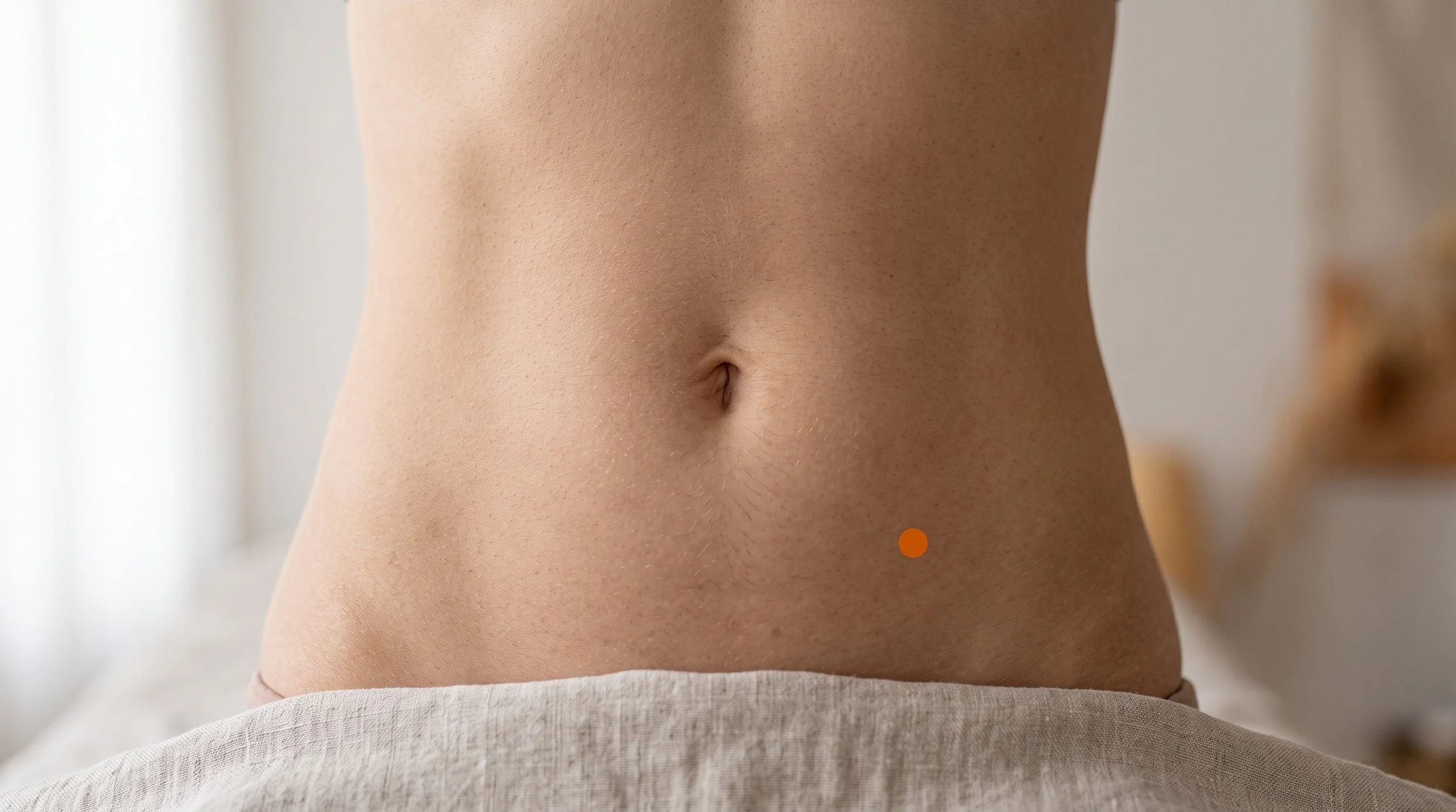
ST27 Acupuncture Point (Daju)
The Great Point Below the Navel: Anatomy, Mechanism, and Why This Lower Abdominal Stomach Channel Point Bridges Digestion, Bladder Function, and Sleep
ST27, known in Chinese as Daju and usually translated as The Great, sits on the lower abdomen two cun below the umbilicus and two cun out from the midline, level with CV5, on the line that runs halfway between the midline and the palpable edge of the rectus abdominis.
In plain terms, it is roughly two finger widths below the belly button and two finger widths to the side, right over the belly of the rectus muscle. That places the st27 acupuncture point directly over the lower abdominal wall in a segment shared with the small intestine and the dome of the bladder, which is exactly why classical texts assigned it such a wide range of jobs: lower abdominal distention, difficult urination, groin and genital complaints, and, more surprisingly, fright palpitations and insomnia.
For a clinician, stomach 27 is a practical local point for the lower belly that also happens to sit on one of the most autonomically responsive pieces of body wall we have access to.
- Location and layers: ST27 lies 2 cun inferior to the umbilicus and 2 cun lateral to the midline, level with CV5, and the needle passes through skin, subcutaneous fat, the anterior rectus sheath, and the rectus abdominis before reaching preperitoneal tissue (Deadman et al., 2007).
- Traditional attributions: classical sources credit Daju with benefiting the Kidneys and firming essence, and with regulating qi and promoting urination, with indications spanning lower abdominal fullness, shan (groin and genital) disorders, difficult urination, seminal emission, and irregular menstruation (Deadman et al., 2007).
- Mechanism in modern terms: needling the lower abdominal wall recruits somatic afferents in a T11 to T12 segment that overlaps spinal input from the bowel and bladder, and animal work shows that somatic stimulation reliably modulates visceral organ activity through somato-autonomic reflex pathways (Uchida et al., 2017).
- Beyond the segment, needling engages descending inhibitory systems and endogenous opioid signaling that reduce dorsal horn excitability, which is the shared mechanism behind acupuncture analgesia at both local and distal points (Zhao, 2008).
- Research picture: pooled individual patient data support modest, persistent effects of acupuncture for chronic pain (Vickers et al., 2018), and a sham-controlled multicenter trial found sustained symptom improvement in men with chronic prostatitis and chronic pelvic pain syndrome (Sun et al., 2021), though no trial has isolated ST27 by itself.
- De qi at ST27 is usually a dull, spreading heaviness or a mild sense of fullness that radiates across the lower belly or toward the groin, not a sharp or electric sensation; the bladder should be emptied first, and deep needling is avoided in thin patients (Deadman et al., 2007).
Struggling With Lower Abdominal Bloating, Cramping, or Pelvic Heaviness?
Lower belly complaints rarely come from one tissue, and we treat them that way. At Morningside Acupuncture, ST27 is used alongside other lower abdominal and leg points to settle a reactive gut and abdominal wall, and we pair it with breathing and manual work so the area stops guarding between visits. Your acupuncturist will map where the discomfort actually sits before a single needle goes in. Schedule a visit and let's find out what your lower abdomen is responding to.
Schedule NowAnatomy of ST27: Why the Lower Rectus Abdominis Is Such an Important Location
From the surface down, a needle at ST27 travels through skin, a variable layer of subcutaneous fat, the anterior rectus sheath, and then into the muscular belly of the lower rectus abdominis. This part of the abdominal wall does a lot of quiet work: it stabilizes the pelvis against the pull of the hip flexors, it manages intra-abdominal pressure with every cough, lift, and forced exhale, and it takes the brunt of postural collapse in prolonged sitting.
Below the arcuate line, the posterior sheath is absent, so deep to the muscle there is only transversalis fascia, preperitoneal fat, and then peritoneum, with the small intestine and the dome of a filling bladder sitting just beyond. That anatomy explains both the point's clinical reach and its cautions.
The nerve geography is straightforward and clinically useful. The skin and muscle here are supplied by the lower intercostal and subcostal nerves in roughly the T11 to T12 range, and those same spinal levels receive afferent traffic from the distal small intestine, the pelvic viscera, and the bladder through sympathetic pathways.
Because somatic and visceral afferents converge on shared dorsal horn neurons, stimulating the abdominal wall at this level can alter how the spinal cord processes visceral input, and it can also drive reflex changes in autonomic outflow to those organs; this somato-autonomic reflex has been mapped in detail in animal studies (Uchida et al., 2017). Layered on top of the segmental effect is a systemic one: needling recruits descending inhibitory pathways and opioid-mediated modulation that raise the threshold for pain signaling well beyond the treated segment (Zhao, 2008).
Deep structures matter here. The inferior epigastric artery and vein run upward on the deep surface of the rectus, and the branches of the eleventh intercostal vessels supply the more superficial layers, so needling stays within the muscle rather than probing laterally or steeply. Standard practice is perpendicular insertion of about 1 to 1.5 cun, with the explicit caution that in thin patients deep needling may reach the peritoneal cavity (Deadman et al., 2007).
We also have patients empty the bladder before lower abdominal needling, since a distended bladder rises above the pubic symphysis and closes the safety margin, and we modify or avoid the area entirely in pregnancy.
Related Rectus Abdominis Trigger Points Related Stomach ChannelST27 at a Glance: Classification, Location, and Clinical Use
| Category | Detail |
|---|---|
| Traditional Name | Daju, commonly rendered as The Great or Big Greatness |
| Channel Classification | Stomach channel (foot yangming), lower abdominal section |
| Point Categories | No five-shu, luo-connecting, xi-cleft, or extraordinary vessel intersection is assigned to this point in the standard references. It is classified as a Stomach channel abdominal point, with traditional actions listed as benefiting the Kidneys and firming essence, and regulating qi and promoting urination (Deadman et al., 2007). |
| Precise Location | On the lower abdomen, 2 cun inferior to the umbilicus and 2 cun lateral to the anterior midline, level with CV5. The 2 cun line falls midway between the midline and the palpable lateral border of the rectus abdominis. For daju point location, remember that umbilicus to pubic symphysis is 5 cun and midline to nipple line is 4 cun, so ST27 sits at two-fifths of the first measurement and half of the second. |
| Tissue Stimulated | Skin and subcutaneous fat, anterior rectus sheath, and the lower rectus abdominis muscle belly, with the transverse abdominis and abdominal obliques adjacent laterally |
| Needle Depth / Direction | Perpendicular insertion 1 to 1.5 cun into the rectus belly; shallower oblique or transverse angling in thin patients. Moxibustion is traditionally applied here. Deep needling can reach the peritoneal cavity in slender patients, so depth is judged by tissue thickness, not by a fixed number. |
| De Qi Sensation | A dull, heavy, slightly distending ache that spreads across the lower abdomen, sometimes with a faint pull toward the groin or a warm, settled feeling. Sharp, burning, or electric sensations are not the goal and prompt repositioning. |
| Primary Clinical Uses | Lower abdominal distention, fullness, and cramping; classical use for difficult urination and urinary retention; classical use for groin and genital (shan) complaints, seminal emission, and premature ejaculation; classical use for fright palpitations and insomnia; supportive point in menstrual irregularity and pelvic discomfort |
| Common Point Combinations |
|
In Deadman's point compendium, Daju is presented with two traditional actions that seem to pull in different directions: firming essence and supporting the Kidneys on one hand, and regulating qi with promotion of urination on the other. The listed indications follow that split, running from seminal emission, premature ejaculation, irregular menstruation, difficult urination, and urinary retention through to lower abdominal distention and shan disorder, which in classical language covers a family of groin, genital, and lower abdominal pain syndromes.
What stands out is the third cluster: fright palpitations, insomnia, a tendency to startle easily, and agitation with thirst, alongside references to limb weakness and one-sided paralysis. These are presented as traditional attributions rather than tested outcomes, and modern practice does not treat neurological deficits with a lower abdominal point.
Still, the pattern is striking, because a point selected for holding and consolidating the lower body was also asked to settle a startled, restless mind, and that pairing of pelvic firmness with nervous system quieting maps unexpectedly well onto how we now think about autonomic regulation.
Why ST27 Is Used for Insomnia and Startle Responses in Classical Practice
The first part of the story is segmental. The skin and muscle at ST27 are supplied by nerves in the T11 to T12 range, and that same slice of spinal cord receives sensory traffic from the lower small intestine, the sigmoid region, and the bladder by way of sympathetic pathways. When somatic and visceral inputs converge on the same dorsal horn cells, a needle in the abdominal wall becomes a way of speaking to the spinal circuits that are already amplifying gut or bladder sensation.
Animal studies of somato-autonomic reflexes have shown that stimulating the body surface changes bladder contraction, gastric motility, and heart rate through defined afferent and efferent limbs, with the direction of the effect depending on where the stimulus is applied (Uchida et al., 2017). That is the plausible physiology behind a lower abdominal point being used for both bowel distention and urinary difficulty.
The second part is systemic. Needling recruits descending inhibitory control from the brainstem and drives endogenous opioid and monoamine signaling that dampen how readily pain and visceral discomfort get transmitted upward (Zhao, 2008). Patients often report the subjective side of this within a session: slower breathing, a warm or heavy abdomen, and the particular drowsy calm that follows a shift toward parasympathetic dominance. If you think of the classical fright palpitations and insomnia indication in those terms, it is less mysterious.
A person who is startled, thirsty, agitated, and sleepless is describing a sympathetically driven state, and a slow abdominal treatment is one of the more reliable ways to move that dial.
None of this means ST27 is a sleep point in a research sense. The Cochrane review of acupuncture for insomnia concluded that the trials were diverse and at high risk of bias, which limited any reliable conclusion about efficacy (Cheuk et al., 2012). What can be said honestly is that the traditional indication has a coherent physiological reading, and that in practice this point is used as one contributor to a whole-body autonomic effect rather than as a standalone remedy for sleeplessness.
What the Research Shows for ST27
There is no clinical trial that tests ST27 in isolation, and that is true of nearly every individual acupuncture point. What the literature offers instead is evidence about protocols that include lower abdominal points for exactly the conditions this point was traditionally used for: bladder symptoms, pelvic pain, and bowel dysfunction.
Reading that evidence fairly means accepting a few things at once: some large sham-controlled trials show real, durable differences, several Cochrane reviews find the certainty of evidence low, and the contribution of any single point within a multi-point protocol cannot be separated out. The table below summarizes the most relevant work and should be read as context for clinical reasoning rather than as proof about this point.
| Study | Type | Focus | Key Finding |
|---|---|---|---|
| Hargreaves et al., 2022 | Cochrane systematic review | Acupuncture for overactive bladder in adults | The review found the available randomized evidence limited and of low certainty, so firm conclusions about acupuncture for overactive bladder could not be drawn. |
| Mak et al., 2019 | Systematic review and meta-analysis | Acupuncture for overactive bladder, including point usage patterns | Across seven trials with 695 participants, acupuncture appeared broadly comparable to antimuscarinic medication on voiding outcomes, but heterogeneity was high and the results should be interpreted cautiously. |
| Sun et al., 2021 | Multicenter randomized sham-controlled trial | Chronic prostatitis and chronic pelvic pain syndrome in men | Twenty sessions over eight weeks produced greater symptom improvement than sham acupuncture, and the difference was maintained across 24 weeks of follow-up. |
| Liu et al., 2016 | Randomized sham-controlled trial | Electroacupuncture including abdominal points for chronic severe functional constipation | Electroacupuncture increased mean weekly complete spontaneous bowel movements more than sham, suggesting abdominal and leg point protocols can influence bowel function. |
| Cheuk et al., 2012 | Cochrane systematic review | Acupuncture for insomnia | Thirty-three trials with 2293 participants were included, but all were judged at high risk of bias, leaving the efficacy and safety question unresolved. |
| Vickers et al., 2018 | Individual patient data meta-analysis | Acupuncture for chronic pain conditions | Acupuncture outperformed both sham and no-acupuncture controls, with effects that persisted over twelve months rather than fading immediately after treatment. |
| Uchida et al., 2017 | Narrative review of experimental physiology | Somato-autonomic reflexes underlying acupuncture effects on visceral organs | Somatic stimulation reliably alters bladder, gastric, and cardiovascular function through segmental and supraspinal reflex arcs, though animal findings do not translate directly to conscious patients. |
Bladder Urgency, Pelvic Tension, or Sleep That Falls Apart at 3 AM?
Urinary urgency, pelvic tightness, and broken sleep often travel together because they share autonomic wiring. We use ST27 with points like CV4, CV6, and SP6 as part of a calm, low-stimulation protocol aimed at down-regulating an over-recruited nervous system. Sessions are unhurried, and progress is tracked visit to visit rather than promised up front. Book an appointment and we'll build a plan around your actual pattern.
Schedule NowST27 in the Context of Trigger Point Work
The st 27 abdomen location sits squarely in the lower rectus abdominis, which is a well-documented site for myofascial trigger points that refer pain across the lower belly and can mimic visceral symptoms including bladder urgency, bloating, and dysmenorrhea-like cramping (Simons et al., 1999). This overlap is not a coincidence of geography so much as a consequence of shared innervation: the abdominal wall and the pelvic organs report to the same spinal segments, so a sensitized muscle can feel like a sick organ and an irritated organ can leave taut, tender bands in the wall above it.
When we palpate a patient at ST27 and reproduce their exact complaint with pressure, that tells us the abdominal wall is at least part of the picture.
In practice at Morningside, this means the point is rarely used alone. Depending on findings, we may needle the rectus abdominis directly, add the external oblique and transverse abdominis where the lateral wall is guarding, and include hip flexor work when a lower cross pattern is pulling the pelvis into anterior tilt and shortening the whole front line. Because acupuncture is defined by the use of an acupuncture needle rather than by any one explanatory framework, the classical point and the trigger point can be addressed in the same session with the same tool.
Technique in this region stays conservative: shallow to moderate depth, angled with the muscle fibers when tissue is thin, bladder emptied beforehand, and no deep perpendicular needling in slender patients.
ST27 Lower Abdominal and Pelvic Treatment at NYC's Highest-Rated Acupuncture Clinic
Morningside Acupuncture is the highest-rated acupuncture and dry needling clinic in New York City with over 500 five-star Google reviews, and our approach blends classical point selection with orthopedic and neuroanatomic reasoning. For lower abdominal, urinary, and pelvic complaints, ST27 is one piece of a broader plan that may include trigger point dry needling of the abdominal wall, cupping, and movement guidance. Every treatment is licensed, clean-needle-technique compliant, and tailored to how you present that day. Schedule your appointment and start with a full evaluation.
Schedule NowFrequently Asked Questions
What does ST27 feel like when needled?
Most people describe a dull, spreading heaviness or a mild sense of fullness in the lower abdomen, sometimes with a faint pull toward the groin and often with a warm, settled feeling as the session goes on. The abdominal wall is thinner and more mobile than the limbs, so the insertion itself is usually felt as a brief pressure rather than a pinch. It is common for the belly to gurgle during treatment, which is simply the gut responding to a shift in autonomic tone. Sharp, burning, or electric sensations are not expected, and your acupuncturist will adjust the needle if you report them.
Why needle the abdomen for bladder or sleep complaints instead of the low back or head?
The abdominal wall at ST27 shares spinal segments with the bladder and the lower gut, so needling here reaches the same dorsal horn neurons that are processing visceral input, and somatic stimulation of this kind has been shown to change visceral organ activity through reflex autonomic pathways (Uchida et al., 2017). There is also a general effect: needling engages descending inhibition and opioid-mediated modulation that reduce overall nervous system reactivity (Zhao, 2008). For sleep specifically, the classical grouping of this point with CV6 and SP6 reflects a pattern where restlessness shows up as lower abdominal tension, and calming that region often helps the whole state. Most treatment plans still combine the abdomen with back, leg, or scalp points rather than relying on one region.
Can I press ST27 myself between sessions?
Yes, and self-acupressure is reasonable here as long as you are not pregnant, have no acute abdominal pain, fever, unexplained mass, or recent abdominal surgery. Lie on your back with knees bent so the abdominal wall relaxes, find the point two finger widths below the navel and two finger widths to the side, and press straight down with the pads of two fingers using firm but comfortable pressure. Hold for 30 to 60 seconds while breathing slowly into the belly, release, and repeat two or three times per side, once or twice a day. A slow circular massage over the same area for one to two minutes works well as an alternative. Stop if pressure produces sharp pain, nausea, or a pulsing sensation, and see your physician for any new or worsening abdominal symptom.
Is ST27 safe to needle?
In trained hands it is a routine point, but it carries genuine cautions because of what lies deep to it. Standard depth is perpendicular insertion of about 1 to 1.5 cun, and the classical texts specifically warn that in thin patients deep needling can penetrate the peritoneal cavity (Deadman et al., 2007). We ask patients to empty the bladder before lower abdominal needling, since a full bladder rises out of the pelvis and sits closer to the needle path. The point is avoided in pregnancy, over hernias, scars, or recent surgical sites, and depth is reduced in lean patients or anyone on anticoagulation. This is not a self-needling location under any circumstances.
Where exactly is ST27 located?
ST27 is on the lower abdomen, 2 cun below the center of the umbilicus and 2 cun lateral to the anterior midline, level with CV5. To find it, use two standard measurements: the umbilicus to the pubic symphysis is 5 cun, so move down two-fifths of that distance, and the midline to the nipple line is 4 cun, so move out half of that distance. The 2 cun line also corresponds to the point midway between the midline and the palpable lateral edge of the rectus abdominis, which is often easier to feel if you have the patient lift their head slightly to engage the muscle. The point sits directly over the muscle belly, not in the linea alba and not out at the flank.
References
- Deadman, P., Al-Khafaji, M., & Baker, K. (2009). A manual of acupuncture. Journal of Chinese Medicine Publications.
- Kim, H. (2008). Handbook of Oriental medicine (3rd ed.). Harmony & Balance Press.
- Simons, D. G., Travell, J. G., & Simons, L. S. (1999). Travell & Simons' myofascial pain and dysfunction: The trigger point manual, Vol. 1: Upper half of body (2nd ed.). Williams & Wilkins.
- Uchida, S., Kagitani, F., & Sato-Suzuki, I. (2017). Somatoautonomic reflexes in acupuncture therapy: A review. Autonomic Neuroscience, 203, 1-8. https://doi.org/10.1016/j.autneu.2016.11.001
- Hargreaves, E., Baker, K., Barry, G., Harding, C., Zhang, Y., Kandala, N. B., Zhang, X., Kernohan, A., & Clarkson, C. E. (2022). Acupuncture for treating overactive bladder in adults. Cochrane Database of Systematic Reviews, 2022(9), CD013519. https://doi.org/10.1002/14651858.CD013519.pub2
- Mak, T. C., Chen, H. Y., & Cho, W. C. (2019). Acupuncture for overactive bladder in adults: A systematic review and meta-analysis. Acupuncture in Medicine, 37(6), 321-331. https://doi.org/10.1136/acupmed-2017-011528
- Sun, Y., Liu, Y., Liu, B., Zhou, K., Yue, Z., Zhang, W., Fu, W., Yang, J., Li, N., He, L., ... Liu, Z. (2021). Efficacy of acupuncture for chronic prostatitis/chronic pelvic pain syndrome: A randomized trial. Annals of Internal Medicine, 174(10), 1357-1366. https://doi.org/10.7326/M21-1814
- Liu, Z., Yan, S., Wu, J., He, L., Li, N., Dong, G., Fang, J., Fu, W., Fu, L., Sun, J., ... Liu, B. (2016). Acupuncture for chronic severe functional constipation: A randomized trial. Annals of Internal Medicine, 165(11), 761-769. https://doi.org/10.7326/M15-3118
- Cheuk, D. K. L., Yeung, W. F., Chung, K. F., & Wong, V. (2012). Acupuncture for insomnia. Cochrane Database of Systematic Reviews, 2012(9), CD005472. https://doi.org/10.1002/14651858.CD005472.pub3
- Zhao, Z. Q. (2008). Neural mechanism underlying acupuncture analgesia. Progress in Neurobiology, 85(4), 355-375. https://doi.org/10.1016/j.pneurobio.2008.05.004
- Vickers, A. J., Vertosick, E. A., Lewith, G., MacPherson, H., Foster, N. E., Sherman, K. J., Irnich, D., Witt, C. M., & Linde, K. (2018). Acupuncture for chronic pain: Update of an individual patient data meta-analysis. Journal of Pain, 19(5), 455-474. https://doi.org/10.1016/j.jpain.2017.11.005
Disclaimer: This web site is intended for educational and informational purposes only. Reading this website does not constitute providing medical advice or any professional services. This information should not be used for diagnosing or treating any health issue or disease. Those seeking medical advice should consult with a licensed physician. Seek the advice of a medical doctor or other qualified health professional for any medical condition. If you think you have a medical emergency, call 911 or go to the emergency room. No acupuncturist-patient relationship is created by reading this website or using the information. Morningside Acupuncture PLLC and its employees and contributors do not make any express or implied representations with respect to the information on this site or its use. For any legal interpretation of scope of practice in your state, consult a licensed attorney or regulatory authority.
Read more from our blog



