ST28 Acupuncture Point (Shuidao)
The Water Passage of the Lower Abdomen: Anatomy, Segmental Mechanism, and Why This Stomach Channel Point Anchors Menstrual and Bladder Treatments
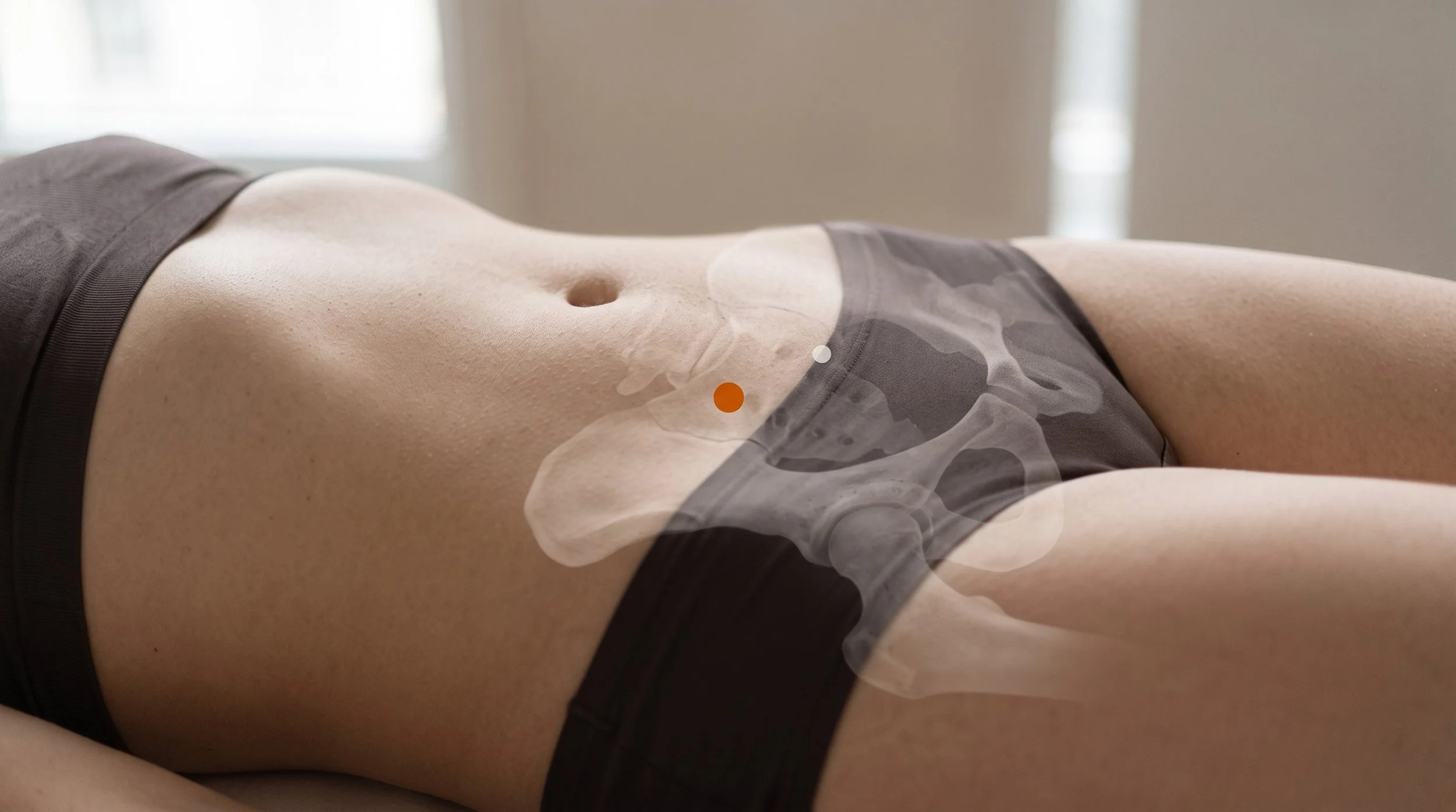
ST28 (Shuidao, usually translated as Water Passage) sits low on the belly, three finger-widths plus a hand-width below the navel and about two thumb-widths out to the side, level with CV4. In practical terms, if you drop straight down from the umbilicus toward the pubic bone and then move sideways to a line halfway between the midline and the outer edge of the six-pack muscle, you are on it.
The st28 acupuncture point matters clinically because the needle lands in the same spinal segments (roughly T12 to L1) that carry sensation from the bladder, the uterus, and the lower abdominal wall, which is exactly why classical texts and modern pelvic protocols both keep returning to this small patch of the lower abdomen for menstrual cramping, urinary symptoms, and the low back ache that travels with them.
- Location and layers: stomach 28 is found 3 cun below the umbilicus and 2 cun lateral to the midline, level with CV4, with the 2 cun line running halfway between the midline and the palpable outer border of rectus abdominis (Deadman et al., 2001). The needle passes skin, subcutaneous fat, the anterior rectus sheath, and the rectus abdominis itself.
- Traditional attributions: classical sources describe ST28 as regulating the lower abdomen, moving stagnation, and benefiting the bladder and uterus, with indications clustering around urinary retention patterns, fluid retention, lower abdominal distention, painful periods, and difficulty conceiving (Deadman et al., 2001; Kim, 2013). These are historical categories, not physiological claims.
- Nerve geography: the point lies in the T12 to L1 dermatomal and myotomal field supplied by the subcostal and iliohypogastric territory, segments that also receive afferent traffic from the bladder and uterus, which gives a plausible substrate for viscerosomatic convergence (Shanghai College of Traditional Chinese Medicine, 1981).
- Mechanism: needling somatic tissue in a shared spinal segment can modify autonomic outflow to pelvic organs through somato-autonomic reflexes, while broader analgesia involves opioid-mediated descending inhibition from brainstem circuits (Uchida et al., 2017; Zhao, 2008).
- Research picture: reviews of acupuncture for period pain and for urinary symptoms report mixed and often low-certainty results, though individual patient data on chronic pain support modest, persisting effects for acupuncture overall (Smith et al., 2016; Hargreaves et al., 2022; Vickers et al., 2018).
- De qi and safety: patients usually feel a dull, heavy fullness that can spread across the lower belly rather than a sharp sting; because deep insertion in thin patients may reach the peritoneal cavity or a distended bladder, we ask patients to empty the bladder before needling (Deadman et al., 2001).
Struggling With Period Cramps That Wrap Into Your Low Back?
At Morningside Acupuncture, ST28 is one of the lower abdominal points we reach for when cramping sits low and deep and drags into the sacrum or upper thighs. We usually combine it with SP6 on the lower leg, sacral points, and gentle heat, then adjust the plan across a full cycle rather than a single visit. Treatment is paired with practical self-care so you know what to do at home in the days before your period. Book a session and let's map your cycle pattern together.
Schedule NowAnatomy of ST28: Why the Lower Abdominal Wall Two Cun From the Midline Is Such an Important Location
From the surface down, ST28 sits under thin skin and a variable layer of subcutaneous fat, then the anterior layer of the rectus sheath, then the rectus abdominis muscle belly itself (Deadman et al., 2001; Shanghai College of Traditional Chinese Medicine, 1981). This part of the abdominal wall works constantly: it stabilizes the trunk during walking, resists the pull of the hip flexors, and takes strain from sit-ups, heavy lifting, prolonged sitting, post-surgical scarring, and pregnancy-related changes. Tenderness here is common, and it is often a mix of muscular guarding and referred visceral sensitivity rather than one or the other.
The nerve supply is segmental and predictable. The lower abdominal wall at this level is served by the subcostal and adjacent lower thoracic to first lumbar nerves, and those same T12 to L1 spinal levels receive afferent input from the bladder and uterus (Shanghai College of Traditional Chinese Medicine, 1981). When somatic and visceral afferents converge on shared dorsal horn neurons, the nervous system can blur the source of a signal, which is one reason period pain is felt as a broad ache across the lower belly and back rather than as a pinpoint.
Stimulating somatic tissue in that segment can also shift autonomic outflow to pelvic organs through somato-autonomic reflex pathways described in animal work (Uchida et al., 2017; Sato, 1997), and needling more generally recruits opioid-mediated descending inhibition that dampens dorsal horn transmission (Zhao, 2008).
Deep to the muscle lies the peritoneal cavity, and just beyond the midline structures the bladder rises out of the pelvis when it fills. The inferior epigastric vessels run along the lateral aspect of the rectus, which is another reason depth and angle are controlled rather than casual (Shanghai College of Traditional Chinese Medicine, 1981). Standard practice is perpendicular insertion of about 1 to 1.5 cun, with shallower depths in thin patients, and asking the patient to empty the bladder before treatment so a distended bladder is not sitting in the needle path (Deadman et al., 2001; Kim, 2013).
Related Stomach Channel Related Rectus Abdominis Trigger PointsST28 at a Glance: Classification, Location, and Clinical Use
| Category | Detail |
|---|---|
| Traditional Name | Shuidao (Water Passage or Waterway); Sun Si-miao recorded the left point as Baomen (Gate of the Uterus) and the right as Zihu (Child's Door) |
| Channel Classification | 28th point of the Stomach channel of Foot Yangming, on the lower abdomen (see the Stomach Channel overview) |
| Point Categories | No five-shu, luo-connecting, xi-cleft, front-mu, or extraordinary vessel intersection status is recorded for ST28 in the standard texts; it is classed simply as a Stomach channel point of the lower abdomen, level with CV4, and Maciocia groups it with GV26 and CV9 as the traditional trio of water-named points assigned to the upper, middle, and lower jiao |
| Precise Location | 3 cun below the umbilicus and 2 cun lateral to the anterior midline, level with CV4 (Guanyuan); the umbilicus to pubic symphysis distance is 5 cun, and the 2 cun line falls halfway between the midline and the palpable lateral border of rectus abdominis |
| Tissue Stimulated | Skin, subcutaneous fat, anterior rectus sheath, and rectus abdominis, with functional overlap with the transverse abdominis and pelvic floor |
| Needle Depth / Direction | Perpendicular insertion, commonly 1 to 1.5 cun, with several texts listing a more conservative 0.7 to 1.2 cun; moxibustion is traditionally applied. Depth is reduced in thin patients, and the bladder is emptied before needling |
| De Qi Sensation | A dull, heavy, distending soreness at the point that may spread across the same side of the lower abdomen, sometimes toward the groin; sharp or radiating pain means the needle should be adjusted |
| Primary Clinical Uses | Traditionally used for lower abdominal distention and cold-type discomfort, urinary retention patterns and fluid retention, painful periods with low back pain, and fertility support; used in modern practice within pelvic and lower abdominal wall protocols |
| Common Point Combinations |
|
Deadman, Al-Khafaji, and Baker present ST28 as a point whose traditional actions run in two directions from a single idea: obstruction. On the urinary side, classical texts assign it to patterns of blocked urination and fluid accumulation in the lower body; on the gynecological side, they assign it to cold and stasis in the uterus, with a long indication list that compresses into painful periods, pain reaching the lumbar region or thighs, difficulty conceiving, abdominal masses of shifting character, and retained products after childbirth.
The same authors note the point's classical use for lumbar and shoulder pain, which they read as an example of treating the back by needling the front, supported by the Stomach sinew channel's described connection with the spine.
What is striking is how consistently the tradition treated this point as an excess-type, unblocking point rather than a tonifying one, and how neatly that classical grouping of bladder, uterus, and low back maps onto a single band of spinal segments that modern anatomy would recognize.
Why ST28 Is Used for Low Back Pain That Shows Up With Your Period
Patients are often surprised that a point on the front of the belly gets used for pain felt in the back. The segmental story makes it less strange. Sensory fibers from the lower abdominal wall, the bladder, and the uterus all funnel into the lower thoracic and upper lumbar segments of the spinal cord (Shanghai College of Traditional Chinese Medicine, 1981). When the uterus is cramping, that input can spill over onto neurons that normally report skin and muscle, so the brain reads the situation as a broad ache spanning the belly, sacrum, and sometimes the thighs.
Needling somatic tissue inside that same segment gives the nervous system a competing, well-localized input in exactly the neighborhood where the confusion is happening.
Beyond the segment, needling recruits central pain-modulating machinery. Experimental work indicates that acupuncture stimulation activates endogenous opioid systems and descending inhibitory pathways from the midbrain and brainstem, reducing transmission at the dorsal horn (Zhao, 2008). Animal studies of somato-autonomic reflexes also show that stimulating body wall tissues can change autonomic outflow to visceral organs, with responses that are sometimes segmentally organized and sometimes systemic (Uchida et al., 2017; Sato, 1997).
That framework is a reasonable way to think about why an abdominal point might influence bladder sensation or menstrual cramping, though it is a mechanism story rather than proof of clinical benefit.
There is also a vascular thread worth mentioning carefully. A small, non-randomized study reported reduced blood flow impedance in the uterine arteries of infertile women after a course of electroacupuncture, which the authors attributed to reduced sympathetic tone (Stener-Victorin et al., 1996). The sample was tiny and the design uncontrolled, so this is best treated as a hypothesis about autonomic and vascular effects rather than a reason to expect a particular outcome.
What the Research Shows for ST28
No trial has isolated ST28 on its own, and it would be unusual if one had. Clinical research tests whole protocols, and lower abdominal points like this one are typically embedded alongside CV4, SP6, sacral points, and electroacupuncture at BL33 or BL35. That means the evidence below tells you something about the treatment approaches ST28 belongs to, not about the point in isolation. Read it as context: some findings are encouraging, several are low certainty, and at least one large trial was clearly negative. We think that honesty is more useful than overselling.
| Study | Type | Focus | Key Finding |
|---|---|---|---|
| Smith et al., 2016 | Cochrane systematic review | Acupuncture and acupressure for primary dysmenorrhea | The review authors concluded that the available evidence was insufficient to determine whether these approaches reduce period pain, with risk of bias and inconsistency limiting confidence. |
| Wang et al., 2013 | Cochrane systematic review | Acupuncture for stress urinary incontinence in adults | Evidence was too limited at the time of the review to draw conclusions about effectiveness or side effects. |
| Hargreaves et al., 2022 | Cochrane systematic review | Acupuncture for overactive bladder in adults | The certainty of evidence was low, and the review did not establish clear benefit over comparators. |
| Liu et al., 2017 | Multicenter randomized clinical trial (JAMA) | Electroacupuncture versus sham for stress urinary incontinence in women | Electroacupuncture using lumbosacral points was associated with a greater reduction in urine leakage than sham over six weeks, suggesting pelvic segment stimulation can influence bladder function. |
| Smith et al., 2018 | Randomized clinical trial (JAMA) | Acupuncture versus sham around ovarian stimulation and embryo transfer in IVF | Live birth rates did not differ significantly between acupuncture and sham, so fertility-related use should be framed as supportive care rather than an outcome-changing intervention. |
| Stener-Victorin et al., 1996 | Small prospective, non-randomized study | Uterine artery blood flow impedance after electroacupuncture | Impedance decreased after a treatment course in a very small sample, offering a preliminary autonomic and vascular hypothesis rather than clinical proof. |
| Vickers et al., 2018 | Individual patient data meta-analysis | Acupuncture for chronic pain conditions | Acupuncture was superior to sham and to no-acupuncture control for chronic pain, with effects that persisted over time, supporting acupuncture as a reasonable option within a broader pain plan. |
| Uchida et al., 2017 | Narrative physiological review | Somato-autonomic reflexes relevant to acupuncture | Somatic stimulation can reflexively alter autonomic activity to visceral organs, with some responses organized segmentally, though most data come from anesthetized animals. |
| Zhao, 2008 | Neurophysiology review | Mechanisms of acupuncture analgesia | Analgesic effects are attributed largely to endogenous opioid signaling and descending inhibitory control rather than to any local tissue-specific action. |
Lower Abdominal Heaviness, Bladder Pressure, or Pelvic Tension?
Shuidao sits in the segmental field that also serves the bladder, which is why it appears so often in pelvic treatment plans alongside CV4 and BL32. Our clinicians assess the abdominal wall, pelvic floor, and low back together, since tight abdominal muscles and pelvic pressure often travel as a package. Every treatment starts with a clear conversation about what acupuncture may and may not help, and when to loop in your physician. Schedule a visit to get a plan built around your symptoms.
Schedule NowST28 in the Context of Trigger Point Work
Because ST28 sits directly in the rectus abdominis, its location overlaps with a muscle that trigger point clinicians take seriously. Taut bands in the lower rectus abdominis are described as referring pain in horizontal bands across the low back and lower abdomen, and abdominal wall trigger points can produce symptoms that feel visceral, including cramping, bloating sensations, and urinary urgency (Simons et al., 1999).
At Morningside we palpate before we needle, and if pressing the lower rectus reproduces the exact ache a patient has been describing, that finding shapes the treatment plan.
In practice we often use the st28 abdomen location as both a channel point and a myofascial target, then add dry needling of the obliques, the transverse abdominis region, and quadratus lumborum or the paraspinals when the low back is involved. Since dry needling is acupuncture needling under a different name and clinical framework, these approaches sit comfortably in one session. The abdominal wall is treated with shallow, controlled technique, and the same precautions apply: bladder emptied first, depth tailored to body type, and no deep needling over an area that has not been carefully assessed.
ST28 Menstrual and Pelvic Discomfort Treatment at NYC's Highest-Rated Acupuncture Clinic
Morningside Acupuncture is the highest-rated acupuncture and dry needling clinic in New York City with over 500 five-star Google reviews, and our Upper West Side practice blends classical point selection with modern pain science. We use ST28 within broader protocols for menstrual discomfort, lower abdominal tension, and back pain that flares with the cycle. You get careful, hygienic needling, clear expectations, and follow-up you can measure. Schedule your appointment today.
Schedule NowFrequently Asked Questions
What does ST28 feel like when needled?
Most people report a dull, heavy, slightly distending soreness right at the point that can spread sideways across the lower abdomen, and occasionally toward the groin. That spreading heaviness is the classic de qi response for abdominal points, and it is usually milder than the electric sensation people notice at points on the arms and legs. You should not feel sharp, burning, or radiating pain; if you do, tell your acupuncturist so the needle can be repositioned. Many patients find the area feels warm and softened afterward, especially when moxibustion or heat is added.
Why needle the front of the abdomen when my pain is in my low back?
The lower abdominal wall at ST28 shares spinal segments with the bladder, uterus, and the sensory fields that also cover the lumbar region, so input from one can influence how the others are processed (Shanghai College of Traditional Chinese Medicine, 1981). Classical texts arrived at a similar conclusion by observation, listing ST28 for lumbar and back pain in at least two formulas and treating it as an example of using front-of-body points for back complaints (Deadman et al., 2001). Add to that the general recruitment of descending pain inhibition with needling (Zhao, 2008), and treating from the front becomes a reasonable strategy rather than a curiosity. In the clinic we usually treat both surfaces, pairing ST28 with sacral or back points.
Can I press ST28 myself between sessions?
Yes, acupressure here is easy to self-apply and low risk when done gently. Lie on your back with knees bent so the abdominal wall relaxes, find the point by measuring roughly four finger-widths below the navel and then about two thumb-widths out to the side, and settle your fingertips there. Press with steady, moderate pressure to a level you would call a firm ache rather than pain, hold for 30 to 60 seconds, release, and repeat three to five times per side, ideally once or twice a day in the days leading up to and during your period. Small circular motions or a warm pack over the area work well too. Skip it if you are pregnant, if the abdomen is acutely painful, tender to light touch, or distended, or if you have unexplained pelvic symptoms that have not been evaluated by a physician.
Is ST28 safe to needle?
In trained hands it is a routine point, but it deserves respect because of what lies underneath. The main cautions are that deep insertion in thin patients can reach the peritoneal cavity, and that a full bladder rises out of the pelvis into the needle path, which is why we ask patients to use the restroom before treatment (Deadman et al., 2001). Depth is kept in the conservative range, commonly under 1.5 cun and less in slim individuals, and angle is perpendicular rather than deeply oblique. We avoid needling the lower abdomen during pregnancy, over hernias, surgical scars, or acutely inflamed tissue, and we always assess unexplained abdominal pain medically before treating it.
Where exactly is ST28 located?
For shuidao point location, use two measurements. First, the distance from the umbilicus to the top of the pubic bone is counted as 5 cun, so measure 3 cun straight down from the navel, which puts you level with CV4. Second, the distance from the midline to the nipple line is counted as 4 cun, so 2 cun lateral is the halfway mark, which usually lands about midway between the midline and the palpable outer border of the rectus abdominis (Kim, 2013; Deadman et al., 2001). Verify by palpating for the muscle border and for a tender or slightly tense spot; the point is bilateral, so it exists on both sides.
References
- Deadman, P., Al-Khafaji, M., & Baker, K. (2009). A manual of acupuncture. Journal of Chinese Medicine Publications.
- O'Connor, J., & Bensky, D. (Eds. & Trans.). (1981). Acupuncture: A comprehensive text. Shanghai College of Traditional Medicine. Eastland Press.
- Kim, H. (2008). Handbook of Oriental medicine (3rd ed.). Harmony & Balance Press.
- Maciocia, G. (2006). The channels of acupuncture: Clinical use of the secondary channels and eight extraordinary vessels. Churchill Livingstone Elsevier.
- Maciocia, G. (2005). The foundations of Chinese medicine: A comprehensive text for acupuncturists and herbalists (2nd ed.). Elsevier Churchill Livingstone.
- Simons, D. G., Travell, J. G., & Simons, L. S. (1999). Travell & Simons' myofascial pain and dysfunction: The trigger point manual, Vol. 1: Upper half of body (2nd ed.). Williams & Wilkins.
- Smith, C. A., Armour, M., Zhu, X., Li, X., Lu, Z. Y., & Song, J. (2016). Acupuncture for dysmenorrhoea. Cochrane Database of Systematic Reviews, 2016(4), CD007854. https://doi.org/10.1002/14651858.CD007854.pub3
- Wang, Y., Zhishun, L., Peng, W., Zhao, J., & Liu, B. (2013). Acupuncture for stress urinary incontinence in adults. Cochrane Database of Systematic Reviews, 2013(7), CD009408. https://doi.org/10.1002/14651858.CD009408.pub2
- Hargreaves, E., Baker, K., Barry, G., Harding, C., Zhang, Y., Kandala, N. B., Zhang, X., Kernohan, A., & Clarkson, C. E. (2022). Acupuncture for treating overactive bladder in adults. Cochrane Database of Systematic Reviews, 2022(9), CD013519. https://doi.org/10.1002/14651858.CD013519.pub2
- Liu, Z., Liu, Y., Xu, H., He, L., Chen, Y., Fu, L., Li, N., Lu, Y., Su, T., Sun, J., Wang, J., Yue, Z., Zhang, W., Zhao, J., Zhou, Z., Wu, J., Zhou, K., Ai, Y., Zhou, J., ... Liu, B. (2017). Effect of electroacupuncture on urinary leakage among women with stress urinary incontinence: A randomized clinical trial. JAMA, 317(24), 2493-2501. https://doi.org/10.1001/jama.2017.7220
- Smith, C. A., de Lacey, S., Chapman, M., Ratcliffe, J., Norman, R. J., Johnson, N. P., Boothroyd, C., & Fahey, P. (2018). Effect of acupuncture vs sham acupuncture on live births among women undergoing in vitro fertilization: A randomized clinical trial. JAMA, 319(19), 1990-1998. https://doi.org/10.1001/jama.2018.5336
- Stener-Victorin, E., Waldenström, U., Andersson, S. A., & Wikland, M. (1996). Reduction of blood flow impedance in the uterine arteries of infertile women with electro-acupuncture. Human Reproduction, 11(6), 1314-1317. https://doi.org/10.1093/oxfordjournals.humrep.a019378
- Uchida, S., Kagitani, F., & Sato-Suzuki, I. (2017). Somatoautonomic reflexes in acupuncture therapy: A review. Autonomic Neuroscience, 203, 1-8. https://doi.org/10.1016/j.autneu.2016.11.001
- Sato, A. (1997). Neural mechanisms of autonomic responses elicited by somatic sensory stimulation. Neuroscience and Behavioral Physiology, 27(5), 610-621. https://doi.org/10.1007/BF02463910
- Vickers, A. J., Vertosick, E. A., Lewith, G., MacPherson, H., Foster, N. E., Sherman, K. J., Irnich, D., Witt, C. M., & Linde, K. (2018). Acupuncture for chronic pain: Update of an individual patient data meta-analysis. Journal of Pain, 19(5), 455-474. https://doi.org/10.1016/j.jpain.2017.11.005
- Zhao, Z. Q. (2008). Neural mechanism underlying acupuncture analgesia. Progress in Neurobiology, 85(4), 355-375. https://doi.org/10.1016/j.pneurobio.2008.05.004
Disclaimer: This web site is intended for educational and informational purposes only. Reading this website does not constitute providing medical advice or any professional services. This information should not be used for diagnosing or treating any health issue or disease. Those seeking medical advice should consult with a licensed physician. Seek the advice of a medical doctor or other qualified health professional for any medical condition. If you think you have a medical emergency, call 911 or go to the emergency room. No acupuncturist-patient relationship is created by reading this website or using the information. Morningside Acupuncture PLLC and its employees and contributors do not make any express or implied representations with respect to the information on this site or its use. For any legal interpretation of scope of practice in your state, consult a licensed attorney or regulatory authority.
Read more from our blog