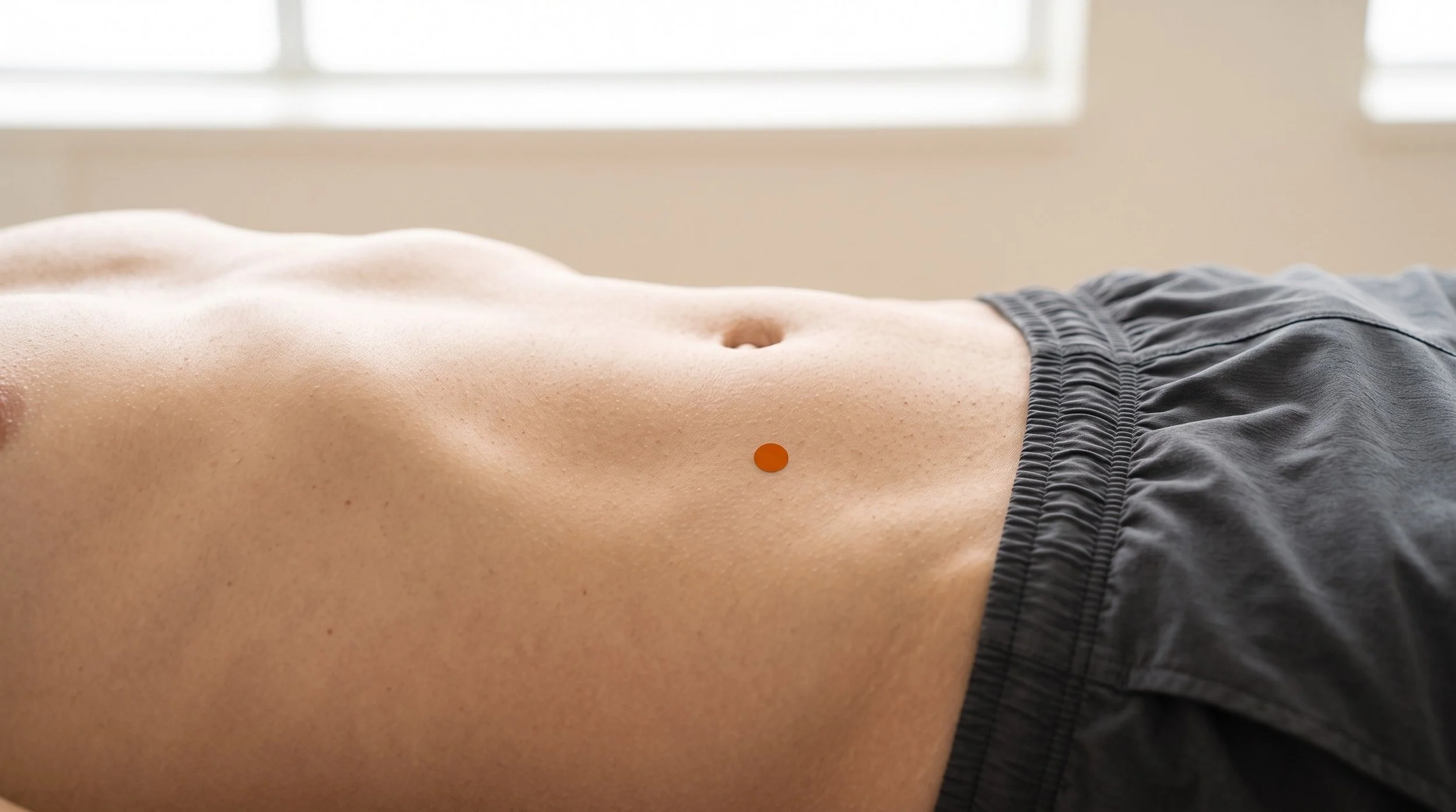
ST26 Acupuncture Point (Wailing)
The Outer Mound Below the Navel: Anatomy, Segmental Mechanism, and Why This Lower Abdominal Stomach Point Is Used for Cramping Pain
ST26, known in Chinese as Wailing and translated as Outer Mound, sits on the lower abdomen one cun below the umbilicus and two cun out from the midline, level with CV7, on the halfway line between the belly button and the palpable outer edge of the rectus abdominis (Deadman et al., 2007). It is one level below its much better known neighbor ST25, and while it gets far less attention, the st26 acupuncture point has a narrow and very practical classical reputation: cramping, gripping lower abdominal pain, distention, and menstrual pain.
Anatomically the needle passes through the rectus abdominis in roughly T10 to T11 territory, directly over loops of small intestine, which is exactly the segmental neighborhood shared by the uterus, the lower gut, and the abdominal wall itself. That overlap is the reason a small point on the belly wall can matter for pain that patients describe as coming from deep inside.
- Location and layers: ST26 lies 1 cun below the navel and 2 cun lateral to the midline, level with CV7, with the 2 cun line found halfway between midline and the outer border of the rectus abdominis (Deadman et al., 2007). The needle traverses skin, subcutaneous fat, the anterior rectus sheath, and the rectus abdominis belly.
- Traditional attribution: classical texts credit ST26 with regulating qi and relieving pain, and list severe abdominal pain, abdominal distention, shan (hernia type) disorders, painful periods, and absent periods among its indications (Deadman et al., 2007; Kim, 2015). Cunningham adds warming the lower burner and regulating menstruation to the traditional description (Cunningham, 1996).
- Mechanism in modern terms: needling here stimulates the muscular and anterior cutaneous branches of the lower thoracoabdominal nerves, whose input converges in the same spinal segments that receive afferents from the uterus and lower small bowel, a somatovisceral convergence that can dampen visceral nociceptive signaling (Yu et al., 2018).
- Systemic effects: acupuncture analgesia involves spinal gating plus descending inhibitory pathways and endogenous opioid release, which helps explain why abdominal points are typically paired with limb points rather than used alone (Zhao, 2008; Vickers et al., 2018).
- Research picture: Cochrane found the trial evidence for acupuncture and acupressure in primary dysmenorrhea inconclusive and of low or very low certainty (Smith et al., 2016), while reviews in irritable bowel syndrome report benefit against usual care but little separation from sham (Manheimer et al., 2012; Yang et al., 2022), so expectations should stay measured.
- De qi and dosing: patients usually report a dull, heavy, spreading fullness under the navel rather than sharpness, sometimes with a brief visible twitch of the rectus. Standard needling is perpendicular 1 to 1.5 cun, with the important caution that in thin patients deep insertion can reach the peritoneal cavity (Deadman et al., 2007).
Struggling With Cramping Lower Abdominal Pain or Painful Periods?
Cramping pain below the navel rarely comes from one tissue alone, and our clinicians assess the gut, the pelvis, and the abdominal wall before choosing points. ST26 is often used alongside ST25, CV6, and SP6 as part of a lower abdominal treatment that also addresses the rectus abdominis and obliques when they are guarding. We combine gentle abdominal needling with distal points so the treatment works on both the local tissue and the wider pain modulation system. Book a session and let's map out what is actually driving your discomfort.
Schedule NowAnatomy of ST26: Why the Rectus Abdominis Just Below the Navel Is Such an Important Location
The st 26 abdomen location is deceptively simple. One cun below the umbilicus and two cun lateral, the needle passes through skin and subcutaneous fat, then the anterior rectus sheath, then the rectus abdominis muscle belly. Because the two cun line sits midway between the midline and the outer edge of the rectus, ST26 is almost always squarely in muscle rather than at its border (Deadman et al., 2007).
This part of the wall is loaded constantly: it resists trunk extension during standing and walking, it braces during lifting and coughing, and it takes on protective tone whenever the viscera underneath are irritated. Patients with chronic bloating, post-surgical scarring, or long standing bracing habits frequently palpate as ropey and tender right here.
Sensory and motor supply in this zone comes from the lower thoracoabdominal (intercostal) nerves, generally T10 through T11 at the level just below the navel. Those same segments carry afferent traffic from the lower small intestine and contribute to the neural supply of the uterus, so somatic input from the belly wall and visceral input from the pelvis and gut converge on shared dorsal horn neurons.
Experimental work shows that electroacupuncture can suppress visceral nociceptive responses through exactly this kind of somatovisceral interaction, involving both segmental circuits and brainstem structures that participate in diffuse pain inhibition (Yu et al., 2018). Layered on top of that is the broader analgesic machinery described in the acupuncture literature: activation of A-delta and group III afferents, engagement of descending serotonergic and noradrenergic inhibition, and endogenous opioid release (Zhao, 2008).
It is also worth noting that the anterior cutaneous branches of these nerves can become irritated as they pierce the rectus sheath, producing a well described and frequently missed cause of chronic abdominal wall pain (Scheltinga & Roumen, 2018).
Deep to the muscle lies the posterior rectus sheath (still present at this level, becoming deficient further down at the arcuate line), then transversalis fascia, extraperitoneal fat, peritoneum, and loops of small intestine. The inferior epigastric vessels ascend on the deep surface of the rectus, which is another reason needling here stays controlled and vertical rather than angled steeply. Classical needling convention is perpendicular insertion of 1 to 1.5 cun, with the explicit caution that deep needling in thin patients can penetrate the peritoneal cavity (Deadman et al., 2007).
In practice we adjust depth to body habitus, needle on a relaxed exhale rather than into a braced wall, avoid the area over surgical mesh, hernias, or unexplained masses, and do not needle the lower abdomen during pregnancy.
Related Rectus Abdominis Trigger Points Related Stomach ChannelST26 at a Glance: Classification, Location, and Clinical Use
| Category | Detail |
|---|---|
| Traditional Name | Wailing (Outer Mound, also translated Outer Tomb) |
| Channel Classification | Stomach channel of Foot Yangming, lower abdominal section |
| Point Categories | No five-shu, luo-connecting, xi-cleft, hui-meeting, or extraordinary vessel intersection is attributed to this point in the reference texts. It is classified simply as a Stomach channel point of the lower abdomen, level with CV7 (Yinjiao). Traditional actions given are regulating qi and relieving pain (Deadman), with warming the lower burner and regulating menstruation added by Cunningham. Moxibustion is described as applicable. |
| Precise Location | Lower abdomen, 1 cun inferior to the umbilicus and 2 cun lateral to the anterior midline, level with CV7. The 2 cun line is found halfway between the midline and the palpable lateral border of the rectus abdominis. |
| Tissue Stimulated | Skin, subcutaneous fat, anterior rectus sheath, and the rectus abdominis muscle belly, with the abdominal obliques and transverse abdominis as adjacent functional targets; deep to the muscle lie transversalis fascia, peritoneum, and small intestine. |
| Needle Depth / Direction | Perpendicular insertion 1 to 1.5 cun, depth adjusted to body habitus. Shallower in thin patients, since deep needling may reach the peritoneal cavity. Moxibustion is traditionally applicable. |
| De Qi Sensation | A dull, heavy, spreading fullness beneath the navel that may radiate toward the midline or the pelvis, occasionally with a brief rectus twitch. Sharp or electric sensation means the needle should be withdrawn and redirected. |
| Primary Clinical Uses | Severe cramping abdominal pain, lower abdominal distention, menstrual cramps in classical use, shan (hernia type) disorders in classical texts, and lower rectus tension in modern abdominal wall presentations. |
| Common Point Combinations |
|
In Deadman's Manual of Acupuncture, ST26 is presented with unusual economy: a single traditional action, regulating qi and relieving pain, and a short indication list built around severe abdominal pain, abdominal distention, shan disorder, painful menstruation, and absent menstruation. Other standard texts follow the same narrow line, with the Shanghai College text and Chinese Acupuncture and Moxibustion listing abdominal pain, hernia, and dysmenorrhea, and Kim repeating that trio.
Cunningham broadens it slightly by attributing a warming effect on the lower burner and a menstrual regulating role, and offers a memorable naming rationale: the rectus abdominis rises like a mound on either side of the belly, giving the outer mound point its name. These are traditional attributions rather than physiological claims.
What is striking is how consistent the classical pattern is across sources: unlike ST25, which accumulated a sprawling indication list, ST26 stayed tightly bound to one clinical picture, gripping pain low in the abdomen, which is precisely the picture its segmental anatomy would predict.
Why ST26 Is Used for Menstrual Cramps and for Abdominal Wall Pain That Mimics Gut Pain
The lower abdominal wall, the uterus, and the lower small intestine all send sensory information into overlapping spinal segments. When those inputs converge on the same dorsal horn neurons, the brain has limited ability to tell them apart, which is why menstrual cramps are felt as a broad ache across the lower belly and why gut irritation makes the abdominal wall tighten. Needling into the rectus abdominis at ST26 introduces a strong, well localized somatic signal into that shared segment.
Experimental work has shown that electroacupuncture can reduce visceral nociceptive responses through this somatovisceral interaction, engaging both spinal and brainstem circuitry involved in pain inhibition (Yu et al., 2018).
The second half of the story is not local at all. Acupuncture analgesia depends heavily on descending inhibitory pathways from the brainstem, along with endogenous opioid and monoamine mechanisms, which is why treatment plans almost always pair abdominal points with limb points such as SP6 and ST36 (Zhao, 2008). Individual patient data from a large chronic pain meta-analysis suggests that these effects are modest but real and persist beyond the treatment period (Vickers et al., 2018). That combination of a segmental input and a systemic one is the working rationale behind the classical abdomen plus leg formulas.
There is also a purely musculoskeletal reason to be interested in this location. Chronic abdominal wall pain, including irritation of the anterior cutaneous nerve branches as they pass through the rectus sheath, is a recognized and often overlooked cause of persistent belly pain, and it can be identified with straightforward bedside testing (Scheltinga & Roumen, 2018).
When tenderness at the st26 acupuncture point increases as the patient tenses the abdominal wall, the pain generator is more likely to be in the wall than the viscera, and local needling of the rectus becomes a reasonable and targeted option rather than a shot in the dark.
What the Research Shows for ST26
No clinical trial has tested ST26 by itself. Like nearly every abdominal point, it appears inside multi-point protocols for menstrual pain or functional gut symptoms, so the honest framing is that the research tells us something about the treatment approach ST26 belongs to, not about the point in isolation. Reviews in these areas are also methodologically messy, with heavy reliance on trials from a single region, inconsistent sham designs, and variable reporting.
The reasonable position is that abdominal acupuncture is a low risk adjunct with plausible mechanisms and mixed clinical evidence, best judged by an individual patient's response over a short trial of care.
| Study | Type | Focus | Key Finding |
|---|---|---|---|
| Smith et al., 2016 | Cochrane systematic review | Acupuncture and acupressure for primary dysmenorrhea | The reviewers concluded there is insufficient evidence to determine whether acupuncture or acupressure reduce period pain, with certainty rated low to very low across comparisons. |
| Liu et al., 2014 | Randomized controlled trial | Single point acupuncture in primary dysmenorrhea | A multicenter trial examining single acupoint treatment during menstruation reported analgesic effects, though single point designs cannot be generalized to abdominal points like ST26. |
| Manheimer et al., 2012 | Systematic review and meta-analysis | Acupuncture for irritable bowel syndrome | Pooled results showed no improvement over sham acupuncture for symptom severity or quality of life, while comparisons with usual care were more favorable. |
| Yang et al., 2022 | Systematic review and meta-analysis | Acupuncture and moxibustion for irritable bowel syndrome | The authors reported benefits for symptom severity, abdominal pain, and quality of life, with evidence strength ranging from very low to high. |
| Yu et al., 2018 | Experimental animal study | Electroacupuncture and visceral nociception | Electroacupuncture reduced responses to noxious visceral stimulation through somatovisceral convergence at brainstem neurons, supporting a segmental and supraspinal mechanism. |
| Vickers et al., 2018 | Individual patient data meta-analysis | Acupuncture for chronic pain | Acupuncture outperformed both sham and no-acupuncture controls for chronic pain conditions, with effects that were modest in size but durable over twelve months. |
| Scheltinga & Roumen, 2018 | Narrative review | Anterior cutaneous nerve entrapment syndrome | Irritation of abdominal wall nerve branches is described as an underrecognized source of severe chronic abdominal pain that is identifiable on clinical examination. |
Is Your Abdominal Pain Coming From the Belly Wall Rather Than the Gut?
A meaningful subset of chronic abdominal pain is generated by the abdominal wall itself, and tender, taut bands in the rectus abdominis can reproduce symptoms that look gastrointestinal. At Morningside Acupuncture we palpate the wall carefully, and when the pain is reproduced on tensing the muscle we treat locally with acupuncture and dry needling around points such as ST26 and ST25. That local work sits inside a broader plan that includes breathing mechanics, movement, and follow up care. Schedule an evaluation and get a clearer answer about your pain.
Schedule NowST26 in the Context of Trigger Point Work
Acupuncture is defined by the use of an acupuncture needle, and dry needling is one of the many styles that fall under that umbrella. That matters at ST26, because the point sits inside a muscle with a well documented referral pattern. Trigger points in the rectus abdominis can refer pain across the abdomen and into the back, and lower rectus involvement can produce symptoms that patients and clinicians alike interpret as bladder, bowel, or menstrual in origin (Simons et al., 1999).
When we palpate the st 26 abdomen location and find a taut, exquisitely tender band that reproduces a patient's familiar cramping, the needling target and the classical point occupy essentially the same real estate.
In practice, our clinicians combine the point with regional myofascial work rather than treating them as separate systems. That usually means ST26 and ST25 along the rectus, with the external oblique and transverse abdominis addressed if the lateral wall is guarding, and distal points such as SP6 and ST36 to recruit the wider pain modulation response. Needle depth stays conservative over the lower abdomen, insertion follows the breath, and we screen for hernias, mesh, recent surgery, and pregnancy before treating.
Patients often report a sense of the abdomen letting go and breathing dropping lower, which is a useful sign that protective tone rather than the viscera was driving a good share of the discomfort.
ST26 Abdominal and Menstrual Pain Treatment at NYC's Highest-Rated Acupuncture Clinic
Morningside Acupuncture is the highest-rated acupuncture and dry needling clinic in New York City with over 500 five-star Google reviews, and lower abdominal and menstrual pain are among the concerns we see most often. Treatments blend classical point selection like the ST26 and ST25 pairing with modern myofascial needling and clear, realistic goal setting. You will always know why a point was chosen and what to expect between visits. Schedule your appointment today and start with an assessment rather than a guess.
Schedule NowFrequently Asked Questions
What does ST26 feel like when needled?
Most people feel a dull, heavy, slightly spreading fullness beneath the navel once the needle reaches the rectus abdominis, sometimes with a mild ache that drifts toward the midline or pelvis. If a taut band is present, you may feel a quick twitch of the muscle, which is normal and usually followed by a softening. Sharp, burning, or electric sensations are not the goal and mean the needle should be adjusted. Sensation typically settles within a minute and the abdomen often feels looser afterward.
Why needle the abdomen for menstrual cramps instead of just using points on the legs?
Both approaches have a rationale, and most treatment plans use them together. Points on the lower abdomen sit in the same spinal segments that carry sensory information from the uterus, so they can influence pain processing at the level where those signals first arrive (Yu et al., 2018). Distal points on the legs, such as SP6 and ST36, work more through descending inhibitory and systemic mechanisms that operate above the spinal cord (Zhao, 2008). Classical formulas paired abdomen with leg long before those mechanisms were described, and that structure still holds up well.
Can I press ST26 myself between sessions?
Yes, acupressure at the outer mound point is easy to do at home. Lie on your back with knees bent so the abdominal wall is relaxed, find the spot one thumb width below your navel and about two thumb widths out to the side, and sink two fingertips in slowly with steady, moderate pressure. Hold for 30 to 60 seconds while breathing into the belly, release, then repeat two or three times per side, for a total of about 3 to 5 minutes. Warmth from a heating pad over the area beforehand often makes it more comfortable. Stop if pressure produces sharp pain, and skip self-treatment entirely if you are pregnant, have an undiagnosed abdominal mass or hernia, recent abdominal surgery, or fever with abdominal pain.
Is ST26 safe to needle?
In trained hands it is a routine point, but it deserves respect because the peritoneal cavity lies underneath. Standard depth is perpendicular insertion of 1 to 1.5 cun, and classical texts specifically warn that in thin patients deep needling can penetrate the peritoneal cavity, so depth is matched to body habitus (Deadman et al., 2007). We avoid the lower abdomen during pregnancy and needle cautiously or not at all over hernias, surgical mesh, fresh scars, or unexplained masses. Anyone with new, severe, or progressive abdominal pain, fever, vomiting, or blood in the stool needs medical evaluation first, since acupuncture is not a substitute for diagnosis.
Where exactly is ST26 located?
Find your navel, then move straight down 1 cun (about one thumb width) to the level of CV7, then out to the side 2 cun from the midline. A reliable way to set that lateral distance is to locate the palpable outer border of the rectus abdominis, which sits roughly 4 cun from the midline, and take the halfway point (Deadman et al., 2007). For the vertical measurement, remember that the distance from the navel to the pubic symphysis is 5 cun, so ST26 sits one fifth of the way down that span. The point is bilateral and normally lands within the muscle belly rather than at its edge.
References
- Deadman, P., Al-Khafaji, M., & Baker, K. (2009). A manual of acupuncture. Journal of Chinese Medicine Publications.
- Cunningham, P. M. (2000). Acupuncture points: A practical guide to classical and modern usage. Odyssey Press.
- Kim, H. (2008). Handbook of Oriental medicine (3rd ed.). Harmony & Balance Press.
- Cheng, X. (Ed.). (1999). Chinese acupuncture and moxibustion (Rev. ed.). Foreign Languages Press.
- O'Connor, J., & Bensky, D. (Eds. & Trans.). (1981). Acupuncture: A comprehensive text. Shanghai College of Traditional Medicine. Eastland Press.
- Simons, D. G., Travell, J. G., & Simons, L. S. (1999). Travell & Simons' myofascial pain and dysfunction: The trigger point manual, Vol. 1: Upper half of body (2nd ed.). Williams & Wilkins.
- Smith, C. A., Armour, M., Zhu, X., Li, X., Lu, Z. Y., & Song, J. (2016). Acupuncture for dysmenorrhoea. Cochrane Database of Systematic Reviews, 2016(4), CD007854. https://doi.org/10.1002/14651858.CD007854.pub3
- Liu, C. Z., Xie, J. P., Wang, L. P., Liu, Y. Q., Song, J. S., Chen, Y. Y., Shi, G. X., Zhou, W., Gao, S. Z., Li, S. L., Xing, J. M., Ma, L. X., Wang, Y. X., Zhu, J., & Liu, J. P. (2014). A randomized controlled trial of single point acupuncture in primary dysmenorrhea. Pain Medicine, 15(6), 910-920. https://doi.org/10.1111/pme.12392
- Manheimer, E., Wieland, L. S., Cheng, K., Li, S. M., Shen, X., Berman, B. M., & Lao, L. (2012). Acupuncture for irritable bowel syndrome: Systematic review and meta-analysis. American Journal of Gastroenterology, 107(6), 835-847. https://doi.org/10.1038/ajg.2012.66
- Yang, Y., Rao, K., Zhan, K., Shen, M., Zheng, H., Qin, S., Wu, H., Bian, Z., & Huang, S. (2022). Clinical evidence of acupuncture and moxibustion for irritable bowel syndrome: A systematic review and meta-analysis of randomized controlled trials. Frontiers in Public Health, 10, 1022145. https://doi.org/10.3389/fpubh.2022.1022145
- Yu, L., Li, L., Qin, Q., Yu, Y., Cui, X., Rong, P., & Zhu, B. (2018). Electroacupuncture inhibits visceral nociception via somatovisceral interaction at subnucleus reticularis dorsalis neurons in the rat medulla. Frontiers in Neuroscience, 12, 775. https://doi.org/10.3389/fnins.2018.00775
- Scheltinga, M. R., & Roumen, R. M. (2018). Anterior cutaneous nerve entrapment syndrome (ACNES). Hernia, 22(3), 507-516. https://doi.org/10.1007/s10029-017-1710-z
- Zhao, Z. Q. (2008). Neural mechanism underlying acupuncture analgesia. Progress in Neurobiology, 85(4), 355-375. https://doi.org/10.1016/j.pneurobio.2008.05.004
- Vickers, A. J., Vertosick, E. A., Lewith, G., MacPherson, H., Foster, N. E., Sherman, K. J., Irnich, D., Witt, C. M., & Linde, K. (2018). Acupuncture for chronic pain: Update of an individual patient data meta-analysis. Journal of Pain, 19(5), 455-474. https://doi.org/10.1016/j.jpain.2017.11.005
Disclaimer: This web site is intended for educational and informational purposes only. Reading this website does not constitute providing medical advice or any professional services. This information should not be used for diagnosing or treating any health issue or disease. Those seeking medical advice should consult with a licensed physician. Seek the advice of a medical doctor or other qualified health professional for any medical condition. If you think you have a medical emergency, call 911 or go to the emergency room. No acupuncturist-patient relationship is created by reading this website or using the information. Morningside Acupuncture PLLC and its employees and contributors do not make any express or implied representations with respect to the information on this site or its use. For any legal interpretation of scope of practice in your state, consult a licensed attorney or regulatory authority.
Read more from our blog



