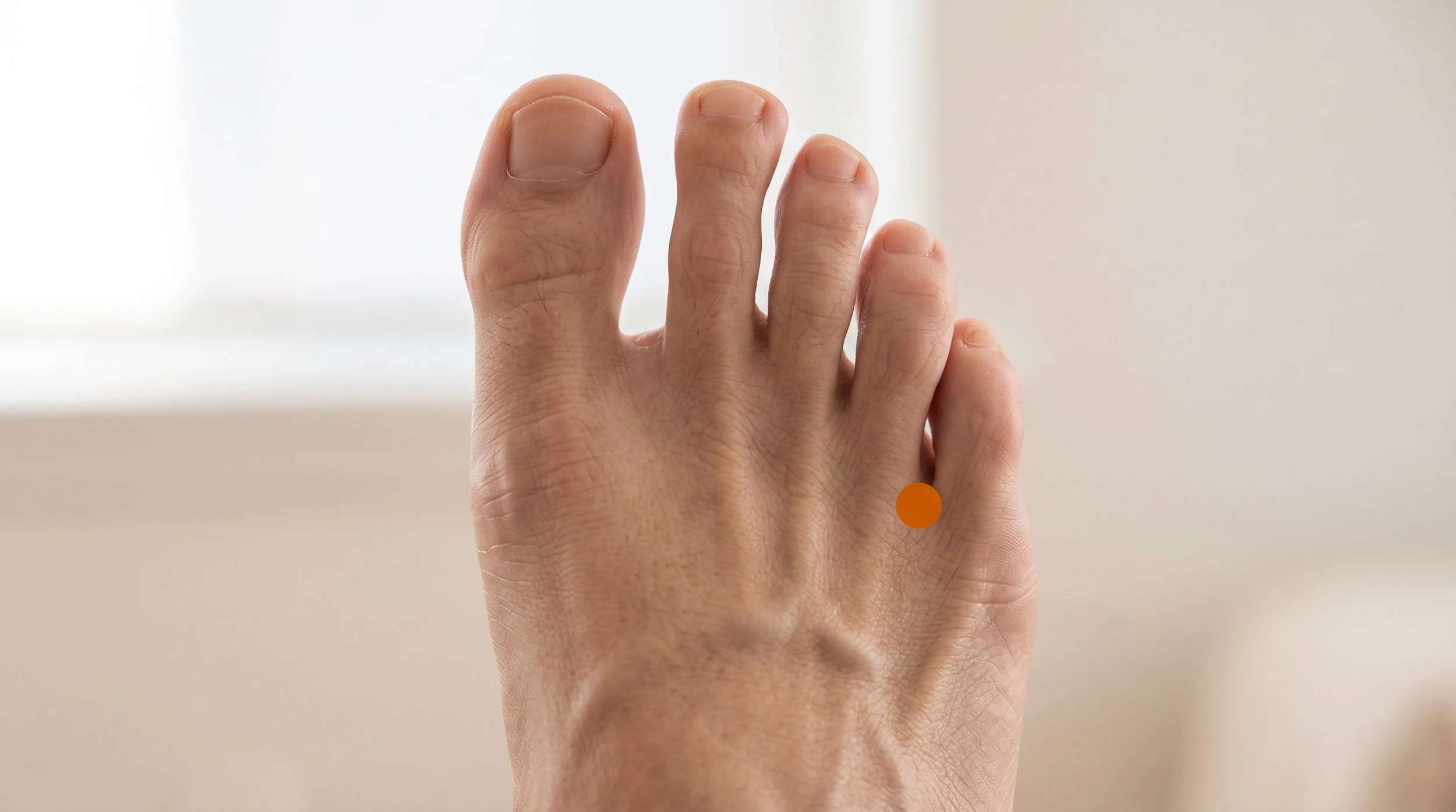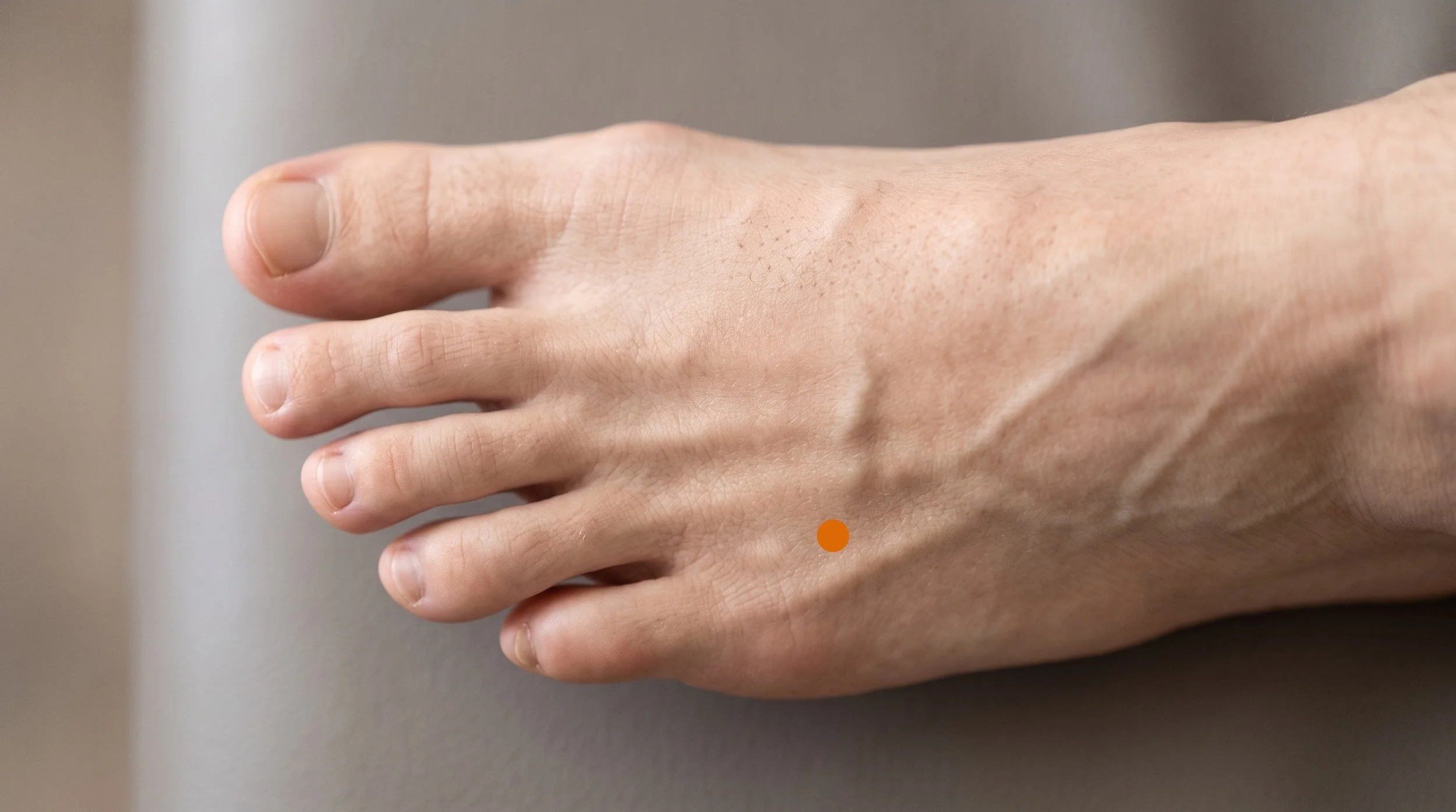
ST24 Acupuncture Point (Huaroumen)
The Slippery Flesh Gate Above the Navel: Anatomy, Segmental Mechanism, and Why This Upper Abdominal Point Sits Between Digestion and Agitation
ST24 (Huaroumen), often translated as Slippery Flesh Gate, is a Stomach channel point on the upper abdomen, located 2 cun lateral to the midline and 1 cun above the navel, level with CV9. In plain terms, it sits about two finger widths out from the belly button and one finger width up, right in the belly of the rectus abdominis muscle, over the loops of small intestine.
Classical texts group it with its neighbor ST23 and credit the pair with settling the mind as well as calming the stomach, which is why the st24 acupuncture point shows up in old formulas for both vomiting and agitation.
Modern practice keeps the same territory but explains it differently: this is a segmental point in T9 to T10 skin and muscle, layered directly over the viscera it has always been used to influence.
- Location and layers: stomach 24 lies on the halfway line between the midline and the palpable lateral border of the rectus abdominis, 1 cun above the umbilicus (Deadman et al., 2007). The needle passes through skin, subcutaneous fat, the anterior rectus sheath, and rectus abdominis, with the peritoneum and small intestine below.
- Traditional attributions: classical sources describe Huaroumen as transforming phlegm and calming the spirit while harmonizing the Stomach and stopping vomiting, with indications spanning gastric pain, vomiting, mania-depression, and tongue disorders (Deadman et al., 2007; Cunningham, 2000). We present these as historical categories, not as physiological claims.
- Nerve story: the point sits in the cutaneous and muscular territory of the ninth to tenth intercostal nerves (Cheng, 1987), the same spinal segments that carry visceral afferents from the stomach and upper small bowel, so needling here can influence how the cord processes both abdominal wall and visceral input (Li et al., 2007).
- Mechanism: needling in homosegmental abdominal territory tends to produce reflex changes in gastric motility mediated largely by sympathetic pathways, while limb points act more through vagal reflexes (Li et al., 2007; Lu et al., 2019; Dong et al., 2025). Needle stimulation also engages descending inhibitory systems that dampen pain signaling more broadly (Zhao, 2008).
- Research picture: trials of acupuncture for functional dyspepsia and related upper gut complaints usually test multi-point protocols and report modest symptom improvements with meaningful methodological limits (Pang et al., 2016; Guo et al., 2020). No trial isolates ST24, so its role is best described as supporting rather than proven on its own.
- In practice and de qi: patients typically feel a dull, heavy, slightly spreading pressure in the abdominal wall rather than a sharp sting, and this sensation is part of what acupuncture research treats as an active ingredient in point stimulation (Vickers et al., 2018). Depth is kept conservative, especially in thin patients.
Struggling With Epigastric Pain, Bloating, or Nausea That Keeps Coming Back?
At Morningside Acupuncture, ST24 is one of several abdominal points we may use when upper belly discomfort, queasiness, and post-meal tightness are the main complaints. We combine gentle abdominal needling with distal points like PC6 and ST36, then check how your abdominal wall responds to palpation between visits. Treatment is paced to your comfort, and depth over the abdomen is always kept conservative. Schedule a visit to see how your digestive symptoms respond over a short trial of care.
Schedule NowAnatomy of ST24: Why the Rectus Abdominis Just Above the Navel Is Such an Important Location
The st 24 abdomen location is straightforward once you set the landmarks. The umbilicus to the sternocostal angle is measured as 8 cun, so 1 cun above the navel is one eighth of that span. Laterally, the midline to the mammillary line is 4 cun, and ST24 sits at the halfway mark of that distance, which in most people falls over the middle of the rectus abdominis rather than at its outer edge (Deadman et al., 2007). From the surface down, a needle here passes through skin, a variable layer of subcutaneous fat, the anterior rectus sheath, and then the muscle itself.
That muscle works constantly: it stabilizes the trunk during sitting, lifting, coughing, and bracing, and it commonly develops tender, taut bands in people who train hard, who have had abdominal surgery, or who hold tension in the belly under stress (Simons et al., 1999).
Nerve geography explains why a point on the belly wall gets used for stomach complaints. The skin and muscle at this level are supplied by branches of the ninth and tenth intercostal nerves (Cheng, 1987), and those same thoracic segments receive visceral afferent traffic from the stomach and proximal small intestine. Somatic and visceral inputs converge on shared dorsal horn neurons, which is the standard explanation for referred abdominal pain and for why segmental needling can modulate visceral sensation and motor output.
Experimental work shows a consistent pattern: stimulation of abdominal points in the same segments as gastric innervation tends to inhibit gastric motility through sympathetic pathways, while stimulation at limb points tends to facilitate motility through vagal reflexes (Li et al., 2007; Lu et al., 2019). Newer neuroanatomical work has mapped this limb versus abdomen distinction in more detail (Dong et al., 2025). Alongside these segmental effects, needling recruits descending inhibitory pathways that reduce pain transmission more generally (Zhao, 2008).
Below the muscle sit the deep epigastric vessels, the transversalis fascia, the peritoneum, and the small intestine. That is why needling conventions here are cautious rather than heroic. Textbooks describe perpendicular insertion of roughly 0.7 to 1.5 cun, with an explicit warning that deep needling in thin patients can reach the peritoneal cavity (Deadman et al., 2007; Cheng, 1987).
In practice, we adjust depth to body habitus, angle away from anything that feels like a hernia or a surgical defect, and use shallower insertion whenever the abdominal wall is thin. Abdominal points are also routinely avoided during pregnancy.
Related Rectus Abdominis Trigger Points Related Stomach ChannelST24 at a Glance: Classification, Location, and Clinical Use
| Category | Detail |
|---|---|
| Traditional Name | Huaroumen (Slippery Flesh Gate, also translated as Slippery Flesh Door) |
| Channel Classification | Stomach channel of Foot Yangming, abdominal section, level with CV9 (Shuifen) |
| Point Categories | No five-shu, luo-connecting, xi-cleft, front-mu, or extraordinary vessel intersection is recorded for this point in the standard references. It is classified simply as a Stomach channel abdominal point, traditionally grouped with ST23 for its combined spirit-calming and stomach-harmonizing attributions (Deadman et al., 2007). |
| Precise Location | On the abdomen, 1 cun superior to the umbilicus and 2 cun lateral to the anterior midline, level with CV9. The 2 cun line is taken as halfway between the midline and the palpable lateral border of the rectus abdominis. |
| Tissue Stimulated | Skin and subcutaneous tissue of the T9 to T10 dermatomes, anterior rectus sheath, and rectus abdominis muscle, with the transverse abdominis and abdominal obliques as nearby myofascial targets. |
| Needle Depth / Direction | Perpendicular insertion, commonly 0.7 to 1.5 cun depending on body habitus. Deep needling can penetrate the peritoneal cavity in thin patients, so depth is reduced accordingly. Moxibustion is described as applicable. |
| De Qi Sensation | A dull, heavy, mildly distending pressure that can spread across the upper abdomen, sometimes with a warm or wave-like feeling. Sharp or radiating pain is not the goal and means the needle should be adjusted. |
| Primary Clinical Uses | Epigastric pain, nausea and vomiting, poor digestion and post-meal fullness, tension and tenderness of the abdominal wall near the navel, and, in classical use, restlessness and agitation. |
| Common Point Combinations |
|
In the classical literature summarized by Deadman, Al-Khafaji and Baker, Huaroumen is presented as a point with a split personality. One half of its traditional description is digestive: it is said to harmonize the Stomach and stop vomiting, and it appears in older indication lists for epigastric pain, vomiting, and vomiting of blood. The other half is mental and spirit-related: the same texts credit it with transforming phlegm and calming the spirit, and list mania-depression along with a cluster of tongue signs including stiffness, protrusion, and thrusting.
Other compilations echo the pattern, listing acute and chronic gastritis alongside disordered mental states (Shanghai College of Traditional Chinese Medicine, 1981), and one modern commentary suggests the name may refer to the slippery flesh of the intestines beneath the point or to the tongue itself (Cunningham, 2000). What makes the classical pattern striking is the pairing: the same two neighboring abdominal points, ST23 and ST24, were used for both a stomach that would not settle and a mind that would not settle, long before anyone described the gut and brain as a single communicating system.
Why ST24 Is Used for Agitation and Restlessness, Not Just Stomach Symptoms
The first part of the answer is segmental. The skin and muscle at ST24 share spinal cord segments with the stomach and upper small intestine, so sensory input from the abdominal wall and from the viscera arrive at overlapping neurons in the dorsal horn (Li et al., 2007). When a stomach is irritated, that convergence can make the overlying abdominal wall feel tender and tight, and the reverse also holds: a guarded, sensitized abdominal wall can keep feeding input into the same circuits.
Needling in that shared territory gives the nervous system a clear, competing signal in exactly the segments that are already busy, which is the most plausible reason a point on the belly wall was ever used for epigastric pain and vomiting.
The second part involves autonomic reflexes and descending control. Animal studies consistently show that stimulating abdominal points in the same segments as gastric innervation produces reflex changes in gastric motility carried mainly by sympathetic pathways, while limb points such as ST36 recruit vagal reflexes (Li et al., 2007; Lu et al., 2019), and recent neuroanatomical work has traced this limb versus trunk difference in more detail (Dong et al., 2025). This is one reason clinicians rarely use abdominal points alone and typically add distal points to the prescription.
At the same time, needle stimulation engages descending inhibitory systems involving endogenous opioid and monoamine pathways that reduce pain signaling well beyond the treated segment (Zhao, 2008).
As for the classical spirit-calming attributions, we frame them cautiously. There is no study showing that Huaroumen specifically reduces anxiety or agitation. What research does suggest is that acupuncture protocols may modestly reduce anxiety symptoms across mixed populations, with trial quality limiting confidence (Yang et al., 2021), and that many patients experience needling as autonomically settling.
For someone whose stress reliably lands in the stomach, a point that addresses abdominal wall tension and visceral discomfort at the same time is a reasonable inclusion, without any claim that it treats a psychiatric condition.
What the Research Shows for ST24
It's worth being direct about the evidence: no randomized trial has tested ST24 on its own. Studies of acupuncture for upper digestive complaints use multi-point protocols in which abdominal points near the navel appear alongside distal points, so any benefit is attributed to the package rather than to a single location. The reviews below describe how that package performs, plus the animal physiology that explains what abdominal needling plausibly does to gut motor function. Read them as context for why ST24 earns a place in a prescription, not as proof of point-specific effects.
| Study | Type | Focus | Key Finding |
|---|---|---|---|
| Pang et al., 2016 | Systematic review and meta-analysis | Acupuncture for functional dyspepsia | Pooled results favored acupuncture for dyspepsia symptom scores and quality of life, though most included trials were judged low quality. |
| Guo, Wei & Chen, 2020 | Systematic review of mechanistic trials | Effects and mechanisms of acupuncture and electroacupuncture in functional dyspepsia | Included studies suggested changes in gastric motility and accommodation, gut hormones, and autonomic measures, with the authors calling for better designed research. |
| Li et al., 2007 | Animal neurophysiology study | Segmental basis of acupuncture effects on gastric motility | Stimulation of abdominal points in segments matching gastric innervation tended to inhibit gastric motility via sympathetic pathways, unlike limb point stimulation. |
| Lu et al., 2019 | Animal neurophysiology study | Electroacupuncture at ST36 and gastric motility | Motility changes were mediated by both vagovagal and sympathetic reflexes, supporting the practice of pairing abdominal points with distal ones. |
| Dong et al., 2025 | Preclinical and translational neuroanatomy study | How electroacupuncture at different body regions modulates gastric function | Mapped distinct pathways for limb versus abdominal stimulation, reinforcing that point location shapes the autonomic response. |
| Yang et al., 2021 | Systematic review and meta-analysis | Acupuncture for anxiety disorders | Acupuncture was associated with modest reductions in anxiety symptoms compared with controls, with heterogeneity and risk of bias limiting confidence. |
| Vickers et al., 2018 | Individual patient data meta-analysis | Acupuncture for chronic pain across conditions | Acupuncture outperformed sham and no-acupuncture controls for chronic pain, with effects persisting over time and only modest decay. |
Carrying Stress in Your Stomach? Acupuncture May Help Settle the System
Plenty of New Yorkers describe a knot above the navel that tightens under deadlines and eases on vacation. Our clinicians use points like Huaroumen alongside calming distal points and, when indicated, dry needling of the rectus abdominis and obliques to reduce guarding in the abdominal wall. The goal is a quieter nervous system and easier digestion, not a quick fix. Book an appointment and we'll map a plan around your symptoms.
Schedule NowST24 in the Context of Trigger Point Work
Acupuncture means the use of an acupuncture needle, and that includes dry needling, so at Morningside we don't treat channel points and myofascial targets as separate systems. ST24 sits directly in the rectus abdominis, a muscle that can develop taut bands and tender points referring pain horizontally across the belly and into the mid back or low back region (Simons et al., 1999). Patients with this pattern often describe a band of soreness at the level of the navel, discomfort with sit-ups or coughing, and a stomach that feels bloated even when imaging and labs are unremarkable.
Palpating the rectus at the ST24 level frequently reproduces a familiar ache, and treating that spot as both a channel point and a myofascial target is often the most efficient approach.
In a typical session we might needle ST24 and its neighbors superficially into the rectus, add the [external abdominal oblique](https://www.morningsideacupuncturenyc.com/external-abdominal-oblique-trigger-points) or [transverse abdominis](https://www.morningsideacupuncturenyc.com/transverse-abdominis-trigger-points) when lateral wall tension is part of the picture, and finish with distal points on the limbs to bring vagal reflex pathways into the mix (Lu et al., 2019).
Depth over the abdomen stays conservative regardless of technique, and we screen for hernias, recent surgery, and organomegaly before needling. Manual work, breathing retraining, and graded core loading usually go alongside the needling, since a rectus that has been guarding for months rarely stays quiet without a movement plan.
ST24 Digestive and Abdominal Tension Treatment at NYC's Highest-Rated Acupuncture Clinic
Morningside Acupuncture is the highest-rated acupuncture and dry needling clinic in New York City with over 500 five-star Google reviews, and abdominal complaints are a routine part of our caseload. Every session begins with palpation and a clear explanation of where the needles go and why, including the safety limits that apply over the abdomen. If epigastric pain, nausea, or stress-related belly tension is affecting your days, schedule an appointment with our team.
Schedule NowFrequently Asked Questions
What does ST24 feel like when needled?
Most people feel a dull, heavy pressure or a mild spreading distension in the upper abdomen once the needle reaches the muscle layer. Some notice a warm sensation or a brief wave-like feeling in the belly. If the rectus abdominis holds an active trigger point, you may feel a familiar ache or a small twitch response. Sharp, burning, or radiating pain isn't expected, and it's a cue for your clinician to adjust the needle.
Why needle the belly wall for a stomach problem instead of a distal point?
Because the abdominal wall at this level shares spinal segments with the stomach and upper small intestine, needling here delivers input directly into the circuits already processing visceral discomfort (Li et al., 2007). That segmental route tends to work through sympathetic reflex pathways, while limb points such as ST36 recruit vagal reflexes (Lu et al., 2019; Dong et al., 2025). Since the two routes aren't interchangeable, most treatment plans use both: local abdominal points like stomach 24 plus distal points on the arms and legs.
Can I press ST24 myself between sessions?
Yes, acupressure at Slippery Flesh Gate is reasonable for most people. Find the spot 1 cun above your navel (about one thumb width) and 2 cun lateral (about two thumb widths), which lands in the muscle bulk beside the midline. Use a flat fingertip or thumb pad with steady, moderate pressure, no digging, for 30 to 60 seconds per side, breathing slowly and letting your belly soften on the exhale. Repeat two or three rounds, once or twice a day, ideally not immediately after a large meal. Skip it if you're pregnant, have a hernia or a recent abdominal surgery, or if pressure produces sharp pain, and always get new or severe abdominal pain evaluated medically.
Is ST24 safe to needle?
In trained hands it's safe, and the main caution is depth. Standard texts note that deep needling in thin patients can reach the peritoneal cavity, so insertion is kept shallow enough for the individual's body habitus (Deadman et al., 2007). We also avoid needling over hernias, surgical scars with unclear anatomy, enlarged organs, or an acutely distended abdomen, and abdominal points are routinely avoided during pregnancy. Minor bruising is the most common side effect. Tell your clinician about blood thinners, recent abdominal surgery, or any new and undiagnosed abdominal pain before treatment.
Where exactly is ST24 located?
ST24 is on the abdomen, 1 cun above the center of the umbilicus and 2 cun lateral to the anterior midline, level with CV9 (Shuifen). Using proportional measurement, the navel to the sternocostal angle spans 8 cun, so move up one eighth of that distance; the midline to the nipple line spans 4 cun, so go half that distance outward. In most people the point lands over the middle of the rectus abdominis, on the halfway line between the midline and the muscle's palpable outer border. ST23 sits 1 cun higher on the same line, and ST25 sits level with the navel.
References
- Deadman, P., Al-Khafaji, M., & Baker, K. (2009). A manual of acupuncture. Journal of Chinese Medicine Publications.
- Cunningham, P. M. (2000). Acupuncture points: A practical guide to classical and modern usage. Odyssey Press.
- Cheng, X. (Ed.). (1999). Chinese acupuncture and moxibustion (Rev. ed.). Foreign Languages Press.
- O'Connor, J., & Bensky, D. (Eds. & Trans.). (1981). Acupuncture: A comprehensive text. Shanghai College of Traditional Medicine. Eastland Press.
- Simons, D. G., Travell, J. G., & Simons, L. S. (1999). Travell & Simons' myofascial pain and dysfunction: The trigger point manual, Vol. 1: Upper half of body (2nd ed.). Williams & Wilkins.
- Li, Y. Q., Zhu, B., Rong, P. J., Ben, H., & Li, Y. H. (2007). Neural mechanism of acupuncture-modulated gastric motility. World Journal of Gastroenterology, 13(5), 709-716. https://doi.org/10.3748/wjg.v13.i5.709
- Lu, M. J., Yu, Z., He, Y., Yin, Y., & Xu, B. (2019). Electroacupuncture at ST36 modulates gastric motility via vagovagal and sympathetic reflexes in rats. World Journal of Gastroenterology, 25(19), 2315-2326. https://doi.org/10.3748/wjg.v25.i19.2315
- Guo, Y., Wei, W., & Chen, J. D. Z. (2020). Effects and mechanisms of acupuncture and electroacupuncture for functional dyspepsia: A systematic review. World Journal of Gastroenterology, 26(19), 2440-2457. https://doi.org/10.3748/wjg.v26.i19.2440
- Pang, B., Jiang, T., Du, Y. H., Li, J., Li, B., Hu, Y. C., & Cai, Q. H. (2016). Acupuncture for functional dyspepsia: What strength does it have? A systematic review and meta-analysis of randomized controlled trials. Evidence-Based Complementary and Alternative Medicine, 2016, 3862916. https://doi.org/10.1155/2016/3862916
- Dong, S., Zhao, L., Liu, J., Sha, X., Wu, Y., Liu, W., et al. (2025). Neuroanatomical organization of electroacupuncture in modulating gastric function in mice and humans. Neuron, 113, 3243-3259.e11. https://doi.org/10.1016/j.neuron.2025.06.023
- Yang, X. Y., Yang, N. B., Huang, F. F., Ren, S., & Li, Z. J. (2021). Effectiveness of acupuncture on anxiety disorder: A systematic review and meta-analysis of randomised controlled trials. Annals of General Psychiatry, 20, 9. https://doi.org/10.1186/s12991-021-00327-5
- Zhao, Z. Q. (2008). Neural mechanism underlying acupuncture analgesia. Progress in Neurobiology, 85(4), 355-375. https://doi.org/10.1016/j.pneurobio.2008.05.004
- Vickers, A. J., Vertosick, E. A., Lewith, G., MacPherson, H., Foster, N. E., Sherman, K. J., Irnich, D., Witt, C. M., & Linde, K. (2018). Acupuncture for chronic pain: Update of an individual patient data meta-analysis. Journal of Pain, 19(5), 455-474. https://doi.org/10.1016/j.jpain.2017.11.005
Disclaimer: This web site is intended for educational and informational purposes only. Reading this website does not constitute providing medical advice or any professional services. This information should not be used for diagnosing or treating any health issue or disease. Those seeking medical advice should consult with a licensed physician. Seek the advice of a medical doctor or other qualified health professional for any medical condition. If you think you have a medical emergency, call 911 or go to the emergency room. No acupuncturist-patient relationship is created by reading this website or using the information. Morningside Acupuncture PLLC and its employees and contributors do not make any express or implied representations with respect to the information on this site or its use. For any legal interpretation of scope of practice in your state, consult a licensed attorney or regulatory authority.
Read more from our blog