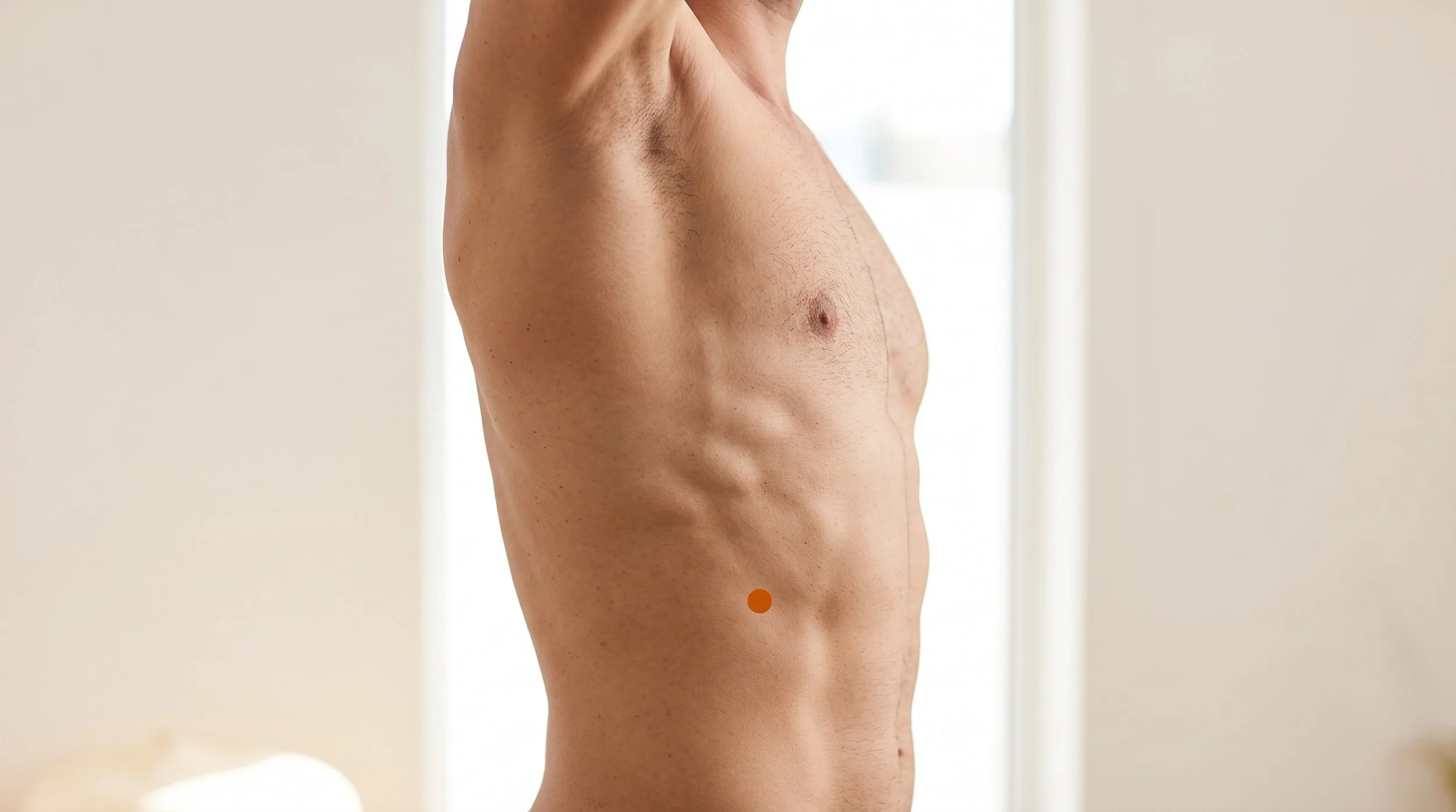
LV13 Acupuncture Point (Zhangmen)
The Completion Gate at the Eleventh Rib: Anatomy, Segmental Reflexes, and Why This Spleen Front-Mu Point Anchors Digestive and Flank Pain Treatment
LV13 (Zhangmen, often translated as Completion Gate or Chapter Gate), also written LR13, sits on the side of the abdomen just in front of and below the free tip of the eleventh rib, usually on or very near the mid-axillary line, roughly at the level of the navel in most builds. It is a Liver channel point that classical texts assign to the Spleen: it is the front-mu (gathering) point of the Spleen and the hui-meeting point of the five zang, which is an unusual double designation and one reason the LV13 acupuncture point shows up in so many classical digestive formulas.
Clinically, liver 13 matters because of where it lives: at the crossroads of the lower ribs, the oblique abdominal wall, the thoracolumbar junction, and the spinal segments that also carry sensory traffic from the gut. That anatomy makes it a practical choice for bloating, cramping, alternating bowel habits, rib-side tightness, and the band of flank and low back stiffness that so often travels with them.
- Location and layers: LV13 lies at the free end of the eleventh rib, where the needle passes through skin and subcutaneous tissue into the external oblique, internal oblique, and (deeper) transversus abdominis aponeurosis, with the rib tip itself as the palpable landmark. Because the lower ribs are where the obliques, diaphragm, and lumbar fascia trade tension, this spot loads with breath-holding, chronic bracing, and prolonged sitting.
- Traditional categories, translated: classical sources list LV13 as the front-mu point of the Spleen, the hui-meeting point of the zang organs, a meeting point of the Liver and Gall Bladder channels, and a point associated with the Girdle vessel. In modern terms these designations mark it as a viscerosomatic reference zone on the abdominal wall that shares spinal segments with upper gut structures.
- Mechanism: LV13 sits in the T10 to T11 sensory field, and abdominal wall stimulation at segments shared with the gut has been shown to modulate gastric motility and autonomic outflow through spinal and supraspinal pathways rather than through anything local to the stomach (Li et al., 2007). Needling also recruits the broader analgesic machinery of endogenous opioids and descending inhibition (Zhao, 2008).
- Research picture: reviews of acupuncture for digestive complaints test whole protocols, not single points, and results are mixed but not empty. A Cochrane review found acupuncture no better than sham for IBS symptom severity while noting benefit over some antispasmodic drugs in unblinded comparisons (Manheimer et al., 2012), and a large sham-controlled trial reported more complete spontaneous bowel movements with electroacupuncture in chronic severe constipation (Liu et al., 2016).
- Clinical framing: at Morningside Acupuncture we use LV 13 ribs work as one element of a plan, usually alongside distal points and manual or dry needling treatment of the abdominal wall and flank, and we track function (bloating after meals, stool pattern, rib-side tightness, sleep) rather than chasing sensation.
- De qi and technique: needling here is transverse or oblique along the line of the rib, typically 0.5 to 1 cun, producing a heavy, spreading fullness under the rib tip that can travel toward the navel or around into the flank. Deep perpendicular insertion is avoided because the liver on the right and the spleen on the left lie beneath, and an enlarged organ can be injured.
Bloating, Cramping, or Bowels That Swing Between Loose and Blocked?
Gut symptoms that change with stress, meals, and sleep rarely respond to a single fix. Our licensed acupuncturists combine LV13 at the eleventh rib with abdominal and distal points, breath retraining, and hands-on work through the obliques and diaphragm attachments to calm an overreactive gut-brain loop. Most patients notice changes in post-meal fullness and bowel regularity within a few weeks. Schedule a session and let us build a plan around your pattern.
Schedule NowAnatomy of LV13: Why the Free Tip of the Eleventh Rib Is Such an Important Location
To find LV13, place a flat hand on the upper abdomen and walk your fingers down along the costal margin until the eleventh rib ends in a free, mobile tip, usually somewhere near the level of the navel and on or close to the mid-axillary line. Under the skin and subcutaneous fat, the needle meets the external oblique, then the internal oblique, with the transversus abdominis and its aponeurosis deeper still.
The eleventh and twelfth ribs are floating ribs, anchored by muscle and fascia rather than by cartilage to the sternum, so this tip acts as a mobile attachment site where the abdominal wall, the diaphragm's costal fibers, and the lumbar fascia negotiate load. Long hours seated, habitual side-leaning, heavy rotational sport, chronic cough, and shallow upper-chest breathing all tug on this junction, which is why the area is frequently tender even in people whose main complaint is digestive rather than musculoskeletal.
The sensory geography here is the interesting part. The tissue around LV13 is supplied by the lateral cutaneous branches of the lower thoracoabdominal nerves, roughly the T10 and T11 levels, with T12 close by. Those same thoracolumbar segments carry sympathetic and visceral afferent traffic to and from the stomach, small intestine, and proximal colon by way of the splanchnic nerves, so the abdominal wall and the gut effectively share address space in the dorsal horn.
This convergence is the mechanistic core of front-mu point theory restated in neurological language: a tender spot on the flank can reflect visceral irritation, and stimulating that spot can feed back into the same segmental circuitry. Experimental work shows that stimulating abdominal acupuncture points at segments matching gastric innervation reliably shifts gastric motility and autonomic nerve discharge, and that the response depends on recruiting small-diameter A-delta and C fibers rather than light touch alone (Li et al., 2007).
Layered on top of that segmental effect is the broader analgesic response that needling produces through endogenous opioid release and descending inhibitory pathways from the brainstem (Zhao, 2008).
Safety at LV13 is mostly about depth and angle. The eleventh intercostal neurovascular bundle runs along the lower border of the rib, and deep to the abdominal wall sit the liver on the right and the spleen on the left, both of which can be enlarged in liver disease, mononucleosis, hematologic conditions, or portal hypertension. Standard practice is therefore transverse or oblique insertion medially or laterally along the line of the rib, about 0.5 to 1 cun, never a deep perpendicular thrust, and never angled steeply upward toward the pleural recess.
Practitioners palpate first, ask about organ enlargement or recent abdominal imaging, and stop short if the tissue feels unexpectedly firm or exquisitely guarded. Moxibustion is traditionally used at this location as a gentler option when needling is not appropriate.
Related reading: Liver Channel and Spleen Channel.
Related Liver Channel Related Spleen ChannelLV13 (LR13) at a Glance: Classification, Location, and Clinical Use
| Category | Detail |
|---|---|
| Traditional Name | Zhangmen (Completion Gate, also translated Chapter Gate) |
| Channel Classification | Liver channel (Foot Jueyin), point 13 (LV13, also written LIV13 or LR13) |
| Point Categories | Front-mu (gathering) point of the Spleen; hui-meeting point of the five zang organs; meeting point of the Liver and Gall Bladder channels; listed among the points of the Girdle vessel |
| Precise Location | On the lateral abdomen, directly anterior and inferior to the free end of the eleventh rib, usually on or near the mid-axillary line dropped from the apex of the axilla |
| Tissue Stimulated | Skin and subcutaneous tissue over the eleventh rib tip into the abdominal obliques, including the external abdominal oblique and internal obliques, with serratus anterior fibers nearby above the rib |
| Needle Depth / Direction | Transverse or oblique insertion medially or laterally along the line of the rib, 0.5 to 1 cun. Deep perpendicular needling is avoided because of the liver on the right and spleen on the left |
| De Qi Sensation | A heavy, spreading fullness or dull ache beneath the rib tip that may travel toward the navel or wrap into the flank; sharp or pleuritic sensation is not expected and calls for repositioning |
| Primary Clinical Uses | Abdominal distention and cramping, alternating loose stools and constipation of the kind seen in IBS presentations, poor appetite and post-meal fullness, rib and flank pain, and flank-related low back stiffness |
| Common Point Combinations |
|
In the point manual by Deadman and colleagues, Zhangmen is presented as the main abdominal point for what the tradition calls Liver and Spleen disharmony, a pattern in which emotional pressure and digestive weakness feed each other. The traditional reasoning runs as follows: mu means to gather, and the front-mu points are described as places on the front of the body where the qi of an organ collects, so a Spleen front-mu located on the Liver channel is understood to sit exactly where those two spheres meet.
Because the Spleen was regarded as the source of post-natal qi and the distributor of nourishment to all the organs, the same point was also given the status of hui-meeting point of the five zang.
Classical indication lists gathered under this point are broad and can be sorted into four rough groups: digestive complaints (distention, poor appetite, undigested food in the stool, nausea, abdominal masses, jaundice), chest and rib-side symptoms (fullness, costal pain, cough, breathlessness), fatigue and wasting with heaviness of the limbs, and emotional or agitated states including irritability, fearfulness, and restlessness.
Traditional authors also singled out a distinctive bowel pattern: distention and pain that ease after a bowel movement, and diarrhea that alternates with constipation, which is precisely the presentation modern clinicians recognize as irritable bowel syndrome. That a text written centuries before the Rome criteria described the alternating pattern so exactly is what makes this classical entry striking.
Why LV13 Is Used for Flank Tightness and Low Back Stiffness, Not Just Digestion
Patients are often surprised that a point classically filed under digestion appears in plans for flank and low back complaints. The anatomy explains it. The free tip of the eleventh rib is a mechanical hinge: the obliques pull on it from the front, the lumbar fascia and quadratus lumborum from behind, and the diaphragm from above. Sensory input from that region enters the cord at roughly T10 to T12, the same thoracolumbar segments that receive visceral afferents from the upper gut.
When two inputs converge on the same dorsal horn neurons, the nervous system can misattribute the source, which is why gut irritation can present as a sore flank and why a guarded, tight abdominal wall can amplify gut discomfort. Needling into the segment gives the system a strong, well-localized somatic signal in a region that has been receiving vague, poorly localized visceral noise.
Beyond the segment, needling engages descending control. Stimulation that recruits A-delta and C fibers triggers release of endogenous opioids and activates brainstem pathways that dampen incoming nociceptive traffic across multiple levels, an effect documented across decades of mechanistic work (Zhao, 2008). Studies of abdominal point stimulation add a second layer specific to this territory: stimulating points at segments matching gut innervation changes gastric motility and shifts the balance of sympathetic and vagal discharge, with the response scaling to stimulation intensity (Li et al., 2007).
Reviews of acupuncture in functional dyspepsia have similarly reported changes in gastric accommodation, gut hormones, and autonomic measures alongside symptom change, though the authors are clear that study quality varies (Guo et al., 2020).
Practically, this means LV13 is rarely used alone. In the clinic it functions as the local segmental anchor while distal points and manual work handle the rest of the picture, and pain reduction from needling generally shows a modest but real advantage over sham in large pooled analyses of chronic pain conditions (Vickers et al., 2018). Expect gradual change over a course of treatment rather than a single dramatic session.
What the Research Shows for LV13 (LR13)
One note on naming before the evidence: in the research literature this point is usually listed as LR13, the WHO standard code, and sometimes as LV13 or LIV13, so it is worth searching all three if you want to read the studies below in full.
One caution before the table: no trial has isolated LV13. Clinical research on acupuncture for gut and pain conditions tests multi-point protocols delivered over several weeks, and abdominal points near the lower ribs are usually part of the prescription rather than the whole of it. The evidence below tells you what those protocols have and have not shown, and where LV13 plausibly contributes. Results in functional gut disorders are also complicated by strong placebo responses, which the review authors themselves emphasize.
| Study | Type | Focus | Key Finding |
|---|---|---|---|
| Manheimer et al., 2012 | Cochrane systematic review | Acupuncture for irritable bowel syndrome, 17 randomized trials with 1,806 participants | Acupuncture did not outperform sham acupuncture for IBS symptom severity, though it appeared superior to two antispasmodic drugs in unblinded Chinese trials, which the authors say may reflect expectation rather than a specific effect. |
| Liu et al., 2016 | Multicenter randomized sham-controlled trial | Electroacupuncture for chronic severe functional constipation, 1,075 patients across 15 hospitals | Electroacupuncture produced a greater increase in weekly complete spontaneous bowel movements than sham over eight weeks, with benefit persisting into follow-up and no serious safety signal. |
| Pang et al., 2016 | Systematic review and meta-analysis | Acupuncture and electroacupuncture for functional dyspepsia, 16 trials with 1,436 participants | Pooled results favored acupuncture for dyspepsia indices and quality of life, especially postprandial fullness and early satiation, but most included trials were judged low quality. |
| Guo et al., 2020 | Systematic review of mechanistic trials | Physiological effects of acupuncture and electroacupuncture in functional dyspepsia | Included studies suggest acupuncture may improve gastric motility and accommodation and shift autonomic and gut hormone measures, though the authors call for better designed research. |
| Li et al., 2007 | Experimental animal physiology study | Segmental versus distal acupuncture stimulation and gastric motility | Stimulation of abdominal points sharing spinal segments with the stomach inhibited gastric motility via sympathetic pathways, while limb points facilitated motility via vagal pathways, with effects dependent on recruiting A-delta and C fibers. |
| Vickers et al., 2018 | Individual patient data meta-analysis | Acupuncture for chronic pain across 39 trials | Acupuncture was modestly superior to both sham and no-acupuncture controls for chronic pain, with effects persisting over time, supporting more than a purely placebo explanation. |
| Zhao, 2008 | Narrative review of neurophysiology | Neural mechanisms of acupuncture analgesia | Needling activates afferent fibers that recruit endogenous opioid and monoaminergic descending inhibitory systems, providing a plausible mechanism for segmental and systemic pain relief. |
Rib-Side Tightness, Flank Pain, or a Low Back That Will Not Rotate?
The eleventh rib tip is where oblique tension, thoracolumbar stiffness, and referred visceral discomfort all converge, which is exactly why the Zhangmen spleen mu point earns a place in flank and low back plans. We pair LV13 with dry needling of the abdominal obliques, quadratus lumborum, and serratus anterior when those tissues test tender or restricted. Treatment is precise, well tolerated, and paired with rotation and breathing drills you can repeat at home. Book an evaluation to find out what is actually driving the tightness.
Schedule NowLV13 in the Context of Trigger Point Work
Acupuncture is defined by the tool, an acupuncture needle, and it covers hundreds of styles including dry needling. At Morningside we treat LV13 as both a classical point and a doorway into the lateral abdominal wall. Taut bands in the external and internal obliques near the eleventh rib tip can refer discomfort across the lower abdomen, into the groin, and around into the flank, and abdominal wall trigger points are well described as mimics of visceral complaints (Simons et al., 1999).
When palpation reproduces a patient's familiar ache, we needle the band directly with the same shallow, rib-parallel angles used at the point itself, then reassess rotation, side bending, and breath.
In practice the flank rarely misbehaves alone. Serratus anterior above the rib cage, quadratus lumborum behind, and the diaphragm's costal attachments often share the workload, so a session may combine LV13 with dry needling of those tissues plus distal points such as LV3, ST36, or GB34 depending on the presentation. Screening matters more than technique here: unexplained abdominal or flank pain, fever, weight loss, blood in the stool, or a history of organ enlargement means medical evaluation first.
When the picture is clearly musculoskeletal or functional, needling combined with breathing retraining and graded rotational movement tends to hold better than needling alone.
LV13 Digestive and Flank Pain Treatment at NYC's Highest-Rated Acupuncture Clinic
Morningside Acupuncture is the highest-rated acupuncture and dry needling clinic in New York City with over 500 five-star Google reviews, and our approach blends classical point selection with current pain and neuroscience research. We use liver 13 within structured protocols for IBS-type presentations, functional dyspepsia, bloating, and rib-side or flank pain, always explained in plain anatomical terms. Every visit includes assessment, needling, and a short home plan so progress continues between sessions. Schedule your appointment today.
Schedule NowFrequently Asked Questions
Is LV13 the same point as LR13 or LIV13?
Yes. LV13, LR13, and LIV13 are all codes for the same point, Zhangmen, point 13 of the Liver channel. LR is the WHO standard abbreviation and the one you will see in most research papers. LV is the form used by many American schools and clinics, and LIV appears in several widely used textbooks. You will also come across it written as Liver 13 or LIV-13. Whichever code is used, the location and the uses are the same.
What does LV13 feel like when needled?
Most people describe a heavy, dull, spreading fullness right under the tip of the eleventh rib, sometimes traveling toward the navel or wrapping into the flank. Because the needle runs shallow and parallel to the rib, the sensation is usually broad rather than sharp. A brief muscle twitch can occur if a taut band in the obliques is engaged. Sharp, electric, or breath-catching sensations are not expected, and you should tell your practitioner immediately if you feel one so the needle can be adjusted.
Why needle a point on the ribs for a bowel problem?
Because the abdominal wall at the eleventh rib and the upper digestive tract share spinal segments, roughly T10 to T12. Sensory nerves from that patch of flank and visceral afferents from the gut converge on the same regions of the spinal cord, so stimulating the wall can influence autonomic outflow to the gut and modulate how visceral signals are processed (Li et al., 2007). Classical texts arrived at a similar clinical conclusion through the front-mu point framework, describing this location as where Spleen function gathers on the surface of the body. The traditional map and the segmental anatomy point to the same square of skin.
Can I press LV13 myself between sessions?
Yes, acupressure here is straightforward and safe for most people. Sit or lie on your side, slide your fingers down the costal margin until you find the mobile tip of the eleventh rib, then move just in front of and below it into the soft tissue. Use flat finger pads (not fingertips digging in) with light to moderate pressure, angled along the rib rather than straight into the abdomen. Hold for 30 to 60 seconds per side while breathing slowly into the lower ribs, and repeat two or three times, once or twice daily. Total time of two to five minutes per side is plenty. Skip it if you feel a pulsing mass, if the area is sharply painful, or if you have known liver or spleen enlargement, and check with your clinician if you are pregnant or on blood thinners.
Is LV13 safe to needle?
In trained hands, yes. The main consideration is depth and direction: the liver sits deep to this point on the right and the spleen on the left, and standard technique is therefore transverse or oblique insertion along the rib line at about 0.5 to 1 cun rather than a deep perpendicular approach. Practitioners avoid steep upward angles near the pleural recess and take extra care in anyone with known or suspected organ enlargement, recent abdominal trauma, bleeding disorders, or anticoagulant use. Moxibustion is a traditional alternative when needling is not suitable. Mild soreness or a bruise at the site is the most common side effect.
Where exactly is LV13 located?
On the side of the abdomen, directly in front of and just below the free end of the eleventh rib, typically on or near the mid-axillary line drawn straight down from the top of the armpit. The practical way to find it is to lay your whole hand on the upper abdomen and walk your fingers gently down along the costal margin until you feel the rib end in a free, movable tip, usually somewhere near the level of the navel. Rib anatomy varies, so palpation beats measurement here. If you are counting, remember the eleventh and twelfth are floating ribs, so the eleventh is the second from the bottom.
References
- Deadman, P., Al-Khafaji, M., & Baker, K. (2009). A manual of acupuncture. Journal of Chinese Medicine Publications.
- Maciocia, G. (2006). The channels of acupuncture: Clinical use of the secondary channels and eight extraordinary vessels. Churchill Livingstone Elsevier.
- Kim, H. (2008). Handbook of Oriental medicine (3rd ed.). Harmony & Balance Press.
- Simons, D. G., Travell, J. G., & Simons, L. S. (1999). Travell & Simons' myofascial pain and dysfunction: The trigger point manual, Vol. 1: Upper half of body (2nd ed.). Williams & Wilkins.
- Manheimer, E., Cheng, K., Wieland, L. S., Min, L. S., Shen, X., Berman, B. M., & Lao, L. (2012). Acupuncture for treatment of irritable bowel syndrome. Cochrane Database of Systematic Reviews, 2012(5), CD005111. https://doi.org/10.1002/14651858.CD005111.pub3
- Liu, Z., Yan, S., Wu, J., He, L., Li, N., Dong, G., Fang, J., Fu, W., Fu, L., Sun, J., Wang, L., Wang, S., Yang, J., Zhang, H., Zhang, J., Zhao, J., Zhou, W., Zhou, Z., Ai, Y., ... Liu, B. (2016). Acupuncture for chronic severe functional constipation: A randomized trial. Annals of Internal Medicine, 165(11), 761-769. https://doi.org/10.7326/M15-3118
- Pang, B., Jiang, T., Du, Y. H., Li, J., Li, B., Hu, Y. C., & Cai, Q. H. (2016). Acupuncture for functional dyspepsia: What strength does it have? A systematic review and meta-analysis of randomized controlled trials. Evidence-Based Complementary and Alternative Medicine, 2016, 3862916. https://doi.org/10.1155/2016/3862916
- Guo, Y., Wei, W., & Chen, J. D. Z. (2020). Effects and mechanisms of acupuncture and electroacupuncture for functional dyspepsia: A systematic review. World Journal of Gastroenterology, 26(19), 2440-2457. https://doi.org/10.3748/wjg.v26.i19.2440
- Li, Y. Q., Zhu, B., Rong, P. J., Ben, H., & Li, Y. H. (2007). Neural mechanism of acupuncture-modulated gastric motility. World Journal of Gastroenterology, 13(5), 709-716. https://doi.org/10.3748/wjg.v13.i5.709
- Vickers, A. J., Vertosick, E. A., Lewith, G., MacPherson, H., Foster, N. E., Sherman, K. J., Irnich, D., Witt, C. M., & Linde, K. (2018). Acupuncture for chronic pain: Update of an individual patient data meta-analysis. Journal of Pain, 19(5), 455-474. https://doi.org/10.1016/j.jpain.2017.11.005
- Zhao, Z. Q. (2008). Neural mechanism underlying acupuncture analgesia. Progress in Neurobiology, 85(4), 355-375. https://doi.org/10.1016/j.pneurobio.2008.05.004
Disclaimer: This web site is intended for educational and informational purposes only. Reading this website does not constitute providing medical advice or any professional services. This information should not be used for diagnosing or treating any health issue or disease. Those seeking medical advice should consult with a licensed physician. Seek the advice of a medical doctor or other qualified health professional for any medical condition. If you think you have a medical emergency, call 911 or go to the emergency room. No acupuncturist-patient relationship is created by reading this website or using the information. Morningside Acupuncture PLLC and its employees and contributors do not make any express or implied representations with respect to the information on this site or its use. For any legal interpretation of scope of practice in your state, consult a licensed attorney or regulatory authority.
Read more from our blog



