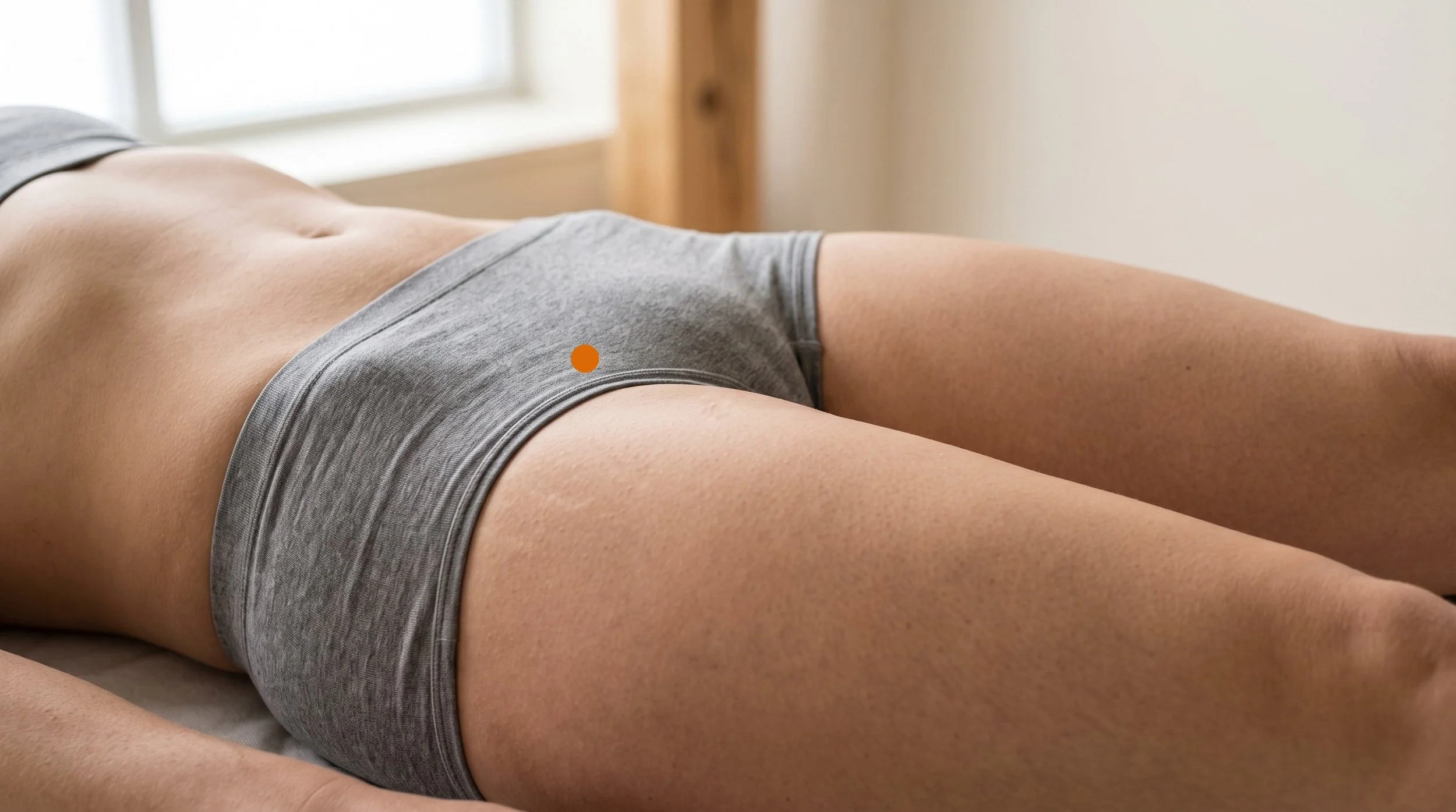
LV12 Acupuncture Point (Jimai)
The Urgent Pulse in the Groin Crease: Anatomy, Mechanism, and Why This Liver Channel Point Is Defined by the Vessels Beside It
LV12 (Jimai, "Urgent Pulse"), also written LR12, is the twelfth point of the Liver channel, and its name is a straightforward anatomical description: it sits in the crease of the groin, right where the femoral pulse can be felt under the fingers.
In plain terms, you find it by locating that pulsation about midway between the pubic bone and the front point of the hip bone, then moving just to the inside of it, roughly 1 cun below and 2.5 cun lateral to CV2 on the groin crease.
Classically, this LV12 acupuncture point was listed for pain of the genitals, hernia-type (shan) complaints, hypogastric pain, and pain along the inner thigh, which places it squarely in the territory of the lower abdomen, pelvic floor, and adductor region. It matters clinically less because it is used often (it is not) and more because it is a lesson in anatomy: LV12 is a point defined by the femoral vein, artery, and nerve lying immediately lateral to it, and it belongs only to practitioners who are confident of that geography.
- Location and layers: LV12 lies on the groin crease, 1 cun inferior and 2.5 cun lateral to CV2, immediately medial to the femoral vein. A needle here passes skin, then subcutaneous fat containing superficial inguinal lymph nodes and small branches of the external pudendal vessels, toward the pectineus and the upper fibers of the adductor longus, tissues loaded by hip flexion, adduction, sprinting, and prolonged sitting.
- Traditional categories, restated: classical and modern Chinese texts attribute to Jimai the functions of dispelling cold from the Liver channel, benefiting the lower jiao, moving qi, and relieving pain. Read neurophysiologically, those descriptions map onto segmental modulation of a small area of the lower abdominal wall and groin that shares spinal levels with the bladder, prostate, uterus, and external genitalia.
- Nerve geography: the skin and superficial tissue here are supplied largely by the ilioinguinal nerve (L1), with the genitofemoral nerve nearby and the anterior branch of the obturator nerve deeper and slightly lateral. Stimulating L1 and L2 territory may influence pelvic and genital symptoms through convergence of somatic and visceral afferents in the same spinal segments, alongside the descending inhibitory and endorphin-mediated pathways described in mechanistic reviews of acupuncture analgesia (Zhao, 2008).
- Research picture: there are no trials of LV12 as a single point. What exists is evidence for multi-point acupuncture protocols in pelvic pain and pelvic floor conditions, including a large sham-controlled trial in chronic prostatitis and chronic pelvic pain syndrome (Sun et al., 2021), a Cochrane review of non-pharmacological interventions for the same condition (Franco et al., 2018), and individual patient data meta-analysis for chronic pain generally (Vickers et al., 2018).
- Clinical practice framing: modern texts disagree about how to treat this point, with some advising careful shallow needling directed medially and others restricting it to moxibustion or massage only because of the femoral vessels. At Morningside we treat LV12 conservatively, often working the safer neighboring points and adductor tissue instead, and we would never needle it in a patient on anticoagulants or with vascular disease in the groin.
- De qi: when the point is needled at all, the expected sensation is a dull, heavy, spreading fullness in the groin that may travel a short distance down the inner thigh. Sharp, electric, or radiating sensation toward the genitals means the needle is near a nerve and should be withdrawn and redirected, and any pulsatile feeling means it is too close to the vessels.
Struggling With Groin, Inner Thigh, or Deep Pelvic Pain That Nobody Can Localize?
Groin pain is one of the harder complaints to sort out because the adductors, hip joint, inguinal region, and pelvic floor all refer into the same small area. At Morningside Acupuncture we start with an orthopedic exam, then combine channel-based points along the Liver and Spleen pathways with precise dry needling of the adductor group and surrounding hip muscles. Points in the LV12 region are used cautiously and only when the anatomy is clearly palpable, with safer neighbors carrying most of the treatment. Schedule a visit and let us map where your groin pain is actually coming from.
Schedule NowAnatomy of LV12: Why the Femoral Pulse in the Groin Crease Is Such an Important Location
LV12 sits in the inguinal crease, the fold that appears when the hip flexes. The most superficial layer is thin skin over subcutaneous fat that houses superficial inguinal lymph nodes and small branches of the external pudendal vessels, along with pubic branches from the inferior epigastric vessels. Deep to that lies the pectineus, with the origin of the adductor longus just medial and the iliopsoas passing under the inguinal ligament laterally.
These are the tissues that get loaded in sprinting, cutting sports, hockey and soccer kicking mechanics, and in the long-held hip flexion of desk work and cycling, which is why patients often describe groin pain that starts with activity and lingers as a deep ache.
The nerve supply of this small area is why the point has the indications it does. The overlying skin is served mainly by the ilioinguinal nerve from L1, with the genitofemoral nerve contributing nearby and the anterior branch of the obturator nerve running deeper and slightly lateral toward the adductors. Those segments are the same ones that carry sympathetic and sensory traffic from the lower urinary tract and reproductive structures, so somatic input from the groin and visceral input from the pelvis converge on shared dorsal horn neurons.
Needling in a well-innervated segment may reduce the excitability of that shared pool while also recruiting descending inhibitory pathways involving endogenous opioids, serotonin, and noradrenaline, mechanisms that have been mapped in some detail in animal and human studies (Zhao, 2008). This segmental logic explains why a point in the groin crease was traditionally listed for genital pain, hernia-type complaints, and hypogastric pain rather than for anything distant.
The deep structure that governs everything about this point is the femoral neurovascular bundle. From medial to lateral the arrangement is vein, artery, nerve, so LV12 sits immediately medial to the femoral vein with the artery and femoral nerve further out. Standard texts describe a slightly oblique insertion directed medially, 0.5 to 0.8 cun, after the femoral pulse has been palpated and the needle path deliberately angled away from it.
Some modern sources go further and restrict the point to moxibustion or manual pressure only, while others reverse that and contraindicate moxa here because of the vessels and the hair-bearing skin, favoring careful needling instead. Both camps agree on the practical point: nobody should be needling here casually, and there is almost always a safer way to reach the same segment.
Related Pain Finder Hip Thigh Knee Related Best Acupuncture Points For Hip PainLV12 (LR12) at a Glance: Classification, Location, and Clinical Use
| Category | Detail |
|---|---|
| Traditional Name | Jimai, "Urgent Pulse" (LIV-12 in Deadman's numbering, also written Liver 12 or LR 12), named for the femoral pulsation felt at the site |
| Channel Classification | Twelfth point of the Liver (Jue Yin) channel of the foot, located on the groin crease of the lower abdomen (LV12, also written LIV12 or LR12) |
| Point Categories | No five-shu, luo-connecting, xi-cleft, front-mu, hui-meeting, or extraordinary vessel designations are assigned to this point in the classical sources reviewed. Its status is unusual in a different way: it first appears in the Essential Questions but was omitted from both the Systematic Classic and the Great Compendium, which describe only thirteen Liver channel points. Traditional actions listed in modern texts include dispelling cold from the Liver channel and benefiting the lower jiao, with some sources adding smoothing the Liver, regulating qi, and alleviating pain. |
| Precise Location | In the crease of the groin, 1 cun inferior and 2.5 cun lateral to CV2 (Qugu), just medial to the femoral vein. Locate the femoral arterial pulse roughly midway between the pubic symphysis and the anterior superior iliac spine, note that the vein lies about a fingerbreadth medial to the artery, and place the point immediately medial to the vein on the crease. |
| Tissue Stimulated | Skin and subcutaneous tissue of the inguinal crease with superficial inguinal lymph nodes and external pudendal vessel branches; deeper, the pectineus and the proximal fibers of the adductor longus and adductor brevis, with the adductor magnus and the lower abdominal wall nearby as related myofascial targets |
| Needle Depth / Direction | Slightly oblique insertion angled medially, 0.5 to 0.8 cun, always after palpating the femoral pulse and keeping the needle medial to the vein. Sources differ, with several modern texts limiting the point to moxibustion or pressure only and others contraindicating moxa here and preferring cautious needling; either way this is a point for experienced hands and clear anatomy. |
| De Qi Sensation | A dull, heavy, spreading fullness at the groin crease that may travel a short way down the inner thigh. Sharp or electric radiation toward the genitals suggests nerve proximity and any pulsing sensation suggests vessel proximity; both call for immediate withdrawal and redirection. |
| Primary Clinical Uses | Traditionally listed for pain of the genitals, shan (hernia-type) disorder, hypogastric and lower abdominal pain, pain of the inner thigh, and uterine prolapse. In modern practice the region is considered for adductor-related groin pain, post-hernia-repair inguinal discomfort, and as part of lower jiao point groupings for pelvic and urogenital complaints. |
| Common Point Combinations |
|
Deadman's A Manual of Acupuncture notes that Jimai LV12 makes its first appearance in the Essential Questions, and this is presented as traditional attribution rather than as a claim about physiology.
What is striking is what happened afterward: two of the most influential later compilations, the Systematic Classic of Acupuncture and Moxibustion and the Great Compendium of Acupuncture and Moxibustion, do not discuss the point at all and instead refer to the Liver channel as having thirteen points. Traditional actions collected in modern texts describe LV12 as dispelling cold from the Liver channel and benefiting the lower jiao, with an indication list that stays close to home: pain of the genitals, swelling of the testicles, uterine prolapse, hypogastric pain, shan disorder, and inner thigh pain.
The pattern is a coherent one, a small regional point for the lower abdomen and groin, and the striking part is that a point named for a major arterial pulse survived in the canon at all while being quietly dropped from the standard channel count for centuries.
Why LV12 Is Used for Hernia-Type Groin and Genital Pain Rather Than for the Hip Joint Right Next Door
Patients are often surprised that a point sitting inches from the hip joint was never really a hip point. The reason is segmental. The tissue at the groin crease is innervated mainly at L1 and L2 through the ilioinguinal and genitofemoral nerves, and those are the same spinal levels that receive sensory and sympathetic traffic from the bladder neck, prostate, uterus, and external genitalia. The hip joint capsule, by contrast, draws more heavily on L2 through L5 by way of the femoral, obturator, and sciatic supply.
Classical indication lists for Jimai (genital pain, shan disorder, hypogastric pain, prolapse) read like a segmental map of L1 and L2 rather than a list of joint problems, which is a recurring pattern once you start comparing point locations against dermatomes and sclerotomes.
The mechanism story has two layers. Locally, needling produces a small controlled tissue stimulus that recruits A-delta and C fibers, triggers axon reflex vasodilation, and alters the sensitivity of dorsal horn neurons that are receiving input from both the groin wall and pelvic viscera. Systemically, sustained needle stimulation engages descending inhibitory control from the periaqueductal gray and rostral ventromedial medulla, with opioid, serotonergic, and noradrenergic mediation, and this system is the best-characterized part of acupuncture analgesia (Zhao, 2008).
Neither layer requires any appeal to energy flow, and both are consistent with why a point can influence sensation across a region wider than the needle itself.
For a patient this means LV12 is best understood as a regional tool for the groin and lower abdominal wall, not as a general treatment for hip arthritis or low back pain. When groin pain turns out to be adductor tendinopathy, the treatment moves toward the muscles themselves; when it turns out to be pelvic floor or urogenital in origin, the treatment moves toward the lower abdominal and sacral points that share those segments. The LV 12 groin location is a landmark that helps organize that thinking, whether or not a needle ever goes into it.
What the Research Shows for LV12 (LR12)
One note on naming before the evidence: in the research literature this point is usually listed as LR12, the WHO standard code, and sometimes as LV12 or LIV12, so it is worth searching all three if you want to read the studies below in full.
There is no research on LV12 as an isolated point, and it would be misleading to suggest otherwise. The evidence that bears on this region comes from trials and reviews of multi-point protocols for pelvic pain and pelvic floor conditions, where lower abdominal, inguinal, and sacral points are used together, plus broader work on acupuncture for chronic musculoskeletal pain. Those studies tell us something about the plausibility of treating this segment, not about the contribution of any single needle.
Results are also mixed by condition, sham-controlled comparisons often narrow the effect, and the following table should be read as context rather than as proof that Jimai does anything on its own.
| Study | Type | Focus | Key Finding |
|---|---|---|---|
| Vickers et al., 2018 | Individual patient data meta-analysis | Acupuncture for chronic musculoskeletal, headache, and osteoarthritis pain across nearly 21,000 patients | Acupuncture was associated with modest but persistent benefits over both sham and no-acupuncture controls, supporting its use as a reasonable option for chronic pain without attributing effects to any single point. |
| Sun et al., 2021 | Multicenter sham-controlled randomized trial | Twenty sessions of acupuncture over eight weeks for moderate to severe chronic prostatitis and chronic pelvic pain syndrome, with 24-week follow-up | Acupuncture produced greater symptom improvement than sham at both eight and 32 weeks, suggesting benefits in this region may persist after treatment ends, though the protocol used several points rather than one. |
| Franco et al., 2018 | Cochrane systematic review | Non-pharmacological interventions, including acupuncture, for chronic prostatitis and chronic pelvic pain syndrome | The review found signals of benefit for acupuncture on symptom scores but rated confidence in the evidence as limited, so conclusions remain provisional. |
| Liu et al., 2017 | Multicenter randomized clinical trial | Electroacupuncture involving lumbosacral points versus sham for women with stress urinary incontinence | Electroacupuncture reduced measured urine leakage more than sham over six weeks, which supports the plausibility of segmental effects on pelvic floor function without addressing groin points specifically. |
| Lee & Lee, 2009 | Three-arm randomized trial | Electroacupuncture compared with sham and advice alone for pain in men with chronic prostatitis and chronic pelvic pain syndrome | Electroacupuncture was associated with greater pain reduction than the comparison arms in a small sample, an early signal that needs replication in larger studies. |
| Zhao, 2008 | Narrative review of mechanism research | Neural pathways underlying acupuncture analgesia, including segmental spinal effects and descending inhibitory control | Analgesic effects are attributed to identifiable neural and neurochemical pathways, which gives a physiological framework for regional points such as LV12. |
Pelvic Floor Tension, Urinary Urgency, or Post-Hernia Groin Discomfort?
Lower abdominal and groin symptoms often involve both muscle guarding and heightened nerve sensitivity in the L1 and L2 segments. Our licensed acupuncturists use lower abdominal and sacral points, adductor and abdominal wall needling, and breathing and mobility work to lower that protective tone over a course of treatment. Jimai acupuncture is part of the classical map for this region, but we apply it with strict attention to the femoral vessels. Book an appointment to build a plan that fits your history.
Schedule NowLV12 in the Context of Trigger Point Work
The LV12 region overlaps with a busy myofascial neighborhood. The proximal adductor longus and brevis, the pectineus, and the distal iliopsoas all sit within a few centimeters of the groin crease, and trigger points in these muscles refer pain into the groin, deep into the front of the hip, and down the inner thigh in patterns that patients frequently describe as a pulled groin that never fully resolved (Simons et al., 1999). Because those referral zones cover the same territory as the classical indications for Jimai, an accurate exam matters more than point selection.
At Morningside we test resisted adduction, hip flexion, and passive stretch, and we palpate each muscle individually before deciding whether the problem is muscular, joint-related, inguinal, or referred from the lumbar spine.
In practice, dry needling of the adductor longus and brevis, adductor magnus, and pectineus is done from a safe medial approach with the hip in a supported open position, well away from the femoral vessels, rather than at the LV12 site itself. Acupuncture, defined as the use of an acupuncture needle, covers both this musculoskeletal approach and the channel-based one, and the two are usually combined: distal Liver and Spleen channel points, lower abdominal points, and targeted needling of the adductor group in the same session, followed by loading exercises such as the Copenhagen adduction progression.
LV12 functions mostly as an anatomical reference in that plan, reminding the clinician where the vessels are and how far medial the safe working zone begins.
LV12 Groin and Pelvic Pain Treatment at NYC's Highest-Rated Acupuncture Clinic
Morningside Acupuncture is the highest-rated acupuncture and dry needling clinic in New York City with over 500 five-star Google reviews, and our practitioners are trained in both classical channel theory and modern musculoskeletal needling. That combination matters most for a region like the groin, where anatomy is dense and precision is not optional. We will explain exactly what we are treating, why, and what to expect between sessions. Schedule your appointment today.
Schedule NowFrequently Asked Questions
Is LV12 the same point as LR12 or LIV12?
Yes. LV12, LR12, and LIV12 are all codes for the same point, Jimai, point 12 of the Liver channel. LR is the WHO standard abbreviation and the one you will see in most research papers. LV is the form used by many American schools and clinics, and LIV appears in several widely used textbooks. You will also come across it written as Liver 12 or LIV-12. Whichever code is used, the location and the uses are the same.
What does LV12 feel like when needled?
When it is treated at all, LV12 should produce a dull, heavy, slightly spreading fullness right at the groin crease, sometimes traveling a short distance toward the inner thigh. It is a shallow, gentle technique, and the sensation is usually milder than at points in thicker muscle. Anything sharp, electric, or radiating toward the genitals means the needle is close to the ilioinguinal or genitofemoral nerve, and any pulsating feeling means it is near the femoral vessels; in both cases the needle should be withdrawn right away. Tell your practitioner immediately if you feel either.
Why treat the groin crease itself instead of a distal point on the leg?
Both approaches have a rationale, and they answer different questions. Distal Liver channel points such as LV3 and LV8 are chosen for channel-wide effects and are far easier and safer to needle, which is why they carry most of the clinical load. A local point like LV12 targets the L1 and L2 segment directly, where somatic input from the groin wall converges with visceral input from the bladder, prostate, uterus, and genitals in the spinal cord, and that segmental convergence is one of the better-supported explanations for local point effects (Zhao, 2008). In modern practice, though, most clinicians reach that segment through safer neighboring points rather than through LV12 itself.
Can I press LV12 myself between sessions?
Yes, with a light touch and a clear understanding of what you are avoiding. Lie on your back with the knee bent and supported, find the femoral pulse in the groin crease about midway between the pubic bone and the bony point at the front of your hip, then move your fingers roughly one to two fingerbreadths medially, toward the midline, so you are away from the pulse. Apply steady, moderate pressure that feels like a firm ache and never a sharp or tingling sensation, hold for 30 to 60 seconds, release, and repeat two or three times per side, once or twice a day. Never press directly on a pulse, never dig deeply, stop at once if you feel numbness or shooting pain into the genitals or thigh, and skip this entirely if you are pregnant, take blood thinners, have known vascular disease or an aneurysm, or have a hernia, swollen lymph nodes, or an unexplained lump in the groin. Massaging the adductor muscles a few inches down the inner thigh is a gentler and often more useful option between sessions.
Is LV12 safe to needle?
It can be, in trained hands, but it is one of the higher-caution points on the body and is not used routinely. The femoral vein lies immediately lateral to the point, with the artery and femoral nerve just beyond it, so the standard approach is to palpate the pulse first, insert only 0.5 to 0.8 cun at a slight medial angle, and stay clearly medial to the vein. Texts disagree about technique, with some restricting the point to moxibustion or manual pressure and others contraindicating moxa here and favoring cautious needling, which tells you how much respect the location deserves. It should be avoided in patients on anticoagulants, with clotting disorders, vascular disease or aneurysm in the groin, active infection, swollen inguinal lymph nodes, or an unrepaired hernia, and in most cases a safer neighboring point will accomplish the same segmental goal.
Where exactly is LV12 located?
LV12 is found on the crease of the groin, 1 cun inferior and 2.5 cun lateral to CV2 (Qugu) at the upper border of the pubic bone. The practical method is anatomical rather than measured: palpate the femoral arterial pulse in the groin crease, roughly midway between the pubic symphysis and the anterior superior iliac spine, remember that the femoral vein runs along the medial side of that artery and is about a fingerbreadth wide, and place the point just medial to the vein on the crease itself. Some texts describe it as lateral and inferior to the pubic tubercle, below and lateral to ST30, which lands in the same small area. The vessels, not the cun measurement, define the point.
References
- Deadman, P., Al-Khafaji, M., & Baker, K. (2009). A manual of acupuncture. Journal of Chinese Medicine Publications.
- Cheng, X. (Ed.). (1999). Chinese acupuncture and moxibustion (Rev. ed.). Foreign Languages Press.
- O'Connor, J., & Bensky, D. (Eds. & Trans.). (1981). Acupuncture: A comprehensive text. Shanghai College of Traditional Medicine. Eastland Press.
- Cunningham, P. M. (2000). Acupuncture points: A practical guide to classical and modern usage. Odyssey Press.
- Kim, H. (2008). Handbook of Oriental medicine (3rd ed.). Harmony & Balance Press.
- Simons, D. G., Travell, J. G., & Simons, L. S. (1999). Travell & Simons' myofascial pain and dysfunction: The trigger point manual, Vol. 1: Upper half of body (2nd ed.). Williams & Wilkins.
- Zhao, Z. Q. (2008). Neural mechanism underlying acupuncture analgesia. Progress in Neurobiology, 85(4), 355-375. https://doi.org/10.1016/j.pneurobio.2008.05.004
- Vickers, A. J., Vertosick, E. A., Lewith, G., MacPherson, H., Foster, N. E., Sherman, K. J., Irnich, D., Witt, C. M., & Linde, K. (2018). Acupuncture for chronic pain: Update of an individual patient data meta-analysis. Journal of Pain, 19(5), 455-474. https://doi.org/10.1016/j.jpain.2017.11.005
- Sun, Y., Liu, Y., Liu, B., Zhou, K., Yue, Z., Zhang, W., Fu, W., Yang, J., Li, N., He, L., Zang, Z., Su, T., Fang, J., Ding, Y., Qin, Z., Song, H., Hu, H., Zhao, H., Mo, Q., ... Liu, Z. (2021). Efficacy of acupuncture for chronic prostatitis/chronic pelvic pain syndrome: A randomized trial. Annals of Internal Medicine, 174(10), 1357-1366. https://doi.org/10.7326/M21-1814
- Franco, J. V. A., Turk, T., Jung, J. H., Xiao, Y. T., Iakhno, S., Garrote, V., & Vietto, V. (2018). Non-pharmacological interventions for treating chronic prostatitis/chronic pelvic pain syndrome. Cochrane Database of Systematic Reviews, 2018(5), CD012551. https://doi.org/10.1002/14651858.CD012551.pub3
- Liu, Z., Liu, Y., Xu, H., He, L., Chen, Y., Fu, L., Li, N., Lu, Y., Su, T., Sun, J., Wang, J., Yue, Z., Zhang, W., Zhao, J., Zhou, Z., Wu, J., Zhou, K., Ai, Y., Zhou, J., Pang, R., Wang, Y., Qin, Z., Yan, S., Li, H., Luo, L., & Liu, B. (2017). Effect of electroacupuncture on urinary leakage among women with stress urinary incontinence: A randomized clinical trial. JAMA, 317(24), 2493-2501. https://doi.org/10.1001/jama.2017.7220
- Lee, S. H., & Lee, B. C. (2009). Electroacupuncture relieves pain in men with chronic prostatitis/chronic pelvic pain syndrome: Three-arm randomized trial. Urology, 73(5), 1036-1041. https://doi.org/10.1016/j.urology.2008.10.047
Disclaimer: This web site is intended for educational and informational purposes only. Reading this website does not constitute providing medical advice or any professional services. This information should not be used for diagnosing or treating any health issue or disease. Those seeking medical advice should consult with a licensed physician. Seek the advice of a medical doctor or other qualified health professional for any medical condition. If you think you have a medical emergency, call 911 or go to the emergency room. No acupuncturist-patient relationship is created by reading this website or using the information. Morningside Acupuncture PLLC and its employees and contributors do not make any express or implied representations with respect to the information on this site or its use. For any legal interpretation of scope of practice in your state, consult a licensed attorney or regulatory authority.
Read more from our blog



