CV3 Acupuncture Point (Zhongji)
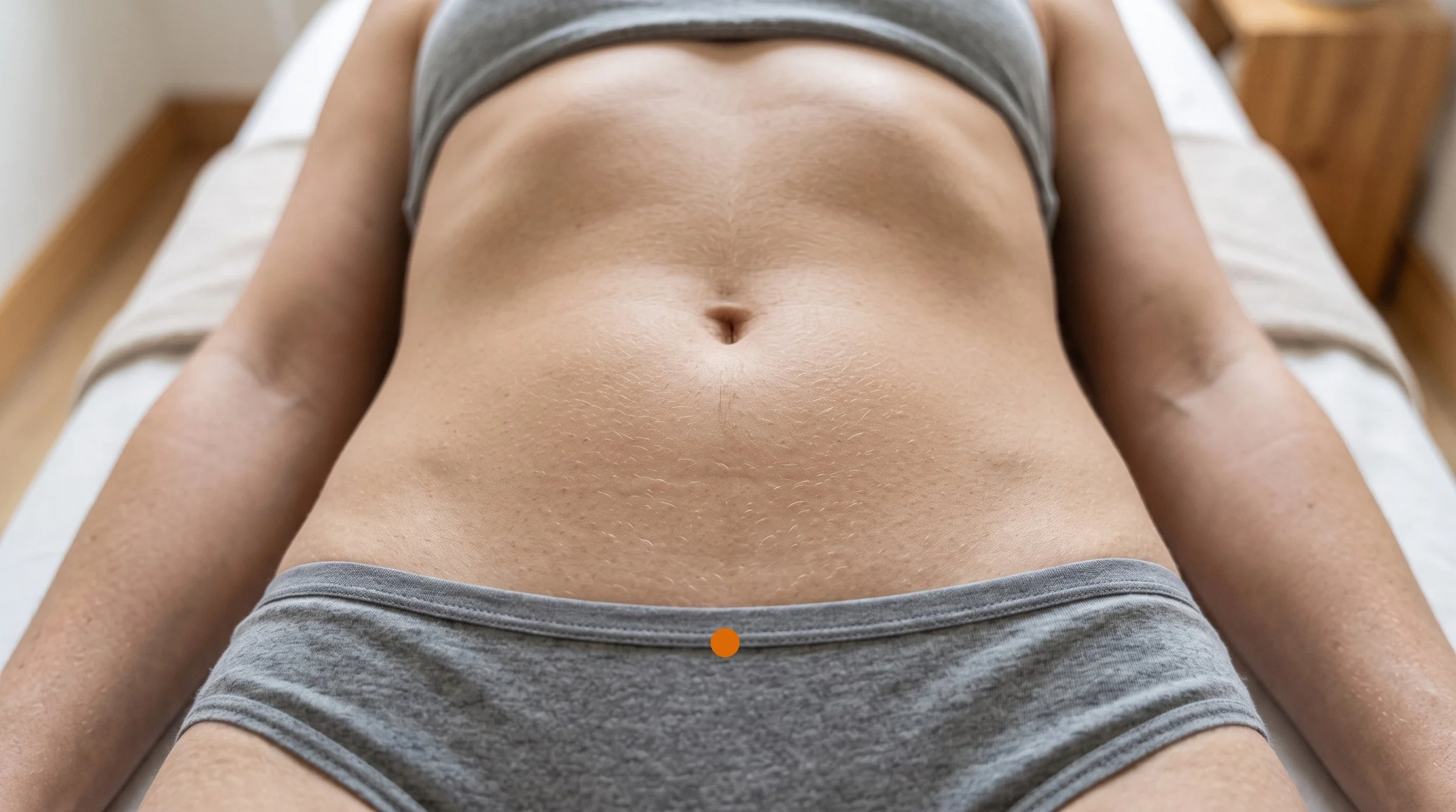
CV3 Acupuncture Point (Zhongji)
The Middle Pole Above the Pubic Bone: Anatomy, Segmental Mechanism, and Why This Lower Abdominal Point Anchors Bladder and Pelvic Treatment
CV3 (Zhongji, often translated as Middle Pole) is the third point of the Conception Vessel, sitting on the midline of the lower abdomen four cun below the navel and one cun above the top edge of the pubic bone. In classical texts it carries two heavy designations: it is the front-mu (gathering) point of the Bladder and a meeting point of the Conception vessel with the Spleen, Liver and Kidney channels (Deadman et al., 2007).
Strip away the traditional vocabulary and what remains is still striking: this is the most direct somatic window onto bladder territory on the front of the body, a patch of midline tissue innervated from roughly T12 to L1, the same segments that carry sympathetic traffic to and from the bladder. That anatomical overlap is why the cv3 acupuncture point shows up in protocols for urinary frequency and urgency, pelvic pain, and period pain, and why it is almost always needled with an empty bladder.
- Location and layers: CV3 sits on the linea alba, the dense midline seam where the abdominal wall aponeuroses interlace, four cun inferior to the umbilicus and one cun superior to the pubic symphysis, with the bladder lying immediately deep when it is full (Deadman et al., 2007).
- Traditional categories, translated: the front-mu designation and the crossing of the three leg yin channels are classical ways of saying that this small piece of lower abdominal wall shares neural real estate with the bladder, uterus and pelvic viscera, which is exactly what modern segmental anatomy describes.
- Mechanism: needling here recruits anterior branches of the lower thoracoabdominal and iliohypogastric nerves (about T12 to L1), segments that converge in the dorsal horn with visceral afferents from the bladder, and acupuncture stimulation is thought to work through segmental modulation plus descending inhibitory pathways involving opioid, serotonergic and noradrenergic systems (Zhao, 2008).
- Research picture: a Cochrane review of acupuncture for overactive bladder found the trial base too small and too uneven to support firm conclusions (Hargreaves et al., 2022), while a Cochrane review of acupuncture for dysmenorrhoea reported very low quality evidence and called for better trials (Smith et al., 2016). Larger sham-controlled trials in stress urinary incontinence and chronic pelvic pain have been more encouraging (Liu et al., 2017; Sun et al., 2021).
- Point-specific physiology: in a crossover urodynamic study of people with neurogenic detrusor overactivity after spinal cord injury, electroacupuncture at CV3 and CV4 was associated with larger bladder volumes at first detrusor contraction, greater cystometric capacity and lower maximum detrusor pressure, with the abdominal points changing measures more than SP6 (Lu et al., 2024).
- De qi and practice framing: expect a heavy, dull, spreading fullness low in the abdomen rather than anything sharp, needled perpendicular 0.5 to 1 cun after the patient has voided, and approached with extra caution in pregnancy (Deadman et al., 2007).
Struggling With Urinary Urgency, Frequency, or Pelvic Pain?
Lower urinary and pelvic complaints rarely live in one tissue, so we treat them the same way we treat any regional pain problem: locally, segmentally, and distally. At Morningside Acupuncture we use CV3 alongside sacral points, SP6, and careful dry needling of the abdominal wall and pelvic floor musculature when the exam points there. Every session starts with an assessment so the point selection matches your presentation rather than a generic template. Schedule a visit and let's map out what is actually driving your symptoms.
Schedule NowAnatomy of CV3: Why the Midline Just Above the Pubic Symphysis Is Such an Important Location
From the surface down, CV3 passes through skin, a subcutaneous fat layer that is often generous in this region, and then the linea alba, the tough fibrous seam created where the aponeuroses of the external oblique, internal oblique and transversus abdominis interlace across the midline. The rectus abdominis bellies sit just to either side, with the small pyramidalis muscles tucked in near the pubic crest.
This tissue gets loaded by trunk flexion, coughing, straining, prolonged bracing, and by scarring from cesarean section or hernia repair, all of which can leave the lower abdominal wall sensitive, guarded, or restricted long after the original event.
The nerve geography is what makes this location clinically interesting. The skin and wall at CV3 are supplied by anterior branches of the lower thoracoabdominal and iliohypogastric nerves, roughly the T12 to L1 segments, and those same segments carry sympathetic afferent and efferent traffic to and from the bladder and lower pelvis. When somatic and visceral inputs converge on shared dorsal horn neurons, stimulating the somatic side can change how the visceral side is processed, which is the plain-language version of what segmental convergence means.
Acupuncture stimulation is also understood to engage descending inhibitory control involving opioid, serotonergic and noradrenergic pathways, so effects are not purely local (Zhao, 2008). Patient-level pooled data across chronic pain conditions suggest modest but persistent benefits over sham and no-acupuncture controls, which is a reasonable way to frame expectations here as well (Vickers et al., 2018). Point-specific urodynamic work adds a further layer, with electroacupuncture at CV3 associated with measurable changes in bladder filling parameters in a small crossover study (Lu et al., 2024).
Deep to the abdominal wall at this level lies the bladder itself, which rises above the pubic symphysis as it fills, along with the peritoneum and, in many patients, the uterus. That is why the standing convention is perpendicular insertion of 0.5 to 1 cun with the bladder emptied before treatment, since deep needling into a full bladder is the specific risk this point carries (Deadman et al., 2007). The inferior epigastric vessels run lateral to the midline rather than through it, so a true midline insertion keeps clear of them, but depth still needs to be scaled to body habitus.
Lower abdominal points are classically approached with caution in pregnancy, and we treat that as a hard practice boundary rather than a soft suggestion.
Related Conception Vessel Related SP6 Acupuncture PointCV3 at a Glance: Classification, Location, and Clinical Use
| Category | Detail |
|---|---|
| Traditional Name | Zhongji (Middle Pole), Ren 3, also written Conception Vessel 3 or CV 3 |
| Channel Classification | Conception Vessel (Ren mai), third point of the channel |
| Point Categories | Front-mu (gathering) point of the Bladder; meeting point of the Conception vessel with the Spleen, Liver and Kidney channels |
| Precise Location | On the midline of the lower abdomen, 4 cun inferior to the umbilicus and 1 cun superior to the upper border of the pubic symphysis (the umbilicus to symphysis distance is measured as 5 cun) |
| Tissue Stimulated | Skin, subcutaneous fat, and the linea alba where the abdominal aponeuroses decussate, adjacent to the lower rectus abdominis and pyramidalis; clinically related myofascial territory includes the abdominal obliques and the pelvic floor |
| Needle Depth / Direction | Perpendicular insertion 0.5 to 1 cun, with the bladder emptied beforehand; some styles angle slightly inferiorly toward the pubic bone, and lower abdominal points are avoided in pregnancy |
| De Qi Sensation | A heavy, dull, spreading fullness low in the abdomen, sometimes with a mild pulling toward the pubic bone or a warm, pressing quality; sharp or electric sensations mean the needle should be adjusted |
| Primary Clinical Uses | Urinary frequency, urgency and difficulty voiding; pelvic pain; menstrual pain and cycle irregularity; genital-region complaints in classical listings; classically also used for lumbar pain via front-to-back point selection |
| Common Point Combinations |
|
In the classical literature summarized by Deadman and colleagues, the character mu carries the sense of gathering or collecting, and the front-mu points are described as places where the qi of an organ concentrates on the front of the body, which is why Zhongji is treated as having a direct relationship with the Bladder. Traditional actions attributed to the point include benefiting the Bladder and its qi transformation, draining damp-heat, regulating the uterus and menstruation, moving stagnation in the lower jiao, and supporting the Kidneys.
The recorded indications cluster into four traditional groups: urinary complaints of frequency, retention, pain and the five types of painful urinary dysfunction; genital-region symptoms including itching, swelling, discharge and seminal emission; gynecological patterns such as irregular or absent periods, infertility, abdominal masses and retained placenta or lochia, with the Great Compendium of Acupuncture and Moxibustion singling the point out for pain and swelling of the cervix; and lower abdominal accumulations described as cold or heat, twisting pain, shan disorders, and the upward-surging sensation called running piglet qi.
Deadman's commentary adds a practical distinction worth keeping: Zhongji is favored for excess presentations while Guanyuan (CV4) is favored for deficiency, and CV3 is also listed for lumbar pain on the principle of selecting front points to treat the back.
What is striking is how tightly that classical spread matches one segmental territory, as if generations of clinicians had mapped the T12 to L1 viscerosomatic field without the vocabulary to name it.
Why CV3 Is Used for Urinary Urgency and Low Back Pain That Local Treatment Never Reaches
Patients often expect a bladder complaint to be treated at the bladder, and are surprised that a needle in the lower abdominal wall could change anything visceral. The reason sits in how the nervous system is wired. The wall at CV3 is supplied by nerves emerging around T12 to L1, and afferent traffic from the bladder travels back through the hypogastric route into that same lower thoracic and upper lumbar region. Somatic and visceral inputs from a shared segment converge on the same second-order neurons in the spinal cord, so the brain receives a blended signal.
This is why bladder irritation can feel like suprapubic aching, why lower abdominal wall sensitivity can mimic urinary urgency, and why stimulating the somatic side can shift the visceral side (Zhao, 2008).
That same convergence explains the classical habit of using a front-of-body point for low back symptoms. The lumbar region and the lower abdominal wall are not as neurologically distant as they look from the outside, and the traditional listing of Zhongji for lumbar pain reflects a pattern clinicians kept noticing.
Beyond segmental effects, acupuncture stimulation engages descending inhibitory systems that raise the threshold for pain signaling more broadly, which is the mechanism most often invoked to explain effects that persist after the needles come out (Zhao, 2008). Pooled patient-level data across chronic pain conditions support modest, durable benefit rather than dramatic change, which is the honest expectation to set (Vickers et al., 2018).
There is also a small but relevant physiological signal specific to this point. In a crossover urodynamic study of people with neurogenic bladder after spinal cord injury, electroacupuncture at CV3 and CV4 was associated with increased bladder volume at the first detrusor contraction, greater maximum cystometric capacity, and lower maximum detrusor pressure, with the abdominal points shifting these measures more than SP6 (Lu et al., 2024). That population is not the same as an office patient with urgency and frequency, and the sample was small, so this is best read as a plausibility argument rather than proof. Still, it is one of the few places where a measurable organ-level change has been recorded during needling of this specific location.
What the Research Shows for CV3
Almost no trial isolates a single point, and CV3 is no exception: it appears inside multi-point protocols for urinary, menstrual and pelvic conditions, usually alongside SP6, CV4 and sacral points, and often with electroacupuncture. That means the research below tells us about the treatment packages CV3 belongs to, not about the point in isolation. Two Cochrane reviews in this space are notably cautious, several large sham-controlled trials are more positive, and one small mechanistic study looks directly at what changes during needling here.
Reading them together, the fair conclusion is that acupuncture may help some urinary and pelvic presentations, that trial quality has been the limiting factor, and that any individual response still has to be judged over a course of care.
| Study | Type | Focus | Key Finding |
|---|---|---|---|
| Hargreaves et al., 2022 | Cochrane systematic review | Acupuncture for overactive bladder in adults (15 studies, 1,395 participants) | The included trials were mostly small with design concerns, so the review concluded that firm conclusions about effectiveness could not be drawn and larger trials are needed. |
| Smith et al., 2016 | Cochrane systematic review | Acupuncture and acupressure for primary dysmenorrhoea | Evidence quality was rated very low overall, so any suggested benefit for period pain should be treated as uncertain rather than established. |
| Liu et al., 2017 | Multicenter randomized clinical trial (JAMA) | Electroacupuncture versus sham in 504 women with stress urinary incontinence | Electroacupuncture was associated with less urine leakage at six weeks than sham, though the authors noted that long-term efficacy and mechanism remain to be clarified. |
| Sun et al., 2021 | Multicenter sham-controlled randomized trial (Annals of Internal Medicine) | Twenty sessions of acupuncture over 8 weeks in 440 men with chronic prostatitis and chronic pelvic pain syndrome | Acupuncture produced greater symptom improvement than sham, with benefits that appeared to persist through 24 weeks of follow-up. |
| Lu et al., 2024 | Randomized crossover urodynamic study | Electroacupuncture at CV3, CV4 and SP6 in neurogenic bladder after spinal cord injury | Needling at CV3 and CV4 was associated with increased bladder capacity and reduced maximum detrusor pressure during filling, with larger changes than SP6 in this small sample. |
| Vickers et al., 2018 | Individual patient data meta-analysis | Acupuncture across chronic pain conditions (roughly 20,000 patients) | Acupuncture was better than both sham and no-acupuncture controls, with effects that decreased only modestly over about a year. |
| Zhao, 2008 | Narrative mechanism review | Neural mechanisms of acupuncture analgesia | Analgesic effects are attributed to segmental spinal modulation together with descending inhibitory pathways using opioid, serotonergic and noradrenergic signaling. |
Period Pain That Reliably Derails Your Month?
Menstrual cramping that lands low and central is one of the oldest recorded uses of Zhongji, and it remains one of the most common reasons patients ask us about this area. We often combine CV3 with SP6 and sacral points across several cycles, since research in dysmenorrhoea suggests treatment timing and repeated sessions may matter. Our acupuncturists will also review what else is loading the abdominal wall and pelvis between cycles. Book an appointment to start before your next period rather than during the worst of it.
Schedule NowCV3 in the Context of Trigger Point Work
The abdominal wall is one of the more overlooked sources of pelvic and urinary-feeling symptoms. Trigger points in the lower rectus abdominis and the oblique musculature can refer into the suprapubic region and lower back, and abdominal wall referral has long been described as capable of producing visceral-seeming complaints, including urinary urgency and cramping sensations (Simons et al., 1999). CV3 sits in the middle of that referral territory, which is one reason the point earns its place in both traditional and modern protocols.
When a patient's suprapubic ache reproduces on palpation of the abdominal wall rather than tracking with bladder filling, the myofascial contribution is worth treating directly.
At Morningside Acupuncture, that usually means combining CV3 with dry needling of the lower rectus abdominis and abdominal obliques where the exam points there, and, when appropriate and consented, addressing pelvic floor musculature and gluteal or thoracolumbar contributors. Because acupuncture is defined by the use of an acupuncture needle across hundreds of styles, dry needling of a taut band and needling of a classical point like Zhongji are the same tool applied with different reasoning.
The clinical decision is which reasoning fits the case: segmental modulation for bladder-territory symptoms, myofascial release for a guarded abdominal wall, or both in the same visit.
CV3 Pelvic and Urinary Treatment at NYC's Highest-Rated Acupuncture Clinic
Morningside Acupuncture is the highest-rated acupuncture and dry needling clinic in New York City with over 500 five-star Google reviews, and our Midtown practice blends classical point selection with orthopedic and neurophysiological reasoning. For lower abdominal and pelvic presentations, that means using CV3 as one anchor within a fuller plan that can include sacral needling, electroacupuncture, and manual work. You will always know why each point was chosen and what we expect it to change. Schedule your visit and we will build the plan around your goals.
Schedule NowFrequently Asked Questions
What does CV3 feel like when needled?
Most patients describe a heavy, dull, spreading fullness low in the abdomen, sometimes with a mild pulling sensation toward the pubic bone or a warm, pressing quality. Some people feel a faint awareness in the bladder region itself, which is expected given the shared segmental supply. It should not feel sharp, burning, or electric. Needling is shallow to moderate (0.5 to 1 cun perpendicular), and the sensation usually settles into a dull ache within a few seconds of insertion.
Why needle the lower abdomen for bladder symptoms instead of the low back?
Often we do both. The classical approach pairs the front-mu point with the corresponding back point, and modern pelvic protocols frequently pair CV3 with BL32 over the sacrum for exactly that reason. The abdominal wall at CV3 is supplied by nerves around T12 to L1, which overlaps with sympathetic pathways serving the bladder, while sacral points reach the S2 to S4 parasympathetic region. Approaching a bladder complaint from front and back covers more of the relevant neural territory than either side alone (Zhao, 2008).
Can I press CV3 myself between sessions?
Yes, acupressure here is straightforward and safe for most people. Find the midline about one finger width above the top of the pubic bone, lie down with knees bent so the abdominal wall relaxes, and press with the pads of two fingers using slow, moderate pressure until you feel a dull fullness rather than sharpness. Hold for 30 to 60 seconds, release, and repeat two or three times, or use small circular motions for one to two minutes. Once or twice a day is plenty. Skip it if you are pregnant, if you have a full bladder, if there is unexplained abdominal pain, fever, or recent abdominal surgery, and see a clinician instead of self-treating if urinary symptoms are new, worsening, or accompanied by blood or fever.
Is CV3 safe to needle?
In trained hands, yes, with two specific cautions. The bladder sits immediately deep to this point when it is full, so patients are asked to void before treatment and depth is kept within the standard 0.5 to 1 cun range (Deadman et al., 2007). Lower abdominal points are classically approached with caution during pregnancy, and we avoid them in that setting. Beyond that, the usual expectations apply: minor local tenderness or a small bruise is possible, and depth is always adjusted to body size and tissue thickness rather than applied by formula.
Where exactly is CV3 located?
On the midline of the lower abdomen, four cun below the center of the umbilicus and one cun above the upper border of the pubic symphysis. The practical way to find it is to treat the distance from navel to pubic bone as five units, then measure four of those units down from the navel, which lands you roughly one finger width above the pubic bone on the midline. It sits one cun below CV4 (Guanyuan) and one cun above CV2 (Qugu), so the three are easy to distinguish by their relationship to the pubic bone.
References
- Deadman, P., Al-Khafaji, M., & Baker, K. (2009). A manual of acupuncture. Journal of Chinese Medicine Publications.
- Maciocia, G. (2005). The foundations of Chinese medicine: A comprehensive text for acupuncturists and herbalists (2nd ed.). Elsevier Churchill Livingstone.
- Cunningham, P. M. (2000). Acupuncture points: A practical guide to classical and modern usage. Odyssey Press.
- Simons, D. G., Travell, J. G., & Simons, L. S. (1999). Travell & Simons' myofascial pain and dysfunction: The trigger point manual, Vol. 1: Upper half of body (2nd ed.). Williams & Wilkins.
- Hargreaves, E., Baker, K., Barry, G., Harding, C., Zhang, Y., Kandala, N.-B., Zhang, X., Kernohan, A., & Clarkson, C. E. (2022). Acupuncture for treating overactive bladder in adults. Cochrane Database of Systematic Reviews, 2022(9), CD013519. https://doi.org/10.1002/14651858.CD013519.pub2
- Smith, C. A., Armour, M., Zhu, X., Li, X., Lu, Z. Y., & Song, J. (2016). Acupuncture for dysmenorrhoea. Cochrane Database of Systematic Reviews, 2016(4), CD007854. https://doi.org/10.1002/14651858.CD007854.pub3 [VERIFY BEFORE PUBLISHING]
- Liu, Z., Liu, Y., Xu, H., He, L., Chen, Y., Fu, L., Li, N., Lu, Y., Su, T., Sun, J., Wang, J., Yue, Z., Zhang, W., Zhao, J., Zhou, Z., Wu, J., Zhou, K., Ai, Y., Zhou, J., ... Liu, B. (2017). Effect of electroacupuncture on urinary leakage among women with stress urinary incontinence: A randomized clinical trial. JAMA, 317(24), 2493-2501. https://doi.org/10.1001/jama.2017.7220
- Sun, Y., Liu, Y., Liu, B., Zhou, K., Yue, Z., Zhang, W., Fu, W., Yang, J., Li, N., He, L., Zang, Z., Su, T., Fang, J., Ding, Y., Qin, Z., Song, H., Hu, H., Zhao, H., Mo, Q., ... Liu, Z. (2021). Efficacy of acupuncture for chronic prostatitis/chronic pelvic pain syndrome: A randomized trial. Annals of Internal Medicine, 174(10), 1357-1366. https://doi.org/10.7326/M21-1814
- Lu, J., Cheng, B., & Lin, L. (2024). Urodynamic analysis of the effect of electroacupuncture at different acupoints on the bladder after spinal cord injury. Neurourology and Urodynamics, 43(8), 2065-2075. https://doi.org/10.1002/nau.25534
- Zhao, Z. Q. (2008). Neural mechanism underlying acupuncture analgesia. Progress in Neurobiology, 85(4), 355-375. https://doi.org/10.1016/j.pneurobio.2008.05.004
- Vickers, A. J., Vertosick, E. A., Lewith, G., MacPherson, H., Foster, N. E., Sherman, K. J., Irnich, D., Witt, C. M., & Linde, K. (2018). Acupuncture for chronic pain: Update of an individual patient data meta-analysis. Journal of Pain, 19(5), 455-474. https://doi.org/10.1016/j.jpain.2017.11.005
Disclaimer: This web site is intended for educational and informational purposes only. Reading this website does not constitute providing medical advice or any professional services. This information should not be used for diagnosing or treating any health issue or disease. Those seeking medical advice should consult with a licensed physician. Seek the advice of a medical doctor or other qualified health professional for any medical condition. If you think you have a medical emergency, call 911 or go to the emergency room. No acupuncturist-patient relationship is created by reading this website or using the information. Morningside Acupuncture PLLC and its employees and contributors do not make any express or implied representations with respect to the information on this site or its use. For any legal interpretation of scope of practice in your state, consult a licensed attorney or regulatory authority.
Read more from our blog