GB41 Acupuncture Point (Zulinqi)
GB41 Acupuncture Point (Zulinqi)
The Foot Governor of Tears: Anatomy, Mechanism, and Why This Small Depression Between the Fourth and Fifth Metatarsals Anchors Temporal Headache and Lateral Line Treatment
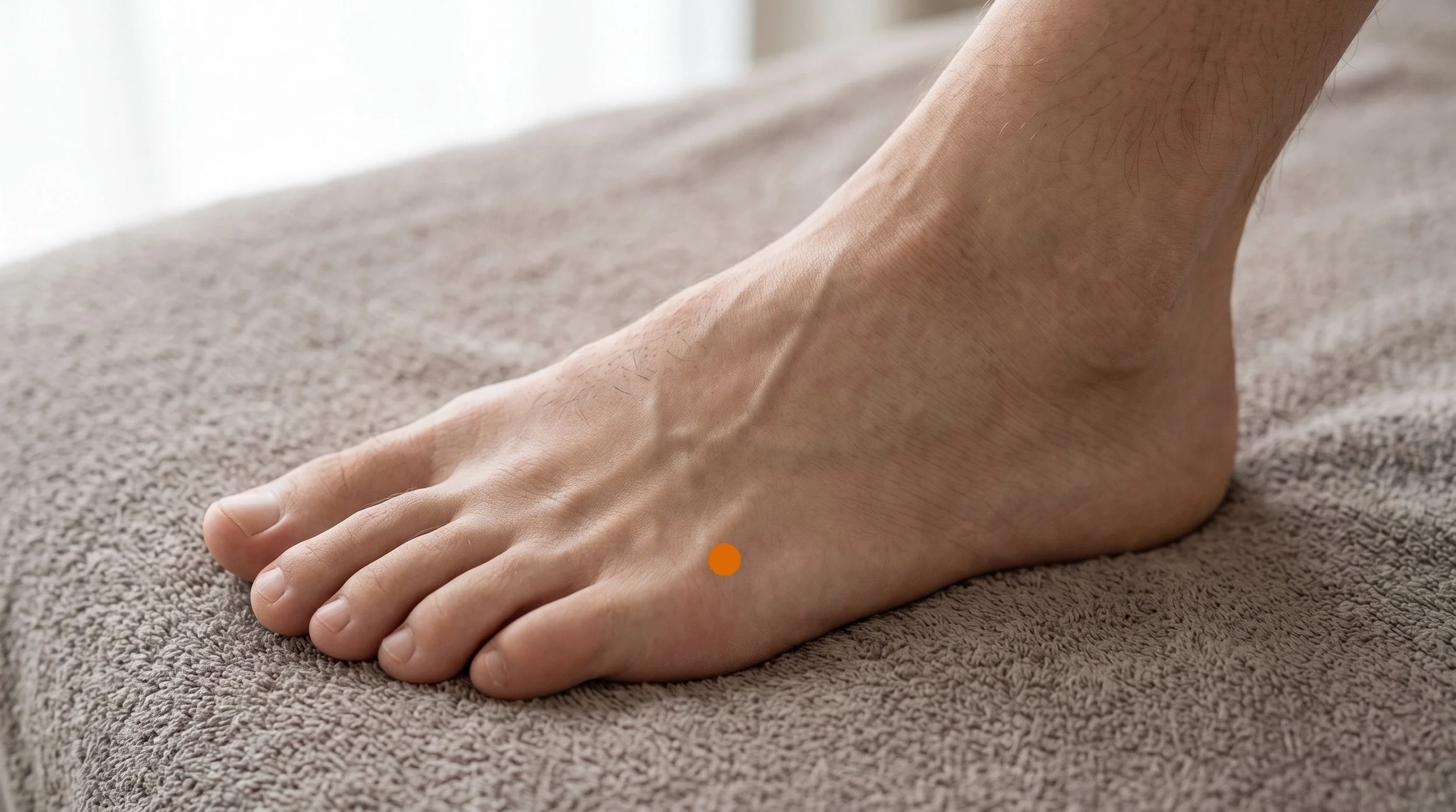
GB41, known in Chinese as Zulinqi and usually translated as Foot Governor of Tears, sits on the top of the foot in the small hollow just beyond where the fourth and fifth metatarsal bones meet, immediately to the outside of the tendon running toward the little toe. It's the shu-stream and Wood point of the Gallbladder channel and the confluent (opening) point of the Girdling Vessel, which in classical theory is the one channel that circles the body horizontally at the waist (Deadman et al., 2007).
For patients, that pedigree translates into something practical: gallbladder 41 is one of the distal points clinicians reach for when symptoms track the side of the body, from the temple and outer eye region, along the ribs and hip, down the outer leg to the foot itself. The gb41 acupuncture point is also a genuinely local point for dorsal foot pain, which is why it earns its place in both classical formulas and modern needling protocols.
- Location and layers: gb 41 location is the depression distal to the junction of the fourth and fifth metatarsal bases, lateral to the tendon of extensor digitorum longus heading to the little toe; under thin skin and dorsal fascia sit tendon, the fourth dorsal interosseous muscle, and the interosseous space itself (Deadman et al., 2007; Kim, 2015).
- Traditional categories translated: classical texts assign Zulinqi shu-stream and Wood status on a yang channel, plus confluent point status for the Girdling Vessel, paired with TE5 in the Ming dynasty coupled pairings (Deadman et al., 2007; Sterman, 2019). Read neurophysiologically, those categories describe a distal point used to influence regions far from the foot rather than any literal flow of energy.
- Nerve story: the point sits in territory supplied by dorsal digital branches of the superficial fibular nerve, with deeper input from the deep fibular nerve near the interosseous space, so needling recruits A-delta and C-fiber afferents that enter the cord at roughly L4 to S1 (Zhao, 2008).
- Mechanism beyond the segment: because the head shares no spinal segment with the foot, effects on temporal symptoms are best explained by descending inhibition from brainstem structures and by broader central modulation, and imaging work using GB41 specifically has reported changes in pain-related cortical and limbic networks in migraine patients (Zhao, 2008; Liu et al., 2021; Tong et al., 2025).
- Research picture: Cochrane reviews support acupuncture as a preventive option for episodic migraine and tension-type headache, though the tested protocols are multi-point prescriptions in which GB41 may or may not appear, so no trial isolates this point's contribution (Linde et al., 2016a; Linde et al., 2016b; Vickers et al., 2018).
- Practice framing and de qi: needling is shallow and perpendicular, typically 0.3 to 0.5 cun, angled to slip between the metatarsal shafts; patients usually report a tight, spreading ache or a brief electric flicker toward the fourth and fifth toes, and the point is often noticeably tender in runners, dancers, and people with chronic lateral foot loading (Deadman et al., 2007; Kim, 2015).
Tired of Temporal Headaches That Start Behind the Eye?
One-sided head pain that settles over the temple or outer eye often travels with jaw tension, neck tightness, and a sensitivity to light and screens. At Morningside Acupuncture, we pair distal points like GB41 with local needling at the temporalis and suboccipitals, and we track your headache frequency session by session rather than guessing. Many patients notice the shift first in how quickly a headache resolves, then in how often one arrives. Schedule a visit and let's map your pattern.
Schedule NowAnatomy of GB41: Why the Fourth and Fifth Metatarsal Interspace Is Such an Important Location
The dorsum of the foot is a thin place. At GB41 the needle passes through skin and a layer of loose subcutaneous tissue that carries superficial veins, then through the dorsal fascia and the extensor tendon system, including the slip of extensor digitorum longus that runs toward the little toe and fibers of extensor digitorum brevis nearby. Deeper still lies the fourth dorsal interosseous muscle filling the space between the fourth and fifth metatarsal shafts.
These are the tissues that absorb repeated toe extension, lace pressure, and the shear of push-off, which is why the interspace becomes tender in people who run, cycle in stiff shoes, dance, or simply walk long city blocks in unsupportive footwear. Asking a patient to spread the little toe makes the tendon stand out and the hollow easier to find.
Sensory supply here comes mainly from dorsal digital branches of the superficial fibular nerve, with the deep fibular nerve contributing to the interosseous region, carrying signals into the cord around the L4 to S1 levels. Needling this area activates small-diameter afferents whose input recruits spinal and supraspinal analgesic circuitry, including opioid and monoaminergic descending pathways, and this is the most defensible explanation for why a foot point can influence sensation elsewhere (Zhao, 2008).
Local effects matter too: mechanical stimulation of fascia and muscle triggers axon reflex vasodilation and modest changes in local blood flow, which may help tissue that has been loaded and irritated. There's nothing mysterious about the tenderness patients feel at Zulinqi; it usually reflects a genuinely sensitized interosseous and tendon region.
The deep structures to respect are the dorsal metatarsal artery and its accompanying veins, plus the dorsal digital nerves, all of which sit close to the needle path. Standard technique is perpendicular insertion of about 0.3 to 0.5 cun, with some textbooks describing depths up to 1 cun when the angle correctly enters the space between the metatarsal shafts (Deadman et al., 2007; Kim, 2015). Because skin is thin and the region is well innervated, insertion can be sharp for a moment; a fine gauge needle and unhurried technique make a difference. Bruising is the most common minor event, and clinicians take extra care in patients on anticoagulants or with fragile dorsal veins.
Related Extensor Digitorum Longus Trigger Points Related Dorsal Interossei Trigger PointsGB41 at a Glance: Classification, Location, and Clinical Use
| Category | Detail |
|---|---|
| Traditional Name | Zulinqi (Foot Governor of Tears), Gallbladder 41 |
| Channel Classification | Foot Shaoyang Gallbladder channel; a channel branch departs here toward the great toe to link with the Liver channel |
| Point Categories | Shu-stream point; Wood point of the Gallbladder channel; confluent (opening) point of the Girdling Vessel (Dai Mai), classically coupled with TE5 |
| Precise Location | On the dorsum of the foot, in the depression distal to the junction of the fourth and fifth metatarsal bones, lateral to the tendon of extensor digitorum longus running to the little toe |
| Tissue Stimulated | Dorsal fascia, extensor tendon slips, and the fourth dorsal interosseous region; clinically adjacent to extensor digitorum longus, extensor digitorum brevis, and dorsal interossei trigger point targets |
| Needle Depth / Direction | Perpendicular insertion 0.3 to 0.5 cun, angled to enter the space between the fourth and fifth metatarsal shafts; deeper insertion up to 1 cun is described in some texts |
| De Qi Sensation | A concentrated ache or pressure in the interspace, sometimes spreading toward the fourth and fifth toes or up the outer foot; brief sharpness on insertion is common because dorsal skin is thin |
| Primary Clinical Uses | Lateral and dorsal foot pain, temporal or one-sided headache, rib-side and chest tightness, hip and lateral leg line tension, premenstrual head and breast distention (traditional indication) |
| Common Point Combinations |
|
Deadman, Al-Khafaji, and Baker present Zulinqi primarily as a point that frees constrained Liver qi where that constraint shows up physically along the Gallbladder channel, meaning pressure, distention, and pain in the chest and flank, the temple and outer eye, the axilla, and the breast, with the classical texts also listing dizziness, tinnitus, ear symptoms, swelling and nodules of the neck and armpit, menstrual irregularity, and a long list of foot complaints (Deadman et al., 2007).
Those attributions are traditional, not physiological claims, and they should be read as a historical map of where this point was thought to exert influence. Kim frames the same point as regulating the Girdling Vessel and clearing damp heat, with indications spanning headache, vertigo, outer canthus pain, hypochondriac pain, breast distention, and painful swelling of the dorsum of the foot (Kim, 2015).
What's striking is the mismatch between old and new usage: modern clinicians reach for gallbladder 41 mostly for one-sided temporal headache, especially around the menstrual cycle, while the major classical references point instead toward occipital and vertex pain, a reminder that point indications have kept evolving in practice.
Why GB41 Is Used for Headaches That Sit Over the Temple
Patients are often surprised that a point on the foot gets chosen for head pain. The honest answer is that this isn't a segmental effect. The foot and the temple share no spinal level, so needling GB41 can't influence the head through convergence in the dorsal horn the way needling the upper trapezius or suboccipitals does. What distal points do appear to do is drive small-fiber input that engages descending pain modulation from the periaqueductal gray and rostral ventromedial medulla, along with endogenous opioid and serotonergic mechanisms that raise pain thresholds well beyond the needled segment (Zhao, 2008).
In practice we use both: local needling for the tissues generating the headache, and distal points like Zulinqi for the systemwide dampening effect and for the calm most patients report during retention.
There's also a small but interesting body of point-specific imaging work. Resting-state fMRI studies conducted at GB41 in migraine patients have described changes in the activity and connectivity of pain-processing and default mode regions, including sensorimotor cortex, parietal areas, and limbic structures, and reviews of the migraine neuroimaging literature list several studies that used this exact point (Liu et al., 2021; Tong et al., 2025).
These are small studies with short follow-up, and brain signal changes are not the same as symptom relief, so they should be treated as mechanistic hints rather than proof of clinical benefit.
The lateral line story is more straightforward. Complaints along the outer body, from the temple to the ribs to the hip to the outer foot, often coexist because of shared loading patterns and shared muscular contributors, and GB41 sits at the bottom of that line while also being a genuinely local point for a tender interosseous space. When someone has both dorsal foot irritation and outer hip tightness, needling here does double duty, which may be part of why the classical sources kept listing hip pain and foot pain side by side (Deadman et al., 2007).
What the Research Shows for GB41
Here's the important caveat before reading any evidence table: acupuncture trials test whole protocols, not single points. When a randomized trial reports that acupuncture reduced migraine days, the treatment usually involved eight to fifteen points selected by pattern, and GB41 may have been one of them or absent entirely. So the research below tells us how the therapy performs for conditions this point is traditionally used to treat, not how much of the effect belongs to Zulinqi. The point-specific literature is limited to small imaging studies, which speak to plausible mechanisms rather than clinical outcomes.
| Study | Type | Focus | Key Finding |
|---|---|---|---|
| Linde et al., 2016a | Cochrane systematic review | Acupuncture for prevention of episodic migraine | Acupuncture was associated with fewer migraine days than no prophylaxis and sham, and appeared at least as effective as prophylactic drugs, with moderate certainty evidence. |
| Linde et al., 2016b | Cochrane systematic review | Acupuncture for prevention of tension-type headache | Added acupuncture reduced headache frequency compared with usual care, with small additional benefit over sham in the pooled trials. |
| Vickers et al., 2018 | Individual patient data meta-analysis | Chronic pain including headache and musculoskeletal pain | Effects were statistically superior to both sham and no-acupuncture controls and persisted over twelve months, though differences from sham were modest. |
| Liu et al., 2021 | Systematic review of neuroimaging studies | Central mechanisms of acupuncture in migraine without aura | Studies needling GB41 reported altered activity and connectivity in pain-related and default mode networks, with small samples limiting conclusions. |
| Tong et al., 2025 | Systematic review of neuroimaging studies | Immediate and preventive brain effects of acupuncture for migraine | Several included trials stimulated GB41 specifically and reported enhanced connectivity across pain-processing regions, suggesting central modulation rather than local effect. |
| Zhao, 2008 | Narrative review of mechanism research | Neural basis of acupuncture analgesia | Analgesic effects are attributed to small-fiber afferent input engaging spinal and descending opioid and monoaminergic inhibition. |
Lateral Foot Pain or a Cranky Outer Line From Hip to Ankle?
Pain along the outside of the foot, the outer shin, or the lateral hip often behaves as one irritable line rather than four separate problems. We use GB41 as both a local point for the dorsum of the foot and a distal anchor when we're needling the peroneals, gluteus medius, and tensor fasciae latae. Treatment is paired with loading advice so the tissue tolerates your walking, running, or standing demands. Book an appointment to get the whole line assessed.
Schedule NowGB41 in the Context of Trigger Point Work
The location of GB41 overlaps closely with myofascial targets on the dorsum of the foot. Trigger points in the dorsal interossei and extensor digitorum brevis can refer pain across the top of the foot and into the toes, and extensor digitorum longus refers into the dorsum and ankle from higher in the leg (Simons et al., 1999). When a patient presents with vague top-of-foot pain that imaging hasn't explained, we palpate all of these before deciding what to needle, and the tender spot frequently sits within a needle's width of Zulinqi.
In that situation the distinction between an acupuncture point and a dry needling target is largely a matter of vocabulary; both use an acupuncture needle to stimulate the same irritable tissue.
For headache and lateral line presentations, we typically build outward from the foot. A session might combine GB41 with dry needling of the peroneals, tensor fasciae latae, and gluteus medius for outer hip and leg tension, or with temporalis, suboccipital, and upper trapezius work when the complaint is one-sided head pain. Needle dosage on the foot stays conservative, since the region is sensitive and easily overtreated, and we reassess between sessions rather than repeating an identical protocol out of habit. Manual therapy, footwear review, and graded loading of the calf and foot intrinsics usually accompany the needling.
GB41 Headache and Foot Pain Treatment at NYC's Highest-Rated Acupuncture Clinic
Morningside Acupuncture is the highest-rated acupuncture and dry needling clinic in New York City with over 500 five-star Google reviews, and we treat headache, foot pain, and lateral hip complaints every day. Our approach blends classical point selection, including Zulinqi and its traditional pairing with TE5, with orthopedic assessment and trigger point dry needling. You'll get a clear plan, measurable goals, and honest expectations about how many sessions it should take. Schedule your first visit today.
Schedule NowFrequently Asked Questions
What does GB41 feel like when needled?
Most people feel a quick pinch as the needle passes the thin dorsal skin, then a deep, tight ache or pressure in the space between the fourth and fifth metatarsals. Some notice the sensation spread toward the little toe or up the outside of the foot, and occasionally a brief electric flicker occurs if the needle brushes a dorsal digital nerve branch. That heavy, spreading feeling is what practitioners call de qi. It should fade within seconds and settle into a dull awareness for the rest of the retention period, usually fifteen to twenty-five minutes. Mild post-needling tenderness for a day is normal.
Why would a point on the foot be used for a headache in the temple?
Because the effect isn't segmental. The foot and the head share no spinal level, so relief can't come from convergence in the same part of the spinal cord. The more plausible explanation is that needle stimulation of small-diameter nerve fibers engages descending inhibitory pathways from the brainstem, along with opioid and serotonergic systems that raise pain thresholds throughout the body (Zhao, 2008). Small imaging studies that needled GB41 in migraine patients have reported shifts in pain-related brain networks, which supports a central mechanism, though those studies are preliminary (Liu et al., 2021; Tong et al., 2025). Traditionally, the choice is explained by the Gallbladder channel's path along the side of the head, an attribution rather than a physiological claim.
Can I press GB41 myself between sessions?
Yes, and it's an easy point to find on yourself. Sit with one foot resting on the opposite knee, run a fingertip up the groove between the fourth and fifth toes toward the ankle until it drops into the hollow just past where the two metatarsal bones meet, and slide slightly to the outer side of the tendon you feel there. Press straight down with your thumb or a knuckle at a firm but tolerable pressure, hold for thirty to sixty seconds, then release, and repeat three to five times per foot. Small circular motions work equally well. Two or three rounds per day is plenty, and you can add gentle toe spreading and ankle circles afterward. Stop if the area becomes bruised, sharply painful, or numb, and skip self-pressure over broken skin, active infection, or recent foot injury.
Is GB41 safe to needle?
In trained hands it's a low-risk point. The main considerations are the superficial veins and the dorsal metatarsal artery in the interspace, so bruising is the most common minor effect, and clinicians use extra caution with patients on blood thinners. Needling stays shallow, generally 0.3 to 0.5 cun perpendicular, angled into the space between the metatarsal shafts rather than into bone (Deadman et al., 2007; Kim, 2015). Skin here is thin and well supplied with nerves, so the point can feel sharp on insertion; a fine needle and slow technique reduce that. Anyone with cellulitis, an open wound, significant dorsal foot swelling of unclear cause, or peripheral neuropathy with reduced sensation should have the area assessed before needling.
Where exactly is GB41 located?
On the top of the foot, in the depression just distal to where the bases of the fourth and fifth metatarsal bones meet, on the outer side of the tendon of extensor digitorum longus that travels to the little toe. A reliable way to find it is to abduct the little toe so that tendon becomes visible, then trace from the web space between the fourth and fifth toes back toward the ankle along the interspace until your finger passes over the tendon and drops into a clear hollow. The point is proximal to GB43 and GB42 on the same line, and it should feel like a distinct pocket rather than flat bone. Tenderness on palpation is common in people with foot loading complaints.
References
- Deadman, P., Al-Khafaji, M., & Baker, K. (2009). A manual of acupuncture. Journal of Chinese Medicine Publications.
- Kim, H. (2008). Handbook of Oriental medicine (3rd ed.). Harmony & Balance Press.
- Maciocia, G. (2006). The channels of acupuncture: Clinical use of the secondary channels and eight extraordinary vessels. Churchill Livingstone Elsevier.
- Cecil-Sterman, A. (2012). Advanced acupuncture: A clinic manual. Classical Wellness Press.
- Simons, D. G., Travell, J. G., & Simons, L. S. (1999). Travell & Simons' myofascial pain and dysfunction: The trigger point manual, Vol. 1: Upper half of body (2nd ed.). Williams & Wilkins.
- Linde, K., Allais, G., Brinkhaus, B., Fei, Y., Mehring, M., Vertosick, E. A., Vickers, A., & White, A. R. (2016a). Acupuncture for the prevention of episodic migraine. Cochrane Database of Systematic Reviews, 2016(6), CD001218. https://doi.org/10.1002/14651858.CD001218.pub3
- Linde, K., Allais, G., Brinkhaus, B., Fei, Y., Mehring, M., Shin, B. C., Vickers, A., & White, A. R. (2016b). Acupuncture for the prevention of tension-type headache. Cochrane Database of Systematic Reviews, 2016(4), CD007587. https://doi.org/10.1002/14651858.CD007587.pub2
- Vickers, A. J., Vertosick, E. A., Lewith, G., MacPherson, H., Foster, N. E., Sherman, K. J., Irnich, D., Witt, C. M., & Linde, K. (2018). Acupuncture for chronic pain: Update of an individual patient data meta-analysis. Journal of Pain, 19(5), 455-474. https://doi.org/10.1016/j.jpain.2017.11.005
- Liu, L., Tian, T., Li, X., Wang, Y., Xu, T., Ni, X., Li, X., He, Z., Gao, S., Sun, M., Liang, F., & Zhao, L. (2021). Revealing the neural mechanism underlying the effects of acupuncture on migraine: A systematic review. Frontiers in Neuroscience, 15, 674852. https://doi.org/10.3389/fnins.2021.674852
- Tong, D., Yao, R., Zhang, X., Tao, S., Chen, N., Wu, W., Wu, S., Zhou, J., Ren, Y., Liang, F., Pan, L., & Li, Z. (2025). Acupuncture for migraine: A literature review of neuroimaging studies. Frontiers in Neurology, 16, 1601554. https://doi.org/10.3389/fneur.2025.1601554
- Zhao, Z. Q. (2008). Neural mechanism underlying acupuncture analgesia. Progress in Neurobiology, 85(4), 355-375. https://doi.org/10.1016/j.pneurobio.2008.05.004
Disclaimer: This web site is intended for educational and informational purposes only. Reading this website does not constitute providing medical advice or any professional services. This information should not be used for diagnosing or treating any health issue or disease. Those seeking medical advice should consult with a licensed physician. Seek the advice of a medical doctor or other qualified health professional for any medical condition. If you think you have a medical emergency, call 911 or go to the emergency room. No acupuncturist-patient relationship is created by reading this website or using the information. Morningside Acupuncture PLLC and its employees and contributors do not make any express or implied representations with respect to the information on this site or its use. For any legal interpretation of scope of practice in your state, consult a licensed attorney or regulatory authority.
Read more from our blog