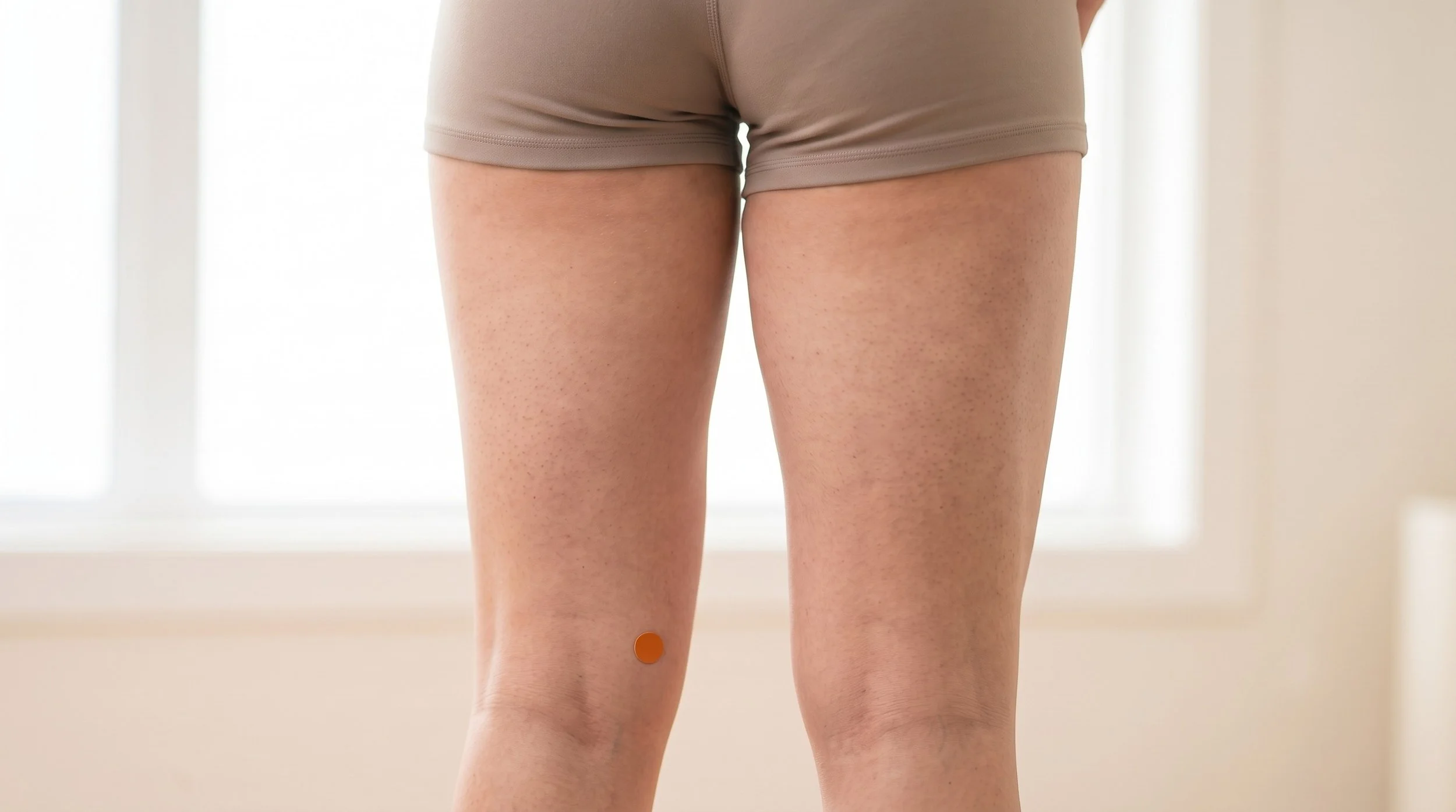
LV8 Acupuncture Point (Ququan)
The Spring at the Crook of the Knee: Anatomy, Mechanism, and Why This Medial Knee Point Bridges Joint Pain and Pelvic Complaints
LV8 (Ququan, often translated as Spring at the Crook or Spring at the Bend), also written LR8, sits at the inner end of the knee crease, just in front of the two ropey hamstring tendons you can feel when you bend your knee against resistance. It is the he-sea point and the water point of the Liver channel, which in classical theory makes it the deepest, most "inward" point of that channel below the knee, and traditionally the place where Liver channel disorders of the lower body were addressed.
For modern clinicians the LV8 acupuncture point is interesting for two very different reasons: it lands in the middle of the medial knee soft tissue that gets irritated in pes anserine syndrome and medial compartment knee pain, and it carries a long classical reputation for pelvic, menstrual, and urogenital complaints. This post covers where liver 8 actually is, what tissue the needle enters, how the effects are best explained neurophysiologically, and what the research does and does not support.
- Location and layers: LV8 lies at the medial end of the knee crease with the knee flexed, in the small depression just anterior to the semitendinosus and semimembranosus tendons and roughly a thumb width in front of KD10. The needle passes skin and subcutaneous tissue into the connective tissue plane where sartorius and gracilis are converging toward the pes anserine insertion.
- Traditional categories, translated: classical texts class LV8 as the he-sea and water point of the Liver channel and, in five element terms, the point selected on that channel when the Liver is judged deficient (the water or mother point). Read neurophysiologically, that category tells you it is a deep, richly innervated site chosen for persistent lower body and pelvic complaints rather than a superficial distal point.
- Nerve story: the tissue under LV8 is saphenous nerve territory, a sensory branch of the femoral nerve carrying L3 and L4 input. An anatomical and neural tract tracing study of the Liver channel confirmed that a saphenous branch lies under LR8 and that its sensory and motor labeling follows an orderly segmental pattern in the dorsal root ganglia and spinal cord (Xu et al., 2021).
- Mechanism: needling here recruits small diameter afferents that converge in the same lumbar segments receiving input from the medial joint capsule, medial collateral ligament, and pes anserine tendons, and it engages descending inhibitory pathways that damp spinal nociceptive transmission more broadly (Zhao, 2008).
- Research picture: acupuncture as a whole shows modest but real effects for chronic musculoskeletal pain in individual patient data analyses (Vickers et al., 2018), while the Cochrane review of peripheral joint osteoarthritis found small, statistically significant sham-controlled benefits that did not reach its predefined thresholds for clinical importance (Manheimer et al., 2010). No trial has tested LV8 on its own.
- De qi and practice framing: patients usually describe a deep, heavy, spreading ache at the inner knee, sometimes tracking up the inner thigh or down toward the calf, and it should never feel electric or shooting. LV8 is nearly always one point inside a broader plan that includes other knee points, dry needling of the medial thigh muscles, and loading exercise.
Struggling With Inner Knee Pain That Will Not Settle?
Medial knee pain rarely comes from one structure, which is why we assess the joint line, the pes anserine tendons, and the muscles that load them before choosing points. At Morningside Acupuncture we commonly use LV8 with nearby knee points and dry needling of sartorius, gracilis, and the medial hamstrings, then pair the session with simple loading work you can do at home. Most patients feel a difference in how the knee tolerates stairs and squatting within a few visits. Schedule an evaluation and we will map out a realistic plan for your knee.
Schedule NowAnatomy of LV8: Why the Medial Knee Crease Is Such an Important Location
Bend your knee and the medial end of the popliteal crease reveals two distinct cords: semitendinosus, the more prominent and more posterior of the pair, and semimembranosus just in front of it. LV8 sits in the soft depression immediately anterior to those tendons, which places the needle in the busy medial knee corridor where sartorius and gracilis are traveling down to join semitendinosus at the pes anserine insertion on the upper medial tibia.
This region takes load from anything that repeatedly flexes the knee under tension or lets the knee drift inward: running, cycling, breaststroke kick, deep squatting, stair climbing, and the valgus collapse pattern common in people with weak hip abductors. Medial compartment osteoarthritis, medial meniscus irritation, and pes anserine bursitis all produce tenderness within a couple of centimeters of this point, which is one reason it is palpated so often in clinic.
The sensory supply here belongs to the saphenous nerve, the long terminal cutaneous branch of the femoral nerve carrying L3 and L4 fibers, with the hamstring tendons behind receiving tibial nerve input. A neural tracing study that compared LR3 and LR8 in the rat found a saphenous branch under the LR8 site and showed that the associated sensory and motor neurons mapped onto their own spinal segments and target regions in an orderly way, which supports thinking about points on one channel as distinct segmental inputs rather than interchangeable stops on a line (Xu et al., 2021).
Practically, that means needling LV8 delivers afferent input into the same lumbar segments that receive nociceptive traffic from the medial capsule, the medial collateral ligament, and the pes anserine tendons, so the spinal cord processes needle input and joint pain in overlapping territory. Layered on top of that segmental convergence, needle stimulation recruits descending inhibitory control from the brainstem, a mechanism reviewed in detail in the neurophysiology literature (Zhao, 2008).
Deep and anterior to the point, the great saphenous vein ascends the medial knee, and branches of the descending genicular artery supply the area, so practitioners palpate first and avoid needling directly through a visible or varicose vein. The popliteal fossa, with the popliteal artery and vein and the tibial nerve, sits behind the hamstring tendons, which is why any posterior angulation stays shallow and controlled.
Textbook conventions for needling vary: A Manual of Acupuncture describes perpendicular or slightly posterior insertion of 1 to 1.5 cun, while Chinese Acupuncture and Moxibustion and other texts recommend a more conservative 0.5 to 0.8 cun perpendicular.
In practice the knee is supported in semi-flexion with a bolster, the tendons are identified with the knee bent, and depth is chosen for the patient's build rather than the page.
Related Best Acupuncture Points For Knee Pain Related Liver ChannelLV8 (LR8) at a Glance: Classification, Location, and Clinical Use
| Category | Detail |
|---|---|
| Traditional Name | Ququan (Spring at the Crook), LV8, also written LR8 or LIV-8 |
| Channel Classification | Liver channel of the foot jueyin, the last channel point above the knee crease on the medial thigh (LV8, also written LIV8 or LR8) |
| Point Categories | He-sea point of the Liver channel; water point of the Liver channel within the five shu system, and therefore the point chosen on this channel in five element practice when the Liver is treated through its mother element |
| Precise Location | With the knee flexed, at the medial end of the transverse popliteal crease, in the depression just anterior to the tendons of semitendinosus and semimembranosus, approximately 1 cun anterior to KD10 Yingu. Flexing the knee makes the two tendons obvious; the point can then be needled with the leg semi-flexed over a bolster. |
| Tissue Stimulated | Skin and subcutaneous tissue over the medial knee, the distal fibers and tendons of sartorius and gracilis heading toward the pes anserine insertion, and the anterior border of the semitendinosus and semimembranosus tendons, all within saphenous nerve territory |
| Needle Depth / Direction | Perpendicular or slightly posteriorly angled insertion, 1 to 1.5 cun in classical texts and 0.5 to 0.8 cun in more conservative sources; knee supported in semi-flexion, needle kept anterior to the hamstring tendons and away from the great saphenous vein |
| De Qi Sensation | A deep, dull, heavy ache or fullness at the inner knee that may spread up the inner thigh or down toward the medial calf; sharp, electric, or radiating sensations mean the needle should be withdrawn and redirected |
| Primary Clinical Uses | Medial knee pain and stiffness, pes anserine region irritation, medial compartment osteoarthritis as part of a wider protocol, and, in classical use, menstrual and lower abdominal complaints, urinary difficulty, and genital itching or discomfort |
| Common Point Combinations |
|
In A Manual of Acupuncture, Deadman and Al-Khafaji present Ququan as the he-sea and water point of the Liver channel, with traditional actions described as clearing damp-heat from the lower burner, benefiting the genitals, moving blood and benefiting the uterus, and nourishing blood and yin.
Their commentary makes a neat structural point: the he-sea points of the three leg yin channels are all water points, and all three were traditionally used to drain dampness from the lower body, with KD10 weighted toward the urinary system, SP9 toward dampness generally, and LV8 toward the genital region because of the Liver channel's classical connection there.
The classical indication lists that follow are wide, covering genital swelling, itching and pain, difficult urination and retention, chronic diarrhea, uterine prolapse, abdominal masses and absent periods attributed to stagnant blood, plus headache, visual dizziness, and local knee pain, swelling and coldness. These are traditional attributions from within a pre-modern medical framework, not diagnoses or claims we make today, and Deadman notes that historically the point was used mostly for excess patterns even though its water point status also earned it a secondary reputation for nourishing Liver blood and yin.
What is striking is the consistency of the pattern: for centuries a single point at the crook of the knee was treated as the Liver channel's access route to the pelvis.
Why LV8 Is Used for Pelvic and Menstrual Complaints, Not Just the Knee
The local story is straightforward. Needling at the medial knee crease feeds afferent input into the L3 and L4 spinal segments that already receive nociceptive traffic from the medial joint capsule, the medial collateral ligament, and the pes anserine tendons, and this convergence is the most plausible explanation for why local needling changes medial knee pain and tenderness (Xu et al., 2021).
Add the mechanical effect of a needle in irritated connective tissue and the local vascular response that follows, and you have a reasonable account of why patients often report the inner knee feeling looser and less guarded after treatment.
The pelvic story requires more honesty. The uterus, bladder, and pelvic organs receive their autonomic and sensory supply from thoracolumbar and sacral levels, which do not line up with the L3 to L4 territory of the saphenous nerve. So when LV8 is used for menstrual cramping or pelvic heaviness, a simple segmental convergence explanation does not hold.
What is more likely is a heterosegmental effect: needle stimulation strong enough to produce de qi activates brainstem and midbrain circuits that exert descending inhibition over spinal nociceptive transmission at distant levels, along with autonomic shifts that patients often experience as a general calming during and after treatment (Zhao, 2008). That is a modest, well-documented mechanism, and it applies to acupuncture generally rather than to this point specifically.
Clinically, that means LV8 is a supporting player rather than the star in pelvic treatment. Menstrual protocols typically center on lower abdominal points and lower leg points such as SP6, with LV8 added when the medial thigh and knee region is tender or when a practitioner is working within a Liver channel framework. Expect a course of treatment across several cycles rather than a single dramatic session, and expect your acupuncturist to coordinate with your gynecologist rather than substitute for that care.
What the Research Shows for LV8 (LR8)
One note on naming before the evidence: in the research literature this point is usually listed as LR8, the WHO standard code, and sometimes as LV8 or LIV8, so it is worth searching all three if you want to read the studies below in full.
There is no clinical trial of LV8 alone, and that is true of nearly every individual acupuncture point. Trials and reviews test multi-point protocols, so the fair question is not whether Ququan works but whether the treatment approaches that include it show benefit. For the knee, the evidence base is reasonably large and the results are consistently modest: statistically detectable effects that often fall short of thresholds for clinical importance, with better showings against usual care than against sham needling. For menstrual pain, the evidence is thinner and rated low quality. The table below summarizes what the more rigorous reviews have found.
| Study | Type | Focus | Key Finding |
|---|---|---|---|
| Manheimer et al., 2010 | Cochrane systematic review | Acupuncture for peripheral joint osteoarthritis, including knee OA | Sham-controlled trials showed small statistically significant short-term improvements in pain and function that did not meet the review's predefined thresholds for clinical relevance. |
| Vickers et al., 2018 | Individual patient data meta-analysis | Chronic pain conditions including osteoarthritis | Acupuncture outperformed both sham and no-acupuncture controls, with effects that persisted over follow-up but were modest in size. |
| Jiménez-del-Barrio et al., 2022 | Systematic review and meta-analysis | Dry needling of trigger points in hip or knee osteoarthritis | Very low quality evidence suggested short-term reductions in pain intensity and improvements in physical function, with medium and long-term effects undetermined. |
| Ughreja & Prem, 2021 | Systematic review and meta-analysis | Dry needling techniques in knee osteoarthritis | Trigger point dry needling results were contradictory across trials, while periosteal stimulation showed moderate quality evidence for short-term pain and function benefits. |
| Smith et al., 2016 | Cochrane systematic review | Acupuncture and acupressure for primary dysmenorrhoea | Evidence was insufficient to determine whether acupuncture or acupressure reduces period pain, with all comparisons rated low or very low quality. |
| Xu et al., 2021 | Animal anatomical and neural tracing study | Innervation of the LR3 and LR8 acupoint sites | A saphenous nerve branch was identified under the LR8 site, with sensory and motor labeling organized segmentally and distinct from that of LR3. |
Looking for Support With Menstrual and Pelvic Discomfort?
Classical texts leaned heavily on LV8 for lower abdominal and pelvic patterns, and it still appears in modern treatment plans alongside points on the lower abdomen and lower leg. We combine acupuncture with clear conversation about cycle tracking, sleep, and stress load rather than promising any single point will fix things. Sessions are calm, unhurried, and coordinated with the care you already receive from your physician. Book a consultation to talk through what a course of treatment would look like.
Schedule NowLV8 in the Context of Trigger Point Work
Because acupuncture means the use of an acupuncture needle across hundreds of styles, including dry needling, LV8 and myofascial technique are not competing approaches. At Morningside we frequently treat the point in the same session as dry needling of sartorius, gracilis, semitendinosus, and semimembranosus, and sometimes vastus medialis when the medial knee is broadly irritable.
Trigger points in these muscles refer pain into patterns that overlap the medial knee and upper medial calf, which is exactly the territory patients point to when they describe inner knee pain, so palpating them is part of the assessment rather than an add-on (Simons et al., 1999).
The overlap is anatomical, not coincidental. LV8 sits in the plane where the pes anserine tendons converge, so a needle placed there is already engaging the tissue a dry needling practitioner would target for pes anserine irritation, and the classical grouping of LV8 with ST34 and GB33 for a knee that will not bend or straighten reads, in modern terms, like a protocol for the quadriceps, hamstring, and lateral knee tissues around a stiff joint.
Reviews of dry needling in knee osteoarthritis report short-term pain and function benefits from low quality evidence, which matches what we see clinically: useful improvements that hold best when needling is paired with progressive loading of the hip and thigh (Jiménez-del-Barrio et al., 2022).
LV8 Knee and Pelvic Pain Treatment at NYC's Highest-Rated Acupuncture Clinic
Morningside Acupuncture is the highest-rated acupuncture and dry needling clinic in New York City with over 500 five-star Google reviews, and our Upper West Side treatment rooms are built for careful orthopedic work. Our licensed acupuncturists use LV8 as part of structured protocols for medial knee pain, pes anserine irritation, and pelvic discomfort, with clean needle technique and clear expectations at every visit. You will leave each session knowing exactly what we treated and why. Schedule your first appointment online today.
Schedule NowFrequently Asked Questions
Is LV8 the same point as LR8 or LIV8?
Yes. LV8, LR8, and LIV8 are all codes for the same point, Ququan, point 8 of the Liver channel. LR is the WHO standard abbreviation and the one you will see in most research papers. LV is the form used by many American schools and clinics, and LIV appears in several widely used textbooks. You will also come across it written as Liver 8 or LIV-8. Whichever code is used, the location and the uses are the same.
What does LV8 feel like when needled?
Most people feel a dull, heavy ache or a sense of spreading fullness at the inner knee that may travel a short way up the inner thigh or down toward the calf. That heavy, distending quality is de qi, and it usually settles within a minute of the needle being placed. Some patients notice a warm or slightly buzzy feeling around the point during retention. What you should not feel is a sharp, electric, or shooting sensation; tell your practitioner immediately if you do, since the needle simply needs to be adjusted.
Why needle the knee for pelvic or menstrual symptoms?
Honestly, the classical reasoning and the modern reasoning are different. Classically, LV8 was chosen because the Liver channel was understood to connect the medial leg with the genital and pelvic region, so its he-sea point became the channel's main access route to the lower abdomen. Neurophysiologically, the saphenous nerve territory at the knee is not segmentally linked to the uterus, so any effect on pelvic symptoms is better explained by descending inhibitory and autonomic mechanisms triggered by strong enough needle stimulation anywhere on the body (Zhao, 2008). We use LV8 in pelvic work as a supporting point, alongside abdominal and lower leg points, and we set expectations accordingly.
Can I press LV8 myself between sessions?
Yes, and it is easy to reach. Sit with your knee bent to roughly ninety degrees and run your thumb along the crease behind your knee toward the inner side until you feel the two firm tendon cords; slide your thumb just in front of them into the soft hollow. Press with steady, moderate pressure that feels like a satisfying ache rather than a sharp pain, hold for thirty to sixty seconds, release, and repeat two or three times. Doing this two or three times a day is plenty, and small circular pressure works as well as static holding. Skip it if you have visible varicose veins in that area, if the skin is broken or bruised, or if pressing reproduces sharp or radiating pain, and remember that acupressure is a self-care adjunct rather than a substitute for treatment or for the strengthening work that keeps the knee resilient.
Is LV8 safe to needle?
In trained hands it has a good safety profile, but it is not a beginner's point. The great saphenous vein runs up the medial knee just in front of the point and the descending genicular vessels branch nearby, so practitioners palpate first, avoid visible veins, and use clean needle technique. The popliteal fossa with its artery, vein, and tibial nerve lies behind the hamstring tendons, so any posterior angling is kept shallow and deliberate rather than deep. Depth is adjusted for body size, with textbook ranges running from about 0.5 to 1.5 cun. Minor bruising is the most common side effect anywhere on the body, and it is more likely at the knee if you take blood thinners, so mention any anticoagulant medication before treatment.
Where exactly is LV8 located?
Bend the knee so the crease behind it becomes obvious. At the inner end of that crease you will feel two prominent tendons, semitendinosus being the more posterior and more noticeable of the pair, with semimembranosus just in front of it. The Ququan point location is the depression immediately anterior to those tendons, about 1 cun in front of KD10. A useful cross check for the LV 8 knee position is that it sits in the same medial soft tissue zone where the sartorius and gracilis tendons are heading toward the pes anserine insertion on the upper shin. Once located with the knee flexed, the point is usually needled with the leg resting semi-flexed over a bolster.
References
- Deadman, P., Al-Khafaji, M., & Baker, K. (2009). A manual of acupuncture. Journal of Chinese Medicine Publications.
- Cheng, X. (Ed.). (1999). Chinese acupuncture and moxibustion (Rev. ed.). Foreign Languages Press.
- Kim, H. (2008). Handbook of Oriental medicine (3rd ed.). Harmony & Balance Press.
- Maciocia, G. (2005). The foundations of Chinese medicine: A comprehensive text for acupuncturists and herbalists (2nd ed.). Elsevier Churchill Livingstone.
- Simons, D. G., Travell, J. G., & Simons, L. S. (1999). Travell & Simons' myofascial pain and dysfunction: The trigger point manual, Vol. 1: Upper half of body (2nd ed.). Williams & Wilkins.
- Xu, D., Zou, L., Zhang, W., Liao, J., Wang, J., Cui, J., Su, Y., Wang, Y., Guo, Y., Shen, Y., & Bai, W. (2021). Comparison of sensory and motor innervation between the acupoints LR3 and LR8 in the rat with regional anatomy and neural tract tracing. Frontiers in Integrative Neuroscience, 15, 728747. https://doi.org/10.3389/fnint.2021.728747
- Manheimer, E., Cheng, K., Linde, K., Lao, L., Yoo, J., Wieland, S., van der Windt, D. A., Berman, B. M., & Bouter, L. M. (2010). Acupuncture for peripheral joint osteoarthritis. Cochrane Database of Systematic Reviews, 2010(1), CD001977. https://doi.org/10.1002/14651858.CD001977.pub2
- Smith, C. A., Armour, M., Zhu, X., Li, X., Lu, Z. Y., & Song, J. (2016). Acupuncture for dysmenorrhoea. Cochrane Database of Systematic Reviews, 2016(4), CD007854. https://doi.org/10.1002/14651858.CD007854.pub3
- Jiménez-del-Barrio, S., Medrano-de-la-Fuente, R., Hernando-Garijo, I., Mingo-Gómez, M. T., Estébanez-de-Miguel, E., & Ceballos-Laita, L. (2022). The effectiveness of dry needling in patients with hip or knee osteoarthritis: A systematic review and meta-analysis. Life, 12(10), 1575. https://doi.org/10.3390/life12101575
- Ughreja, R. A., & Prem, V. (2021). Effectiveness of dry needling techniques in patients with knee osteoarthritis: A systematic review and meta-analysis. Journal of Bodywork and Movement Therapies, 27, 328-338. https://doi.org/10.1016/j.jbmt.2021.02.015
- Vickers, A. J., Vertosick, E. A., Lewith, G., MacPherson, H., Foster, N. E., Sherman, K. J., Irnich, D., Witt, C. M., & Linde, K. (2018). Acupuncture for chronic pain: Update of an individual patient data meta-analysis. Journal of Pain, 19(5), 455-474. https://doi.org/10.1016/j.jpain.2017.11.005
- Zhao, Z. Q. (2008). Neural mechanism underlying acupuncture analgesia. Progress in Neurobiology, 85(4), 355-375. https://doi.org/10.1016/j.pneurobio.2008.05.004
Disclaimer: This web site is intended for educational and informational purposes only. Reading this website does not constitute providing medical advice or any professional services. This information should not be used for diagnosing or treating any health issue or disease. Those seeking medical advice should consult with a licensed physician. Seek the advice of a medical doctor or other qualified health professional for any medical condition. If you think you have a medical emergency, call 911 or go to the emergency room. No acupuncturist-patient relationship is created by reading this website or using the information. Morningside Acupuncture PLLC and its employees and contributors do not make any express or implied representations with respect to the information on this site or its use. For any legal interpretation of scope of practice in your state, consult a licensed attorney or regulatory authority.
Read more from our blog



