BL60 Acupuncture Point (Kunlun)
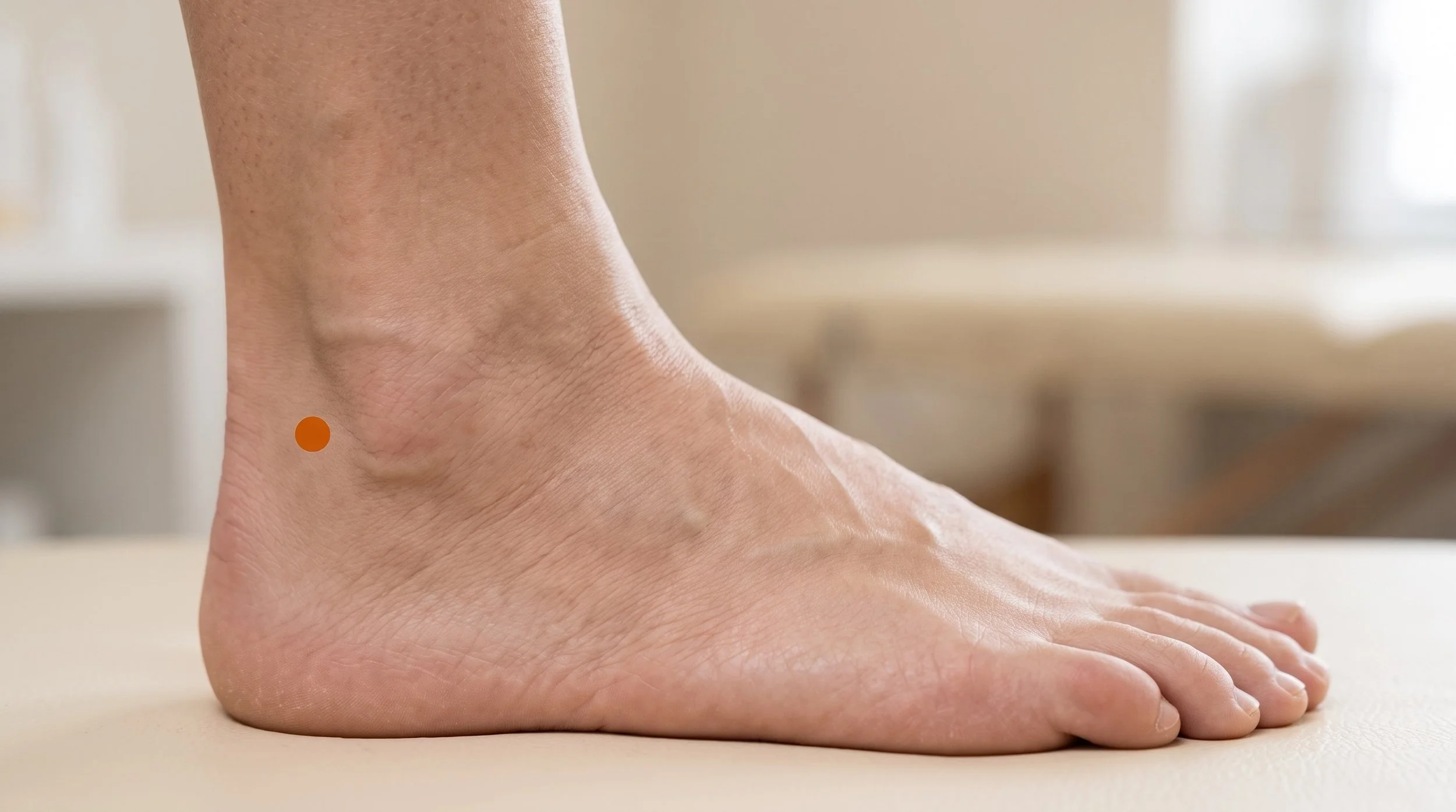
BL60 Acupuncture Point
The Retromalleolar Gate of the Bladder Channel: Anatomy, Mechanism, and Why This Ankle Point Reaches All the Way to the Neck
BL60, called Kunlun after the Kunlun Mountains of Chinese cosmology, sits in the soft hollow you can feel between the bony bump on the outside of the ankle (the lateral malleolus) and the front edge of the Achilles tendon. Classically it is the jing-river point and the fire point of the Bladder channel, and one of the small group of points Ma Dan-yang singled out as heavenly star points (Deadman et al., 2001). In modern clinical terms it is a workhorse: a local point for lateral ankle and heel pain, and a distal point that clinicians reach for when the complaint is in the neck, upper back, low back, or down the back of the leg. Its appeal is practical as well as anatomical, because it can be needled with the patient prone or side-lying while the painful spine or shoulder region is being treated at the same time.
- Bladder 60 lies in the retromalleolar depression, roughly midway between the tip of the lateral malleolus and the posterior border of the Achilles tendon, with thin skin and subcutaneous fat over the fibular retinaculum, the peroneal tendon sheaths, and the calcaneofibular ligament (Deadman et al., 2001).
- Traditionally BL60 is classified as the jing-river point and the fire point of the taiyang Bladder channel, and it is credited with descending excess from the head, relaxing the sinews, and steadying the lumbar spine (Deadman et al., 2001). We translate those attributions as strong somatosensory input from an S1 to S2 territory that recruits spinal and brainstem pain modulation rather than as literal movement of qi.
- The sural nerve and its lateral calcaneal branches supply this zone, so needling here feeds signals into the same sacral segments that serve the posterior thigh, calf, Achilles, and heel, a plausible substrate for segmental convergence effects (Zhao, 2008).
- Needle stimulation at acupuncture points engages A-delta and group III afferents that drive descending inhibition through periaqueductal gray and rostroventromedial medulla circuits, with endogenous opioid and adenosine mediation described in mechanistic reviews (Zhao, 2008). A BOLD fMRI study needling BL60 specifically reported distributed cortical, thalamic, and cingulate signal changes, some of which persisted after the point was locally anesthetized (Kim et al., 2013).
- Reviews of acupuncture for ankle sprain and dry needling for plantar heel pain report modest short-term pain and function gains alongside real methodological limits, so BL60 is best framed as one component of a loading, manual therapy, and rehab plan (Park et al., 2013; Liu et al., 2020; Llurda-Almuzara et al., 2021).
- De qi at BL60 is usually a deep, dull, slightly spreading ache or heaviness that wraps around the outside of the ankle, sometimes tracking toward the heel or up the calf. A brief electric flick means the needle brushed a sural nerve branch, and the needle should be withdrawn slightly and redirected.
Struggling With Ankle Pain That Never Fully Settles After a Sprain?
Lingering lateral ankle pain, stiffness, and a sense of instability months after a sprain are among the most common complaints we see. At Morningside Acupuncture we use BL60 with local needling around the peroneal tendons and calcaneofibular ligament, plus dry needling of the soleus and peroneals when they are guarding, and pair it with graded loading advice you can actually follow. Sessions are quiet, precise, and built around what you need to get back to running, lifting, or simply walking Manhattan without thinking about your foot. Book a visit and let's map out what your ankle needs.
Schedule NowAnatomy of BL60: Why the Hollow Behind the Lateral Malleolus Is Such an Important Location
Slide a fingertip backward from the bony prominence on the outside of the ankle and you drop into a small valley before you reach the firm cord of the Achilles tendon. That valley is BL60. The tissue stack here is shallow and busy: thin skin, a modest layer of subcutaneous fat, then the superior and inferior peroneal retinacula holding the peroneus longus and brevis tendons against the back of the fibula, with the calcaneofibular ligament and the lateral wall of the calcaneus deeper and slightly forward (Deadman et al., 2001). This is exactly where inversion sprains load the lateral ligaments, where peroneal tendons get irritated in runners and dancers, and where posterior heel complaints often localize.
Sensation over this region travels through the sural nerve and its lateral calcaneal branches, which carry information from S1 and S2 spinal segments. That segmental identity matters: the same neurological neighborhood serves the posterior calf, Achilles, plantar heel, and much of the posterior thigh and sacral region. Needling here therefore delivers a strong afferent barrage into dorsal horn territory shared with painful structures well above the ankle, which is the modern reading of the classical claim that BL60 activates the length of the Bladder channel (Deadman et al., 2001). Beyond segmental effects, needle stimulation of muscle and connective tissue afferents recruits descending inhibitory pathways from the midbrain and medulla, along with local adenosine and neuropeptide-mediated changes in the treated tissue (Zhao, 2008). Imaging work needling BL60 itself found widespread central signal changes rather than an isolated foot representation, which fits the idea that a distal point can influence pain processing broadly (Kim et al., 2013).
Deep and slightly anterior to the point lie branches of the peroneal (fibular) artery and the accompanying veins, and the Achilles tendon forms the posterior wall of the space. Standard technique is perpendicular insertion of 0.5 to 1 cun into the hollow itself, avoiding the tendon and staying out of the tendon sheaths; some clinicians angle superiorly and medially to join toward KI3 at 1.5 to 2 cun when treating lumbar complaints (Deadman et al., 2001). Classical sources list BL60 as contraindicated in pregnancy because of its traditional labor-promoting reputation, and we honor that caution. Slight patient positioning changes, a side-lying or prone setup with the foot supported, make the depression easier to find and the needle more comfortable.
Related Pain Finder Leg Ankle Foot Related Bladder ChannelBL60 at a Glance: Classification, Location, and Clinical Use
| Category | Detail |
|---|---|
| Traditional Name | Kunlun (Kunlun Mountains), BL60, Bladder 60, also written BL-60 |
| Channel Classification | Bladder channel of the foot taiyang, lower limb, lateral retromalleolar region |
| Point Categories | Jing-river point of the Bladder channel; Fire point of the Bladder channel; listed among Ma Dan-yang's heavenly star points (Deadman et al., 2001) |
| Precise Location | Behind the ankle joint, in the center of the depression midway between the prominence of the lateral malleolus and the posterior border of the Achilles tendon |
| Tissue Stimulated | Skin and subcutaneous tissue of the retromalleolar hollow, peroneal retinacula and peroneus longus and brevis tendon sheaths, calcaneofibular ligament, adjacent Achilles paratendon; commonly treated alongside tibialis posterior and abductor digiti minimi myofascial targets |
| Needle Depth / Direction | Perpendicular 0.5 to 1 cun into the depression; optionally directed superiorly toward KI3 for 1.5 to 2 cun; contraindicated in pregnancy per classical sources |
| De Qi Sensation | Deep dull ache, heaviness, or pressure spreading around the lateral ankle, sometimes toward the heel or up the calf; a brief electric sensation suggests contact with a sural nerve branch and calls for redirection |
| Primary Clinical Uses | Lateral ankle pain and stiffness, posterior and plantar heel pain, Achilles region complaints, distal treatment of neck and occipital pain, upper and low back pain, sciatic pain down the posterior leg |
| Common Point Combinations |
|
In the classical literature summarized by Deadman, Al-Khafaji and Baker in A Manual of Acupuncture, BL60 is understood through three overlapping facts: it is the fire point of the most yang of the channels, it sits near the bottom end of a channel that runs the whole back of the body, and it is on the foot. That combination made it the point of choice for drawing overheated, upward-rushing symptoms downward, so the traditional indication lists run from occipital and vertex headache, red painful eyes, nosebleed, upper toothache, and dizziness through to convulsive presentations, and then continue with the entire posterior axis: stiff neck, shoulder and upper back contraction, chest pain radiating to the back, lumbar and sacral pain, coccyx pain, sciatica, pain behind the knee, ankle pain, and heel pain (Deadman et al., 2001). Obstetric uses form a third cluster, including difficult labor and retained placenta, which is precisely why classical texts also flag it as contraindicated during pregnancy. A smaller set of respiratory indications, chest fullness with cough and breathlessness, is traditionally explained by its jing-river status rather than by the channel pathway. What makes the pattern striking is how consistently the sources treat one ankle point as a lever on the far end of the body, an idea that modern segmental and central pain models now give us a very different vocabulary for.
Why BL60 Is Used for Neck and Upper Back Pain When the Needle Goes In at the Ankle
Patients are often surprised when a point at the outside of the ankle is chosen for a stiff neck or an aching upper back. The classical rationale is channel based: the Bladder channel runs from the head down both sides of the spine and along the back of the leg to the foot, so distal points on the leg are said to influence the whole line, with BL60 in particular treated as the leading distal point for upper back and occipital complaints (Maciocia, 2006; Deadman et al., 2001). The neurophysiological rationale is different but not incompatible. Needling produces strong input into sacral segments through the sural nerve, and that input does not stay local. It ascends, engages brainstem circuits, and returns as diffuse descending modulation that reduces dorsal horn excitability across multiple segments, which is one reason distal needling can change pain and muscle guarding in regions the needle never touched (Zhao, 2008).
Central imaging supports the notion that this point is not simply a local stimulus. When BL60 was needled inside an MRI scanner, investigators recorded signal changes across frontal, parietal, temporal, thalamic, and cingulate regions, and some of those changes remained after the skin at the point was locally anesthetized, suggesting a component of the response that is not just pain from the needle (Kim et al., 2013). Findings like these do not prove that BL60 targets the neck specifically, and honest reporting cuts both ways: an anesthesia trial that electrically stimulated BL60 along with ST36 and GB34 found no reduction in inhaled anesthetic requirement, a reminder that point stimulation is not a general purpose analgesic switch (Morioka et al., 2002).
Clinically, we treat BL60 as a complement rather than a substitute. If your neck or upper back hurts, the local segment gets attention: needling into the painful cervical and thoracic tissues, dry needling of the muscles that are actually loaded, manual work, and movement retraining. BL60 is added because it gives a strong, well-tolerated distal input in a position that is easy to maintain, and because it is unusually well supported by the classical record for exactly this use.
What the Research Shows for BL60
There is no body of trials testing BL60 in isolation, and that is true of nearly every acupuncture point. Randomized studies and systematic reviews almost always evaluate multi-point protocols, so the fair question is whether the conditions BL60 is chosen for respond to acupuncture and needling in general, and whether any physiological work has looked at this point directly. On both counts the picture is mixed but usable: reviews of low back pain, ankle sprain, and plantar heel pain report short-term benefits of modest size with limited certainty, while point-specific imaging and anesthesia studies show that BL60 stimulation produces measurable central effects without functioning as a universal analgesic.
| Study | Type | Focus | Key Finding |
|---|---|---|---|
| Mu et al., 2020 | Cochrane systematic review | Acupuncture for chronic nonspecific low back pain | Acupuncture may produce small short-term improvements in pain and function compared with sham, no treatment, or usual care, with low to moderate certainty evidence. |
| Vickers et al., 2018 | Individual patient data meta-analysis | Acupuncture for chronic musculoskeletal, headache, and osteoarthritis pain | Acupuncture outperformed both sham and no-acupuncture controls for chronic pain, with effects that persisted over roughly a year in the pooled data. |
| Park et al., 2013 | Systematic review and meta-analysis | Acupuncture for ankle sprain | Pooled results favored acupuncture for global symptom improvement, but the authors judged methodological quality too weak to support a firm recommendation. |
| Liu et al., 2020 | Systematic review and meta-analysis | Acupuncture for acute ankle sprain | Acupuncture alone or added to standard care was associated with better ankle scores and pain outcomes, with heterogeneous interventions limiting confidence. |
| Llurda-Almuzara et al., 2021 | Systematic review and meta-analysis | Trigger point dry needling for plantar heel pain | Moderate to low quality evidence suggested reduced pain intensity in the short term and improved pain-related disability at longer follow-up. |
| Kim et al., 2013 | BOLD fMRI crossover study | Neural responses to needling at BL60 with and without local anesthesia | Needling BL60 produced distributed cortical, thalamic, and cingulate signal changes, part of which appeared independent of needle-evoked pain. |
| Morioka et al., 2002 | Randomized crossover volunteer trial | Electroacupuncture at BL60, ST36, and GB34 during general anesthesia | Stimulating these three leg points did not reduce desflurane requirement, indicating limits to generalized analgesic claims for leg point stimulation. |
Heel Pain in the Morning or Neck Pain at Your Desk? BL60 May Belong in Your Plan
BL60 is one of the few distal points that clinicians use for complaints at both ends of the body, from posterior heel pain to stubborn occipital and upper back tension. We combine it with local needling at the painful segment, trigger point dry needling of the muscles that are actually loaded, and simple between-session self-care. That combination tends to give people a clearer sense of progress than needling one region alone. Reach out and schedule an evaluation to see whether this approach fits your case.
Schedule NowBL60 in the Context of Trigger Point Work
At Morningside, acupuncture and dry needling are the same tool used with different maps, and BL60 sits close to several myofascial targets that matter for ankle and heel complaints. The soleus is a frequent culprit: taut bands in the deep calf can refer pain to the posterior heel and Achilles region, which overlaps almost exactly with the territory patients point to when they describe pain at BL60 (Simons et al., 1999). The peroneus longus and brevis run just deep to the point, and their trigger points refer around the lateral malleolus and along the outer foot, so when a runner presents with lateral ankle pain that imaging calls unremarkable, needling the peroneals and soleus alongside BL60 addresses both the point and the muscles feeding the complaint.
For plantar and medial heel presentations we often extend the plan to the tibialis posterior, abductor hallucis, and abductor digiti minimi, all of which contribute to heel and arch pain patterns (Simons et al., 1999). BL60 then serves as a segmental anchor in the same S1 to S2 territory while the muscle work handles the mechanical contributors. When the primary complaint is spinal, the logic reverses: dry needling goes to the cervical, thoracic, or lumbar musculature that reproduces the patient's pain, and BL60 is added as a distal input that keeps the session efficient and lets us stimulate the posterior chain without moving the patient.
BL60 Ankle, Heel, and Back Pain Treatment at NYC's Highest-Rated Acupuncture Clinic
Morningside Acupuncture is the highest-rated acupuncture and dry needling clinic in New York City with over 500 five-star Google reviews, and we treat lower limb and spine pain every single day. Every visit begins with an orthopedic assessment, so points like BL60 are chosen for anatomical and clinical reasons rather than from a template. You get careful needling, clear explanations, and a plan that respects your training and work demands. Schedule your appointment and get started this week.
Schedule NowFrequently Asked Questions
What does BL60 feel like when needled?
Most people report a deep, dull, slightly spreading ache or pressure right behind the ankle bone, sometimes with heaviness that travels toward the heel or up the back of the calf. That sensation is de qi, and it usually fades within a few seconds to a minute while the needle stays in place. Because the sural nerve runs through the area, an occasional brief electric tingle can happen; tell your clinician if it does, and the needle will be adjusted. Mild post-needling tenderness at the ankle for a day is normal and not a problem.
Why would an acupuncturist needle my ankle for neck or back pain?
Two reasons. Traditionally, BL60 is considered the leading distal point on a channel that runs the full length of the back and neck, and classical texts describe it as leading excess downward from the head (Deadman et al., 2001; Maciocia, 2006). Physiologically, needling here delivers strong afferent input into sacral spinal segments that recruits descending pain-modulating pathways acting across multiple segments, not only at the foot (Zhao, 2008). Distal points also let us treat while you stay comfortably positioned for local work on the painful region, which makes a session more efficient.
Can I press BL60 myself between sessions?
Yes, and it is an easy point to find. Sit with the foot resting on the opposite knee or on a low stool, feel the bony bump on the outside of your ankle, then slide your thumb backward into the soft hollow before you reach the Achilles tendon. Press straight in with steady, moderate pressure until you feel a firm ache rather than a sharp pain, hold for 30 to 60 seconds, release, and repeat two or three times per side. You can do this two or three times a day, and small circular pressure or gentle ankle circles while pressing often feels better than static pressure. Skip it if the area is acutely swollen, bruised, or freshly injured, and do not use BL60 acupressure if you are pregnant.
Is BL60 safe to needle?
In trained hands, yes. The point is shallow and the technique is straightforward, with perpendicular insertion of about 0.5 to 1 cun into the hollow, keeping clear of the Achilles tendon and the peroneal tendon sheaths (Deadman et al., 2001). Branches of the peroneal artery and the sural nerve are in the neighborhood, so accurate location and gentle technique matter, and a brief electric sensation is a signal to redirect. Classical sources contraindicate BL60 in pregnancy given its traditional association with promoting labor, and we follow that. Ordinary risks are minor: transient soreness, a small bruise, or brief lightheadedness.
Where exactly is BL60 located?
BL 60 location is behind the ankle joint on the outer side, in the center of the depression midway between the tip of the lateral malleolus and the posterior border of the Achilles tendon (Deadman et al., 2001). A quick check: keep your finger level with the most prominent part of the ankle bone and move straight backward until it sinks into the soft gap. KI3 is the mirror-image point in the corresponding hollow on the inner ankle, which is why the two are often used together, and BL60 also serves as the landmark that other Bladder channel points such as BL58 and BL59 are measured from.
References
- Deadman, P., Al-Khafaji, M., & Baker, K. (2009). A manual of acupuncture. Journal of Chinese Medicine Publications.
- Maciocia, G. (2006). The channels of acupuncture: Clinical use of the secondary channels and eight extraordinary vessels. Churchill Livingstone Elsevier.
- Cheng, X. (Ed.). (1999). Chinese acupuncture and moxibustion (Rev. ed.). Foreign Languages Press.
- Simons, D. G., Travell, J. G., & Simons, L. S. (1999). Travell & Simons' myofascial pain and dysfunction: The trigger point manual, Vol. 1: Upper half of body (2nd ed.). Williams & Wilkins.
- Zhao, Z. Q. (2008). Neural mechanism underlying acupuncture analgesia. Progress in Neurobiology, 85(4), 355-375. https://doi.org/10.1016/j.pneurobio.2008.05.004
- Vickers, A. J., Vertosick, E. A., Lewith, G., MacPherson, H., Foster, N. E., Sherman, K. J., Irnich, D., Witt, C. M., & Linde, K. (2018). Acupuncture for chronic pain: Update of an individual patient data meta-analysis. Journal of Pain, 19(5), 455-474. https://doi.org/10.1016/j.jpain.2017.11.005
- Mu, J., Furlan, A. D., Lam, W. Y., Hsu, M. Y., Ning, Z., & Lao, L. (2020). Acupuncture for chronic nonspecific low back pain. Cochrane Database of Systematic Reviews, 12, CD013814. https://doi.org/10.1002/14651858.CD013814
- Park, J., Hahn, S., Park, J. Y., Park, H. J., & Lee, H. (2013). Acupuncture for ankle sprain: Systematic review and meta-analysis. BMC Complementary and Alternative Medicine, 13, 55. https://doi.org/10.1186/1472-6882-13-55
- Liu, A. F., Gong, S. W., Chen, J. X., & Zhai, J. B. (2020). Efficacy and safety of acupuncture therapy for patients with acute ankle sprain: A systematic review and meta-analysis of randomized controlled trials. Evidence-Based Complementary and Alternative Medicine, 2020, 9109531. https://doi.org/10.1155/2020/9109531
- Llurda-Almuzara, L., Labata-Lezaun, N., Meca-Rivera, T., Navarro-Santana, M. J., Cleland, J. A., Fernandez-de-las-Penas, C., & Perez-Bellmunt, A. (2021). Is dry needling effective for the management of plantar heel pain or plantar fasciitis? An updated systematic review and meta-analysis. Pain Medicine, 22(7), 1630-1641. https://doi.org/10.1093/pm/pnab114
- Kim, N. H., Cho, S. Y., Jahng, G. H., Ryu, C. W., Park, S. U., Ko, C. N., & Park, J. M. (2013). Differential localization of pain-related and pain-unrelated neural responses for acupuncture at BL60 using BOLD fMRI. Evidence-Based Complementary and Alternative Medicine, 2013, 804696. https://doi.org/10.1155/2013/804696
- Morioka, N., Akca, O., Doufas, A. G., Chernyak, G., & Sessler, D. I. (2002). Electro-acupuncture at the Zusanli, Yanglingquan, and Kunlun points does not reduce anesthetic requirement. Anesthesia & Analgesia, 95(1), 98-102. https://doi.org/10.1097/00000539-200207000-00017
Disclaimer: This web site is intended for educational and informational purposes only. Reading this website does not constitute providing medical advice or any professional services. This information should not be used for diagnosing or treating any health issue or disease. Those seeking medical advice should consult with a licensed physician. Seek the advice of a medical doctor or other qualified health professional for any medical condition. If you think you have a medical emergency, call 911 or go to the emergency room. No acupuncturist-patient relationship is created by reading this website or using the information. Morningside Acupuncture PLLC and its employees and contributors do not make any express or implied representations with respect to the information on this site or its use. For any legal interpretation of scope of practice in your state, consult a licensed attorney or regulatory authority.
Read more from our blog