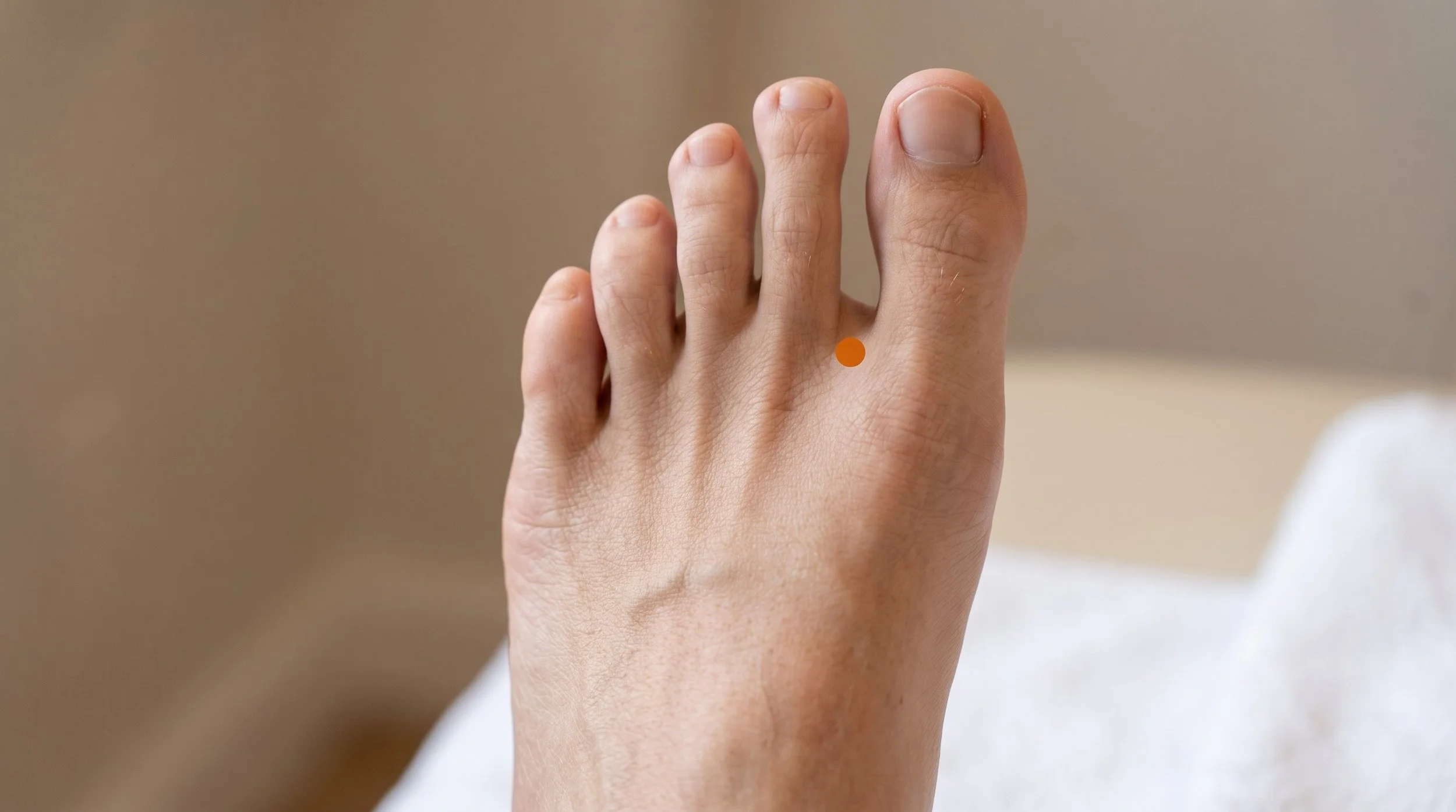
LV2 Acupuncture Point (Xingjian)
Moving Between the First and Second Toes: Anatomy, Mechanism, and Why This Ying-Spring Point Anchors Treatment for Irritability, Headache, and Forefoot Pain
LV2 (Xingjian, often written Liver 2 and translated as Moving Between), also written LR2, sits in the web of the foot between the big toe and second toe, right where the thicker sole skin meets the thinner skin of the dorsum.
In plain terms, if you slide a fingertip into the first web space and then move slightly back toward the ankle, you are over the LV 2 location.
Classical texts class it as the ying-spring and Fire point of the Liver channel and treat it as the channel's main heat-clearing point (Deadman et al., 2009), while in a modern clinic the LV2 acupuncture point earns its place for a more practical reason: it is a densely innervated distal site that patients feel strongly, it pairs naturally with LV3 for stress-related tension, and it sits directly over forefoot tissues that ache in dancers, runners, and anyone in stiff New York City shoes.
- Location and layers: LV2 lies in the first web space of the foot dorsum at the junction of the red and white skin, with some texts placing it about half a cun proximal to the web margin (Deadman et al., 2009; Cheng, 1999). The needle passes through thin skin and loose subcutaneous tissue before reaching interosseous fascia, so depth is modest and the target is neural rather than muscular.
- Traditional category, translated: sources describe LV2 as the ying-spring and Fire point of the Liver channel, traditionally used to clear Liver fire, calm rising Liver yang, settle interior wind, and cool the blood (Deadman et al., 2009; Kim, 2008). In modern language, that classical profile maps onto complaints of heat, agitation, headache, and pressure in the head rather than onto any measurable organ effect.
- Nerve story: the point overlies dorsal digital branches of the deep peroneal nerve alongside the dorsal digital vessels (Cheng, 1999), placing its input in the L4 to S1 segmental range and feeding the same spinal levels that serve the low back, hip, and leg.
- Mechanism: needling a distal, richly innervated site recruits small-diameter afferents that engage segmental inhibition in the dorsal horn and descending pain control from midbrain and brainstem circuits, with endogenous opioid and monoamine involvement (Zhao, 2008). Imaging work at the neighbouring Liver channel point LV3 has reported changes in cingulate, thalamic, and cerebellar activity compared with sham needling, which offers a plausible, if preliminary, account of why foot points can shift how the head feels (Wu et al., 2014; Rao et al., 2024).
- Research picture: Cochrane reviews of acupuncture protocols that commonly include distal Liver channel points found modest, moderate-certainty benefit for episodic migraine prevention and support for tension-type headache prevention (Linde et al., 2016a; Linde et al., 2016b), and individual patient data pooling shows small to moderate effects for chronic pain that persist over time (Vickers et al., 2018). No trial isolates LV2 by itself.
- Clinical framing and de qi: expect a dull, spreading ache or heaviness in the web space that may travel toward the big toe or up the dorsum, sometimes with a brief sharp note because distal points are sensitive. Retention is usually short, stimulation gentle, and LV2 is almost always used inside a larger prescription rather than alone.
Stressed, Wired, and Getting Headaches by Thursday?
At Morningside Acupuncture we use LV2 and LV3 together in downregulating sessions for patients whose stress shows up as a tight jaw, a short fuse, and end-of-week head pain. Distal foot points let us calm the nervous system while we treat the neck and shoulders directly with acupuncture and dry needling. Every plan is built around your history, your triggers, and your schedule. Book an appointment and let's map out what your pattern actually responds to.
Schedule NowAnatomy of LV2: Why the First Web Space of the Foot Is Such an Important Location
The first web space is a thin, mobile piece of real estate. Above the point is skin that changes texture within a few millimetres, from the tougher plantar surface to the finer skin of the dorsum, which is exactly the transition classical texts call the junction of the red and white skin (Deadman et al., 2009). Under that is a loose subcutaneous layer carrying the dorsal venous network, then fascia and the interosseous space between the first and second metatarsals, with the adductor hallucis and first dorsal interosseous nearby and the extensor hallucis longus tendon just medial.
What loads these tissues is everyday forefoot work: push-off during walking and running, sustained big toe extension in dance and yoga, and hours in narrow or rigid shoes that compress the web space and splay nothing while asking the toes to stabilize.
The nerve geography is what makes LV2 clinically useful. The point sits where dorsal digital nerve branches derived from the deep peroneal nerve run alongside the dorsal digital artery and vein toward the adjacent sides of the first and second toes (Cheng, 1999). Those fibres return to the spinal cord in roughly the L4 to S1 range, and once a needle recruits small-diameter afferents in that territory, the signal converges in the dorsal horn with input from muscle, joint, and skin at the same segments.
This convergence explains part of the local effect: segmental inhibition can reduce forefoot and dorsal foot pain without touching the tender spot itself. Stimulation of this kind also drives descending inhibitory pathways from the periaqueductal grey and rostral medulla, with opioid and monoaminergic transmitters involved, which is how a needle in the foot can modulate pain reported somewhere else entirely (Zhao, 2008).
Depth-wise there is little to worry about beneath the point, which is one reason LV2 has such consistent needling conventions across sources. The structures at risk are small: the dorsal digital vessels and superficial veins, so a brief bleed or a small bruise is the usual worst case. Standard technique is oblique insertion of roughly 0.5 to 1 cun angled proximally toward the heel, while other texts describe a shallower oblique approach of about 0.3 to 0.5 inch or a perpendicular insertion of 0.5 to 0.8 cun (Deadman et al., 2009; Cheng, 1999). Clinicians generally avoid visible varicosities, use fine needles because the area is sensitive, and keep stimulation moderate rather than heavy.
Related Liver Channel Related LV3 Acupuncture PointLV2 (LR2) at a Glance: Classification, Location, and Clinical Use
| Category | Detail |
|---|---|
| Traditional Name | Xingjian (Moving Between, also rendered Walk Between or Temporary In-Between) |
| Channel Classification | Liver channel, point 2 (LIV-2 in Deadman numbering, LR2 in WHO style) |
| Point Categories | Ying-spring point of the Liver channel; Fire point of the Liver channel in five-phase point theory, which makes it the child point of a Wood channel and a common choice for reducing method in excess patterns (Deadman et al., 2009; Maciocia, 2005) |
| Precise Location | On the dorsum of the foot at the margin of the web between the first and second toes, at the junction of the red and white skin; some texts place it about 0.5 cun proximal to the web margin |
| Tissue Stimulated | Skin and subcutaneous tissue of the first web space, interosseous fascia, and the adjacent forefoot muscles targeted in dry needling such as the dorsal interossei, the interossei of the foot, and adductor hallucis |
| Needle Depth / Direction | Oblique insertion 0.5 to 1 cun directed proximally toward the heel; shallower oblique or perpendicular insertion of about 0.3 to 0.8 cun is also described |
| De Qi Sensation | Dull spreading ache, fullness, or heaviness in the web space, often radiating toward the big toe or up the dorsum of the foot; a brief sharp sensation on insertion is common at distal points |
| Primary Clinical Uses | Stress-related irritability and tension (traditional attribution), headache, red or irritated eyes (traditional attribution), forefoot and dorsal foot pain |
| Common Point Combinations |
|
Traditional sources give LV2 an unusually confident job description. Deadman, Al-Khafaji, and Baker's Manual of Acupuncture presents it as the ying-spring and Fire point of the Liver channel and, on that basis, as the channel's leading point for clearing what the tradition called Liver fire and for settling rising Liver yang, citing the Great Compendium of Acupuncture and Moxibustion's instruction to reduce Xingjian when the Liver is in excess, and the Classic of Difficulties' association of ying-spring points with generalized heat (Deadman et al., 2009).
The classical indication lists cluster into three broad territories that are worth remembering as categories rather than as symptom inventories: complaints of the head and face (headache, dizziness, red and painful eyes, tearing, nosebleed, dry or constricted throat, a hot flushed face), emotional and spirit-level complaints (anger and irritability, fright and timidity, insomnia, palpitations, seizure disorders, childhood convulsions), and complaints of the lower body (genital pain and itching, difficult or painful urination, abdominal distention, menstrual irregularity and heavy bleeding, plus local pain of the instep, shin, knee, and low back).
Later commentary in the same text also notes cold hands and feet in a warm body, understood traditionally as heat constrained inside rather than true cold (Deadman et al., 2009). What is striking is how tightly that whole spread hangs on a single organizing idea: one small web-space point was asked to answer everything the tradition read as excess heat and forceful upward movement, from a red eye to a raging temper to reckless bleeding.
Why LV2 Is Used for Headaches, Irritability, and a Clenched Jaw When Nothing Hurts in the Foot
The first thing to say plainly is that needling your foot does not do anything to your liver. What it does do is create a strong, well-localized sensory event in a densely innervated area. Dorsal digital branches of the deep peroneal nerve carry that input back to lower lumbar and upper sacral spinal segments (Cheng, 1999), where it converges with signals from the leg, hip, and low back. That segmental convergence is why LV2 has a legitimate local and regional role: it can reduce forefoot pain, dorsal foot pain, and referred aching in the leg without needing to be inserted into the tender tissue itself.
The effects further away are explained differently. Sustained needle stimulation activates spinal and supraspinal circuits that damp pain transmission from above, with the periaqueductal grey, rostral ventromedial medulla, and endogenous opioid and monoamine systems all implicated (Zhao, 2008). The same networks overlap heavily with autonomic control, which is the most defensible way to describe what patients notice: slower breathing, a warmer sensation in the hands and feet, less muscular bracing, and a mood that feels less on edge by the end of a session. That is the neurophysiological translation of what classical texts called clearing heat and calming an over-driven system.
There is also point-adjacent imaging work. Resting-state fMRI studies of the neighbouring Liver channel point LV3 have reported altered activity in the anterior cingulate, thalamus, and cerebellum with true needling compared with sham (Wu et al., 2014), and a coordinate-based meta-analysis of LV3 imaging studies has looked at whether those patterns are consistent across trials (Rao et al., 2024). These are small studies in mostly healthy volunteers, and none of them tested LV2 specifically, so the honest framing is that they suggest a plausible central mechanism rather than proving point specificity.
For the emotional side of the picture, meta-analyses of acupuncture for anxiety report reductions in symptom scores with good tolerability but caution about methodological quality (Yang et al., 2021).
What the Research Shows for LV2 (LR2)
One note on naming before the evidence: in the research literature this point is usually listed as LR2, the WHO standard code, and sometimes as LV2 or LIV2, so it is worth searching all three if you want to read the studies below in full.
Nearly all of the useful research here tests whole protocols, not single points. Trials of acupuncture for headache, chronic pain, blood pressure, and anxiety typically use prescriptions of six to fifteen points selected by pattern, and distal Liver channel points such as LV2 and LV3 often appear inside those prescriptions without being reported separately. That means the reviews below tell you something about the treatment approach LV2 belongs to, and very little about LV2 in isolation.
Read them as context for a reasonable trial of care rather than as evidence for one location in the web of the foot, and expect gradual change across a course of sessions rather than a single dramatic response.
| Study | Type | Focus | Key Finding |
|---|---|---|---|
| Linde et al., 2016a | Cochrane systematic review | Acupuncture for the prevention of episodic migraine (22 trials, 4,985 participants) | Moderate-certainty evidence suggested that a course of at least six sessions may reduce migraine frequency compared with usual care, sham needling, and some drug prophylaxis, with effects described as modest. |
| Linde et al., 2016b | Cochrane systematic review | Acupuncture for the prevention of tension-type headache (12 trials, 2,349 adults) | Reviewers concluded acupuncture may be a useful option for frequent episodic or chronic tension-type headache, while noting limited trial quality and small differences against sham. |
| Vickers et al., 2018 | Individual patient data meta-analysis | Chronic musculoskeletal, headache, and osteoarthritis pain | Acupuncture was associated with small to moderate improvements over sham and no-acupuncture controls, with benefits that appeared to persist over about twelve months. |
| Yang et al., 2018 | Cochrane systematic review | Acupuncture for primary hypertension, a traditional indication listed for LV2 | The reviewers judged the available evidence insufficient to draw firm conclusions, with any short-term blood pressure changes rated as low certainty. |
| Yang et al., 2021 | Systematic review and meta-analysis | Acupuncture for anxiety disorders | Pooled results suggested reductions in anxiety symptom scores with few adverse effects, though the authors cautioned that included trials were heterogeneous and often methodologically weak. |
| Wu et al., 2014 | Resting-state fMRI study, true versus sham | Brain response to needling the adjacent Liver channel point LV3 in healthy volunteers | True needling was associated with changes in regions linked to sensation, emotion, and pain processing, including anterior cingulate, thalamus, and cerebellum, in a small sample. |
| Rao et al., 2024 | Systematic review with coordinate-based meta-analysis | Pooled fMRI findings for acupuncture at LV3 | The authors reported recurring activation patterns across imaging studies but emphasized that the neural mechanisms of the point remain incompletely defined. |
| Zhao, 2008 | Narrative mechanistic review | Neural pathways of acupuncture analgesia | Describes afferent recruitment, segmental spinal inhibition, and descending opioid and monoaminergic control as the core mechanisms behind needling-induced pain relief. |
Aching Forefoot From Running, Dancing, or Stiff City Shoes?
The first web space sits over tissues that get loaded hard by toe-off, narrow toe boxes, and long days on concrete. We combine gentle needling at LV2 with dry needling of the dorsal interossei and adductor hallucis, then add manual therapy and loading advice so the relief holds. Our clinicians treat feet as part of a chain that includes the calf, hip, and low back. Schedule a visit and we'll assess the whole chain, not just the sore spot.
Schedule NowLV2 in the Context of Trigger Point Work
Acupuncture, defined as treatment using an acupuncture needle, covers hundreds of styles, and dry needling is one of them. That matters at LV2 because the point sits directly over tissue that myofascial mapping also cares about. Tender, taut bands in the dorsal interossei, the deeper intrinsic foot muscles, and adductor hallucis can refer pain across the forefoot and into the toes (Simons et al., 1999), which overlaps closely with the instep pain, forefoot swelling, and toe discomfort that classical texts listed among the local indications for this point (Deadman et al., 2009).
In practice, palpation decides the approach: if the web space itself is exquisitely tender and the adjacent interosseous tissue feels ropey, we needle both the point and the muscle.
At Morningside we typically build a foot session around three layers. Local needling at or near LV2 addresses the web space and interosseous fascia, dry needling of the interossei, adductor hallucis, and abductor hallucis addresses the intrinsic muscles that fatigue under load, and proximal needling of the calf, peroneals, and hip muscles addresses what is driving forefoot overload in the first place.
When the presenting complaint is headache or stress rather than foot pain, LV2 usually appears in a much lighter role, paired with LV3 and combined with dry needling of the upper trapezius, suboccipitals, and masseter where the tension actually lives.
LV2 Headache and Stress Treatment at NYC's Highest-Rated Acupuncture Clinic
Morningside Acupuncture is the highest-rated acupuncture and dry needling clinic in New York City with over 500 five-star Google reviews. We integrate classical point selection such as LV2 and LV3 with orthopedic assessment and evidence-informed dry needling, so treatment addresses both your symptoms and the mechanics behind them. Patients tell us the difference is how carefully we explain what each needle is doing and why. Schedule your appointment today.
Schedule NowFrequently Asked Questions
Is LV2 the same point as LR2 or LIV2?
Yes. LV2, LR2, and LIV2 are all codes for the same point, Xingjian, point 2 of the Liver channel. LR is the WHO standard abbreviation and the one you will see in most research papers. LV is the form used by many American schools and clinics, and LIV appears in several widely used textbooks. You will also come across it written as Liver 2 or LIV-2. Whichever code is used, the location and the uses are the same.
What does LV2 feel like when needled?
Most people feel a quick pinch as the needle passes through the skin of the web space, then a dull spreading ache, fullness, or heaviness that may travel toward the big toe or up the dorsum of the foot. Because the area is richly innervated and thinly padded, the sensation can be sharper than at points on the thigh or back, so clinicians usually use a fine needle, insert obliquely toward the heel, and keep stimulation moderate. The ache typically settles within a few seconds and often turns into a warm, heavy feeling in the foot. Mild tenderness at the site for a day afterward is normal and not a problem.
Why needle a point on my foot for a headache or for stress?
Two reasons, one traditional and one physiological. Traditionally, LV2 is the ying-spring and Fire point of the Liver channel, and the classical model held that this channel's activity rose upward toward the head and eyes, so a distal point was used to draw that activity down (Deadman et al., 2009). Physiologically, needling a densely innervated distal site recruits afferent fibres that engage descending pain-modulating pathways from the brainstem and midbrain, along with autonomic changes that patients experience as reduced bracing and a calmer state (Zhao, 2008). Small imaging studies of the neighbouring point LV3 have reported changes in emotion- and pain-related brain regions with true versus sham needling (Wu et al., 2014). Distal points are also practical: they let us treat while you lie comfortably with the painful area accessible for manual work.
Can I press LV2 myself between sessions?
Yes, and it is one of the easier points to find on yourself. Sit down, slide your thumb tip into the web between your big toe and second toe, then move back toward the ankle a few millimetres until you feel a slight depression. Angle your pressure toward your heel rather than straight down, and press firmly enough to feel a dull ache without sharp pain. Hold for 30 to 60 seconds, release, and repeat two or three times per foot, doing both feet and up to a few times a day. Pair it with slow nasal breathing, six seconds in and six seconds out, since the breathing likely contributes as much as the pressure. Skip it over broken skin, visible varicose veins, infection, or a fresh injury, and check with your clinician first if you are pregnant or on blood thinners.
Is LV2 safe to needle?
It is a low-risk location in trained hands. There are no organs, joint capsules, or major nerves at depth, and the structures to respect are the small dorsal digital artery and vein and the superficial venous network of the foot dorsum (Cheng, 1999). The realistic side effects are a brief spot of bleeding, a small bruise, or short-lived soreness in the web space. Clinicians avoid needling through visible varicosities or areas of infection, cellulitis, or open wounds, and take extra care with patients who have diabetes-related neuropathy, poor circulation, or a history of foot ulceration, where any foot needling should be discussed with the treating physician. In a licensed practice using single-use sterile needles, infection risk is very low.
Where exactly is LV2 located?
LV2 is on the top of the foot in the web between the first and second toes, at the margin of the web where the paler dorsal skin meets the tougher plantar skin, a boundary classical texts call the junction of the red and white skin. Some sources describe the same point roughly half a cun proximal to the web margin, closer to the joint of the big toe, and in practice clinicians palpate for the tender depression between the two conventions (Deadman et al., 2009; Cheng, 1999). A simple way to orient yourself: find LV3 first, in the depression where the first and second metatarsal bones meet on the dorsum of the foot, then slide forward toward the toes until you reach the web. LV2 is on that same line, just short of the webbing.
References
- Deadman, P., Al-Khafaji, M., & Baker, K. (2009). A manual of acupuncture. Journal of Chinese Medicine Publications.
- Cheng, X. (Ed.). (1999). Chinese acupuncture and moxibustion (Rev. ed.). Foreign Languages Press.
- Maciocia, G. (2005). The foundations of Chinese medicine: A comprehensive text for acupuncturists and herbalists (2nd ed.). Elsevier Churchill Livingstone.
- Kim, H. (2008). Handbook of Oriental medicine (3rd ed.). Harmony & Balance Press.
- Simons, D. G., Travell, J. G., & Simons, L. S. (1999). Travell & Simons' myofascial pain and dysfunction: The trigger point manual, Vol. 1: Upper half of body (2nd ed.). Williams & Wilkins.
- Zhao, Z. Q. (2008). Neural mechanism underlying acupuncture analgesia. Progress in Neurobiology, 85(4), 355-375. https://doi.org/10.1016/j.pneurobio.2008.05.004
- Vickers, A. J., Vertosick, E. A., Lewith, G., MacPherson, H., Foster, N. E., Sherman, K. J., Irnich, D., Witt, C. M., & Linde, K. (2018). Acupuncture for chronic pain: Update of an individual patient data meta-analysis. Journal of Pain, 19(5), 455-474. https://doi.org/10.1016/j.jpain.2017.11.005
- Linde, K., Allais, G., Brinkhaus, B., Fei, Y., Mehring, M., Vertosick, E. A., Vickers, A., & White, A. R. (2016a). Acupuncture for the prevention of episodic migraine. Cochrane Database of Systematic Reviews, 2016(6), CD001218. https://doi.org/10.1002/14651858.CD001218.pub3
- Linde, K., Allais, G., Brinkhaus, B., Fei, Y., Mehring, M., Shin, B. C., Vickers, A., & White, A. R. (2016b). Acupuncture for the prevention of tension-type headache. Cochrane Database of Systematic Reviews, 2016(4), CD007587. https://doi.org/10.1002/14651858.CD007587.pub2
- Yang, J., Chen, J., Yang, M., Yu, S., Ying, L., Liu, G. J., Ren, Y. L., Wright, J. M., & Liang, F. R. (2018). Acupuncture for hypertension. Cochrane Database of Systematic Reviews, 2018(11), CD008821. https://doi.org/10.1002/14651858.CD008821.pub2
- Yang, X.-Y., Yang, N.-B., Huang, F.-F., Ren, S., & Li, Z.-J. (2021). Effectiveness of acupuncture on anxiety disorder: A systematic review and meta-analysis of randomised controlled trials. Annals of General Psychiatry, 20(1), 9. https://doi.org/10.1186/s12991-021-00327-5
- Wu, C., Qu, S., Zhang, J., Chen, J., Zhang, S., Li, Z., Chen, J., Ouyang, H., Huang, Y., & Tang, C. (2014). Correlation between the effects of acupuncture at Taichong (LR3) and functional brain areas: A resting-state functional magnetic resonance imaging study using true versus sham acupuncture. Evidence-Based Complementary and Alternative Medicine, 2014, 729091. https://doi.org/10.1155/2014/729091
- Rao, Y., Ge, L., & Wu, J. (2024). A systematic review and coordinate-based meta-analysis of fMRI studies on acupuncture at LR 3. Frontiers in Neuroscience, 18, 1341567. https://doi.org/10.3389/fnins.2024.1341567
Disclaimer: This web site is intended for educational and informational purposes only. Reading this website does not constitute providing medical advice or any professional services. This information should not be used for diagnosing or treating any health issue or disease. Those seeking medical advice should consult with a licensed physician. Seek the advice of a medical doctor or other qualified health professional for any medical condition. If you think you have a medical emergency, call 911 or go to the emergency room. No acupuncturist-patient relationship is created by reading this website or using the information. Morningside Acupuncture PLLC and its employees and contributors do not make any express or implied representations with respect to the information on this site or its use. For any legal interpretation of scope of practice in your state, consult a licensed attorney or regulatory authority.
Read more from our blog



