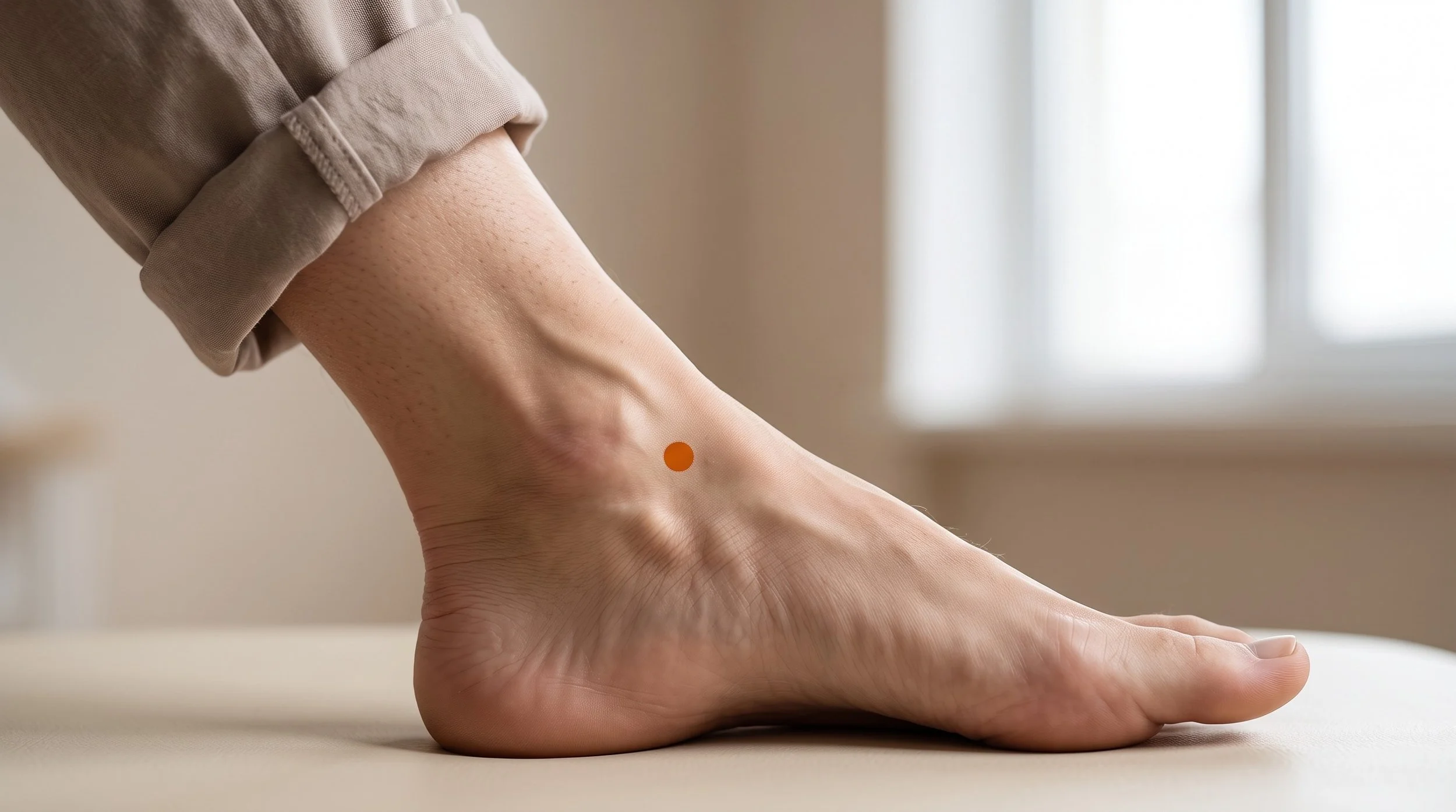
LV4 Acupuncture Point (Zhongfeng)
The Middle Seal at the Front of the Inner Ankle: Anatomy, Mechanism, and Why This Jing-River Point Bridges Ankle Pain and Lower Abdominal Complaints
LV4 (Zhongfeng, often translated as Middle Seal), also written LR4, is the fourth point on the Liver channel and its jing-river point, sitting in the small hollow at the front of the inner ankle just inside the tibialis anterior tendon. To find it, you draw your toes up toward your shin so that tendon stands out, then slide your finger to its medial side, roughly level with and slightly forward of the bony bump of the medial malleolus, about midway between SP5 and ST41.
Clinically it does double duty: it's a genuinely local point for medial ankle pain, stiffness, and post-sprain restriction, and it's one of the classical distal points traditionally used for complaints of the groin, lower abdomen, and urinary tract. That combination of a precise joint-line location and a long-standing pelvic reputation is what makes the LV4 acupuncture point worth understanding in detail.
- Location and layers: LV4 sits at the anterior ankle crease medial to the tibialis anterior tendon, where the needle passes through thin skin and subcutaneous tissue, the extensor retinaculum, and loose fascial planes overlying the talocrural joint capsule, which is why it's needled shallowly at 0.3 to 0.5 cun.
- Traditional framing: classical sources list Zhongfeng as the jing-river and Metal point of the Liver channel and attribute to it the spreading of Liver qi in the lower burner, with indications clustering around the genitals, urination, and the region around the navel (Deadman, A Manual of Acupuncture; Kim, Acupuncture Points).
- Mechanism in modern terms: the point lies in saphenous nerve skin territory over an ankle joint richly supplied by articular and fascial afferents, so needling here recruits A-delta and C fibers that feed lumbar spinal segments and engage descending inhibitory pathways rather than moving anything through a channel (Zhao, 2008).
- Research picture: reviews of needling for acute ankle sprain and chronic ankle instability report modest improvements in pain, proprioception, balance, and self-reported function, with the authors themselves flagging small trials and uneven methods (Park et al., 2013; Liu et al., 2020; Luan et al., 2023).
- Pelvic use has indirect support: a large sham-controlled trial found sustained symptom improvement in men with chronic prostatitis and chronic pelvic pain syndrome using multi-point protocols, which lends plausibility to the classical lower-abdominal role of distal Liver channel points without proving that LV4 alone does the work (Sun et al., 2021).
- De qi at LV4 is usually a tight, slightly achy fullness that can spread forward into the dorsum of the foot or back toward the inner heel; because the point overlies a joint line, it often feels sharper than fleshy points, so the needle is kept fine and the stimulation gentle.
Stiff, Aching Inner Ankle That Never Fully Recovered After a Sprain?
Old ankle sprains often leave behind guarded dorsiflexion, a sore medial joint line, and a foot that no longer trusts uneven ground. At Morningside Acupuncture we use LV4 as a precise local point at the front of the inner ankle, combined with dry needling of tibialis anterior, tibialis posterior, and the peroneals, plus loading and balance work you can carry into the gym. Sessions are structured, unhurried, and built around what your ankle actually does during the day. Schedule a visit and let's get that joint moving cleanly again.
Schedule NowAnatomy of LV4: Why the Front of the Medial Malleolus Is Such an Important Location
LV4 sits at the anterior ankle crease, in the depression on the medial side of the tibialis anterior tendon, roughly a cun in front of the prominence of the medial malleolus and about midway between SP5 and ST41. The tissue here is thin: skin, a shallow layer of subcutaneous fat, the superior and inferior extensor retinacula, and then dense connective tissue draping the talocrural joint capsule and the head and neck of the talus. Dorsiflexion tightens the tibialis anterior tendon and opens the hollow, which is why locating the point with the toes drawn up is not a stylistic preference but a practical necessity.
Loads that irritate this zone include repeated deep dorsiflexion in squatting and hill running, anterior ankle impingement, post-sprain capsular thickening, and boots or laces that compress the front of the joint.
The skin over LV4 is supplied by the saphenous nerve, the terminal sensory branch of the femoral nerve carrying L3 and L4 fibers, with medial branches of the superficial fibular nerve arriving just laterally. Deeper articular branches from the deep fibular and tibial nerves innervate the joint capsule itself. That means a needle here stimulates cutaneous, fascial, and periarticular afferents that all converge on lower lumbar and upper sacral dorsal horn segments, where wide-dynamic-range neurons pool input from skin, joint, and muscle.
Stimulating these afferents recruits segmental gating and activates descending inhibitory control through the periaqueductal gray and rostral ventromedial medulla, with endogenous opioid and monoaminergic signaling contributing to the analgesic response (Zhao, 2008). Deep fascial afferents are also the tissue class shown to matter most for somatosensory autonomic reflexes in animal work on hindlimb points, which is a useful reminder that fascia, not a channel, is the relevant substrate (Liu et al., 2021).
The structure that governs safety here is vascular. The great saphenous vein runs just in front of the medial malleolus and can be prominent in athletes and in anyone with venous insufficiency, so practitioners visually inspect and palpate before insertion and angle away from any visible vessel. Deeper and slightly lateral, the anterior tibial artery becomes the dorsalis pedis near ST41, another reason needling at LV4 stays shallow and medial to the tendon.
Standard technique is perpendicular insertion of 0.3 to 0.5 cun, or an oblique approach directed medially toward SP5 or laterally toward ST41 when a practitioner wants to spread stimulation along the joint line. Moxibustion is traditionally applied at this point, and in modern clinics that usually means indirect warming rather than anything placed directly on skin.
Related Acupuncture For Tibialis Anterior Pain Related Pain Finder Leg Ankle FootLV4 (LR4) at a Glance: Classification, Location, and Clinical Use
| Category | Detail |
|---|---|
| Traditional Name | Zhongfeng, commonly translated as Middle Seal |
| Channel Classification | Fourth point of the Liver channel (Foot Jueyin), on the anterior aspect of the medial ankle (LV4, also written LIV4 or LR4) |
| Point Categories | Jing-river point of the Liver channel; Metal point among the five transporting (five-shu) points; no meeting, hui-meeting, or extraordinary vessel designations are attributed to this point in the standard texts |
| Precise Location | On the anterior ankle, in the clear depression immediately medial to the tibialis anterior tendon when the ankle is dorsiflexed, about 1 cun in front of the prominence of the medial malleolus and midway between SP5 and ST41; classical sources place it variously at 1 or 1.5 cun from the malleolus |
| Tissue Stimulated | Skin in saphenous nerve territory, extensor retinaculum, the medial border of the tibialis anterior tendon sheath, and connective tissue over the talocrural joint capsule; nearby myofascial targets include tibialis posterior |
| Needle Depth / Direction | Perpendicular 0.3 to 0.5 cun, or oblique toward SP5 medially or ST41 laterally; fine needles, gentle stimulation, and visual check for the great saphenous vein first |
| De Qi Sensation | A tight, slightly achy fullness at the joint line that may spread into the top of the foot or toward the inner heel; sharper and more distinct than the heavy ache of muscular points |
| Primary Clinical Uses | Medial and anterior ankle pain, stiffness, and post-sprain restriction; classically used for groin and lower abdominal discomfort, difficult urination, and the sighing, low-mood presentation described in Liver qi terms |
| Common Point Combinations |
|
In A Manual of Acupuncture, Deadman and colleagues present Zhongfeng as the jing-river and Metal point of the Liver channel, and the traditional actions attributed to it are spreading Liver qi with a focus on the lower burner and clearing stagnant heat from the channel.
The classical indication lists, presented here as traditional attributions rather than physiological claims, fall into four rough groups: genital and hypogastric complaints including retraction, cold-type shan disorders, and several varieties of seminal emission; urinary difficulty ranging from hesitancy to the painful urinary syndromes and frank retention; abdominal patterns centered on the navel, with distention, discomfort after eating, and difficult bowel movements; and a scattered set including jaundice with low-grade fever, a greenish complexion, dry throat, contracted sinews, medial knee pain, cold feet, and swelling of the inner ankle.
Older commentary explains the genital and urinary emphasis by noting that the Liver channel was said to encircle the genitals and that smooth qi flow was held to govern both ejaculation in men and cycle regularity in women, while the Kidneys and Bladder handled urination with the Liver assisting. What's striking is the consistency: across many centuries and several source texts, this small hollow at the ankle kept being assigned to the pelvis rather than to the leg, which tells you the classical authors were tracking something more like a functional map than a local anatomy chart.
Why LV4 Is Used for Groin, Pelvic, and Urinary Complaints Far From the Ankle
The first part of the answer is spinal bookkeeping. The skin at LV4 is saphenous nerve territory, which traces back through the femoral nerve to the L3 and L4 nerve roots, while the joint capsule underneath adds articular afferents entering the lower lumbar and upper sacral cord. Sensory input from the pelvis, groin, and bladder enters the same general neighborhood of the spinal cord through lumbar and sacral routes, and the dorsal horn neurons receiving all of this are famously indiscriminate: they pool signals from skin, joint, viscera, and muscle.
That convergence is the standard explanation for why stimulation at a distant limb site can change how a pelvic or abdominal region is perceived, and it does not require any energy to travel anywhere (Zhao, 2008).
The second part is top-down. Needling that produces a clear de qi sensation reliably engages descending inhibitory systems running from the periaqueductal gray and rostral ventromedial medulla back down to the dorsal horn, using endogenous opioids, serotonin, and noradrenaline to turn down the volume on incoming signals across multiple segments at once (Zhao, 2008). Because this pathway is regional rather than pinpoint, a needle in the ankle can plausibly influence discomfort several segments away.
Animal work on hindlimb points adds a third layer, showing that specific deep fascial sensory neurons drive somatosensory autonomic reflexes and that where a needle sits in the tissue matters for which reflex it recruits (Liu et al., 2021). LV4 sits in exactly the kind of deep fascial and periarticular tissue implicated in that research, although extending mouse findings to human bladder or pelvic function remains speculative.
Clinically, the honest position is this: LV4 is a reasonable, well-grounded local point for the medial and anterior ankle, and a traditional distal choice for pelvic and lower abdominal complaints that we include as part of a broader protocol rather than as a standalone fix. The best pelvic evidence comes from trials of multi-point acupuncture, not from studies isolating this point, and those trials suggest meaningful, sustained symptom change in conditions like chronic pelvic pain syndrome (Sun et al., 2021). We use that as grounds for cautious optimism, not as a claim about one needle.
What the Research Shows for LV4 (LR4)
One note on naming before the evidence: in the research literature this point is usually listed as LR4, the WHO standard code, and sometimes as LV4 or LIV4, so it is worth searching all three if you want to read the studies below in full.
There's no clinical trial that isolates LV4, and there almost certainly never will be, because acupuncture research tests protocols rather than single points. What the literature can tell us is whether needling helps the conditions this point is chosen for, and how confident we should be. For the ankle the answer is a qualified yes with methodological caveats attached; for pelvic and urinary complaints the answer rests on multi-point trials where distal Liver channel points are typically part of a larger prescription. Read the table below as context for a clinical decision, not as proof that any single point carries the effect.
| Study | Type | Focus | Key Finding |
|---|---|---|---|
| Park et al., 2013 | Systematic review and meta-analysis | Acupuncture for ankle sprain (17 trials, 1820 participants) | Pooled results favored acupuncture for global symptom improvement, but the authors concluded that poor trial quality left the evidence insufficient to recommend it as an established treatment. |
| Liu et al., 2020 | Systematic review and meta-analysis | Acupuncture for acute ankle sprain, ankle scores and pain outcomes | An updated synthesis reported benefit on ankle function and pain measures with no signal of serious adverse events, while noting heterogeneity across included trials. |
| Luan et al., 2023 | Systematic review and meta-analysis | Acupuncture and related needling for chronic ankle instability (12 trials, 571 participants) | Needling was associated with improvements in pain, joint position sense, balance, and patient-reported ankle function, though the authors called for more trials to confirm the findings. |
| Sun et al., 2021 | Multicenter randomized sham-controlled trial | Acupuncture for chronic prostatitis and chronic pelvic pain syndrome | Twenty sessions over eight weeks produced greater symptom improvement than sham, with effects that persisted through 24 weeks of follow-up. |
| Vickers et al., 2018 | Individual patient data meta-analysis | Acupuncture for chronic musculoskeletal pain across roughly 20,000 patients | Acupuncture outperformed both sham and no-acupuncture controls, with effects that were modest in size but largely maintained over twelve months. |
| Liu et al., 2021 | Preclinical neuroanatomy study | Deep fascial sensory neurons and somatosensory autonomic reflexes at hindlimb points in mice | A specific population of deep fascia sensory neurons was required for electroacupuncture at a hindlimb site to drive an autonomic response, supporting tissue-level specificity rather than channel theory. |
Lower Abdominal, Groin, or Pelvic Discomfort That Keeps Coming Back?
Persistent pelvic and lower abdominal complaints rarely respond to a single point, and they rarely respond to guesswork either. Our practitioners combine distal Liver channel points like LV4 and LV3 with segmental needling near the lumbar and sacral levels that supply the pelvis, along with breathing and pelvic floor down-training when the exam suggests it. We're clear about what needling may and may not help with, and we coordinate with your physician when workup is needed. Book an evaluation to see whether this approach fits your case.
Schedule NowLV4 in the Context of Trigger Point Work
LV4 is not itself a muscle belly point, so it isn't a trigger point target in the strict sense. It sits at a tendon and joint interface, which makes it a useful anchor for the local half of an ankle treatment while the muscular half happens elsewhere. Tibialis anterior is the obvious neighbor, since its tendon forms the lateral wall of the depression, and taut bands in that muscle refer pain down toward the front of the ankle and great toe, a pattern well documented in the trigger point literature (Simons et al., 1999).
Tibialis posterior, flexor digitorum longus, and the peroneals commonly join the picture in patients with recurrent sprains or a collapsed medial arch, and needling those bellies frequently changes how the anterior joint line feels within the same session.
In practice at Morningside, a medial ankle case might start with LV4 and one or two neighboring joint-line points such as SP5, KD3, or ST41, then move to dry needling of tibialis anterior and tibialis posterior, with the calf complex added if dorsiflexion is limited by soleus rather than by the joint. Acupuncture here simply means the use of an acupuncture needle, and whether a given insertion is described in channel language or trigger point language matters less than whether it targets the tissue driving the complaint.
We finish with loading: calf raises, controlled dorsiflexion under load, and single-leg balance work, because needling reduces symptoms and irritability while the exercise is what restores capacity.
LV4 Ankle and Pelvic Pain Treatment at NYC's Highest-Rated Acupuncture Clinic
Morningside Acupuncture is the highest-rated acupuncture and dry needling clinic in New York City with over 500 five-star Google reviews, and that reputation comes from careful orthopedic assessment rather than one-size-fits-all point recipes. We treat the medial ankle with hands-on testing first, then needle LV4 and its neighbors alongside the muscles that actually control the joint. Every plan includes home strategies so progress holds between visits. Schedule your appointment with our Upper West Side team today.
Schedule NowFrequently Asked Questions
Is LV4 the same point as LR4 or LIV4?
Yes. LV4, LR4, and LIV4 are all codes for the same point, Zhongfeng, point 4 of the Liver channel. LR is the WHO standard abbreviation and the one you will see in most research papers. LV is the form used by many American schools and clinics, and LIV appears in several widely used textbooks. You will also come across it written as Liver 4 or LIV-4. Whichever code is used, the location and the uses are the same.
What does LV4 feel like when needled?
Most people describe a tight, slightly achy fullness right at the front of the inner ankle, sometimes with a spreading sensation into the top of the foot or back toward the inner heel. Because the point sits over a joint capsule with thin overlying tissue, the initial insertion can feel sharper and more defined than needling into a fleshy muscle. That sensation, called de qi, typically settles into a dull warmth within a few seconds. If it stays sharp, electric, or genuinely painful, tell your practitioner: the needle is adjusted or withdrawn, not endured.
Why would a point at the ankle be used for lower abdominal or urinary complaints?
Because the nervous system pools sensory information rather than keeping it in tidy compartments. Input from the skin and joint at LV4 enters the lower lumbar spinal cord, where dorsal horn neurons also receive signals from pelvic and abdominal structures, so stimulating one input can modulate how the other is processed (Zhao, 2008). Needling also engages descending inhibitory pathways from the brainstem that act broadly rather than at a single spot. Classical texts described this relationship in Liver channel language centuries before the neuroanatomy was mapped, and we keep the point selection while updating the explanation.
Can I press LV4 myself between sessions?
Yes, and it's easy to reach. Sit with your foot flat, draw your toes up toward your shin so the tibialis anterior tendon stands out at the front of the ankle, then slide a fingertip to the inner side of that tendon into the soft hollow, roughly level with the front edge of the ankle bone. Relax the foot and press straight in with your thumb or index finger at a firm but comfortable pressure, around a five or six out of ten, for 30 to 60 seconds. Repeat two or three rounds per ankle, once or twice a day, and try slow ankle circles or gentle dorsiflexion while holding pressure. Skip it over visible varicose veins, broken skin, an acutely swollen ankle, or any area that's numb, and stop if pressure sharply increases your pain.
Is LV4 safe to needle?
In trained hands it's a low-risk point, but it deserves respect for two reasons. The great saphenous vein passes just in front of the medial malleolus and can be superficial and prominent, so practitioners look and palpate before inserting and avoid any visible vessel. The point also lies over the ankle joint capsule, which is why the standard depth is a shallow 0.3 to 0.5 cun rather than anything deeper. Extra caution applies if you're on anticoagulants, have significant ankle swelling or an active joint infection, or have had recent ankle surgery or hardware placed. Bruising is the most common minor side effect at any ankle point.
Where exactly is LV4 located?
On the front of the ankle, in the depression immediately on the inner side of the tibialis anterior tendon, roughly 1 cun anterior to the prominence of the medial malleolus and about midway between SP5 and ST41. Dorsiflexing the ankle is essential for accurate Zhongfeng point location, since pulling the toes upward makes the tendon visible and opens the hollow beside it. Classical sources disagree slightly on the distance from the ankle bone, listing it as either 1 or 1.5 cun, which is a reminder that the palpable depression matters more than the tape measure. If you're checking your own LV 4 ankle landmark, look for the spot that feels distinctly softer than the bone in front of it and the tendon beside it.
References
- Deadman, P., Al-Khafaji, M., & Baker, K. (2009). A manual of acupuncture. Journal of Chinese Medicine Publications.
- Kim, H. (2008). Handbook of Oriental medicine (3rd ed.). Harmony & Balance Press.
- Maciocia, G. (2005). The foundations of Chinese medicine: A comprehensive text for acupuncturists and herbalists (2nd ed.). Elsevier Churchill Livingstone.
- Maciocia, G. (2006). The channels of acupuncture: Clinical use of the secondary channels and eight extraordinary vessels. Churchill Livingstone Elsevier.
- Simons, D. G., Travell, J. G., & Simons, L. S. (1999). Travell & Simons' myofascial pain and dysfunction: The trigger point manual, Vol. 1: Upper half of body (2nd ed.). Williams & Wilkins.
- Park, J., Hahn, S., Park, J. Y., Park, H. J., & Lee, H. (2013). Acupuncture for ankle sprain: Systematic review and meta-analysis. BMC Complementary and Alternative Medicine, 13, 55. https://doi.org/10.1186/1472-6882-13-55
- Liu, A. F., Gong, S. W., Chen, J. X., & Zhai, J. B. (2020). Efficacy and safety of acupuncture therapy for patients with acute ankle sprain: A systematic review and meta-analysis of randomized controlled trials. Evidence-Based Complementary and Alternative Medicine, 2020, 9109531. https://doi.org/10.1155/2020/9109531
- Luan, L., Zhu, M., Adams, R., Witchalls, J., Pranata, A., & Han, J. (2023). Effects of acupuncture or similar needling therapy on pain, proprioception, balance, and self-reported function in individuals with chronic ankle instability: A systematic review and meta-analysis. Complementary Therapies in Medicine, 77, 102983. https://doi.org/10.1016/j.ctim.2023.102983
- Sun, Y., Liu, Y., Liu, B., Zhou, K., Yue, Z., Zhang, W., Fu, W., Yang, J., Li, N., He, L., Zang, Z., Su, T., Fang, J., Ding, Y., Qin, Z., Song, H., Hu, H., Zhao, H., Mo, Q., ... Liu, Z. (2021). Efficacy of acupuncture for chronic prostatitis/chronic pelvic pain syndrome: A randomized trial. Annals of Internal Medicine, 174(10), 1357-1366. https://doi.org/10.7326/M21-1814
- Liu, S., Wang, Z., Su, Y., Qi, L., Yang, W., Fu, M., Jing, X., Wang, Y., & Ma, Q. (2021). A neuroanatomical basis for electroacupuncture to drive the vagal-adrenal axis. Nature, 598(7882), 641-645. https://doi.org/10.1038/s41586-021-04001-4
- Zhao, Z. Q. (2008). Neural mechanism underlying acupuncture analgesia. Progress in Neurobiology, 85(4), 355-375. https://doi.org/10.1016/j.pneurobio.2008.05.004
- Vickers, A. J., Vertosick, E. A., Lewith, G., MacPherson, H., Foster, N. E., Sherman, K. J., Irnich, D., Witt, C. M., & Linde, K. (2018). Acupuncture for chronic pain: Update of an individual patient data meta-analysis. Journal of Pain, 19(5), 455-474. https://doi.org/10.1016/j.jpain.2017.11.005
Disclaimer: This web site is intended for educational and informational purposes only. Reading this website does not constitute providing medical advice or any professional services. This information should not be used for diagnosing or treating any health issue or disease. Those seeking medical advice should consult with a licensed physician. Seek the advice of a medical doctor or other qualified health professional for any medical condition. If you think you have a medical emergency, call 911 or go to the emergency room. No acupuncturist-patient relationship is created by reading this website or using the information. Morningside Acupuncture PLLC and its employees and contributors do not make any express or implied representations with respect to the information on this site or its use. For any legal interpretation of scope of practice in your state, consult a licensed attorney or regulatory authority.
Read more from our blog



