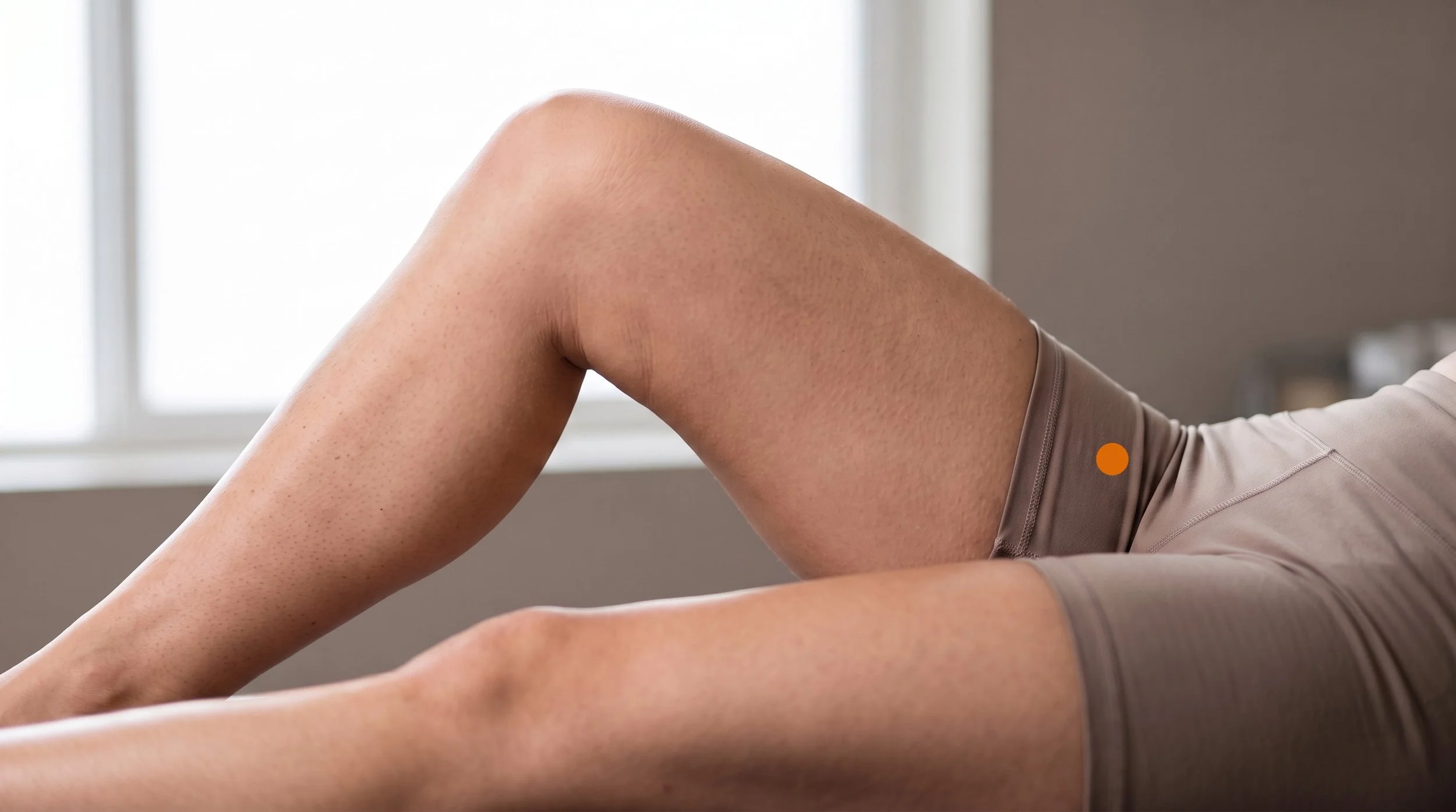
LV10 Acupuncture Point (Zuwuli)
Leg Five Miles on the Adductor Border: Anatomy, Mechanism, and Why This Upper Inner Thigh Point Bridges Groin Pain and Lower Abdominal Complaints
LV10 (Zuwuli), also written LR10, often translated as Leg Five Miles or Foot Five Li, sits high on the inner thigh at the front edge of the adductor longus, roughly one handbreadth (3 cun) below ST30 in the crease region of the groin. It's one of the least discussed points on the Liver channel, partly because the location is modest territory that requires careful draping and consent, and partly because its classical indications (difficult urination, genital itching, testicular swelling, lower abdominal fullness, and a striking listing for heavy sleepiness) look scattered until you map the local nerve supply.
Read anatomically, the LV10 acupuncture point sits over tissue innervated by the genitofemoral, medial femoral cutaneous, and obturator nerves, which share spinal segments with the lower abdomen, bladder, and external genitalia. That segmental overlap is what makes liver 10 worth knowing for groin strain, adductor-related pain, hip and pelvic complaints, and the stubborn inner thigh tension that shows up in runners, cyclists, and desk-bound New Yorkers alike.
- Location and layers: LV10 lies 3 cun below ST30 on the anterior (some texts say lateral) border of adductor longus, with skin and subcutaneous fat over the adductor longus tendon and belly, and pectineus and adductor brevis deeper. This is high-load tissue for anyone who sprints, changes direction, cycles, or sits with the hips flexed for long hours.
- Traditional attribution: classical sources credit LV10 with clearing damp-heat and benefiting the lower jiao, with indications gathered around urination and retention, genital itching and testicular swelling, lower abdominal fullness, and a distinctive listing for somnolence (Deadman text; Kim text). We present these as traditional attributions, not physiological claims.
- Mechanism story: needling here recruits genitofemoral and medial femoral cutaneous afferents superficially and anterior obturator branches more deeply, which enter the cord at roughly L1 to L4, the same neighborhood serving the groin, external genitalia, and parts of the bladder's autonomic supply. Convergence at those segments plausibly explains why an inner thigh point acquired a urinary and genital indication list (Zhao, 2008).
- Research picture: no trial isolates LV10, so the evidence is indirect. Individual patient data meta-analysis supports acupuncture over sham and no-acupuncture control for chronic musculoskeletal pain (Vickers et al., 2018), while pelvic and urinary reviews report modest and low-certainty benefits for multi-point protocols (Franco et al., 2018; Pan et al., 2023; Zheng et al., 2021).
- Clinical framing: at Morningside we mostly use liver 10 as a regional and myofascial point for adductor-related groin pain and hip complaints, layered into a treatment that includes distal points and, when appropriate, dry needling of the adductor group (Simons et al., 1999).
- De qi: expect a deep, spreading heaviness or dull ache across the upper inner thigh, sometimes drifting toward the groin or down along the adductor line. When the needle contacts a taut adductor band, a brief visible twitch and a short cramping sensation may occur, then settle.
Groin, Inner Thigh, or Hip Pain That Won't Settle?
Adductor-related groin pain rarely resolves with stretching alone, because the tissue is loaded every time you walk, climb subway stairs, or push off. Our licensed acupuncturists use LV10 and neighboring points on the adductor border alongside dry needling of the adductor longus, brevis, and magnus to reduce local tenderness and improve tolerance to loading. We pair that hands-on work with clear guidance on what to train between sessions. Schedule an evaluation and let's map where your groin pain is actually coming from.
Schedule NowAnatomy of LV10: Why the Adductor Longus Border Is Such an Important Location
Find the adductor longus tendon first: it's the prominent cord you can feel in the groin as you gently resist bringing the thigh inward, arising from the pubic bone. LV10 sits about one handbreadth below ST30 along the front edge of that muscle. The layers under the needle are thin skin, a variable pad of subcutaneous fat, then the tendon and upper belly of adductor longus, with pectineus and adductor brevis lying deeper toward the pubic ramus. This is the tissue that decelerates the leg in cutting sports, stabilizes the pelvis in single-leg stance, and shortens quietly during long hours of hip flexion. Adductor longus tendinopathy and taut bands in the proximal adductors are common findings in exactly this region.
The nerve geography is why LV10 behaves the way it does. Superficially, the area is served by the genitofemoral nerve and branches of the medial femoral cutaneous nerve; deeper, the anterior division of the obturator nerve supplies adductor longus and brevis. Those inputs enter the spinal cord around the first through fourth lumbar segments, which also carry sensation from the groin, scrotum or labia, and part of the lower abdominal wall, and which sit adjacent to autonomic outflow relevant to the bladder.
Needling stimulation of muscle and cutaneous afferents at a given segment can modulate processing of other inputs converging at the same level and recruits descending inhibitory pathways from the brainstem, which is the current working model for both local and remote acupuncture analgesia (Zhao, 2008). It also gives a plausible neurophysiological reading of the classical urinary and genital indication list without invoking any literal flow of energy.
Safety governs technique here. The femoral artery and vein run just lateral in the femoral triangle, the great saphenous vein passes through the region, and inguinal lymph nodes sit nearby, so practitioners palpate for the femoral pulse and needle medial to it, at the adductor border rather than into the triangle. Standard guidance is perpendicular or oblique insertion of about 0.5 to 1.5 cun, with shallower depths in lean patients (Deadman text; Kim text). Patients are positioned supine with the hip slightly abducted and externally rotated, and the area is draped so that only a small window of skin is exposed. Because the point is proximal and private, informed consent and clear explanation come before the needle does.
Related Adductor Longus Adductor Brevis Trigger Points Related Liver ChannelLV10 (LR10) at a Glance: Classification, Location, and Clinical Use
| Category | Detail |
|---|---|
| Traditional Name | Zuwuli (Leg Five Miles, also translated Foot Five Li) |
| Channel Classification | Liver channel of the foot (Jueyin), point 10 of 14, in the upper inner thigh group with LV9, LV11, and LV12 (LV10, also written LIV10 or LR10) |
| Point Categories | No five-shu, luo-connecting, xi-cleft, hui-meeting, or extraordinary vessel intersection designations are recorded for this point in the reference texts. It's listed simply for its actions of clearing damp-heat and benefiting the lower jiao (Deadman text; Kim text), and Maciocia's writing notes it among the classical arterial pulse-palpation sites and Liver channel palpation zones. |
| Precise Location | On the medial thigh, 3 cun (one handbreadth) directly inferior to ST30, along the anterior or lateral border of adductor longus, below the pubic tubercle. LV11 sits 2 cun below ST30, one cun proximal to LV10. |
| Tissue Stimulated | Skin and subcutaneous tissue of the proximal medial thigh, the tendon and upper belly of adductor longus with adductor brevis and pectineus deeper; overlaps clinically with adductor longus and adductor brevis trigger points and, with angled work, adductor magnus trigger points |
| Needle Depth / Direction | Perpendicular or oblique insertion 0.5 to 1.5 cun, angled along the adductor border and away from the femoral vessels; moxibustion is described as applicable in several texts |
| De Qi Sensation | Deep, spreading heaviness or dull ache in the upper inner thigh, sometimes referring toward the groin; a brief adductor twitch and short cramp may occur when a taut band is engaged |
| Primary Clinical Uses | Traditionally used for difficult urination and retention, genital itching and testicular swelling, lower abdominal fullness, and classically for heavy somnolence; used clinically today for adductor-related groin pain, proximal inner thigh tension, hip and pelvic region complaints |
| Common Point Combinations |
|
In the Deadman text, LV10 is presented with a single overarching traditional action, clearing damp-heat and benefiting the lower jiao, and an indication list that clusters in two places. The first cluster is urogenital and abdominal: trouble passing urine, retention, bedwetting, itching of the genitals, swollen and painful testicles, and fullness of the abdomen or lower abdomen.
The second is unexpected: sleepiness attributed to wind-taxation, along with labored breathing and cough. The combination entries come from the Thousand Ducat Formulas, which pair the point with SJ8, SJ10, ST45, and LI3 for somnolence in which a person has no desire to move the limbs, and with LV4 for jaundice accompanied by periodic low grade fever. Other classical sources add inguinal and lymphatic complaints and note a longstanding association with fatigue and constant lying down (Cunningham text).
What's striking is the pattern itself: a small, rarely used thigh point that classical authors kept attaching to both the plumbing of the lower abdomen and to profound heaviness of the whole body, two themes that a modern reader can at least partly reconcile through shared lumbar segmental innervation.
Why LV10 Is Used for Adductor-Related Groin Pain and Lower Abdominal Heaviness
Groin pain is a segmental crossroads. The proximal adductors, the lower abdominal wall, the pubic region, and parts of the pelvic viscera all report to the upper lumbar and lower thoracic segments of the spinal cord, so pain in one of them frequently blurs into the others. Athletes with adductor tendinopathy often describe symptoms that spread into the lower belly, and people with pelvic pain conditions often have exquisitely tender adductors.
Needling at the LV 10 thigh location delivers a strong, well-localized input into that shared segmental zone, and mechanistically the aim is to reduce excitability in the dorsal horn while recruiting descending inhibition from the brainstem, which is the best-supported explanation for how needling changes pain report (Zhao, 2008).
There's also a purely local story. The proximal adductor longus is a common site of taut bands and referred pain that spreads up into the groin and down the inner thigh, and needling directly into those bands is a standard myofascial approach (Simons et al., 1999). Because LV10 sits right on the anterior border of that muscle, the classical point and the modern trigger point target frequently overlap.
In practice, that means the same needle placement can be justified two ways, as a traditional Liver channel point of the lower jiao and as a mechanical intervention on an irritable adductor.
Expectations should stay measured. Reviews of acupuncture for chronic pain report benefits that are statistically clear but modest in size, with effects persisting over months rather than disappearing immediately (Vickers et al., 2018), while reviews focused specifically on hip osteoarthritis found only small, short-term differences of uncertain clinical importance (Manheimer et al., 2018). LV10 is a supporting player inside a broader treatment plan that usually includes loading exercise, not a standalone answer.
What the Research Shows for LV10 (LR10)
One note on naming before the evidence: in the research literature this point is usually listed as LR10, the WHO standard code, and sometimes as LV10 or LIV10, so it is worth searching all three if you want to read the studies below in full.
There's no clinical trial that tests LV10 by itself, and that's true for most single acupuncture points. What the literature offers instead is evidence about multi-point protocols in conditions where this point is one plausible component: chronic musculoskeletal pain, hip pain, pelvic pain syndromes, and urinary retention. Read those results as context for how a treatment plan containing Zuwuli might perform, not as evidence for the point in isolation. Certainty is often low, sham comparisons are difficult to design in needling research, and many trials are small.
| Study | Type | Focus | Key Finding |
|---|---|---|---|
| Vickers et al., 2018 | Individual patient data meta-analysis | Chronic musculoskeletal, headache, and osteoarthritis pain across roughly 20,000 patients | Acupuncture outperformed both sham and no-acupuncture controls with effects that were modest in magnitude and largely sustained over 12 months. |
| Manheimer et al., 2018 | Cochrane systematic review | Acupuncture for hip osteoarthritis | Differences versus sham on short-term pain and function were small and of uncertain clinical importance, with low-certainty evidence overall. |
| Franco et al., 2018 | Cochrane systematic review | Non-pharmacological interventions, including acupuncture, for chronic prostatitis and chronic pelvic pain syndrome | Acupuncture may reduce symptom scores compared with sham, though the certainty of evidence was limited by trial quality and size. |
| Pan et al., 2023 | Systematic review and meta-analysis | Acupuncture for chronic prostatitis and chronic pelvic pain syndrome | Pooled results favored acupuncture over sham and medication on pain and symptom indices, but only ten trials were available and larger studies were called for. |
| Zheng et al., 2021 | Meta-analysis | Acupuncture for urinary retention, mainly postpartum and postoperative | Acupuncture appeared safe and helpful for these forms of retention, with the commonly used points being abdominal and sacral rather than thigh points. |
| Zhong et al., 2018 | Systematic review and meta-analysis | Electroacupuncture for postoperative urinary retention in women | Reported outcomes favored electroacupuncture, though methodological limitations across the included trials temper the conclusion. |
| Zhao, 2008 | Narrative review of mechanisms | Neural pathways underlying acupuncture analgesia | Needling effects are attributed to afferent stimulation, spinal segmental modulation, and descending inhibitory control involving endogenous opioids and monoamines. |
Pelvic Heaviness and Lower Abdominal Tension After Everything Checked Out Fine?
When imaging and labs are unremarkable but the lower abdomen, groin, and inner thigh still feel tight and heavy, the pattern is often muscular and neural rather than structural. Zuwuli acupuncture, combined with points along the abdomen and lower leg, may help reduce protective guarding in the adductor and pelvic region while supporting calmer autonomic tone. Every session starts with a full intake and, where relevant, referral to your physician. Book a consultation to talk through your history.
Schedule NowLV10 in the Context of Trigger Point Work
Because LV10 sits on the front border of adductor longus, it lands in the same tissue that myofascial texts describe as a source of groin and inner thigh referral (Simons et al., 1999). At Morningside, when a patient presents with proximal groin pain that worsens with resisted adduction, we typically palpate the adductor longus tendon and belly first, then decide whether the most useful needle is a shallow classical insertion at the point or a slightly deeper, angled placement into a taut band.
Adductor brevis and pectineus can be addressed from a similar entry with careful angulation, and adductor magnus is usually treated further distally and posteriorly.
That combination approach is why Zuwuli acupuncture often appears in a treatment that doesn't look purely traditional. A session for adductor-related groin pain may include LV10 and LV11 locally, dry needling of the adductor group, distal points such as LV3 or GB34, and manual therapy or loading advice for the tendon. Acupuncture here simply means the use of an acupuncture needle, and the same tool serves both the classical point prescription and the trigger point target.
We also screen for the things needling won't address, including hip joint pathology, hernia, and pubic bone stress injury, and refer when the picture calls for imaging.
LV10 Groin and Hip Pain Treatment at NYC's Highest-Rated Acupuncture Clinic
Morningside Acupuncture is the highest-rated acupuncture and dry needling clinic in New York City with over 500 five-star Google reviews. Our practitioners combine classical point selection like LV10 with modern trigger point needling and rehabilitation-minded advice, so treatment addresses both the sore tissue and the way you load it. Sessions are private, respectfully draped, and paced to your comfort. Schedule your appointment today and get a plan you can actually follow.
Schedule NowFrequently Asked Questions
Is LV10 the same point as LR10 or LIV10?
Yes. LV10, LR10, and LIV10 are all codes for the same point, Zuwuli, point 10 of the Liver channel. LR is the WHO standard abbreviation and the one you will see in most research papers. LV is the form used by many American schools and clinics, and LIV appears in several widely used textbooks. You will also come across it written as Liver 10 or LIV-10. Whichever code is used, the location and the uses are the same.
What does LV10 feel like when needled?
Most people describe a deep, spreading heaviness or a dull ache across the upper inner thigh, sometimes drifting toward the groin. If the needle engages a taut band in the adductor longus, you may feel a brief cramp and see a quick twitch, which usually settles within a few seconds. Sharpness or an electric sensation is not the goal, and you should tell your practitioner right away so the needle can be adjusted or withdrawn.
Why would a point on the inner thigh be used for lower abdominal or urinary symptoms?
The skin and muscle around LV10 are supplied by the genitofemoral, medial femoral cutaneous, and obturator nerves, which enter the spinal cord at roughly the same lumbar levels that carry information from the groin, external genitalia, and part of the bladder's autonomic supply. Inputs converging at shared segments can influence one another, and needling also recruits descending pain-modulating pathways (Zhao, 2008). That segmental overlap is a reasonable modern reading of the classical indication list, though it does not mean the point treats urinary conditions on its own.
Can I press LV10 myself between sessions?
Yes, with a couple of caveats. Lie on your back with the knee bent and the thigh rolled outward, find the firm adductor longus tendon in the groin as you gently squeeze your knees together, then slide about a handbreadth down along its front edge. Press with a thumb or fingertips at a moderate, tolerable pressure for 30 to 60 seconds, repeat two or three times per side, and stop if you feel any pulsing under your fingers, which means you have drifted too far toward the femoral artery. Once or twice daily is plenty, and pair it with gentle adductor loading rather than aggressive stretching. Avoid the area if you have an unexplained lump, swelling, skin infection, or an acute injury that has not been assessed.
Is LV10 safe to needle?
In trained hands, yes. The main considerations are the femoral artery and vein lateral in the femoral triangle, the great saphenous vein, and nearby inguinal lymph nodes, so practitioners palpate the femoral pulse and needle medial to it along the adductor border at about 0.5 to 1.5 cun. Bruising is the most likely minor side effect, and depth is reduced in lean patients. The point is also anatomically private, so consent, careful draping, and clear communication are part of standard practice. People on anticoagulants, with local infection, or with a recent groin surgery should tell their practitioner before treatment.
Where exactly is LV10 located?
On the medial thigh, 3 cun (about one handbreadth) directly below ST30, along the anterior border of the adductor longus muscle. ST30 itself sits on the lower abdomen, 2 cun lateral to the midline and level with the top of the pubic symphysis. LV11 is 2 cun below ST30, so LV10 lies one cun distal to LV11 in the same line, with LV9 further down the thigh. Sources vary slightly, with some Chinese texts describing the lateral border of the adductor rather than the anterior border, so most clinicians locate the muscle first and then confirm by palpating for the most tender or taut spot.
References
- Deadman, P., Al-Khafaji, M., & Baker, K. (2009). A manual of acupuncture. Journal of Chinese Medicine Publications.
- Kim, H. (2008). Handbook of Oriental medicine (3rd ed.). Harmony & Balance Press.
- Cheng, X. (Ed.). (1999). Chinese acupuncture and moxibustion (Rev. ed.). Foreign Languages Press.
- O'Connor, J., & Bensky, D. (Eds. & Trans.). (1981). Acupuncture: A comprehensive text. Shanghai College of Traditional Medicine. Eastland Press.
- Cunningham, P. M. (2000). Acupuncture points: A practical guide to classical and modern usage. Odyssey Press.
- Maciocia, G. (2006). The channels of acupuncture: Clinical use of the secondary channels and eight extraordinary vessels. Churchill Livingstone Elsevier.
- Maciocia, G. (2005). The foundations of Chinese medicine: A comprehensive text for acupuncturists and herbalists (2nd ed.). Elsevier Churchill Livingstone.
- Simons, D. G., Travell, J. G., & Simons, L. S. (1999). Travell & Simons' myofascial pain and dysfunction: The trigger point manual, Vol. 1: Upper half of body (2nd ed.). Williams & Wilkins.
- Zhao, Z. Q. (2008). Neural mechanism underlying acupuncture analgesia. Progress in Neurobiology, 85(4), 355-375. https://doi.org/10.1016/j.pneurobio.2008.05.004
- Vickers, A. J., Vertosick, E. A., Lewith, G., MacPherson, H., Foster, N. E., Sherman, K. J., Irnich, D., Witt, C. M., & Linde, K. (2018). Acupuncture for chronic pain: Update of an individual patient data meta-analysis. Journal of Pain, 19(5), 455-474. https://doi.org/10.1016/j.jpain.2017.11.005
- Manheimer, E., Cheng, K., Wieland, L. S., Shen, X., Lao, L., Guo, M., & Berman, B. M. (2018). Acupuncture for hip osteoarthritis. Cochrane Database of Systematic Reviews, 2018(5), CD013010. https://doi.org/10.1002/14651858.CD013010
- Franco, J. V., Turk, T., Jung, J. H., Xiao, Y. T., Iakhno, S., Garrote, V., & Vietto, V. (2018). Non-pharmacological interventions for treating chronic prostatitis/chronic pelvic pain syndrome. Cochrane Database of Systematic Reviews, 2018(5), CD012551. https://doi.org/10.1002/14651858.CD012551.pub3
- Pan, J., Jin, S., Xie, Q., Wang, Y., Wu, Z., Sun, J., Guo, T. P., & Zhang, D. (2023). Acupuncture for chronic prostatitis or chronic pelvic pain syndrome: An updated systematic review and meta-analysis. Pain Research and Management, 2023, 7754876. https://doi.org/10.1155/2023/7754876
- Zheng, C., Li, Z., Lu, H., & Zhou, Y. (2021). Effectiveness of acupuncture on urinary retention: A meta-analysis. Evidence-Based Complementary and Alternative Medicine, 2021, 2500282. https://doi.org/10.1155/2021/2500282
- Zhong, Y., Zeng, F., Li, J., Yang, Y., Zhong, S., & Song, Y. (2018). Electroacupuncture for postoperative urinary retention: A systematic review and meta-analysis. Evidence-Based Complementary and Alternative Medicine, 2018, 7612618. https://doi.org/10.1155/2018/7612618
Disclaimer: This web site is intended for educational and informational purposes only. Reading this website does not constitute providing medical advice or any professional services. This information should not be used for diagnosing or treating any health issue or disease. Those seeking medical advice should consult with a licensed physician. Seek the advice of a medical doctor or other qualified health professional for any medical condition. If you think you have a medical emergency, call 911 or go to the emergency room. No acupuncturist-patient relationship is created by reading this website or using the information. Morningside Acupuncture PLLC and its employees and contributors do not make any express or implied representations with respect to the information on this site or its use. For any legal interpretation of scope of practice in your state, consult a licensed attorney or regulatory authority.
Read more from our blog



