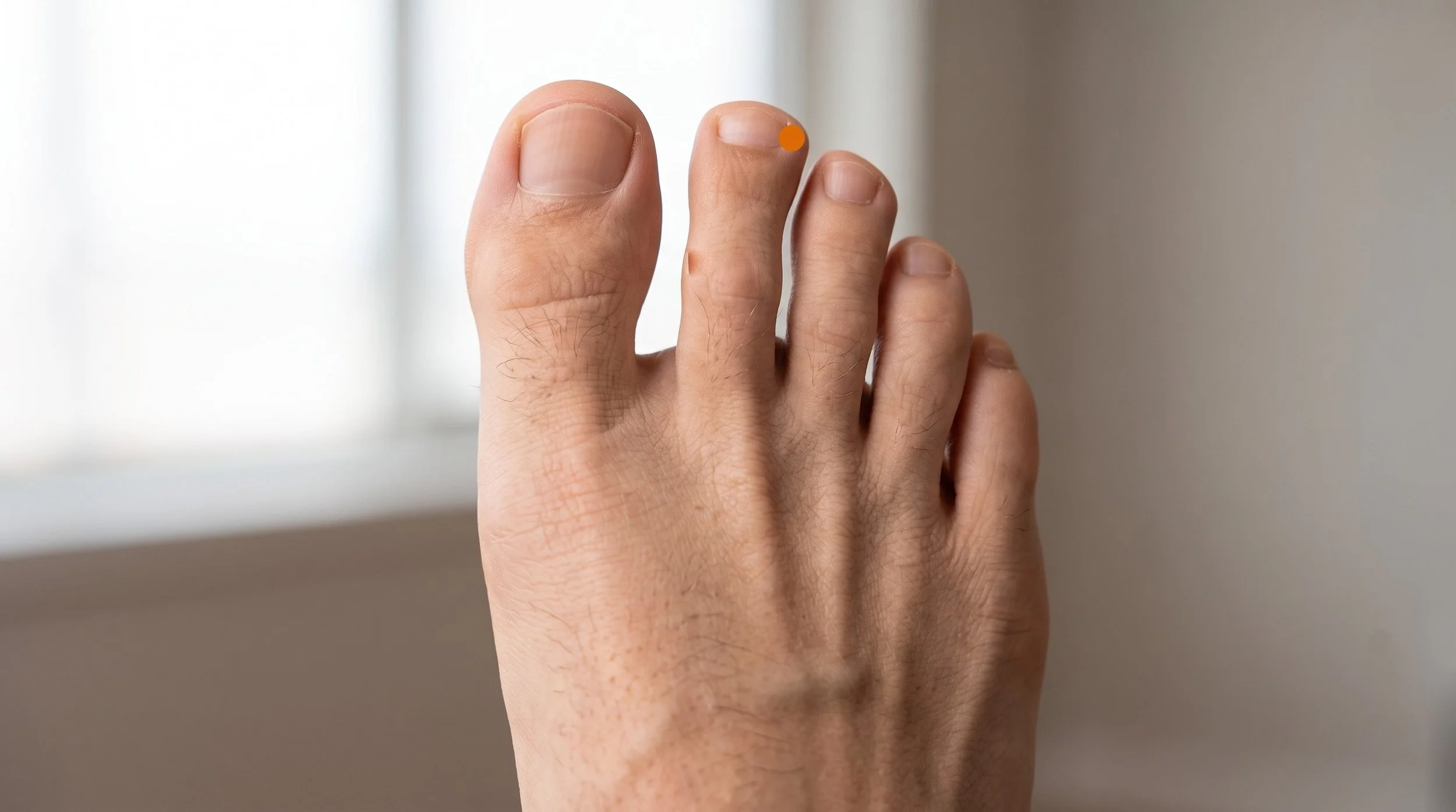
ST45 Acupuncture Point (Lidui)
The Jing-Well Point at the Corner of the Second Toenail: Anatomy, Mechanism, and Why the Stomach Channel's Most Distal Point Is Used for Restless Sleep and Facial Heat
ST45, known in Chinese as Lidui and usually translated as Strict Exchange (some texts render it Sick Mouth), sits at the very end of the Stomach channel on the outer corner of the second toenail, roughly a nail's width from the corner where the side and base of the nail meet. It is the jing-well point and the Metal point of the channel, which in classical five-shu theory makes it the place where the channel is considered to begin and where its influence on the opposite end of the pathway, the face and mouth, is strongest.
Clinically, the st45 acupuncture point is a small, highly innervated, briefly needled location that practitioners reach for in two very different situations: heat patterns showing up in the head (toothache, cracked lips, facial swelling, nosebleed) and restless, dream-heavy sleep. The st 45 toe location makes it one of the most sensation-rich points on the body, so technique matters more here than depth.
- Location and layers: ST45 lies at the lateral nail corner of the second toe, about 0.1 cun proximal to the angle formed by the side and base of the nail, in thin nail-fold skin over the distal phalanx with essentially no muscle beneath (Deadman et al., 2007; Kim, 2013). Needling is shallow, 0.1 to 0.2 cun angled backward, or the point may be pricked to release a drop or two of blood.
- Traditional categories translated: as the Stomach channel's jing-well and Metal point, classical texts assign it the roles of clearing heat from the channel and the Stomach, settling the spirit, and restoring consciousness (Deadman et al., 2007). In modern terms, that maps onto strong small-fiber input from a densely innervated acral site rather than any literal movement of heat.
- Nerve story: the toe tip is served by terminal dorsal digital branches of the fibular (peroneal) nerves in a field with very high receptor density and abundant arteriovenous anastomoses, so brief stimulation here recruits A-delta and C fibers efficiently and engages spinal and brainstem descending pain-control systems along with sympathetic vasomotor reflexes (Zhao, 2008).
- Research picture: reviews of acupuncture for insomnia report improvements in sleep quality scores but consistently flag methodological weakness and heterogeneity across trials (Cheuk et al., 2012; Kim et al., 2021), while objective polysomnographic changes appear modest and inconsistent (Zhao et al., 2021). None of these reviews isolate ST45, so its contribution stays inferential.
- Clinical framing: ST45 is rarely a stand-alone treatment. It is typically added to a broader prescription, often paired with ST44 for face and mouth heat or with SP1 for dream-disturbed sleep, and it is generally retained only briefly because of how sensitive the site is (Deadman et al., 2007).
- De qi at ST45 is not the dull, spreading ache of a thick-muscle point. Most people feel a sharp, bright pinch that fades within seconds into a hot or tingling pinpoint sensation, sometimes with a brief line of feeling running up the top of the foot.
Struggling With Restless, Dream-Filled Sleep in NYC?
At Morningside Acupuncture we treat sleep complaints as a nervous system problem, not just a bedtime problem, and distal points like ST45 are one small part of a larger plan that usually includes calming points, cervical and jaw release, and breathing work. We take a full sleep history first, including caffeine timing, screen exposure, stress load, and any digestive symptoms that show up at night. Then we build a protocol you can actually follow between visits. Schedule a session and let's map out what your sleep pattern is really doing.
Schedule NowAnatomy of ST45: Why the Second Toenail Corner Is Such an Important Location
The tissue at ST45 is about as simple as anatomy gets and about as sensitive as skin becomes. Just above the bone you have a thin layer of nail-fold skin, the lateral paronychium, a small amount of subcutaneous fat, and then the periosteum of the distal phalanx of the second toe. There is no muscle belly here and no meaningful fascial plane to thread through, which is exactly why the classical instruction is a 0.1 to 0.2 cun insertion angled proximally rather than anything deeper (Deadman et al., 2007).
What loads this area in daily life is footwear and gait: narrow toe boxes, long second toes, hammertoe deformity, and repeated push-off pressure all make the second toe tip a chronically compressed, occasionally inflamed piece of real estate. That matters clinically, because patients who already have nail-fold irritation are poor candidates for needling or bleeding at this site.
Neurologically, the toe tips are premium territory. Terminal dorsal digital nerves derived from the fibular (peroneal) nerve system fan out into the nail bed and lateral nail fold, and this region carries one of the higher innervation densities in the lower limb, with abundant free nerve endings and mechanoreceptors packed into a few square millimeters. Sensory input from here enters the cord at roughly the L4 through S1 levels, so ST45 shares no segmental relationship at all with the teeth, lips, or face.
The plausible mechanism for its traditional facial indications is therefore not segmental but heterosegmental: brief, intense small-fiber input from an acral site recruits descending inhibitory pathways involving the periaqueductal gray and rostral ventromedial medulla, along with endogenous opioid and monoamine signaling that can dampen nociceptive traffic far from the needle (Zhao, 2008). Trials of acupuncture in acute dental pain suggest a possible analgesic effect that is real but modest and limited by study quality (Müller et al., 2023), which fits a diffuse inhibitory mechanism rather than a targeted one.
Vascularly, the nail fold sits over a dense capillary bed and a network of arteriovenous anastomoses and glomus bodies that regulate digital blood flow, fed by the small dorsal digital arteries. There is no large vessel or organ at risk, but the density of that microvasculature is exactly why the point bleeds readily when pricked and why a drop or two is the usual endpoint.
Practical conventions follow from this: sterile single-use needles or a lancet, brief retention, firm hemostasis afterward, and a low threshold to skip the point entirely in patients with diabetes, peripheral neuropathy, peripheral arterial disease, lymphedema, active nail infection, or bleeding disorders and anticoagulant therapy. Moxibustion is also traditionally applied at this point, and when it is used, careful heat control at a location with limited soft tissue padding is essential (Kim, 2013).
Related Stomach Channel Related Deep Intrinsic Foot Muscles Trigger PointsST45 at a Glance: Classification, Location, and Clinical Use
| Category | Detail |
|---|---|
| Traditional Name | Lidui (Strict Exchange; also translated Sick Mouth) |
| Channel Classification | Stomach channel of Foot Yangming, forty-fifth and final point |
| Point Categories | Jing-well point and Metal point of the Stomach channel in the five-shu sequence; the channel's most distal point, described in classical channel theory as the Origin and Root of the Stomach channel, whose End and Branch lie in the frontal region of the face |
| Precise Location | On the dorsal aspect of the second toe, where a line along the outer border of the nail meets a line along its base, about 0.1 cun from the nail corner |
| Tissue Stimulated | Nail-fold skin, subcutaneous tissue, and terminal dorsal digital nerve endings over the distal phalanx; no muscle at the site itself, though treatment often includes nearby interossei and deep intrinsic foot muscles |
| Needle Depth / Direction | Perpendicular or oblique insertion angled proximally, 0.1 to 0.2 cun; alternatively pricked with a lancet to release one to two drops of blood; moxibustion is traditionally applicable |
| De Qi Sensation | A sharp initial pinch settling into a hot, tingling pinpoint, occasionally with a brief thread of sensation up the dorsum of the foot; strong ache is neither expected nor needed here |
| Primary Clinical Uses | Traditionally used for dream-disturbed sleep, nightmares, and insomnia with restlessness; face and mouth heat patterns including toothache, cracked lips, facial swelling, and nosebleed; excessive hunger and food retention patterns; and as a jing-well point for acute loss of consciousness |
| Common Point Combinations |
|
In the classical literature summarized by Deadman and colleagues, ST45 carries two headline attributions: it clears heat from the Stomach channel and to some extent the Stomach organ, and it clears heat while settling the spirit, with the additional jing-well capacity to rouse someone from collapse.
The reasoning offered for its reach is structural rather than mystical in the traditional framing: the Spiritual Pivot advises treating what is above by selecting below, and ST45 sits at the opposite pole of a channel whose upper course covers the forehead, nose, teeth, and lips, so heat rising along Yangming to the face was treated from the toe.
The spirit-calming side is traditionally explained by the Stomach channel's internal connections toward the Heart and its links with the Governing vessel on the face, and the point appears in classical indication lists for excessive dreaming, insomnia, being easily frightened, and florid manic presentations described in vivid behavioral language. What makes the pattern striking is its symmetry: the same point was used both for people who could not sleep and for people who could not stay awake, which classical authors read as a regulating rather than a one-directional effect.
Why ST45 Is Used for Insomnia and Nightmares When It Sits on the Second Toe
The most common question about the lidui insomnia point is the obvious one: how can a needle at the toe have anything to do with sleep or with a toothache? The honest answer is that there is no segmental route. Sensation from the second toe enters the spinal cord around L4 to S1, nowhere near the trigeminal system that serves the teeth and face, and nowhere near the brainstem nuclei that gate arousal. So whatever ST45 contributes has to travel a longer road, through supraspinal processing rather than local reflex.
That longer road is well described in the pain neuroscience literature. Needling recruits A-delta and C afferents, which activate the periaqueductal gray and rostral ventromedial medulla and trigger descending inhibition mediated by endogenous opioids, serotonin, and noradrenaline, with measurable effects on how the central nervous system processes incoming signals (Zhao, 2008). Acral sites like the toe tips are efficient triggers for this because of their receptor density.
There is also an autonomic dimension: strong distal stimulation produces reflex changes in cutaneous vasomotor tone and heart rate variability, and a shift toward parasympathetic dominance is plausibly relevant to sleep onset, though this remains an inference rather than a demonstrated effect of ST45 specifically.
On the sleep side, the most interesting physiological signal comes from a small early study in which five weeks of acupuncture was associated with increased nocturnal melatonin secretion and improvements in polysomnographic measures including sleep onset latency, total sleep time, and sleep efficiency (Spence et al., 2004). That study was open-label and uncontrolled, and it used a multi-point protocol, so it cannot be read as evidence for stomach 45 in particular.
It does, though, offer a plausible physiological bridge between what practitioners observe clinically and what the classical texts described as calming the spirit.
What the Research Shows for ST45
There is no clinical trial of ST45 on its own, and there almost certainly never will be, because acupuncture is delivered as a prescription of several points rather than as an isolated intervention. What the literature can tell us is whether the conditions ST45 is traditionally used for respond to acupuncture protocols that sometimes include it, and how confident we should be in those findings.
The short version: sleep outcomes generally improve on subjective scales, objective sleep architecture changes are smaller and less consistent, dental pain findings are suggestive but limited, and study quality across the board is the main constraint. Read the table below as context for how ST45 might contribute, not as evidence for the point itself.
| Study | Type | Focus | Key Finding |
|---|---|---|---|
| Cheuk et al., 2012 | Cochrane systematic review | Acupuncture and acupressure for insomnia across 33 trials and 2,293 participants | Some sleep quality benefit was reported, particularly for acupressure and for acupuncture added to other treatment, but the authors concluded that high-quality evidence was lacking and that all included trials carried high risk of bias. |
| Kim et al., 2021 | Systematic review and meta-analysis | Acupuncture versus pharmacotherapy or sham for insomnia, 24 randomized controlled trials | Pooled analysis of 15 trials favored acupuncture on the Pittsburgh Sleep Quality Index, though heterogeneity was very high and the authors called for more rigorous trials. |
| Zhao et al., 2021 | Systematic review and meta-analysis | Objective sleep indices measured by polysomnography or actigraphy in primary insomnia | Objective improvements were less consistent than subjective ones, suggesting that reported benefit may exceed what instruments currently capture. |
| Spence et al., 2004 | Open-label clinical study with polysomnography | Nocturnal melatonin and sleep architecture in 18 anxious adults with insomnia | Five weeks of acupuncture was associated with increased nocturnal melatonin and improved sleep onset latency and efficiency, though the uncontrolled design limits interpretation. |
| Müller et al., 2023 | Systematic review and meta-analysis | Acupuncture for acute dental pain, intraoperative and postoperative | Pooled data suggested lower postoperative pain scores versus sham acupuncture, with the authors emphasizing methodological shortcomings and the need for higher-quality studies. |
| Vickers et al., 2018 | Individual patient data meta-analysis | Chronic pain across roughly 20,000 patients in high-quality trials | Acupuncture outperformed both sham and no-acupuncture controls with effects persisting over time, supporting the broader analgesic framework within which distal points are used. |
Facial Heat, Jaw Tension, and Tooth-Related Pain?
Stomach channel points from the toe to the jaw are traditionally used together for heat patterns in the face, and we combine them with dry needling of the masseter, temporalis, and lateral pterygoid when myofascial referral is part of the picture. Acupuncture is never a substitute for dental evaluation, so we coordinate with your dentist when a tooth is the source. What we can address is the muscular and neural amplification around it. Book a visit to have your jaw and face assessed properly.
Schedule NowST45 in the Context of Trigger Point Work
ST45 itself is not a muscular point, so it does not overlap with any trigger point in the way that ST36 overlaps with tibialis anterior. What it does share is a neighborhood. When patients come in with forefoot pain, second toe symptoms, or the burning, cramping quality that often accompanies narrow footwear and long hours on hard NYC pavement, we frequently find taut bands and referral patterns in the dorsal and plantar interossei, adductor hallucis, and the deeper intrinsic foot muscles, all of which can refer pain toward the toes (Simons et al., 1999).
In those cases the treatment plan usually leads with dry needling of the involved intrinsics and adds ST45 only if the classical indications also fit.
The pairing runs in the other direction too. For patients whose complaint is jaw, tooth, or facial pain, we often needle the masseter, temporalis, and lateral pterygoid, since myofascial referral from these muscles can convincingly mimic dental pain and frequently accompanies clenching and disturbed sleep (Simons et al., 1999). Adding a distal Stomach channel point like ST45 or ST44 to that local work is a way of layering a heterosegmental input onto segmental treatment.
Because ST45 is genuinely sharp, we discuss it with patients beforehand, keep retention brief, and skip it without hesitation in anyone with compromised circulation, neuropathy, or nail-fold irritation.
ST45 Insomnia and Facial Heat Treatment at NYC's Highest-Rated Acupuncture Clinic
Morningside Acupuncture is the highest-rated acupuncture and dry needling clinic in New York City with over 500 five-star Google reviews, and our approach blends classical point selection with modern pain science. We use points like ST45 deliberately and sparingly, always inside a treatment plan built around your specific presentation. Sessions are unhurried, clearly explained, and adjusted visit by visit. Schedule your appointment today.
Schedule NowFrequently Asked Questions
What does ST45 feel like when needled?
Expect a sharp, bright pinch on insertion. The toe tips are densely innervated, so this point is more intense than most, though the sensation typically drops off within a few seconds into a warm, tingling pinpoint that some people feel tracking a short distance up the top of the foot. Because it is only inserted 0.1 to 0.2 cun, the needle is barely under the skin. If your practitioner is pricking the point to release a drop of blood instead, the sensation is a quick sting followed by almost nothing. Tell us if it is too much and we will adjust or use a different point.
Why treat sleep or a toothache from a point on the toe?
Classical texts framed it as treating what is above by selecting from below, since ST45 sits at the far end of a channel whose upper course covers the forehead, nose, teeth, and lips (Deadman et al., 2007). Physiologically, there is no segmental connection between the second toe and the face, so the plausible explanation is heterosegmental: intense small-fiber input from a densely innervated acral site engages descending inhibitory systems in the brainstem that can modulate pain and arousal well away from the needle (Zhao, 2008). That is a mechanism for general modulation, not a targeted line from toe to tooth, and it is one reason ST45 is used alongside local points rather than instead of them.
Can I press ST45 myself between sessions?
Yes, and acupressure is the sensible self-care version of this point since needling and bleeding are clinic procedures. Find the outer corner of your second toenail and slide about a nail's width toward the base of the nail, staying on the outer side. Use your thumbnail edge or the pad of your index finger and apply firm, steady pressure for 30 to 60 seconds, enough to feel a distinct ache but never enough to break skin or leave a mark. Repeat on the other foot, and do two or three rounds per side. For sleep, most people find it most useful 30 to 60 minutes before bed, often combined with slow nasal breathing with a longer exhale. Skip it if you have neuropathy, poor circulation, diabetes with foot complications, an ingrown nail, or any local infection, and stop if it causes lasting soreness.
Is ST45 safe to needle?
In trained hands, yes. There is no organ, major vessel, or nerve trunk at risk, and the insertion is only 0.1 to 0.2 cun, so the main considerations are comfort, bleeding, and infection control rather than deep structures. We use sterile single-use needles or lancets, retain briefly, and apply firm pressure afterward. We avoid the point, or choose a different approach entirely, in patients with peripheral neuropathy, peripheral arterial disease, diabetes-related foot risk, lymphedema of the leg, bleeding disorders or anticoagulant therapy, or any active nail-fold infection or ingrown nail. Moxibustion is traditionally applicable here but requires careful heat control given how little soft tissue covers the bone.
Where exactly is ST45 located?
On the top of the second toe at the outer nail corner. Picture one line running along the outer border of the nail and another running along its base: ST45 sits where those two lines meet, then about 0.1 cun (roughly a nail's width, or 1 to 2 millimeters) proximal to that corner, in the nail fold. It is on the lateral side, meaning the side facing the third toe, not the side facing the big toe. If you are hunting for the st 45 toe location on yourself, work from the nail corner rather than from the tip of the toe, since the tip is easy to overshoot.
References
- Deadman, P., Al-Khafaji, M., & Baker, K. (2009). A manual of acupuncture. Journal of Chinese Medicine Publications.
- Kim, H. (2008). Handbook of Oriental medicine (3rd ed.). Harmony & Balance Press.
- Simons, D. G., Travell, J. G., & Simons, L. S. (1999). Travell & Simons' myofascial pain and dysfunction: The trigger point manual, Vol. 1: Upper half of body (2nd ed.). Williams & Wilkins.
- Cheuk, D. K. L., Yeung, W. F., Chung, K. F., & Wong, V. (2012). Acupuncture for insomnia. Cochrane Database of Systematic Reviews, 2012(9), CD005472. https://doi.org/10.1002/14651858.CD005472.pub3
- Kim, S. A., Lee, S. H., Kim, J. H., van den Noort, M., Bosch, P., Won, T., Yeo, S., & Lim, S. (2021). Efficacy of acupuncture for insomnia: A systematic review and meta-analysis. American Journal of Chinese Medicine, 49(5), 1135-1150. https://doi.org/10.1142/S0192415X21500543
- Zhao, F. Y., Fu, Q. Q., Kennedy, G. A., Conduit, R., Zhang, W. J., Wu, W. Z., & Zheng, Z. (2021). Can acupuncture improve objective sleep indices in patients with primary insomnia? A systematic review and meta-analysis. Sleep Medicine, 80, 244-259. https://doi.org/10.1016/j.sleep.2021.01.053
- Spence, D. W., Kayumov, L., Chen, A., Lowe, A., Jain, U., Katzman, M. A., Shen, J., Perelman, B., & Shapiro, C. M. (2004). Acupuncture increases nocturnal melatonin secretion and reduces insomnia and anxiety: A preliminary report. Journal of Neuropsychiatry and Clinical Neurosciences, 16(1), 19-28. https://doi.org/10.1176/jnp.16.1.19
- Müller, M., Schmucker, C., Naumann, J., Schlueter, N., Huber, R., & Lederer, A. K. (2023). Acupuncture in management of acute dental pain: A systematic review and meta-analysis. Japanese Dental Science Review, 59, 114-128. https://doi.org/10.1016/j.jdsr.2023.02.005
- Zhao, Z. Q. (2008). Neural mechanism underlying acupuncture analgesia. Progress in Neurobiology, 85(4), 355-375. https://doi.org/10.1016/j.pneurobio.2008.05.004
- Vickers, A. J., Vertosick, E. A., Lewith, G., MacPherson, H., Foster, N. E., Sherman, K. J., Irnich, D., Witt, C. M., & Linde, K. (2018). Acupuncture for chronic pain: Update of an individual patient data meta-analysis. Journal of Pain, 19(5), 455-474. https://doi.org/10.1016/j.jpain.2017.11.005
Disclaimer: This web site is intended for educational and informational purposes only. Reading this website does not constitute providing medical advice or any professional services. This information should not be used for diagnosing or treating any health issue or disease. Those seeking medical advice should consult with a licensed physician. Seek the advice of a medical doctor or other qualified health professional for any medical condition. If you think you have a medical emergency, call 911 or go to the emergency room. No acupuncturist-patient relationship is created by reading this website or using the information. Morningside Acupuncture PLLC and its employees and contributors do not make any express or implied representations with respect to the information on this site or its use. For any legal interpretation of scope of practice in your state, consult a licensed attorney or regulatory authority.
Read more from our blog



