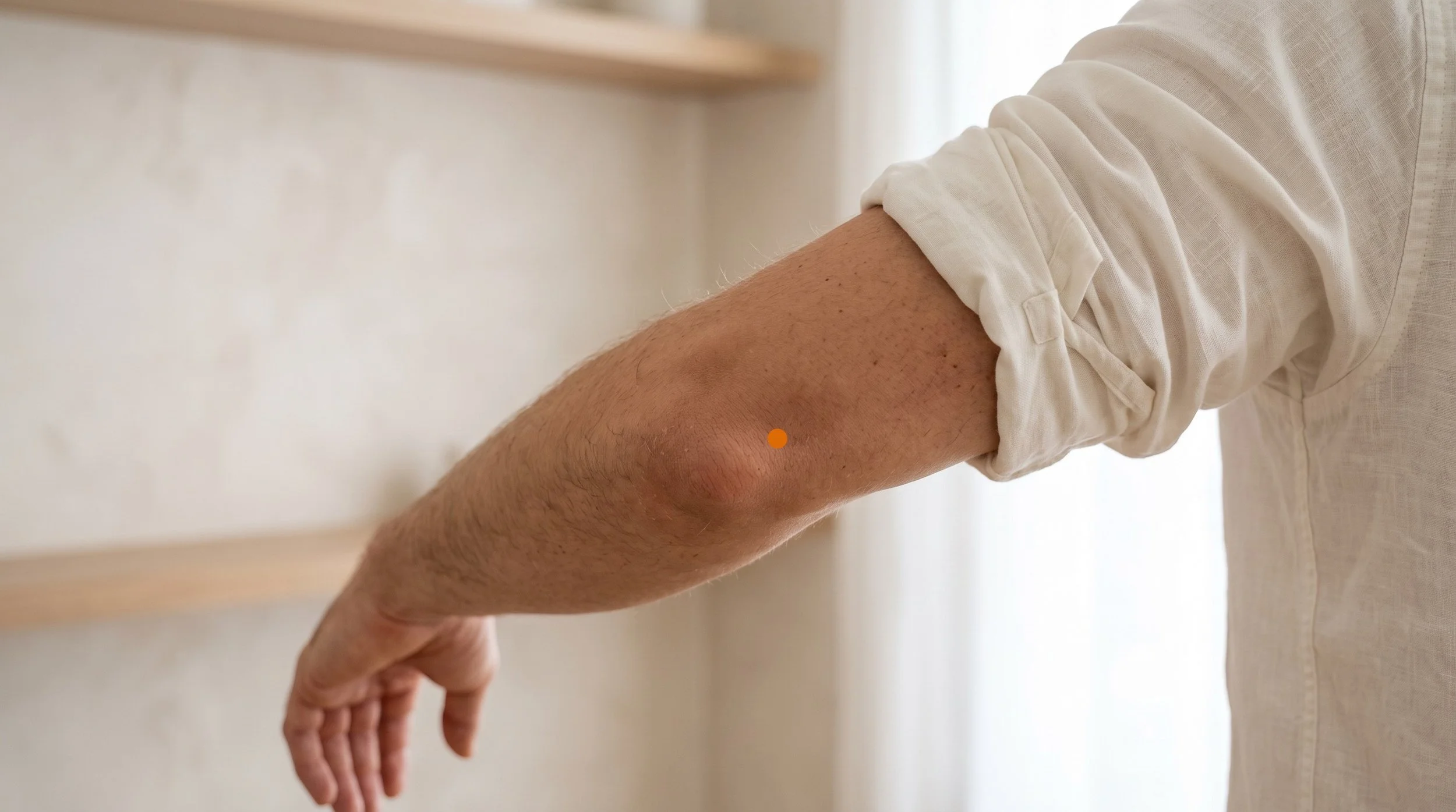
SJ10 Acupuncture Point (Tianjing)
The Heavenly Well Above the Elbow: Anatomy, Mechanism, and Why This Triceps Tendon Point Anchors Posterior Elbow, Arm, and Shoulder Treatment
SJ10 (Tianjing, translated as Heavenly Well), also written TE10, is the he-sea and earth point of the Triple Burner channel, sitting in the small depression about 1 cun above the tip of the elbow when the arm is bent. In plain terms, it is the soft dip you can feel just above the bony point of the elbow, right in the distal triceps tendon as it converges on the olecranon. That location makes the te10 acupuncture point one of the most practical tools we have for posterior elbow pain, triceps tendon irritation, and the deep achy arm pain that comes from overhead work, pressing, climbing, and long hours at a keyboard.
Classically, triple burner 10 was also reached for far beyond the elbow: for nodular swellings around the neck and armpit, for one-sided headaches, and for a jumpy, easily startled emotional state, all of which we now explain in terms of nerves, muscle load, and central pain processing rather than energy flow.
- Location and layers: TE 10 elbow needling passes through thin skin and subcutaneous fascia into the distal triceps tendon just above the olecranon, with the olecranon fat pad and posterior elbow capsule deeper still, so the needle engages tendon and enthesis tissue rather than bulky muscle (Deadman et al., 2007).
- Traditional categories, translated: classical texts list Tianjing as the he-sea and earth point of the Triple Burner channel and attribute to it the transformation of phlegm, the dissipation of nodules, calming of the spirit, and clearing of heat from the channel; in clinical terms we use it as a strong local and regional point for the posterior arm with a secondary role in tension, headache, and stress presentations (Deadman et al., 2007).
- Mechanism: needling here stimulates the posterior cutaneous nerve of the arm and muscular branches of the radial nerve supplying triceps, feeding segmental input into the lower cervical dorsal horn and recruiting descending inhibitory pathways that damp pain signaling more broadly (Zhao, 2008).
- Research picture: acupuncture and dry needling around the elbow have short term support for pain, disability, and grip strength in lateral elbow tendinopathy, with reviews rating the evidence low to moderate and heterogeneous (Green et al., 2002; Navarro-Santana et al., 2020; Ma et al., 2024).
- Clinical framing: SJ10 is rarely used alone; it is typically one node in a protocol that includes local elbow points, forearm extensor or flexor needling, and shoulder or neck work, which is exactly how large chronic pain analyses have tested acupuncture (Vickers et al., 2018).
- De qi: patients usually report a dull, tight, spreading ache in the back of the arm, sometimes tracking up toward the shoulder or down toward the forearm; a brief triceps twitch is common when the needle contacts a taut band (Simons et al., 1999).
Aching Behind the Elbow Every Time You Press, Push, or Type?
Posterior elbow and triceps pain often gets dismissed as tennis elbow when the real driver is tendon load at the olecranon plus taut bands through the triceps and posterior shoulder. At Morningside Acupuncture we use SJ10 as an anchor point in that region, combining it with dry needling of the triceps and surrounding elbow points to reduce local sensitivity and improve tolerance to loading. Treatment is paired with simple loading advice so gains hold between visits. Schedule a session and let us assess what is actually generating your elbow pain.
Schedule NowAnatomy of SJ10: Why the Triceps Tendon Above the Olecranon Is Such an Important Location
With the elbow flexed, SJ10 sits in a palpable depression roughly 1 cun above the olecranon, the bony tip of the elbow (Deadman et al., 2007). The needle enters thin skin and superficial fascia, then the distal triceps tendon where the long, lateral, and medial heads converge on their insertion. Deeper lies the olecranon fat pad and the posterior elbow capsule. This is a high-load zone: every push-up, dip, overhead press, plank, and heavy laptop bag transmits tensile force through that tendon, and repetitive extension work concentrates strain at the insertion.
That is why the tissue under SJ10 becomes tender in throwers, lifters, climbers, and desk workers alike, and why the point is so often reactive on palpation before a patient even mentions elbow symptoms.
The nerve geography explains the referral pattern. The skin here is supplied by the posterior cutaneous nerve of the arm, and the triceps itself is driven by muscular branches of the radial nerve, both carrying lower cervical segmental input. Needling generates a burst of activity in small diameter afferents that converge in the dorsal horn with input from the elbow joint, tendon, and surrounding muscle, which is one reason a well-placed needle can alter pain felt across a wider area than the needle tip touches.
That same afferent barrage engages descending inhibitory control from the brainstem and drives central release of endogenous opioids and monoamines, a mechanism repeatedly demonstrated in experimental models of acupuncture analgesia (Zhao, 2008). Locally, the needle also provokes a small axon reflex response with increased blood flow, which may matter in a relatively poorly vascularized tendon region (Deadman et al., 2007).
Deep to the point run terminal branches of the median collateral artery and vein, small vessels that are easily avoided with normal technique. The structure requiring most respect is the ulnar nerve, which passes behind the medial epicondyle in its groove, medial to this point; needling should stay in the tendon over the olecranon fossa and never chase toward that groove. Standard depth is perpendicular insertion of 0.5 to 1 cun, with more conservative texts recommending 0.3 to 0.5 cun, and the shallower range is often plenty when the tendon is irritable (Deadman et al., 2007; Kim, 2001). Because the tissue is fibrous, sensation can be sharp on entry and then settle into a dull spread, so slow insertion and clear communication matter.
Related Triceps Brachii Trigger Points Related Pain Finder Upper Back Shoulder ArmSJ10 (TE10) at a Glance: Classification, Location, and Clinical Use
| Category | Detail |
|---|---|
| Traditional Name | Tianjing (Heavenly Well), SJ10, also written TE10 or TB-10 |
| Channel Classification | Triple Burner (Sanjiao) channel of the hand, shaoyang (SJ10, also written TE10 or TB10; also called the Triple Energizer, the Triple Heater or Triple Warmer) |
| Point Categories | He-sea point of the Triple Burner channel; earth point of the five-shu sequence; described in classical five-shu theory as one of the upper sea points of the arm yang channels; listed in some modern texts as the sedation point of the channel |
| Precise Location | On the back of the upper arm, in the depression about 1 cun proximal to the olecranon, located with the elbow flexed |
| Tissue Stimulated | Distal triceps brachii tendon at its olecranon insertion, overlying fascia, and the fat pad of the olecranon fossa, with the posterior cutaneous nerve of the arm and radial nerve muscular branches in the field |
| Needle Depth / Direction | Perpendicular insertion 0.5 to 1 cun (0.3 to 0.5 cun in more conservative texts), angled into the tendon over the olecranon fossa and away from the ulnar groove medially; moxibustion is traditionally permitted |
| De Qi Sensation | Dull, heavy, spreading ache in the back of the arm, often tracking toward the shoulder or forearm; a brief triceps twitch is common when a taut band is engaged |
| Primary Clinical Uses | Posterior elbow and triceps pain, triceps tendinopathy, arm and shoulder pain with weakness or numbness, one-sided headache, and traditionally nodular swellings of the neck and axilla |
| Common Point Combinations |
|
In A Manual of Acupuncture, Deadman and colleagues frame Tianjing primarily as a phlegm point: the he-sea and earth point of a channel described in the Classic of Difficulties as the passageway for fluids through the body, and therefore the point turned to when fluids congeal into palpable lumps, thick cough, or a clouded emotional state. That single traditional idea threads together an otherwise odd indication list.
Nodules on the side of the neck and in the armpit, the disorder classical texts called scrofula, were understood as phlegm bound with stagnant qi or heat, and SJ10 appears in several classical formulas for it. Because he-sea points were said to address counterflow, the same point was used for cough, chest oppression with heart pain, and rib-side pain. And because the Triple Burner is paired with the Pericardium, phlegm clouding the heart and spirit brought SJ10 into formulas for fright palpitations, sadness, and a startle-prone temperament.
Deadman also notes that the modern working use of the point is far narrower and more grounded: pain, restricted movement, and weakness of the elbow, arm, shoulder, neck, and upper back. What is striking is how one traditional pattern, fluids condensing where they should be moving, was stretched to cover lumps, cough, mood, and one-sided head pain from a point on the back of the elbow.
Why SJ10 Is Used for One-Sided Headaches and Neck Swellings, Not Just Elbow Pain
The elbow use is easy to explain: the needle sits in the tendon that hurts. The head and neck applications need a different account. Sensory input from the posterior arm enters the lower cervical spinal cord, the same neighborhood that receives input from the neck, upper trapezius, and shoulder girdle. Neurons in the dorsal horn receive convergent input from skin, muscle, tendon, and joint across these regions, so stimulating one input can change how the pool of neurons responds to the others. When a headache is riding on a base of neck and shoulder tension, treating the arm chain is not as far-fetched as it looks on a chart.
The second mechanism is not segmental at all. Needle stimulation strong enough to produce de qi activates brainstem circuits that inhibit pain transmission throughout the spinal cord, using endogenous opioid, serotonergic, and noradrenergic pathways (Zhao, 2008). This is why distal points can influence symptoms far from the needle, and why acupuncture protocols for headache tend to include limb points alongside local ones.
In Cochrane's review of acupuncture for episodic migraine, adding acupuncture to usual care reduced headache frequency compared with usual care alone, with effects at least comparable to prophylactic drug treatment, though the reviewers were careful about the size and durability of the benefit (Linde et al., 2016).
As for the classical use of Tianjing for swollen glands and nodules, we present that strictly as a traditional attribution. There is no modern evidence that needling this point resolves lymphadenopathy, and any persistent, hard, or growing lump in the neck or armpit belongs in a physician's hands for workup, not on a treatment table. What survives from that tradition in current practice is the observation that this region of the arm responds well to needling for pain, stiffness, and heaviness, which is where we keep our focus.
What the Research Shows for SJ10 (TE10)
One note on naming before the evidence: in the research literature this point appears as TE10, the WHO standard code, and also as SJ10 or TB10 depending on the authors, so it is worth searching all three if you want to read the studies below in full.
There is no trial that isolates SJ10. Like nearly every point, it has been studied only inside multi-point protocols, so the honest framing is that research tells us about acupuncture and dry needling for elbow, shoulder, and head pain, and clinical reasoning tells us where this specific point fits within those protocols. The elbow evidence is short-term and modest, the chronic pain evidence is broader and more robust, and the headache evidence sits in between. Reviews below are summarized cautiously, and none of them establish that any single point is responsible for the results.
| Study | Type | Focus | Key Finding |
|---|---|---|---|
| Green et al., 2002 | Cochrane systematic review | Acupuncture for lateral elbow pain (tennis elbow) | The reviewers found needle acupuncture may give short-term pain relief, but the trials were few and small, leaving the evidence insufficient to confirm or rule out longer-term benefit. |
| Ma et al., 2024 | Updated systematic review and meta-analysis | Dry needling for lateral epicondylitis | Pooled results suggested improvements in pain within the first week plus gains in elbow function and grip strength, with trigger point needling that produced a local twitch response performing better on short-term pain. |
| Navarro-Santana et al., 2020 | Systematic review and meta-analysis | Trigger point dry needling for lateral epicondylalgia of musculoskeletal origin | Across seven trials the authors reported short-term reductions in pain and disability with low to moderate certainty, downgraded by heterogeneity between studies. |
| Green et al., 2005 | Cochrane systematic review | Acupuncture for shoulder pain | Evidence was judged too limited to support or refute acupuncture for shoulder pain, with possible short-term benefit for pain and function around four weeks. |
| Vickers et al., 2018 | Individual patient data meta-analysis | Acupuncture for chronic musculoskeletal, headache, and osteoarthritis pain | Acupuncture outperformed both sham and no-acupuncture controls, with effects that persisted over time rather than dissipating immediately after treatment. |
| Linde et al., 2016 | Cochrane systematic review | Acupuncture for the prevention of episodic migraine | Acupuncture reduced migraine frequency compared with usual care and appeared at least non-inferior to prophylactic medication, though the advantage over sham needling was small. |
| Zhao, 2008 | Narrative review of experimental neurophysiology | Neural mechanisms of acupuncture analgesia | Needle stimulation of somatic afferents engages spinal and supraspinal inhibitory circuits involving endogenous opioids and monoamines, providing a plausible basis for both local and distal effects. |
One-Sided Headaches Riding on Top of Tight Shoulders and Arms?
Classical sources reached for the sj10 acupuncture point for one-sided head pain, and modern practice keeps a version of that logic: treating the arm and shoulder chain often changes how the head and neck feel. We combine SJ10 with distal channel points, upper trapezius and suboccipital work, and autonomic downshifting to address both the headache and the postural load feeding it. Most patients notice changes within a handful of visits. Book an appointment to build a plan around your specific headache pattern.
Schedule NowSJ10 in the Context of Trigger Point Work
SJ10 sits directly over the distal triceps tendon, and the triceps is a well-documented source of referred pain into the back of the arm, the point of the elbow, and occasionally into the forearm and fourth and fifth fingers (Simons et al., 1999).
In practice, when we palpate a patient who complains of pain at the tip of the elbow, we frequently find taut bands in the long and medial heads of triceps a few inches proximal to the point itself. That means a session may include needling at SJ10 for the tendon and enthesis, plus separate insertions into the triceps bellies to address the myofascial contribution.
Acupuncture is defined by the use of an acupuncture needle, and dry needling of trigger points is one of the hundreds of styles that use that same tool, so there is no contradiction in combining channel points with muscle-specific needling in a single treatment.
How we sequence it depends on the presentation. For a lifter with posterior elbow pain on lockouts, we tend to start with the triceps bellies, then finish at SJ10 and local ashi points around the olecranon, and add posterior shoulder work if the deltoid or teres group is also loaded. For a desk worker with a heavy, achy arm and one-sided headache, SJ10 often functions as a regional anchor while the bulk of the work goes to the neck, upper trapezius, and scapular muscles.
Meta-analytic data on dry needling for elbow tendinopathy suggests that eliciting a local twitch response is associated with better short-term pain outcomes, which is one reason we aim for the taut band rather than simply needling near the sore spot (Ma et al., 2024).
SJ10 Elbow Pain Treatment at NYC's Highest-Rated Acupuncture Clinic
Morningside Acupuncture is the highest-rated acupuncture and dry needling clinic in New York City with over 500 five-star Google reviews, and elbow, arm, and shoulder pain are among the conditions we treat most. Every session begins with an orthopedic assessment so points like SJ10 are chosen for your presentation, not from a template. We integrate acupuncture, dry needling, cupping, and movement guidance in one visit. Schedule your appointment today and get a clear plan for your arm.
Schedule NowFrequently Asked Questions
Is SJ10 the same point as TE10 or TB10?
Yes. SJ10, TE10, and TB10 are all codes for the same point, Tianjing. SJ stands for San Jiao, the Chinese name of the channel. TE (Triple Energizer) is the WHO standard abbreviation and the one you will see in most Western textbooks and research papers. TB (Triple Burner) and TW (Triple Warmer) are older English renderings of the same name that still appear in many books. You will also come across it written as San Jiao 10 or Triple Energizer 10. Whichever code is used, the location and the uses are the same.
What does SJ10 feel like when needled?
Most people feel a firm pressure on entry, since the needle is passing into tendon rather than soft muscle, followed by a dull, heavy ache that spreads up the back of the arm toward the shoulder or down toward the forearm. That spreading ache is de qi, and it usually fades within seconds to a minute while the needle stays in place. If the triceps has active taut bands, you may feel a quick involuntary twitch, which is normal and typically followed by a brief cramping sensation and then a loosening feeling. Sharp, electric, or shooting sensations are not the goal, and you should tell your acupuncturist immediately if you feel one so the needle can be adjusted.
Why needle the back of the elbow when my pain is on the outside of the elbow or in my forearm?
Two reasons. First, elbow pain is rarely confined to one tendon: the triceps insertion, the common extensor origin, the joint capsule, and the forearm muscles all share innervation at the lower cervical spinal levels, and neurons receiving that input respond to the whole neighborhood rather than to a single structure. Second, needling in one part of that field triggers descending inhibitory pathways that reduce pain sensitivity more broadly (Zhao, 2008). Classically, Tianjing was the he-sea point where the channel was said to enter deeply, which is the traditional way of saying the same thing: this is a point with regional reach, not just a local one.
Can I press SJ10 myself between sessions?
Yes, and it is easy to find on yourself. Bend your elbow to about 90 degrees, find the bony tip of the elbow with your opposite thumb, then slide up about one thumb-width toward the shoulder until you drop into a soft depression in the tendon. Press straight in with your thumb or knuckle using moderate pressure, enough to feel a clear ache but not enough to make you brace, and hold for 30 to 60 seconds. You can add small circular motions for another 30 seconds, then repeat on the other arm if both are symptomatic. Two or three rounds, once or twice a day, is plenty. Stop if you feel any tingling or electric sensation down into the little finger, which suggests you have drifted toward the ulnar nerve on the inner side of the elbow, and skip acupressure entirely over broken skin, an acutely swollen elbow, or an area that has recently been injected.
Is SJ10 safe to needle?
In trained hands it is a low-risk point. There are no organs or major vessels beneath it, only small terminal branches of the median collateral artery and vein, and standard depth is a perpendicular insertion of 0.5 to 1 cun, with shallower needling often sufficient when the tendon is irritable (Deadman et al., 2007). The structure that deserves respect is the ulnar nerve in its groove behind the medial epicondyle, which is why needling stays over the olecranon fossa and does not angle medially. Expected side effects are minor: brief soreness for a day, occasional small bruising, and sometimes a temporary flare before symptoms settle. Tell your practitioner about blood thinners, recent corticosteroid injections at the elbow, or any implanted hardware in the area.
Where exactly is SJ10 located?
On the back of the upper arm, in the depression roughly 1 cun (about one thumb-width) above the olecranon, which is the pointed bone you feel at the tip of your elbow. It is found with the elbow flexed, because flexion relaxes the triceps tendon and makes the depression easier to feel. Anatomically the point sits within the distal triceps tendon just above its insertion, over the fat pad of the olecranon fossa. You will sometimes see it written as TE10 or TB-10 in older texts, all referring to the same Triple Burner channel point known as Tianjing.
References
- Deadman, P., Al-Khafaji, M., & Baker, K. (2009). A manual of acupuncture. Journal of Chinese Medicine Publications.
- Kim, H. (2008). Handbook of Oriental medicine (3rd ed.). Harmony & Balance Press.
- Simons, D. G., Travell, J. G., & Simons, L. S. (1999). Travell & Simons' myofascial pain and dysfunction: The trigger point manual, Vol. 1: Upper half of body (2nd ed.). Williams & Wilkins.
- Green, S., Buchbinder, R., Barnsley, L., Hall, S., White, M., Smidt, N., & Assendelft, W. J. J. (2002). Acupuncture for lateral elbow pain. Cochrane Database of Systematic Reviews, 2002(1), CD003527. https://doi.org/10.1002/14651858.CD003527
- Green, S., Buchbinder, R., & Hetrick, S. (2005). Acupuncture for shoulder pain. Cochrane Database of Systematic Reviews, 2005(2), CD005319. https://doi.org/10.1002/14651858.CD005319
- Ma, X., Qiao, Y., Wang, J., Xu, A., & Rong, J. (2024). Therapeutic effects of dry needling on lateral epicondylitis: An updated systematic review and meta-analysis. Archives of Physical Medicine and Rehabilitation, 105(11), 2184-2197. https://doi.org/10.1016/j.apmr.2024.02.713
- Navarro-Santana, M. J., Sanchez-Infante, J., Gómez-Chiguano, G. F., Cleland, J. A., López-de-Uralde-Villanueva, I., Fernández-de-las-Peñas, C., & Plaza-Manzano, G. (2020). Effects of trigger point dry needling on lateral epicondylalgia of musculoskeletal origin: A systematic review and meta-analysis. Clinical Rehabilitation, 34(11), 1327-1340. https://doi.org/10.1177/0269215520937468
- Linde, K., Allais, G., Brinkhaus, B., Fei, Y., Mehring, M., Vertosick, E. A., Vickers, A., & White, A. R. (2016). Acupuncture for the prevention of episodic migraine. Cochrane Database of Systematic Reviews, 2016(6), CD001218. https://doi.org/10.1002/14651858.CD001218.pub3
- Vickers, A. J., Vertosick, E. A., Lewith, G., MacPherson, H., Foster, N. E., Sherman, K. J., Irnich, D., Witt, C. M., & Linde, K. (2018). Acupuncture for chronic pain: Update of an individual patient data meta-analysis. Journal of Pain, 19(5), 455-474. https://doi.org/10.1016/j.jpain.2017.11.005
- Zhao, Z. Q. (2008). Neural mechanism underlying acupuncture analgesia. Progress in Neurobiology, 85(4), 355-375. https://doi.org/10.1016/j.pneurobio.2008.05.004
Disclaimer: This web site is intended for educational and informational purposes only. Reading this website does not constitute providing medical advice or any professional services. This information should not be used for diagnosing or treating any health issue or disease. Those seeking medical advice should consult with a licensed physician. Seek the advice of a medical doctor or other qualified health professional for any medical condition. If you think you have a medical emergency, call 911 or go to the emergency room. No acupuncturist-patient relationship is created by reading this website or using the information. Morningside Acupuncture PLLC and its employees and contributors do not make any express or implied representations with respect to the information on this site or its use. For any legal interpretation of scope of practice in your state, consult a licensed attorney or regulatory authority.
Read more from our blog



