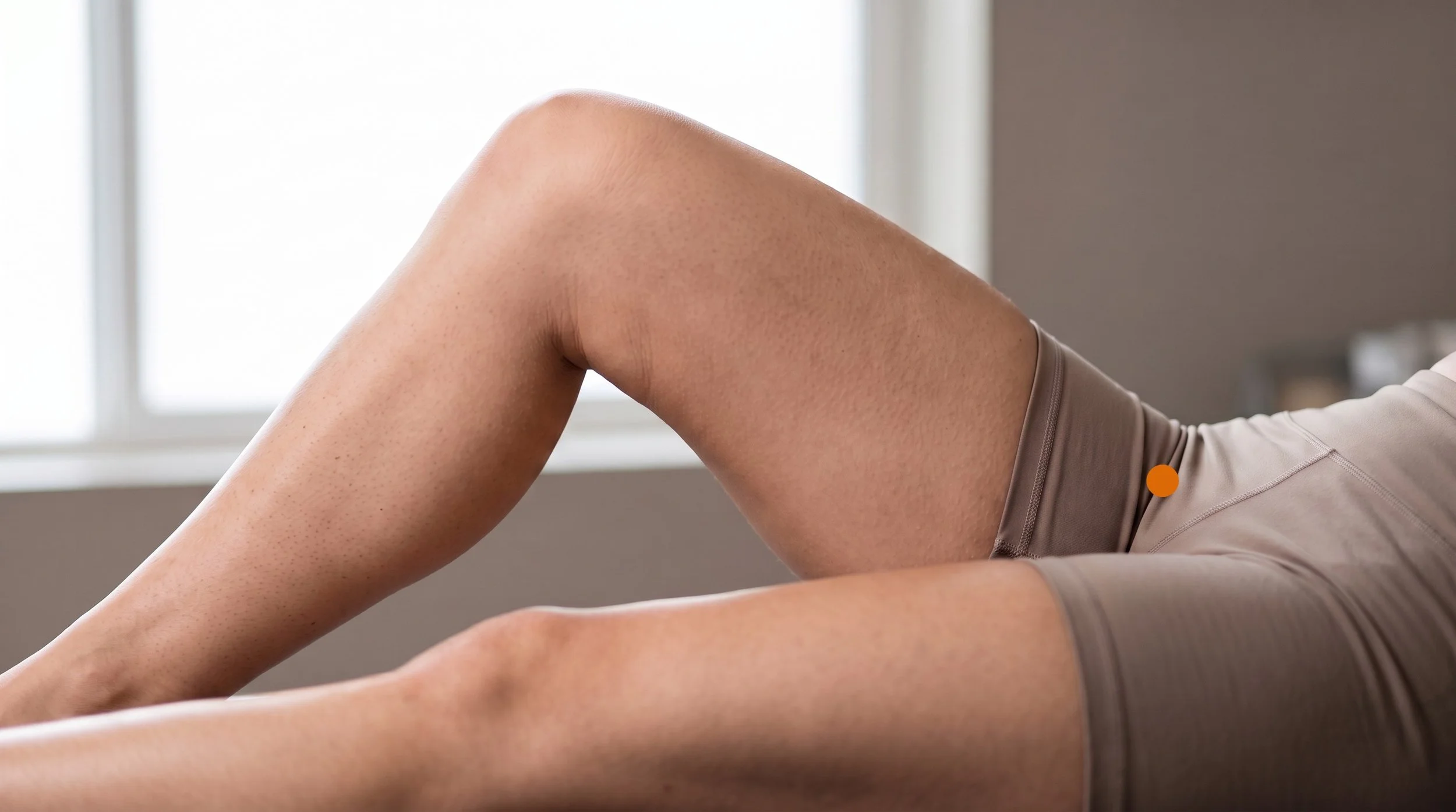
LV11 Acupuncture Point (Yinlian)
The Yin Corner at the Adductor Origin: Anatomy, Mechanism, and Why This Groin Point Bridges Classical Fertility Moxibustion and Modern Adductor Pain
LV11 (Yinlian, often translated as Yin Corner or Yin Edge), also written LR11, is the eleventh point of the Liver channel, sitting high in the groin about 2 cun below ST30 along the front edge of the adductor longus, the ropey tendon you can feel snap into the pubic bone when you squeeze your knees together.
It is one of the least glamorous points on the channel and one of the most anatomically interesting: classical texts group it with the lower abdominal and uterine points and recommended moxibustion here for infertility, while modern clinicians reach for the same spot when a runner, skater, or soccer player has tenderness right at the adductor longus origin. That double identity, a fertility point in the classical literature and an adductor tendon point in sports practice, is what makes the LV11 acupuncture point worth understanding rather than skipping over.
- Location and layers: LV11 lies in the groin 2 cun inferior to ST30 on the border of adductor longus, with skin, subcutaneous fat, and the adductor tendon and muscle belly under the needle; A Manual of Acupuncture places it on the anterior border of the muscle, while several Chinese texts describe the lateral border, so palpation of the tendon matters more than measurement alone.
- Traditional attribution: classical sources assign LV11 the action of benefiting the uterus and list irregular menstruation, vaginal discharge, lower abdominal pain, infertility, and pain of the inner thigh and knee among its indications; these are historical claims about a pattern of use, not statements of physiology.
- Mechanism: the tissue here is supplied by the genitofemoral and anterior femoral cutaneous nerves superficially and by the anterior branch of the obturator nerve more deeply, so needling recruits L1 to L4 input that converges in the same spinal segments serving the lower abdominal wall and pelvic viscera, a plausible route for segmental modulation (Zhao, 2008).
- Descending inhibition and autonomic effects: needle stimulation strong enough to produce de qi engages endogenous opioid and monoaminergic pain control and can shift sympathetic tone, and an early physiological study using electroacupuncture reported reduced uterine artery blood flow impedance in infertile women, which the authors attributed to central sympathetic inhibition (Zhao, 2008; Stener-Victorin et al., 1996).
- Research picture: reviews of acupuncture in fertility care and in period pain test multi-point protocols rather than single points, and their conclusions remain cautious, with uncertainty about live birth rates and low quality evidence in dysmenorrhoea (Cheong et al., 2013; Smith et al., 2016).
- De qi and practice: patients usually feel a deep, heavy ache or fullness at the tendon that can spread down the inner thigh; LV11 is almost always a supporting point, added to a lower abdominal or distal prescription rather than used alone (Vickers et al., 2018).
Groin Pain That Keeps Coming Back Every Season?
Adductor origin pain rarely resolves with rest alone, because the tendon keeps getting loaded the moment you return to sprinting, cutting, or skating. At Morningside Acupuncture we needle LV11 and the surrounding adductor field alongside ST30 and hip stabilizer work, then pair the session with loading advice so the tissue rebuilds tolerance. Most patients notice the difference in how the first few minutes of activity feel. Book a visit and let's map out what is actually driving your groin pain.
Schedule NowAnatomy of LV11: Why the Adductor Longus Origin Is Such an Important Location
Find ST30 first: it sits 2 cun lateral to the midline at the level of the top of the pubic bone. Drop 2 cun straight down the thigh and you land at LV11, right along the edge of adductor longus, whose tendon of origin is the most obvious cord in the groin when the hip is flexed and the knee squeezed inward. Under the needle you pass skin and a variable layer of subcutaneous fat, then the tendon and proximal muscle belly of adductor longus, with adductor brevis and pectineus deeper and slightly lateral.
This is a high-load junction: the adductor longus origin is a small attachment absorbing large decelerating and cutting forces, which is exactly why sprinters, hockey players, and soccer athletes accumulate tenderness in the Yinlian point location.
Nerve geography here is dense and clinically useful. The superficial tissue is supplied by branches of the genitofemoral nerve and the anterior femoral cutaneous nerve, while the deeper adductor muscles are supplied by the anterior branch of the obturator nerve, giving the region a segmental range of roughly L1 through L4. Those same segments carry sensory traffic from the lower abdominal wall, inguinal region, and parts of the pelvic viscera, so a needle in the groin feeds into dorsal horn territory that is already receiving pelvic input.
That anatomical convergence is the modern reading of why a thigh point ended up in the classical uterine and menstrual category. Beyond the segment, repeated needle stimulation recruits descending inhibitory pathways using endogenous opioids, serotonin, and noradrenaline, which is the best characterized mechanism for acupuncture analgesia in general (Zhao, 2008).
The safety picture is straightforward if you respect the femoral triangle. The femoral artery, vein, and nerve run lateral to LV11, and the pulse itself marks the neighboring point LV12, so the practical rule is to palpate the femoral pulse and stay medial to it, on the adductor tendon. Superficial vessels including tributaries of the great saphenous vein cross this region as well. Standard needling is perpendicular or oblique to a depth of 0.5 to 1.5 cun depending on body type, angled along the adductor rather than deep toward the pelvis, and moxibustion is described as applicable in the classical literature.
Given the proximity to the genitals, careful draping, plain-language consent, and clear communication are non-negotiable parts of using this point well.
Related Adductor Longus Adductor Brevis Trigger Points Related Liver ChannelLV11 (LR11) at a Glance: Classification, Location, and Clinical Use
| Category | Detail |
|---|---|
| Traditional Name | Yinlian (Yin Corner, also translated Yin Edge) |
| Channel Classification | Eleventh point of the Liver channel (Foot Jueyin), on the proximal medial thigh between LV10 above and LV12 lateral to it (LV11, also written LIV11 or LR11) |
| Point Categories | No five-shu, yuan, luo, xi-cleft, or hui-meeting designation and no extraordinary vessel intersection is attributed to this point in the standard reference texts. It is classified functionally as a lower thigh and groin point of the Liver channel, with the traditional action of benefiting the uterus, and Cunningham additionally credits it with regulating Liver blood, regulating menstruation, and relaxing the thigh adductors. |
| Precise Location | In the groin, 2 cun directly below ST30, on the border of the adductor longus muscle near its pubic origin. ST30 lies 2 cun lateral to the anterior midline at the level of the upper border of the pubic bone. A Manual of Acupuncture describes the anterior border of adductor longus, while several Chinese sources describe the lateral border, so identify the most prominent tendon in the groin and work from it. |
| Tissue Stimulated | Skin and subcutaneous tissue of the medial femoral triangle, tendon of origin and proximal belly of adductor longus and adductor brevis, with the upper fibers of adductor magnus and pectineus nearby; innervation from the genitofemoral and anterior femoral cutaneous nerves superficially and the anterior branch of the obturator nerve at depth |
| Needle Depth / Direction | Perpendicular or oblique insertion 0.5 to 1.5 cun, angled along the adductor tendon and away from the femoral pulse; moxibustion is traditionally described as applicable |
| De Qi Sensation | A deep, heavy, distending ache at the tendon, often with a dull spread down the inner thigh toward the knee; sharp or electric sensation means redirect, since it suggests cutaneous nerve contact |
| Primary Clinical Uses | Traditionally used for infertility (classically by moxibustion), irregular menstruation, vaginal discharge, and lower abdominal pain; in modern practice for adductor origin and groin pain, medial thigh tightness, and inner thigh pain referring toward the knee |
| Common Point Combinations |
|
In A Manual of Acupuncture, Deadman and colleagues give LV11 a single traditional action, benefiting the uterus, and a short indication list covering infertility, irregular menstruation, and pain of the inner thigh and knee, noting that many classical texts specifically recommended moxibustion at this point for infertility.
Cunningham's point manual echoes that history, describing older sources that called for a small number of direct moxa cones here for female infertility, and expands the traditional indication list to include vaginal discharge, genital itching, hernia pain, and lower abdominal pain, along with a functional role in relaxing the thigh adductors. Chinese textbook sources such as Acupuncture: A Comprehensive Text keep the same core list of irregular menstruation, leukorrhea, lower abdominal pain, and thigh and leg pain.
What is striking is the shape of the pattern rather than any single claim: a point on the upper inner thigh, well away from the abdomen, was consistently assigned to uterine and menstrual complaints across centuries of texts, and modern segmental anatomy offers a coherent explanation for why groin stimulation and pelvic symptoms kept getting linked.
Why LV11 Is Used for Both Menstrual Complaints and Adductor Strain
The bridge between those two very different uses is segmental convergence. Sensory fibers from the LV11 region travel with the genitofemoral, anterior femoral cutaneous, and obturator nerves into roughly the L1 to L4 spinal segments, and those segments also receive input from the lower abdominal wall, the inguinal region, and, through the lumbar sympathetic outflow, parts of the pelvic viscera.
When neurons in the dorsal horn receive input from several sources, stimulating one source can alter how the others are processed, which is a standard model for how a point far from the symptom can still influence it (Zhao, 2008). It also explains a common clinical observation in reverse: pelvic and hip pathology often shows up as groin and inner thigh pain, and adductor tension frequently accompanies pelvic complaints.
On top of the segmental effect, sustained needle stimulation activates descending inhibitory systems in the brainstem that use endogenous opioids and monoamines to dampen nociceptive traffic, and this is the mechanism with the strongest experimental support behind acupuncture analgesia (Zhao, 2008).
There is also a vascular and autonomic thread relevant to the classical fertility framing: an early Swedish study reported that a course of electroacupuncture was followed by reduced blood flow impedance in the uterine arteries of infertile women, and the authors proposed central inhibition of sympathetic activity as the explanation (Stener-Victorin et al., 1996). That study was small, non-randomized, and did not isolate LV11, so it should be read as a mechanism signal rather than proof of clinical benefit.
For adductor origin pain, the reasoning is more direct. The needle is placed in the exact tissue that hurts, and needling a symptomatic muscle and its trigger points may reduce pain and improve pressure pain threshold in the short to medium term, though evidence quality across musculoskeletal conditions ranges from very low to moderate (Gattie et al., 2017).
Broader individual patient data analyses of acupuncture for chronic pain support modest, persisting effects over sham and usual care, which is roughly the magnitude patients should expect from a course of treatment rather than a single visit (Vickers et al., 2018).
What the Research Shows for LV11 (LR11)
One note on naming before the evidence: in the research literature this point is usually listed as LR11, the WHO standard code, and sometimes as LV11 or LIV11, so it is worth searching all three if you want to read the studies below in full.
There is no clinical trial isolating LV11, and there almost certainly never will be. Like most secondary points, it appears inside multi-point protocols for menstrual pain, fertility support, and groin injury, so the honest way to read the literature is to ask what those protocols achieve overall and where a groin point plausibly contributes. The reviews below are the most relevant, and their conclusions are mixed and mostly cautious.
| Study | Type | Focus | Key Finding |
|---|---|---|---|
| Cheong et al., 2013 | Cochrane systematic review | Acupuncture as an adjunct to assisted reproductive technology cycles | Across 20 randomized trials the review found no clear evidence that acupuncture improves live birth or pregnancy rates in IVF, with results sensitive to the type of control used. |
| Smith et al., 2016 | Cochrane systematic review | Acupuncture and acupressure for primary dysmenorrhoea | The review reported that the evidence was of low quality and insufficient to determine whether acupuncture reliably reduces period pain compared with sham or usual care. |
| Stener-Victorin et al., 1996 | Prospective non-randomized physiological study | Uterine artery blood flow impedance after electroacupuncture in infertile women | Pulsatility index fell significantly after a course of electroacupuncture in a small sample, which the authors attributed to reduced central sympathetic activity. |
| Vickers et al., 2018 | Individual patient data meta-analysis | Acupuncture for chronic musculoskeletal and other persistent pain | Acupuncture was associated with modest but statistically significant benefits over both sham and no-acupuncture controls, with effects largely maintained at one year. |
| Gattie et al., 2017 | Systematic review and meta-analysis | Trigger point dry needling for musculoskeletal pain | Very low to moderate quality evidence suggested dry needling may reduce pain and improve pressure pain threshold in the short term, with long-term benefit unclear. |
| Kaur et al., 2023 | Case series (two elite footballers) | Dry needling plus eccentric strengthening for adductor strain | Both athletes reported reduced pain and improved function, though case-level findings cannot be generalized and the authors called for randomized trials. |
Looking for Menstrual and Fertility Support Alongside Your Medical Care?
Classical texts used LV11 with lower abdominal points as part of menstrual and fertility focused treatment, and modern practice keeps that pattern while working in coordination with your OB-GYN or reproductive endocrinologist. We build calm, well-paced sessions that may reduce cramping intensity, ease pelvic and inner thigh tension, and give you a regular downshift in a stressful cycle. Nothing we do replaces medical treatment, and we will always tell you when a referral is the right next step. Schedule a consultation to talk through timing and expectations.
Schedule NowLV11 in the Context of Trigger Point Work
LV11 sits directly over territory that trigger point clinicians already treat. In the Travell and Simons framework, trigger points in adductor longus and brevis characteristically refer pain up into the groin and down the medial thigh, sometimes reaching toward the knee, and adductor magnus can send pain deep into the pelvis. That referral map overlaps almost exactly with the classical LV11 indication of inner thigh and knee pain, which is one of the neater convergences between a classical point list and a twentieth century pain map.
In practice we palpate along the adductor longus tendon and belly, find the taut band and the spot that reproduces the patient's familiar pain, and needle it; whether that spot is labeled a Liver channel point or a myofascial target changes the vocabulary, not the anatomy.
At Morningside, LV11 usually appears in a groin session alongside dry needling of adductor longus, adductor brevis, adductor magnus, pectineus, and often iliopsoas, with ST30 and hip stabilizer points added when the pubic attachment is the main pain generator. Needling is one input, so we pair it with progressive adductor loading, since needling plus eccentric strengthening is the combination reported in the sports literature rather than needling alone (Kaur et al., 2023; Gattie et al., 2017).
The same reasoning applies to patients who arrive for menstrual or pelvic complaints and turn out to have significant adductor guarding: reducing that tension is worth doing on its own terms, whatever the primary reason for the visit.
LV11 Groin and Menstrual Pain Treatment at NYC's Highest-Rated Acupuncture Clinic
Morningside Acupuncture is the highest-rated acupuncture and dry needling clinic in New York City with over 500 five-star Google reviews, and our team treats groin, hip, and pelvic complaints every week. We combine classical point selection like LV11 and ST30 with precise dry needling of the adductor group, then reinforce it with movement strategy you can actually use. Clean technique, clear consent, and careful draping are standard in every session. Book your appointment on the Upper West Side and get a plan built around your presentation.
Schedule NowFrequently Asked Questions
Is LV11 the same point as LR11 or LIV11?
Yes. LV11, LR11, and LIV11 are all codes for the same point, Yinlian, point 11 of the Liver channel. LR is the WHO standard abbreviation and the one you will see in most research papers. LV is the form used by many American schools and clinics, and LIV appears in several widely used textbooks. You will also come across it written as Liver 11 or LIV-11. Whichever code is used, the location and the uses are the same.
What does LV11 feel like when needled?
Most people describe a deep, heavy ache or a sense of fullness right at the tendon in the groin, sometimes spreading a few inches down the inner thigh. If the adductor origin is irritated, the point can be distinctly tender before the needle even goes in, and you may feel a brief twitch as the taut band releases. Sharp, burning, or electric sensations are a signal to reposition, since they suggest the needle is near a cutaneous nerve branch rather than in muscle. A dull post-treatment soreness for a day, similar to what you feel after a hard set of adductor work, is common and typically fades on its own.
Why would a point in the groin be used for menstrual problems rather than a point on the abdomen?
Both get used, and often together. The neurophysiological argument for the LV 11 groin location is segmental: sensory fibers from this region enter the spinal cord at roughly L1 through L4, the same levels that receive input from the lower abdominal wall, inguinal region, and parts of the pelvic viscera, so stimulation here converges with pelvic input in the dorsal horn (Zhao, 2008). Classical texts arrived at a similar pairing by observation, grouping LV11 with the uterine points and recommending moxibustion here for infertility. In modern practice LV11 is a supporting point, added to abdominal points like CV4 and distal points like SP6, not a substitute for them.
Can I press LV11 myself between sessions?
Yes, with a caveat about the location. Lie on your back with the knee bent and dropped outward, then squeeze your knees gently together to make the adductor longus tendon pop up in the groin; slide about two finger widths down from the tendon's attachment at the pubic bone and stay on the muscle, well away from the pulse you can feel more laterally. Apply steady, moderate pressure with the pad of your thumb for 30 to 60 seconds, breathing normally, then release and repeat two or three times per side. Keep total work under about five minutes, stop if you feel numbness, tingling, or a pulsing sensation under your finger, and skip self-pressure entirely if you are pregnant, have a hernia, or have recent groin swelling until you have checked with a clinician.
Is LV11 safe to needle?
In trained hands, yes. The main structures to respect are the femoral artery, vein, and nerve, which lie lateral to the point; the standard approach is to locate the femoral pulse first and needle medial to it, along the adductor tendon, with perpendicular or oblique insertion 0.5 to 1.5 cun and no deep angling toward the pelvis. Because of the location, consent and careful draping matter, and a good clinician will explain exactly where the point is before touching it. LV11 is generally avoided or used with extra caution during pregnancy, and anyone on anticoagulants, with a groin hernia, lymphadenopathy, or an implanted device in the region should tell their practitioner beforehand.
Where exactly is LV11 located?
Start at ST30, which sits 2 cun lateral to the midline of the lower abdomen at the level of the upper border of the pubic bone. From there, measure 2 cun straight down onto the thigh: LV11 is at that level on the border of the adductor longus, the most prominent tendon you can feel in the groin when you flex the hip and squeeze the knees together. A Manual of Acupuncture describes the anterior border of the muscle and several Chinese texts describe the lateral border, so the reliable method for finding the Yinlian point location is to palpate the tendon itself, then work along its edge rather than relying on measurement alone. Liver 11 sits between LV10 above and LV12, which is found at the femoral pulse.
References
- Deadman, P., Al-Khafaji, M., & Baker, K. (2009). A manual of acupuncture. Journal of Chinese Medicine Publications.
- Cheng, X. (Ed.). (1999). Chinese acupuncture and moxibustion (Rev. ed.). Foreign Languages Press.
- Cunningham, P. M. (2000). Acupuncture points: A practical guide to classical and modern usage. Odyssey Press.
- Maciocia, G. (2005). The foundations of Chinese medicine: A comprehensive text for acupuncturists and herbalists (2nd ed.). Elsevier Churchill Livingstone.
- Simons, D. G., Travell, J. G., & Simons, L. S. (1999). Travell & Simons' myofascial pain and dysfunction: The trigger point manual, Vol. 1: Upper half of body (2nd ed.). Williams & Wilkins.
- Zhao, Z. Q. (2008). Neural mechanism underlying acupuncture analgesia. Progress in Neurobiology, 85(4), 355-375. https://doi.org/10.1016/j.pneurobio.2008.05.004
- Vickers, A. J., Vertosick, E. A., Lewith, G., MacPherson, H., Foster, N. E., Sherman, K. J., Irnich, D., Witt, C. M., & Linde, K. (2018). Acupuncture for chronic pain: Update of an individual patient data meta-analysis. Journal of Pain, 19(5), 455-474. https://doi.org/10.1016/j.jpain.2017.11.005
- Cheong, Y. C., Dix, S., Hung Yu Ng, E., Ledger, W. L., & Farquhar, C. (2013). Acupuncture and assisted reproductive technology. Cochrane Database of Systematic Reviews, 2013(7), CD006920. https://doi.org/10.1002/14651858.CD006920.pub3
- Smith, C. A., Armour, M., Zhu, X., Li, X., Lu, Z. Y., & Song, J. (2016). Acupuncture for dysmenorrhoea. Cochrane Database of Systematic Reviews, 2016(4), CD007854. https://doi.org/10.1002/14651858.CD007854.pub3
- Stener-Victorin, E., Waldenström, U., Andersson, S. A., & Wikland, M. (1996). Reduction of blood flow impedance in the uterine arteries of infertile women with electro-acupuncture. Human Reproduction, 11(6), 1314-1317. https://doi.org/10.1093/oxfordjournals.humrep.a019378
- Gattie, E., Cleland, J. A., & Snodgrass, S. (2017). The effectiveness of trigger point dry needling for musculoskeletal conditions by physical therapists: A systematic review and meta-analysis. Journal of Orthopaedic & Sports Physical Therapy, 47(3), 133-149. https://doi.org/10.2519/jospt.2017.7096
- Kaur, S., Maurya, U. K., & Shenoy, S. (2023). Recovery of two elite footballers from adductor strain with dry needling and eccentric strengthening: Two case studies. Journal of Bodywork and Movement Therapies, 35, 332-336. https://doi.org/10.1016/j.jbmt.2023.04.043
Disclaimer: This web site is intended for educational and informational purposes only. Reading this website does not constitute providing medical advice or any professional services. This information should not be used for diagnosing or treating any health issue or disease. Those seeking medical advice should consult with a licensed physician. Seek the advice of a medical doctor or other qualified health professional for any medical condition. If you think you have a medical emergency, call 911 or go to the emergency room. No acupuncturist-patient relationship is created by reading this website or using the information. Morningside Acupuncture PLLC and its employees and contributors do not make any express or implied representations with respect to the information on this site or its use. For any legal interpretation of scope of practice in your state, consult a licensed attorney or regulatory authority.
Read more from our blog



