ST30 Acupuncture Point (Qichong)
The Groin Crossing of the Stomach Channel and the Penetrating Vessel: Anatomy, Mechanism, and Why ST30 Anchors Lower Abdominal and Pelvic Treatment
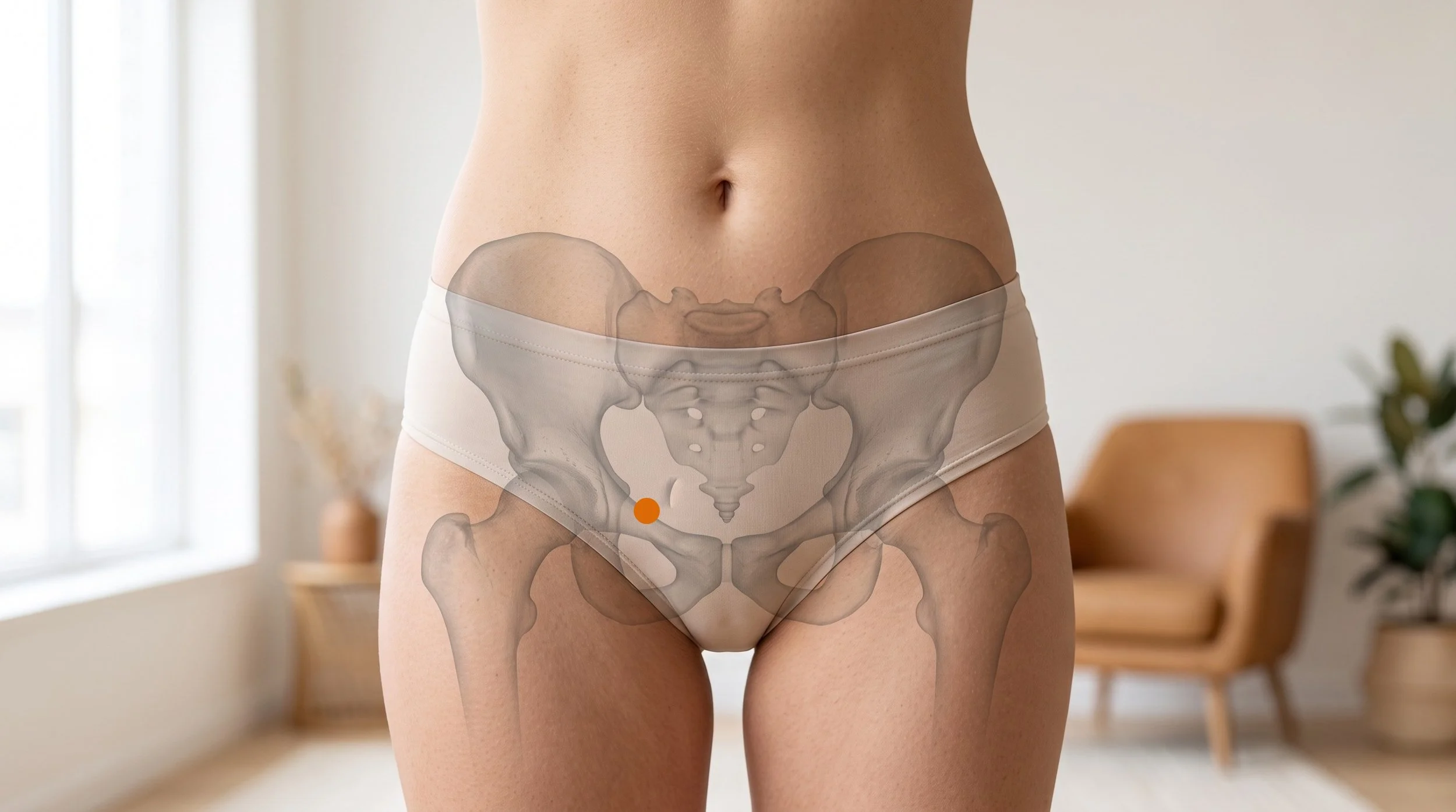
ST30, known in Chinese as Qichong and usually translated as Rushing Qi or Surging Qi, sits low on the abdomen at the groin crease, 2 cun lateral to the midline and level with the top edge of the pubic bone (the same horizontal line as CV2). It is one of the few points where a major channel and an extraordinary vessel formally meet: classical texts place it where the Stomach channel crosses the Penetrating vessel, the deep pelvic pathway associated with the uterus, the genitals, and menstruation (Deadman et al., 2007).
Clinically the st30 acupuncture point matters because that small patch of skin over the inguinal region shares spinal segments with the bladder, uterus, prostate, and lower bowel, which is why a point at the groin has been used for centuries for lower abdominal pain, genital and reproductive complaints, and the unsettling feeling of something surging upward from the pelvis toward the chest.
- Location and layers: ST30 lies at the medial groin, 2 cun lateral to the midline at the level of the upper border of the pubic symphysis, over skin, subcutaneous fascia, and the lower aponeurotic fibers of the abdominal wall just above the inguinal ligament, with the femoral vessels lateral and the round ligament or spermatic cord passing beneath (Deadman et al., 2007).
- Traditional categories, translated: classical sources call ST30 the meeting point of the Stomach channel with the Penetrating vessel and the upper point of the Sea of Water and Grain (ST36 is the lower point), designations that describe a point with strong influence over the lower abdomen and digestion rather than any measurable flow of energy (Deadman et al., 2007).
- Nerve story: this region is supplied by the subcostal, iliohypogastric, ilioinguinal, and genitofemoral nerves (roughly T12 to L2), the same segmental territory into which pelvic visceral afferents from the uterus, bladder, and prostate converge, which gives a plausible neurophysiological account of a groin point being used for pelvic complaints (Chen et al., 2013).
- Mechanism: needling activates A-delta and C fiber afferents that engage segmental spinal gating, descending inhibition from the periaqueductal gray and rostral ventromedial medulla, and endogenous opioid release, alongside local vascular and autonomic changes (Zhao, 2008).
- Research picture: large individual patient data analyses support acupuncture for chronic pain generally (Vickers et al., 2018), a sham-controlled trial found lasting symptom improvement in men with chronic pelvic pain syndrome (Sun et al., 2021), and Cochrane reviews of period pain and assisted reproduction remain cautious about the quality of the evidence (Smith et al., 2016; Cheong et al., 2013).
- De qi and practice: ST30 typically produces a heavy, spreading, slightly distending ache that may travel toward the pubic bone or inner thigh; sharp or electric sensation means the needle is near a nerve and the angle is changed. The bladder is emptied before treatment, and depth and direction stay controlled in thin patients (Deadman et al., 2007).
Struggling With Groin, Lower Abdominal, or Pelvic Pain?
Persistent groin pain rarely comes from one tissue, and it often involves the abdominal wall, the adductors, and sensitized pelvic nerves at the same time. At Morningside Acupuncture we use ST30 alongside nearby inguinal points and dry needling of the adductor and lower abdominal muscles to calm that whole region rather than chasing one sore spot. Every session includes an orthopedic assessment so treatment targets what is actually driving your symptoms. Schedule a visit and let's map out where your pain is coming from.
Schedule NowAnatomy of ST30: Why the Inguinal Groove Is Such an Important Location
Working from the surface inward, ST30 passes through skin and a variable layer of subcutaneous fat, then into the lower fibers and aponeurosis of the abdominal wall where the external oblique, internal oblique, and transversus abdominis converge just above the inguinal ligament, near the lateral edge of the rectus abdominis. The 2 cun measurement can be estimated as roughly halfway between the midline and the palpable lateral border of the rectus (Deadman et al., 2007).
This is a mechanically busy corner: it is loaded by hip flexion and adduction, by coughing and bracing, and by sport that involves cutting, kicking, and sprinting, which is why athletes with adductor-related or abdominal wall groin pain are often tender exactly here.
The sensory supply of this territory comes from the subcostal nerve and the iliohypogastric, ilioinguinal, and genitofemoral nerves, spanning approximately T12 to L2. Those same spinal segments receive afferent traffic from pelvic organs traveling with the sympathetic hypogastric pathways, so groin skin and pelvic viscera share second-order neurons in the dorsal horn.
Anatomical tracing work using the groin region has demonstrated shared central connections between groin somatic input and the uterus, supporting a somatovisceral reflex model for why stimulating this area can influence pelvic function (Chen et al., 2013). On top of that segmental convergence, needling recruits A-delta and C fibers that trigger descending inhibitory control and endogenous opioid mechanisms, which is the standard neurophysiological account of acupuncture analgesia (Zhao, 2008).
Deeper structures set the safety rules. The femoral artery, vein, and canal lie lateral to the point, the inferior epigastric vessels run medial and deep, and the round ligament in women or the spermatic cord in men passes beneath the inguinal region. Standard practice is perpendicular insertion of about 1 to 1.5 cun with the bladder emptied beforehand, because in thin patients a deep upward angle can reach the peritoneal cavity or a distended bladder, and a deep downward angle in men can reach the spermatic cord (Deadman et al., 2007). Practitioners palpate the femoral pulse first, keep the needle medial to it, and use controlled depth rather than aggressive technique in this area.
Related Stomach Channel Related Pain Finder Lower TorsoST30 at a Glance: Classification, Location, and Clinical Use
| Category | Detail |
|---|---|
| Traditional Name | Qichong (Rushing Qi, also rendered Surging Qi or Penetrating Qi); an alternative classical name is Qi Jie, the Avenue of Qi |
| Channel Classification | Stomach channel of Foot Yangming, point 30 of 45 (stomach 30) |
| Point Categories | Meeting point of the Stomach channel with the Penetrating vessel (Chong Mai); upper point of the Sea of Water and Grain, with ST36 as the lower point; included in the classical group of eight points used to clear heat from the Stomach; listed as the opening point of the Stomach Divergent channel in some modern divergent channel systems |
| Precise Location | On the lower abdomen at the groin, 2 cun lateral to the anterior midline, level with the upper border of the pubic symphysis and CV2. The 2 cun line can be estimated as halfway between the midline and the palpable lateral border of the rectus abdominis (qichong point location) |
| Tissue Stimulated | Skin and subcutaneous fascia of the inguinal region, lower fibers and aponeurosis of the abdominal wall including the external abdominal oblique and adjacent abdominal obliques, near the lateral border of the rectus abdominis and the upper attachments of the adductor longus and brevis |
| Needle Depth / Direction | Perpendicular insertion 1 to 1.5 cun, angle and depth kept conservative. Bladder emptied first; avoid deep superior angling in thin patients and deep inferior angling in men; stay medial to the palpable femoral pulse |
| De Qi Sensation | Heavy, full, slightly distending ache spreading across the groin and low abdomen, sometimes toward the pubic bone or inner thigh; sharp, burning, or electric sensation prompts withdrawal and repositioning |
| Primary Clinical Uses | Groin and lower abdominal pain, inguinal region complaints, menstrual irregularity and reproductive concerns in classical use, genital pain and shan-pattern disorders in classical use, and upward-rushing sensations from the lower abdomen (classical running piglet qi) |
| Common Point Combinations |
|
Deadman, Al-Khafaji, and Baker's A Manual of Acupuncture presents ST30 traditionally as a point that regulates qi in the lower burner, regulates the Penetrating vessel, and subdues running piglet qi, and the classical indication lists cluster into four recognizable groups: abdominal pain, fullness, and distention along with urinary and bowel symptoms; gynecological and obstetric complaints such as irregular or suddenly absent periods, abnormal bleeding, infertility, and postpartum problems; genital and shan-pattern disorders including swelling and pain of the external genitals and testicular pain; and the striking pattern in which qi is said to rush upward from the lower abdomen toward the chest and throat.
The commentary explains that the Penetrating vessel surfaces from the perineum and meets the Stomach channel here, which is why a point on the abdominal wall carries such heavy reproductive attribution, and the Spiritual Pivot names ST30 as the upper point of the Sea of Water and Grain alongside ST36. What makes the classical picture worth pausing on is that texts written without any concept of spinal segments repeatedly linked this specific patch of groin to the uterus, bladder, and bowel, exactly the organs that share its innervation.
Why ST30 Is Used for Sensations That Rise from the Lower Abdomen
The first part of the explanation is convergence. Sensory nerves serving the groin skin and abdominal wall at ST30 enter the cord around T12 to L2, and pelvic organ afferents traveling with sympathetic pathways enter the same segments. Because those inputs share dorsal horn neurons, the brain can have genuine difficulty localizing pelvic visceral irritation, which is one reason uterine, bladder, and prostate problems so often refer pain to the groin and inner thigh.
Needling into that shared segment gives the nervous system a strong, well-localized somatic signal that can dampen the noisier visceral input, and tracing studies have shown shared central connections between groin stimulation and the uterus that support this somatovisceral model (Chen et al., 2013).
The second part is central. Needle stimulation recruits small-diameter afferents that engage descending inhibitory pathways through the periaqueductal gray and rostral ventromedial medulla and promote release of endogenous opioids and other neuromodulators, which reduces the gain on incoming nociceptive traffic well beyond the treated segment (Zhao, 2008).
There is also a vascular and autonomic dimension: early electroacupuncture work reported reduced blood flow impedance in the uterine arteries of women with high baseline pulsatility, a finding usually interpreted as reduced sympathetic vasoconstrictor tone (Stener-Victorin et al., 1996). That study was small and uncontrolled, so it should be read as a hypothesis about mechanism rather than proof of clinical benefit.
Put together, this gives a plain-language answer to the classical claim. A point at the groin can influence menstrual cramping, bladder symptoms, or pelvic discomfort not because something flows along a vessel, but because that skin, muscle, and pelvic organs are wired into the same spinal neighborhood, and because needling reliably shifts pain processing and autonomic tone in that neighborhood.
The sensation of something surging upward from the lower abdomen, described classically as running piglet qi, is treated in modern terms as a mix of visceral hypersensitivity and autonomic arousal, which is why ST30 is usually combined with points and breathing work aimed at downshifting the stress response.
What the Research Shows for ST30
There is no body of research isolating ST30 by itself. Trials test multi-point protocols in which this point may appear as one of several lower abdominal selections, so the honest framing is that the evidence speaks to acupuncture as a treatment package for pain and pelvic conditions, not to any single point's contribution. Reviews in this area also vary widely in quality, sham design, and treatment dose, and Cochrane assessments of menstrual pain and assisted reproduction have been notably restrained. What follows summarizes the most relevant high-quality sources and the mechanism studies that make the groin location plausible.
| Study | Type | Focus | Key Finding |
|---|---|---|---|
| Vickers et al., 2018 | Individual patient data meta-analysis | Chronic pain across musculoskeletal, headache, and osteoarthritis conditions (about 21,000 patients) | Acupuncture was superior to both sham and no-acupuncture controls, with modest effects that persisted over time. |
| Smith et al., 2016 | Cochrane systematic review | Acupuncture and acupressure for primary dysmenorrhoea | The review concluded that evidence was insufficient to determine whether these treatments help period pain, with adverse event data often missing. |
| Sun et al., 2021 | Multicenter randomized sham-controlled trial (440 men) | Chronic prostatitis and chronic pelvic pain syndrome | Twenty acupuncture sessions over eight weeks produced more responders than sham, and the difference was still present at 32 weeks, suggesting durable benefit in pelvic pain. |
| Cheong et al., 2013 | Cochrane systematic review | Acupuncture as an adjunct to assisted reproductive technology | No evidence of benefit was found for live birth or clinical pregnancy rates around embryo transfer or egg collection, and results were inconsistent across studies. |
| Chen et al., 2013 | Animal neuroanatomical tracing study | Central connections between the groin region and the uterus | Tracing demonstrated shared sympathetic and parasympathetic neuronal links, offering a possible anatomical basis for treating pelvic organs from groin points. |
| Stener-Victorin et al., 1996 | Small prospective clinical study | Uterine artery blood flow impedance in women with infertility | Repeated electroacupuncture was associated with reduced pulsatility index, though the sample was small and uncontrolled. |
| Zhao, 2008 | Narrative review of mechanism research | Neural basis of acupuncture analgesia | Effects are attributed to afferent stimulation engaging spinal gating, descending inhibition, and endogenous opioid systems. |
Working on Menstrual Health or Fertility Support in NYC?
ST30 is traditionally described as a meeting point with the Penetrating vessel, the classical pathway tied to menstruation and reproduction, and modern practice uses it as part of lower abdominal protocols for cramping, irregular cycles, and reproductive support. Our practitioners combine it with points such as SP6 and CV4, gentle abdominal work, and lifestyle guidance that fits a demanding New York schedule. Acupuncture is used as a complement to your medical care, never a replacement for it. Book a consultation to build a plan around your cycle.
Schedule NowST30 in the Context of Trigger Point Work
Acupuncture is defined by the tool, an acupuncture needle, and that same needle covers hundreds of styles including dry needling. At Morningside, treatment at the st 30 groin location is usually part of a larger regional plan rather than a standalone point prescription.
Patients with athletic or persistent groin pain typically need the adductor longus and brevis addressed at their pubic attachments, along with the lower fibers of the abdominal obliques and the lower rectus abdominis, all of which can refer pain into the groin and lower abdomen in patterns documented in the trigger point literature (Simons et al., 1999). Because ST30 sits right where the abdominal wall meets the pelvis, needling here often reproduces a familiar ache that patients recognize as their symptom.
The overlap is genuinely useful. Tender bands in the lower abdominal wall frequently sit within a centimeter or two of the textbook location, and treating them addresses the same T12 to L2 segmental territory that the classical point occupies. We stay conservative in this area: shallow to moderate depth, controlled angles, bladder emptied first, and no deep needling toward the femoral vessels or the inguinal canal. Patients with a known or suspected inguinal hernia, recent abdominal or pelvic surgery, or pregnancy are managed differently, and in those cases we often work adjacent muscles and distal points instead.
ST30 Pelvic and Groin Pain Treatment at NYC's Highest-Rated Acupuncture Clinic
Morningside Acupuncture is the highest-rated acupuncture and dry needling clinic in New York City with over 500 five-star Google reviews, and patients come to us specifically for careful work in sensitive regions like the groin and lower abdomen. Every treatment uses clean needle technique, clear consent, and conservative depth and angle in an area with important vessels and nerves. You will leave understanding exactly what we treated and why. Schedule your appointment today.
Schedule NowFrequently Asked Questions
What does ST30 feel like when needled?
Most people feel a dull, heavy, spreading fullness across the groin and low abdomen, sometimes with a mild pulling sensation toward the pubic bone or inner thigh. That distending ache is the classical de qi response and it usually fades within a minute or two while the needle is retained. It should not feel sharp, burning, or electric; if it does, the needle is close to a cutaneous nerve and your practitioner will withdraw slightly and change the angle. Some patients also notice a brief warm or heavy feeling in the pelvis afterward.
Why treat the groin for menstrual, bladder, or pelvic symptoms instead of the organ itself?
Because the groin and the pelvic organs share spinal segments. Skin and muscle at ST30 are supplied by nerves entering the cord around T12 to L2, and afferents from the uterus, bladder, and prostate feed into those same segments, which is also why pelvic conditions commonly refer pain into the groin. Stimulating that shared territory gives the nervous system a clear somatic input that can modulate visceral signaling through segmental and descending inhibitory pathways (Zhao, 2008), and neuroanatomical tracing has shown shared central connections between groin input and the uterus (Chen et al., 2013). It is neuroanatomy, not a mysterious channel.
Can I press ST30 myself between sessions?
Yes, gently, and it is worth learning the landmark first. Lie on your back with knees bent and the bladder empty, find the top edge of your pubic bone at the midline, then move about two thumb widths (2 cun, roughly three finger widths) out to the side along that same level, into the soft area just above the groin crease. Press with two fingertips using slow, steady, moderate pressure for 30 to 60 seconds while breathing out slowly, release, and repeat two or three rounds per side, once or twice a day. Keep your fingers medial to any pulse you feel, since the femoral artery lies lateral, and stop immediately if pressure causes sharp pain, numbness, or bulging. If you are pregnant, trying to conceive, or have a hernia or recent pelvic surgery, ask a licensed provider before using abdominal acupressure.
Is ST30 safe to needle?
In trained hands, yes, but it is a point that demands respect for local anatomy. Standard depth is about 1 to 1.5 cun perpendicular, with the patient asked to empty the bladder first, because a deep upward angle in a thin patient can reach a full bladder or the peritoneal cavity, and a deep downward angle in men can reach the spermatic cord (Deadman et al., 2007). The femoral vessels lie lateral and the inferior epigastric vessels run deep and medial, so practitioners palpate first and keep angles controlled. It is not a point for self-needling, and it is used with extra caution or avoided in pregnancy, with hernias, and after recent abdominal or pelvic surgery. Large trials of acupuncture report adverse events as uncommon and generally minor (Sun et al., 2021).
Where exactly is ST30 located?
Qichong is on the lower abdomen at the groin, 2 cun lateral to the anterior midline, level with the upper border of the pubic symphysis, which puts it on the same horizontal line as CV2. A practical way to find the 2 cun line is to split the distance between the midline and the palpable outer edge of the rectus abdominis. On most people the point lands in the soft tissue just above the inguinal crease, medial to where you can feel the femoral pulse. Tenderness on palpation is common in patients with groin strain, abdominal wall pain, or pelvic complaints.
References
- Deadman, P., Al-Khafaji, M., & Baker, K. (2009). A manual of acupuncture. Journal of Chinese Medicine Publications.
- Maciocia, G. (2006). The channels of acupuncture: Clinical use of the secondary channels and eight extraordinary vessels. Churchill Livingstone Elsevier.
- Simons, D. G., Travell, J. G., & Simons, L. S. (1999). Travell & Simons' myofascial pain and dysfunction: The trigger point manual, Vol. 1: Upper half of body (2nd ed.). Williams & Wilkins.
- Zhao, Z. Q. (2008). Neural mechanism underlying acupuncture analgesia. Progress in Neurobiology, 85(4), 355-375. https://doi.org/10.1016/j.pneurobio.2008.05.004
- Vickers, A. J., Vertosick, E. A., Lewith, G., MacPherson, H., Foster, N. E., Sherman, K. J., Irnich, D., Witt, C. M., & Linde, K. (2018). Acupuncture for chronic pain: Update of an individual patient data meta-analysis. Journal of Pain, 19(5), 455-474. https://doi.org/10.1016/j.jpain.2017.11.005
- Smith, C. A., Armour, M., Zhu, X., Li, X., Lu, Z. Y., & Song, J. (2016). Acupuncture for dysmenorrhoea. Cochrane Database of Systematic Reviews, 2016(4), CD007854. https://doi.org/10.1002/14651858.CD007854.pub3
- Cheong, Y. C., Dix, S., Hung Yu Ng, E., Ledger, W. L., & Farquhar, C. (2013). Acupuncture and assisted reproductive technology. Cochrane Database of Systematic Reviews, 2013(7), CD006920. https://doi.org/10.1002/14651858.CD006920.pub3
- Sun, Y., Liu, Y., Liu, B., Zhou, K., Yue, Z., Zhang, W., ... Liu, Z. (2021). Efficacy of acupuncture for chronic prostatitis/chronic pelvic pain syndrome: A randomized trial. Annals of Internal Medicine, 174(10), 1357-1366. https://doi.org/10.7326/M21-1814
- Chen, C. Y., Chern, R. S., Liao, M. H., Chang, Y. H., Hsu, J. Y. C., & Chien, C. H. (2013). The possible neuronal mechanism of acupuncture: Morphological evidence of the neuronal connection between groin A-Shi point and uterus. Evidence-Based Complementary and Alternative Medicine, 2013, 429186. https://doi.org/10.1155/2013/429186
- Stener-Victorin, E., Waldenstrom, U., Andersson, S. A., & Wikland, M. (1996). Reduction of blood flow impedance in the uterine arteries of infertile women with electro-acupuncture. Human Reproduction, 11(6), 1314-1317. https://doi.org/10.1093/oxfordjournals.humrep.a019378
Disclaimer: This web site is intended for educational and informational purposes only. Reading this website does not constitute providing medical advice or any professional services. This information should not be used for diagnosing or treating any health issue or disease. Those seeking medical advice should consult with a licensed physician. Seek the advice of a medical doctor or other qualified health professional for any medical condition. If you think you have a medical emergency, call 911 or go to the emergency room. No acupuncturist-patient relationship is created by reading this website or using the information. Morningside Acupuncture PLLC and its employees and contributors do not make any express or implied representations with respect to the information on this site or its use. For any legal interpretation of scope of practice in your state, consult a licensed attorney or regulatory authority.
Read more from our blog