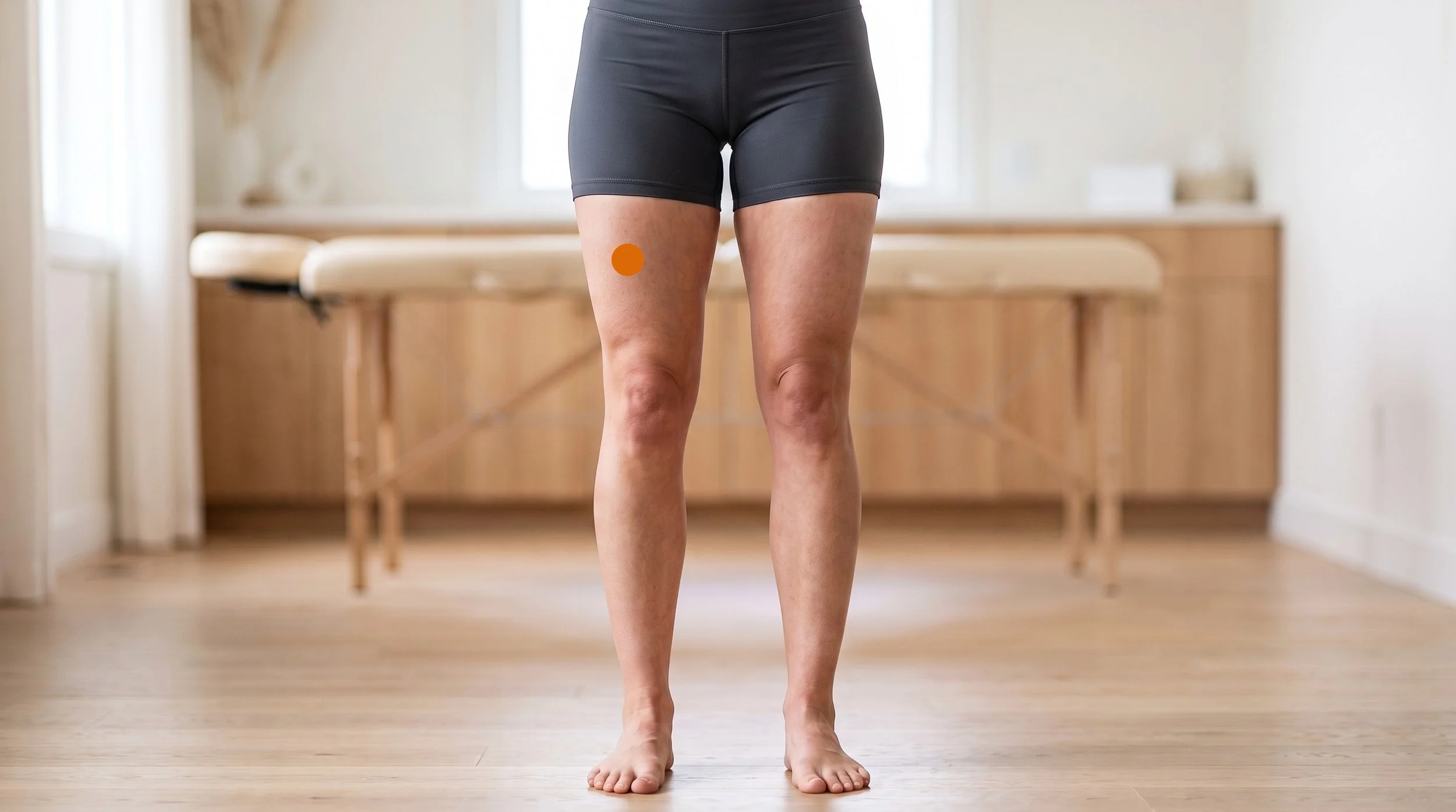
ST32 Acupuncture Point (Futu)
The Crouching Rabbit in the Quadriceps: Anatomy, Mechanism, and Why This Mid-Thigh Stomach Point Anchors Knee and Thigh Pain Treatment
ST32 (Futu, or Crouching Rabbit) is the Stomach channel point that sits in the thick belly of the rectus femoris, roughly a hand's span above the top of the kneecap on the line running toward the front hip bone. The name is anatomical rather than poetic: when the quadriceps contracts, the muscle bulk under the point rises like a rabbit hunched in the grass.
Clinically, the st32 acupuncture point is one of the most useful mid-thigh targets we have, because a needle placed here reaches the largest knee extensor in the body, sits in femoral nerve territory that shares spinal segments with the knee joint itself, and gives practitioners direct access to the muscular engine behind stair climbing, squatting, and single-leg control.
Traditional texts credit Futu ST32 with activating the channel, easing pain, and dispelling wind-damp from the leg (Deadman et al., 2007), while modern practice values it as a quadriceps and knee-support point in runners, cyclists, and desk-bound New Yorkers whose thighs have gone quiet.
- Location and layers: ST32 lies 6 cun above the upper border of the patella on the line to the anterior superior iliac spine, just above the junction of the lower and middle thirds of the thigh, in the rectus femoris belly with vastus intermedius beneath it (Deadman et al., 2007).
- Traditional categories translated: classical sources list ST32 as a channel-activating, pain-relieving, wind-damp-dispelling point for painful obstruction and atrophy patterns of the leg, which in modern language describes myofascial thigh pain, stiffness, and disuse weakness rather than any literal movement of energy (Deadman et al., 2007).
- Mechanism: needling here recruits A-delta and group III afferents in femoral nerve territory (roughly L2 to L4), the same segmental pool that supplies the knee joint capsule, so input converges in the lumbar dorsal horn and may dampen local pain signaling while also engaging descending inhibitory pathways from the brainstem (Zhao, 2008).
- Research picture: individual patient data pooling across chronic pain trials shows modest but persistent benefit for acupuncture over sham and no-acupuncture controls (Vickers et al., 2018), and needling of knee-region muscles has shown moderate short-term effects on pain and disability in knee pain syndromes (Rahou-El-Bachiri et al., 2020).
- Clinical framing: ST32 is rarely used alone; we pair it with ST34, ST36, Heding, and local knee points, and we treat it as an adjunct to loading and strengthening rather than a substitute for it (Espí-López et al., 2017).
- De qi: patients usually report a deep, spreading ache or heaviness in the middle of the thigh, sometimes with a brief twitch of the quadriceps if a taut band is engaged, which is expected and settles quickly (Simons et al., 1999).
Thigh Tightness or Knee Pain That Keeps Coming Back?
Quadriceps pain and anterior knee pain often trace back to the same overloaded extensor group, and ST32 sits right in the middle of it. At Morningside Acupuncture we use stomach 32 alongside knee-local points and dry needling of the rectus femoris and vastus intermedius to reduce tenderness and restore comfortable knee extension. Treatment is paired with simple loading work so the gains hold between visits. Schedule a session and let's map where your thigh is actually failing.
Schedule NowAnatomy of ST32: Why the Rectus Femoris Belly Is Such an Important Location
From the skin surface, a needle at ST32 passes through thin subcutaneous fat and the fascia lata before entering the rectus femoris, the only quadriceps head that crosses both the hip and the knee. Deeper still lies vastus intermedius, lying flat against the femoral shaft. This is the tissue that decelerates you on stairs and downhills, absorbs load in squatting and lunging, and shortens quietly during long hours of sitting with the hip flexed.
Because rectus femoris is a two-joint muscle, it gets loaded from both ends, which is part of why the mid-thigh region becomes tender in runners, cyclists, and anyone returning to training after time off.
The nerve geography explains a good deal of the point's usefulness. The anterior thigh here is supplied by branches of the femoral nerve and the anterior cutaneous nerves of the thigh, drawing on lumbar segments in the L2 to L4 range, which is also the segmental territory of much of the knee joint. Needle input from ST32 therefore arrives in the same spinal cord neighborhood as nociceptive traffic from the knee, and convergence at that level is one of the recognized routes by which acupuncture stimulation may reduce pain signaling (Zhao, 2008).
Beyond the segment, needling engages brainstem-mediated descending inhibition and endogenous opioid systems, which helps explain effects that outlast the treatment itself (Zhao, 2008). Local mechanical effects matter too: needling a taut band in the quadriceps can produce a local twitch response and reduce the sensitivity of that band (Simons et al., 1999).
Anatomically, ST32 is a forgiving location. The femoral artery, vein, and nerve trunk run medially in the femoral triangle, well away from this point, and the needle path from the front of the thigh encounters muscle rather than viscera or lung. Standard practice is perpendicular or oblique insertion of 1 to 2 cun, adjusted to the patient's build (Deadman et al., 2007). Deeper insertion approaches the periosteum of the femur, so most clinicians stop short of bone contact unless there is a specific reason.
Clean needle technique, careful positioning of a supported and slightly flexed knee, and clear instructions about the heavy ache of de qi make this a straightforward and well-tolerated point.
Related Acupuncture For Rectus Femoris Pain Related Rectus Femoris Trigger PointsST32 at a Glance: Classification, Location, and Clinical Use
| Category | Detail |
|---|---|
| Traditional Name | Futu (Crouching Rabbit) |
| Channel Classification | Stomach channel of the leg (Yang Ming), thigh portion; also noted where a sub-branch of the Gall Bladder sinew channel joins the thigh just above this point |
| Point Categories | No five-shu, command, or extraordinary vessel designation in the classical record; a local channel point of the anterior thigh, traditionally credited with activating the channel, alleviating pain, and dispelling wind-damp |
| Precise Location | On the front of the thigh, on a line from the lateral border of the patella to the anterior superior iliac spine, 6 cun above the upper border of the kneecap, just proximal to the junction of the lower and middle thirds of that line |
| Tissue Stimulated | Rectus femoris belly over vastus intermedius; see Rectus Femoris Trigger Points and Vastus Intermedius Trigger Points |
| Needle Depth / Direction | Perpendicular or oblique insertion, 1 to 2 cun, angled along the muscle belly when treating taut bands |
| De Qi Sensation | Deep, broad ache or heaviness through the mid-thigh, occasionally with a visible quadriceps twitch or a warm spread toward the knee |
| Primary Clinical Uses | Thigh pain, numbness and muscle tightness; knee coldness, pain and weakness; leg weakness and atrophy patterns in classical use; quadriceps strain and patellofemoral pain in modern sports practice |
| Common Point Combinations |
|
Deadman, Al-Khafaji, and Baker record Futu ST32 as a point used chiefly for channel disorders of the lower limb: painful obstruction and atrophy patterns, leg qi, thigh pain with numbness and muscular contraction, cold and weak knees, and lumbar pain, along with the unexpected addition of contraction of the arm.
Their commentary notes that the Sagelike Prescriptions from the Taiping Era extended the point far beyond the leg, recommending it for what that text called the eight regions of disease in women, a grouping that covered genital, breast, pregnancy, postpartum, bleeding, discharge, menstrual, and abdominal mass complaints. Other classical entries attach mania, disordered speech, hives, and a heavy-feeling head to the same point. These are traditional attributions rather than modern clinical claims, and they are worth reading as a record of how broadly a strong lower limb point was once deployed.
What makes the pattern striking is the contrast: a point whose modern reputation is almost entirely orthopedic once carried one of the widest indication lists on the anterior thigh.
Why ST32 Is Used for Knee Pain When It Sits Six Inches Above the Kneecap
Patients often ask why we needle the middle of the thigh for a problem they feel at the kneecap. The short answer is that the knee does not act alone. The quadriceps controls how the patella tracks, how much load reaches the joint surfaces during stairs and squats, and how quickly the leg stabilizes when you step off a curb. When the rectus femoris and vastus intermedius are tight, sensitized, or inhibited after an injury, the knee absorbs the difference. Needling ST32 addresses the muscular contributor directly rather than only the site of complaint.
There is also a nervous system rationale. ST32 sits in femoral nerve territory sharing lumbar segments with the knee joint, so afferent input from the needle converges with knee nociception in the same region of the dorsal horn, one of the better-described mechanisms behind segmental acupuncture analgesia (Zhao, 2008). Layered on top of that, needling activates descending inhibitory control and endogenous opioid release, effects measured in both animal and human work, which contributes to relief that extends past the treatment session (Zhao, 2008). Locally, engaging a taut band in the quadriceps can reduce that band's sensitivity and improve tolerance to stretch and load (Simons et al., 1999).
In practice this means ST32 tends to be most useful when thigh tissue is genuinely part of the problem: tenderness on palpation of the rectus femoris, pain reproduced by resisted knee extension, quadriceps stiffness after long sitting or long rides, or a knee that feels unsupported rather than sharply damaged. When the primary driver is elsewhere, at the hip, the calf, or the joint surfaces themselves, ST32 becomes a supporting player rather than the main target.
What the Research Shows for ST32
Almost no trial isolates a single point, and none has tested ST32 on its own. What the literature offers instead is evidence about acupuncture and needling protocols for knee and thigh pain that commonly include quadriceps and Stomach channel points, plus mechanistic work explaining how needle stimulation may modify pain processing. The reasonable reading is that ST32 is a well-chosen component of a multi-point approach for anterior thigh and knee complaints, not a stand-alone intervention, and results for quadriceps needling specifically have been mixed.
| Study | Type | Focus | Key Finding |
|---|---|---|---|
| Manheimer et al., 2010 | Cochrane systematic review | Acupuncture for peripheral joint osteoarthritis, mostly knee | Acupuncture produced statistically significant benefits over sham for pain and function, though the authors judged the difference from sham small enough to be of questionable clinical importance. |
| Vickers et al., 2018 | Individual patient data meta-analysis | Chronic pain including osteoarthritis and musculoskeletal pain | Acupuncture outperformed both sham and no-acupuncture controls, with effects that persisted over twelve months rather than fading immediately. |
| Rahou-El-Bachiri et al., 2020 | Systematic review and meta-analysis | Trigger point dry needling for knee pain syndromes | Needling showed moderate short-term effects on pain and related disability, with the authors noting variable trial quality. |
| Espí-López et al., 2017 | Randomized parallel-group trial | Dry needling added to a multimodal program for patellofemoral pain | Adding needling to a multimodal therapy program did not clearly improve outcomes beyond the program itself in this trial, which argues for using needling as an adjunct to loading work. |
| Dunning et al., 2018 | Multicenter randomized clinical trial | Periosteal electrical dry needling with exercise and manual therapy for knee osteoarthritis | The group receiving electrical dry needling alongside standard care reported greater improvements in pain and function at follow-up. |
| Zhao, 2008 | Narrative review of mechanisms | Neural basis of acupuncture analgesia | Reviews evidence that needle stimulation engages segmental dorsal horn inhibition, descending control, and endogenous opioid pathways. |
Stairs, Squats, and Hills Feeling Harder Than They Should?
Weak or guarded quadriceps make ordinary movement feel like a workout, and the st 32 thigh point is one of our go-to targets when knee support is the problem. We combine ST32 with ST34 and ST36 along the Stomach channel to address the whole extensor chain rather than one sore spot. Sessions are precise, comfortable, and built around your training or work demands. Book an appointment and get your legs working under you again.
Schedule NowST32 in the Context of Trigger Point Work
The crouching rabbit point sits squarely in territory that trigger point practitioners already know well. Rectus femoris harbors a well-documented trigger point in its upper portion that tends to refer pain down toward the front of the knee, and vastus intermedius, lying directly beneath ST32, is associated with diffuse anterior thigh aching and difficulty with stairs (Simons et al., 1999). Because the point and the myofascial targets overlap, needling at ST32 often doubles as dry needling of the quadriceps: same needle, same tissue, different explanatory framework.
At Morningside we palpate before we needle, and if a taut band runs through the ST32 region we treat it as such, watching for the local twitch response that signals engagement of the band.
In a typical session for anterior knee pain or quadriceps strain, we might needle ST32 and ST34 in the extensor group, add local knee points, then extend dry needling to vastus lateralis, vastus medialis, or the hip musculature depending on findings. Evidence for needling around the knee is encouraging but not uniform, and one trial found no added benefit from quadriceps needling on top of a good exercise program (Espí-López et al., 2017), so we treat needling as a way to reduce pain and improve tolerance for the loading work that actually rebuilds capacity. Patients usually leave with two or three specific exercises and a plan for progressing them.
ST32 Thigh and Knee Pain Treatment at NYC's Highest-Rated Acupuncture Clinic
Morningside Acupuncture is the highest-rated acupuncture and dry needling clinic in New York City with over 500 five-star Google reviews, and we treat quadriceps strain, patellofemoral pain, and post-injury knee weakness every week. Our approach blends classical point selection with orthopedic assessment and trigger point needling of the exact muscles driving your symptoms. You get a clear plan, not an open-ended treatment schedule. Schedule your visit today.
Schedule NowFrequently Asked Questions
What does ST32 feel like when needled?
Most people describe a deep, dull ache or a spreading heaviness through the middle of the thigh rather than a sharp sensation. That heavy ache is de qi, and it typically builds over a few seconds and then eases. If the needle contacts a taut band in the rectus femoris you may feel a quick involuntary twitch of the quadriceps, which can be briefly startling but is not harmful. Some soreness the next day, similar to post-workout muscle soreness, is common and usually resolves within a day or two.
Why needle the mid-thigh for pain I feel at my kneecap?
Because the quadriceps controls the knee. The muscles beneath ST32 govern how the kneecap tracks and how much load reaches the joint during stairs, squatting, and downhill walking, so tight or sensitized quadriceps tissue frequently shows up as anterior knee pain. There is also a neurological reason: ST32 lies in femoral nerve territory sharing spinal segments with the knee joint, so needle input converges with knee pain signals at the same level of the spinal cord (Zhao, 2008). Treating upstream at the muscle often changes the downstream symptom.
Can I press ST32 myself between sessions?
Yes, and it is one of the easier points to self-treat. Sit with your leg extended and relaxed, find the top edge of your kneecap, then measure roughly a hand's width plus a couple of finger widths up the front of your thigh, slightly toward the outside, on the line toward your hip bone. Press with your thumb or the heel of your hand into the muscle belly until you feel a firm, tolerable ache, then hold steady pressure for 30 to 60 seconds and release. Repeat two or three times per thigh, once or twice a day, and follow with gentle knee bending or a quadriceps stretch. Stop if the pressure creates sharp pain, numbness, or tingling down the leg.
Is ST32 safe to needle?
In trained hands it is a low-risk point. The major femoral vessels and nerve trunk run well medial to it in the femoral triangle, and there are no organs or lung tissue in the needle path, which is why standard texts allow perpendicular or oblique insertion of 1 to 2 cun (Deadman et al., 2007). The usual precautions still apply: sterile single-use needles, care in patients on blood thinners or with bleeding disorders, avoidance of broken or infected skin, and adjusted depth in very lean patients. Temporary soreness or a small bruise is the most common side effect. Always work with a licensed acupuncturist rather than needling yourself.
Where exactly is ST32 located?
Draw an imaginary line from the outer border of your kneecap up to the bony point at the front of your hip (the anterior superior iliac spine). ST32 sits on that line, 6 cun above the top edge of the kneecap, which for most people is roughly a hand's width plus two finger widths. A useful cross-check comes from the classical texts: divide the distance between the prominence of the greater trochanter and the upper border of the patella into thirds, and the point lies just above the junction of the lower and middle thirds (Deadman et al., 2007). You should feel it land in the fleshy bulk of the rectus femoris, which rises under your fingers when you tighten the thigh.
References
- Deadman, P., Al-Khafaji, M., & Baker, K. (2009). A manual of acupuncture. Journal of Chinese Medicine Publications.
- Simons, D. G., Travell, J. G., & Simons, L. S. (1999). Travell & Simons' myofascial pain and dysfunction: The trigger point manual, Vol. 1: Upper half of body (2nd ed.). Williams & Wilkins.
- Manheimer, E., Cheng, K., Linde, K., Lao, L., Yoo, J., Wieland, S., van der Windt, D. A. W. M., Berman, B. M., & Bouter, L. M. (2010). Acupuncture for peripheral joint osteoarthritis. Cochrane Database of Systematic Reviews, 2010(1), CD001977. https://doi.org/10.1002/14651858.CD001977.pub2
- Vickers, A. J., Vertosick, E. A., Lewith, G., MacPherson, H., Foster, N. E., Sherman, K. J., Irnich, D., Witt, C. M., & Linde, K. (2018). Acupuncture for chronic pain: Update of an individual patient data meta-analysis. Journal of Pain, 19(5), 455-474. https://doi.org/10.1016/j.jpain.2017.11.005
- Rahou-El-Bachiri, Y., Navarro-Santana, M. J., Gómez-Chiguano, G. F., Cleland, J. A., López-de-Uralde-Villanueva, I., Fernández-de-las-Peñas, C., Ortega-Santiago, R., & Plaza-Manzano, G. (2020). Effects of trigger point dry needling for the management of knee pain syndromes: A systematic review and meta-analysis. Journal of Clinical Medicine, 9(7), 2044. https://doi.org/10.3390/jcm9072044
- Espí-López, G. V., Serra-Añó, P., Vicent-Ferrando, J., Sánchez-Moreno-Giner, M., Arias-Buría, J. L., Cleland, J., & Fernández-de-las-Peñas, C. (2017). Effectiveness of inclusion of dry needling in a multimodal therapy program for patellofemoral pain: A randomized parallel-group trial. Journal of Orthopaedic & Sports Physical Therapy, 47(6), 392-401. https://doi.org/10.2519/jospt.2017.7389
- Dunning, J., Butts, R., Young, I., Mourad, F., Galante, V., Bliton, P., Tanner, M., & Fernández-de-las-Peñas, C. (2018). Periosteal electrical dry needling as an adjunct to exercise and manual therapy for knee osteoarthritis: A multicenter randomized clinical trial. The Clinical Journal of Pain, 34(12), 1149-1158. https://doi.org/10.1097/AJP.0000000000000634
- Zhao, Z. Q. (2008). Neural mechanism underlying acupuncture analgesia. Progress in Neurobiology, 85(4), 355-375. https://doi.org/10.1016/j.pneurobio.2008.05.004
Disclaimer: This web site is intended for educational and informational purposes only. Reading this website does not constitute providing medical advice or any professional services. This information should not be used for diagnosing or treating any health issue or disease. Those seeking medical advice should consult with a licensed physician. Seek the advice of a medical doctor or other qualified health professional for any medical condition. If you think you have a medical emergency, call 911 or go to the emergency room. No acupuncturist-patient relationship is created by reading this website or using the information. Morningside Acupuncture PLLC and its employees and contributors do not make any express or implied representations with respect to the information on this site or its use. For any legal interpretation of scope of practice in your state, consult a licensed attorney or regulatory authority.
Read more from our blog



