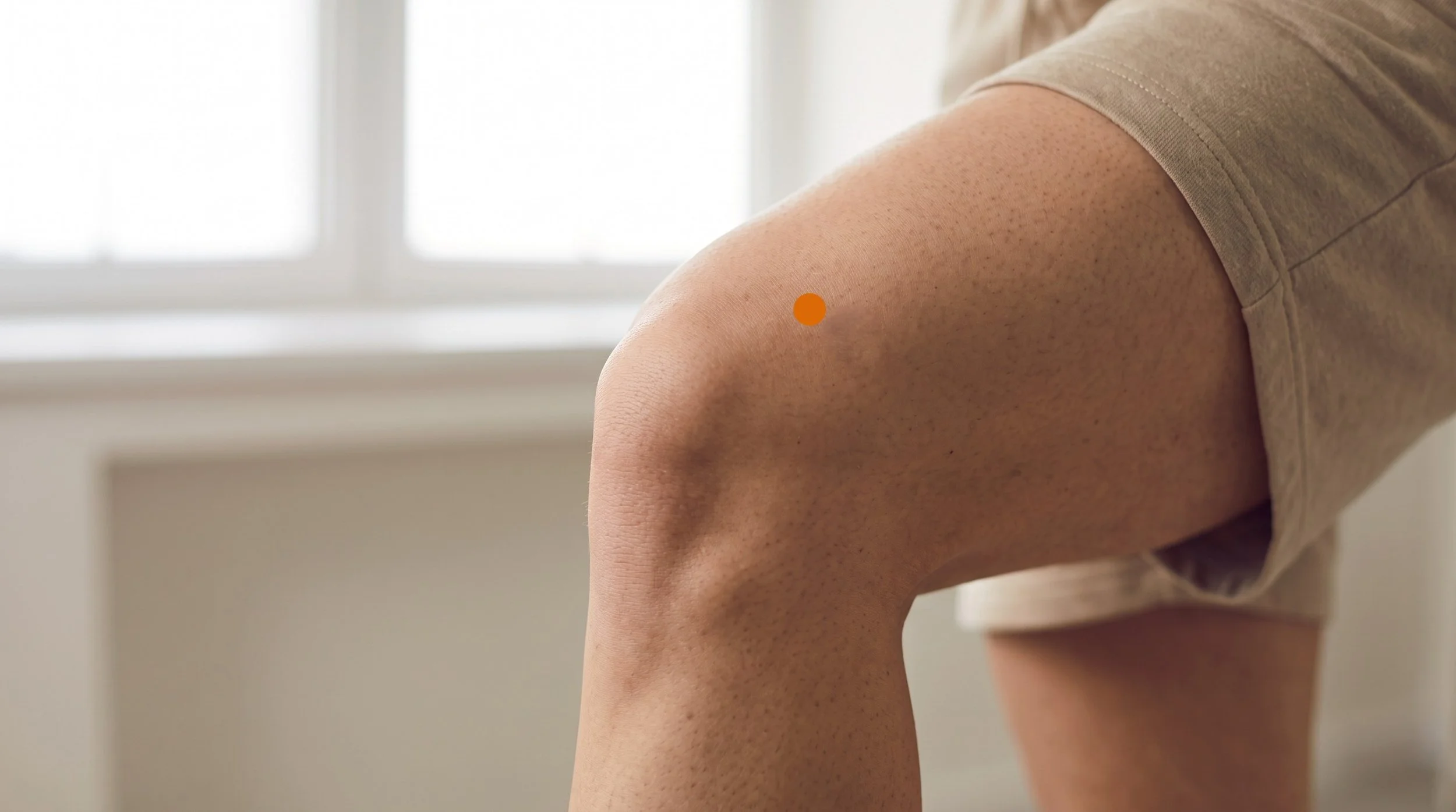
ST34 Acupuncture Point (Liangqiu)
The Ridge Mound Above the Kneecap: Anatomy, Mechanism, and Why the Stomach Channel's Xi-Cleft Point Anchors Acute Knee and Quadriceps Treatment
ST34, known as Liangqiu (Ridge Mound), sits on the front and outer thigh about two finger-widths plus a bit more above the top outer corner of the kneecap, in the soft groove where rectus femoris meets vastus lateralis. In classical terms it is the xi-cleft (accumulation) point of the Stomach channel, and it is the only xi-cleft point of the twelve primary channels located above the knee or elbow (Deadman et al., 2001).
That combination of a distinctive anatomical cleft, a dense quadriceps motor zone, and shared L2 to L4 innervation with the front of the knee is why the st34 acupuncture point shows up in almost every serious knee protocol, from osteoarthritis trials to runner's knee rehab in our Upper West Side clinic.
- Stomach 34 lies 2 cun proximal to the superior lateral border of the patella on the line from the anterior superior iliac spine to the lateral patellar border, and because the patella itself measures 2 cun, one patella height above its upper edge is a fast landmark (Deadman et al., 2001).
- The needle passes through skin and fascia into the junction of rectus femoris and vastus lateralis, with vastus intermedius and the quadriceps tendon deeper, so ST34 is simultaneously a channel point and a quadriceps motor point in modern terms (Simons et al., 1999).
- Traditionally ST34 is described as activating the channel, harmonising the Stomach, and moderating acute conditions, which translates neurophysiologically into local muscle and vascular effects plus segmental input at the same spinal levels that serve the anterior knee (Deadman et al., 2001; Zhao, 2008).
- Branches of the femoral nerve supply this region, and the anterior knee capsule and patellofemoral joint share that L2 to L4 supply, giving a plausible convergence pathway for pain modulation rather than any literal flow of energy (Zhao, 2008).
- ST34 is one of the most frequently used points in knee osteoarthritis trials, typically paired with SP10, ST35, EX-LE4, GB34, and SP9, and reviews of these multi-point protocols report modest but real improvements in pain and function (Manheimer et al., 2010; Sun et al., 2025).
- De qi at ST34 is usually a deep, heavy ache or spreading fullness that may travel toward the kneecap, and a brief involuntary quadriceps twitch is common when a taut band in the vastus lateralis is engaged (Simons et al., 1999).
Knee Pain That Flares Every Time You Load the Quad?
At Morningside Acupuncture we use ST34 as an anchor point for stairs pain, squat pain, and that deep ache above the kneecap that shows up the day after a long run. We combine it with local knee points, quadriceps dry needling, and electrical stimulation when the presentation calls for it, then send you home with loading and mobility homework. Most patients notice a change in how the knee feels under load within the first few visits. Schedule a knee evaluation and let's find out what your quad is actually doing.
Schedule NowAnatomy of ST34: Why the Cleft Above the Kneecap Is Such an Important Location
Start at the top outer corner of the kneecap with the knee bent, then move two cun up the thigh along the line running toward the anterior superior iliac spine. Since the patella itself is measured as two cun tall, one patella length above its upper border lands you in the right neighborhood (Deadman et al., 2001). What your finger settles into is a genuine groove: the septum between rectus femoris in front and vastus lateralis on the outside. Under that septum sit vastus intermedius and, deeper still, the femur and the distal quadriceps tendon.
This tissue takes an enormous eccentric load every time you walk downhill, descend subway stairs, or decelerate at the end of a run, which is exactly why it becomes tender, ropey, and reactive in anterior knee pain.
The nerve story here is straightforward and clinically useful. Muscular branches of the femoral nerve supply the quadriceps at this level, and articular branches of the same nerve carry sensation from the front of the knee capsule and the patellofemoral joint. Both routes report back to roughly the same spinal segments, so needle input at ST34 and nociceptive input from an irritated knee converge on shared dorsal horn neurons. That convergence is one mechanism by which a needle placed above the joint can change how the joint itself feels.
Beyond the segmental effect, needling recruits ascending pathways that engage brainstem descending inhibition and endogenous opioid signalling, which is the best-supported explanation for why acupuncture analgesia often outlasts the treatment session (Zhao, 2008). Locally, needling a taut band in the quadriceps can reduce resting tone and improve tolerance to stretch, effects long described in the myofascial literature (Simons et al., 1999).
Vascular structures in this region are deep and largely protected. The descending branch of the lateral circumflex femoral artery travels in the plane between rectus femoris and vastus lateralis, well below the depth used for standard technique. Perpendicular insertion of 1 to 1.5 cun is the conventional depth, with oblique angling also described (Deadman et al., 2001). Two practical cautions: stop short of periosteum on the femur, which is unnecessarily uncomfortable, and angle away from the suprapatellar recess if you are working low, since that space communicates with the knee joint.
Clean needle technique, appropriate needle length for the patient's build, and a bent-knee or supported-leg position make ST34 a comfortable and low-risk point in trained hands.
Related Best Acupuncture Points For Knee Pain Related Acupuncture For Rectus Femoris PainST34 at a Glance: Classification, Location, and Clinical Use
| Category | Detail |
|---|---|
| Traditional Name | Liangqiu (Ridge Mound), ST34, Stomach 34 |
| Channel Classification | Foot Yangming Stomach channel, distal anterolateral thigh |
| Point Categories | Xi-cleft (accumulation) point of the Stomach channel; notable as the only xi-cleft point among the twelve primary channels situated proximal to the knee or elbow, and traditionally grouped with points used for acute conditions and pain (Deadman et al., 2001) |
| Precise Location | With the knee flexed, 2 cun proximal to the superior lateral border of the patella, on the line connecting the anterior superior iliac spine and the lateral border of the patella. Since the patella measures 2 cun, one patella height above its top edge is a reliable shortcut. |
| Tissue Stimulated | Skin and subcutaneous fascia of the distal anterolateral thigh, the septum between rectus femoris and vastus lateralis, with vastus intermedius and the distal quadriceps tendon deeper; branches of the femoral nerve |
| Needle Depth / Direction | Perpendicular insertion 1 to 1.5 cun into the muscle belly, oblique insertion also used; stop short of femoral periosteum and angle away from the suprapatellar recess |
| De Qi Sensation | Deep heaviness, ache, or spreading fullness that may travel toward the kneecap or down the outer thigh; a brief quadriceps twitch is common when a taut band is engaged |
| Primary Clinical Uses | Knee pain and stiffness, difficulty bending or straightening the knee, quadriceps tightness and anterior knee overload, shin and leg pain, and traditionally acute epigastric discomfort and acute breast swelling |
| Common Point Combinations |
|
In the classical literature summarised by Deadman and colleagues, ST34 is the xi-cleft point of the Stomach channel, and xi-cleft points are traditionally described as places where channel qi and blood gather and plunge more deeply, which is why the category as a whole is reserved for acute presentations and pain (Deadman et al., 2001).
The recorded indications for Liangqiu cluster into three groups: knee and leg complaints (swelling and pain of the knee, trouble bending or straightening it, the old description of crane's knee wind, difficulty walking, painful obstruction and cold in the shin and feet, and lumbar pain), acute chest and breast disorders including swelling, pain, and abscess, which the tradition explains by the Stomach channel's course across the chest, and digestive complaints such as epigastric pain and acid regurgitation.
Deadman notes that the epigastric use, while common in modern clinics, looks like a later development rather than a classical one, which is a useful reminder that point repertoires evolve. What makes the classical pattern striking is the anatomy of the exception: of all twelve primary channel xi-cleft points, this is the only one placed above the knee or elbow, as if the tradition recognised that the tissue just above the kneecap deserved its own emergency valve.
Why ST34 Is Used for Sudden Knee Flare-Ups and, Traditionally, Acute Stomach Pain
The knee explanation is the easier one. The front of the knee capsule, the patellofemoral joint, and the quadriceps that control them all draw their nerve supply from the same upper lumbar levels via the femoral nerve. When you needle ST34, that input arrives at spinal segments already receiving a barrage of signals from the irritated joint, and the two streams converge on shared neurons.
Turning down the gain at that level is a plausible reason why a point above the joint can change symptoms inside it, and it is the same logic behind the classical habit of adding a point proximal to a painful joint rather than needling only the sore spot. Add the mechanical effect on a tight, load-bearing quadriceps and you get two mechanisms working in the same tissue (Zhao, 2008; Simons et al., 1999).
The wider analgesic story is not local at all. Needle stimulation that produces de qi recruits small-diameter afferents whose signals ascend to the periaqueductal gray and rostral ventromedial medulla, which then send descending inhibition back down to the dorsal horn, with endogenous opioids, serotonin, and noradrenaline among the mediators identified in experimental work (Zhao, 2008). This is why patients often report that the whole knee feels quieter rather than just the spot that was needled, and why effects can persist between visits (Vickers et al., 2018).
The digestive indication is more interesting than it first appears. Deadman and colleagues note that acute epigastric pain is a modern rather than classical use of ST34, even though acid regurgitation appears in the older indication lists (Deadman et al., 2001). Chinese clinical research summarised in the Shanghai text described an inhibitory effect on gastric acid secretion when Liangqiu was needled, in contrast with the stimulating effect reported for ST36 (Shanghai College of Traditional Chinese Medicine, 1981).
We present that as a traditional and observational finding rather than a settled mechanism, and in practice we treat digestive complaints with a broader plan than a single thigh point. Somato-autonomic reflex effects are a real and studied phenomenon, but the evidence base for ST34 specifically in gastric conditions is much thinner than the knee evidence.
What the Research Shows for ST34
A caveat before the table: almost no clinical trial isolates ST34. Knee osteoarthritis studies test protocols in which Liangqiu appears alongside SP10, ST35, EX-LE4, GB34, and SP9, so the honest claim is that ST34 is a consistent component of protocols that outperform sham and usual care, not that it carries the effect by itself. Reviews also differ on how much of the benefit survives sham comparison, and effect sizes for chronic pain conditions are generally modest. What follows is the current picture, with those limits kept in view.
| Study | Type | Focus | Key Finding |
|---|---|---|---|
| Manheimer et al., 2010 | Cochrane systematic review | Acupuncture for peripheral joint osteoarthritis, mostly knee | Acupuncture produced statistically significant short-term improvements in pain and function compared with sham, though the authors judged the difference from sham to be small and of uncertain clinical importance, with larger benefits against waiting list and usual care. |
| Chen et al., 2024 | Systematic review and meta-analysis | Durability of acupuncture effects after treatment ends in knee osteoarthritis | Pooled data suggested pain and function benefits may persist for roughly three to six months after the course of treatment, with a favourable safety profile. |
| Sun et al., 2025 | Multi-centre randomized controlled trial | Manual acupuncture, electroacupuncture, warm needling and moxibustion at a protocol including ST34, SP10, ST35, EX-LE4, GB34 and SP9 | All active needling techniques improved pain and WOMAC physical function versus sham, and electroacupuncture showed the largest reduction in pain intensity, outperforming celecoxib on the reported outcomes. |
| Vickers et al., 2018 | Individual patient data meta-analysis | Acupuncture for chronic pain including osteoarthritis, across 39 trials | Acupuncture was superior to both sham and no-acupuncture controls for chronic pain, with effects that declined only modestly over twelve months. |
| Rahou-El-Bachiri et al., 2020 | Systematic review and meta-analysis | Trigger point dry needling for knee pain syndromes | Low to moderate evidence supported short-term reductions in pain and disability, with the clearest signal in patellofemoral pain rather than osteoarthritis or post-surgical knee pain. |
| Jiménez-del-Barrio et al., 2022 | Systematic review and meta-analysis | Dry needling in hip or knee osteoarthritis | Across seven trials the authors reported benefits for pain and physical function, while noting variable study quality and small pooled samples. |
Runner's Knee, Patellar Tracking, and Quad Tightness in NYC
Anterior knee pain in city runners and cyclists is rarely just a knee problem, and ST34 sits right over the lateral quadriceps tissue that so often drives it. Our licensed acupuncturists assess hip strength, quadriceps tone, and patellar tracking before needling, so the point selection matches your mechanics rather than a template. We layer acupuncture and dry needling with practical training adjustments you can start the same week. Book a session and get ahead of the next flare.
Schedule NowST34 in the Context of Trigger Point Work
The st 34 location overlaps almost perfectly with a region clinicians target in myofascial practice: the distal portion of the quadriceps where rectus femoris and vastus lateralis meet. Taut bands in vastus lateralis are classically associated with pain along the outer thigh and around the kneecap, and rectus femoris bands tend to refer deep to the patella, which is exactly the complaint many runners and stair climbers describe (Simons et al., 1999). When we needle ST34 at Morningside, we are often engaging that tissue directly, and a local twitch response is a common and expected finding. Whether we call it a channel point or a trigger point depends on the framework, but the needle and the tissue are the same.
In practice we rarely use ST34 alone. A typical anterior knee session might combine ST34 with vastus medialis and vastus intermedius needling, SP10 medially, GB34 laterally to address the peroneal region, and hamstring work when the posterior chain is guarding. Electrical stimulation across ST34 and a nearby local point is a reasonable addition given the trial evidence favouring electroacupuncture for pain intensity in knee osteoarthritis (Sun et al., 2025).
Dry needling reviews for knee conditions are encouraging but not definitive, with the strongest short-term signal in patellofemoral presentations (Rahou-El-Bachiri et al., 2020), so we treat needling as one input inside a plan that also includes loading, hip strength, and training modification.
ST34 Knee Pain Treatment at NYC's Highest-Rated Acupuncture Clinic
Morningside Acupuncture is the highest-rated acupuncture and dry needling clinic in New York City with over 500 five-star Google reviews, and knee pain is one of the conditions we treat most. Our approach pairs classical point selection like ST34 and SP10 with orthopedic assessment and trigger point needling of the quadriceps group. You get a clear plan, measurable goals, and honest expectations about how many visits it should take. Schedule your first appointment today.
Schedule NowFrequently Asked Questions
What does ST34 feel like when needled?
Most patients describe a deep, heavy ache or a sense of fullness that can spread toward the kneecap or down the outer thigh. Because the point sits in dense quadriceps tissue, the sensation is usually stronger than at points on the hands or feet, and a brief involuntary muscle twitch can occur when a taut band is engaged. That twitch is quick and not painful, though the area may feel worked or mildly sore for a day afterward, similar to post-exercise soreness.
Why needle above the knee when my pain is in the joint itself?
Two reasons. First, the quadriceps that cross and compress the patellofemoral joint attach above it, so the tissue generating load-related pain is often proximal to where the pain is felt. Second, the front of the knee and the muscles at ST34 share nerve supply from the same upper lumbar segments, which means needle input here reaches the same spinal neurons that process knee pain (Zhao, 2008). The classical texts arrived at the same practice from a different direction, routinely adding a point above an affected joint alongside local points (Deadman et al., 2001).
Can I press ST34 myself between sessions?
Yes, and it is one of the easier points to self-treat. Sit with the knee bent to about ninety degrees and the quadriceps relaxed, find the top outer corner of your kneecap, then slide your thumb about one kneecap height straight up the thigh toward the outer hip bone. You should feel a soft groove between the two muscle bellies. Press straight in with your thumb or a knuckle to a firm but tolerable ache, hold 30 to 60 seconds, release, and repeat 3 to 5 times per leg. Two or three rounds a day is plenty. Finish with a gentle standing quad stretch or a few slow sit-to-stands. Stop if pressure produces sharp, radiating, or numb sensations, and skip the area entirely over bruises, rashes, or a recently swollen and hot knee.
Is ST34 safe to needle?
In trained hands, yes. The region has no superficial vessels or organs at risk, and the descending branch of the lateral circumflex femoral artery lies deep in the intermuscular plane, well below the conventional depth of 1 to 1.5 cun (Deadman et al., 2001). Practitioners avoid striking femoral periosteum, which is uncomfortable and unnecessary, and angle away from the suprapatellar recess since that space communicates with the knee joint. Patients with a knee prosthesis, an active joint infection, a bleeding disorder, or anticoagulant therapy should tell their acupuncturist, since technique and depth are adjusted accordingly. Transient soreness or a small bruise are the most common side effects.
Where exactly is ST34 located?
With the knee flexed, ST34 is 2 cun proximal to the superior lateral border of the patella, on the line drawn between the lateral border of the patella and the anterior superior iliac spine. Because the height of the patella is itself measured as 2 cun, one patella length above its upper border is a quick and reliable way to find it (Deadman et al., 2001). Anatomically you are aiming for the depression between rectus femoris and vastus lateralis, which is usually easy to palpate when the quadriceps is relaxed. In a real patient that cleft may sit slightly higher or lower than the measured spot, and the palpated cleft is generally the better target.
References
- Deadman, P., Al-Khafaji, M., & Baker, K. (2009). A manual of acupuncture. Journal of Chinese Medicine Publications.
- O'Connor, J., & Bensky, D. (Eds. & Trans.). (1981). Acupuncture: A comprehensive text. Shanghai College of Traditional Medicine. Eastland Press.
- Simons, D. G., Travell, J. G., & Simons, L. S. (1999). Travell & Simons' myofascial pain and dysfunction: The trigger point manual, Vol. 1: Upper half of body (2nd ed.). Williams & Wilkins.
- Manheimer, E., Cheng, K., Linde, K., Lao, L., Yoo, J., Wieland, S., van der Windt, D. A. W. M., Berman, B. M., & Bouter, L. M. (2010). Acupuncture for peripheral joint osteoarthritis. Cochrane Database of Systematic Reviews, 2010(1), CD001977. https://doi.org/10.1002/14651858.CD001977.pub2
- Chen, H., Shi, H., Gao, S., Fang, J., Yi, J., Wu, W., Liu, X., & Liu, Z. (2024). Durable effects of acupuncture for knee osteoarthritis: A systematic review and meta-analysis. Current Pain and Headache Reports, 28(7), 709-722. https://doi.org/10.1007/s11916-024-01242-6
- Sun, J., Liang, Y., Luo, K.-T., Shao, X.-M., Tu, M.-Q., Wu, X.-T., Liu, F., Li, X.-W., Chen, Y.-D., Zhang, Q.-F., Ji, C.-H., Li, R.-R., Li, X.-Y., Xu, F., & Fang, J.-Q. (2025). Efficacy of different acupuncture techniques for pain and dysfunction in patients with knee osteoarthritis: A randomized controlled trial. Pain and Therapy, 14(2), 737-751. https://doi.org/10.1007/s40122-025-00713-x
- Vickers, A. J., Vertosick, E. A., Lewith, G., MacPherson, H., Foster, N. E., Sherman, K. J., Irnich, D., Witt, C. M., & Linde, K. (2018). Acupuncture for chronic pain: Update of an individual patient data meta-analysis. Journal of Pain, 19(5), 455-474. https://doi.org/10.1016/j.jpain.2017.11.005
- Zhao, Z. Q. (2008). Neural mechanism underlying acupuncture analgesia. Progress in Neurobiology, 85(4), 355-375. https://doi.org/10.1016/j.pneurobio.2008.05.004
- Rahou-El-Bachiri, Y., Navarro-Santana, M. J., Gómez-Chiguano, G. F., Cleland, J. A., López-de-Uralde-Villanueva, I., Fernández-de-las-Peñas, C., Ortega-Santiago, R., & Plaza-Manzano, G. (2020). Effects of trigger point dry needling for the management of knee pain syndromes: A systematic review and meta-analysis. Journal of Clinical Medicine, 9(7), 2044. https://doi.org/10.3390/jcm9072044
- Jiménez-del-Barrio, S., Medrano-de-la-Fuente, R., Hernando-Garijo, I., Mingo-Gómez, M. T., Estébanez-de-Miguel, E., & Ceballos-Laita, L. (2022). The effectiveness of dry needling in patients with hip or knee osteoarthritis: A systematic review and meta-analysis. Life, 12(10), 1575. https://doi.org/10.3390/life12101575
Disclaimer: This web site is intended for educational and informational purposes only. Reading this website does not constitute providing medical advice or any professional services. This information should not be used for diagnosing or treating any health issue or disease. Those seeking medical advice should consult with a licensed physician. Seek the advice of a medical doctor or other qualified health professional for any medical condition. If you think you have a medical emergency, call 911 or go to the emergency room. No acupuncturist-patient relationship is created by reading this website or using the information. Morningside Acupuncture PLLC and its employees and contributors do not make any express or implied representations with respect to the information on this site or its use. For any legal interpretation of scope of practice in your state, consult a licensed attorney or regulatory authority.
Read more from our blog



