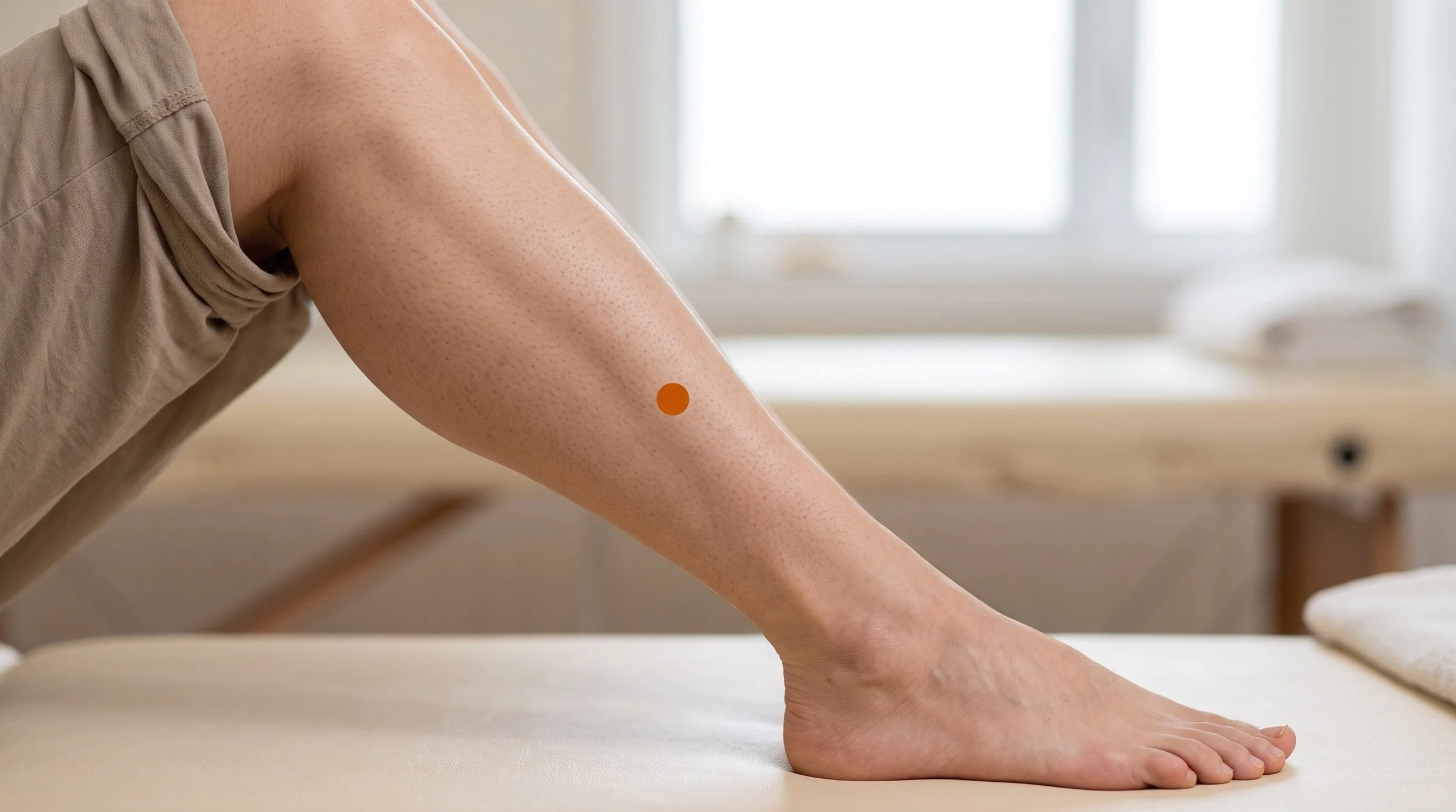
ST39 Acupuncture Point (Xiajuxu)
The Lower Great Void Below the Knee: Anatomy, Mechanism, and Why the Small Intestine's Lower He-Sea Point Sits on the Stomach Channel
ST39, called Xiajuxu in Chinese and usually translated as Lower Great Void or Lower Great Emptiness, sits on the front of the shin in the belly of the tibialis anterior muscle, one finger-breadth lateral to the sharp edge of the tibia and one cun below ST38. It's the third member of a vertical trio on the foot yangming Stomach channel: ST36, then ST37, then ST39, each classically assigned to a different hollow organ of the digestive tract. What makes the st39 acupuncture point unusual is its job description.
Classical texts assign it as the lower he-sea point of the Small Intestine (Deadman et al., 2007), which means a point on the leg was designated to treat an organ whose channel never comes anywhere near the leg. In modern practice that same location is a workaday needling target for anterior shin pain, tibialis anterior overload, and lower limb weakness, so stomach 39 lives a double life as both a visceral regulation point and a straightforward musculoskeletal one.
- Location and layers: ST39 lies one finger-breadth lateral to the anterior crest of the tibia, three cun below ST37 and one cun below ST38, which itself marks the midpoint between the knee joint line and the tip of the lateral malleolus (Deadman et al., 2007; Kim, 2010). The needle passes skin, thin subcutaneous tissue, and crural fascia into the tibialis anterior muscle belly.
- Traditional categories translated: classical sources list ST39 as the lower he-sea point of the Small Intestine and as one of the two lower points of the Sea of Blood alongside ST37 (Deadman et al., 2007; Maciocia, 2006). In neurophysiological terms, that's a classical way of saying a distal limb point was observed to change gut behavior and was catalogued accordingly, not a claim about literal energy travel.
- Nerve story: the point sits in tibialis anterior within deep fibular nerve territory, with L4 and L5 segmental input, so local needling recruits muscle and fascial afferents that feed the dorsal horn and can dampen shin and ankle pain through spinal and descending mechanisms (Zhao, 2008).
- Mechanism for gut effects: small intestine afferents enter the cord well above the leg segments, so any bowel effect from a shin point runs through long-loop somato-autonomic reflexes rather than same-segment convergence. Animal work at the neighboring lower he-sea point ST37 shows measurable changes in enteric neuron markers and colonic motility (Liang et al., 2018), and ST37 stimulation has enhanced jejunal motility through parasympathetic pathways (Yuan et al., 2016).
- Research picture: the trials that matter tested multi-point protocols, not ST39 alone. A Cochrane review of acupuncture for irritable bowel syndrome found no benefit over sham (Manheimer et al., 2012), while reviews of acupuncture after abdominal surgery report shorter times to bowel recovery with cautious confidence (Zhao et al., 2023).
- In practice and de qi: patients usually feel a dull, heavy, slightly spreading ache in the shin that may travel toward the ankle. A brief electric flick means the needle is near the deep fibular nerve and the angle should be changed.
Struggling With Bloating, Cramping, or Unpredictable Bowels?
At Morningside Acupuncture we treat digestive complaints with the whole leg trio, using ST36, ST37, and ST39 together with abdominal and back points chosen for your pattern. Sessions are unhurried, we track symptom diaries between visits, and we're honest about what acupuncture may and may not change for you. Many patients pair treatment with breathing work that supports parasympathetic tone. Book a visit and let's map out a realistic plan.
Schedule NowAnatomy of ST39: Why the Tibialis Anterior Below Mid-Shin Is Such an Important Location
Run your thumb down the sharp front edge of the tibia and slide it one finger-breadth laterally into the soft muscular gutter. That's the neighborhood of ST39. Under the needle there's skin, a thin layer of subcutaneous tissue, the crural fascia, and then the belly of tibialis anterior, the muscle that lifts the foot and controls its descent every time your heel strikes the ground. Deeper still sit extensor digitorum longus and the interosseous membrane.
This tissue takes a beating in runners, walkers who log serious mileage on concrete, people ramping up hill or treadmill incline work, and anyone whose foot slaps down after heel strike. Tibialis anterior is an eccentric decelerator, and eccentric load is exactly the kind that leaves muscle tender, ropey, and irritable.
The nerve geography here is straightforward and clinically useful. ST39 lies in deep fibular nerve territory, with segmental input from roughly L4 and L5. Needling engages muscle spindles, free nerve endings, and fascial afferents whose signals converge in the dorsal horn with input from the ankle, foot, and shin, which is one reason a needle in the mid-shin can change how the whole anterior lower leg feels.
Beyond the spinal level, needle stimulation recruits descending inhibitory pathways from the brainstem and releases endogenous opioids, a mechanism mapped in detail across decades of neurophysiology work (Zhao, 2008). Trigger points in tibialis anterior have their own referral behavior, typically projecting to the front of the ankle and the great toe, which means a patient complaining of ankle-front pain may actually need needling several inches higher, right where ST39 sits (Simons et al., 1999).
Across pooled individual patient data, acupuncture outperforms both no-acupuncture and sham controls for chronic musculoskeletal pain, with modest effect sizes that persist over time (Vickers et al., 2018).
The structure to respect is deep. The anterior tibial artery and its accompanying veins travel with the deep fibular nerve along the interosseous membrane, well beneath the tibialis anterior belly. Classical needling guidance for ST39 is perpendicular or oblique insertion of one to one and a half cun (Deadman et al., 2007), and more conservative modern texts suggest half a cun to one cun perpendicular (Kim, 2010). Both keep the needle in muscle rather than driving toward the neurovascular bundle.
A sharp electric sensation shooting toward the foot means redirect, not push harder. Clean needle technique, awareness of anticoagulant use, and avoiding insertion through broken or infected skin are the usual sensible precautions.
Related Acupuncture For Tibialis Anterior Pain Related Tibialis Anterior Trigger PointsST39 at a Glance: Classification, Location, and Clinical Use
| Category | Detail |
|---|---|
| Traditional Name | Xiajuxu (Lower Great Void, also translated Lower Great Emptiness or Lower Great Hollow) |
| Channel Classification | Stomach channel of the foot yangming, ST39, the third of the three lower he-sea points on this channel |
| Point Categories | Lower he-sea point of the Small Intestine; one of the two lower points of the Sea of Blood, paired with ST37 and matched to the upper point BL11; classically included among the points used to clear heat from the Stomach; listed by some authors as a point of the Penetrating Vessel trajectory |
| Precise Location | On the anterior lower leg, 3 cun below ST37 and 1 cun below ST38, one finger-breadth lateral to the anterior crest of the tibia. ST38 is found at the midpoint between the tibiofemoral joint line and the prominence of the lateral malleolus. |
| Tissue Stimulated | Belly of tibialis anterior, crural fascia, and adjacent anterior compartment tissue, in deep fibular nerve territory (L4 to L5) |
| Needle Depth / Direction | Perpendicular or oblique insertion 1 to 1.5 cun into the muscle belly; more conservative sources use 0.5 to 1 cun. Angle away from any electric sensation traveling to the foot. |
| De Qi Sensation | A dull, heavy, expanding ache in the front of the shin, often spreading distally toward the ankle. Brief cramping in the muscle belly is common and settles quickly. |
| Primary Clinical Uses | Traditionally used for lower abdominal pain, diarrhea and dysenteric patterns framed through the Small Intestine, and breast disorders; used in modern practice for anterior shin pain, tibialis anterior overload, lower limb weakness, and as part of leg-based digestive protocols |
| Common Point Combinations |
|
The traditional logic behind ST39 is worth understanding on its own terms. As Deadman and colleagues explain, the Inner Classic placed the large and small intestines under the influence of the Stomach, which is why both organs were given treatment points on the Stomach channel of the leg rather than on their own arm channels (Deadman et al., 2007). The three yang channels of the arm present a structural oddity in classical theory: their pathways run through the upper body while the organs they're named for sit low in the abdomen.
The he-sea points on those arm channels were therefore considered weak at reaching their own organs, and a separate set of lower he-sea points on the leg was assigned the task, with ST39 taking the Small Intestine. Two traditional patterns dominate its use: a sharp lower abdominal pain radiating toward the low back and testicles, and a duller, cold-type abdominal ache with chronic loose stools that eases with warmth and pressure. Damp-heat diarrhea with pus and blood is a third classical indication.
Because the point also sits on the Stomach channel, the Essential Questions counted it among the points used to drain heat from the Stomach, which explains classical listings for breast abscess, dry lips, and throat obstruction. What makes the classical record genuinely striking is the last group of indications: cold and heat sensations at the shoulder, odd heat between the ring and little fingers, and burning in front of the ear. Those are all Small Intestine channel territories in the upper body, catalogued for a point on the shin.
Why ST39 Is Used for Lower Abdominal Pain and Bowel Symptoms Far From the Leg
The honest answer starts with what segmental convergence can and can't explain. When we needle a point over the low back or abdomen for gut symptoms, the mechanism is relatively tidy: the sensory nerves of that skin and muscle share spinal segments with the visceral afferents from the organ, so the two inputs meet in the same neighborhood of the spinal cord. ST39 doesn't have that advantage. Its innervation is L4 and L5, while small intestine afferents enter the cord much higher through thoracic splanchnic pathways and the vagus.
Any effect on gut function from the shin has to travel a longer route, through somato-autonomic reflexes that loop up to the brainstem and back down as autonomic output. That distinction matters clinically, because it predicts that leg points will produce more diffuse, systemic autonomic effects while abdominal points produce more local, direct ones.
Laboratory work on the neighboring lower he-sea points supports that picture without overselling it. Electroacupuncture at ST37 has been shown to change colonic motility and to shift markers of excitatory and inhibitory enteric neurons in a constipation model (Liang et al., 2018), and separate work found ST37 stimulation enhanced jejunal motility through parasympathetic pathways (Yuan et al., 2016).
A comparison study that stimulated ST36, ST37, and ST39 against abdominal points in a functional dyspepsia model found the leg points and the abdominal points produced different effects on gastric emptying and mucosal inflammation markers, with ST37 and ST39 influencing a leukocyte marker in the duodenum (Li et al., 2022). These are animal experiments, and they don't tell us how a person with cramping will feel next Tuesday. What they do suggest is that the classical grouping of these three shin points around digestive function isn't arbitrary.
Alongside the visceral story, ST39 earns its place for reasons a physical therapist would recognize immediately. It's in the middle of a muscle that's frequently overloaded, in a segment that shares dorsal horn real estate with the ankle and foot, and needling there recruits the same descending inhibitory machinery that underpins acupuncture analgesia more broadly (Zhao, 2008). For a patient with anterior shin pain and sluggish digestion, the same point serves both agendas, which is a practical convenience rather than anything mystical.
What the Research Shows for ST39
Setting expectations honestly matters here. There is no body of trials testing ST39 by itself, and there probably never will be, because clinical acupuncture uses point combinations selected for the individual. What we have instead are reviews of multi-point protocols in which ST39 frequently appears alongside ST36 and ST37, plus laboratory studies that isolate one or two points in animal models. The reviews below tell us something about the protocols ST39 belongs to, not about the point in isolation, and the findings are mixed rather than uniformly positive.
| Study | Type | Focus | Key Finding |
|---|---|---|---|
| Manheimer et al., 2012 | Cochrane systematic review | Acupuncture for irritable bowel syndrome, 17 trials with 1,806 participants | Acupuncture didn't outperform sham acupuncture for IBS symptom severity, though comparisons against some antispasmodic drugs favored acupuncture in unblinded trials where expectation effects can't be ruled out. |
| Zhao et al., 2023 | Systematic review and meta-analysis | Manual and electroacupuncture for postoperative ileus after colorectal cancer surgery | Pooled results suggested acupuncture may shorten time to return of bowel function, with the authors describing the underlying evidence as limited. |
| Li et al., 2022 | Controlled animal experiment | Electroacupuncture at lower limb points (ST36, ST37, ST39) versus abdominal points in a functional dyspepsia rat model | Leg and abdominal point groups produced different effects on gastric emptying and duodenal inflammation markers, which the authors interpreted as evidence of acupoint specificity. |
| Liang et al., 2018 | Mechanistic animal study | Electroacupuncture at ST37 versus ST25 on colonic motility in a mouse constipation model | ST37 stimulation improved proximal colonic pressure and normalized both excitatory and inhibitory enteric neuron markers, while the abdominal point affected only one of them. |
| Yuan et al., 2016 | Mechanistic animal study | Electroacupuncture at ST37 and jejunal motility in rats and mice | Stimulation enhanced jejunal motility, and the effect appeared to depend on parasympathetic pathways. |
| Vickers et al., 2018 | Individual patient data meta-analysis | Acupuncture for chronic musculoskeletal, headache, and osteoarthritis pain across 39 trials | Acupuncture was superior to both sham and no-acupuncture controls with modest effect sizes, supporting its use for the musculoskeletal side of ST39's application. |
Shin Pain, Tight Tibialis Anterior, or Weak Dorsiflexion?
ST39 sits directly in the tibialis anterior, which makes it a natural target when running, hill work, or long days on hard NYC pavement leave the front of your shin sore and stiff. We combine point needling with dry needling of the anterior compartment, calf work, and loading advice so the change holds. Every treatment includes a movement assessment, not just needles. Schedule an evaluation and get the shin looked at properly.
Schedule NowST39 in the Context of Trigger Point Work
ST39 and the tibialis anterior trigger point zone overlap so closely that in practice they're often the same needle. Trigger points in this muscle tend to cluster in the upper and middle thirds of the belly, and their referral pattern runs down the front of the leg into the anteromedial ankle and the great toe (Simons et al., 1999). Patients typically describe it as ankle pain, not shin pain, which is why palpating up the anterior compartment matters.
When we needle ST39 in a runner or a walker with front-of-ankle symptoms, we're usually treating a taut band in tibialis anterior that happens to sit at a classically named location.
At Morningside we rarely needle ST39 in isolation for shin complaints. A typical session might combine it with ST36 higher on the same muscle, fibularis longus laterally, tibialis posterior through the deep posterior compartment when the medial shin is involved, and gastrocnemius or soleus if calf stiffness is driving compensatory dorsiflexor overload. The needling is followed by loading: heel walks, controlled eccentric lowering, and a look at footwear and training volume.
Acupuncture is the use of an acupuncture needle, and whether we describe a given insertion as ST39 or as a tibialis anterior trigger point release, the tissue and the mechanism are identical. The framing simply changes with the reasoning behind it.
ST39 Digestive and Shin Pain Treatment at NYC's Highest-Rated Acupuncture Clinic
Morningside Acupuncture is the highest-rated acupuncture and dry needling clinic in New York City with over 500 five-star Google reviews, and our licensed acupuncturists use points like ST39 inside evidence-informed treatment plans rather than as standalone fixes. Whether you're here for gut symptoms, lower abdominal discomfort, or anterior shin pain, you'll get a clear explanation of what we're doing and why. We treat on the Upper West Side with same-week availability. Schedule your first session today.
Schedule NowFrequently Asked Questions
What does ST39 feel like when needled?
Most people feel a dull, heavy, slightly spreading ache in the front of the shin once the needle reaches the tibialis anterior belly. That sensation, called de qi, may travel down toward the ankle or occasionally up toward the knee. If the muscle holds an active trigger point, you might get a brief twitch and a short cramping sensation that fades within seconds. What you shouldn't feel is a sharp electric jolt shooting into the foot, which indicates proximity to the deep fibular nerve and means the practitioner should withdraw slightly and change the angle.
Why needle a point on the shin for abdominal or bowel symptoms?
Classical texts assigned ST39 as the lower he-sea point of the Small Intestine because the arm channels of the intestines don't reach their own organs effectively, so treatment points were placed on the leg instead (Deadman et al., 2007). Physiologically, distal limb points appear to influence gut function through somato-autonomic reflexes that loop through the brainstem rather than through the direct segmental connections that abdominal points use. Animal studies at the neighboring point ST37 have documented changes in intestinal motility and enteric neuron markers (Liang et al., 2018; Yuan et al., 2016), though human trial evidence for gut conditions remains mixed.
Can I press ST39 myself between sessions?
Yes, and it's an easy point to find on yourself. Sit with your knee bent and slide a finger down the sharp front edge of the shinbone to a point roughly two thirds of the way from your knee to your ankle bone, then move one finger-width outward into the muscle. Press with your thumb using firm, steady pressure until you feel a satisfying ache, hold for 30 to 60 seconds, release, and repeat two or three times per leg. Once or twice a day is plenty. You can add slow ankle pumps while holding the pressure to add a mobility component. Stop if the pressure produces numbness, tingling into the foot, or pain that lingers afterward.
Is ST39 safe to needle?
In trained hands, yes. The main structures to respect are the deep fibular nerve and the anterior tibial artery, which travel deep in the anterior compartment along the interosseous membrane, well below the depths used at this point. Standard guidance is perpendicular or oblique insertion of one to one and a half cun, with more conservative sources using half to one cun (Deadman et al., 2007; Kim, 2010). Practitioners keep the needle in muscle and redirect if a patient reports electric sensation into the foot. Usual precautions apply for people on blood thinners, with local skin infection, or with reduced sensation in the lower leg. Transient soreness for a day afterward is common and not a concern.
Where exactly is ST39 located?
Start by finding ST38: divide the distance between the knee joint line and the prominence of the outer ankle bone in half, and the midpoint on the front of the leg marks ST38. ST39 sits one cun (about one thumb-width) below that, and three cun below ST37. From the sharp anterior crest of the tibia, move one finger-breadth laterally into the soft muscle. Some texts describe the same spot as nine cun below the depression lateral to the kneecap (Kim, 2010). You'll know you're in the right tissue if the muscle firms up under your finger when you lift your foot toward your shin.
References
- Deadman, P., Al-Khafaji, M., & Baker, K. (2009). A manual of acupuncture. Journal of Chinese Medicine Publications.
- Kim, H. (2008). Handbook of Oriental medicine (3rd ed.). Harmony & Balance Press.
- Maciocia, G. (2005). The foundations of Chinese medicine: A comprehensive text for acupuncturists and herbalists (2nd ed.). Elsevier Churchill Livingstone.
- Cecil-Sterman, A. (2012). Advanced acupuncture: A clinic manual. Classical Wellness Press.
- Simons, D. G., Travell, J. G., & Simons, L. S. (1999). Travell & Simons' myofascial pain and dysfunction: The trigger point manual, Vol. 1: Upper half of body (2nd ed.). Williams & Wilkins.
- Manheimer, E., Cheng, K., Wieland, L. S., Min, L. S., Shen, X., Berman, B. M., & Lao, L. (2012). Acupuncture for treatment of irritable bowel syndrome. Cochrane Database of Systematic Reviews, 2012(5), CD005111. https://doi.org/10.1002/14651858.CD005111.pub3
- Zhao, X., Si, S., Liu, X., Liu, J., Zhang, D., Mu, Y., & Hou, A. (2023). Does invasive acupuncture improve postoperative ileus after colorectal cancer surgery? A systematic review and meta-analysis. Frontiers in Medicine, 10, 1201769. https://doi.org/10.3389/fmed.2023.1201769
- Li, Y.-J., Yang, N.-N., Huang, J., Lin, L.-L., Qi, L.-Y., Ma, S.-M., Hu, C.-X., Wang, Y., Yang, J.-W., & Liu, C.-Z. (2022). Effects of electroacupuncture at different acupoints on functional dyspepsia rats. Evidence-Based Complementary and Alternative Medicine, 2022, 6548623. https://doi.org/10.1155/2022/6548623
- Liang, C., Wang, K.-Y., Gong, M.-R., Li, Q., Yu, Z., & Xu, B. (2018). Electro-acupuncture at ST37 and ST25 induce different effects on colonic motility via the enteric nervous system by affecting excitatory and inhibitory neurons. Neurogastroenterology & Motility, 30(7), e13318. https://doi.org/10.1111/nmo.13318
- Yuan, M., Li, Y., Wang, Y., Zhang, N., Hu, X., Yin, Y., Zhu, B., Yu, Z., & Xu, B. (2016). Electroacupuncture at ST37 enhances jejunal motility via excitation of the parasympathetic system in rats and mice. Evidence-Based Complementary and Alternative Medicine, 2016, 3840230. https://doi.org/10.1155/2016/3840230
- Zhao, Z. Q. (2008). Neural mechanism underlying acupuncture analgesia. Progress in Neurobiology, 85(4), 355-375. https://doi.org/10.1016/j.pneurobio.2008.05.004
- Vickers, A. J., Vertosick, E. A., Lewith, G., MacPherson, H., Foster, N. E., Sherman, K. J., Irnich, D., Witt, C. M., & Linde, K. (2018). Acupuncture for chronic pain: Update of an individual patient data meta-analysis. Journal of Pain, 19(5), 455-474. https://doi.org/10.1016/j.jpain.2017.11.005
Disclaimer: This web site is intended for educational and informational purposes only. Reading this website does not constitute providing medical advice or any professional services. This information should not be used for diagnosing or treating any health issue or disease. Those seeking medical advice should consult with a licensed physician. Seek the advice of a medical doctor or other qualified health professional for any medical condition. If you think you have a medical emergency, call 911 or go to the emergency room. No acupuncturist-patient relationship is created by reading this website or using the information. Morningside Acupuncture PLLC and its employees and contributors do not make any express or implied representations with respect to the information on this site or its use. For any legal interpretation of scope of practice in your state, consult a licensed attorney or regulatory authority.
Read more from our blog



