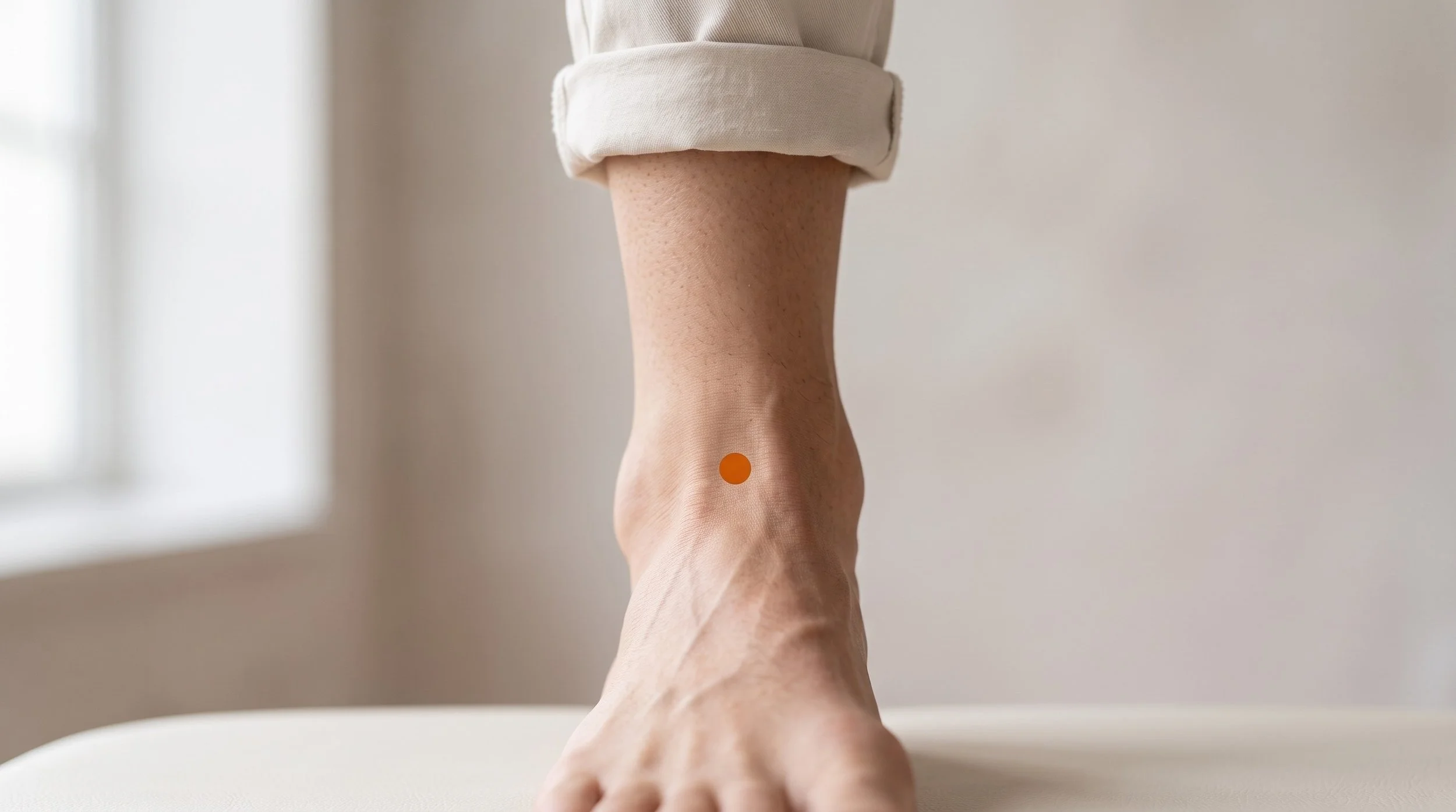
ST41 Acupuncture Point (Jiexi)
The Stream Divide at the Front of the Ankle: Anatomy, Mechanism, and Why This Jing-River Point Bridges Ankle Rehab and Classical Heat-Clearing Strategy
ST41 (Jiexi, often translated as Stream Divide or Dispersing Stream) sits in the small valley at the front of the ankle, level with the tip of the outer ankle bone, in the soft gap between the tendon that lifts your big toe and the tendon that lifts the other four. It is the jing-river point and the fire point of the Stomach channel, which in classical terms places it midway along a very long channel and gives it a foot in two worlds.
Modern clinicians reach for the ST41 acupuncture point mostly for what is directly under the needle: anterior ankle pain, stiffness and swelling, sluggish dorsiflexion, and the tight extensor tendon corridor that gets loaded by walking hills, running downhill, and the stop-start pace of city sidewalks.
Classical texts used the same point for a very different-looking list, including frontal headache, red face and eyes, abdominal distention and constipation, which makes stomach 41 one of the more instructive points for showing how a single needling site can serve both local mechanics and older pattern-based reasoning.
- Location and layers: ST41 lies at the ankle crease level with the tip of the lateral malleolus, between the tendons of extensor hallucis longus and extensor digitorum longus, under skin, superficial fascia and the extensor retinaculum. Defining the tendons by asking the patient to lift the big toe and then the other toes against resistance is the most reliable way to find the jiexi point location.
- Traditional categories translated: the classical literature classifies ST41 as the jing-river and fire point of the Stomach channel and attributes to it actions of clearing channel heat, settling the spirit and freeing the channel. Read neurophysiologically, those attributions describe a well-innervated joint-line point that modulates local nociception and autonomic tone rather than anything moving through a conduit.
- Nerve story: the deep fibular nerve and anterior tibial vessels run just beneath the tendon interval, and the dorsum of the foot carries branches of the superficial fibular nerve, so needling here recruits somatic afferents that project to L4 to S1 dorsal horn segments shared with the ankle joint capsule and extensor compartment. Segmental input of this kind is one of the better-characterized routes by which needling engages spinal and descending inhibitory circuits (Zhao, 2008).
- Research picture: acupuncture reviews for ankle injury report modest and inconsistent benefit with methodological limits (Park et al., 2013; Liu et al., 2020), while individual patient data from chronic pain trials show effects that persist beyond the treatment period (Vickers et al., 2018), and stroke rehabilitation reviews suggest added lower limb motor gains when needling is layered onto standard rehab (Chen et al., 2025).
- Clinical framing: at Morningside, ST41 is usually one node in a plan that also includes dry needling of tibialis anterior and the long toe extensors, loading work for dorsiflexion, and balance retraining after sprain, since trials of needling for ankle instability pair the needle with proprioceptive exercise rather than using it alone (Salom-Moreno et al., 2015).
- De qi: patients typically report a deep, spreading ache or a heavy pressure inside the front of the ankle, sometimes drifting toward the toes. A sharp electric line down the foot suggests the needle is too close to the deep fibular nerve and should prompt withdrawal and redirection.
Stiff, Achy Ankle That Never Fully Recovered From a Sprain?
Anterior ankle pain that lingers months after the swelling settles is usually a mix of joint irritation, guarded extensor tendons and lost dorsiflexion range. We use ST41 at the ankle crease along with GB40 and SP5 to work the front, lateral and medial aspects of the joint in one session, then add dry needling to tibialis anterior and the long toe extensors. Loading and balance work is built in so the gains hold between visits. Book an evaluation and we will map out what your ankle actually needs.
Schedule NowAnatomy of ST41: Why the Tendon Gap at the Ankle Crease Is Such an Important Location
Run your finger across the front of your ankle while lifting your big toe and you will feel a firm cord pop up: that is extensor hallucis longus. Lift the other four toes and a second, more lateral set of cords appears, the extensor digitorum longus. ST41 occupies the depression between them at the level of the outer ankle bone tip. The tissue stack here is thin and busy.
Skin and a slim layer of superficial fascia sit over the extensor retinaculum, the strap-like band that pins the long tendons down as they turn the corner onto the foot, and beneath that lie the tendons themselves with the tibialis anterior tendon just medial. Directly deep is the front of the ankle joint capsule and the talus. Downhill walking, running on cambered streets, stair-heavy commutes and long periods in stiff shoes all load this corridor, which is why the anterior ankle so often feels tight, pinched or swollen after a sprain or a spike in mileage.
The nerve geography explains most of what needling does here. Cutaneous branches of the superficial fibular nerve fan across the dorsum of the foot, while the deep fibular nerve travels with the anterior tibial vessels just beneath the tendon interval, supplying the extensor muscles and the joint. All of this converges on spinal segments roughly L4 through S1, the same segments that receive nociceptive traffic from the anterior ankle capsule and the extensor compartment.
Needle stimulation at ST41 therefore delivers a strong, well-localized afferent volley into precisely the segments that are already sensitized in a cranky ankle. Experimental work on acupuncture analgesia describes how that afferent input engages spinal inhibitory interneurons and recruits descending pathways from the midbrain and brainstem that dampen dorsal horn transmission, along with local vascular and autonomic changes at the needling site (Zhao, 2008). Clinically that may translate into less pain on dorsiflexion, easier tendon glide and better tolerance of loading exercises.
Safety follows directly from the anatomy. The anterior tibial artery and vein and the deep fibular nerve lie deep to the point, so depth stays modest. Standard practice is a perpendicular insertion of roughly half a cun, or an oblique insertion that slides beneath the tendons toward SP5 medially or GB40 laterally when the goal is to cover more of the joint line. Practitioners palpate for the arterial pulse before inserting and avoid it, and a sharp radiating electric sensation down the foot is a signal to withdraw and adjust rather than push deeper. Handled this way, ST41 is a comfortable point that most patients tolerate easily even with an irritable ankle.
Related Extensor Digitorum Longus Trigger Points Related Extensor Hallucis Longus Trigger PointsST41 at a Glance: Classification, Location, and Clinical Use
| Category | Detail |
|---|---|
| Traditional Name | Jiexi (Stream Divide, also rendered as Dispersing Stream) |
| Channel Classification | Stomach channel of the foot yangming, point 41 of 45 |
| Point Categories | Jing-river point of the Stomach channel; fire point of the Stomach channel (yang channel five-shu series) |
| Precise Location | On the front of the ankle at the level of the tip of the lateral malleolus, in the depression between the tendons of extensor hallucis longus and extensor digitorum longus; extend the big toe against resistance to define the medial tendon, then the other toes to define the lateral one |
| Tissue Stimulated | Skin and superficial fascia of the anterior ankle, the extensor retinaculum, and the tendon interval between extensor hallucis longus and extensor digitorum longus, with the tibialis anterior tendon immediately medial and the anterior ankle joint capsule deep |
| Needle Depth / Direction | Perpendicular insertion about 0.5 cun, or oblique insertion beneath the tendons directed medially toward SP5 or laterally toward GB40; depth stays conservative because the anterior tibial vessels and deep fibular nerve lie deep to the point |
| De Qi Sensation | A deep, spreading ache or heavy fullness inside the front of the ankle, sometimes drifting toward the toes; a sharp electrical sensation means the needle is too close to the deep fibular nerve and should be withdrawn and redirected |
| Primary Clinical Uses | Anterior ankle pain, stiffness and swelling; post-sprain stiffness and reduced dorsiflexion; drop foot and weak dorsiflexion in rehabilitation settings; as a distal point in Stomach channel leg and knee complaints; traditionally for frontal headache, red face and eyes, abdominal distention and constipation |
| Common Point Combinations |
|
The commentary in Deadman, Al-Khafaji and Baker's point manual frames ST41 through a five-shu logic worth understanding as traditional attribution rather than physiology: points nearer the toes were held to act most strongly on the far end of the channel, points nearer the knee on the internal organ and trunk, and the jing-river point, sitting between the two, was credited with an even-handed effect on both.
On that reasoning the text gathers an unusually wide classical indication list under one point: heat signs in the yangming portion of the head such as frontal headache, brow pain, facial swelling and red eyes; digestive complaints attributed to Stomach heat, including distention after eating, belching, hunger without appetite and constipation; disturbances of spirit such as agitation, fright palpitations, weeping and manic states; and a large local and regional group covering ankle pain and swelling, drop foot, atrophy and heaviness of the leg.
The manual also notes the chain and lock arrangement with ST31 and ST36 for weakness of the leg, and the habit of angling the needle toward SP5 or GB40 depending on which part of the ankle hurts. What is striking is that the same anatomical spot supported the most local of uses and the most distant, and that the local uses are the ones modern anatomy explains most easily.
Why ST41 Is Used for Frontal Headache and Facial Heat, Not Just Ankle Pain
Patients are often surprised that a point on the ankle appears in classical formulas for headache across the forehead and brow. The traditional explanation is channel-based: the Stomach channel runs up the front of the body to the face and forehead, and the jing-river point was thought to clear heat along it. A modern reading is different. Distal needling produces a robust, non-noxious afferent barrage that reaches spinal and supraspinal pain-modulating systems, and those systems are not segmentally restricted.
Diffuse inhibitory control and descending projections from the periaqueductal gray and rostral ventromedial medulla can reduce transmission in trigeminal as well as spinal circuits, which is one plausible reason a foot point can influence head pain (Zhao, 2008). Nothing needs to travel up a channel for that to happen.
The evidence for needling in headache does not isolate ST41, but it does support the broader practice. The Cochrane review of acupuncture for tension-type headache prevention found that a course of treatment can reduce headache frequency for people with frequent episodes, while noting the usual difficulties with sham comparisons (Linde et al., 2016). Pooled individual patient data across chronic pain conditions, including headache, show benefits over both sham and no-acupuncture control that decline only modestly over a year (Vickers et al., 2018). In practice we would not treat headache with ST41 alone; it earns its place inside a protocol, often alongside LI4 and points on the head itself.
The digestive indications follow similar reasoning. Somatic input from the lower limb can influence autonomic outflow, and the older descriptions of Stomach heat causing distention, belching and constipation map loosely onto states of altered gut motility and visceral sensitivity. This is an area where we stay deliberately cautious in what we claim: ST41 may be a reasonable supporting point within a broader treatment plan, and it is not a substitute for gastroenterological assessment when symptoms are persistent or new.
What the Research Shows for ST41
One honest caveat frames everything below. Trials almost never test a single point, so there is no body of research on ST41 by itself. What exists are studies of multi-point protocols in which a point like Jiexi typically appears as one of several local and distal selections, plus mechanistic work explaining how needle stimulation influences pain processing. The most useful way to read the table is as evidence about the method in the conditions where ST41 is commonly chosen, not as evidence about the point in isolation.
| Study | Type | Focus | Key Finding |
|---|---|---|---|
| Park et al., 2013 | Systematic review and meta-analysis | Acupuncture for ankle sprain | Pooled trials suggested possible benefit for symptom improvement, but the authors judged the evidence insufficient to recommend acupuncture as an established option because of methodological weaknesses. |
| Liu et al., 2020 | Systematic review and meta-analysis of RCTs | Acupuncture for acute ankle sprain, alone or added to conventional care | Acupuncture combined with standard measures appeared to improve pain and recovery outcomes compared with standard care alone, with heterogeneous techniques limiting confidence. |
| Vickers et al., 2018 | Individual patient data meta-analysis | Acupuncture for chronic musculoskeletal, headache and osteoarthritis pain | Acupuncture outperformed both sham and no-acupuncture controls, and roughly 85 percent of the benefit was retained at twelve months, supporting durable rather than purely transient effects. |
| Linde et al., 2016 | Cochrane systematic review | Acupuncture for prevention of tension-type headache | A course of at least six sessions may be a reasonable option for people with frequent tension-type headache, though differences from sham needling were small. |
| Chen et al., 2025 | Systematic review and meta-analysis of RCTs | Acupuncture for lower limb motor dysfunction after stroke | Adding acupuncture to conventional rehabilitation was associated with better motor, balance and walking outcomes, with the caveat that most trials were conducted in one region and varied in quality. |
| Salom-Moreno et al., 2015 | Randomized clinical trial | Trigger point dry needling plus proprioceptive exercise for chronic ankle instability | Adding dry needling to an exercise program produced greater improvements in ankle function and pain than exercise alone in a small sample. |
| López-González et al., 2021 | Single-blinded randomized controlled trial | Dry needling of tibialis anterior and peroneus longus in athletes with chronic ankle instability | A single dry needling session altered pre-activation muscle timing and postural control measures compared with placebo needling, suggesting a neuromuscular rather than purely analgesic effect. |
| Zhao, 2008 | Narrative review of experimental studies | Neural mechanisms of acupuncture analgesia | Needle stimulation activates peripheral afferents that engage spinal inhibitory circuits and descending modulatory pathways, providing a plausible mechanism for both local and distant pain relief. |
Weak Dorsiflexion, Foot Slap or Tripping on Uneven Sidewalks?
When the foot feels heavy on the way through swing phase, the anterior compartment is often both irritable and underused. ST41 sits directly in that dorsiflexion territory, and we combine it with proximal Stomach channel points and targeted needling of the extensor group to reduce discomfort while you rebuild strength. Treatment always runs alongside graded exercise rather than replacing it. Schedule a visit and we will assess your gait and build the plan around it.
Schedule NowST41 in the Context of Trigger Point Work
ST41 sits at the crossroads of the anterior compartment, so it is a natural anchor for combined treatment. In Travell and Simons' trigger point manual, tibialis anterior refers pain to the front of the ankle and the big toe, extensor digitorum longus refers into the dorsum of the foot and the middle toes, and extensor hallucis longus refers toward the great toe. Those referral maps overlap the exact area patients point to when they say the front of the ankle hurts, which means a thorough session often includes both the point itself and the muscle bellies further up the shin.
We palpate the anterior compartment for taut bands and tenderness before deciding how much of the treatment should be local joint-line work and how much should be muscular.
Because acupuncture is defined by the use of an acupuncture needle across hundreds of styles, dry needling of tibialis anterior and the long toe extensors and channel-based needling at ST41 are the same tool applied with different reasoning. Trials in chronic ankle instability suggest that needling the ankle stabilizers can shift neuromuscular timing and postural control measures, not just soreness (López-González et al., 2021), and that pairing it with proprioceptive exercise improves function more than exercise alone (Salom-Moreno et al., 2015). Our sessions reflect that: needle the irritable tissue, restore dorsiflexion range, then load it.
ST41 Ankle and Foot Treatment at NYC's Highest-Rated Acupuncture Clinic
Morningside Acupuncture is the highest-rated acupuncture and dry needling clinic in New York City with over 500 five-star Google reviews, and ankle, foot and lower limb complaints are among the most common reasons patients come to us. Our sessions blend classical point selection such as st 41 ankle work with orthopedic assessment, myofascial dry needling and rehabilitation-minded advice. You will leave knowing what we treated and why. Schedule your appointment and let's get the front of that ankle moving again.
Schedule NowFrequently Asked Questions
What does ST41 feel like when needled?
Most people describe a deep, spreading ache or a sense of heavy fullness inside the front of the ankle, occasionally traveling toward the toes. The initial skin sensation is brief because the needles are very thin. Because the deep fibular nerve runs beneath the point, a sharp electric zap down the foot is possible; tell your practitioner if that happens, since the needle will simply be withdrawn slightly and redirected. Many patients notice the ankle feels looser on dorsiflexion within the same session.
Why would a point on my ankle help a headache or digestive symptoms?
Classical texts explained it through the Stomach channel, which runs from the face down the front of the body to the foot, and they treated ST41 as the point that clears heat along it. The modern explanation is different: needle stimulation generates strong afferent input that engages spinal and brainstem pain-modulating systems whose reach is not limited to the segment being needled (Zhao, 2008). The clinical evidence for needling in headache comes from multi-point protocols rather than single points (Linde et al., 2016), so we treat ST41 as one contributor rather than the whole strategy.
Can I press ST41 myself between sessions?
Yes, and it is an easy point to self-treat. Sit with your foot flat, lift your big toe to find the tendon that pops up at the front of the ankle, then lift the other toes to find the second tendon just lateral to it. The dip between them, level with the tip of your outer ankle bone, is ST41. Use your thumb or index finger to press straight down with steady, moderate pressure for 30 to 60 seconds, either holding or making small circles, and repeat two or three times per ankle. Two or three rounds a day is plenty. Skip it if you feel a pulse under your fingertip, if the skin is broken or bruised, or if pressure produces sharp shooting sensations into the foot, and stop if it aggravates symptoms.
Is ST41 safe to needle?
In trained hands, yes. The main considerations are the anterior tibial artery and vein and the deep fibular nerve lying deep to the tendon interval, which is why insertion stays shallow, typically around half a cun perpendicular, or angled obliquely beneath the tendons when a broader effect across the joint line is wanted. Practitioners palpate for the arterial pulse and avoid it. Normal cautions apply for acute swelling, infection, broken skin, recent surgical hardware at the ankle, and anticoagulant use, all of which should be mentioned before treatment.
Where exactly is ST41 located?
On the front of the ankle at the level of the tip of the lateral malleolus, the bony bump on the outside of your ankle, in the depression between the tendons of extensor hallucis longus and extensor digitorum longus. The most accurate way to confirm the jiexi point location is dynamic: extend the big toe against resistance to make the medial tendon stand out, then extend the other toes against resistance to define the lateral tendon. ST41 is the soft gap between them, roughly at the midpoint of the ankle crease.
References
- Deadman, P., Al-Khafaji, M., & Baker, K. (2009). A manual of acupuncture. Journal of Chinese Medicine Publications.
- Kim, H. (2008). Handbook of Oriental medicine (3rd ed.). Harmony & Balance Press.
- Maciocia, G. (2005). The foundations of Chinese medicine: A comprehensive text for acupuncturists and herbalists (2nd ed.). Elsevier Churchill Livingstone.
- Simons, D. G., Travell, J. G., & Simons, L. S. (1999). Travell & Simons' myofascial pain and dysfunction: The trigger point manual, Vol. 1: Upper half of body (2nd ed.). Williams & Wilkins.
- Zhao, Z. Q. (2008). Neural mechanism underlying acupuncture analgesia. Progress in Neurobiology, 85(4), 355-375. https://doi.org/10.1016/j.pneurobio.2008.05.004
- Vickers, A. J., Vertosick, E. A., Lewith, G., MacPherson, H., Foster, N. E., Sherman, K. J., Irnich, D., Witt, C. M., & Linde, K. (2018). Acupuncture for chronic pain: Update of an individual patient data meta-analysis. Journal of Pain, 19(5), 455-474. https://doi.org/10.1016/j.jpain.2017.11.005
- Park, J., Hahn, S., Park, J. Y., Park, H. J., & Lee, H. (2013). Acupuncture for ankle sprain: Systematic review and meta-analysis. BMC Complementary and Alternative Medicine, 13, 55. https://doi.org/10.1186/1472-6882-13-55
- Liu, A. F., Gong, S. W., Chen, J. X., & Zhai, J. B. (2020). Efficacy and safety of acupuncture therapy for patients with acute ankle sprain: A systematic review and meta-analysis of randomized controlled trials. Evidence-Based Complementary and Alternative Medicine, 2020, 9109531. https://doi.org/10.1155/2020/9109531
- Linde, K., Allais, G., Brinkhaus, B., Fei, Y., Mehring, M., Shin, B. C., Vickers, A., & White, A. R. (2016). Acupuncture for the prevention of tension-type headache. Cochrane Database of Systematic Reviews, 2016(4), CD007587. https://doi.org/10.1002/14651858.CD007587.pub2
- Chen, P., Jin, X., Yu, D., Chen, X., Lin, Y., Wu, F., & Shao, B. (2025). Efficacy of acupuncture on lower limb motor dysfunction following stroke: A systematic review and meta-analysis of randomized controlled trials. PLOS ONE, 20(5), e0312918. https://doi.org/10.1371/journal.pone.0312918
- Salom-Moreno, J., Ayuso-Casado, B., Tamaral-Costa, B., Sánchez-Milá, Z., Fernández-de-las-Peñas, C., & Alburquerque-Sendín, F. (2015). Trigger point dry needling and proprioceptive exercises for the management of chronic ankle instability: A randomized clinical trial. Evidence-Based Complementary and Alternative Medicine, 2015, 790209. https://doi.org/10.1155/2015/790209
- López-González, L., Falla, D., Lázaro-Navas, I., Lorenzo-Sánchez-Aguilera, C., Rodríguez-Costa, I., Pecos-Martín, D., & Gallego-Izquierdo, T. (2021). Effects of dry needling on neuromuscular control of ankle stabilizer muscles and center of pressure displacement in basketball players with chronic ankle instability: A single-blinded randomized controlled trial. International Journal of Environmental Research and Public Health, 18(4), 2092. https://doi.org/10.3390/ijerph18042092
Disclaimer: This web site is intended for educational and informational purposes only. Reading this website does not constitute providing medical advice or any professional services. This information should not be used for diagnosing or treating any health issue or disease. Those seeking medical advice should consult with a licensed physician. Seek the advice of a medical doctor or other qualified health professional for any medical condition. If you think you have a medical emergency, call 911 or go to the emergency room. No acupuncturist-patient relationship is created by reading this website or using the information. Morningside Acupuncture PLLC and its employees and contributors do not make any express or implied representations with respect to the information on this site or its use. For any legal interpretation of scope of practice in your state, consult a licensed attorney or regulatory authority.
Read more from our blog



