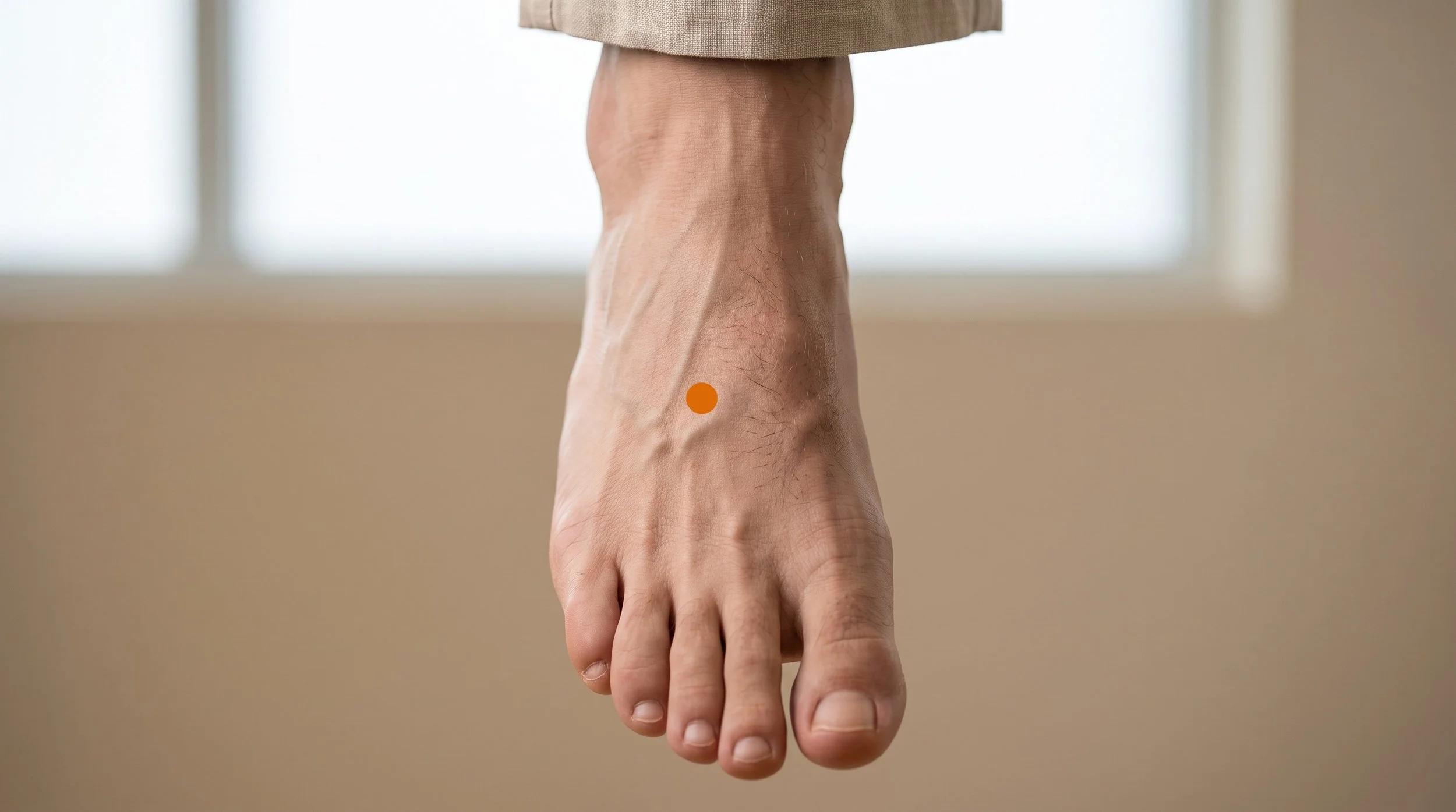
ST42 Acupuncture Point (Chongyang)
Rushing Yang on the Top of the Foot: Anatomy, Mechanism, and Why the Stomach Channel's Yuan-Source Point Sits Directly Over an Artery
ST42 (Chongyang, often translated as Rushing Yang or Surging Yang) is the yuan-source point of the Stomach channel, and it is one of the very few points in the classical map that is defined by a pulse rather than by a bone or a tendon alone. You'll find it on the top of the foot, roughly halfway between the front-of-ankle crease and the web space region, in the soft depression where the second and third metatarsal bases meet the cuneiform bones, right where the dorsalis pedis artery can be felt beating under your fingertip.
That single anatomical fact shapes everything about how the st42 acupuncture point is located, needled, and interpreted: it sits over the main dorsal blood supply of the foot, in territory served by the deep fibular nerve, at the stiff, load-bearing hinge of the midfoot. In modern practice it is used mostly for pain and swelling across the dorsum of the foot and for midfoot stiffness, while the classical literature attributes to it a much wider range of uses involving the face, the teeth, digestion, and the spirit.
- Location and layers: ST42 lies about 1.5 cun distal to ST41 on the line toward ST43, in the depression at the second and third tarsometatarsal junction, beside the extensor digitorum longus slip running to the second toe. The tissue under the needle is thin skin, dorsal fascia, tendon margin, and joint capsule, with the dorsalis pedis artery immediately deep (Deadman et al., 2001).
- Traditional categories, translated: classical sources list ST42 as the yuan-source point of the Stomach channel and credit it with clearing heat from the channel, harmonizing the Stomach, calming the spirit, and freeing the channel to relieve pain (Deadman et al., 2001; Kim, 2015). In neurophysiological terms these headings describe a distal segmental input point with strong autonomic and vascular neighbors.
- Nerve story: the site sits in deep fibular nerve territory (roughly L4 to S1), so needle input converges in the same lower lumbar and upper sacral dorsal horn segments that receive nociception from the midfoot joints and extensor tendons, a plausible substrate for segmental modulation of local pain (Zhao, 2008).
- Descending and vascular effects: needling recruits ascending pathways that engage periaqueductal grey and raphe circuits with opioid mediation, and local needling has been shown to change cutaneous microcirculation near the needled site, though the review evidence on blood flow remains limited and inconsistent (Zhao, 2008; Min et al., 2015; Kim et al., 2016).
- Research picture: no trial isolates ST42, so its evidence is inherited from multi-point protocols for chronic musculoskeletal pain and from ankle and foot injury reviews of mixed quality (Vickers et al., 2018; Park et al., 2013; Liu et al., 2020).
- De qi and safety: patients usually report a dull, spreading ache or heaviness toward the second and third toes rather than a sharp sensation, and because arterial anatomy on the dorsum varies between individuals, the pulse is palpated first and the needle is placed to the side of it (Hemamalini & Manjunatha, 2021; Deadman et al., 2001).
Dealing With Stubborn Pain Across the Top of Your Foot?
Dorsal midfoot pain is one of those complaints that lingers because the area keeps getting loaded every single step. At Morningside Acupuncture we combine careful palpation of the midfoot with points like ST42 and ST41, plus dry needling of the foot and lower leg extensors when the exam points that way. Most patients notice change in how the foot feels during push-off within a few sessions. Schedule a visit and we'll map out where your pain is actually coming from.
Schedule NowAnatomy of ST42: Why the Dorsalis Pedis Pulse Is Such an Important Location
The skin on the top of the foot is thin and mobile, with very little fat between it and the structures beneath. Just under that surface lies the dorsal fascia and the dorsal venous network, then the tendon of extensor hallucis longus medially and the slip of extensor digitorum longus heading toward the second toe, with the short extensors of the toes fanning out laterally. Deeper still are the tarsometatarsal joints, the stiff articulations where the cuneiforms meet the metatarsal bases.
This region absorbs and transmits load every time you push off, so it accumulates irritation from long walking days on hard pavement, tight or narrow footwear, dropped objects, and the compensatory gait patterns that follow an ankle sprain.
The sensory supply here comes largely from the deep fibular nerve, which shares this dorsal corridor with the artery, along with cutaneous branches of the superficial fibular nerve. Those fibers carry lower lumbar and upper sacral segmental information, which means needle-evoked activity at ST42 enters the same spinal levels that receive input from the midfoot joints, the extensor tendons, and the anterior compartment of the leg.
Convergence at that level is one reason a distal point can influence pain perceived across a wider region than the needle itself touches, and stimulation of this kind also recruits supraspinal pathways involving the periaqueductal grey and raphe nuclei with opioid mediation (Zhao, 2008). Local needling can additionally shift microcirculation near the site, an effect measured with laser Doppler imaging, though systematic review of this literature concludes the findings are not yet consistent enough to draw firm conclusions (Min et al., 2015; Kim et al., 2016).
The defining structure at ST42 is the dorsalis pedis artery, which runs directly beneath the point and is the reason the classical texts told practitioners to find the beat before finding the point. Anatomical studies show that this artery is not identical from person to person: in one cadaveric series the standard pattern appeared in most limbs while a meaningful minority showed anomalous origin, lateral deviation, duplication, or other branching differences (Hemamalini & Manjunatha, 2021).
Practically, that variability means palpation always comes first. The standard convention is oblique or perpendicular insertion of about 0.3 to 0.5 cun, angled and placed to one side of the palpated pulsation so the vessel is avoided, with firm post-needle pressure if any bleeding occurs (Deadman et al., 2001; Kim, 2015).
Related Pain Finder Leg Ankle Foot Related Deep Intrinsic Foot Muscles Trigger PointsST42 at a Glance: Classification, Location, and Clinical Use
| Category | Detail |
|---|---|
| Traditional Name | Chongyang (Rushing Yang, also rendered as Surging Yang or Penetrating Yang), ST42, Stomach 42 |
| Channel Classification | Stomach channel of the foot (yang ming), on the dorsum of the foot |
| Point Categories | Yuan-source point of the Stomach channel. Not a five-shu point and not listed with hui-meeting or crossing designations in the sources used here; some classical channel-theory teachings describe it as a site where Gallbladder luo pathology can transfer toward the Chong mai (Deadman et al., 2001; Kim, 2015; Sterman, 2018). |
| Precise Location | On the top of the foot, about 1.5 cun distal to ST41 along the line toward ST43, in the depression where the second and third metatarsal bases meet the cuneiform bones, at the point where the dorsalis pedis pulse is felt. It may fall on either side of the extensor digitorum longus slip to the second toe. |
| Tissue Stimulated | Dorsal fascia and tarsometatarsal joint capsule, extensor tendon margins including the extensor digitorum longus slip and extensor hallucis longus, with the extensor digitorum brevis and deep intrinsic foot muscles nearby; deep fibular nerve territory |
| Needle Depth / Direction | Oblique or perpendicular insertion 0.3 to 0.5 cun, angled away from the palpated dorsalis pedis pulse; palpate the artery before inserting and never needle into a pulsation |
| De Qi Sensation | Usually a dull, full ache or heaviness that spreads toward the second and third toes or up toward the front of the ankle; a brief electric flick can occur if a small nerve branch is brushed, in which case the needle is repositioned |
| Primary Clinical Uses | Pain and swelling on the top of the foot, midfoot stiffness and extensor irritation in modern practice; traditionally used for facial swelling, upper toothache, poor appetite with abdominal distention, and weakness of the foot |
| Common Point Combinations |
|
Deadman, Al-Khafaji and Baker's A Manual of Acupuncture presents ST42 as the yuan-source point of the Stomach channel, with traditional actions given as clearing heat from the channel, harmonizing the Stomach, calming the spirit, and freeing the channel to relieve pain, and it notes that the point's actions overlap considerably with ST41 even though ST41 is used far more often today.
The classical indication list is unusually broad for a small point on the top of the foot: complaints of the face and mouth including swelling, facial deviation, and toothache; digestive complaints such as abdominal distention with loss of appetite, epigastric pain, and vomiting; febrile presentations; vivid descriptions of agitated behavior; and local swelling, pain, or weakness of the foot itself.
Other texts add a diagnostic layer, describing palpation of the pulse and the skin at this site as a window on the Stomach, with qualities such as superficial versus deep or rapid versus slow read as different patterns (Maciocia, 2006). What makes the classical pattern striking is that a point defined by an arterial beat was treated both as a place to needle and as a place to read the patient, which is a very different logic from most points on the map.
Why ST42 Is Used for Toothache and Facial Swelling, Not Just Foot Pain
Patients are often surprised that a point on the top of the foot appears in classical formulas for upper toothache and swelling of the face. The traditional explanation is channel-based: the Stomach channel runs from the face down the front of the body and leg to the foot, so a source point at the far end of that line is understood to influence the whole pathway. A modern reading is more modest.
Needling a distal site produces a strong, well-localized afferent volley that does not require any anatomical connection to the face in order to change how pain is processed centrally, because the stimulus engages brainstem circuits that modulate nociception broadly rather than segment by segment (Zhao, 2008).
For the complaints ST42 is actually used for most today, the mechanism is closer to home. Midfoot pain, dorsal swelling, and stiffness after a sprain or a period of immobilization involve joint capsules, extensor tendons, and altered loading, all of which report into the same lower lumbar and sacral segments the needle stimulates. That shared segmental address gives the input a plausible route to reduce dorsal horn sensitivity and to change local muscle guarding, while descending inhibition supplies a second, broader layer of effect (Zhao, 2008).
Local vascular responses may contribute as well, since needling can alter microcirculation near the treated site, although reviews of that literature call the evidence preliminary (Min et al., 2015; Kim et al., 2016).
The honest framing for patients is this: ST42 is a small, precisely placed point that contributes to a treatment, not a switch that resolves a condition on its own. Broad analyses of acupuncture for chronic musculoskeletal pain show effects that are real and durable but moderate in size, and they were produced by multi-point protocols delivered over a course of sessions (Vickers et al., 2018). We use ST42 when the exam and the palpated findings point to the dorsal midfoot, and we combine it with the rest of the kinetic chain.
What the Research Shows for ST42
There is no clinical trial that tests ST42 by itself, and that is worth stating plainly. The research relevant to this point comes from three directions: large syntheses of acupuncture for chronic pain that used multi-point protocols, condition-level reviews of acupuncture for ankle and foot injury that are limited by small trials and inconsistent methods, and mechanistic and anatomical studies that explain what happens at and beneath a needle placed on the dorsum of the foot.
Taken together they suggest that a point like ST42 may contribute usefully to a treatment plan for dorsal foot pain, while none of them establish an effect for the point on its own.
| Study | Type | Focus | Key Finding |
|---|---|---|---|
| Vickers et al., 2018 | Individual patient data meta-analysis | Acupuncture for chronic musculoskeletal, headache, and osteoarthritis pain | Reported clinically relevant effects that persisted over time and were not explained by placebo alone, which supports including points like ST42 within a broader multi-point protocol rather than using them in isolation. |
| Park et al., 2013 | Systematic review and meta-analysis | Acupuncture for ankle sprain | Found some favorable results for symptom improvement but judged the trials to be of limited methodological quality, so the authors treated the evidence as inconclusive. |
| Liu et al., 2020 | Systematic review and meta-analysis of RCTs | Acupuncture for acute ankle sprain | Suggested possible benefit on ankle function and pain outcomes, with the authors cautioning that heterogeneity in acupuncture styles and trial quality limits confidence. |
| Min et al., 2015 | Controlled laser Doppler perfusion imaging study | Local microcirculation and analgesic response to needling | Observed that repeated needle manipulation produced greater local microcirculatory change that tracked with analgesic effects at related sites. |
| Kim et al., 2016 | Systematic review | Local blood flow changes after acupuncture stimulation | Concluded that most included trials showed some microcirculatory change, but that the overall evidence was too sparse and variable for reliable conclusions. |
| Zhao, 2008 | Narrative review of mechanism research | Neural pathways of acupuncture analgesia | Described segmental and supraspinal opioid-mediated pathways as the leading explanation for needle-induced pain modulation, which is the framework we use for ST42. |
| Hemamalini & Manjunatha, 2021 | Cadaveric anatomical study | Variations in origin, course, and branching of the dorsalis pedis artery | Documented the standard pattern in most limbs alongside a meaningful minority with anomalous origin, deviation, or duplication, which is a direct argument for palpating before needling ST42. |
Stiff Midfoot After an Ankle Sprain or a Long Season of Running?
When the front of the ankle and the top of the foot stay tight months after an injury, the problem is usually a mix of joint guarding, extensor overload, and altered gait mechanics. We use ST42 as part of a local and segmental strategy, paired with movement retraining so the gains carry into your walking and training. Sessions are unhurried, and we explain what we're doing and why. Book an appointment and let's get the foot moving again.
Schedule NowST42 in the Context of Trigger Point Work
Acupuncture is the use of an acupuncture needle, and that includes dry needling, so at Morningside we move freely between a classical point prescription and a myofascial map depending on what the exam shows. ST42 sits in a neighborhood crowded with muscles that refer pain into the top of the foot and toes: extensor digitorum brevis and extensor hallucis brevis directly beneath and lateral to the point, the dorsal interossei between the metatarsals, and the long extensors of the leg whose tendons cross the site on their way to the toes.
Trigger points in these muscles commonly produce a diffuse dorsal foot ache that patients describe as bruised or tight rather than sharply localized (Simons et al., 1999).
In practice, a session for dorsal midfoot pain might start with ST42 and ST41 needled shallowly along the joint line, then move to precise dry needling of the short toe extensors and interossei, and finish upstream at tibialis anterior and the long extensors in the leg. Because ST42 overlies the artery, it is treated as a palpate-first, shallow-angle site, while the muscular targets a centimeter or two away tolerate more manipulation. We then pair the needling with loading work, calf and foot mobility, and footwear adjustments, because the midfoot only stays better if the way you load it changes too.
ST42 Foot and Midfoot Pain Treatment at NYC's Highest-Rated Acupuncture Clinic
Morningside Acupuncture is the highest-rated acupuncture and dry needling clinic in New York City with over 500 five-star Google reviews, and foot and ankle complaints are among the most common reasons people come see us. We treat the whole chain, from the midfoot and extensors to the calf and hip, using acupuncture needles in whichever style fits the case. If your foot pain has outlasted rest and new shoes, schedule a session and we'll build a plan around it.
Schedule NowFrequently Asked Questions
What does ST42 feel like when needled?
Most people feel a brief pinch as the needle passes the thin dorsal skin, then a dull, full ache or heaviness that can spread toward the second and third toes or back toward the front of the ankle. That heavy, spreading quality is the classical de qi sensation, and it is what we're aiming for rather than sharpness. A quick electric flick can occur if a small nerve branch is brushed, and if that happens the needle is withdrawn slightly and repositioned. The needle is left in for a short retention while other points are treated, and the top of the foot can feel warm or slightly tingly afterward.
Why needle a point on the foot for tooth or face complaints?
Classical texts group ST42 with the face, mouth, and teeth because it is the source point at the distal end of the Stomach channel, which begins on the face and travels the whole length of the body. That is a traditional attribution, not a claim about literal energy flow. The mechanism we can describe with confidence is that a strong distal needle stimulus engages brainstem pain-modulating circuits that are not organized point to point with the painful region, so distal points can influence pain that is felt elsewhere (Zhao, 2008). In current practice, dental and facial complaints are treated with local and regional points first, and ST42 is a supporting rather than a primary choice.
Can I press ST42 myself between sessions?
Yes, with one important adjustment: this is a pulse site, so the technique is different from most acupressure. Sit with your foot resting on the opposite knee and slide a fingertip from the space between the second and third toes back toward the ankle until you reach the soft hollow where the metatarsal bases meet the cuneiforms, usually about two finger widths below the front of the ankle crease. If you feel a beat under your finger, shift a few millimeters to either side of it before applying pressure. Use steady, moderate pressure for 30 to 60 seconds, repeat two or three times per foot, and stop if you feel numbness, tingling, or throbbing. Avoid sustained pressure directly over a pulse, and skip this entirely if you have known circulatory problems in the feet, diabetic neuropathy, or any swelling, redness, or warmth that has not been evaluated.
Is ST42 safe to needle?
In trained hands, yes, with the obvious caveat that the dorsalis pedis artery runs directly beneath it. Standard practice is to palpate the pulse first, then insert obliquely or perpendicularly to a shallow depth of roughly 0.3 to 0.5 cun beside the vessel, never into it (Deadman et al., 2001). Because arterial anatomy on the dorsum varies between individuals, palpation matters more here than at most points (Hemamalini & Manjunatha, 2021). The most common minor event is a small bruise, since dorsal veins are superficial, and this is managed with brief pressure after withdrawal. Extra caution applies for patients on anticoagulants, those with peripheral vascular disease or diabetic foot changes, and any foot with unexplained swelling, and in those situations we usually choose a different point.
Where exactly is ST42 located?
ST42 is on the top of the foot at the highest part of the dorsum, about 1.5 cun distal to ST41 (the depression at the front of the ankle between the two main extensor tendons) along the line running toward ST43. Anatomically it sits in the depression formed where the second and third metatarsal bases meet the second and third cuneiform bones, and it may lie on either side of the extensor digitorum longus slip that runs to the second toe. The simplest way to confirm chongyang point location is to trace proximally from ST43 in the second and third metatarsal space until your finger drops into a hollow roughly midway to ST41, then feel for the dorsalis pedis pulse, which marks the site.
References
- Deadman, P., Al-Khafaji, M., & Baker, K. (2009). A manual of acupuncture. Journal of Chinese Medicine Publications.
- Kim, H. (2008). Handbook of Oriental medicine (3rd ed.). Harmony & Balance Press.
- Maciocia, G. (2005). The foundations of Chinese medicine: A comprehensive text for acupuncturists and herbalists (2nd ed.). Elsevier Churchill Livingstone.
- Maciocia, G. (2006). The channels of acupuncture: Clinical use of the secondary channels and eight extraordinary vessels. Churchill Livingstone Elsevier.
- Cecil-Sterman, A. (2012). Advanced acupuncture: A clinic manual. Classical Wellness Press.
- Simons, D. G., Travell, J. G., & Simons, L. S. (1999). Travell & Simons' myofascial pain and dysfunction: The trigger point manual, Vol. 1: Upper half of body (2nd ed.). Williams & Wilkins.
- Vickers, A. J., Vertosick, E. A., Lewith, G., MacPherson, H., Foster, N. E., Sherman, K. J., Irnich, D., Witt, C. M., & Linde, K. (2018). Acupuncture for chronic pain: Update of an individual patient data meta-analysis. The Journal of Pain, 19(5), 455-474. https://doi.org/10.1016/j.jpain.2017.11.005
- Zhao, Z. Q. (2008). Neural mechanism underlying acupuncture analgesia. Progress in Neurobiology, 85(4), 355-375. https://doi.org/10.1016/j.pneurobio.2008.05.004
- Park, J., Hahn, S., Park, J. Y., Park, H. J., & Lee, H. (2013). Acupuncture for ankle sprain: Systematic review and meta-analysis. BMC Complementary and Alternative Medicine, 13, 55. https://doi.org/10.1186/1472-6882-13-55
- Liu, A. F., Gong, S. W., Chen, J. X., & Zhai, J. B. (2020). Efficacy and safety of acupuncture therapy for patients with acute ankle sprain: A systematic review and meta-analysis of randomized controlled trials. Evidence-Based Complementary and Alternative Medicine, 2020, 9109531. https://doi.org/10.1155/2020/9109531
- Min, S., Lee, H., Kim, S. Y., Park, J. Y., Chae, Y., Lee, H., & Park, H. J. (2015). Local changes in microcirculation and the analgesic effects of acupuncture: A laser Doppler perfusion imaging study. The Journal of Alternative and Complementary Medicine, 21(1), 46-52. https://doi.org/10.1089/acm.2013.0442
- Kim, S. Y., Min, S., Lee, H., Cheon, S., Zhang, X., Park, J. Y., Song, T. J., & Park, H. J. (2016). Changes of local blood flow in response to acupuncture stimulation: A systematic review. Evidence-Based Complementary and Alternative Medicine, 2016, 9874207. https://doi.org/10.1155/2016/9874207
- Hemamalini, & Manjunatha, H. N. (2021). Variations in the origin, course and branching pattern of dorsalis pedis artery with clinical significance. Scientific Reports, 11, 1448. https://doi.org/10.1038/s41598-020-80555-z
Disclaimer: This web site is intended for educational and informational purposes only. Reading this website does not constitute providing medical advice or any professional services. This information should not be used for diagnosing or treating any health issue or disease. Those seeking medical advice should consult with a licensed physician. Seek the advice of a medical doctor or other qualified health professional for any medical condition. If you think you have a medical emergency, call 911 or go to the emergency room. No acupuncturist-patient relationship is created by reading this website or using the information. Morningside Acupuncture PLLC and its employees and contributors do not make any express or implied representations with respect to the information on this site or its use. For any legal interpretation of scope of practice in your state, consult a licensed attorney or regulatory authority.
Read more from our blog



