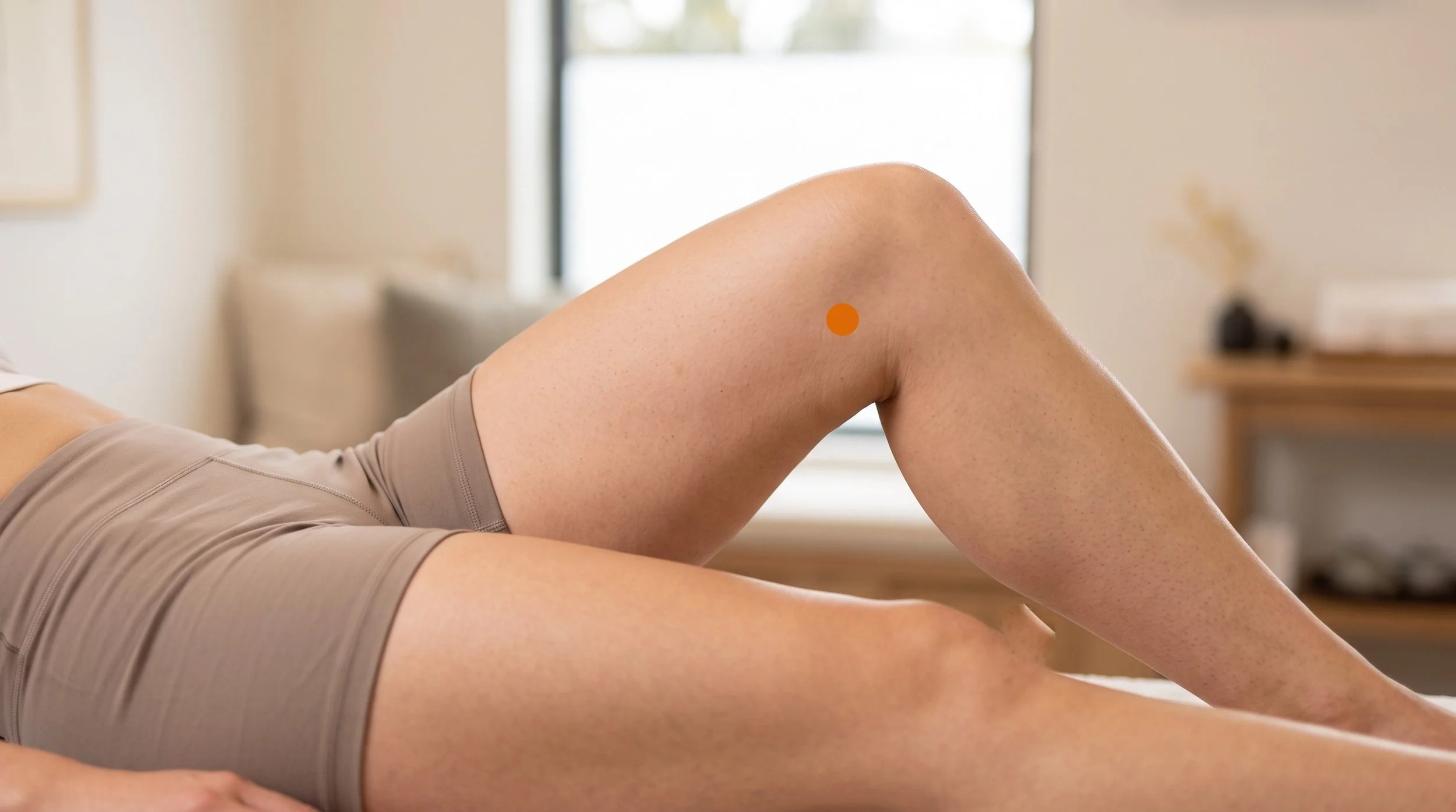
LV9 Acupuncture Point (Yinbao)
The Yin Wrapping Point Above the Knee: Anatomy, Mechanism, and Why This Inner Thigh Point Links Menstrual, Urinary, and Adductor Complaints
LV9 (Yinbao, often translated as Yin Wrapping), also written LR9, is the Liver channel point that sits high on the inner thigh, roughly one patella's height above the top of the kneecap, in the soft cleft between the vastus medialis and the sartorius. It is a quiet point in most textbooks and a surprisingly busy one in practice: classically it was grouped with menstrual irregularity, difficult urination, and lumbosacral pain that pulls forward into the lower abdomen, while in a modern musculoskeletal clinic the same spot is often the most tender place on a stiff, overloaded inner thigh.
Anatomically the LV9 acupuncture point overlies the roof of the adductor canal, the corridor where the saphenous nerve and the femoral vessels travel, which is exactly why liver 9 has both a local effect on medial thigh and knee complaints and a segmental relationship with the lower abdomen and pelvis.
- Location and layers: LV9 lies 4 cun above LV8 at the medial knee crease, in the groove between vastus medialis and sartorius, which puts the needle through skin and subcutaneous fascia into an intermuscular cleft rather than into thick muscle belly. Standard needling is perpendicular or oblique to a depth of about 1 to 2 cun, with palpation first because the femoral pulse can be felt nearby.
- Traditional attribution: classical sources credit LV9 with adjusting menstruation and regulating the lower jiao, and list irregular or disordered periods, difficult urination, urinary retention, bedwetting, and lumbosacral pain extending into the lower abdomen. These are traditional indications, not modern diagnostic claims.
- Nerve geography: the point sits over the adductor canal, where the saphenous nerve runs with the femoral artery and vein between sartorius and vastus medialis, a relationship mapped in detail in regional anesthesia anatomy studies (Kapoor et al., 2012).
- Mechanism: needling here recruits A-delta and group III afferents from the L2 to L4 territory, which converge in the same spinal segments that receive input from the lumbosacral region and hypogastrium, and it engages descending inhibitory pathways involving endogenous opioid and monoaminergic systems (Zhao, 2008).
- Research picture: reviews of acupuncture for period pain report modest and uncertain effects with real methodological limits (Smith et al., 2016; Woo et al., 2018), while individual patient data across chronic pain conditions show small but persistent benefits over sham (Vickers et al., 2018). No trial has tested LV9 in isolation.
- De qi at LV9 is usually a deep, warm ache or heaviness that may spread along the inner thigh toward the knee or up toward the groin; a sharp, electric line running down toward the medial ankle suggests saphenous nerve contact and the needle should be adjusted.
Struggling With Painful Periods or a Tight, Aching Inner Thigh?
At Morningside Acupuncture we use LV9 as part of a full-leg and lower-abdomen strategy rather than as a standalone fix. For menstrual complaints it is often paired with points on the lower abdomen and the yin channels of the leg, and for adductor tension it is treated alongside the surrounding muscles with careful, palpation-guided needling. Every plan starts with an exam, so we know what is actually driving the symptom before a needle goes in. Book a visit and let us build the plan around your presentation.
Schedule NowAnatomy of LV9: Why the Cleft Between Vastus Medialis and Sartorius Is Such an Important Location
From the surface, LV9 begins with thin skin and a variable layer of subcutaneous fat over the distal medial thigh. Beneath that, the needle enters a fascial seam rather than a muscle belly: the bulky vastus medialis sits on one side, the strap-like sartorius crosses on the other, and the adductor group approaches from behind. This interval is loaded constantly during walking, stair climbing, cycling, deep squats, and any sport that demands quick cutting or side-to-side changes of direction, because the adductors decelerate the leg while vastus medialis controls the kneecap.
When those demands outpace tissue capacity, the whole medial thigh tends to become guarded, and the seam at LV9 is often exquisitely tender to firm palpation.
Deep to the sartorius at this level lies the adductor canal, a triangular corridor whose roof is formed by sartorius and whose walls involve vastus medialis and the adductors. The saphenous nerve, the sensory terminal branch of the femoral nerve, travels here alongside the femoral artery and vein, together with the nerve to vastus medialis, and anatomical studies of this corridor show these structures running in close proximity within a few millimeters of one another (Kapoor et al., 2012).
Because the saphenous nerve carries fibers from the L2 to L4 roots, stimulation at LV9 feeds into spinal segments that also receive afferent traffic from the lower lumbar spine, the sacroiliac region, and, through overlapping autonomic pathways, the pelvic viscera. That convergence is the plainest neurophysiological explanation for why an inner thigh point was historically associated with lower abdominal and lumbosacral symptoms.
On top of the segmental story, needle stimulation activates descending inhibitory control from the midbrain and brainstem, with opioid and monoaminergic mediators dampening pain transmission well beyond the needled segment (Zhao, 2008).
The safety consideration at LV9 is vascular. The femoral artery and vein sit deeper and slightly lateral to the point as they pass through the canal, so competent practice means locating the pulse by palpation first, angling away from it, and using measured depth rather than aggressive deep insertion. The conventional range of 1 to 2 cun perpendicular or oblique is comfortably within the muscular and fascial planes when the point is located accurately, and many practitioners favor a shallower oblique angle in lean patients.
Moxibustion is traditionally described as applicable here. Patients on anticoagulants, or anyone with a history of deep vein thrombosis or vascular disease in the leg, should tell their practitioner before this region is needled.
Related Acupuncture For Vastus Medialis Pain Related Acupuncture For Sartorius Muscle PainLV9 (LR9) at a Glance: Classification, Location, and Clinical Use
| Category | Detail |
|---|---|
| Traditional Name | Yinbao, commonly rendered as Yin Wrapping or Yin Womb; the character bao can point to wrapping or containing and also to the uterus or bladder, which is how classical commentators explained the point's reach |
| Channel Classification | Ninth point of the Liver channel (Foot Jueyin), on the distal medial thigh (LV9, also written LIV9 or LR9) |
| Point Categories | No five-shu, luo-connecting, xi-cleft, front-mu, or extraordinary vessel intersection is assigned to LV9 in the standard references; it is a regular channel point whose traditional actions are given as adjusting menstruation and regulating the lower jiao. It is also named in channel palpation texts, alongside LV3 and LV10, as one of the Liver channel diagnostic areas assessed for tenderness, temperature, and arterial pulsation |
| Precise Location | On the medial thigh, 4 cun above LV8 at the knee crease, directly above the medial epicondyle of the femur, in the cleft between vastus medialis and sartorius; practically, measure one patella height (about 2 cun) above the upper border of the kneecap and find the tender depression between the two muscles |
| Tissue Stimulated | Skin and subcutaneous fascia, then the intermuscular seam between vastus medialis and sartorius, overlying the roof of the adductor canal, with the adductor group (adductor magnus) close behind |
| Needle Depth / Direction | Perpendicular or oblique insertion, 1 to 2 cun, angled away from the palpable femoral pulse; moxibustion is traditionally described as applicable |
| De Qi Sensation | A deep, warm, heavy ache in the seam of the inner thigh, often spreading toward the medial knee or upward toward the groin; a sharp electrical sensation running toward the medial ankle indicates saphenous nerve proximity and calls for repositioning |
| Primary Clinical Uses | Traditionally used for irregular menstruation and lower jiao regulation, difficult urination, urinary retention and enuresis, and lumbosacral pain extending into the lower abdomen; in modern practice, medial thigh and adductor-related tension, medial knee complaints, and as a tender diagnostic point on the Liver channel |
| Common Point Combinations |
|
In A Manual of Acupuncture, Deadman and colleagues present LV9 with a compact traditional profile: it is said to adjust menstruation and regulate the lower jiao, and its listed indications cluster into two groups, gynecological and urinary complaints on one side (irregular or disordered periods, difficult urination, retention, bedwetting) and lumbosacral pain that extends forward into the lower abdomen on the other. Those attributions are traditional, not modern clinical claims.
Later commentators, including Cunningham, note that the name itself carries the sense of wrapping or containing and can also gesture toward the uterus and bladder, which is how classical writers accounted for a thigh point being credited with pelvic effects, and Cunningham adds a practical modern reading: lumbar and sacral pain that radiates toward the groin may involve tight adductors pulling on the pelvis, so releasing this interval can be part of the answer.
What makes the classical pattern striking is that a point four cun above the knee, chosen for reasons that had nothing to do with peripheral nerve anatomy, ended up sitting directly over the corridor of the saphenous nerve, in a segment that shares spinal real estate with the very region the old texts said it treated.
Why LV9 Is Used for Low Back Pain That Wraps Into the Lower Abdomen
The classical pairing of an inner thigh point with lumbosacral pain that radiates forward makes more sense once you follow the nerves. The saphenous nerve at LV9 is the sensory end of the femoral nerve, built from the L2, L3, and L4 roots. Those same segments receive input from the lower lumbar joints, parts of the sacroiliac region, and, through overlapping visceral pathways, the lower abdomen.
When afferent traffic from different structures converges on shared spinal neurons, the nervous system can misattribute the source, which is why a lumbar problem may be felt in the groin and lower belly, and why stimulating the thigh can modulate what is happening in a distant but segmentally related area (Zhao, 2008).
There is a mechanical layer too. The adductors attach to the pubic bone, so persistently short and irritable adductors exert a downward pull on the front of the pelvis. In someone who already stands in an anterior pelvic tilt, that pull can keep the lumbosacral junction and its ligamentous restraints under load, and the pain pattern that results tends to wrap from the low back around into the groin. Working the vastus medialis and sartorius seam at LV9, along with the adductor group, may reduce that resting tension so the pelvis can settle into a less provocative position.
The third layer is the general analgesic response. Needle stimulation activates descending inhibitory control involving opioid, serotonergic, and noradrenergic pathways, an effect that is not confined to the treated limb (Zhao, 2008). Pooled individual patient data from chronic pain trials suggest acupuncture produces small but durable improvements compared with sham and larger differences compared with no acupuncture, with benefits persisting over a year in follow-up (Vickers et al., 2018).
That is a realistic frame: meaningful, incremental change layered onto good rehabilitation, not a single point that resolves a complex pelvic or lumbar problem.
What the Research Shows for LV9 (LR9)
One note on naming before the evidence: in the research literature this point is usually listed as LR9, the WHO standard code, and sometimes as LV9 or LIV9, so it is worth searching all three if you want to read the studies below in full.
There is no clinical trial of LV9 by itself, and that is true of nearly every individual acupuncture point. Trials test protocols, usually six to twelve points selected for a condition, so the honest question is what the evidence says about the conditions LV9 is traditionally used for and how plausible its contribution is within a multi-point treatment. The picture for menstrual pain is mixed and limited by study quality, the picture for urinary symptoms includes one large well-designed trial, and the picture for chronic musculoskeletal pain is more settled. Studies suggest benefit in several of these areas, but none of them isolates this point.
| Study | Type | Focus | Key Finding |
|---|---|---|---|
| Smith et al., 2016 | Cochrane systematic review | Acupuncture and acupressure for primary dysmenorrhoea | The review concluded that the available evidence was insufficient to determine whether acupuncture or acupressure reduce period pain, with risk of bias and inconsistency limiting confidence. |
| Woo et al., 2018 | Systematic review and meta-analysis | Acupuncture in women with primary dysmenorrhea | Pooled results favored acupuncture for pain intensity compared with several controls, though the authors cautioned that trial quality and heterogeneity temper the conclusion. |
| Liu et al., 2017 | Multicenter randomized clinical trial | Electroacupuncture for stress urinary incontinence in women | Electroacupuncture was associated with greater reductions in urine leakage than sham over six weeks, supporting a plausible neuromodulatory effect on lower urinary tract function. |
| Vickers et al., 2018 | Individual patient data meta-analysis | Acupuncture for chronic musculoskeletal, headache, and osteoarthritis pain | Acupuncture was superior to both sham and no-acupuncture controls, with effects that decreased only modestly over twelve months. |
| Zhao, 2008 | Narrative review of mechanisms | Neural basis of acupuncture analgesia | Describes segmental spinal inhibition and supraspinal descending control mediated by opioid and monoaminergic systems as the core mechanisms of needle analgesia. |
| Kapoor et al., 2012 | Cadaveric anatomical study | Saphenous nerve and nerve to vastus medialis in the adductor canal | Documents the close relationship of the saphenous nerve, the nerve to vastus medialis, and the femoral vessels within the canal that LV9 overlies. |
Inner Thigh, Groin, and Medial Knee Pain That Keeps Coming Back?
Recurrent adductor strains and medial knee pain often involve a stiff vastus medialis and sartorius interval, and LV9 sits right in that seam. We combine acupuncture at LV9 with dry needling of the adductor group, movement retraining, and load management so the tissue is not simply quieted and then re-irritated. Runners, cyclists, and lifters across NYC come to us for exactly this kind of work. Schedule an evaluation to get started.
Schedule NowLV9 in the Context of Trigger Point Work
Acupuncture means the use of an acupuncture needle, and that includes the hundreds of styles practiced today, dry needling among them. At Morningside, LV9 is frequently needled in the same session as trigger points in the adductor longus, adductor brevis, adductor magnus, vastus medialis, and sartorius, because the point sits in the seam where those muscles meet and the referral patterns overlap.
Trigger points in the adductor group are classically described as referring pain deep into the groin and down the medial thigh toward the knee, while vastus medialis refers toward the front and inside of the knee (Simons et al., 1999). Patients presenting with medial knee pain, a nagging groin ache after sport, or a general sense that the inner thigh will not let go often have tenderness at LV9 and taut bands in the neighboring muscles at the same time.
The practical difference is intent. Needling LV9 as a channel point follows the classical location and the traditional rationale of regulating the lower jiao and the Liver channel, while dry needling the vastus medialis or adductor magnus targets a palpable taut band and its local twitch response. Both use the same tool and both work through the same neurophysiology of local nociceptor modulation, segmental inhibition, and descending control.
In our clinic the two are usually combined, followed by loaded exercise for the adductors and quadriceps, because needling can reduce tone and sensitivity but only progressive loading changes what the tissue can tolerate.
LV9 Menstrual and Thigh Pain Treatment at NYC's Highest-Rated Acupuncture Clinic
Morningside Acupuncture is the highest-rated acupuncture and dry needling clinic in New York City with over 500 five-star Google reviews, and our approach blends classical point selection with modern pain science. Points like LV9 are chosen for anatomical reasons you can understand, then integrated with orthopedic assessment and home care. Whether your concern is cycle-related discomfort, pelvic and low back pain, or a stubborn adductor problem, we will tell you honestly what acupuncture can and cannot do. Schedule your first session and let's map out a plan.
Schedule NowFrequently Asked Questions
Is LV9 the same point as LR9 or LIV9?
Yes. LV9, LR9, and LIV9 are all codes for the same point, Yinbao, point 9 of the Liver channel. LR is the WHO standard abbreviation and the one you will see in most research papers. LV is the form used by many American schools and clinics, and LIV appears in several widely used textbooks. You will also come across it written as Liver 9 or LIV-9. Whichever code is used, the location and the uses are the same.
What does LV9 feel like when needled?
Most people report a deep, spreading ache or a heavy, warm fullness in the inner thigh that may travel toward the medial knee or up toward the groin. Because the point sits in a fascial seam rather than a thick muscle belly, the sensation is often more diffuse than at a dense trigger point. A brief sharp or electric feeling running down toward the inner ankle means the needle is near the saphenous nerve, and your practitioner should withdraw slightly and redirect. Mild tenderness for a day afterward is common and usually eases with gentle movement.
Why would a point on the thigh be used for menstrual or urinary symptoms?
The neurophysiological answer is segmental convergence. The saphenous nerve at LV9 carries fibers from the L2 to L4 spinal segments, and those segments also process input from the lower lumbar spine and, through overlapping autonomic routes, the pelvic organs, so stimulation in the thigh can influence how the nervous system handles signals from a related area (Zhao, 2008). Classical texts arrived at a similar clinical grouping through a different framework, listing this point for menstrual irregularity and difficult urination alongside lumbosacral pain reaching into the lower abdomen. That said, acupuncture is not a substitute for gynecological or urological evaluation, and new or changing pelvic symptoms should be assessed by a physician.
Can I press LV9 myself between sessions?
Yes, and it is straightforward to find. Sit with the knee slightly bent, place your hand flat on the inner thigh, and measure about one kneecap height above the top edge of the patella. Slide your thumb into the soft groove between the big vastus medialis bulge in front and the strap of the sartorius behind, then press gently until you find the tender spot. Use steady, moderate pressure for 30 to 60 seconds per side, breathing normally, and repeat two or three times with short breaks; twice a day is plenty. Do not press hard enough to cause sharp pain, and avoid pressing over any pulsing vessel. If you feel an artery beating under your thumb, move your contact slightly forward or backward and use lighter pressure.
Is LV9 safe to needle?
In trained hands, yes. The main consideration is the femoral artery and vein, which run deeper and slightly lateral to the point within the adductor canal, so practitioners palpate for the pulse first, angle away from it, and stay within the conventional 1 to 2 cun depth. The saphenous nerve is also nearby, which is why an electric sensation is a signal to reposition rather than to push deeper. Tell your practitioner if you take blood thinners, have a history of blood clots or vascular disease in the leg, or have had recent knee or thigh surgery. Minor bruising is the most common side effect.
Where exactly is LV9 located?
LV9 sits on the inner thigh, 4 cun above LV8 at the medial end of the knee crease, directly above the medial epicondyle of the femur, in the cleft between the vastus medialis and sartorius muscles. The quickest practical landmark is one patella height (about 2 cun) above the upper border of the kneecap, in the tender depression between those two muscles, directly in line above LV8. Bending the knee and gently resisting a straight-leg raise makes both muscles stand out, which sharpens the groove between them. Palpation matters more than measurement here, since the tender point in the seam is usually obvious once you are in the right neighborhood.
References
- Deadman, P., Al-Khafaji, M., & Baker, K. (2009). A manual of acupuncture. Journal of Chinese Medicine Publications.
- Cunningham, P. M. (2000). Acupuncture points: A practical guide to classical and modern usage. Odyssey Press.
- Maciocia, G. (2006). The channels of acupuncture: Clinical use of the secondary channels and eight extraordinary vessels. Churchill Livingstone Elsevier.
- Cheng, X. (Ed.). (1999). Chinese acupuncture and moxibustion (Rev. ed.). Foreign Languages Press.
- Simons, D. G., Travell, J. G., & Simons, L. S. (1999). Travell & Simons' myofascial pain and dysfunction: The trigger point manual, Vol. 1: Upper half of body (2nd ed.). Williams & Wilkins.
- Smith, C. A., Armour, M., Zhu, X., Li, X., Lu, Z. Y., & Song, J. (2016). Acupuncture for dysmenorrhoea. Cochrane Database of Systematic Reviews, 2016(4), CD007854. https://doi.org/10.1002/14651858.CD007854.pub3
- Woo, H. L., Ji, H. R., Pak, Y. K., Lee, H., Heo, S. J., Lee, J. M., & Park, K. S. (2018). The efficacy and safety of acupuncture in women with primary dysmenorrhea: A systematic review and meta-analysis. Medicine, 97(23), e11007. https://doi.org/10.1097/MD.0000000000011007
- Liu, Z., Liu, Y., Xu, H., He, L., Chen, Y., Fu, L., ... Liu, B. (2017). Effect of electroacupuncture on urinary leakage among women with stress urinary incontinence: A randomized clinical trial. JAMA, 317(24), 2493-2501. https://doi.org/10.1001/jama.2017.7220
- Kapoor, R., Adhikary, S. D., Siefring, C., & McQuillan, P. M. (2012). The saphenous nerve and its relationship to the nerve to the vastus medialis in and around the adductor canal: An anatomical study. Acta Anaesthesiologica Scandinavica, 56(3), 365-367. https://doi.org/10.1111/j.1399-6576.2011.02645.x
- Vickers, A. J., Vertosick, E. A., Lewith, G., MacPherson, H., Foster, N. E., Sherman, K. J., Irnich, D., Witt, C. M., & Linde, K. (2018). Acupuncture for chronic pain: Update of an individual patient data meta-analysis. Journal of Pain, 19(5), 455-474. https://doi.org/10.1016/j.jpain.2017.11.005
- Zhao, Z. Q. (2008). Neural mechanism underlying acupuncture analgesia. Progress in Neurobiology, 85(4), 355-375. https://doi.org/10.1016/j.pneurobio.2008.05.004
Disclaimer: This web site is intended for educational and informational purposes only. Reading this website does not constitute providing medical advice or any professional services. This information should not be used for diagnosing or treating any health issue or disease. Those seeking medical advice should consult with a licensed physician. Seek the advice of a medical doctor or other qualified health professional for any medical condition. If you think you have a medical emergency, call 911 or go to the emergency room. No acupuncturist-patient relationship is created by reading this website or using the information. Morningside Acupuncture PLLC and its employees and contributors do not make any express or implied representations with respect to the information on this site or its use. For any legal interpretation of scope of practice in your state, consult a licensed attorney or regulatory authority.
Read more from our blog



