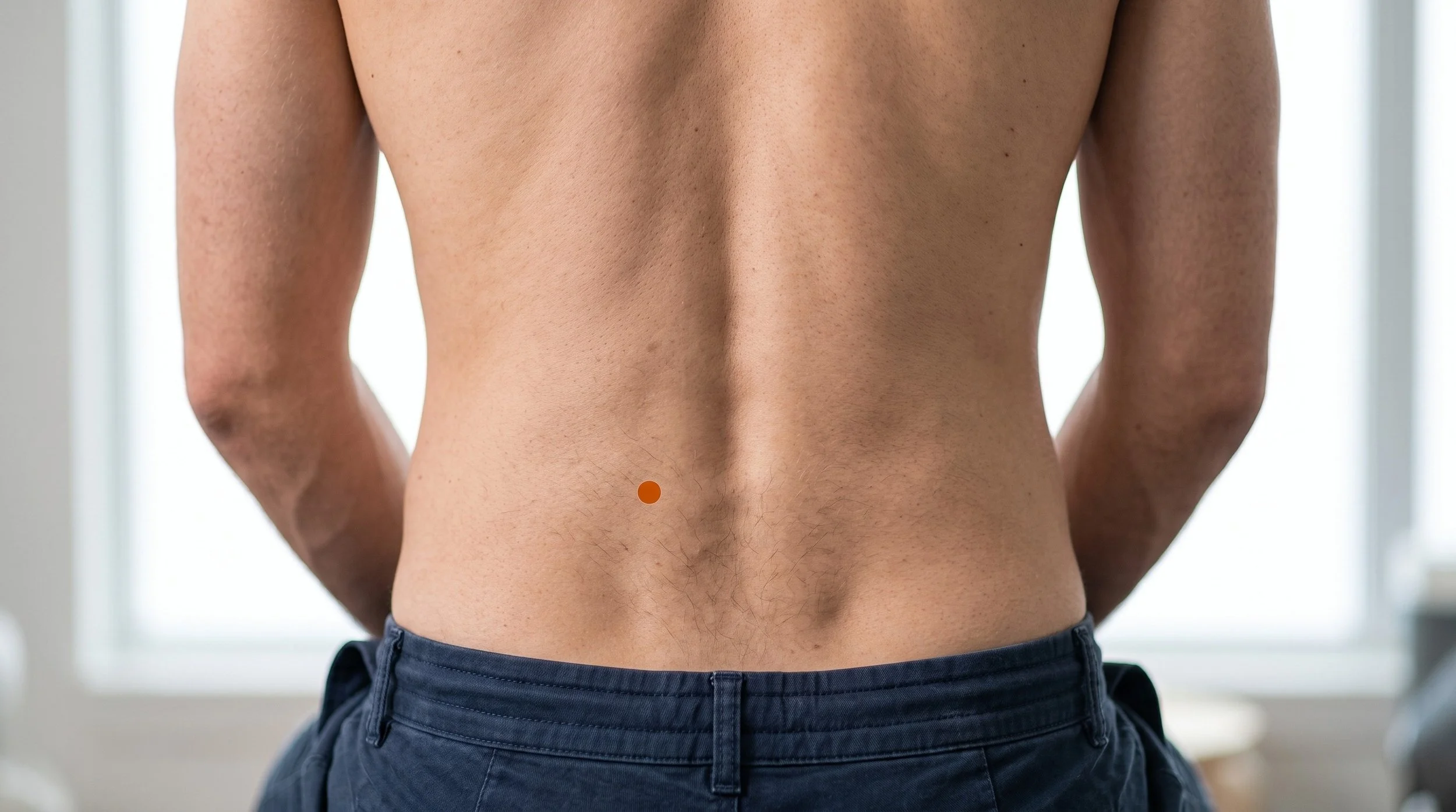
BL26 Acupuncture Point (Guanyuanshu)
Gate of Origin Shu at the Lumbosacral Junction: Anatomy, Mechanism, and Why This L5 Point Anchors Treatment of Stubborn Low Back Pain
BL26, known in Chinese as Guanyuanshu and usually translated as Gate of Origin Shu, is the twenty-sixth point of the Bladder channel and sits on the inner paraspinal line at the very bottom of the lumbar spine. You'll find it about 1.5 cun (roughly two finger widths) to either side of the lower edge of the L5 spinous process, right on the visible crest of the erector spinae muscles just above the pelvic rim.
That address matters: L5 and the lumbosacral junction carry more compressive and rotational load than any other level of the low back, which is why bladder 26 shows up in so many treatment plans for aching, heavy, end-of-day lumbar pain, and why the classical literature singled it out for chronic, fatigue-linked backache long before anyone described segmental pain physiology.
- Location and layers: the bl26 acupuncture point lies 1.5 cun lateral to the lower border of the L5 spinous process, over skin, thoracolumbar fascia, the erector spinae (longissimus and iliocostalis), and, with deeper insertion, the multifidus overlying the L5 lamina and transverse process (Deadman et al., 2007).
- Traditional attributions: classical sources credit Guanyuanshu with strengthening the lumbar region and regulating the lower jiao, and list lumbar pain, abdominal distention, diarrhea, enuresis, and frequent urination among its indications (Deadman et al., 2007; Kim, 2013).
- Mechanism in modern terms: needling here stimulates the medial branch of the L5 dorsal ramus and its muscular and articular targets, feeding segmental input into dorsal horn levels that also receive afferents from lumbar joints, discs, and pelvic structures, a convergence pattern central to how acupuncture analgesia is understood (Zhao, 2008).
- Research picture: reviews evaluate whole protocols rather than single points, and for chronic nonspecific low back pain the evidence suggests modest, real benefit versus no treatment with less certainty against sham (Mu et al., 2020; Rizzo et al., 2025), consistent with individual patient data showing effects that persist over time (Vickers et al., 2018).
- Clinical framing: BL26 is worth palpating in almost any bl 26 low back presentation, since tenderness at the L5 level often marks the segment doing the most mechanical work, and it pairs naturally with adjacent levels and with distal leg points.
- De qi: expect a deep, dull, spreading heaviness or soreness at the L5 level, sometimes drifting toward the sacroiliac area or upper buttock, rather than sharp or electric sensation.
Is Your Low Back Pain Worst Right Above the Belt Line?
Pain that concentrates at L5 and the lumbosacral junction usually involves the deep paraspinals, the facet joints, and the muscles that stabilize your pelvis. At Morningside Acupuncture, we palpate BL26 and its neighboring levels before we needle anything, then build a treatment that combines local segmental needling with distal points and targeted dry needling. Most patients feel a change in stiffness within the first few sessions. Schedule a visit and let's map where your pain actually lives.
Schedule NowAnatomy of BL26: Why the L5 Paraspinal Level Is Such an Important Location
Working from the surface down, a needle at BL26 passes through skin and subcutaneous fat, then the posterior layer of the thoracolumbar fascia, then the bulk of the erector spinae (longissimus medially, iliocostalis more laterally), and finally the multifidus, which fills the trough between the L5 spinous process and the lamina. This is the thickest, hardest-working part of the lumbar extensor group. It resists trunk flexion all day, controls the transition from a mobile lumbar spine into a rigid sacrum, and takes on extra work when the hips are stiff or the abdominal wall isn't contributing.
Point the location out on yourself and you'll notice the muscle mass stands up highest right here, which is exactly the landmark the classical texts used (Deadman et al., 2007).
The nerve supply explains most of the clinical behavior. The medial branch of the L5 dorsal ramus innervates the multifidus and the facet joint capsules at this level, while lateral branches serve the iliocostalis and the skin over the upper buttock. Because facet, disc, muscle, ligament, and even pelvic afferents converge on overlapping dorsal horn neurons in the lower lumbar cord, a mechanical problem at one structure can be felt as diffuse aching across the whole region, and segmental needle input can modulate that shared pool of neurons.
Experimental work on acupuncture analgesia describes both this local segmental gating and the recruitment of descending inhibitory pathways from the midbrain and brainstem, along with endogenous opioid mediation (Zhao, 2008). Needling into a taut lumbar paraspinal band adds a mechanical component too, since deep needling of the lumbosacral multifidus has been shown to shift local pressure pain thresholds in the short term (Wang-Price et al., 2020).
Deeper structures are worth respecting even though this level is relatively forgiving. The spinal cord itself ends well above L5, and the kidneys sit far higher, near the T12 to L2 levels, so the classic renal caution that applies to BL23 is less of a concern here. What lies deep is the L5 lamina and transverse process, the paraspinal venous network, and, further anterior, the psoas and retroperitoneal space.
Standard practice is perpendicular insertion of 1 to 1.5 cun (Deadman et al., 2007), with Chinese clinical texts often citing a slightly shallower 0.8 to 1.2 cun and noting that moxibustion is appropriate (Cheng, 2010; Kim, 2013). In heavier patients the muscle mass is deep and a longer needle may be needed, while in very slender patients depth should be reduced. Contacting bone is a signal to withdraw slightly rather than push.
Related Acupuncture For Low Back Pain Related Best Acupuncture Points For Back PainBL26 at a Glance: Classification, Location, and Clinical Use
| Category | Detail |
|---|---|
| Traditional Name | Guanyuanshu, Gate of Origin Shu (also translated as Origin Gate Back Transporting Point or Back Transporting Point of the Origin Pass) |
| Channel Classification | Twenty-sixth point of the Bladder channel of Foot Taiyang, on the inner Bladder line at the lumbosacral junction (BL26, also written UB26; also called the Urinary Bladder channel) |
| Point Categories | The source texts assign no five-shu, hui-meeting, or extraordinary vessel designations to this point. It is grouped with the back transporting points of the inner Bladder line, and several authors classify it as a transporting point related to a body region rather than to an organ, specifically the lower back and uterus (Maciocia, 2015). Its name links it to CV4 Guanyuan, and it is sometimes described as an unofficial back correspondence to that point where source qi is said to be transported to the back (Kim, 2013; Cunningham, 2008), a traditional attribution rather than a formal category. |
| Precise Location | On the low back, 1.5 cun lateral to the midline at the level of the lower border of the L5 spinous process, located at the visible highest point of the paraspinal muscle mass |
| Tissue Stimulated | Thoracolumbar fascia, lumbar erector spinae (longissimus and iliocostalis), and the multifidus at L5; frequently overlaps with myofascial targets described in muscles that cause low back pain and with tight muscles and trigger points in the lumbar extensors |
| Needle Depth / Direction | Perpendicular insertion 1 to 1.5 cun (Deadman et al., 2007); many Chinese texts use 0.8 to 1.2 cun perpendicular, and moxibustion is considered appropriate |
| De Qi Sensation | Deep, dull, heavy soreness or distention at the L5 level, sometimes spreading toward the sacroiliac region or upper buttock; sharp, burning, or electric sensations mean the needle should be adjusted |
| Primary Clinical Uses | Lumbosacral low back pain, chronic fatigue-associated lumbar aching in the classical wind-taxation framing, sciatica-pattern referral into the buttock, and, in traditional use, urinary frequency, enuresis, and abdominal distention |
| Common Point Combinations |
|
Deadman's A Manual of Acupuncture presents BL26 primarily as a lumbar point, valued because it sits directly alongside L5, and notes that a run of Chinese classics recommended it for what they called wind-taxation lumbar pain. In that traditional framing, an external influence lodges in the back after strain or exposure, and over months or years the tissue and constitution behind it weaken, so the pain becomes chronic rather than resolving.
The text cites Standards of Patterns and Treatment for the idea that whatever the presenting cause of backache (cold, damp, heat, sprain, stagnation), the underlying root was understood as Kidney depletion, and it quotes the Essential Questions on chronic bone-level obstruction eventually settling into the Kidneys. The name itself, Gate of Origin Shu, was read as implying a supplementing action, which is why classical lists extend it to wasting and thirsting disorder, deficiency-type distention, diarrhea, and various urinary complaints.
What's striking is Deadman's clinical caveat: the point's usefulness for back pain isn't confined to deficiency patterns at all, and it belongs among the points a practitioner should palpate, and needle if tender, in essentially every case of backache. A classical theory built around depletion ends up recommending the same point that modern segmental reasoning would choose for the busiest level of the lumbar spine.
Why BL26 Is Used for Low Back Pain That Comes With Urinary Frequency and Lower Abdominal Heaviness
Patients are often surprised that a low back point appears in traditional lists for urinary frequency, enuresis, and abdominal distention. The neurophysiology makes the pairing less strange than it sounds. Sensory fibers from the lumbar paraspinal tissues enter the cord at the same lower lumbar segments that participate in the autonomic control of pelvic organs, and the dorsal horn neurons receiving that input also receive visceral afferents.
This viscerosomatic convergence is the ordinary reason people feel bladder or bowel irritation as low back heaviness, and it's the same anatomy that allows segmental needle input to influence both regions at once (Zhao, 2008). We're describing a shared neural address, not an energetic connection.
For the pain itself, two mechanisms are usually in play. Locally, needling a taut, tender paraspinal band produces mechanical and inflammatory signaling that can reduce muscle tone and raise pressure pain thresholds at the treated segment, an effect measured after deep needling of the lumbosacral multifidus (Wang-Price et al., 2020).
Regionally, needle stimulation recruits descending inhibitory control from the periaqueductal gray and rostral ventromedial medulla, with endogenous opioid and monoamine mediation, which helps explain why relief often extends beyond the specific muscle needled and why it can outlast the session (Zhao, 2008). There may also be a vascular component: exploratory work on lumbar acupuncture stimulation reported changes in blood flow to the sciatic nerve trunk, although the study designs were small and the findings should be treated as preliminary (Inoue et al., 2008).
In practice this means BL26 tends to be chosen for the diffuse, deep, hard-to-point-at ache of the lumbosacral junction rather than for a sharply localized pinpoint pain. When patients also describe a dragging or full sensation in the lower abdomen, or notice their back and bladder symptoms fluctuate together, the traditional grouping of indications for Guanyuanshu is worth taking seriously, with the caveat that new urinary symptoms always warrant medical evaluation first.
What the Research Shows for BL26
It's important to be clear about what the research can and can't tell us. No trial has isolated BL26 by itself, and that's true of nearly every acupuncture point. Clinical studies test protocols, typically a lumbar cluster such as BL23, BL25, BL26, GV3, and Jiaji points combined with distal choices like BL40, so the evidence below speaks to whether acupuncture helps low back pain, and BL26's role is as a component of the protocols reviewed. Individual points also aren't interchangeable placebos: segmental reasoning, patient anatomy, and palpation findings determine which levels get needled. Read the table as supportive context for a point selection, not as proof of a single point's effect.
| Study | Type | Focus | Key Finding |
|---|---|---|---|
| Mu et al., 2020 | Cochrane systematic review | Acupuncture compared with sham, no treatment, or usual care for chronic nonspecific low back pain (33 trials, 8,270 participants) | Compared with no treatment, moderate-certainty evidence suggested acupuncture improved pain to a clinically relevant degree, while comparisons with sham and usual care were less certain. |
| Rizzo et al., 2025 | Cochrane overview of reviews | Non-pharmacological and non-surgical treatments for low back pain in adults | Acupuncture appeared among the better-supported non-drug options for chronic low back pain, though certainty of evidence varied across comparisons. |
| Vickers et al., 2018 | Individual patient data meta-analysis | Chronic pain conditions including musculoskeletal back and neck pain (about 20,800 patients) | Acupuncture outperformed both sham and no-acupuncture controls, with modest effect sizes that decayed only slightly over roughly a year. |
| Liu et al., 2018 | Systematic review and meta-analysis | Dry needling of myofascial trigger points associated with low back pain (11 RCTs, 802 patients) | Dry needling may reduce pain and disability in the short term compared with other treatments, though study quality and follow-up were limited. |
| Wang-Price et al., 2020 | Randomized clinical trial | Two deep dry needling techniques applied to the lumbosacral multifidus in patients with low back pain | Both techniques produced short-term changes in pressure pain thresholds and muscle activation, with a small sample limiting broader conclusions. |
| Inoue et al., 2008 | Combined clinical and animal experimental study | Lumbar acupuncture and electroacupuncture stimulation in relation to sciatic nerve blood flow | Local lumbar needling was associated with increased sciatic nerve blood flow, an exploratory mechanistic finding that needs replication. |
Chronic Back Aching That Returns Every Time You Get Tired?
The classical texts described exactly this pattern, a lumbar ache that flares with fatigue, cold, and long hours, and they pointed to Guanyuanshu for it. We treat that presentation with a paced course of care rather than one-off sessions, layering BL26 with BL25, GV3, and distal points so the effect accumulates. We'll also look at load, sleep, and movement habits that keep feeding the cycle. Book an appointment and start a plan that fits your week.
Schedule NowBL26 in the Context of Trigger Point Work
Acupuncture, as we define it, is treatment with an acupuncture needle, and that includes the hundreds of styles practiced worldwide as well as dry needling. At the L5 level, the classical point location and the myofascial target overlap almost completely. The lumbar multifidus and the lower iliocostalis develop taut bands that refer pain into the lumbosacral area, the sacroiliac region, and the upper buttock, a referral map documented in the trigger point literature (Simons et al., 1999). When a patient's tender spot at BL26 sits inside a palpable band, we're needling one structure and can describe it in either language.
In a typical session at Morningside, BL26 anchors the lumbar segment and we work outward from there: multifidus and iliocostalis at L4 and L5, quadratus lumborum along the lateral border, and gluteus medius or piriformis when the pain travels into the hip. Dry needling of trigger points associated with low back pain has shown short-term reductions in pain and disability in pooled analyses, with the usual caveats about study quality (Liu et al., 2018), and deep needling of the lumbosacral multifidus specifically has been shown to change local pressure sensitivity (Wang-Price et al., 2020).
We generally follow the needling with loading work, because releasing a chronically overworked extensor group without improving hip mobility or trunk endurance tends to buy relief that doesn't last.
BL26 Low Back Pain Treatment at NYC's Highest-Rated Acupuncture Clinic
Morningside Acupuncture is the highest-rated acupuncture and dry needling clinic in New York City with over 500 five-star Google reviews, and low back pain is one of the most common reasons patients come through the door. Our licensed acupuncturists use bladder 26 as part of a segmental approach that also addresses the multifidus, quadratus lumborum, and gluteal muscles when they're involved. Every plan is built around your exam findings, not a template. Schedule your first session and see what a thorough low back assessment feels like.
Schedule NowFrequently Asked Questions
What does BL26 feel like when needled?
Most people describe a deep, heavy, spreading soreness or a dull sense of pressure at the very bottom of the low back, sometimes drifting toward the sacroiliac joint or the top of the buttock. That's the de qi sensation, and it usually builds over a few seconds rather than arriving suddenly. If the muscle is very tight you may feel a brief cramping twitch as the band releases, which settles quickly. Sharp, burning, or electric sensations aren't expected here and mean your acupuncturist should adjust the needle.
Why needle BL26 when my pain radiates down my leg instead of staying in my back?
Leg-referred pain often originates at the L5 segment, either from irritated joint and disc structures or from taut bands in the deep paraspinals and gluteal muscles that refer downward. Needling at the source segment addresses the input rather than chasing the symptom, and it's why BL26 is regularly combined with distal points such as BL40 or gluteal points like GB30 for sciatica-pattern complaints. That said, true radicular pain with numbness, weakness, or changes in bowel or bladder function needs medical assessment first.
Can I press BL26 myself between sessions?
Yes, and it's an easy one to reach. Find the top of your pelvic bones on each side, then run your thumbs toward the spine and slightly upward until you feel the firm ridge of muscle running alongside the bony bumps of the spine. Press about two finger widths out from the midline at the lowest lumbar level, where the muscle stands up highest. Apply steady, moderate pressure with your thumbs or knuckles for 30 to 60 seconds per side, breathing normally, and repeat two or three times. You can also lie on your back with a tennis ball placed under the muscle just to one side of the spine, letting your body weight do the work for a minute or two. Aim for a good-hurt intensity, never sharp pain, and stop if you feel any tingling or numbness in the legs. Acupressure is a reasonable maintenance tool between visits, not a substitute for treatment or for evaluation of persistent pain.
Is BL26 safe to needle?
In trained hands, yes. This level is relatively forgiving compared with the mid and upper back: the spinal cord terminates well above L5, the kidneys sit much higher near the T12 to L2 region, and there's no lung risk at the lumbar spine. Standard technique is perpendicular insertion to about 1 to 1.5 cun, with Chinese texts often citing 0.8 to 1.2 cun, adjusted for the patient's build. The needle should be redirected if it contacts bone at the lamina or transverse process. Ordinary cautions apply, including care with anticoagulant use, avoiding broken or infected skin, and additional caution during pregnancy, when lumbosacral needling should only be done by a licensed practitioner who has been told about the pregnancy.
Where exactly is BL26 located?
On the low back, 1.5 cun lateral to the midline, level with the lower border of the L5 spinous process, which places it just above the level of the top of the iliac crests in most people. The practical landmark from the classical texts is the visible highest point of the paraspinal muscle mass, so if you look at a relaxed prone back, the point sits on the crest of that muscle ridge. One cun here is measured proportionally to the patient, roughly the width of the thumb at the knuckle, so 1.5 cun is close to two finger widths for most adults.
References
- Deadman, P., Al-Khafaji, M., & Baker, K. (2009). A manual of acupuncture. Journal of Chinese Medicine Publications.
- Cheng, X. (Ed.). (1999). Chinese acupuncture and moxibustion (Rev. ed.). Foreign Languages Press.
- Kim, H. (2008). Handbook of Oriental medicine (3rd ed.). Harmony & Balance Press.
- Cunningham, P. M. (2000). Acupuncture points: A practical guide to classical and modern usage. Odyssey Press.
- Maciocia, G. (2005). The foundations of Chinese medicine: A comprehensive text for acupuncturists and herbalists (2nd ed.). Elsevier Churchill Livingstone.
- Maciocia, G. (2006). The channels of acupuncture: Clinical use of the secondary channels and eight extraordinary vessels. Churchill Livingstone Elsevier.
- Simons, D. G., Travell, J. G., & Simons, L. S. (1999). Travell & Simons' myofascial pain and dysfunction: The trigger point manual, Vol. 1: Upper half of body (2nd ed.). Williams & Wilkins.
- Mu, J., Furlan, A. D., Lam, W. Y., Hsu, M. Y., Ning, Z., & Lao, L. (2020). Acupuncture for chronic nonspecific low back pain. Cochrane Database of Systematic Reviews, 2020(12), CD013814. https://doi.org/10.1002/14651858.CD013814
- Rizzo, R. R. N., Cashin, A. G., Wand, B. M., Ferraro, M. C., Sharma, S., Lee, H., O'Hagan, E., Maher, C. G., Furlan, A. D., van Tulder, M. W., & McAuley, J. H. (2025). Non-pharmacological and non-surgical treatments for low back pain in adults: An overview of Cochrane Reviews. Cochrane Database of Systematic Reviews, 3(3), CD014691. https://doi.org/10.1002/14651858.CD014691.pub2
- Vickers, A. J., Vertosick, E. A., Lewith, G., MacPherson, H., Foster, N. E., Sherman, K. J., Irnich, D., Witt, C. M., & Linde, K. (2018). Acupuncture for chronic pain: Update of an individual patient data meta-analysis. Journal of Pain, 19(5), 455-474. https://doi.org/10.1016/j.jpain.2017.11.005
- Zhao, Z. Q. (2008). Neural mechanism underlying acupuncture analgesia. Progress in Neurobiology, 85(4), 355-375. https://doi.org/10.1016/j.pneurobio.2008.05.004
- Liu, L., Huang, Q. M., Liu, Q. G., Thitham, N., Li, L. H., Ma, Y. T., & Zhao, J. M. (2018). Evidence for dry needling in the management of myofascial trigger points associated with low back pain: A systematic review and meta-analysis. Archives of Physical Medicine and Rehabilitation, 99(1), 144-152.e2. https://doi.org/10.1016/j.apmr.2017.06.008
- Wang-Price, S., Zafereo, J., Couch, Z., Brizzolara, K., Heins, T., & Smith, L. (2020). Short-term effects of two deep dry needling techniques on pressure pain thresholds and electromyographic amplitude of the lumbosacral multifidus in patients with low back pain: A randomized clinical trial. Journal of Manual & Manipulative Therapy, 28(5), 254-265. https://doi.org/10.1080/10669817.2020.1714165
- Inoue, M., Kitakoji, H., Yano, T., Ishizaki, N., Itoi, M., & Katsumi, Y. (2008). Acupuncture treatment for low back pain and lower limb symptoms: The relation between acupuncture or electroacupuncture stimulation and sciatic nerve blood flow. Evidence-Based Complementary and Alternative Medicine, 5(2), 133-143. https://doi.org/10.1093/ecam/nem050
Disclaimer: This web site is intended for educational and informational purposes only. Reading this website does not constitute providing medical advice or any professional services. This information should not be used for diagnosing or treating any health issue or disease. Those seeking medical advice should consult with a licensed physician. Seek the advice of a medical doctor or other qualified health professional for any medical condition. If you think you have a medical emergency, call 911 or go to the emergency room. No acupuncturist-patient relationship is created by reading this website or using the information. Morningside Acupuncture PLLC and its employees and contributors do not make any express or implied representations with respect to the information on this site or its use. For any legal interpretation of scope of practice in your state, consult a licensed attorney or regulatory authority.
Read more from our blog



