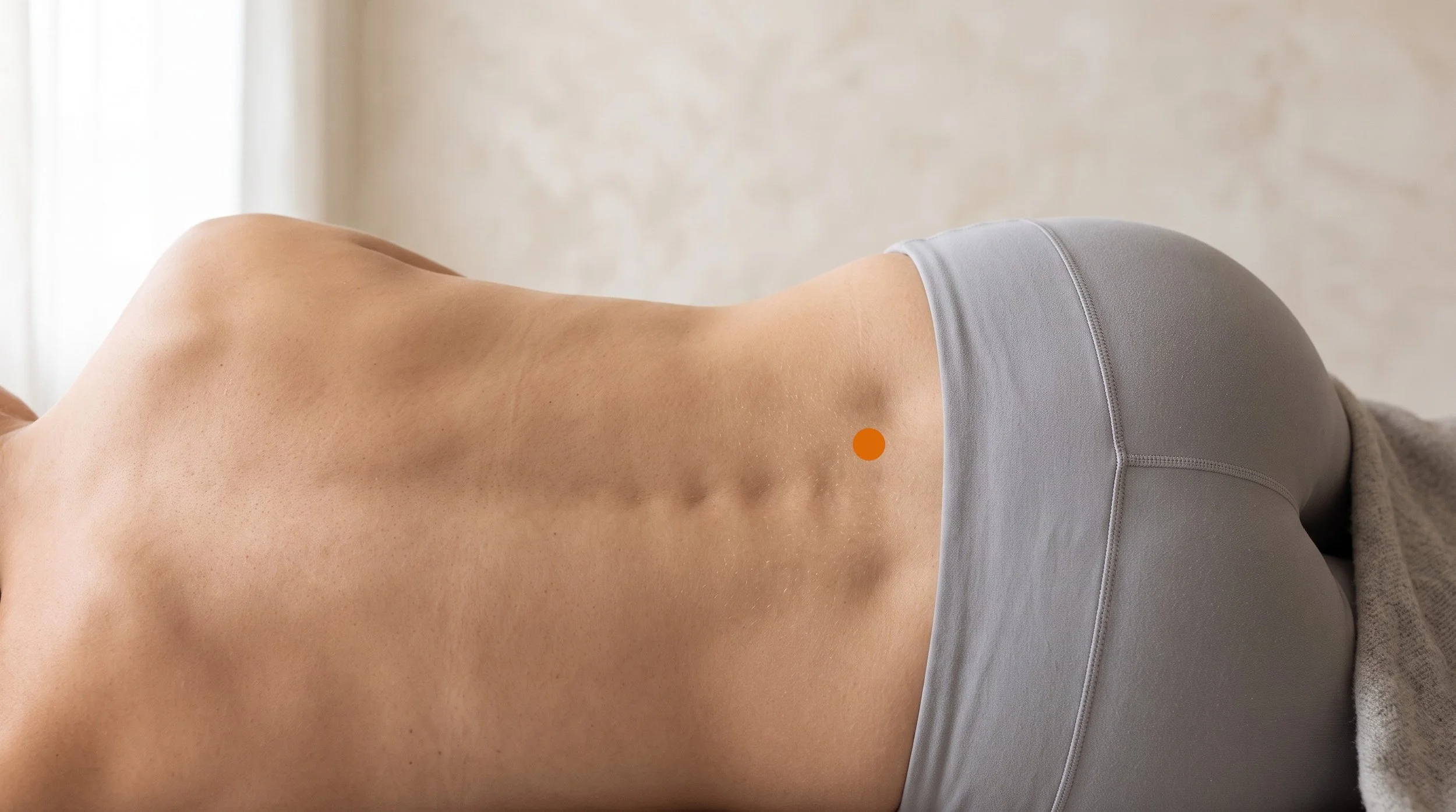
BL27 Acupuncture Point (Xiaochangshu)
The Small Intestine Shu at the Top of the Sacrum: Anatomy, Sacral Segmental Mechanisms, and Why BL27 Bridges Low Back Pain and Gut Complaints
BL27, known in Chinese as Xiaochangshu and in English as Small Intestine Shu, is the back-shu point of the Small Intestine and the first point of the Bladder channel's inner line to sit on the sacrum itself.
In plain terms, it lies about a thumb's width and a half out from the midline at the level of the first posterior sacral foramen, roughly level with BL31, just below the ridge you can feel where the lumbar spine ends and the sacral plate begins. Clinically it matters for two reasons that turn out to be one reason: it sits directly over the muscular and fascial tissue that takes load at the lumbosacral junction and sacroiliac region, and it sits in a segment whose nerves also serve the pelvic organs.
That overlap is why the bl27 acupuncture point shows up in treatment plans for sacral and low back pain as well as for the bowel and bladder complaints described in classical texts.
- Location and layers: BL27 is 1.5 cun lateral to the midline at the level of the first posterior sacral foramen, passing through skin, thoracolumbar fascia and the sacral portion of multifidus before reaching the sacral periosteum (Deadman et al., 2007). Because the inner Bladder line converges toward the midline as it descends onto the sacrum, the 1.5 cun measurement here is shorter than it is over the lumbar spine.
- Traditional category, translated: classical sources call BL27 the back-shu point of the Small Intestine and credit it with separating the pure from the turbid, regulating the intestines and bladder, and clearing damp-heat from the lower body (Deadman et al., 2007; Cunningham, 2013). Read neurophysiologically, that is a description of a paraspinal point in a segment that shares afferent and autonomic wiring with pelvic viscera.
- Nerve geography: the tissue at bl 27 sacrum is supplied by the lateral branch of the posterior ramus of the first sacral nerve, with the posterior branches of the lateral sacral artery and vein nearby (Cheng, 2010). Segmental somatic input at this level can influence autonomic outflow to pelvic organs through spinal and supraspinal reflex circuits (Uchida et al., 2017).
- Mechanism story: needling here appears to work through convergence of somatic and visceral afferents in the sacral dorsal horn, local nociceptor and mechanoreceptor stimulation in loaded fascia and multifidus, and recruitment of descending inhibitory pathways involving endogenous opioid and monoaminergic systems (Zhao, 2008).
- Research picture: no trial has isolated BL27 on its own, but Cochrane work supports acupuncture as a reasonable option for chronic low back pain, individual patient data meta-analysis shows effects that persist over time for chronic pain, and sacral electroacupuncture near this row of points has reduced urinary leakage in a large randomized trial (Rizzo et al., 2025; Vickers et al., 2018; Liu et al., 2017).
- What it feels like: most people describe a deep, heavy, spreading ache or pressure over the upper sacrum rather than a sharp sensation, sometimes with a dull sense of fullness toward the sacroiliac joint. That de qi response usually settles within seconds and is a normal part of treatment, not a sign of injury.
Struggling With Sacral and Low Back Pain That Never Fully Settles?
Pain at the top of the sacrum often involves multifidus, the sacroiliac region and the lumbosacral junction all at once, which is exactly the tissue BL27 sits over. At Morningside Acupuncture we combine sacral shu points like BL27 with dry needling of the deep paraspinals and a movement plan you can actually follow between visits. Treatment is tailored, not templated, and we track what changes week to week. Schedule an appointment and let's map out what is driving your pain.
Schedule NowAnatomy of BL27: Why the First Sacral Foramen Level Is Such an Important Location
BL27 sits on the posterior surface of the sacrum, 1.5 cun lateral to the midline at the level of the first posterior sacral foramen (Deadman et al., 2007). Under the needle you pass through thin skin and subcutaneous tissue, then a dense sheet of thoracolumbar and sacral fascia, then the sacral attachment of multifidus and the aponeurotic origin of the erector spinae group, with the sacral bone just beneath. This is a high-load neighborhood.
Every time you hinge, lift, rise from a chair or push off during gait, force transfers from the lumbar spine across the sacroiliac joints and into the pelvis through exactly these tissues, which is one reason tenderness here is so common in people with chronic lumbosacral complaints.
The tissue at this point is innervated by the lateral branch of the posterior ramus of the first sacral nerve, and the local blood supply comes from posterior branches of the lateral sacral vessels (Cheng, 2010). That segmental detail is the whole mechanism story in miniature. Afferents from skin, fascia and deep paraspinal muscle at the S1 level enter the cord alongside afferents carrying information from pelvic structures, and this convergence gives needling a route to influence both muscle tone and autonomic outflow rather than just local soreness (Uchida et al., 2017).
Stimulation of these afferents also engages descending inhibitory control from the brainstem, which is a well-described contributor to acupuncture analgesia and helps explain why relief is often felt beyond the immediate needle site (Zhao, 2008).
Deep to the point, the sacrum forms a solid backstop, and the sacroiliac joint lies lateral to it while the S1 foramen and its emerging nerve root sit just medial and deep to the target zone. Standard needling is perpendicular to a depth of about 0.5 to 1 cun, with some texts allowing up to roughly 1.2 cun in larger patients (Deadman et al., 2007; Cheng, 2010). Angling deliberately into a sacral foramen is a different technique with different risks and is not part of routine BL27 needling.
In practice, a clean perpendicular insertion into fascia and multifidus over bone is comfortable, low-risk in trained hands and reaches the tissue that matters.
Related Back Shu Points Related Bladder ChannelBL27 at a Glance: Classification, Location, and Clinical Use
| Category | Detail |
|---|---|
| Traditional Name | Xiaochangshu (Small Intestine Shu), BL27, also written Bladder 27 or BL-27 |
| Channel Classification | Bladder channel, inner line of the back, first sacral level of the shu row (BL27, also written UB27; also called the Urinary Bladder channel) |
| Point Categories | Back-shu (back transporting) point of the Small Intestine fu, sitting in the sacral portion of the inner Bladder line between BL26 above and BL28 below, level with BL31; no five-shu, hui-meeting or extraordinary vessel designations are attributed to this point in the classical sources |
| Precise Location | On the sacrum, 1.5 cun lateral to the posterior midline at the level of the first posterior sacral foramen, level with BL31. Note that the inner Bladder line runs relatively closer to the midline over the sacrum, so the 1.5 cun here measures shorter than it does over the lumbar spine. |
| Tissue Stimulated | Skin and subcutaneous tissue, sacral and thoracolumbar fascia, the sacral attachment of multifidus and the aponeurotic origin of the erector spinae group, over sacral periosteum |
| Needle Depth / Direction | Perpendicular insertion 0.5 to 1 cun, with some texts allowing up to about 1.2 cun; moxibustion is traditionally applicable |
| De Qi Sensation | A deep, heavy, spreading ache or pressure over the upper sacrum, occasionally with a dull sense of fullness toward the sacroiliac joint, usually easing within seconds |
| Primary Clinical Uses | Sacral and low back pain, sacroiliac-region tenderness, lumbosacral stiffness, and the classical indications of dark or difficult urination, loose stools and bowel irregularity, and lower abdominal discomfort |
| Common Point Combinations |
|
In Deadman, Al-Khafaji and Baker's A Manual of Acupuncture, BL27 is presented as the back-shu point where the qi of the Small Intestine surfaces on the back, and the traditional actions attributed to it are separating the pure from the turbid, regulating the intestines and bladder, draining turbid dampness and damp-heat, and regulating Small Intestine qi.
The classical logic is worth understanding on its own terms: the Small Intestine was described as the organ that sorts what the body keeps from what it discards, sending fluid toward the bladder and residue toward the large intestine, which is why a Small Intestine point was traditionally used for problems in two other organs entirely.
The indication lists that follow group into loose stools and dysenteric complaints, blood or mucus in the stool, constipation and hemorrhoidal pain, dark or scanty urination, incontinence and urinary retention, lower abdominal and testicular pain of the shan pattern, and a scattering of heat-type presentations such as dryness and thirst. Cunningham adds the modern clinical emphasis on low back and sacral pain, particularly involving the sacroiliac joints.
What is striking is that a point chosen classically to sort fluids and waste sits precisely in the spinal segment that modern anatomy assigns to the pelvic floor and pelvic organs, which is a coincidence worth taking seriously even if the explanatory language is different.
Why BL27 Is Used for Loose Stools and Urinary Urgency, Not Just Sacral Pain
The short answer is segmental anatomy. Nerves at the sacral level do double duty: the same spinal segments that carry sensation from the skin, fascia and deep muscles of the upper sacrum also participate in the pathways serving the bladder, the distal bowel and the pelvic floor. When afferent fibers from these different sources converge on shared neurons in the spinal cord, stimulating one input can change how the cord processes the other.
Experimental work on somato-autonomic reflexes shows that stimulating segmental afferents can alter autonomic outflow to viscera through both spinal and supraspinal circuits, which gives a plausible, testable account of why a point on the back of the sacrum was ever associated with urination and bowel function (Uchida et al., 2017).
The pain side of the story runs on partly separate machinery. Needle stimulation activates small-diameter afferents that trigger descending inhibitory pathways from the brainstem, recruiting endogenous opioid, serotonergic and noradrenergic systems that turn down nociceptive signaling at the dorsal horn (Zhao, 2008). Locally, needling loaded fascia and the sacral attachment of multifidus can reduce the protective guarding that keeps the lumbosacral junction stiff.
Patients often describe the change as the area feeling less braced rather than simply less painful, and that shift in muscle behavior tends to be what makes movement work feel possible again.
There is also indirect clinical support from nearby territory. In a large randomized trial, electroacupuncture at the sacral points BL33 and BL35 reduced urine leakage in women with stress urinary incontinence compared with sham, an effect consistent with sacral neuromodulation principles used elsewhere in medicine (Liu et al., 2017). That trial did not test BL27, and it would be a stretch to transfer its findings directly.
What it does suggest is that stimulation over the sacrum can produce measurable effects on pelvic organ function, which makes the classical pairing of a sacral point with urinary and bowel complaints look less improbable than it might first appear.
What the Research Shows for BL27
It helps to set expectations honestly here. No published trial has tested BL27 in isolation, and almost none of the acupuncture literature is designed to isolate single points. What the research actually evaluates is multi-point protocols for a condition, with sacral and lumbar shu points frequently included in the prescription.
So the reasonable claim is not that bladder 27 has been proven to do anything by itself, but that it sits inside protocols with reasonable supporting evidence for chronic low back pain and mixed evidence for functional gut and urinary complaints, and that its anatomical position gives a coherent rationale for including it.
| Study | Type | Focus | Key Finding |
|---|---|---|---|
| Rizzo et al., 2025 | Cochrane overview of systematic reviews | Non-pharmacological and non-surgical treatments for low back pain in adults | Acupuncture emerged among the better-supported non-drug options for chronic low back pain, though certainty of evidence varied across comparisons. |
| Vickers et al., 2018 | Individual patient data meta-analysis | Acupuncture for chronic musculoskeletal, headache and osteoarthritis pain | Acupuncture was more effective than sham and no-acupuncture controls, with treatment effects that persisted over about twelve months. |
| Manheimer et al., 2012 | Cochrane systematic review | Acupuncture for irritable bowel syndrome | No benefit over credible sham was found, although patients reported greater improvement with acupuncture than with two antispasmodic drugs in comparative trials. |
| Liu et al., 2016 | Multicenter randomized sham-controlled trial | Electroacupuncture for chronic severe functional constipation | Eight weeks of electroacupuncture increased complete spontaneous bowel movements more than sham, with no serious adverse events reported. |
| Liu et al., 2017 | Multicenter randomized sham-controlled trial | Electroacupuncture at sacral points BL33 and BL35 for stress urinary incontinence in women | Six weeks of electroacupuncture reduced urine leakage compared with sham, suggesting sacral stimulation may influence pelvic organ function. |
| Uchida et al., 2017 | Narrative review of physiological studies | Somatoautonomic reflexes underlying acupuncture effects on visceral function | Segmental somatic stimulation can modulate autonomic outflow through spinal and supraspinal reflex pathways, though most data come from anesthetized animals. |
| Zhao, 2008 | Mechanistic review | Neural mechanisms of acupuncture analgesia | Needle stimulation engages spinal gating and descending inhibitory systems involving opioid and monoaminergic signaling. |
Gut Symptoms and Back Pain Showing Up Together?
Plenty of our patients arrive with low back tightness and an irritable gut in the same story, and the sacral segment is one place where those two systems share wiring. We use xiaochangshu alongside abdominal and distal points, with gentle stimulation aimed at autonomic regulation rather than aggressive needling. It pairs well with the digestive and sleep habits we review during your intake. Book a visit and we'll build a plan around both complaints.
Schedule NowBL27 in the Context of Trigger Point Work
The small intestine shu point sits directly over tissue that myofascial practitioners target independently. The sacral attachments of multifidus and the deep fibers of the erector spinae aponeurosis are common sources of localized lumbosacral pain, and taut bands in the deep paraspinals can refer discomfort into the sacral and gluteal region in patterns that overlap closely with what patients point to when they describe sacroiliac pain (Simons et al., 1999).
At Morningside we treat acupuncture and dry needling as the same tool used with different reasoning, so when the tissue at BL27 is tender and stiff, we may needle it as a classical back-shu point, as a segmental input, or as a myofascial target, depending on what the exam shows.
In a typical session for stubborn lumbosacral pain, BL27 might be combined with dry needling of multifidus at the adjacent lumbar segments, plus attention to quadratus lumborum, gluteus medius and the thoracolumbar fascia depending on the referral pattern. Broader lumbar and sacral point selection such as BL23, BL25 and BL40 often rounds out the treatment. We generally finish with loading work: hip hinge patterning, glute strengthening and graded return to the activity that provoked the problem, because needling tends to open a window and movement is what keeps it open.
BL27 Low Back and Digestive Treatment at NYC's Highest-Rated Acupuncture Clinic
Morningside Acupuncture is the highest-rated acupuncture and dry needling clinic in New York City with over 500 five-star Google reviews, and our approach blends classical point selection with modern pain science. Bladder 27 is one of several sacral points we use for stubborn lumbosacral pain, sacroiliac tenderness and bowel or bladder complaints that track with tension in the low back. Every session includes hands-on assessment, needling and practical self-care so progress continues at home. Schedule your appointment today.
Schedule NowFrequently Asked Questions
What does BL27 feel like when needled?
Most people feel a deep, heavy, spreading ache or a sense of pressure over the upper sacrum as the needle reaches fascia and the sacral fibers of multifidus. That sensation, called de qi, typically arrives briefly and then softens within a few seconds. Some patients notice a dull fullness spreading toward the sacroiliac joint or a warm feeling across the low back. Sharp, electric or shooting sensations are not the goal, and you should tell your practitioner immediately if you feel one so the needle can be adjusted.
Why needle the sacrum for gut or bladder symptoms instead of the abdomen?
Both approaches are used, and they are not in competition. The reason a sacral point can influence pelvic organ function is segmental: nerves serving the tissue at BL27 enter the spinal cord at the same level as pathways serving the bladder, distal bowel and pelvic floor, so stimulating one can influence how the cord handles the other (Uchida et al., 2017). Back-shu points were traditionally used precisely this way, as a route to internal organs from the back. In practice we often combine a sacral point like BL27 with abdominal and distal points rather than choosing one region.
Can I press BL27 myself between sessions?
Yes, and it is easy to reach. Sit or lie on your side, find the bony plate of the sacrum below the lumbar spine, then move about a thumb's width and a half out from the midline at the level of the first sacral dimple area. Press with your thumb or a knuckle at a firm but comfortable pressure, around a five or six out of ten, and hold for 30 to 60 seconds while breathing slowly. Repeat two or three times per side, once or twice daily. A tennis ball or lacrosse ball against a wall works well if your hands tire, though keep the ball on muscle and off the bony ridge. Stop if pressure increases pain, causes numbness or tingling down the leg, or feels sharp.
Is BL27 safe to needle?
In trained hands it is a low-risk point. The sacrum lies directly beneath, which limits depth, and standard practice is perpendicular insertion of about 0.5 to 1 cun (Deadman et al., 2007). The main considerations are avoiding deliberate deep insertion toward the sacral foramen, using clean technique, and adjusting depth for body habitus. Tell your acupuncturist if you are pregnant, taking anticoagulants, have a bleeding disorder, or have hardware, implanted stimulators or prior surgery in the lumbosacral region, since any of these may change the approach.
Where exactly is BL27 located?
BL27 is on the back of the sacrum, 1.5 cun lateral to the posterior midline at the level of the first posterior sacral foramen, level with BL31. To find it, trace down the spine until the mobile lumbar vertebrae give way to the flat sacral plate, locate the level of the first sacral foramen just below that transition, then measure roughly 1.5 cun laterally. Keep in mind that the inner Bladder line moves closer to the midline as it descends onto the sacrum, so this distance is proportionally shorter here than over the lumbar spine (Deadman et al., 2007). BL26 sits above it at the L5 level and BL28 sits below at the second sacral foramen.
References
- Deadman, P., Al-Khafaji, M., & Baker, K. (2009). A manual of acupuncture. Journal of Chinese Medicine Publications.
- Cunningham, P. M. (2000). Acupuncture points: A practical guide to classical and modern usage. Odyssey Press.
- Cheng, X. (Ed.). (1999). Chinese acupuncture and moxibustion (Rev. ed.). Foreign Languages Press.
- Simons, D. G., Travell, J. G., & Simons, L. S. (1999). Travell & Simons' myofascial pain and dysfunction: The trigger point manual, Vol. 1: Upper half of body (2nd ed.). Williams & Wilkins.
- Zhao, Z. Q. (2008). Neural mechanism underlying acupuncture analgesia. Progress in Neurobiology, 85(4), 355-375. https://doi.org/10.1016/j.pneurobio.2008.05.004
- Vickers, A. J., Vertosick, E. A., Lewith, G., MacPherson, H., Foster, N. E., Sherman, K. J., Irnich, D., Witt, C. M., & Linde, K. (2018). Acupuncture for chronic pain: Update of an individual patient data meta-analysis. Journal of Pain, 19(5), 455-474. https://doi.org/10.1016/j.jpain.2017.11.005
- Rizzo, R. R. N., Cashin, A. G., Wand, B. M., Ferraro, M. C., Sharma, S., Lee, H., O'Hagan, E., Maher, C. G., Furlan, A. D., van Tulder, M. W., & McAuley, J. H. (2025). Non-pharmacological and non-surgical treatments for low back pain in adults: An overview of Cochrane reviews. Cochrane Database of Systematic Reviews, 3(3), CD014691. https://doi.org/10.1002/14651858.CD014691.pub2
- Manheimer, E., Cheng, K., Wieland, L. S., Min, L. S., Shen, X., Berman, B. M., & Lao, L. (2012). Acupuncture for treatment of irritable bowel syndrome. Cochrane Database of Systematic Reviews, 2012(5), CD005111. https://doi.org/10.1002/14651858.CD005111.pub3
- Liu, Z., Yan, S., Wu, J., He, L., Li, N., Dong, G., Fang, J., Fu, W., Fu, L., Sun, J., Wang, L., Wang, S., Yang, J., Zhang, H., Zhang, J., Zhao, J., Zhou, W., Zhou, Z., Ai, Y., ... Liu, B. (2016). Acupuncture for chronic severe functional constipation: A randomized trial. Annals of Internal Medicine, 165(11), 761-769. https://doi.org/10.7326/M15-3118
- Liu, Z., Liu, Y., Xu, H., He, L., Chen, Y., Fu, L., Li, N., Lu, Y., Su, T., Sun, J., Wang, J., Yue, Z., Zhang, W., Zhao, J., Zhou, Z., Wu, J., Zhou, K., Ai, Y., Zhou, J., ... Liu, B. (2017). Effect of electroacupuncture on urinary leakage among women with stress urinary incontinence: A randomized clinical trial. JAMA, 317(24), 2493-2501. https://doi.org/10.1001/jama.2017.7220
- Uchida, S., Kagitani, F., & Sato-Suzuki, I. (2017). Somatoautonomic reflexes in acupuncture therapy: A review. Autonomic Neuroscience, 203, 1-8. https://doi.org/10.1016/j.autneu.2016.11.001
Disclaimer: This web site is intended for educational and informational purposes only. Reading this website does not constitute providing medical advice or any professional services. This information should not be used for diagnosing or treating any health issue or disease. Those seeking medical advice should consult with a licensed physician. Seek the advice of a medical doctor or other qualified health professional for any medical condition. If you think you have a medical emergency, call 911 or go to the emergency room. No acupuncturist-patient relationship is created by reading this website or using the information. Morningside Acupuncture PLLC and its employees and contributors do not make any express or implied representations with respect to the information on this site or its use. For any legal interpretation of scope of practice in your state, consult a licensed attorney or regulatory authority.
Read more from our blog



