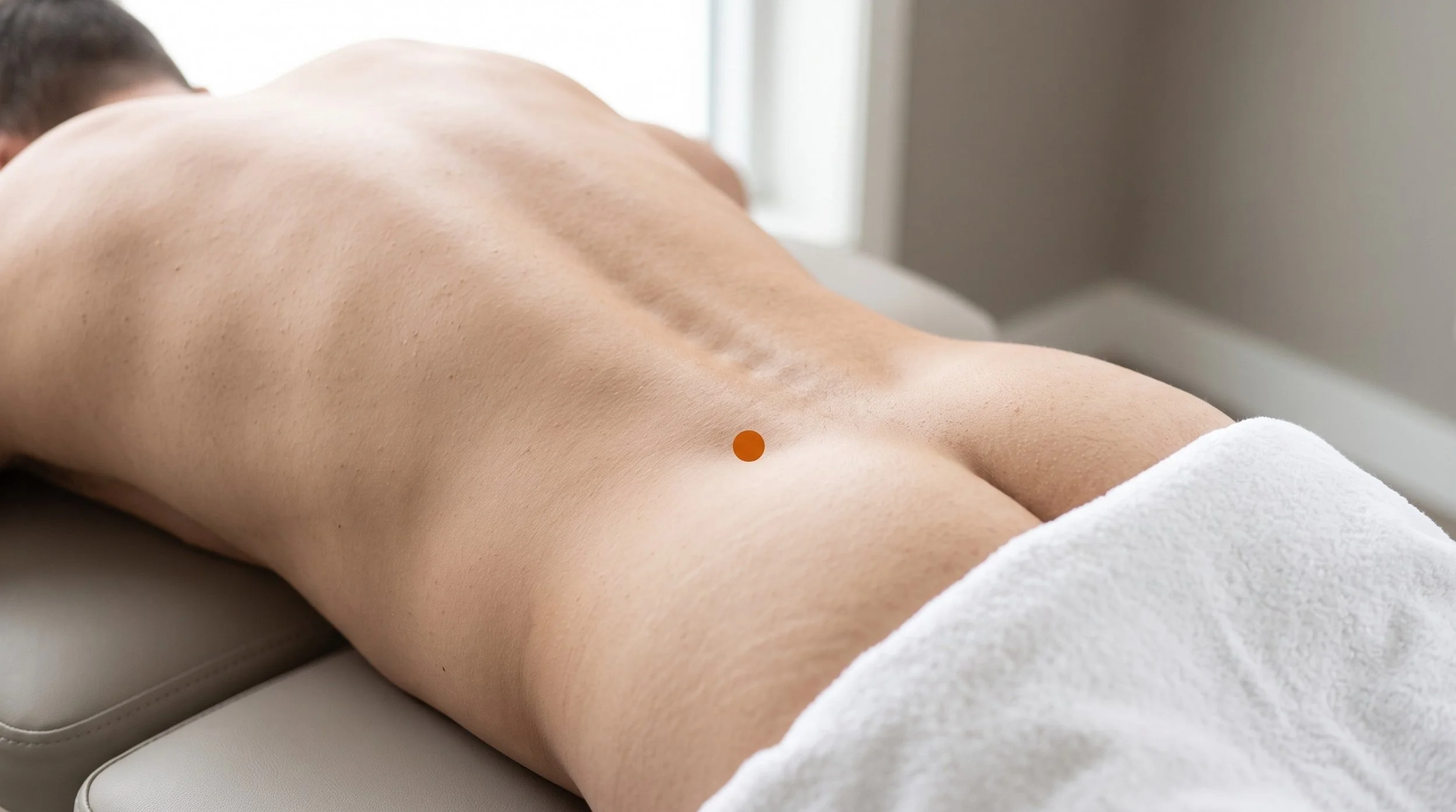
BL28 Acupuncture Point (Pangguangshu)
The Bladder Shu Point Over the Second Sacral Foramen: Anatomy, Segmental Mechanism, and Why BL28 Sits Where Bladder Control and Low Back Pain Overlap
BL28, known in Chinese as Pangguangshu and in English as Bladder Shu, is the back-shu point of the Bladder. You'll find it low on the sacrum, about 1.5 cun off the midline at the level of the second posterior sacral foramen, on the same horizontal line as BL32.
That location is the whole story of this point: the needle sits directly over the sacral segments that supply the bladder, the pelvic floor and the sacroiliac region, which is why the bl28 acupuncture point shows up in treatment plans for urinary urgency and hesitancy, sacral and low back pain, pelvic floor complaints, and pain that travels into the buttock and leg.
Classically it was described as a point for draining damp-heat from the lower burner; in modern anatomical terms, it's a segmentally intelligent place to needle when the pelvis and the low back are both involved.
- Location and layers: bladder 28 sits 1.5 cun lateral to the midline level with the second posterior sacral foramen, so the needle passes through skin, subcutaneous tissue and the thoracolumbar fascia into multifidus fibers overlying the sacrum, with bone limiting depth in most patients.
- Traditional categories translated: as the Bladder's back-shu point, classical texts credit it with regulating the bladder, clearing damp-heat from the lower burner, resolving stagnation in the lower abdomen, and benefiting the low back and legs. Read neurophysiologically, those categories describe a point that influences pelvic viscera and lumbosacral soft tissue through shared S1 to S2 innervation.
- Nerve geography: the point lies in the territory of the lateral branches of the posterior rami of the first and second sacral nerves, one segmental level away from the pelvic splanchnic outflow (S2 to S4) that supplies the detrusor and pelvic floor, which is the plausible route for both local pain relief and autonomic effects.
- Mechanism: needling in this region recruits A-delta and C fiber afferents that engage spinal gating and descending inhibitory pathways involving serotonin, noradrenaline and endogenous opioids (Zhao, 2008), while segmental convergence in the sacral dorsal horn may explain why one point can influence both back pain and pelvic symptoms.
- Research picture: Cochrane work on chronic nonspecific low back pain found benefit over sham that was small and low certainty (Mu et al., 2020), a 2025 Cochrane overview places acupuncture among the reasonable non-drug options (Rizzo et al., 2025), and pooled individual patient data show effects that persist past treatment (Vickers et al., 2018). Bladder-specific evidence is thinner and less certain (Hargreaves et al., 2022).
- What de qi feels like here: most people report a dull, spreading heaviness or ache over the sacrum, sometimes with a mild sinking or pressure sensation toward the pelvis. It shouldn't be sharp, and it shouldn't shoot down the leg.
Struggling With Low Back and Sacral Pain That Won't Settle?
At Morningside Acupuncture, BL28 is one of our go-to points when pain sits low, right over the sacrum, and refuses to respond to stretching alone. We pair it with dry needling of multifidus and the gluteal group, plus neighboring sacral points, so the segment gets both local and reflex input. Treatment plans are built around your exam findings, not a generic protocol. Schedule a visit and we'll map out where your pain is actually coming from.
Schedule NowAnatomy of BL28: Why the Second Sacral Foramen Is Such an Important Location
The bl 28 sacrum location is deceptively simple. Under the fingertip there's skin and a thin layer of subcutaneous fat, then the tough aponeurotic sheet where the erector spinae attachment and thoracolumbar fascia blend onto the back of the sacrum, then the sacral fibers of multifidus, and then bone. Because the sacrum is broad and flat here, the tissue depth is modest compared with the lumbar region above.
This is a heavily loaded piece of real estate: it transmits force between the spine, the sacroiliac joints and the hip extensors, and it's a common site of stubborn tenderness in people who sit for long stretches, lift repeatedly, or brace their pelvic floor without realizing it. As the inner Bladder line descends toward the sacrum it runs a little closer to the midline, so the 1.5 cun measurement here is proportionally shorter than it is at the upper back-shu points.
The nerve story is what makes this point interesting. Standard anatomical descriptions place BL28 in the distribution of the lateral branches of the posterior rami of the first and second sacral nerves, and the point sits directly over the S2 foramen. One level deeper into the pelvis, the S2 to S4 roots give rise to the pelvic splanchnic nerves that carry parasympathetic supply to the detrusor muscle, and to the pudendal nerve that serves the pelvic floor.
Sensory input from the bladder, the sacroiliac ligaments, the sacral multifidus and the overlying skin converge onto shared populations of dorsal horn neurons in these segments. That convergence is the reason a single needle may influence more than one problem: stimulating somatic afferents in a segment can modulate how the cord processes visceral signals from the same segment, and needle-evoked afferent traffic also recruits descending inhibitory control from the brainstem involving serotonergic, noradrenergic and opioid mechanisms (Zhao, 2008). It's the same segmental logic that underlies sacral neuromodulation in urology, though acupuncture is a far gentler and less targeted form of input.
Vascular structures here are small: the posterior branches of the lateral sacral artery and vein run in the region, and bruising is the main risk rather than significant bleeding. There's no lung, no bowel and no large vessel within reach, which makes this one of the more forgiving areas of the back to needle. Classical and modern texts describe perpendicular insertion of roughly 0.5 to 1 cun, with some sources allowing 0.8 to 1.2 cun, and moxibustion is considered appropriate.
In practice we angle the needle perpendicular or very slightly medially, stop at the firm resistance of the sacral bone or the dense fascia, and avoid deep angling into the foramen itself. If a patient reports a sharp or electric sensation running into the leg, the needle is withdrawn and repositioned.
Related Back Shu Points Related Multifidus Trigger PointsBL28 at a Glance: Classification, Location, and Clinical Use
| Category | Detail |
|---|---|
| Traditional Name | Pangguangshu (Bladder Shu), BL28, also written Bladder 28 or BL-28 |
| Channel Classification | Bladder channel (Foot Taiyang), inner line on the sacrum (BL28, also written UB28; also called the Urinary Bladder channel) |
| Point Categories | Back-shu (back transporting) point of the Bladder; located level with the second posterior sacral foramen and on the same horizontal line as BL32 and BL53; traditionally paired with CV3, the front-mu point of the Bladder |
| Precise Location | On the sacrum, 1.5 cun lateral to the posterior midline at the level of the second posterior sacral foramen. Because the inner Bladder line converges toward the midline as it descends, the 1.5 cun here is proportionally shorter than at the thoracic back-shu points. |
| Tissue Stimulated | Skin and subcutaneous tissue over the sacrum, the erector spinae aponeurosis and thoracolumbar fascia, and the sacral fibers of multifidus; functionally related to the pelvic floor through shared sacral segments |
| Needle Depth / Direction | Perpendicular insertion 0.5 to 1 cun (some texts allow 0.8 to 1.2 cun), stopping at sacral bone or dense fascia. Moxibustion is traditionally considered applicable. Avoid deliberate deep needling into the sacral foramen. |
| De Qi Sensation | A dull, heavy, spreading ache over the sacrum, occasionally with a sinking or pressure sensation toward the pelvis. Sharp, burning or electric sensations radiating down the leg are not the goal and call for repositioning. |
| Primary Clinical Uses | Sacral and low back pain, pain radiating into the buttock and leg, urinary urgency, frequency and hesitancy, pelvic floor tension and discomfort, and lower abdominal fullness or sluggish bowels in classical use |
| Common Point Combinations |
|
In A Manual of Acupuncture, Deadman and colleagues present BL28 as the point where the qi of the Bladder organ was traditionally said to surface on the back, and they group its actions under four headings: regulating the Bladder, clearing damp-heat from the lower burner, dispersing stagnation and masses in the lower abdomen, and benefiting the lumbar region and legs.
The classical indication lists that support those actions fall into recognizable clusters: urinary complaints of every kind (difficult, hesitant, dark or retained urine, and bedwetting), genital and perineal problems including swelling, itching and soreness, digestive and abdominal symptoms ranging from diarrhea to constipation and abdominal fullness, and a long run of musculoskeletal complaints covering sacral and coccygeal stiffness, low back pain that wraps toward the lower abdomen, difficulty bending, inability to sit for long, and weakness, numbness or heaviness of the legs.
Older commentary also treats promoting urination as a general strategy for clearing damp anywhere in the body, which is why the point was applied well beyond the bladder itself. What's striking about that pattern is how closely it tracks a single spinal segment: viscera, perineum, sacrum and leg are exactly the territories that share sacral innervation, and a tradition working without any concept of dorsal horn convergence still grouped them together.
Why BL28 Is Used for Sciatica and Leg Symptoms, Not Just Bladder Complaints
Patients are often surprised that a point named for the bladder is being needled for leg pain. The explanation is segmental. The sacral nerve roots that pass beneath BL28 contribute to the sciatic nerve, supply the sacroiliac ligaments and the deep sacral multifidus, and carry sensation from the buttock and posterior thigh. When a nerve root is irritated or when the sacral segment is sensitized by prolonged loading, the whole territory can become tender and referral patterns spread.
Needling into the segment gives the spinal cord competing, non-threatening input from A-delta and C fibers, which can reduce the excitability of the dorsal horn neurons that are amplifying the signal (Zhao, 2008).
Classical texts arrived at similar clinical territory from a different direction, listing sciatica, leg heaviness and weakness of the knee among this point's indications.
Beyond the segment, needling engages descending pain control from the periaqueductal gray and rostral ventromedial medulla, with serotonin, noradrenaline and endogenous opioids contributing to the effect (Zhao, 2008). That system-wide component helps explain why the analgesic response to acupuncture tends to build across a course of treatment rather than appearing all at once, and why pooled individual patient data show that benefits for chronic pain persist for months after treatment stops rather than fading immediately (Vickers et al., 2018).
For low back pain specifically, the evidence is real but modest: Cochrane analysis found acupuncture outperformed sham for pain, though the difference fell short of the review's threshold for clinical importance (Mu et al., 2020).
The bladder side of BL28's reputation has its own plausible mechanism. Sacral somatic stimulation can influence bladder and pelvic floor function through reflex pathways at the S2 to S4 levels, which is the same principle exploited by sacral neuromodulation and by percutaneous tibial nerve stimulation. Trial evidence for sacral electroacupuncture in stress urinary incontinence is the strongest signal we have in this area (Liu et al., 2017), though that study used BL33 and BL35 rather than BL28. We treat BL28 as a reasonable segmental neighbor within that logic, not as a proven equivalent.
What the Research Shows for BL28
Almost no clinical trial isolates a single acupuncture point, and BL28 is no exception. Reviews test multi-point protocols in which this point may or may not have been included, so the honest framing is that BL28 is a commonly used component of prescriptions that have been studied, rather than an independently validated intervention. Two literatures are relevant here: chronic low back pain, where the evidence base is large and moderately supportive, and lower urinary tract symptoms, where the evidence is smaller, more heterogeneous and less certain. The table below summarizes both, and none of it should be read as a promise of a specific result for any individual.
| Study | Type | Focus | Key Finding |
|---|---|---|---|
| Mu et al., 2020 | Cochrane systematic review | Acupuncture for chronic nonspecific low back pain (33 trials, 8,270 participants) | Low-certainty evidence suggested acupuncture reduced pain more than sham, but the difference didn't reach the review's threshold for clinical importance. |
| Rizzo et al., 2025 | Cochrane overview of reviews | Non-pharmacological and non-surgical treatments for low back pain in adults | Acupuncture appears among the non-drug options with supportive evidence for chronic low back pain, with certainty varying by comparison. |
| Vickers et al., 2018 | Individual patient data meta-analysis | Chronic pain including back and neck pain (39 trials, around 20,827 patients) | Acupuncture outperformed both sham and no-acupuncture controls, with effects persisting over about a year rather than disappearing at the end of treatment. |
| Hargreaves et al., 2022 | Cochrane systematic review | Acupuncture for treating overactive bladder in adults | The review found the available evidence too limited and uncertain to draw firm conclusions about benefit. |
| Mak et al., 2019 | Systematic review and meta-analysis | Acupuncture for overactive bladder in adults (7 trials, 695 participants) | Results were broadly comparable to antimuscarinic medication on voiding frequency and symptom scores, but heterogeneity was high and trial quality limited confidence. |
| Liu et al., 2017 | Multicenter randomized clinical trial | Electroacupuncture at sacral points BL33 and BL35 for female stress urinary incontinence (504 women) | Six weeks of sacral electroacupuncture reduced measured urine leakage more than sham, supporting the plausibility of sacral segmental stimulation for bladder symptoms. |
Urinary Urgency, Frequency or Pelvic Floor Tension?
Sacral points like BL28 are traditionally used for urinary urgency, hesitancy and pelvic discomfort, and modern research on sacral needling for bladder symptoms is cautiously encouraging. We work alongside your urologist or pelvic floor physical therapist rather than replacing them, and we're clear about what acupuncture may and may not help. Sessions are calm, unhurried and fully explained before any needle goes in. Book an appointment to talk through your symptoms.
Schedule NowBL28 in the Context of Trigger Point Work
Dry needling is one of many styles of acupuncture, performed with the same filiform needles, and at Morningside we move fluidly between classical point selection and myofascial targeting within a single session. BL28 happens to sit on top of a clinically important myofascial zone: the sacral attachment region of multifidus and the deep fibers of the lumbosacral erector spinae. Trigger points in the sacral multifidus refer pain locally over the sacrum and toward the coccyx and buttock, a pattern that overlaps closely with the classical indication list for this point (Simons et al., 1999).
When a patient's tenderness is exquisitely local and reproduces their pain on palpation, we treat the point as a myofascial target and needle it with that intent.
A typical low back and sacral session might combine BL28 with BL23 and BL25 along the lumbar line, BL32 in the second sacral foramen, and BL40 behind the knee, then add dry needling of quadratus lumborum, gluteus medius and gluteus maximus depending on what the exam shows.
For patients whose main complaint is pelvic floor tension, guarding or urinary urgency, we keep the work in the sacral segment and add abdominal points such as CV3, while coordinating with pelvic floor physical therapy when that's part of the picture. Electrical stimulation across sacral needles is sometimes added, mirroring the setup used in sacral electroacupuncture trials (Liu et al., 2017).
BL28 Low Back and Pelvic Pain Treatment at NYC's Highest-Rated Acupuncture Clinic
Morningside Acupuncture is the highest-rated acupuncture and dry needling clinic in New York City with over 500 five-star Google reviews, and lumbosacral pain is one of the conditions we see most. Our licensed acupuncturists combine classical point selection like BL28 and BL23 with trigger point dry needling, cupping and movement advice. You'll leave each session knowing what we treated and why. Schedule your appointment today.
Schedule NowFrequently Asked Questions
What does BL28 feel like when needled?
Most people describe a dull, heavy, spreading ache over the sacrum, sometimes with a sensation of pressure or sinking that seems to travel forward into the pelvis. That's the de qi response, and it typically eases into a warm, released feeling within a minute or two. It shouldn't feel sharp, burning or electric, and it shouldn't shoot down the leg. If it does, tell your acupuncturist and the needle will be adjusted straight away. Some soreness over the sacrum for a day afterward is normal, especially if dry needling was included.
Why needle the low back and sacrum for a bladder problem rather than the abdomen?
Both approaches are used, and they're often combined. The sacral approach makes anatomical sense because the nerve roots that supply the bladder and pelvic floor exit through the sacral foramina, right beneath BL28, so needling here puts input into the same spinal segment that governs bladder function. Traditional practice reached a similar conclusion by pairing BL28, the back-shu point, with CV3, the front-mu point on the lower abdomen, treating the organ from both sides of the body. In clinic we usually treat prone first, then supine, so both aspects get addressed in a single visit.
Can I press BL28 myself between sessions?
Yes, and it's easy to reach. Sit or lie on your side, find the top of your gluteal cleft, then move up onto the flat of the sacrum and about an inch and a half out from the midline on each side; you're looking for the tender, slightly firm spot at roughly the level of the second sacral dimple. Press with your thumb or a knuckle at a pressure that reads as a strong ache but never sharp, around a 4 to 6 out of 10, and hold for 30 to 60 seconds while breathing slowly. Repeat two or three times per side, once or twice a day. A tennis ball against a wall works well if your thumbs tire, and a heat pack over the sacrum for 10 to 15 minutes afterward often helps. Stop if pressure increases leg symptoms, and skip self-treatment entirely if you're pregnant, have osteoporosis, or have any undiagnosed pelvic pain.
Is BL28 safe to needle?
In trained hands, yes. The point sits over the broad flat surface of the sacrum with no lung, bowel or major vessel within needle range, and the sacral bone itself limits depth. The main considerations are minor bruising from the small lateral sacral vessels, avoiding deliberate deep insertion into the sacral foramen, and appropriate caution with patients on anticoagulants or with local skin conditions. Pregnancy calls for particular caution with sacral and lower abdominal points, and we adjust point selection accordingly. Needles are single-use and sterile, and the technique here is shallow and straightforward.
Where exactly is BL28 located?
BL28 is on the sacrum, 1.5 cun lateral to the posterior midline at the level of the second posterior sacral foramen, level with BL32 on the inner sacral line. A practical way to find it is to locate the posterior superior iliac spines, the two bony bumps often marked by dimples in the low back, then drop to the level of the second sacral foramen just below and medial to them and slide about a thumb's width and a half off the midline. Keep in mind that the inner Bladder line drifts closer to the midline as it descends the sacrum, so 1.5 cun measures shorter here than it does higher up the back. Palpation confirms it: the right spot is usually distinctly tender in someone with lumbosacral or pelvic complaints.
References
- Deadman, P., Al-Khafaji, M., & Baker, K. (2009). A manual of acupuncture. Journal of Chinese Medicine Publications.
- Cheng, X. (Ed.). (1999). Chinese acupuncture and moxibustion (Rev. ed.). Foreign Languages Press.
- Kim, H. (2008). Handbook of Oriental medicine (3rd ed.). Harmony & Balance Press.
- Cunningham, P. M. (2000). Acupuncture points: A practical guide to classical and modern usage. Odyssey Press.
- Simons, D. G., Travell, J. G., & Simons, L. S. (1999). Travell & Simons' myofascial pain and dysfunction: The trigger point manual, Vol. 1: Upper half of body (2nd ed.). Williams & Wilkins.
- Zhao, Z. Q. (2008). Neural mechanism underlying acupuncture analgesia. Progress in Neurobiology, 85(4), 355-375. https://doi.org/10.1016/j.pneurobio.2008.05.004
- Vickers, A. J., Vertosick, E. A., Lewith, G., MacPherson, H., Foster, N. E., Sherman, K. J., Irnich, D., Witt, C. M., & Linde, K. (2018). Acupuncture for chronic pain: Update of an individual patient data meta-analysis. Journal of Pain, 19(5), 455-474. https://doi.org/10.1016/j.jpain.2017.11.005
- Mu, J., Furlan, A. D., Lam, W. Y., Hsu, M. Y., Ning, Z., & Lao, L. (2020). Acupuncture for chronic nonspecific low back pain. Cochrane Database of Systematic Reviews, 12(12), CD013814. https://doi.org/10.1002/14651858.CD013814
- Rizzo, R. R. N., Cashin, A. G., Wand, B. M., Ferraro, M. C., Sharma, S., Lee, H., O'Hagan, E., Maher, C. G., Furlan, A. D., van Tulder, M. W., & McAuley, J. H. (2025). Non-pharmacological and non-surgical treatments for low back pain in adults: An overview of Cochrane reviews. Cochrane Database of Systematic Reviews, 3(3), CD014691. https://doi.org/10.1002/14651858.CD014691.pub2
- Hargreaves, E., Baker, K., Barry, G., Harding, C., Zhang, Y., Kandala, N. B., Zhang, X., Kernohan, A., & Clarkson, C. E. (2022). Acupuncture for treating overactive bladder in adults. Cochrane Database of Systematic Reviews, 9(9), CD013519. https://doi.org/10.1002/14651858.CD013519.pub2
- Mak, T. C., Chen, H. Y., & Cho, W. C. (2019). Acupuncture for overactive bladder in adults: A systematic review and meta-analysis. Acupuncture in Medicine, 37(6), 321-331. https://doi.org/10.1136/acupmed-2017-011528
- Liu, Z., Liu, Y., Xu, H., He, L., Chen, Y., Fu, L., Li, N., Lu, Y., Su, T., Sun, J., Wang, J., Yue, Z., Zhang, W., Zhao, J., Zhou, Z., Wu, J., Zhou, K., Ai, Y., Zhou, J., ... Liu, B. (2017). Effect of electroacupuncture on urinary leakage among women with stress urinary incontinence: A randomized clinical trial. JAMA, 317(24), 2493-2501. https://doi.org/10.1001/jama.2017.7220
Disclaimer: This web site is intended for educational and informational purposes only. Reading this website does not constitute providing medical advice or any professional services. This information should not be used for diagnosing or treating any health issue or disease. Those seeking medical advice should consult with a licensed physician. Seek the advice of a medical doctor or other qualified health professional for any medical condition. If you think you have a medical emergency, call 911 or go to the emergency room. No acupuncturist-patient relationship is created by reading this website or using the information. Morningside Acupuncture PLLC and its employees and contributors do not make any express or implied representations with respect to the information on this site or its use. For any legal interpretation of scope of practice in your state, consult a licensed attorney or regulatory authority.
Read more from our blog



